SBwHsf
EUR 367.e
cimili
kHiri!m:*MtHt>ÍHtf iienS%iNRis«ÍEUROPEAN ATOMIC ENERGY COMMUNITY - EURATOM
Ώ Μ Ϊ Η Γ Η » «SIISÉÍIÍÍSIÍÉÍÍISÍHS^
■ι
Un £ L Ï, !» E J
■Ρ
Γ·' c'hH*^
REFLECTION AND TRANSMISSION
OF NEUTRONS
A B S í B
BY THE MULTIPLE COLLISION METHOD
ft»??
{iiiSP»
»Oi»!
Β
«BNI tørfliW
lililí
1963
i«*Plf|tóSii
Joint Nuclear Research Center
Ispra Establishment Italy
mm
locument was prepare
the European Atomic Energy Community (EURATOM).
Neither the EURATOM Commission, its contractors
on their behalf :
nor any per
erson acting
— Make any warranty or representation, express or implied, with respect to the
accuracy, completeness, or usefulness of the information contained in this
document, or that the use of any information, apparatus, method, or process
disclosed in this document may not infringe privately owned rights ; or
2° — Assume any liability with respect to the use of, or for damages resulting from
the use of any information, apparatus, method or process disclosed in this
document.
■PAW
tfpltør/·':«:
Brussels — account to B E L G I A N A M E R I C A N B A N K A N D T R U S T
(Agence Ma Campagne) No 964.558,
This r e p o r t can be obtained, a t t h e price of Belgian F r a n c s 100, from : P R E S S E S A C A D E M I Q U E S E U R O P E E N N E S — 98, Chaussée de Charleroi, Brussels 6. Please remit p a y m e n t s :
to B A N Q U E DE LA SOCIETE G E N E R A L E
COMPANY — New York — account No 121.86, — to LLOYDS B A N K ( F o r e i g n ) Ltd. — 10 Moorgate
London E.C.2,
ving t h e reference : « E U R 367 . e — Reflection and t r a n s m i s s i o n of n e u t r o n s by t h e multiple collision method »
This document w a s duplicated on t h e basis of t h e best
E U R 3 6 7 . e
REFLECTION AND TRANSMISSION OF NEUTRONS BY THE MULTIPLE COLLISION METHOD
by T. ASAOKA
European Atomic Energy Community — EURATOM Joint Nuclear Research Center
Ispra Establishment — Italy Reactor Physics Department
Applied Mathematical Physics Service
Brussels, July 1963 — pages 67 — figures 31
The reflection and the transmission of neutrons for a homogeneous slab have been dealt with analytically by the multiple collision method or the random walk approach, where the elementary processes of the neutron are followed statistically in order of its spatial movement.
E U R 3 6 7 . e
REFLECTION AND TRANSMISSION OF NEUTRONS BY THE MULTIPLE COLLISION METHOD
by T. ASAOKA
European Atomic Energy Community — EURATOM Joint Nuclear Research Center
Ispra Establishment —■ Italy Reactor Physics Department
Applied Mathematical Physics Service
Brussels, July 1963 — pages 67 — figures 31
Under the assumption that the scattering of neutrons is spherically symmetric in the L system, the number of neutrons leaking from the slab with μ, a directional cosine of the emission angle, as a result of the N-th collision of an incident neutron has been derived. And further, the total number of the leakage neutrons, the total neutron current at the boundary of the slab and so on have been also written in the forms of an infinite series of the spherical Bessel functions.
The numerical results have been obtained by truncating the sum at the first five terms and it has been shown, by comparing some results with the exact ones, that the present approximation gives a very accurate result.
Moreover, the critical condition of the slab in the one-group approximation has been derived and shown that it exactly coincides with the one obtained in the previous work.
Under the assumption that the scattering of neutrons is spherically symmetric in the L system, the number of neutrons leaking from the slab with μ, a directional cosine of the emission angle, as a result of the N-th collision of an incident neutron has been derived. And further, the total number of the leakage neutrons, the total neutron current at the boundary of the slab and so on have been also written in the forms of an infinite series of the spherical Bessel functions.
The numerical results have been obtained by truncating the sum at the first five terms and it has been shown, by comparing some results with the exact ones, that the present approximation gives a very accurate result.
EUR 367.e
EUROPEAN ATOMIC ENERGY COMMUNITY - EURATOM
REFLECTION AND TRANSMISSION
OF NEUTRONS
BY THE MULTIPLE COLLISION METHOD
by
T. ASAOKA
1963
Joint Nuclear Research Center Ispra Establishment - Italy
CONTENTS
1. Introduction
2. Formulations
3. Numerical Results and Discussions
4. Conclusions
References
8
9
16
25
26
Appendix I
Appendix II
Expressions of the Functions in Fig. 2
Expressions of fnOH,)'s
UP to in the
W
-approximation
27
30
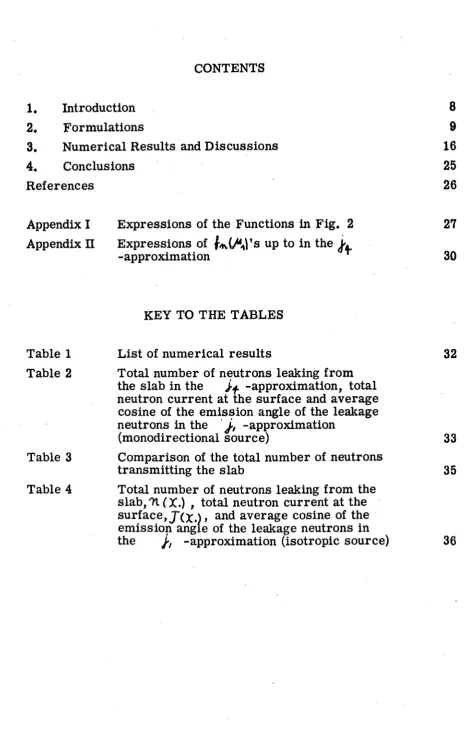
[image:7.595.52.527.61.799.2]KEY TO THE TABLES
Table 1
Table 2
Table 3
Table 4
List of numerical results
Total number of neutrons leaking from
the slab in the
}+
-approximation, total
neutron current at the surface and average
cosine of the emission angle of the leakage
neutrons in the
J>,
-approximation
(monodirectional source)
Comparison of the total number of neutrons
transmitting the slab
Total number of neutrons leaking from the
slab,71
(X.)
ttotal neutron current at the
surface, J"(x.), and average cosine of the
emission angle of the leakage neutrons in
the
y,
-approximation (isotropic source)
32
33
35
KEY TO THE FIGURES
Fig.
Fig.
Fig.
Fig.
Fig.
Fig.
Fig.
Fig.
Fig.
Fig.
Fig.
Fig.
Fig.
Fig.
Fig.
Fig.
Fig.
Fig.
1
2
3
4
5
6
7
8
9
10
11
12
13
14
15
16
17
18
A typical path of the incident neutron in the slab
Flow diagram of calculations in the constant cross
section approximation
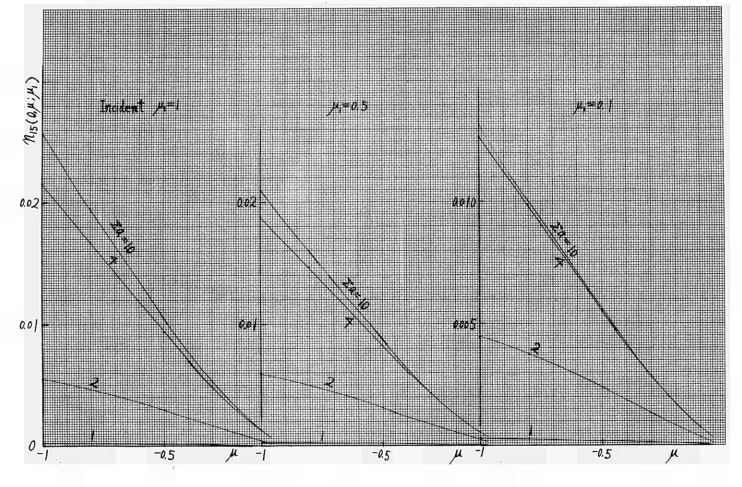
Number of neutrons reflected after the first
colli-sion (monodirectional source)
Number of neutrons reflected after the second
collision (monodirectional source)
Number of neutrons reflected after the third
colli-sion (monodirectional source)
Number of neutrons reflected after the 5-th
colli-sion (monodirectional source)
Number of neutrons reflected after the 7-th
colli-sion (monodirectional source)
Number of neutrons reflected after the 10-th
colli-sion (monodirectional source)
Number of neutrons reflected after the 15-th
colli-sion (monodirectional source)
Number of neutrons reflected after the 20-th
colli-sion (monodirectional source)
Number of neutrons reflected after the 30-th
coUi-sion (monodirectional source)
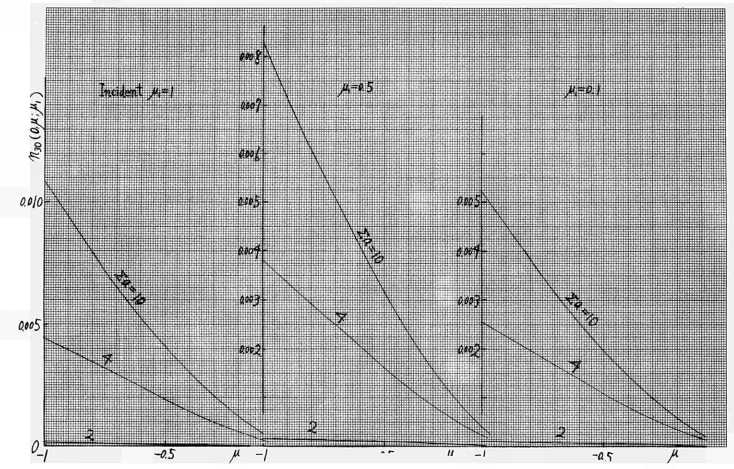
Number of neutrons reflected after the 50-th or the
70-th collision (monodirectional source)
Number of neutrons reflected by the slab with "SA=
2 or 4 after the N-th collision (monodirectional
source)
Number of neutrons transmitting after the first
colli-sion (monodirectional source)
Number of neutrons transmitting after the second
collision (monodirectional source)
Number of neutrons transmitting after the third
collision (monodirectional source)
Number of neutrons transmitting after the 5-th
colli-sion (monodirectional source)
Number of neutrons transmitting after the 10-th
collision (monodirectional source)
Number of neutrons transmitting after the 15-th
collision (monodirectional source)
Number of neutrons transmitting after the 20-th
collision (monodirectional source)
Number of neutrons transmitting after the 30-th
collision (monodirectional source)
Number of neutrons transmitting after the 50-th
or the 70-th collision (monodirectional source)
Number of neutrons transmitting the salb with
a « = 2 or 4 after the N-th collision
(monodirec-tional source)
Total number of neutrons reflected by the slab
(monodirectional source)
Total number of neutrons transmitting the slab
(monodirectional source)
Number of neutrons reflected after the first,
second or 5-th collision (isotropic source)
Number of neutrons reflected after the 10-th, 20-th,
30-th, 50-th, 70-th or 100-th collision (isotropic
source)
Number of neutrons transmitting after the first,
second or 5-th collision (isotropic source)
Number of neutrons transmitting after the 10-th,
20-th, 30-th, 50-th, 70-th or 100-th collision
(isotropic source)
Fig. 31 Total number of neutrons reflected by or transmitting
the slab (isotropic source)
REFLECTION AND TRANSMISSION OF NEUTRONS
BY THE MULTIPLE COLLISION METHOD
SUMMARY
The reflection and the transmission of neutrons for a
homogeneous slab have been dealt with analytically by the multiple collision method or the random walk approach, where the elementary processes of the neutron are followed statistically in order of its spatial movement.
Under the assumption that the scattering of neutrons is spherically symmetric in the L system, the number of neutrons leak-ing from the slab with li , a directional cosine of the emission
angle, as a result of the /\J-th collision of an incident neutron has been derived. And further, the total number of the leakage neutrons, the total neutron current at the boundary of the slab and so on have been also written in the forms of an infinite series of the spherical Bessel functions.
The numerical results have been obtained by truncating the sum at the first five terms and it has been shown, by comparing some re-sults with the exact ones, that the present approximation gives a very accurate result.
8
-1. Introduction
The multiple collision method is a new analytical method for dealing with neutron transport problems. This method is based on a viewpoint different from that of the Boltzmann equation, that is, the life-cycle viewpoint in contrast to the neutron-balance one.
The one-group critical condition has already been derived accu-rately by this method, for a homogeneous slab in which scattering is spherically symmetric in the L system (Asaoka, 1961). The two-group critical condition for the same system has been also derived according to this technique (Asaoka and Nakahara, 1962). In these previous works, the elementary processes of the neutron were followed statistically in order of time and then the critical condition was obtained from the convergence of the total number of neutrons in the system as time proceeds indefinitely.
The present report is concerned with a further development of the multiple collision method for treating the reflection and the transmission of neutrons for a homogeneous slab. Here, the elementary processes are followed statistically in order of the spatial movement of the neutron.
Although a number of investigations have been made on the problem regarding to the reflection or the transmission of radiation (for
9
2. Formulations
Consideration will be given to the case of an infinite homo
geneous slab with finite thickness Ci in which the neutrons are scattered in spherical symmetry in the L system, on the basis of
the constant cross section approximation. To the case that the cross
section for the medium is assumed according to the twogroup model,
the method is easily extended as shown later.
Let X be the space coordinate, K the directional cosine of the neutron velocity, 21 the macroscopic total cross section and C
the mean number of secondaries per collision.
Now, consider one incident neutron with a directional cosine J^~J^i,
upon a surface of the slab, X = 0. It will travel for a certain
distance Y, , in the direction with )^·-}^\ » before it collides with a nucleus. Since this probability is ¿#£(21,) and the collision
probability in íu¡ at Y, is ZI^Y, , the fractional number of neutrons
with directional cosines between H3 and /IS + ^J. a s a result
of this collision will be {CZ/2^XVf{-X1i)oX, ψ. Λ. ·T h ey w i l 1
then travel for a certain distance \z in the direction ΜΛ until they meet another nuclei. As a result of this second collision, the
fractional number of neutrons between M3 and Aj+^a will amount to (C2/J2)*jei*[2:a+ï»)]<lY,<(râ^^t3 . This process of
movement will continue until the neutron leaks out of the slab after
the |\| th collision as shown in Fig. 1.
Thus the fractional number of neutrons leaking from the slab
with directional cosines between yW and H+JlU as a result of the (Vth collision after following a typical path shown in Fig. 1, is
given by
fc2^)
w^(zKr,+r,++r
N+T)]Ar,¿Y
Nfa-fayi,
N|s
10
-Before performing integrations over all allowable paths to obtain the number of neutrons reflected by or transmitting the slab, we must take into account some restrictions imposed upon the range of integration variables in order to exclude the neutrons which have left the slab after the G ~ 0 ~t n collision. These are written as follows:
0 <
t i ψ*<* >
ί
=,
'^·'Ν. (2)
Besides this, an another condition must be imposed in order to make the neutrons leave the slab with a directional cosine M- after the
Kl -th collision:
ίγ;ψ=7=\ °'
for the reflection
.
N
^ | _
( 3
)
¡~' i (I, for the transmission,
This condition (3) can be rewritten in a form of Fourier repre«
sentation of the Dirac delta function:
s α-
>
+
AI
V¡
)=
*k
fr
ψ!9"-^1 V¡
Π
i·'·'·'
-"Η
η· ι "
r
(4)
where the upper sign is applied to the case of reflection ( A < Q J
and the lower one to the case of transmission (M-s*0 ") . The con ditions (2) can be taken into account through Dirichlet*s discontinuity
factors:
J_( ,y.AMUi ¡ψ: ] / when l$,|<|,
11
-Then introducing the ¡\ discontinuity factors and the Fourier representation of the 0 function, the number of neutrons reflected by or transmitting the slab in a direction with ƒ as a result of the
|\j -th collision of one incident neutron with M-~J*\ » i s written as
follows ;
%a./)/o=^Mi)^ri^)¥^^
É5)
x
If | * b
'^
^
(
*ë Vfc-Olj J >
^ [ & H ^ * $
ψρ] i
z , r
^
where <L(Z) i s the spherical Bessel function. Replacing Tí by
1· = (·2/(2ΓΛ))ζΐ Xft (1 = 1/··, N+l ) and performing the integrati ons over
and γ , Eq. (5) is reduced to
(6)
in which the independent variable JA/H i s replaced by 7 . The
functions wiH^'/i)'s satisfy the following recurrence relation:
(7)
Now it is convenient to expand ^M^V'/O *s i n t n e spherical Bessel
functions:
12
Then by using the Gegenbauer*s addition theorem:
j.(2J)Z(^+l)j«tt)¿
w
(J)
7Î0
and the orthogonality relation for the spherical Bessel functions, the
recurrence relation (7) is rewritten as follows:
I
üiïoctt ?.>£ Jn't/tfiW),
¡=n,n-,2,
Hti)\= even
^■>W
f,
->
C
i£Wf;)*f(-f;)
;
W
where
l<%m^f\d^^)j
m
(,pML
}
^=m
Upon substituting Eq. (8) into Eq. (6), we get
(10)
of which the coefficients -$m (ί(Λ are to be determined by the
recurrence relation Ç9") .
cm
The total number of neutrons reflected by or transmitting the slab in a direction with il as a result of the incidence of one neutron with
ii-M-i ,is given by
13
-The infinite sum in this equation is written in the following form according to Eq. (11):
where ■$ (U, ) = X X , M ) is to be determined by an infinite set of linear equations which are derived from Eq. (9):
(14) WHi=even
The total number of neutrons reflected by or transmitting the slab as a result of the incidence of one neutron with J^-M\ is obtained in the following form by integration of Eq. (12) with respect to U from -1 to zero of from zero to 1:
ηα.;/ο^ηρ\^η·(-ψήί„(ί>ψή^ψ-^)
> w:
where
Î
0, for the reflection , 1, for the transmission.When the integration with respect to ¡X is performed after multi plying <ft {JtlU )U¡ Λ by qfU , the total neutron current in the di rection of the outward normal to the surface of the slab is obtained:
14
Then the socalled albedo for this slab for the case of the incidence
of neutrons with JX=Mi can be obtained by
Ar/»)=J(o;/')/>, .
(17)In case of that the angular distribution of incident neutrons is
spherically symmetric, that is, the number of incident neutrons with di
rectional cosines between j ^ \ and MAclM, is du, when the total number is normalized to unity, Eqs. (11)^(13) and ( 1 5 ) Λ / ( 1 7 ) are modified as follows:
^
a)=
&^ff
3
^f(~¥t)i
M
(±Î^t)+AE
3
(^)
;
Α=2Τ(ο).
Cu»)
(12*)
(13*)
(15»)
(16')
(17*)
The coefficients /w"+' and ^w= Σ /W N +' are determined
by the following recurrence relation (9*) and the set of simultaneous
equations (14*), respectively:
J
ι
¿*L
ψ ι I
(moei!
& i ' J ' « ) ,
Γ"Ή-.5,
Ht wi» even
tøn+l)c
Άη- (ϋϊικ 4 + ,g
-Í
RJOK, ft )
;rø=0, U/··· ,
wn=even
(9*)
(14*) 15 (14*)
-A comment will be inserted here, on the critical condition of the slab in the one-group approximation. Also to the case of that there are fissionable nuclei in the medium, the equations having been derived can be applied, if discussions are restricted to monochromatic neutrons. Therefore, in case of that C>-1 , the total number of neutrons leaking from the slab must diverge beyond all bounds at the critical thickness. In other words, the critical condition in the one-group approximation must be derived froa the divergence of
n(o;/i,)i-n<W), J(oy,)+j(A)M,)
)7i(.o)+n(a')
or J(ø)+J(«).
Since these are given in the following form as seen from Eqs. (15), (16), (15*) and (16*):
00
i^töim-tmi/ii+C
or 2»
^mrl.m*C ,
where Dim , C an^ C a r e bounded functions of 21¿t. , the c r i t i c a l
condition should be given by the condition of divergence of -4ίχηψί) and -4sm . This condition i s that the determinant of coefficients for
■fsmi/i) *s or -fxn *s in Eq..(14) or (14*) vanishes; t h a t i s ,
<18)
This condition (18) is nothing but the one-group critical condition
16
Now we shall consider the reflection and the transmission of
tn eu. t iron s in case of that the cross section for the medium is assumed
according to the twogroup model. Let Σ\ and 21 χ D e the macroscopic
total cross section for the fast group and the thermal group, respectively,
and C, and C¿ the mean number of secondaries per collision for each group. And further, let assume that |\JC is the number of collisions re
quired to decrease the energy of the incident neutrons to the thermal
value,.
Following the same procedures as those in the constant cross
section approximation, the number of thermal neutrons reflected by or
transmitting the slab with Ú. as a result of the N~th collision of
one incident neutron with is written as
V(w.)^46^
[
";y
)]
^^),
N2:N
C2:
C19)where
Λ
(20)
Thus the total number of thermal neutrons leaking from the slab with ji
17
where
AmX
as easily seen from the first equation in Eq. (20).
Here the functions qv+( CiiJJ, )*s are expanded in the spherical Bessel
functions:
(23)
of which the coefficients are to be determined by the following equations:
õwruõ4^')=c?ii5ç4
c^ ' )
+S ,
^/07
Λ(^
/η')
intn=even?íM7l=eve?i
4>)= w^U^)^(-f£,),
(24)
where ~}Λ(Μ,<ΪΪ~) and Jj (ηη,η~) are given by Eq. ("10) in which ^-ΈΛ0./Ζ
and Z",fl./¿ , respectively.
Thus, combining Eq. (21) with the first equation in Eq. {23), we get
18
-Similarly, the number of thermal neutrons leaking out after the fSj-th collision, 7ln^{7.,M>M,) shown in Eq. (19) can be easily written also in a form as that of Eq. (25), and further the total number of thermal neu-trons leaking from the slab, Tltø (ï»^<;) , and so on can be obtained also easily, even for the case of the incidence of isotropic neutrons.
3. Numerical Results and Discussions
Since all expressions such as 11^ (XoJ^A) in Eq. (11), 71^(7,,M)
in Eq. (11*) have been written in the form of an infinite sum, we are forced to truncate it at /ïiî = f/\ for obtaining the numerical results. We shall call this approximation as the jM-approximation.
The flow diagram of calculations to get the numerical results in the constant cross section approximation is shown in Fig. 2. And the concrete expressions of the functions with fl-^-ή- which are located at the starting points in the flow diagram, are shown in Appendix I.
In the JM -approximation, the coefficients 4n ψϊ)> ^¡ιιψ'ί)> 4 ^ and 4n are determined approximately by solving the equations ob tained from Eqs. (9), (14), (9·) and (14*), by retaining only 4J' Çui')
Ί<ηψι1> ì j a n d 4 w i t h T Z ^ H . respectively.
As seen from Eqs. (14) and (14*), 4m (Mi) *s and 4*n *s are
coupled only with one another, and not with 4¿n+¡ (Μι ) *s and 4jn+\ *s»
respectively. Therefore, the expressions for these coefficients with an
even suffix in the jaMtl approximation are the same as those in
the Jih1 approximation and the ones with an odd suffix in the
l_jM approximation are the same as those in the ¡JH-Ì approximation, The expressions of 4li (/(i) *s u p t o i n t h e J^ approximation are shown
in Appendix II.The expressions of "on*3 a r e t n e aame a s these except
19
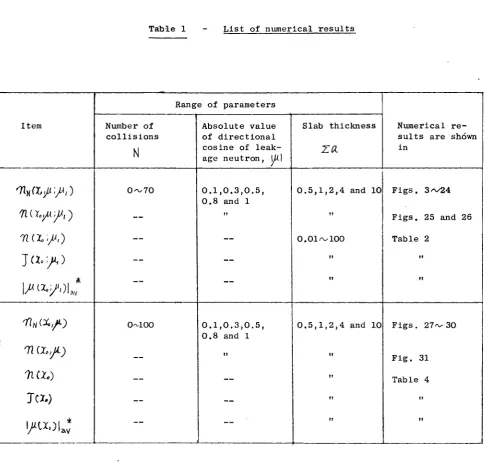
-Numerical computations are carried out for the slab with C = 1, for various values of the parameters shown in Table 1. The results for the three cases of the monodirectional source with J^¡ = 1, 0.5 and 0.1, respectively, are shown in Figs. 3^^-26 and in Tables 2 and 3.
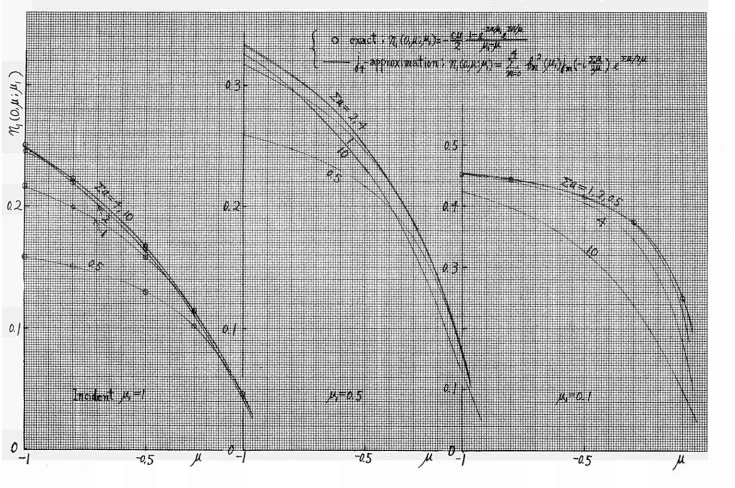
The number of neutrons reflected by or transmitting the slab with JU after the N~th collision has been calculated in the i -approximation. These results for N = 1 are compared with the exact ones which are obtained directly by performing the integration with respect to ·/ after substituting G^Ci'fM,) shown in Eq. (7) into Eq. (6). As seen from Figs. 3 and 14, the present approximation gives very accurate results for the case that the values of M¡ are not close to zero, but it becomes to introduce some error to these results especially for the slab with the larger values of Ud when the values of JU, decrease close to zero. This error, however, may be reduced to be smaller as the value of (\| increases because the values of
4-f (Mi) become small compared with the ones of 4, (M, ) (see Eq. (11)).
20
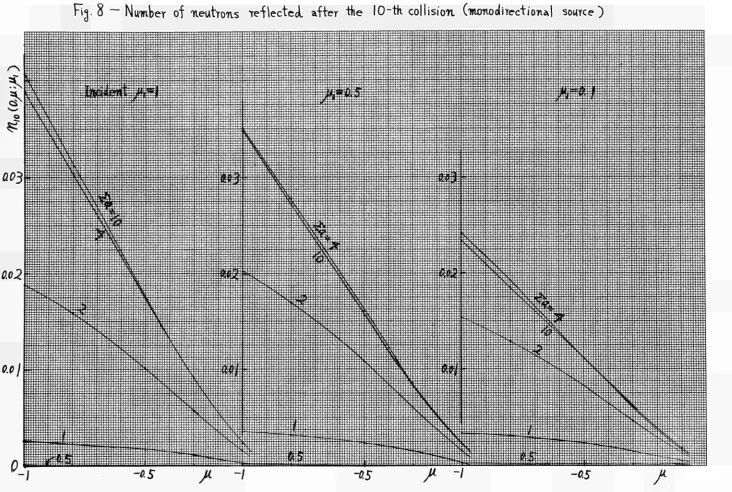
The dependency of 7lN{O.JK¡li,) on the value of JX, is as follows.
For the smaller values of NJ , 7lN(0,/,Ml) increases as JU, decreases, as expected, especially for the smaller ZÆ. . As the value of f\J becomes
large; however, it turns to decrease as JX, does, especially for the larger
Σΰί . This is understandable because flH (0,/:/,) for large |\) comes mainly
from the neutrons which have undergone the first collision near the center of the slab. Fig. 13 shows 7ln(0,/L)/,) for the slab with 2Γ& = 2 and 4 as a function of Ν .
In Figs. 14 <\, 24 are shown Tfy (A,JÀ )J¿,) *s, the number of neutrons transmitting the slab with At as a result of the /\jth collision of one
incident neutron with /λ=/^ι . For the smaller values of J\[ , on the whole,
HÑ(fl,u;M,) for the smaller T.CL is larger than that for the larger 21$ , especially for small JU, and JU. . But as the value of J\| increases,
71Ν ΓΑ.U'Mi) f °r the smaller 2ΙΛ becomes smaller than that for the larger Σ& ,
especially for the large JU, and JU , because it depends upon the value of the probability that the neutrons take collisions Η times within the slab, multiplied by the transmission probability. This may be clarified
by comparing the curves for 2J# = 2 with the ones for 21CL = 4 shown in Fig. 24.
The curves of 'TZM (aJLfl,) are convex for the smaller ~L0L but they turn to be concave as the value of Σ& increases, because the positions at which the neutrons have undergone the final collision may become to be
far from the boundary of the slab. And further, it is seen that for the
smaller X(X , the values of li^iCL.JXiJl,) depend strongly on the value ΟΪ JU, ,
and increase as JU, becomes small. Contrary to this, ^ (CL,M;/l ) for the larger £ # decreases as JU does.
It may be worthwhile to mention that 71^ (â,u ',JU, ) becomes to have the same values as those of ΟΊ^ (Ο,Μ',ΛΙ,) a s t n e v alu e of j\} increases.
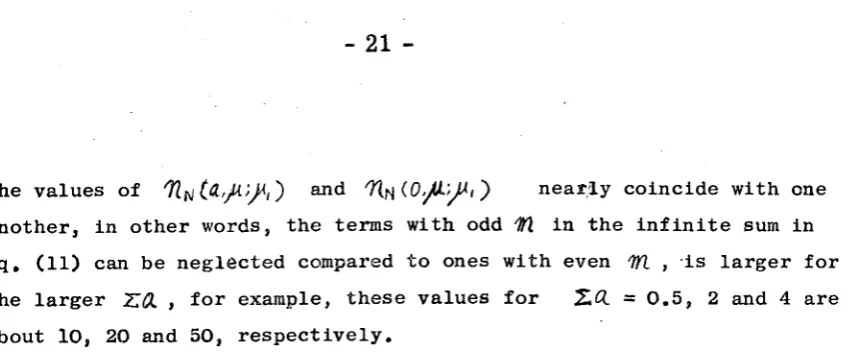
21
the values of TIMCW'/I) and ^ N (0l/í'<J¿ι ) nearly coincide with one another, in other words, the terms with odd fl in the infinite sum in Eq, (11) can be neglected compared to ones with even 77Ί , is larger for
[image:25.595.82.516.41.221.2]the larger Έ(λ , for example, these values for Σ& = 0.5, 2 and 4 are about 10, 20 and 50, respectively.
Figure 25 or 26 shows the results of the total number of neutrons reflected by or transmitting the slab with μ , 7l(0,JC>Jt,) or TlCAJÃiJl,) ,
in the A» approximation. Comparing Fig. 25 with Fig. 3, it is seen
that the contribution of ^¡(Q.JL'-J^i) amounts to more than half of the total number for the smaller Σ Λ » D u t it decreases to ca. 20 % as the
value of 2ÍCL becomes larger, especially for the case of that J^, = 1. In the case of the transmission, the contribution of 7[,{(i,}X;JJL,) to the total number of neutrons having transmitted the slab after suffering
collisions once at least, amounts to ca. 50 % for ΣΆ. = 0.5 and de
creases to several % for Συ. = 4. Therefore, these results of the total number show that the values depend upon the ones of JU, and li, in a similar manner to those for -fl;(%0)n )Jl.) for the smaller ΣΛ and to
those for 1ϊ\\(Χο>Μψ,) with large Ν for the larger Σ& .
The total number of neutrons reflected by or transmitting the slab, 72 (O'-JU-I) or 7l(ft>/Ui) > i s calculated in the ¡,- and ^.appro ximations. The results in the Aapproximation are shown in Table 2.
Since C = 1, that is, there is no absorption of neutrons, the sum of
71(0',M,) and 71 (il//,) should be equal to unity. This conservation condition for the number of neutrons is satisfied for all systems nearly
completely, as seen from Table 2.. Besides this, the results in the
i approximation are little different from those in the /^.approximation,
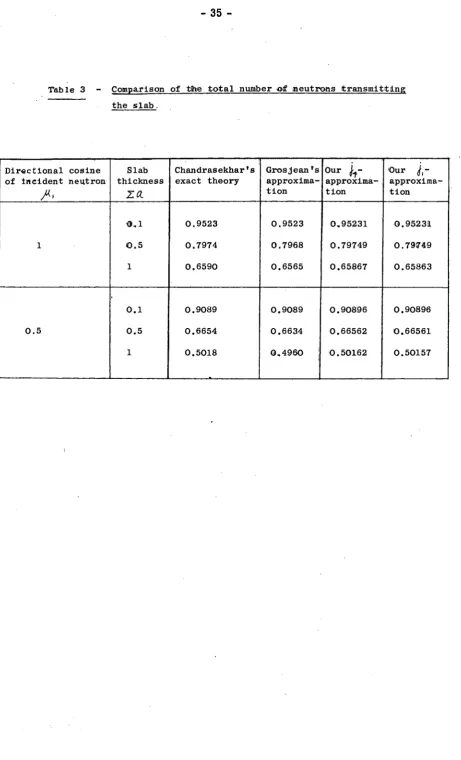
these being shown only for the smaller values of Σ A i n Table 3.
In this table, our results are compared with those in the
Chandrasekhar*s exact theory and in the Grosjean's approximation
22
-our multiple collision method are very accurate. Although the results of 7l,(XoiM''Ji,) i n the i -approximation reveal to have some error,
as mentioned already, it is seen that this error hardly contributes to the total number, as expected, especially for the smaller 2CL . (It is found out some difference between the results of 7l^(7,ju:jn,) in the ^ -and J -approximation, but only a little difference between those of
THX*,/)/,)
)·
The total neutron current at the boundary of the slab, J(Ζ,ϊΆ) , is obtained in the / -approximation because we are convinced that the J -approximation gives an accurate result. The results are shown in Table 2. To interpret these results, the average cosine of the emission angle of the leakage neutrons is calculated:
I/W./01,
w
= J ( V ) / '
n a ;
/ ' ) .
(26)The results in the jr -approximation are shown also in Table 2. For the reflection, this value increases gradually from 1/2 to 2/3 as the value of Z Æ does. These asymptotic values correspond to the ones for the spherically symmetric emission and for the emission with a cosine distribution, that is, 7\.(0>Jk'ylk,)J&c\)k\ , respectively. Moreover, it is seen that the values of the average cosine decrease a little as the value of J,(, does.
These are shown also analytically. According to Appendices I and .II, Eqs. (13), (15) and (16) are written in the following forms, respectively,
23
-71(Χ°ψι)^-
P-P'
j
( v
o4
ψ,ΗΜ^-W
L i
M*'f+f¿),
( Χ - * 0 0 ,
(28)
<Χ//ι->0 ,
(29)
where Of = 27#/2. · And hence the average cosine in the i approximation
is given by
|/i(x./.)|
&v
τ
Ο
+
^ / ί Η · ^ ) ,
^t—f,
a->t>o
> (30)
In the case of the transmission, the average cosine takes the value » (j-S^ + Ä N asymptotically for small Z«/^, and it tends to
Λ.(Η·ύι)/(Η3&\ as ΣΛ. increases indefinitely, as shown in Eq. (30).
As seen from Table 2, these values have a maximum at the thickness
Σ0. o=: 100, 10 and 4 for the cases of that JÅ, = 1, 0.5 and 0.1,
respectively. And they increase as the value of /<, decreases for large Z.&,
as guessed also from the last expression in Eq. (30). These are inter
preted by considering that the smaller the value of β, becomes, the farther the positions from which the transmitting neutrons mainly come, remove from
the boundary.
The numerical results for the spherically symmetric source are shown
24
exact ones which are obtained directly by integrating Eq. (6) for /\| = 1
with respect to JX, . Here again, it is seen that the approximation gives an accurate result except that for 2IÆ * 10, which is underestimated
a little. Comparing the results shown in Figs. 27 and 28 with those in Figs,
3 'N_ 12, it is seen that the former nearly coincides with the latter for
the case of that JX, = 0.5.
The results of
<Yln(a,,JX)
and
71 (X„,Ji)
in the
¡
Λ-approximation are shown in Figs. 29, 30 and 31, respectively. It is seen
also that these results are nearly the same as those for the monodirectio
nal source with JU, = 0.5 except those for 710{&<JU) , 71, (A,U.;u )
[image:28.595.114.534.439.796.2]being given by S
(/'fi )J*f {-Ζ<ψΙ,
) ·
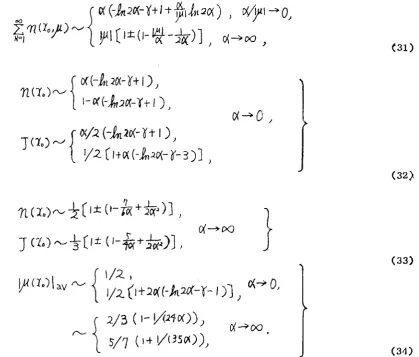
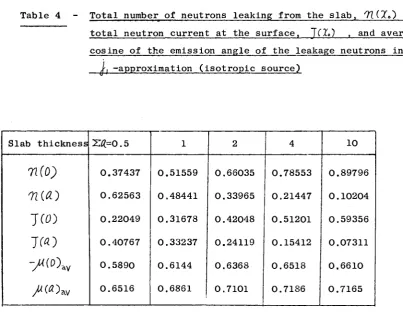
Table 4 shows the results of T U T O , J f70 and LUtt^ky
in the l; approximation. And the analytical expressions of them in
the extreme cases are given as follows:
(31)
ηα>
ja)
«Ή^κ-γ+ο,
tf-*0 ,
(32) tf-> POl/<a.,)|
av
I A O + ^ - M R H ) ] ,
5/7 (I+I/(35ØO),
}
(Χ-*
o,
0(*DO
(33)
25
-4. Conclusions
The reflection and the transmission of neutrons for the homogeneous slab has been dealt with by a new analytical method, the multiple collision method.
In the constant cross section approximation, the expression for the number of leakage neutrons from the slab in a direction with JX as a
result of the N- t n collision of a monodirectional or spherically symmetric
incident neutron, has be derived at first. And then the sum of this number over W and further the integration with respect to JX , the directional cosine of the emission angle, have been performed to get the total number of leakage neutrons. Moreover, the total neutron current at the surface of the slab, the so-called albedo for this slab and the average cosine of the emission angle of the leakage neutrons have been obtained.
Furthermore, it has been shown that these are easily extended to the case of that the cross section for the medium is assumed according to the two-group model. And the critical condition of the slab in the one-group approximation has been derived and shown that it coincides with the one obtained in the previous work.
The numerical results have been obtained by truncating the infinite sum in which all the above-mentioned expressions are written. By comparing some results with the exact ones, it has been shown that our results in the
26
-It is believed that the multiple collision method has, again in this report, revealed itself powerful and useful for obtaining accurate and plentiful information about neutron transport. Although the present work is performed under the assumption that the scattering of neutrons
is spherically symmetric in the L system, the method will be extended to the case without this assumption. Moreover, it is hoped to perform a further extension of this technique to more general problems.
Acknowledgements. - The author wishes to express his gratitude to Dr. G. Blässer for his suggestion that the multiple collision method
is to be applied to the present problem, and for his interest in this work.
REFERENCES
Asaoka T. 0.961) - J. Atomic Energy Soc. Japan, 3, 531.
Asaoka T. and Nakahara Y. (19620 - Internal Report EURATOM, ISPRA-277,
27
APPENDIX I. Expressions of the Functions in Fig. 2
Concrete expressions of ij(íâ)ir'8:
j H ^ ^ ' . f ) ,
¿Ηρ)^=^(('^))('+^)+^0/
3Ο],
j
3(-^)^=^(('^>|(i-^)+^(.^)-^(i-/^)],
j
f(-if)^=^[(i^O^(i+^0+^(^0-^(.
+/f)+^o-^^
Concrete expressions of J (97, W ) *s:
7(0,0)=^)^)^ (h¿
a)+ofE
lW,
J^>^^(>+i^+^(i-^),
J^^=i-^^^^(^0+^^-^('-^),
J(/,5)=^-^(i-A^)+^(i+^)+è^-^(,-^)
)
JC^S)^!-^-^^^!.-^)-^^^^^^^.^^
J(ö,i-)=-^+ip(i+åO-f
s(,-^^)^(,
+^)-i|-
r(,-^)
jJ^>^í'
+
^+^(^^
28
-Concrete expressions of {""¿ti ('ί<Χί~Μχ* 's :
Concrete expressions of J *&ί (iQff)Í" 'S:
^ί
3
(^)^--^ί'-^'-+0+^('Ψ^)-^(·-^;3,
"f i^«^^^'"^
4õf C'-^f^Ã^)+-ã|, (.-^^-^-(,^^^^^^]
29
Leading terms of ¡η(~ψ~)^ 's f o r small |3 :
Leading terms of 7(71,7}!) 's for small 0( ( ï ; the Euler Mascheroni constant):
j(ö,o)-^(-ii^-r+i)+^-|pf
3,
J C O - I « - ! « ^ - ^ ^
Leading terms of ^ ¿ f " ^ ) ^ 's, ( f ^ " * " ^7 ^ 's and
Γ^/*(^)·^
's for small CX :7L
0 1 2 3 4ff^Hrt)/"*
-Jh2K-r+i+<t-i<x
2-£0-$*+£**)
-f(i-i^)
-fcO+Otø
3))
Í D O + O W )
30
-APPENDIX I I . E x p r e s s i o n s of ^(JXJ) 's UP t o i n t h e ^ a p p r o x i m a t i o n
E x p r e s s i o n of /»C^O i n t h e L - and /, a p p r o x i m a t i o n s :
E x p r e s s i o n of -4i(Mi) i n t h e i J. - and ^ a p p r o x i m a t i o n s :
E x p r e s s i o n s of 4i0(/(i) and ^Λ(Μι) in t h e L- and 7 a p p r o x i m a t i o n s :
i^HH>/>Jtø2)+ic£^^^
and the leading terms of the denominator for C = 1 are given by
(i-Jfao))(i-jP,2))-(Trø)-l WP C'"7Ef+5eP¿ tf»eo.
Expressions of -Τ,ίΜι) and -43(J(,) in the A - and /.-approximations:
and
the leading terms of the denominator for C = 1 are given by
(Í-J(/J))(|-J(Í3))-(J(I,3))
31
-Expressions of
^J/i) , 4jM,)
a n d^f
(/<)
in the ^-approximat
i^)=p{K>or(fc-JP^))(i-J^^)-(jfôf;)
sJ
^)=^f^oDw^)(iz-j(w)+Jfót)jföf;]
+ic4
33(Ji,){ti-W)(jz-Wn·^
V'>o[U>)r^
w^t;+j(^Xfc-jp.2))]
where
and the leading terms of each factor and the denominator
¡J
for
C
= /,
for small (X and for large
Q(
, are written in the following forms,
respectively:
(Í-J(«))(|-J^)-(Jfò1))-^C-^) and ¿pO-jfe + å O ,
J(^)(f-J(f,t;)
+Jfôt;j^)-^(,-]!«) and J_
j{)_g.
+i i _ ^
J ( ^ ; j W + 7 r ø ( i - J ^ ) ^ - ^
( /- ^ and - ^ ( ^
> #Tß^(^7ffto)>jr«)T^^-^fi-öfi-M-y+#)] and
# Ό - &
+$ 0 ,
32
Table 1 List of numerical results
Item
^(τμψ,)
TKìcyU-.J/,)
71 (Xc)jU,)
J Ci»
;ƒ, )
\ß^/oC
?IN <*,/>)
71 (X„Jl)
71CX.)
Ta,)
l/U,)|
av*
Range of p a r a m e t e r s Number of
c o l l i s i o n s
Ν
0 ~ 7 0
—
«
~
—
O'vlOO—
—
—
—
A b s o l u t e v a l u e of d i r e c t i o n a l c o s i n e of l e a k age n e u t r o n , LUI
0 . 1 , 0 . 3 , 0 . 5 , 0 . 8 and 1
M
—
—
~
0 . 1 , 0 . 3 , 0 . 5 , 0 . 8 and 1
t l
—
—
S l a b t h i c k n e s s
Σ a.
0 . 5 , 1 , 2 , 4 and 10
t t
0.01^-100
II
n
0 . 5 , 1 , 2 , 4 and 10
It
If
It
ft
Numerical r e s u l t s are shown i n
F i g s . 3^v24
F i g s . 25 and 26
Table 2
It
II
F i g s . 2 7 ^ 3 0
F i g . 31
Table 4
II
M
Table 2 Total number of neutrons leaking from the slab in the L -approximation, total neutron current at the surface and average cosine of the emission angle of the
leakage neutrons in the J-t -approximation (monodirectional source)
(to be continued)
Slab thickness
Σ0.
0.01 0.1 0.5 1 2 4 10 20 100OlCOijU,)
A=
1
0.004975 0.04769 0.20251 0.34133 0.51753 0.69098 0.85322 0.92189 0.98355 0.5 0.009902 0.09104 0.33438 0.49838 0.65722 0.78560 0.89824 0.94568 0.98850 0.1 0.04760 0.32307 0.60494 0.69756 0.78825 0.86551 0.93485 0.96480 0.99246TLCV/AiJ
/ , = 1
0.99503 0.95231 0.79749 0.65S67 0.4S247 0.30902 0.14679 0.07811 0.01644 0.5 0.99010 0.90896 0.66562 0.50162 0.34278 0.21441 0.10176 0.05432 0.01149 , 0.1 0.95240 0.67693 0.39506 0.30244 0.21181 0.13450 0.06515 0.03520 0.007527
J(O;JA,)
Ar
1 0.002533 0.02595 0.12142 0.21349 0.33361 0.45271 0.56464 0.61223 0.65516 0.5 0.005041 0.04950 0.19920 0.30851 0.41937 0.51197 0.59356 0.62772 0.65845 0.1 0.02423 0.17440 0.34908 0.41908 0.49410 0.55977 0.61669 0.64012 0.66108J (*;/<,)
Λ - ι
Table 2 (Continued) Slab thickness 0.01 0.1 0.5 1 2 4 10 20 100
-μ(Όψι)
Mr
ι
0.5092 0.5442 0.5996 0.6254 0.6444 0.6546 0.6614 0.6639 0.6661 0.5 0.5092 0.5437 0.5957 0.6190 0.6380 0.6519 0.6610 0.6639 0.6661
av
0.1 0.5091 0.5398 0.5775 0.6027 0.6302 0.6498 0.6607 0.6638 0.6661 JU((X;JK,)A -
1
35
Table 3 - Comparison of the total number <af neutrons transmitting the slab.
Directional cosine of incident neutron
A
1 0.5 Slab thicknessza
<î.l 0.5 1 0.1 0.5 1 Chandrasekhar*s exact theory 0.9523 0.7974 0.6590 0.9089 0.6654 0.5018 Grosjean's approxima-tion 0.9523 0.7968 0.6565 0.9089 0.6634 0.4960Our jt
- approxima-tion 0.95231 0.79749 0.65867 0.90896 0.66562 0.50162 :
'Our j
-
36-Table 4 - Total number of neutrons leaking from the slab, THJ«) ,
total neutron current at the surface, ~](X°) . and average
cosine of the emission angle of the leakage neutrons in the
} , -approximation (isotropic source)
Slab t h i c k n e s s
71(0)
7ΐ(α)
1(0)
700
Τ ^ λ ν
JXW\v
Σ # = 0 . 5
0.37437 0 . 6 2 5 6 3
0.22049
0.40767
0 . 5 8 9 0 0.6516
1
0.51559
0 . 4 8 4 4 1
0.31678
0.33237 0.6144
0 . 6 8 6 1
2 0.66035 0.33965 0.42048 0.24119 0.6368
0 . 7 1 0 1
4 0.78553 0.21447 0.51201 0.15412 0.6518 0.7186 10 0.89796 0.10204 0.59356 0.07311
0 . 6 6 1 0
[image:40.595.108.512.152.464.2]-
37
->X
38 -Monodirectional source Eq.(9)
Κτι,τη)
Isotropie source -ίο... ,^ i Ä t ) / '
β/,(^)/—V^
•„(lettre
«tEq.(16)
E q . ( 9 ' )
C
E q . ( 1 4 · )
Vil
3
?
Y Eq.<16,
y
E q . ( 9 ' )
/H
E q . ( l l ' )
/
7l
N(%JX)
M
E q . ( 1 3 ' )
Y
N=;
Tiny^,)
îiA/0 J<VO
j(ï.)
παο
Eq.<15')
Y , E q . ( 1 2 ' )
TKXoyU)
F ig . 2 Flow diagram of calculations in the constant cross section
Fig- 4 ~~ Number of neutrons reflected after the second collision (irioWirectioml source)
™3" ** ~" Number of -neutrons reflected after the third collision (monodirectional source)
Mj-7 Number of neutrons reflected after the 7~tn collision, (monodirectional source)
Fg. Π Number of neutrons transmitting after the IOth. collision (monodirectional source )
s.
o
«Oj?
ao\
1
o.
t111111111Nil IttltliffiriMfrffHf
)
rHKij
11 ìMli^
rn I il ί ί il Lii Hi 1 ITI irlilTÍTÍTí Ι ItítHIWIUillJ] 1HI ! 1 fflU"
ΒΙΙΓΗ'Π Η1 iB'fflitwiiiillll lllllilllllliiììillliffitt
/
os
¡¡»ι
ΐ
IliiiljiljB
Fg 2 4 Number of neutrons transmitting the slab with
Σ&=2
or
Λ
after the N-th collision (monodirectional source )
ίΠΙβη i'"Ρ*
libra
Cal ' ■ # *
CDNA00367ENC
•teli NiftHaiKkntflUitaeBf