Munich Personal RePEc Archive
Hopping on the Methadone Bus
Lippert, Steffen and Schumacher, Christoph
Massey University, Department of Commerce
16 January 2009
Online at
https://mpra.ub.uni-muenchen.de/13043/
Hopping on the Methadone Bus
∗
Steffen Lippert
†Massey University Auckland
Christoph Schumacher
‡Massey University Auckland
January 16, 2009
Abstract
This paper investigates the impact of a ’free drug program’ on the market equi-librium of drugs. We introduce a screening model of the hard drug market in which dealers use payment and punishment options to screen between high and low risk users. We show that, if a free drug program selects sufficiently many high risk drug users, the pure-strategy separating market equilibrium ceases to exist and a symmetric mixed-strategy equilibrium results, in which drug users derive a higher expected utility. This encourages new drug users to enter the market. The novelty of the paper is the transmission mechanism for this effect, which is via the influence on market price.
JEL codes: D11, D82, I18
Keywords: Drugs, Drug Policy, Drug Dealing, Free Drug Programs, Screening
1
Introduction
Free drug programs supply severely affected addicts with drugs or their substitutes, such as
methadone, under the supervision of professional medical staff. Advocates of such programs
argue that the initiatives reduce drug-related criminality and help addicts take control of
their problem.1
Empirical evaluations of methadone-maintenance treatment programs to date have
typ-ically restricted their attention to existing users of heavy drugs. They focus on determining
∗We would like to thank Richard Cornes, Eberhard Feess, and Frank St¨ahler and an anonymous referee
for helpful comments and discussions.
†Corresponding Author. Massey University, Department of Commerce, Private Bag 102 904, North Shore
Mail Centre, Auckland, New Zealand. [email protected]. Phone: +64 9 414 0800 Ext. 9283.
‡Massey University, Department of Commerce, Private Bag 102 904, North Shore Mail Centre, Auckland,
New Zealand. Email: [email protected]. Phone: +64 9 414 0800 Ext. 9274.
1
whether users successfully reduce their drug use or eventually refrain from returning to
reg-ular drug use altogether,2 whether there are positive effects of these programs on vocational
rehabilitation of users,3 or whether users are successful in leaving the drug-crime spiral.4
In this paper, we argue that free drug programs not only have an impact on individuals
who are already in the drugs market, but – through a less costly distribution – also on
potential users. We argue that by targeting severely addicted users, who typically need
to resort to crime to finance their habit, free drug programs reduce the average cost of
distributing drugs. This would be reflected in the attractiveness of the deals available and
therefore affect the decisions of whether or not to enter the drug market as a user.
Non drug users might begin their consumption because of price: lower the price and more
non-users will try a drug, and consequently become addicted. The price is determined by
supply and demand, and thus the cost conditions on the supply side determine the cost and
the equilibrium price: lower the supply curve, and price is lower and consumption higher.
The point of our paper is that distributing methadone to drug addicts lowers the supply cost
of competitive drug dealers, and so lowers price and increases demand.5
To this end, we introduce a screening model which analyzes the drug dealer’s adverse
selection problem and identifies the optimal purchase behavior of different types of drug users
and derive the following result: Supplying severely affected addicts with free drugs changes the composition of the drug buyer population in a way that may lead to a situation where
a pure strategy market equilibrium does not exist. We show that in this case a symmetric
mixed strategy equilibrium exists in which all drug users derive a higher expected utility.
This will encourage more drug users to enter the market. To the best of our knowledge, this
negative side effect has not been identified in the literature yet.
We feel we contribute to the literature as we show how a health programme of intervention
on a group of individuals will have an effect on the behaviour of individuals outside the group,
and these effects need to be taken into account when evaluating the costs and benefits of
this programme. This is not new, although it is rarely understood by politicians and the
2
There is a large amount of literature on that topic. For recent contributions, see for example Dekimpe et al. (1998), Cox (2002), Dickinson et al. (2006), Harris et al. (2006), or Black et al. (2007).
3
For example, Magura et al. (2004), Lidz et al. (2004), or Staines et al. (2005) focus on these effects.
4
Brewster (2001) or Holloway et al. (2006) for example study whether drug users that were part of such a methadone maintenance program are less likely to engage in criminal activity.
5
media. The novelty of our paper is the transmission mechanism for this effect, which is via
the influence on market price, rather than some kind of deterrence effects,6 which would
be well understood.7 As such, this mechanism is more general than our application to free
drugs programs suggests. It applies to any program or any opening of a new market that
selects participants from a related market such that the costs of firms in that related market
are affected. If these firms are – at least imperfectly – competitive, these cost changes will
be passed through to buyers and affect their behavior.8
In the literature on rational addiction, initiated by Becker and Murphy (1988), it is
argued that, by making it easier for drug users to exit drugs, more novice drug users might be attracted.9 We do not argue along these lines. We also abstract from issues warranting a
merit goods argument, such as users underestimating their probability of getting addicted or
users buying low-quality drugs, which have been argued as a concern in the context of markets
for illegal substances. Our approach is complementary to these. Instead of concentrating on
the demand side, we rather focus on the cost of supplying the market for illegal drugs. In our
model, entry of new addicts into the drugs market does not rely on the addicts’ calculated
(or miscalculated) decision to become addicted, but is driven by a reduction in the dealers’
distribution costs, which will be passed through to users as a reduction of the price for drugs.
The paper is structured as follows. First we outline our model. Second we characterize the equilibria of the model and show conditions for their existence. We then discuss the
implications of our model on free drug programs and give policy implications and conclude
the paper.
6
See for instance Becker and Murphy (1988) and the following literature on rational addiction.
7
We would like to thank an anonymous referee for pointing out that insight in these words.
8
An example from outside the health industry would be the impact that the emergence of a sizable venture capital industry had on conventional financing of innovative projects. Venture capital firms have been shown to have an advantage in selecting good R&D projects over industry investors and banks. If the population of innovative projects seeking financing is constant over time, the VC industry’s emergence must have affected the average quality of projects financed by other investors negatively, adding to their costs, and reducing the number of projects financed through these investors by more than just the projects that are now financed through venture capital.
9
2
The Model
Free drug programs target severe addicts that engage in criminal activities to finance their
drug habits. The European Monitoring Centre for Drugs and Drug Addiction (2007, p.2)
describes this category of users as follows: All offenders in this category support their
ad-diction by some form of illegal income. This illegal income can come from both consensual
crimes such as drug selling or prostitution (where criminalized), and acquisitive crimes such
as shoplifting, robbery and burglary. The level of criminal activity is determined by the type and pattern of substance use, socioeconomic situation and extent of deviant lifestyle. Some
users therefore will always rely on criminal activities to raise funds while others may try to
regulate their drug consumption according to their financial resources and drug prices, or
attempt to increase their legitimate income (e.g. social benefits, employment or pawning
goods).
Based on these observations we build our model as follows. Consider the segment of the
market for drugs which is populated by drug addicts. Assume that a typical addicted user
i in this market has a valuation of Vi for one unit of drugs; where Vi is independently and
identically distributed on V , V10. As long as this valuation exceeds the expected cost of
buying the unit of drugs, the user will buy it, otherwise he will not buy. There are two types
of drug users, characterized by the uncertainty of their income stream: High risk users (H) and low-risk users (L). Neither type of addicts is able to pay their drugs on the spot if they do not engage in criminal activity. However, users of type H have to engage in criminal activity at any point in time to finance their drug habit whereas users of type Lwould only need to do so if they had to pay their drugs on the spot and not if they were allowed deferred
payment. The initial probability that a user is of typeH is given byλ∈]0,1[. A user’s type is her private information and assumed to be independent of her valuation.11
Depending on the realization of their future income, drug users may need to default on an agreed deferred payment. If a user defaults, we assume the drug dealer may inflict a
punishment to the user, e.g., by requiring her to deal or smuggle drugs for the dealer, in
10
We choose the valuations to vary over users in order to allow for entry of users into the market if the cost of acquiring drugs falls.
11
order to repay (part of) the value owed. A deal γ = (P, R, T) between the dealer and the user is characterized by punishment P in case the user cannot meet the payment obligation, a monetary payment R, and point in time of the payment T ∈ {I, D}, where I stands for immediate payment and D for deferred payment. The probability of repayment of the (H)−type and the (L)−type in case of a deferred payment is θH and θL, respectively, with
θL > θH > 0.12 13 We assume that punishment P of the user has value δP to the dealer,
with δ ∈ (0,1), i.e., punishment is less valuable to the drug dealers than it is costly to the drug users. The marginal cost of drugs is cand there arendealers in the market competing in deals specifying P, R, and T. Users accept the best possible deal. If a user is indifferent between two deals we assume, as a tie-breaking rule, that she chooses the one with the lower
P.
We assume that users who engage in criminal activity receive a disutility 0 < ζ ≪ V
from engaging in criminal activity. Therefore, if a user can avoid getting involved in criminal
activity, keeping everything else constant, she would strictly prefer to do so. As H−type users cannot avoid to become criminal, ceteris paribus, they are indifferent between accepting
a deal with a deferred payment of R and an immediate payment of θHR. In this case, we
assume they choose the deal with immediate, but lower repayment.
As her type is a user’s private information, dealers are unable to distinguish the users of different risk directly. They can do so only indirectly, designing different deals (γH, γL)
such that users sort themselves. Summarizing, the expected utility of drug user of type
t ∈ {L, H} with valuation Vi from a contract with deferred payment is given by UiH =
Vi−θHRH−(1−θH)PH−ζ andUiL =Vi−θLRL−(1−θL)PLfor the two types, respectively;
and that for immediate payment byUit =Vi−Rt−ζ. The corresponding expected profit of
the dealer is given by Πt =θtRt+ (1−θt)δPt−cfor a contract with deferred payment and
by Πt=Rt−c for a contract with immediate payment.
Finally, we assume dealers and users to honor their deals. A rationale for this might
come from underlying reputation mechanisms: Each side might loose their ability to deal with anyone in the future if they renege on their deals.
12
This distinction captures the fact that some users have to take greater risks to finance their drug habit, e.g. to engage in criminal activity with uncertain return.
13
3
Analysis
In this section, we will derive symmetric equilibria in pure and mixed strategies for the game
just laid out. Any equilibrium in this game has to fulfill three conditions, which entail (1)
dealers to make zero profits for each type; (2) incentive compatibility (or self-selection); and
(3) that no dealer can offer another deal on which he obtains a strictly positive profit.
Pure strategy equilibria There are two possible types of pure strategy equilibria,
sepa-rating and pooling equilibria. In a sepasepa-rating equilibrium, dealers offer dealsγ∗
H forH−type
users and γ∗
L for L−type users with γH∗ 6= γL∗. Incentive compatibility, thus, implies that
∀s 6= t, with s, t ∈ {H, L}, Ut(γt∗) ≥ Ut(γs∗). We derive the two separating equilibrium
candidates,
γHS = P S H, R
S H, T
S H
= (0, c, I),
γLS = P S L, R
S L, T
S L
=
(θL−θH)c
θL−δθH −θHθL+δθHθL
, c(1−δ)−c(θH −δθL) θL−δθH −θHθL+δθHθL
, D
and
γHS = P S H, R
S H, T
S H
=
0, c θH
, D
,
γLS = P S L, R
S L, T
S L
=
(θL−θH)c
θL−δθH −θHθL+δθHθL
, c(1−δ)−c(θH −δθL) θL−δθH −θHθL+δθHθL
, D
in the appendix. The corresponding expected utilities in both these separating equilibria are
UH γ S H
=Vi−c−ζ and UL γ S L
=Vi−θL
c(1−δ)−c(θH−δθL)
θL−δθH−θHθL+δθHθL −(1−θL)
(θL−θH)c θL−δθH−θHθL+δθHθL.
Note that there are two separating equilibrium candidates, both of which entail the same
deal for L−types. Even though they are different for the high-risk users, one of them entails immediate payment and the other one deferred payment, both the dealers and the H−users are indifferent between the two deals.
In a pooling equilibrium dealers offer deals γ∗
H forH−type users andγL∗ forL−type users
withγ∗
H =γL∗ =γ, which implies that any candidate fulfills self-selection trivially. We derive
the only pooling equilibrium candidate,
γ = P , R, T=
0, c
λθH + (1−λ)θL
, D
in the appendix. The user’s expected utility in the pooling equilibrium candidate isUiL(γ) =
Vi−θL c
λθH+(1−λ)θL and UiH(γ) =Vi−θH c
λθH+(1−λ)θL −ζ, respectively.
We show in the appendix that a pooling equilibrium does not exist. We also show that a
profitable deviation by the dealers from the separating equilibrium candidate to the pooling
equilibrium candidate is possible if and only if λ < θL−δθL−θL2+δθL2 2θL−θH−δθL−θ2
L+δθ2L. In this case, no pure
[image:8.612.202.411.419.618.2]strategy equilibrium exists.
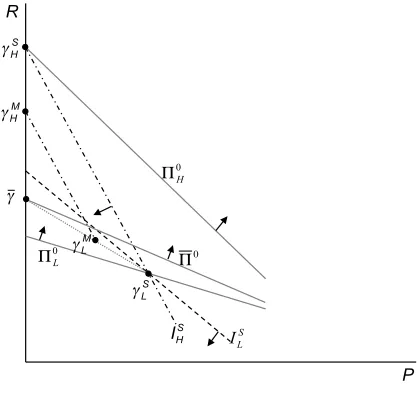
Figure 1 illustrates the equilibrium candidates of the model. For now, restrict attention
to the pure-strategy equilibrium candidates γS H, γ
S L
and γ. They are located on the cor-responding zero-profit lines for deals offered to H−users, to L−users, and to both types of users in an eventual pooling deal, Π0
H, Π0L, and Π
0
, respectively. Arrows indicate direction of
increasing profits. The H−users’ and L−users’ indifference curves at utility levels achieved in γS
H and γ S
L are given by I S
H and I S
L, respectively. Once more, the arrows indicate the
direction of increasing utilities. In the separating equilibrium candidate, self selection is
fulfilled as each type of user is better off by accepting the deal designed for them than by
accepting the deal designed for the other type. The pooling equilibrium candidate,γ, fulfills the zero-profit condition, as it is on Π0. Self-selection would be fulfilled trivially as dealers would only offer one deal to both type of users.
Π0 γ
Figure 1: Equilibrium candidates of the model. γHS, γ S L
is the pure-strategy separating equilibrium candidate, γ is the pure-strategy pooling equilibrium candidate, and γM
L , γ M H
To determine the existence of a pure-strategy separating equilibrium, the location of γ
with respect to the intersection of the IS
L line and the R axis is crucial. The separating
equilibrium candidate will be broken by a dealer offering γ if both types of users receive higher a utility in γ than in their respective γS
H and γ S
L. This is the case if γ involves a
payment R that is smaller than the R in the intersection of the ILS line and the R axis, as
in Figure 1. Given that dR
dλ >0, a free drug program that eliminates selectively sufficiently
many high-risk users from the population dealers deal with, will eventually reduce R to this point.
Reducing the proportion of high risk users increases the expected profits of a dealer from a given deal that pools types. Competition drives dealers to pass on these gains to users,
increasing their expected utility. Eventually the proportion of bad types in the population
becomes so low that also the low risk types are better off accepting this pooling deal.
Given the slopes of the users’ indifference curves, the pooling equilibrium candidate,
however, is not an equilibrium either: It is always possible to offer a deal that is between the
zero-profit lines for H−users and the pooling zero-profit line, which only H−users accept if the pooling deal is still offered. As we will derive next, in this case, a mixed-strategy
equilibrium exists, which leaves all users with a higher expected utility than the pure-strategy
separating equilibrium.
Mixed strategy equilibria We have shown that a pure strategy market equilibrium fails
to exist if and only if λ < θL−δθL−θL2+δθL2 2θL−θH−δθL−θ2
L+δθ2L. Several authors have shown that in markets
with asymmetric information and no pure strategy equilibrium, a mixed strategy equilibrium
may exist (see e.g. Dasgupta and Maskin, 1986; Rosenthal and Weiss, 1984). We follow
Rosenthal and Weiss (1984) in our derivation of the symmetric mixed strategy equilibrium
in our model. The conditions for the mixed strategy equilibrium are the same as for the
pure strategy equilibria.
The strategies played in the mixture are pairs of deals, which look like ”linear
combi-nations” of the candidates for pure strategy equilibria (separating and pooling). A typical
deal for the H−type user, γM
H = 0, R M H, D
, lies on the line between γS
H and γ. The
corre-sponding deal for theL−type user, γM L = P
M L , R
M L , D
, lies on the the line betweenγS L and
γ such that the H−type is indifferent between γM
H and γ M
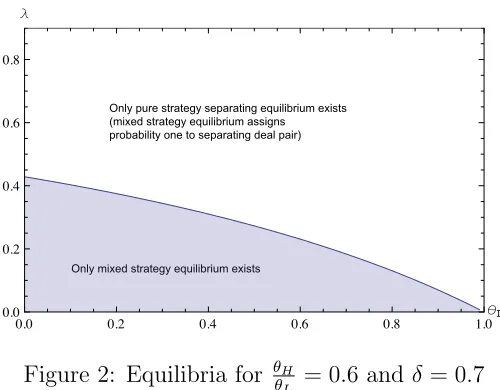
Only mixed strategy equilibrium exists
Only pure strategy separating equilibrium exists (mixed strategy equilibrium assigns probability one to separating deal pair)
0.0 0.2 0.4 0.6 0.8 1.0
[image:10.612.179.429.69.264.2]0.0 0.2 0.4 0.6 0.8 Λ ΘL
Figure 2: Equilibria for θH
θL = 0.6 andδ = 0.7
The symmetric mixed strategy can now be identified with a cumulative distribution function (cdf) F defined on the variable RM
H in the interval [ c λθH+(1−λ)θL,
c
θH]. Define rL :=
1−θL
θL and rH :=
1−θH
θH . Then a symmetric mixed-strategy equilibrium results if all n dealers
play independently γM L , γ
M H
= 0, RM H, D
, PM L , R
M L , D
according to the cdf
F RHM = 0
1−ψ c−θHRMH
−φ
(n−1)λ(rL−rH) 1
forRM H <
c λθH+(1−λ)θL
for λθH+(1c−λ)θL ≤R
M H <
c θH
for c θH ≤R
M H
where
φ = 1
θH
(1−λ) θL−
δ(1−θL)2
θL !
+λ
θH(1−θL)
θL
−(1−θH) !
,
ψ =
c−θH
c
λθH + (1−λ)θL
φ
(n−1)λ(rL−rH)
.
It exists if and only ifλ < θL−δθL−θ2L+δθ2L 2θL−θH−δθL−θ2
L+δθL2. See Appendix for the derivation of the mixed
strategy equilibrium and the proof of this existence condition.
Proposition 1 The pure-strategy separating equilibrium γLS, γ H L
exists if and only if λ ≥
θL−δθL−θ2
L+δθ2L 2θL−θH−δθL−θ2
L+δθ2L
. The mixed-strategy equilibrium characterized by γLM, γ
M H
and F RHM
exists if and only if λ < θL−δθL−θL2+δθ2L
2θL−θH−δθL−θ2
L+δθ2L
. There is no pooling equilibrium.
Define the lowest λ, for which the pure-strategy separating equilibrium exists, as λ :=
θL−δθL−θ2
L+δθ2L 2θL−θH−δθL−θ2
L+δθ2L. For arbitrarily chosen values of
θH
as a function of θL. It visualizes that for λ < λ, only the mixed strategy equilbrium exists,
but neither of the pure strategy equilibria. If however λ ≥ λ, the pure-strategy separating equilibrium exists and the mixed strategy equilibrium we derived only exists in its degenerate
form, assigning probability one on the pair of deals offered in the separating equilibrium.
Supply-side driven entry of new drug users due to free drug programs Free drug
programs target severely affected addicts. Severely affected users are very likely to be those
who need to finance their habit with drug-related crime at any point in time and are, thus,
highly risky to deal with. In terms of our model, this implies that free drugs programs reduce
the share of high-risk users, λ. In order to fully assess the impact of these programs, we thus need to take into account the effect that this change in the user population has on the utility derived by each user.
First note that the utility the users derive in the pure-strategy separating equilibrium
does not depend onλ. That implies that, as long as this equilibrium exists, a change in the composition of the drug user population induced by a free-drug-program does not affect the
utility of the users, and thus, does not lead to supply-side driven entry of new users into the
market. Second, observe that in the mixed strategy equilibrium, users have a higher expected
utility than in the pure-strategy separating equilibrium. As every pair γLM, γ M H
played in
the mixed strategy equilibrium is a linear combination of γ and γS
i and as Ui(γ)> Ui γiS
for the mixed strategy equilibrium to exist, the expected utility of every user in the mixed strategy equilibrium is higher than in the separating equilibrium.
Proposition 2 The expected utility the users derive in the pure-strategy separating
equilib-rium does not depend on λ.
Proposition 3 The expected utility of every user in the mixed strategy equilibrium is higher
than in the separating equilibrium.
Taken together, propositions 1 - 3 imply the following for a free drug program.
Proposition 4 If and only if a free drugs program leads to a reduction of the share of
Comparative statics It can be shown that dλdδ =
(θ2
L−θL)(θL−θH) (2θL−θH−δθL−θ2
L+δθ2L)
2 <0. This means
that the more valuable the mode of punishment of defaulting users is to the dealers, the
smaller is the lowestλ, for which the pure-strategy separating equilibrium exists, and thus the bigger is the range ofλfor which free drugs programs do not lead to supply-side driven entry of new users into the market. Similarly, it can be shown that dθdλH =
(1−δ)(θL−θ2L)
(2θL−θH−δθL−θ2
L+δθL2)
2 >0
and dθdλL =
(1−δ)(−θH+2θHθL−θL2)
(2θL−θH−δθL−θ2
L+δθL2)
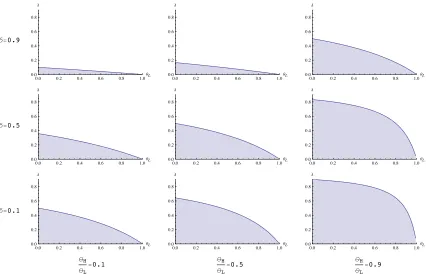
2 <0. In Figure 3, we plot λas a function ofθL forδ (bottom
to top) and θH
θL (left to right) values of 0.1, 0.5, and 0.9.
0.0 0.2 0.4 0.6 0.8 1.0
Θ L 0.0 0.2 0.4 0.6 0.8 Λ
0.0 0.2 0.4 0.6 0.8 1.0
Θ L 0.0 0.2 0.4 0.6 0.8 Λ
0.0 0.2 0.4 0.6 0.8 1.0
Θ L 0.0 0.2 0.4 0.6 0.8 Λ
0.0 0.2 0.4 0.6 0.8 1.0
Θ L 0.0 0.2 0.4 0.6 0.8 Λ
0.0 0.2 0.4 0.6 0.8 1.0
Θ L 0.0 0.2 0.4 0.6 0.8 Λ
0.0 0.2 0.4 0.6 0.8 1.0
Θ L 0.0 0.2 0.4 0.6 0.8 Λ
0.0 0.2 0.4 0.6 0.8 1.0
Θ L 0.0 0.2 0.4 0.6 0.8 Λ
0.0 0.2 0.4 0.6 0.8 1.0
Θ L 0.0 0.2 0.4 0.6 0.8 Λ
0.0 0.2 0.4 0.6 0.8 1.0
[image:12.612.92.518.247.521.2]Θ L 0.0 0.2 0.4 0.6 0.8 Λ ΘH ΘL "0.9 ΘH ΘL "0.5 ΘH ΘL "0.1 ∆"0.9 ∆"0.5 ∆"0.1
Figure 3: In the shaded areas, only the mixed-strategy equilibrium exists
These comparative statics imply that the higher θL, the lower θH, and the higher δ, the
less likely does a free drugs program lead to supply-side driven entry of new users into the
market.
Proposition 5 dλdδ < 0, dθdλ
H > 0, and
dλ
dθL < 0. Free-drug programs are, thus, more likely
to lead to supply-side driven entry of new users into the market, the lower the value of
their repayment abilities, θH and θL, respectively.
The cheaper it is to distinguish types because (i) types are sufficiently different –θL high
or θH low, ceteris paribus, – or because (ii) the punishment that is used creates high value
to the dealers – δ high – the less frequently a free drugs program leads to a breakdown of the pure-strategy separating equilibrium and, as a consequence, the less frequently it leads
to supply-side driven entry of new users.
Limit case If λ → 0, there are only low-risk types in the population left. In this case, competition will (i) drive out costly punishment – it wastes resources – and (ii) imply a
payment of R = c
θL with probability one. For continuity reasons, this implies that, in the
approach of this limit case, the probability weight put on lower payments RMH, and thus
on deals γLM, γ M H
close to the pooling equilibrium deal γ, is higher, the lower the λ. In addition, the lower λ, the lower the payment R in the pooling equilibrium deal. These two properties of the mixed-strategy equilibrium imply that the utilities from consuming drugs
for both types of users increase in a falling λ. We can, thus, state the following.
Proposition 6 The more effectively free-drug programs target high-risk users, the better off
are all users, and thus, the more additional users will enter the drugs market.
Robustness Three remarks on the robustness of our result are due. First, we have derived
only one symmetric mixed-strategy equilibrium and shown that it is an equilibrium indeed.
However, there may be more mixed-strategy equilibria, which we did not derive. Note that the pairs γM
L , γ M H
played in our mixed-strategy equilibrium have been derived using
only the zero-profit and the self-selection conditions. These conditions must hold in any
equilibrium; and, as consequence, our main result – that the expected utility of every user in
the mixed strategy equilibrium is higher than in the separating equilibrium – must hold in
any mixed strategy equilibrium. Second, in our model, we assume for the sake of simplicity
perfectly competitive dealers. Our results, however, do not depend on this. As long as there
is some (imperfect) competitive pressure, distribution cost savings will be passed on to users.
mechanisms further, it is beyond the scope and purpose of this paper and we leave it for
future research.
4
Discussion
Our study revealed a negative, supply-side driven effect of free drug programs on overall drug consumption. In an environment characterized by the outlined information asymmetries, free
drug programs change the composition of drug users which, under specified conditions, lead
to the non-existence of a pure strategy market equilibrium. If the proportion of low risk
users gets sufficiently high, then neither a separating nor pooling equilibrium exists. In this
instance, however, a symmetric mixed strategy equilibrium can be identified that leaves drug
users with a higher utility level than in the pure strategy equilibrium. The higher level of
utility is driven by a lowered effective price offered by drug dealers. The intuition of this
result is as follows. By reducing the number of high risk users, dealing drugs becomes a
less risky undertaking. This in turn will increase competition among dealers which will drive prices down. This supply-side driven effect is different to the already identified demand effect
that causes prices to fall as a result of lower demand (see e.g. Clarke, 2003).
Empirical evidence suggests that heroin demands are very price elastic14 so a reduction
in effective price will encourage more people to consume drugs. Advocates of free drug
programs need to be aware of this negative effect as ignoring it leads to an overestimation
of the positive impact of these programs. The main message of our paper therefore is, that
free drug initiatives should not exclusively focus on users that are in these programs (or that
could be in them) but include the effects on potential users as well. The policy implications
of this will be discussed in the final section.
5
Policy Implications
The key objectives of drug use prevention policies are how to (1) help users take control
of their addiction; (2) reduce drug-related crime and (3) decrease overall drug consump-tion. Previous studies have shown that methadone programs meet objectives one and two.
14
Methadone satisfies a users desire for an opiate without producing a ”rush” or ”high” or the
mental confusion associated with heroin. Although methadone is as addictive as heroin, the
lack of a ”high” makes it easier for users to overcome their addiction. Methadone programs
also help to reduce drug-related crime. To finance drugs, high-risk users are more likely to
commit crimes than new or low-risk users (Clarke, 2003). The provision of free heroin and
methadone limits an addict’s need to finance drugs.
Our analysis, however, shows that methadone programs may fail to deliver on the third
objective by encouraging new users to enter the market or existing users to increase their
level of consumption. This negative impact on overall drug consumption is amplified by policy makers that see methadone initiatives as substitutes for law enforcement measures.
Reality is, that methadone programs rely on public funding which requires savings elsewhere
– as a reduction of the number of high risk users lowers drug related crime, there is less need
for police. We, however, suggest that methadone programs should be used as complements
and not as substitutes to law enforcement measures. Free drug initiatives should lead to
more police on the street not less.
Policy Implication 1 Methadone programs should be used as complements and not as
sub-stitutes to law enforcement measures.
Previous demand-side driven studies have already pointed towards the negative effect
of methadone programs. Policy implications have been the introduction of legal penalties
directed specifically at new users (Clarke, 2003). Our study, however, suggests under which conditions the utility increase of consumers will also be supply-side driven. When these
conditions are met, in addition to targeting new or low-risk users, law enforcement measures
should also be directed at drug dealers.
Policy Implication 2 Methadone programs should be accompanied by law enforcement
mea-sures directed at drug dealers in order to avoid supply-side driven entry of new users into
the drug market.
Reducing the number of severely affected addicts lowers the risk of drug-dealing. Legal
penalties and law enforcement measures need to compensate for this and make drug-dealing
6
Conclusion
In this paper, we analyze the effects and policy consequences of free drug programs within
a screening model of the hard drug market in which dealers use payment and punishment
options to screen between high and low risk users. We show that, if a free drug program
selects suffciently many high risk drug users, the cost of distributing drugs is reduced. Due
to competition of dealers, this will reduce the market price for drugs and attract new drug
users. As a consequence, we recommend to treat free drug programs and law enforcement as complements. Targeting dealers with legal penalties and law enforcement must compensate
for the reduction in the drug distribution costs due to free drug programs and ensure that
drug-dealing stays a risky business.
References
[1] Becker G., Murphy K. Theory of Rational Addiction. Journal of Political Economy
1988; 96; 675-700.
[2] Black A., Khan S., Brown R., Sharp P., Chatfield H., McGuiness C. An evaluation of
opioid replacement pharmacotherapy in an urban Aboriginal Health Service. Australian
and New Zealand Journal of Public Health 2007; 31(5); 428-432.
[3] Brewster M. P. An Evaluation of the Chester County (PA) Drug Court Program. Journal
of Drug Issues 2001; 31(1); 177-206.
[4] Clarke H. Economic Analysis of Public Policies for Controlling Heroin Use. Australian
Economic Papers 2003; 42(2); 234-252.
[5] Cox W. M. Evaluation of a Shared-Care Program for Methadone Treatment of Drug Abuse: An International Perspective. Journal of Drug Issues 2002; 32(4); 1115-1124.
[6] Cussen M., Block W. Legalize Drugs Now! An Analysis of the Benefits of Legalized
Drugs. American Journal of Economics and Sociology 2000; 59(3); 525-536.
[7] Dasgupta P., Maskin E. The Existence of Equilibrium in Discontinuous Economic
[8] Dekimpe M. G., Van de Gucht L., Hanssens D. M., Powers K. I. Long-Run Abstinence
After Narcotics Abuse: What Are the Odds? Management Science 1998; 44(11);
1478-1492.
[9] Dickinson G. L., Rostami-Hodjegan A., Lagundoye O., Seivewright N., Pratt P.,
Lennard M. S. A six-year evaluation of methadone prescribing practices at a substance
misuse treatment centre in the UK. Journal of Clinical Pharmacy and Therapeutics
2006; 31; 477-484.
[10] Donohue III J. J., Levitt S. D. Guns, Violence, and the Efficiency of Illegal Markets. The American Economic Review 1998; 88(2); 463-467.
[11] European Monitoring Centre for Drugs and Drug Addiction. Drugs and Crime - a
com-plex relationship. Drugs in focus 2007; 16; 1-4. Downloaded on 03/04/2008 onhttp://
www.emcdda.europa.eu/attachements.cfm/att_33064_EN_2007_2721_EN_WEB.pdf.
[12] Frey B. Drugs, economics and policy. Economic Policy 1997; 12 (25); 387-398.
[13] Harris Jr. K. A., Arnsten J. H., Joseph H., Hecht J., Marion I, Juliana P., Gourevitch
M. N. A 5-year evaluation of a methadone medical maintenance program. Journal of
Substance Abuse Treatment 2006; 31; 433-438.
[14] Holloway K. R., Bennett T. H., Farrington D. P. The effectiveness of drug treatment
programs in reducing criminal behavior: A meta-analysis. Psicothema 2006; 18(3);
620-629.
[15] Levitt, S. D., Venkatesh S.A. An Economic Analysis of a Drug-Selling Gang’s Finances.
The Quarterly Journal of Economics 2000; 115; 755-789.
[16] Lidz V., Sorrentino D. M., Robinson L., Bunce S. Learning from disappointing outcomes:
An Evaluation of Prevocational Interventions for Methadone Maintenance Patients. Substance Use & Misuse 2004; 39(13-14); 2287-2308.
[17] MacDonald Z. What Price Drug Use? The Contribution of Economics to an
[18] Magura S., Staines G. L., Blankertz L., Madison E. M. The Effectiveness of Vocational
Services for Substance Users in Treatment. Substance Use & Misuse 2004; 39(13-14);
2165-2213.
[19] Prinz A. Drugs from the Supermarket? An Economic Analysis of Drug Policy. Zeitschrift
f¨ur Wirtschafts- und Sozialwissenschaften 1994; 114 (4); 547-571.
[20] Rosenthal R. W., Weiss A. Mixed-Strategy Equilibrium in a Market with Asymmetric
Information. Review of Economics Studies 1984; 51(2); 333-342.
[21] Rothschild M., Stiglitz J.E. Equilibrium in Competitive Insurance Markets: An Essay on the Economics of Information. Quarterly Journal of Economics 1976 90; 225-243.
[22] Saffer H., Chaloupka F. The Demand for Illicit Drugs. Economic Inquiry 1999; 37(3);
401-411.
[23] Staines G. L., Blankertz L., Magura S., Cleland C. M., Bali P. Evaluating vocational
rehabilitation programs for substance users: issues in designing and implementing
ran-domized studies. Evaluation and Planning 2005; 28(1); 61-68.
[24] Stevenson R. Harm Reduction, Rational Addiction and the Optimal Prescribing of Illegal Drugs. Contemporary Economic Policy 1994; 12; 101-108.
Appendix
A
Pure strategies
A.1
Separating equilibrium candidate
Let us first concentrate on deals with deferred payments and introduce immediate payment
deals later on. An equilibrium candidate with deferred payment γLS, γ S H
needs to be on the
zero profit lines for each deal, thus, Πt = θtR S
t + (1−θt)δP S
t −c = 0. As punishment is
wasteful, a dealer will offer punishment only to theL−type (the expected cost of punishment is lower for the L−type) and PS
H = 0. It follows that R S H =
c
θH. Incentive compatibility
requires to choose γS
L such that UH γLS
≤ UH γHS
, which is equivalent to RS L ≥
1−θH
θH P S
L. Together with the zero profit requirement, this implies P S L =
(θL−θH)c θL−δθH−θHθL+δθHθL,
and RS L=
c(1−δ)−c(θH−δθL)
θL−δθH−θHθL+δθHθL.
Note now that both H−type users and dealers are indifferent between a deal with a deferred payment of R and an immediate payment of θHR, whereas an L−type user is
strictly better off with the deferred payment as she can hereby avoid to engage in criminal
activity. Thus, we have derived the following result.15
Lemma 1 Separating equilibrium candidates are γS H = P
S H, R
S H, T
S H
= (0, c, I) and γS L =
PS L, R
S L, T
S L
= (θL−θH)c
θL−δθH−θHθL+δθHθL,
c(1−δ)−c(θH−δθL) θL−δθH−θHθL+δθHθL, D
; and γS
H = P S H, R
S H, T
S H
=
0,θcH, D
and γLS = P
S L, R
S L, T
S L
= (θL−θH)c
θL−δθH−θHθL+δθHθL,
c(1−δ)−c(θH−δθL) θL−δθH−θHθL+δθHθL, D
. The
cor-responding expected utilities in the separating equilibria are UH γHS
= Vi − c − ζ and
UL γLS
=Vi−θL
c(1−δ)−c(θH−δθL)
θL−δθH−θHθL+δθHθL −(1−θL)
(θL−θH)c θL−δθH−θHθL+δθHθL.
Lemma 1 shows that there are two separating equilibrium candidates, both of which
entail the same deal forL−types. Even though they are different for the high-risk users, one of them entails immediate payment and the other one deferred payment, both the dealers
and theH−users are indifferent between the two deals.
A.2
Pooling equilibrium candidate
In a pooling equilibrium dealers offer deals γ∗
H for H−type users and γL∗ for L−type users
with γ∗
H =γL∗ =γ. Also a pooling equilibrium candidate needs to satisfy the above outlined
three conditions, namely self-selection (in pooling this is trivial), zero profits and
impos-sibility to offer better deals. Let pooling equilibrium candidate values of our variables be
indicated by upper bars. As punishment is inefficient, the only pooling equilibrium candidate
is characterized by zero punishment and zero expected profit. Thus a pooling equilibrium candidate with deferred payment requires Π = λθHR+ (1−λ)θLR−c = 0, which implies
R = c
λθH+(1−λ)θL and γ = P , R, T
= 0,λθH+(1c−λ)θL, D
. Note that as θH < θL, the
H−type users strictly prefer the pooled deal to a deal with immediate payment that lets the dealer break even. Therefore, a deal with immediate payment cannot be an equilibrium.
15
Note furthermore that R is increasing in λ, i.e., in the share of H−type users in the population of drug users. The user’s expected utility in the pooling equilibrium candidate
is UiL(γ) = Vi−θL c
λθH+(1−λ)θL and UiH(γ) =Vi−θH c
λθH+(1−λ)θL −ζ, respectively.
First note that a pooling equilibrium does not exist: As θH < θL, the indifference curve
of the H−type user is steeper than that of the L−type user for any deal. Furthermore, the indifference curve of the L−type user is also steeper than the dealer’s isoprofit curve as δ∈
(0,1). Therefore, for any pooling deal, dealers can offer a profitable deal that only L−type users accept. Second, note that a deviation from the separating equilibrium candidate to the
pooling candidate is possible if and only if λ < θL−δθL−θ2L+δθ2L 2θL−θH−δθL−θ2
L+δθL2. For this, both types have
to be better off by accepting a deal that pools types. H−type users are always better off as the pooling candidate promises a lower repayment for zero punishment. L−type users are better off in the pooling candidate than in the pooling equilibrium candidate ifEUL γLS
≤
EUL(γ), which simplifies to λ <
θL−δθL−θ2
L+δθL2 2θL−θH−δθL−θ2
L+δθ2L. Thus, ifλ <
θL−δθL−θ2
L+δθ2L 2θL−θH−δθL−θ2
L+δθ2L, there is
no pure-strategy equilibrium.16
B
Mixed strategies
In the computation of the mixed strategies and the proof that there is not profitable deviation
from the equilibrium in these mixed strategies, we borrow from Rosenthal and Weiss (1984).
B.1
Computation of
P
LM, R
M LA deal offered to aH−type user is of the formγM
H = 0, R M H, D
. For eachγM
H = 0, R M H, D
,
there is exactly oneγM L = P
M L , R
M L , D
for whichUH γHM
=UH γLM
and Π =λΠH γHM
+
(1−λ) ΠL γLM
= 0. The slope of the line connecting γP
and γS L,b, is
b=−R
P
−RS L
PS L
=−λδ−δ−λ+λθH +δθL−λδθL
λθL−λθH −θL
.
Using this and PM
H = 0, we can derive P M L , R
M L
as a function of RM H, i.e.,
PLM =
cθH −RMHθHθL+λRMHθHθL−λRHMθ2H
δθH −θL+λθL−λδθH +θHθL−λθHθL−δθHθL+λδθHθL
,
RML =
cθH −c+λRMHθH +δRMHθH −λδRMHθH −δRMHθHθL+λδRMHθHθL−λRMHθH2
δθH −θL+λθL−λδθH +θHθL−λθHθL−δθHθL+λδθHθL
.
16
B.2
Zero profit condition
To see that offering γHM, γ M L
will always result in zero profits to a dealer when playing
the mixed strategy consider the following: If γHM, γ M L
offered by a specific dealer yields
the highest utility to users, all drug users will buy from this dealer with probability one,
generating a profit of
ΠM =λθHR M
H + (1−λ) θLR M
L + (1−θL)δP M L
−c.
If a dealer is offering the pair γHM, γ M L
that offer drug users the highest utility, he will
get all drug users with probability one and have a profit of
ΠM
γLM, γ M H
=λθHR M H
+ (1−λ)θL
cθH −c+λRMHθH +δRMHθH −λδRMHθH −δRMHθHθL+λδRMHθHθL−λRMHθH2
δθH −θL+λθL−λδθH +θHθL−λθHθL−δθHθL+λδθHθL
+ (1−λ) (1−θL)δ
cθH −RMHθHθL+λRHMθHθL−λRMHθ2H
δθH −θL+λθL−λδθH +θHθL−λθHθL−δθHθL+λδθHθL
−c= 0.
If some other dealer offers deals that yield higher utility to users, then all users will buy from the other dealer and our dealer is left with zero profits.
B.3
Proof that
F
is a proper cdf
DefinerL := 1− θL
θL andrH :=
1−θH
θH . Assume that the cdf that gives the probability of offering
RM
H belowR, is
F RHM = 0
1−ψ c−θHRMH
−φ
(n−1)λ(rL−rH) 1
forRM H <
c λθH+(1−λ)θL
for c
λθH+(1−λ)θL ≤R
M H <
c θH
for c θH ≤R
M H
where
φ = 1
θH
(1−λ) θL−
δ(1−θL)2
θL !
+λ
θH(1−θL)
θL
−(1−θH) !
,
ψ =
c−θH
c
λθH + (1−λ)θL
φ
(n−1)λ(rL−rH)
.
Let us first check that the cdf is a proper cdf. Evaluating at RM H =
c
λθH+(1−λ)θL gives
F
c
λθH + (1−λ)θL
= 1−ψ
c−θH
c
λθH + (1−λ)θL
−φ
Evaluating at RM H =
c θH gives
F
c θH
= 1−ψ
c−θH
c θH
−φ
(n−1)λ(rL−rH) = 1−0 = 1.
Finally, 1−F RM H
gives us the probability of offeringRM
H above R. It is given by
1−F RMH = 1
ψ c−θHRMH
−φ
(n−1)λ(rL−rH) 0
for RMH < c λθH+(1−λ)θL
for c
λθH+(1−λ)θL ≤R M H <
c θH
for θcH ≤R M H
.
The first derivative of (1−F(R)) w.r.t. RM H is
d 1−F RM H
dRM H
=ψ −φ
(n−1)λ(rL−rH)
c−θHRMH
φ
(n−1)λ(rL−rH) (c−θHRHM)
(−θH)
= −φ
(n−1)λ(rL−rH)
−θH
(c−θHRMH)
1−F RMH
.
As d(1−F(RMH))
dRM H
<0, we have dF(RMH)
dRM H
> 0 as long as λ < θL−δθL−θ2L+δθ2L 2θL−θH−δθL−θ2
L+δθ2L. This is true
as long as the pure strategy equilibrium does not exist. Therefore,F is a proper distribution function as long as the pure strategy equilibrium does not exist.
B.4
Proof that there is no profitable deviation
As in Rosenthal and Weiss (1984), ”with (n−1) players playing independently according to F, we need to find the set of best pure-strategy responses by the n−th player to the cdf
Fn−1”. As in their paper, we can restrict attention to pair of deals both of which lie in
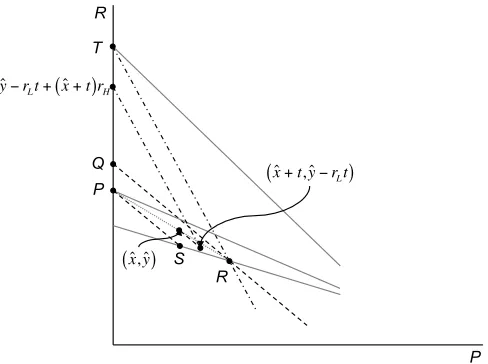
P SRT and one of which lies in P SRQ in figure 4. The reason is that any deal above QR
attracts no L−type and earns non-positive profits and any deal below P SR is dominated by one on P SR. As in their paper, insideP SRQ, profits are non-negative for L−types and non-positive for H−types. We need to show that any pair of deals consisting of the deal (bx+t,by−rLt), with (x,b yb) on P R, and its most profitable companion deal for H−types
(0,yb−rLt+ (bx+t)rH) cannot earn positive profits when played against Fn−1.
The expected payoff from deviating to that pair of deals is
H(t) = (1−F (by−rLt+ (bx+t)rH)) n−1
λ(θH(yb−rLt+rH (xb+t))−c)
+ (1−F (by+rHbx)) n−1
ˆ x , ˆ y
( )
ˆ
x +t, ˆ y −rLt
( )
ˆ
[image:23.612.186.430.71.253.2]y −rLt+(x ˆ +t)rH
Figure 4: Best pure-strategy response to (bx,by)
Note that for c
λθH+(1−λ)θL ≤R
M H <
c
θH the first derivative of 1−F R M H
n−1
w.r.t. RM H
is
d 1−F RM H
n−1
dRM H
= (n−1) 1−F R
M H
n−1
1−F (RM H)
d 1−F RMH
dRM H
= −φ
λ(rL−rH)
−θH
(c−θHRMH)
1−F RMH n−1
>0
and
d2
1−F RHM
n−1
d(RM H)
2 =
−θH(λ(rL−rH)−φ)
λ(rL−rH) (c−θHRMH)
d
1−F RMH
n−1
dRM H
.
The marginal expected payoff is given by
dH(t)
dt =−λθH(rL−rH) (1−F (by−rLt+ (bx+t)rH))
n−1
−(1−λ) (θL−(1−θL)δrL) (1−F(yb+rHbx)) n−1
−λ(θH(yb−rLt+rH(xb+t))−c)
× d
d(by−rLt+ (bx+t)rH)
(1−F (by−rLt+ (bx+t)rH)) n−1
(rL−rH).
Evaluating at t = 0, we can simplify this to
dH(0)
Next, it can be shown that
d2
dtH(t) = 2λθH (rL−rH)
2 d
d(yb−rLt+ (bx+t)rH)
(1−F (yb−rLt+ (xb+t)rH)) n−1
+λ(θH (yb−rLt+rH(bx+t))−c) (rL−rH)2
× d
2
d(by−rLt+ (bx+t)rH)2
(1−F (yb−rLt+ (bx+t)rH)) n−1
<0.