© 2017, IRJET | Impact Factor value: 5.181 | ISO 9001:2008 Certified Journal | Page 1212
AN EXPERIMENTAL INVESTIGATION ON SELF COMPACTING CONCRETE
WITH ARTIFICIAL FINE AGGREGATE AS AN ALTERNATIVE TO THE
NATURAL FINE AGGREGATE
P.Lakshmi teja
1Prof C. Sashidhar 2, D. Pavan Kumar 31M.Tech student in structural engineering, JNT University, Anantapur, India
2Professor, Department of Civil Engineering, JNT University, Anantapur, India
3Lecturer, Department of Civil Engineering, JNT University, Anantapur, India
---***---
Abstract- Concrete can be considered as the most widely used in the construction industry. Concrete is a composite material made up of cement, sand, water and sometimes admixtures. Cement is the most active component and the use of large quantities of cement results in increasing CO2
emissions and as a consequence of the green house effect. On the other hand continuous use of natural aggregates causes environmental problems and it is also necessary to preserve the natural sources. The use of sustainable technologies such as supplementary materials is expected to positively affect the performance of concrete mixtures. Self-compacting concrete (SCC) is an innovative development of conventional concrete, which can be placed and compacted under its self weight with little or no vibration effort. This paper present the Mechanical and Durability properties of self compacting concrete using cementitious materials as a partial replacement of cement like Fly ash(15%), Silica fume(15%) and Metakaolin(5%) ; Artificial fine aggregate as natural fine aggregate having fineness modulus 2.7; Coarse aggregate of size 12mm and
CONPLAST SP337 as Super-plasticizer. SCC containing different proportion of these mineral admixtures has been tested for slump flow, V-funnel, L-box, U-box and J-ring and found that the values are within the limits prescribed by EFNARC, 2002 method. The properties reported in this paper are the workability properties, Mechanical properties and Durability Properties. The Workability properties were investigated by Slump flow (filling ability), V-Funnel (filling ability) and L-Box test (passing ability). The Mechanical properties were tested for Compressive strength, Splitting Tensile strength and Flexural strength of 7 days, 28 days and 90 days were obtained. The Durability properties were tested for Water absorption and Acid tests.
Key words: SELF COMPACTING CONCRETE, FLY ASH, SILICA FUME, METAKAOLIN, ARTIFICIAL FINE AGGREGATE, CONPLAST SP337.
1. INTRODUCTION
Concrete is the most common material used in the construction. Concrete gives considerable freedom to mould the structural component into desired shape or form. Cement and concrete composites are presently the most economic materials for construction. A new trend in designing complex and heavily reinforced structures showed that compaction of concrete by vibrating may be difficult in some cases and strongly depend on a human factor. It is commonly noticed many times that after the formwork is removed, the fresh concrete had not spread to all the points, uniformly and perfectly. A homogenous property of the structure has thus been adulterated. These reasons prompted to the development of Self Compacting Concrete. Self Compacting Concrete (SCC) is considered as a concrete which can be placed and compacted under its self weight with little or no vibration effort, and which is at the same time it is enough to be handled without segregation or bleeding of fresh concrete. It is able to flow under its own weight, completely filling formwork and achieving full compaction.
© 2017, IRJET | Impact Factor value: 5.181 | ISO 9001:2008 Certified Journal | Page 1213 increased. But, the cement production consumes
large amount of energy and emits carbon dioxide results in environmental pollution. Hence, one of the solutions to these problems is to reduce the consumption of cement and utilise Pozzolana materials for the preparation of concrete. Previous studies indicates that the use of cementitious materials like Fly ash, Silica fume, Metakaolin and Ground Granulated Blast Furnace Slag (GGBS) as partial replacement of cement, reduces the cement consumption and also increases the strength and durability of concrete.
In SCC, the aggregates generally contribute approximately 2/3 of the total volume. Proper choice of aggregates has significant effect on the fresh and hardened properties of SCC concrete. In general it is observed that the effects of shape and texture of fine aggregate are much more important than the effects of coarse aggregate. It is in practice that river sand is being used as fine aggregate in concrete for many centuries. Most of the construction industries use river sand only as fine aggregate. Investigations are going on due to increase in demand and depletion of river sand, along with restrictions imposed on the exploitation of the river sand. One of the solution for this problems is the use of alternative materials for river sand such as artificial fine aggregate, industrial by products (some forms of slag, bottom ash), recycled aggregates, etc. Among the above materials, artificial fine aggregate is relatively receiving significant attention as a replacement for river sand. The artificial fine aggregate is produced by impact crushing rock deposits to obtain a well graded fine aggregate. It is known that for SCC, high powder (cement, cementitious materials and inert fillers) content is required for achieving the required fresh concrete properties. Since, artificial fine aggregate contains large amount of fines, can be used as an alternative to river sand. Due to high fines content in artificial fine aggregate, the strength and durability properties of the concrete are reported to be considerably improved by using artificial fine aggregate. From the literature, it is observed that artificial fine aggregate is being used
as fine aggregate in conventional aggregate and limited applications in SCC.
2. LITERATURE REVIEW
Nan Su et al. (2001) proposes a simple design mix method for Self-compacting concrete. Primarily, required quantities of aggregates are evaluated and binder paste is then poured in to space of aggregates to make sure that concrete attained flowability, its own compactability and other properties of SCC. To observe the behavior of SCC compressive test were carried out. Obtained result indicates this method could produce successfully high quality of self-compacting concrete. As compare to the Japanese Ready-Mixed Concrete Association this method is easier, simple for execution, time consumption is less and cost effective.
Jian-Tong Ding et al. (2002) experimentally found out the effects of Metakaolin and Silica fume on the properties of concrete. Experimental investigation with seven concrete mixtures of 0,5,10 and 15% by mass replacement of cement with high reactivity Metakaolin or Silica fume on the workability, strength, shrinkage and resistance to chloride penetration of concrete was investigated. The incorporation of both Metakaolin and Silica fume in concrete was found to reduce the free drying shrinkage and restrained shrinkage cracking width. It is also reported that the incorporation of Metakaolin or Silica fume in concrete can reduce the chloride diffusion rate significantly. The performance of Silica fume was found to be better than Metakaolin.
© 2017, IRJET | Impact Factor value: 5.181 | ISO 9001:2008 Certified Journal | Page 1214 early stages but showed outstanding improvement
in durability.
Benchaa Benabed et al. (2012) had used different types of sand as replacement of fine aggregate like crushed sand, river sand, dune sand and mixture of all sand. Different inert fillers and supplementary cementitious materials they have added. The slump flow, V- funnel flow time and viscosity measurement tests were used to study the rheological properties. The experimental results indicate that the rheological properties and strength imp rove with mixtures of crushed and river sands but decrease with mixtures of crushed and dune sands especially for higher dune sand content. The slump flow time decreased with the increase in limestone fines content whereas V- funnel flow time increased. The V-funnel flow time has a direct relationship with viscosity as the increase in V- funnel flow time increases the viscosity of mortar.
Ganeshwaran.P.A et al. (2012) had evaluated the Mechanical Properties of Self Compacting Concrete with Manufactured Sand and Fly Ash. SCC containing different proportion of fly ash have been tested for Slump flow, V-funnel, U-Box, L-box and J-ring and found that the values are within the limits prescribed by EFNARC. Mechanical properties such as compressive strength, split tensile strength have been evaluated as per Bureau of Indian Standards. It is observed from the studies that the compressive strength and split tensile strength decreases with the increase in replacement of cement by fly ash. It was concluded that SCC with manufactured sand and fly ash can be used for all applications in the construction sector.
3. OBJECTIVE
The main objective of this investigation is to use of Fly ash (15%), Silica fume (15%) and Metakaolin (5%) as a partial replacement of cement and Artificial fine aggregate as a fully replacement of natural fine aggregate in SCC. Characterization of all ingredients of SCC has been performed.
Mechanical and Durability properties have been evaluated.
4. EXERIMENTAL PROGRAMME 4.1 Materials
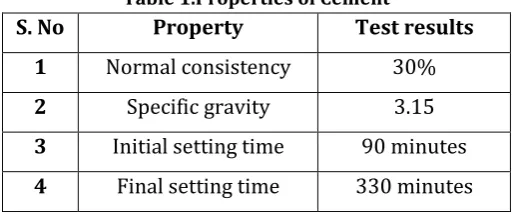
Cement: In this investigation Ordinary Portland cement (OPC) of 43 Grade confirming to IS specifications was used. The properties of cement are shown in Table 1.
Table 1.Properties of Cement
S. No Property Test results
1 Normal consistency 30%
2 Specific gravity 3.15
3 Initial setting time 90 minutes 4 Final setting time 330 minutes
Artificial Fine Aggregate: In this paper, artificial fine aggregate is totally replaced as fine aggregates which is procured from Hyderabad, with different sizes that passing through 4.75mm, 2.36mm, 1.18mm, 600µ, 300µ and 150µ. The properties of Artificial Fine Aggregate are shown in Table 2.
Table 2.Properties of Artificial Fine Aggregate
S. No Property Test results
1 Fineness Modulus 2.7
2 Specific gravity 2.6
3 Bulk density 1600 kg/m3
4 Grading zone II
[image:3.595.309.567.240.347.2]Coarse aggregate: In this investigation coarse aggregate of size 12 mm used and obtained from the local quarry confirming to IS specifications was used. The properties of coarse aggregate are shown in Table.3.
Table 3.Properties of Coarse Aggregate
S.NO PROPERTY VALUES
1 Specific Gravity 2.58
© 2017, IRJET | Impact Factor value: 5.181 | ISO 9001:2008 Certified Journal | Page 1215 Chemical Admixture: CONPLAST SP337 is using as
a Super-plasticizer (chemical admixture) in this work. The main reason of utilizing super-plasticizer in SCC it gives good flowability with very high slump that is to be used in heavily reinforced structural member.
Fly ash: Fly ash used in this present experimental study is obtained from ASTRRA chemicals, Chennai. Properties of fly ash as given by the supplier are given in the following table 4 and table 5.
Table 4.Physical Properties of Fly Ash
Colour White grey
Specific gravity 2.12 Bulk Density 0.994 gm/cc
Table 5.Chemical Properties of Fly Ash
[image:4.595.310.556.218.504.2]Silica fume: Silica fume is a by-product resulting from the reduction of high quantity quartz with coal in electric arc in the manufacture of silicon or ferrosilicon alloy. And it is obtained from ASTRRA chemicals, Chennai. Properties of silica fume as given by the supplier are given in the following Table 6 and Table 7.
Table 6.Physical Properties of Silica Fume
S.No. Properties Results
1 Physical State Micronised Powder
2 Odour Odourless
3 Appearance White Colour Powder
4 Colour White
5 Pack Density 0.76 Gm/Cc
6 Ph Of 5% Solution 6.90
7 Specific Gravity 2.63
8 Moisture .058%
9 Oil Absorption 55 Ml / 100 gms
Table 7.Chemical Properties of Silica Fume
S.No. Properties Results
1 Silica (SiO2) 99.886%
2 Alumina (Al2O2) 0.043%
3 Ferric Oxide (Fe2O3) 0.040%
4 Titanium Oxide (TiO2) 0.001%
5 Calcium Oxide (CaO) 0.001%
6 Magnesium Oxide (MgO) 0.000%
7 Pottasium Oxide (K2O) 0.001%
8 Sodium Oxide (Na2O) 0.003%
9 Loss On Ignition 0.015%
[image:4.595.66.225.354.497.2]Metakaolin: Metakaolin, used in this present experimental study is obtained from ASTRRA chemicals, Chennai. Specification, physical and chemical properties of the Metakaolin as given by the supplier are given in the following Table 8 and Table 9.
Table 8.Physical Properties of Metakaolin
Properties Value
Density (gm/cm3) 2.17 Bulk density (gm/cm3) 1.26
Particle shape Spherical
Colour Half-white
Specific gravity 2.6 Constituents Values
SiO2 59.00%
Al2O 21.00% Fe2O3 3.70%
CaO 6.90%
MgO 1.40%
SO3 1.00%
K2O 0.90%
© 2017, IRJET | Impact Factor value: 5.181 | ISO 9001:2008 Certified Journal | Page 1216 Table 9.Chemical Properties of Metakaolin
Constituents Values
Silica 53%
Alumina 43%
Iron Oxide 0.5% Calcium Oxide 0.1%
Sulphate 0.1%
Sodium Oxide 0.05% Potassium Oxide 0.4%
Water: The water used for casting and curing of concrete test specimens was free from acids, organic matter, suspended solids and impurities which when present can adversely affect the strength of concrete. The local drinking water free from such impurities has been used in this experimental programme for mixing and curing.
4.2 Evaluation fresh properties of SCC
The proportioning of the quantity of cement, cementitious material like Fly ash, Silica fume and Metakaolin, artificial fine aggregate and coarse aggregate has been done by weight as per the mix design. Water and super plasticizer were measured by volume. All the measuring equipments are maintained in a clean serviceable condition with their accuracy periodically checked. The mixing process is carried out in electrically operated concrete mixer. The materials are laid in uniform layers, one on the other in the order – coarse aggregate, artificial fine aggregate and cementitious material. Dry mixing is done to obtain a uniform colour. The Fly ash, Silica fume and Metakaolin is thoroughly blended with cement before mixing. Self Compacting characteristics of fresh concrete are carried out immediately after mixing of concrete using EFNARC specifications. In order to study the effect on fresh concrete properties, the SCC containing different proportion of Fly ash, Silica fume and Metakaolin have been tested for Slump flow, V-funnel and L-box. The results of various fresh properties tested by slump flow test (Filling ability), V-funnel test (Filling ability), L-box test (Passing ability) for various mix compositions in the present study conform to range
[image:5.595.308.563.139.537.2]given by EFNARC, 2002 method standards which are given in following Table 10.
Table 10: Workability properties of SCC (EFNARC, 2002)
Method Property Typical range
Slump flow Filling ability 650-800mm T50cm slump
flow
Filling ability 2-5 seconds
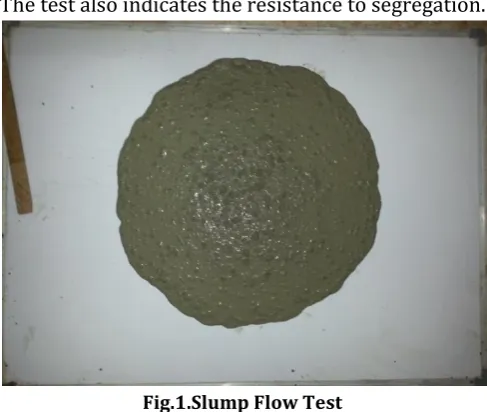
[image:5.595.316.560.320.526.2]V-funnel test Filling ability 6-12 seconds L-box test Passing ability h2/h1 = 0.8-1.0 The Slump flow test is done to assess the horizontal flow of concrete in the absence of obstructions. It is a most commonly used test and gives good assessment of filling ability. It can be used at site. The test also indicates the resistance to segregation.
Fig.1.Slump Flow Test
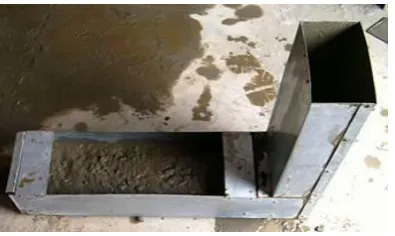
© 2017, IRJET | Impact Factor value: 5.181 | ISO 9001:2008 Certified Journal | Page 1217 Fig.2.V-funnel Test
[image:6.595.61.259.326.444.2]The L-box test assesses the flow of concrete, and also the extent to which the concrete is subjected to blocking by reinforcement. This test is used to determine the passing ability of the concrete.
Fig.3.L-box Test
Test results of this investigation indicated that all SCC mixes meet the requirements of allowable flow time. Maximum size of coarse aggregate is kept as 12 mm in order to avoid blocking effect in the L-box. The gap between rebars in L-box test is 35 mm. As a whole, it is observed that all the fresh properties of concrete values are found to be in good agreement to that of the values provided by European guidelines.
Table 11 presents the mix proportion for Self compacting concrete. These proportions are finalized by keeping all ingredients constants and by adjusting the w/p ratio and superplasticizer.
Table 11.Mix Proportions of SCC Type
of mix
Cement (Kg/m3)
Fly ash
Silica fume
Metakaolin Artificial fine aggregate
Coarse aggregate
Water W/P SP VMA Paste (litre/m3)
SCC 410 72.5 72.5 25 865 720 175 0.36 7.75 0 375
4.3 Evaluation of Mechanical Properties of SCC In this investigation various Mechanical properties such compressive strength, split tensile strength and flexural strength has been evaluated.
To evaluate these properties the following specimens were required to cast.
1. For compressive strength cubes with the dimension of 150 x 150 x 150 mm is casted and the tests were performed at the age of 7, 28 and 90 days.
2. For split tensile strength cylinder with dimension of 150mm diameter and 300mm
height is prepared. Tests were carried out at the age of 7, 28 and 90days.
3. For flexural strength, beams with dimension of 150 x 150 x 700 mm are prepared and tests were conducted at the age of 7, 28 and 90 days.
© 2017, IRJET | Impact Factor value: 5.181 | ISO 9001:2008 Certified Journal | Page 1218 Possible deleterious actions. For durability
characteristics, several tests are used to evaluate the performance of the concrete in different aggressive environment.
In this investigation, the durability properties such as Water absorption and Acid resistance were investigated.
5.0 Results and Discussions 5.1 Fresh properties of SCC
Results obtained by fresh concrete testing are presented in Table 12. SCC mix showed horizontal slump flow without any bleeding at the periphery which indicates good deformability and segregation resistance.
5.2 Mechanical properties
The strength parameters of SCC are presented in the Table 13. Fig.4 represents the compressive strength of SCC. From the figure it can be observed that at 28days strength, an increment of 12.3% can be achieved for SCC compared to controlled mix.
Fig.4.Compression Strength of SCC
[image:7.595.317.563.172.320.2]Fig.5 represents the split tensile strength of SCC. From the figure it can be observed that at 28days strength, an increment of 12.5% can be achieved for SCC compared to controlled mix.
Fig.5.Spit Tensile Strength of SCC
[image:7.595.316.558.407.549.2]Fig.6 represents the Flexural strength of SCC. From the figure it can be observed that at 28days strength, an increment of 11.4% can be achieved for SCC compared to controlled mix.
Fig.6.Flexural Strength of SCC
Table 12.Fresh Properties of SCC
Method Property Typical range
(EFNARC, 2002) Obtained values
Slump flow Filling ability 650-800mm 710mm
T50cm slump flow Filling ability 2-5 seconds 3 seconds V-funnel test Filling ability 6-12 seconds 8 seconds
L-box test Passing ability h2/h1 = 0.8-1.0 0.8
10 15 20 25 30 35 40
7 28 90
Comp
ress
ive
st
reng
th
in
MPa
Age of concrete in days
Control mix
SCC
2 2.5 3 3.5 4 4.5
7 28 90
Sp
p
lit Te
nsi
le
strength
in
MPa
Age of concrete in days
Control mix
SCC
2 4 6 8 10 12
7 28 90
F
lex
u
ra
l S
tr
eng
th
in
MPa
Age of concrete in days
Control mix
© 2017, IRJET | Impact Factor value: 5.181 | ISO 9001:2008 Certified Journal | Page 1219 Table 13.Strength Parameters of SCC
Type of concrete Compressive strength (MPa)
Split tensile strength (MPa)
Flexural strength (MPa)
Age (days) 7 28 90 7 28 90 7 28 90
Control Mix 20 30 35 2.80 3.29 3.66 7.08 9.07 9.29
SCC 26.59 33.70 38.46 3.11 3.76 4.14 7.84 10.27 10.35
5.3 Durability properties 5.3.1 Water absorption
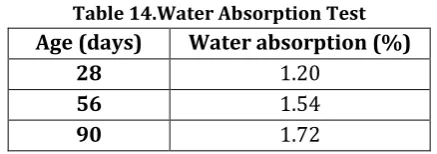
[image:8.595.48.267.300.377.2]Water absorption is the indicator of permeability of concrete. The obtained results are shown in following Table 14.
Table 14.Water Absorption Test Age (days) Water absorption (%)
28 1.20
56 1.54
90 1.72
5.3.2 Acid resistance
The acid resistance test was conducted by immersing the specimens in HCl and H2SO4 solution and measuring the loss in weight and compressive strength of the specimens. The obtained results are shown in the following Table 15.
Table 15.Acid Resistance Test
Age (days) Loss in weight (%)
HCl H2SO4
28 2.58 6.67
56 3.63 14.50
90 4.83 20.12
6.0 A simple tool for SCC mix Design
Table 16.Material Properties Material data
Material Specific gravity Absorption % Moisture %
Cement 3.15 N/A N/A
Fly ash 2.6 N/A N/A
Silica fume 2.63 Metakaolin 2.6
Coarse
aggregate 2.58 0.3 0
Artificial Fine
aggregate 2.6 1.0 0
Table 17.Input parameters section Input parameters
Dry Rodded Unit Weight (kg/m3)
1600
% of CA in DRUW 45.1
% of Artificial Fine aggregate
in Mortar 46.1
% of fly ash 15
% of silica fume 15
% of metakaolin 5
Water/Binder ratio 0.36
Binder(kg/m3) 483
SP (%wt. of binder) 1.6 VMA (% wt. of binder) 0
% of Air 2
© 2017, IRJET | Impact Factor value: 5.181 | ISO 9001:2008 Certified Journal | Page 1220 Table 18.Concrete Mix proportion by Volume
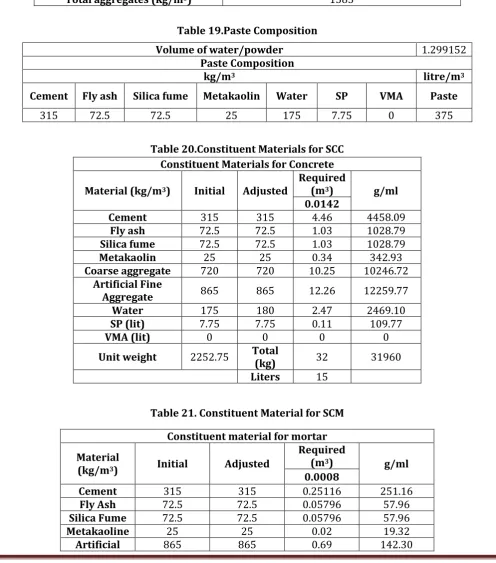
Table 19.Paste Composition
Table 20.Constituent Materials for SCC Constituent Materials for Concrete
Material (kg/m3) Initial Adjusted
Required
(m3) g/ml 0.0142
Cement 315 315 4.46 4458.09
Fly ash 72.5 72.5 1.03 1028.79
Silica fume 72.5 72.5 1.03 1028.79
Metakaolin 25 25 0.34 342.93
Coarse aggregate 720 720 10.25 10246.72
Artificial Fine
Aggregate 865 865 12.26 12259.77
Water 175 180 2.47 2469.10
SP (lit) 7.75 7.75 0.11 109.77
VMA (lit) 0 0 0 0
[image:9.595.50.547.219.783.2]Unit weight 2252.75 Total (kg) 32 31960 Liters 15
Table 21. Constituent Material for SCM
Constituent material for mortar Material
(kg/m3) Initial Adjusted
Required
(m3) g/ml
0.0008
Cement 315 315 0.25116 251.16
Fly Ash 72.5 72.5 0.05796 57.96
Silica Fume 72.5 72.5 0.05796 57.96
Metakaoline 25 25 0.02 19.32
Artificial 865 865 0.69 142.30
Coarse aggregate (kg/m3) 720
% of CA in concrete volume 30
Concrete Mix Proportions by Volume (litre/m3)
CA Mortar Fine aggregate Paste
280 720 335 390
Sand (kg/m3) 865
Total aggregates (kg/m3) 1585
Volume of water/powder 1.299152
Paste Composition
kg/m3 litre/m3
Cement Fly ash Silica fume Metakaolin Water SP VMA Paste
© 2017, IRJET | Impact Factor value: 5.181 | ISO 9001:2008 Certified Journal | Page 1221 Fine
Aggregate
Water 175 175 0.14 690.69
VMA (lit) 7.75 7.75 0.01 6.18
Unit Weight Total (kg) 1.15 1150
[image:10.595.58.258.234.348.2]liters 0.52
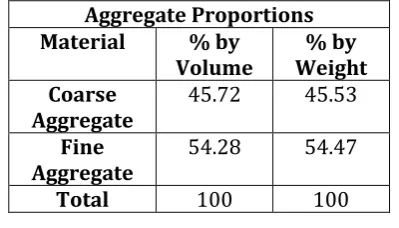
Table 22.Aggregate Proportions by Volume and by Weight
Aggregate Proportions Material % by
Volume
% by Weight Coarse
Aggregate
45.72 45.53
Fine
Aggregate 54.28 54.47
Total 100 100
7.0 Conclusions
1. Based on this study, it concludes that, the required fresh properties of SCC by fixing the fineness modulus of artificial fine aggregate to 2.7 is within the limits of EFNARC, 2002 method.
2. SCC mix showed horizontal slump flow without any bleeding at the periphery which indicates good deformability and segregation resistance.
3. By replacing the limited amount of cement content in SCC with the cementitious materials like Fly ash, Silica fume, Metakaolin in fixed basis resulting mechanical properties increasing manner with respect to age of the concrete.
4. The investigation reveals that, by utilizing the super-plasticizer as chemical admixture in SCC to get required fresh properties in economical way.
5. From the experimental results, it can be concluded that the SCC has higher mechanical properties than control mix. 6. The percentage increase in compressive,
split and flexural strength of SCC at 28 days is 12.3%, 14.3% and 13.2% respectively more compared to the control mix.
7. The evaluated durability properties of SCC showing minimal effect of Water absorption and Acid resistance with respect to performance.
References
1. Jian-Tong Ding and Zongjin Li “Effects of Metakaolin and Silica fume on properties of concrete” ACI materials journal/July-August 2002,PP.393-398.
2. Justice J.M, Kennison L.H, Mohr B.J., Beckwith S.L, Mc Cormick L.E, Wiggins B., Zhang Z.Z, and Kurtis K.E, “Comparision of two Metakaolins and a Silica fume used as Supplementary Cementitious Materials” SP-228(volume 1&2) Seventh International Symposium on Utilization of High-Strength/High performance Concrete, June(2005), SP 228-17.
3. Jiping Bai, Albinas Gailius “Consistency of Fly ash and Metakaolin concrete” journal of civil engineering and management 15(2):(2009), PP.131-135.
4. Pacheo Torgal F, Arman Shasavandi, Said Jalali “Using Metakaolin to improve the compressive strength and the durability of Fly ash based concrete” Invaco2: International seminar, innovation & valorization in civil engineering & construction materials, Rabat-Morocco, 23-25 November(2011), ISBN 987-9954-30-595-5.
© 2017, IRJET | Impact Factor value: 5.181 | ISO 9001:2008 Certified Journal | Page 1222 6. Muthupriya P, Subramanian K, Vishnuram
B.G, “Investigation on behaviour of High Performance Reinforced Concrete columns with Metakaolin and Fly ash as admixture” International Journal of Advanced Engineering Technology IJAET Nol,II/Issue I/January-March (2011), PP.190-202. 7. Paiva H, Velosa.A, Cachim.P, Ferreira.V.M,
“Effect of Metakaolin dispersion on the fresh and hardened state properties of concrete” Cement and Concrete Research 42 (2012) 607-612.
8. Erhan Guneyisi, Mehmet Gesoglu, Seda Karaoglu, Kasm Mermerdas, “Strength, permeability and shrinkage cracking of Silica fume and Metakaolin concrete” Construction and Building Materials 34, (2012) 120-130.
9. Vikas Srivastava, Rakesh Kumar, Agarwal V.C., Mehta P.K, “Effect of Silica fume and Metakaolin combination on concrete” International journal of civil and structural engineering, volume 2, No 3, 2012, ISSN 0976-4399, PP.893-900.
10.Priyanka A., Jadhav, Dilip K. Kullkarni. 2013. Effect of replacement of natural sand by manufactured sand on the properties of mortar. International journal of civil and structural Engineering. 3: 621-628
11.Gonçalves J.P., Tavares L.M., Toledo Filho R.D., Fairbairn E.M.R. and Cunha E.R., “Comparison of natural and manufactured fine aggregates in cement mortars”, Cem Concr Res, 2007, Vol.37, No.6, pp. 924-32. 12.EFNARC, “Specification and guidelines for
Self Compacting Concrete”, 2002.
13.ASTM C494-1977. Standard specification for chemical admixtures for concrete. 14.Shetty M.S., ‘Concrete technology’, S. Chand
publishers, 7th revised edition 2013.
15.IS: 516-1959, “Methods of tests for strength of concrete”, Indian standards bureau, New Delhi, India.
16.IS:2386 – 1963 (all parts) gives Methods of test procedure for aggregate for concrete 17.IS: 8112-1989, “Specification for 43 grade
Ordinary Portland Cement (1 st revision)”, Indian standards bureau, New Delhi, India. 18.IS: 383-1970, “Specification for coarse and
fine aggregates from natural sources for concrete (2nd revision)”, Indian standards bureau, New Delhi, India.
19.IS: 456-2000, “Plain and reinforced concrete code of practice”, Indian standards bureau, New Delhi, India.
20.IS: 3812-2003, “Specification for Flyash for use as Pozzolana & Admixture”.
21.IS: 10262-2009“Recommended guidelines for Concrete mix design”, Indian standards bureau, New Delhi, India.
BIOGRAPHIES
P.Lakshmi Teja has completed her B.Tech in Civil Engineering from Sree Vidyanikethan Engineering College, Andhra Pradesh. She is currently pursuing her M.Tech in Structural Engineering from JNTU college of Engineering, Anantapur, Andhra Pradesh.
C.Sashidhar is Professor in the Department of Civil Engineering, JNTUA, Anantapur. He received M.Tech and Ph.D from J.N.T. University, Hyderabad. His research interests include FRC, SIFCON, HPC and Non Destructive Test Evaluation. He has more than 15 years of teaching experience