© 2018, IRJET | Impact Factor value: 6.171 | ISO 9001:2008 Certified Journal | Page 4415
DESIGN AND FABRICATION OF PNEUMATIC POWERED EXOSKELETON
SUIT FOR ARMS
Gopal Krishna U B
1,Prajwal Hosmutt H R
2, Bharamesh M Nyamagoud
2, Mallikarjun V Patil
2,
Omkar Hunnur
21
Assistant Professor, Department of Mechanical Engineering, Alva’s Institute of Engineering & Technology,
Moodabidre, Dakshina Kannada - 574225, Karnataka
2
U.G. Students, Department of Mechanical Engineering, Alva’s Institute of Engineering & Technology, Moodabidre,
Dakshina Kannada - 574225, Karnataka
---***---
Abstract
- Exoskeleton have evolved as leading tools for augmenting able-bodied performance which is assisting human mobility and restoring lost limb function exploiting biomimetic design, the device may be worn in close proximity to the body and transmits torques via powered revolute joints and structural limbs. In the present work a comprehensive design and fabrication of hand exoskeleton technologies for rehabilitation and assistive engineering were made from the basic hand biomechanics to actuator technology with the involvement of pneumatic power. The designed suit reviews the state of the art of active hand exoskeletons for the applications in the areas of rehabilitation and assistive robots.Keywords
: Exoskeleton, arm, suit, pneumatic, robot.1.
INTRODUCTION
Exoskeleton arm is an anthropomorphic external mechanical structure that allows for the transfer of mechanical power from the exoskeleton structure to the human arm. Excelsior’s exoskeleton suit, also known as powered exoskeleton, exoframe or exosuit, is a mobile machine consisting primarily of an outer framework worn by a person, and a powered system of pneumatic artificial muscles (fluidic muscles) that delivers at least part of the energy for limb movement. Thanks to this device the user will no longer feel any fatigue in carrying heavy loads for long periods of time. Recyclable, light and enduring materials are used in this project in order to fulfill safety and environmental concerns. The main function of the exoskeleton suit is to assist the wearer by boosting their strength, endurance and durability. They are commonly designed for military use, to help soldiers carry heavy loads both in and out of war. In civilian areas, similar exoskeletons could be used to help firefighters and other rescue workers survive dangerous environments. The medical field is another prime area for the exoskeleton technology, where it can be used for enhanced precision during surgery or as an assist to allow nurses to move heavy patients. In our project lift the weight up to 5-20kg.
Because of their inherent motor and sensory requirements, hand exoskeleton technologies for rehabilitation and assistive engineering have not progressed as rapidly as the exoskeleton robots and devices for lower and upper limbs that have become popular over the last decade. These requirements have inspired considerable developments in robotic hands in terms of their degrees of freedom, weight, size and dexterous manipulation capabilities. At the same time, enhancement of hand functions using exoskeleton technologies for those who have lost or weakened hand capabilities because of neuromuscular diseases or aging has become an important issue, because hand functionality is a dominant factor in living an independent and healthy life.
Also, people whose work requires the exertion of a forceful and repetitive hand gripping action are exposed to a high likelihood of developing a musculoskeletal disorder. Therefore, to prevent such work-related musculoskeletal disorders, it is important to reduce the physical burden on these workers. Hand exoskeletons can be used to assist the hand function by amplifying the hand gripping force or automating the motion. Applicable areas include heavy industry, construction, military, and logistics.
© 2018, IRJET | Impact Factor value: 6.171 | ISO 9001:2008 Certified Journal | Page 4416 rotational axes may cause a collision between the user’s
hand and the device, resulting in damage to the user’s hand.
The most intuitive method is to build the exoskeleton’s centre of rotation to coincide with that of the wearer. However, this requires an additional space to locate the mechanism at the side of the finger, making it difficult to build a multi-fingered structure. Otherwise, a remote centre of rotation can be adopted.
Fig-1: Classification of hand exoskeleton according to various criteria
Abdulla Almomani et..al[1] summarizes the concept of the pneumatic exoskeleton and its benefits, theoretical background of exoskeletons and the design process. The exoskeleton suit structure is made mainly from a combination of steel and aluminum. The power system is delivered through a set of Fluidic Muscles.
Slovak et..al[2] deals with robotic exoskeletons and their using in rehabilitation of the upper limbs. First part describes application of robotic devices in rehabilitation, architecture of rehabilitation robotic system and its main subsystems.
Michael Scott Liszka et..al[3] says all about the design of exoskeleton for shoulder rehabilitation. Process of design, kinematics, actuators, transmission and mechanical analysis. The type and process of selection of actuators given in the paper helped us for the requirements of the project. Also the effect of mass and friction clearly explained in the paper made us to consider such parameters for proper design.
Simone Marcheschi et..al[4] gave information of kinematics and dynamic characteristics which is necessary for a power-augmented full body wearable robot which is able to handle heavy objects.
Conor James Walsh et al [5] Gave information of the Metabolic studies and about the Human body joins which is used to make the exoskeleton joints as per human natural joints. A state-machine control strategy is written based on
joint angle and ground-exoskeleton force sensing to control the joint actuation at this exoskeleton hip and knee. The joint components of the exoskeleton in the sagittal plane consist of a force-controllable actuator at the hip, a variable-damper mechanism at the knee and a passive spring at the ankle.
2.
SCOPE OF THE PROJECT
In this present competitive world there is huge scarcity of man power, so there must be an alternative to reduce this problem. Even in industrial application it requires more human resources for daily work and load carrying process is more. All these above work can not done humans. To overcome this situation pneumatic exoskeleton system is adopted to ease the work and minimize stress of prime area for exoskeleton technology, where it can be use for enhanced precision during surgery or as an assist to allow nurses to move heavy patients.
[image:2.612.40.286.198.325.2]3.
RAW MATERIALS AND METHODOLOGY
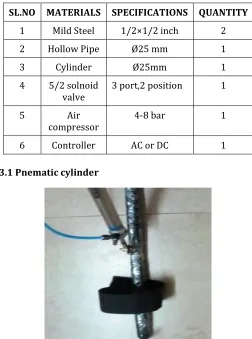
Table 1: Materials used
SL.NO MATERIALS SPECIFICATIONS QUANTITY 1 Mild Steel 1/2×1/2 inch 2 2 Hollow Pipe Ø25 mm 1 3 Cylinder Ø25mm 1 4 5/2 solnoid
valve 3 port,2 position 1 5 Air
compressor 4-8 bar 1 6 Controller AC or DC 1
3.1 Pnematic cylinder
[image:2.612.318.570.354.693.2]© 2018, IRJET | Impact Factor value: 6.171 | ISO 9001:2008 Certified Journal | Page 4417 Fig-3: Fabrication of solenoid valve
Above figure shows that 5/2 solenoid valve for left shoulder and also for left hand fabricated by welding process.
3.2 Fabricated solenoid valve for right cylinders
(a)
(b)
Fig 4(a-b): Fabricated assembled parts
Above figure shows that fabrication 5/2 solenoid valve for right shoulder and also for right arm fabricated by welding process.
[image:3.612.79.255.71.243.2]4.
CALCULATION AND SPECIFICATION
Fig-5 : 2D sketch of the suit
4.1 Specifications
4.1.1 Pneumatic cylinder
Diameter of the Piston (d) =25 mm Pressure acting (p) =0.63kpa Material used for rod =Mild Steel Yield stress (σy) =36 kgf/mm² Assuming factor of safety=2
Force acting on the rod (P) =Pressure x Area =p x (Πd² / 4) =0.4×490.87
P=196.3N
4.1.2 Double acting pneumatic cylinder
Stroke length : 120 mm Quantity: 4
[image:3.612.318.578.125.397.2] [image:3.612.63.271.333.699.2]© 2018, IRJET | Impact Factor value: 6.171 | ISO 9001:2008 Certified Journal | Page 4418 End cones: mild steel
Piston: EN – 8 Media: Air
Temperature :0-80 º C
Max pressure range: 8×10⁵ N/m2
4.1.3 2. 5/2 Solenoid Valve
Max pressure range : 0-8 x 10 ⁵ N/m² Quantity : 1
4.1.4 Connectors
Max working pressure: 8 x 10⁵ N/m² Temperature : 0-100 º C
Fluid media : Air Material : Brass
4.1.5 Hoses
Max pressure : 8 x 10⁵ N/m² Outer diameter: 6 mm
Inner diameter:4 mm
4.2 Details
The important parts of pneumatic exo-skeleton suit are:- 1. Compressor unit
2. Solenoid valve (direction control valve) 3. Double acting cylinders
1. Compressor unit : It is one of the important part of exoskeleton suit. The capacity of compressor is 4-8 bars. It provides the necessary pressurized air required to operate the system. Our compressor has ability to lift up to 5-20 kgs load.
2. Solenoid valve (direction control valve):- It is used to control the direction of the pressurized air in this pneumatic system using 5/2 direction control valve. It requires two valves.
3. Double acting cylinders:- These cylinders are actuated by compressed air which can lift the load. This project requires four cylinders for operation (120mm stroke length
The working of the exoskeleton is completely based on the mechanisms of the pneumatic cylinders and solenoid valves and the joints which will give different degrees of
freedom for every parts to get easy motion for the human wearing it. When air from compressor makes cylinder to actuate and helps in lifting weight which will be connected to hook through arm frame the force required to lift weight will be more so to reduce the effort of cylinder and to increase the capacity we are using one cylinder were the weight will be transferred to single arm and shoulders and the tension on cylinder will reduces to higher extent. In our case lifting energy will be produced by compressed air which will actuates the double acting cylinder and the complete setup of compressor and actuators will produce more force than the stationary weight.
5. RESULT
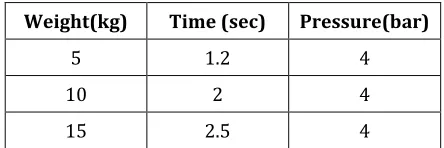
[image:4.612.324.572.326.506.2]This pneumatic powered exoskeleton gives quick response to human action and flexible compared to hydraulic and electrical type exoskeleton. Our project designing is to lift load up to 5-20kgs and testing is in process.
Fig-6: Tested view of Exoskeleton suit for arm
Table-2: Result analysis
Weight(kg) Time (sec) Pressure(bar)
5 1.2 4
10 2 4
15 2.5 4
[image:4.612.335.557.576.650.2]© 2018, IRJET | Impact Factor value: 6.171 | ISO 9001:2008 Certified Journal | Page 4419
6. CONCLUSION
The idea behind this project is to develop an inexpensive and user friendly system. This project shows that it is simple in construction, design and cheaper. It gives quick response and flexible compared to hydraulic and electrical type exoskeleton. This can be achieved while maintaining simplicity, ease of use, implementation and maintenance.
Our project is not only used to lifts weights but also is applicable in rescue operations, military, industries. It makes physically disabled people to carry weights in their daily life because the maximum load is carried by this pneumatic system.
REFRENCES
[1] Abdullah almomani, Faisal Miqdadi, Mustafa Hassanin, Mustaf Samy”pneumatic fluidic muscles based
[2] Boris “RoboticExoskeleton for Rehabilitation of upper limb” American Journal of Mechanical Engineering, 2014 2 (7), pp 299-302.
[3] Liszka, Michael, Department of Aerospace Engineering, university of Maryland, “Mechanical Design of A Robotic Arm Exoskeleton For Shoulder Rehabilitation”, 2007-02-01T20:24:10Z
[4] Simone Marcheschi, Fabio Salsedo, Marco Fontana and Massimo Bergamasco.“Body Extender: whole body exoskeleton for human power augmentation” 2011 IEEE International Conference on Robotics and Automation.
[5] Conor James Walsh, Kenneth Pasch, Hugh Herr, “An autonomous, under actuated exoskeleton for load carrying Augmentation” Proceedings of the 2006 IEEE/RSJ International Conference on Intelligent Robots and Systems.
BIOGRAPHIES
Gopal Krishna U B Asst. Professor
Dept. of Mechanical Engg, AIET, Moodbidri
Prajwal Hosamutt H R UG Scholar
Dept. of Mechanical Engg. AIET, Moodbidri
Bharamesh M Nyamagoud UG Scholar
Dept. of Mechanical Engg. AIET, Moodbidri
Omkar hunnur UG Scholar
Dept. of Mechanical Engg. AIET, Moodbidri
Mallikarjun V Patil UG Scholar
AIET, Moodbidri