© 2017, IRJET | Impact Factor value: 5.181 | ISO 9001:2008 Certified Journal
| Page 576
Compressed Plastic Block
V.G. Nithin
1, B.K. Smitha
21
M.Tech. in structural engineering, East West Institute of Technology, Bengaluru, Karnataka, India
2Assistant Professor, Dept. of Civil Engineering, East West Institute of Technology, Bengaluru, Karnataka, India
---***---Abstract -
Plastic is a relatively cheap, durable andversatile material and its products have brought benefits to society in terms of economic activity, jobs and quality of life. Plastics as waste, when not properly managed, impose negative environmental externalities, because most of it is non-biodegradable and therefore can remain as waste in the environment for a very long time.A masonry unit whose net cross-sectional area in every plane parallel to the bearing surface is 75% or more of its gross cross-sectional area measured in the same plane is termed as a concrete block.
In this paper waste plastic specifically High Density Polyethylene (HDPE) has been utilized to for a casting a plastic block in standard solid block dimensions.
Key Words: HDPE, C.S.B (concrete solid block), Plastic
block, compression test, slump test.
1. INTRODUCTION
Concrete blocks, also called cinder blocks and cement blocks, come in a wide variety of shapes and sizes. They are made out of a mixture of Portland cement, sand, gravel and water. When the mixture is wet it is paste-like and can be cast into the form of the block. When it dries, it hardens until it becomes like stone. Generally speaking, there are two kinds of concrete block, hollow and solid.
1.1 Brief about solid concrete block
A masonry unit whose net cross-sectional area in every plane parallel to the bearing surface is 75% or more of its gross cross-sectional area measured in the same plane is termed as a concrete block.
Concrete is a material that has been used since ancient times, it is used extensively for its versatility. Concrete is a combination of sand, gravel, crushed stone, which is bound with cement. Hydrating agent is added namely water, which forms a slurry consistency undergoing a chemical reaction. Concrete only hardens after hydration.
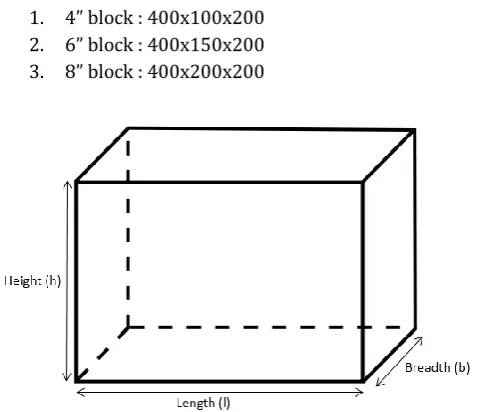
Dimensions of concrete solid block (LxBxH)
[image:1.595.312.551.228.434.2]1. 4” block : 400x100x200 2. 6” block : 400x150x200 3. 8” block : 400x200x200
Fig -1: dimension of a typical block
1.2 Brief about plastic block
Plastic is a material that has bought high benefits to the society in terms of jobs, quality of life and economic activity. It is also very cheap, highly durable and versatile. But when the same plastic turns to waste all of its advantages hold no value. Improper management of plastic leads to environmental pollution, which thereby causes negative impact on not only human life but also to any life.
Plastic is such a material which cannot be replaced by any other alternative. Hence there is a high demand on plastic, which in turn results in ever growing plastic waste. Utilization of waste plastic to form a masonry unit which can partially or fully replace the conventional solid concrete block is termed as a plastic block.
© 2017, IRJET | Impact Factor value: 5.181 | ISO 9001:2008 Certified Journal
| Page 577
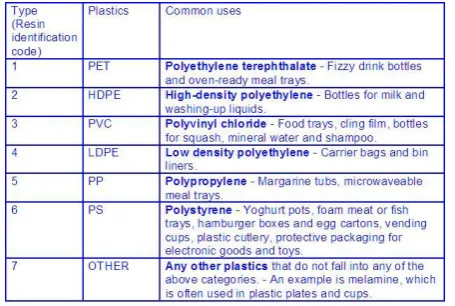
Table -1: Different types of plastic used by industries
2. LITRATURE REVIEW
Dinesh S, Dinesh A, Kirubaran K (2016)[1]:
Hence in this thesis, an attempt is made to study regard the properties of the brick which is manufactured using plastic wastes. Large amount of plastic is being brought into the tourist trekking regions are discarded or burned which leads to the contamination of environment and air. Hence, these waste plastics are to be effectively utilized. High-density polyethylene (HDPE) and polyethylene (PE) bags are cleaned and added with sand and aggregate at various percentages to obtain high strength bricks that possess thermal and sound insulation properties. It controls pollution and reduces the overall cost of construction this is one of the best ways to avoid the accumulation of plastic. This alternatively saves the quanta of sand/clay that has to be taken away from the precious river beds/mines.Noel Deepak Shiri, P. Varun Kajava, Ranjan H. V,
Nikhil Lloyd Pais, Vikhyat M. Naik (2015)[2] : :
The main aim is to reduce the plastic waste that is rising in the present world. A system is designed incorporating a plastic extruder, which recycles waste plastic into useful products. This work uses waste plastics and converts them into building materials with the help of an extruder. Presently waste plastics are effectively converted into useful building materials like bricks, interlocks, roof tiles, railway sleepers, paving slabs, retaining blocks etc., using either single origin plastic waste material or a mixture of different plastic wastes along with waste rubber powder as filler. Polypropylene composite brick could withstand 17.05 tons. LDPE/Rubber composite brick could withstand 16.55 tons, comparing to the clay bricks which can withstand 9.03 tons.Ganesh Tapkire, Satish parihar, Pramod Patil,
Hemraj R Kumavat (2014)[3] :
Plastic bottles, pallets, carry bags, polypropylene and polyethylene Terephthalate were taken as alternative for aggregates in this study. Plastic wastes are mixed with concrete negotiating with the strength of concrete and not affecting any properties of concrete. P.P and P.E.T were taken as alternative for the conventional aggregates of concrete. This was replaced by increments of 10% up to 30% weight of aggregates, and concrete was formed.3. INTEND AND PURVIEW
3.1 Intent of work
The intent of the project is to utilize the pollution causing plastic and reuse this material to create a solid masonry unit.
Compare the results with that of a conventional solid concrete masonry unit.
To reduce carbon footprint by collecting the waste plastic.
3.2 Purview of work
Location and collection of waste plastic.
Fabrication of moulds of standard size.
Casting of concrete blocks.
Casting of plastic blocks.
Perform laboratory test and compare results to provide and effective conclusion.4. PRE-LABORATORY PROCEDURE
4.1 Intent of work
Density of HDPE ranges from 930 kg/m3 to 970 kg/m3.
Weight = xV Where
= density V= volume
∴ V= w/
© 2017, IRJET | Impact Factor value: 5.181 | ISO 9001:2008 Certified Journal
| Page 578
7.76 kg of plastic is required for 1 block of 4 inch thickness.
11.64 kg of plastic is required for 1 block of 6 inch thickness.
[image:3.595.57.263.193.351.2]15.52 kg of plastic is required for 1 block of 8” thickness. Total quantity of plastic =180 kg
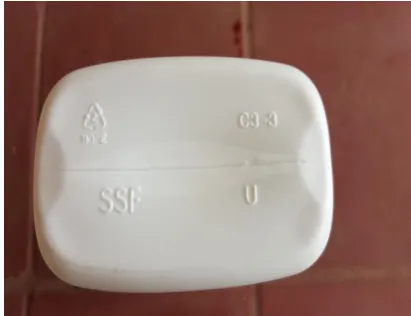
Fig -2: HDPE scrap bottle
5. MANUFACTURE PROCESS
5.1 Concrete solid block
The solid concrete block is manufactured by plants or factories using machinery or manual methods. There are 3 major stations in a manufacture plant namely Batching station, Mixing station, Casting station.
Batching station: This station contains all the materials in silos or placed in each compartment. Carts carry the specified quantity of materials from each of the compartments and transfer them to the mixing station
Mixing station: This station consist of mixers or mixing machines to which constituents of concrete such as cement of required grade, aggregate (coarse and fine) and hydrating agent water is added and mixed until uniform consistency or homogenous mix is obtained.
Casting station: This station consist of the casting machine fixed with a mould of various widths such as 4”, 6”, 8”. The moulds can be swapped for desired dimensions. The concrete carried by the carts are dumped into the casting machine which gets filled into the moulds.
[image:3.595.327.541.263.391.2]Fig 3 -: Moulds for C.S.B production
Fig 4 -: C.S.B blocks
5.1 Plastic block
Moulds are made of size:
1. 400x200x100 2. 400x200x150 3. 400x200x200
The plastic are first shredded into smaller workable pieces which are then placed on a tray and melted to a plasma state in a microwave oven maintaining temperature at 175c.
The moulds are lubricated with grease and the molten plastic is poured into the mould making sure to tamp it, to eliminate the air bubbles. The blocks are to be cure for a period of 48 hours to
cool off completely. The block is de-moulded and is left for another 24 hours. Plastic is not a material that required curing hence 48 to 72 hours is the maximum period to cool the block. Once the block has passed its cooling period, it can
© 2017, IRJET | Impact Factor value: 5.181 | ISO 9001:2008 Certified Journal
| Page 579
[image:4.595.44.281.282.424.2]Fig 5 -: Shredded plastic scrap
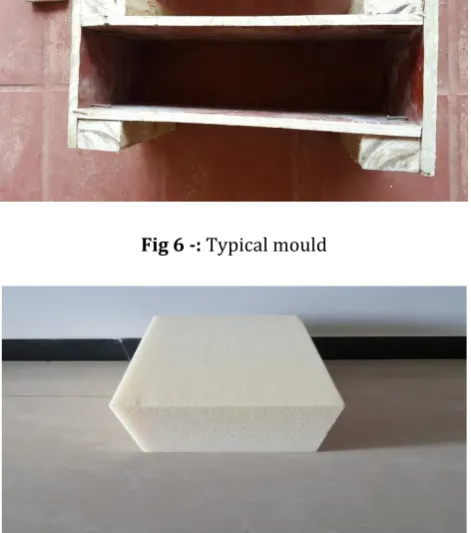
Fig 6 -: Typical mould
Fig 7 -: Typical plastic block
6. LABORATORY TESTS
6.1 Slump test
The aim of this test is to find the workability of the concrete mix. Slump cone test is selected as this is the simplest form to determine the workability or flow. For the manufacture of concrete block the water content has to be maintained very low.
Slump test is usually conducted in laboratories. This test is performed when the constructional activities are in progress. The maximum size of aggregate allowable for this test is 40mm. this can also be performed at site to serve as a check for the consistency.
Water-cement Ratio Slump
0.40 40mm
Table -2: Slump values
Workability is computed from the slump test or flow test. From this test it is established that the specimen has a medium workability. Water content and slump are directly related, as the water content increases the workability increases. Higher water content results in lesser strength. This is the simplest test to be carried out.
6.2 compression test for concrete solid block
The compression test is the laboratory test to estimate the compressive strength of material or product. This is the standard procedure adopted for strength testing. Hence here this method was adopted. The casted concrete blocks which are cured for 28 days are placed on the U.T.M bearing plates and load is increased until the specimen block fails. The load at which the block fails is noted.
[image:4.595.44.280.320.587.2]On dividing the maximum failure load to the cross sectional area, the compressive strength can be calculated.
Table 3 -: compression test values for C.S.B
The compressive strength of solid concrete block:
Average 28 day strength for 4 inch block = 6.33 N/mm2
Average 28 day strength for 6 inch block = 9.8 N/mm2
[image:4.595.318.552.522.651.2]© 2017, IRJET | Impact Factor value: 5.181 | ISO 9001:2008 Certified Journal
| Page 580
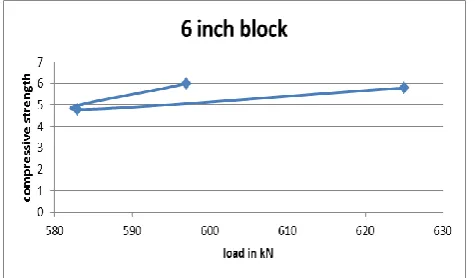
6.3 compression test for plastic block
The compression test procedure for a plastic block is similar to that of the concrete block. The curing period of the plastic block is very small compared to the plastic block, because plastic in molten state acts like glass in molten state, i.e.; when plastic is heated it turns to molten state, on pouring this to the mould, the outer faces cool, leaving the inner core to still remain in molten state. In ambient condition the plastic core can cool slowly in a period of 24 hours, but for safety 72 hours of ambient curing was considered.
Sl no
4 inch thick block
6 inch thick block
8 inch thick block
Load kN
Strength N/mm2
Load kN
Strength N/mm2
Load kN
Strength N/mm2
1 446 4.8 597 6 654 6.2
2 410 4 583 4.8 678 6
3 453 4 625 5.8 682 5.8
[image:5.595.310.557.63.237.2]Mean 4.2 5.5 6
[image:5.595.29.294.263.374.2]Table 4 -: compression test values for plastic block
Fig 8 -: compression value graph for 4” plastic block
[image:5.595.45.281.412.532.2]Fig 9 -: compression value graph for 6” plastic block
Fig 10 -: compression value graph for 8” plastic block
The compressive strength of plastic block:
Average 28 day strength for 4 inch block = 4.2 N/mm2
Average 28 day strength for 6 inch block = 5.5 N/mm2
Average 28 day strength for 8 inch block = 6 N/mm2
7. CONCLUSIONS
Following are the conclusions from this study:
It can be inferred that plastic block cannot completely replace concrete solid block but partially replace the conventional C.S.B.
The plastic block can be used to replace the interior decoration walls and partition walls or non-load bearing walls.
Long lasting and weather resistant.
Plastic can resist mold, mildew, rotting and insect infestation.
Since scrap plastic is being used it is cost effective than C.S.B.
The carbon footprint is highly reduced.
Any shape or size can be manufactured based on the needs of customer.
The blocks are light weight which will result in reduction of steel.
At the time of deconstruction, the blocks can be recycled.
[image:5.595.44.282.574.713.2]© 2017, IRJET | Impact Factor value: 5.181 | ISO 9001:2008 Certified Journal
| Page 581
ACKNOWLEDGEMENT
I would like to take this opportunity to thank the individuals without whose motivation and guidance, my goal would not be met.
I would like to express gratitude to my guide Mrs. B.K. Smith, Assistant Professor, Department of Civil Engineering, EWIT, Bengaluru, for her support and valuable guidance.
I am extremely thankful to Mr. M. S. NAGARAJA GUPTA, HOD of Civil Engineering Department, EWIT, Bengaluru, for his encouragement and support.
I would take this opportunity to express my sincere thanks to Dr. K CHANNAKESHAVALU, Principal of EWIT, Bengaluru, for his warm support throughout the course.
I would like to thank all the Assistant Professors, Department of Civil Engineering for providing me their valuable guidance at all stages of my work.
I express my deepest sense of regards and respects for the inspiration, enthusiasm and help given by my parents and friends.
REFERENCES
1. "An Overview of Plastic Waste Management", Central Pollution Control Board, Delhi, 2012, pp. 1-22.
2. Pawan Sikka, “Plastic Waste Management in India”, Department of Science & Technology, Government of India, New Delhi, pp. 1-4.
3. Plastic Waste Management Institute, “An Introduction to Plastic Recycling", Japan, April 2009, pp. 1-33.
4. Processing of Waste Plastics into Building Materials Using a Plastic Extruder and Compression Testing of Plastic Bricks Noel Deepak Shiri*, P. Varun Kajava, Ranjan H. V., Nikhil Lloyd Pais, Vikhyat M. Naik 5. Application of recycled plastics and its composites
in the built environment Anselm E.O. Eneh department of architecture, Ahmadu Bello University, Zaria. Nigeria
6. Plastic fibre reinforced soil blocks as a sustainable building material C.K Pubramania prasad, E.K Kunhanandan Nambiar, Benny Mathews Abraham 7. Handbook of material testing- Indian Railways
Institute Of Civil Engineering 2006
8. IS 2572 (2005): Construction of hollow and solid concrete block masonry- code of practice [CED 53: Cement matrix products]
9. IS 456 :2000 Indian standard plain ad reinforced concrete – code of practice