© 2017, IRJET | Impact Factor value: 5.181 | ISO 9001:2008 Certified Journal
| Page 98
Influence of Powder Mixed Dielectric EDM on Response Variables and
Methods to Optimize the Response Variables: A Review
G Raju
1, K Santarao
2, P Govindarao
31
P.G. Student, Dept. of Mechanical Engineering, GMR IT, Rajam, Andhra Pradesh, India
2
Asst. Professor, Dept. of Mechanical Engineering, GMR IT, Rajam, Andhra Pradesh, India
3
Professor, Dept. of Mechanical Engineering, GMR IT, Rajam, Andhra Pradesh, India
---***---Abstract -
Electrical discharge machining (EDM) is awell-known present day machining process used to fabricate geometrically complex shapes, process hard materials that are extremely difficult to machine by traditional machining processes. In recent years, researches have emphasized on increasing machining performance of EDM with novel methods. Powder mixed electric discharge machining (PMEDM) is a recent innovation where a conductive powder is mixed to the dielectric fluid for enhancing capabilities of electric discharge machining in this direction. This article presents the research work carried out in the development of PMEDM in the current scenario for the improvement of machining characteristics such as Material Removal Rate (MRR), Tool Wear Ratio (TWR) and Surface Roughness (SR) for various process parameters like peak current, Duty factor, and pulse on time, work piece material, powder type, powder concentration with various dielectric fluids and powder materials. This article also presents Different optimization techniques adopted to analyze the experimental results. The last part of this article outlines the future research in the direction of PMEDM.
Key Words: EDM, PMEDM, MRR, SR, TWR, Powder concentration, optimization techniques
1. INTRODUCTION
Electrical discharge machining (EDM) is most popular nontraditional thermo-electric machining process in which material is removed from the work piece by local melting or vaporizing small areas at the surface of workpiece. Electric sparks are generated between tool and work when the electrodes are held at a small distance from each other in a dielectric medium and a high potential difference is applied across them. Localized regions of high temperatures are formed due to the sparks occurring between the two electrode surfaces. Work piece material in this localized zone melts and vaporizes. Spark occurs wherever the gap between the tool and the work piece surface is smallest. After material is removed due to a spark, this gap increases and the location of the next spark shifts to a different point on the work piece surface. In this way several sparks occur at various locations over the entire surface of the work piece
corresponding to the work piece-tool gap. Irrespective of the strength and toughness, any material of any shape can be machined by EDM [1].
Though, EDM can be used to machine complex shapes easily it has certain confinements such as low machining rate and poor surface finish. Numerous techniques have been developed to improve the surface finish and the machining efficiency of EDM. Introducing conductive particles in the dielectric fluid is a recent development which conquers the constraints and improves the machining capabilities of EDM [2]. This method of introducing conductive particles in the dielectric fluid is known as powder mixed EDM (PMEDM). Addition of a fine conductive powder to the dielectric fluid decreases its insulating strength and consequently increases inter electrode space causing an easy removal of the debris. The powdered particles start moving in a zig-zag path on getting energized, thus forming clusters in the sparking area. The bridging effect takes place underneath the sparking area causing multiple discharges in a single pulse leading to quicker sparking and erosion from the workpiece surface. This easy short circuit enhances the machining rate of the process [3].
Since this is the current trending topic, many authors worked on this and tried their best to analyze the PMEDM process and presented the research work. In this paper, a remarkable research conducted on PMEDM is presented after through review. The first segment of the paper talks about the technology and principle of PMEDM. Thereafter, extensive literature survey is carried out with powder as additive into the dielectric of EDM. At last the future directions and conclusions in the view of survey have been talked about.
1.1 The technology and process mechanism of
PMEDM
© 2017, IRJET | Impact Factor value: 5.181 | ISO 9001:2008 Certified Journal
| Page 99
PMEDM is very complex and stochastic in nature since itinvolves lot of components [4]. It is clearly understood with a schematic representation of PMEDM setup shown in Figure 1. In PMEDM process suitable material in the powder form will be mixed into the dielectric fluid in tank which is made separately. Stirring system is generally employed in this tank to achieve homogeneous dispersion and circulation of powder into dielectric fluid. Constant reuse of powder in the dielectric fluid can be done by the special circulation system. When the tool and workpiece are supplied with a suitable voltage, the powder particles of the material get energized and behave like a zigzag way manner.
1. Magnets 2. Circulating pump 3. Work piece 4. Flushing Nozzle 5. Machining tank 6. Work tank 7. Stirrer
[image:2.595.306.569.153.324.2]8.Electrode
Fig -1: Schematic diagram of Experimental setup PMEDM [5]
Under the sparking zone, the powder particles comes close to each other & arrange themselves in the form of chain like structure between the work piece and tool electrode. The interlocking between the different powder particles occurs in the direction of flow current. The chain formation helps in bridging the discharge gap between the electrodes. Because of bridging effect, the insulating strength of the dielectric fluid decreases resulting in easy short circuiting and hence an early explosion in the gap. A ‘series discharge’ occurs under the electrode area due to early explosion. The faster sparking within a discharge causes faster erosion from the work piece surface and hence the material removal rate increases [6].
1.2 Process parameters of PMEDM
The process parameters in PMEDM are used to regulate the performance methods of the machining process. Process parameters are generally well-disciplined machining input factors that decide the conditions in which machining is carried out [7].These parameters are categorized into
[image:2.595.38.298.245.436.2]electrical, non-electrical, powder parameters and electrode parameters. All the possible process parameters for PMEDM are shown in Figure 2.
Fig -2: Process parameters of Powder Mixed Electric Discharge Machining (PMEDM)
1.3 Principle of PMEDM
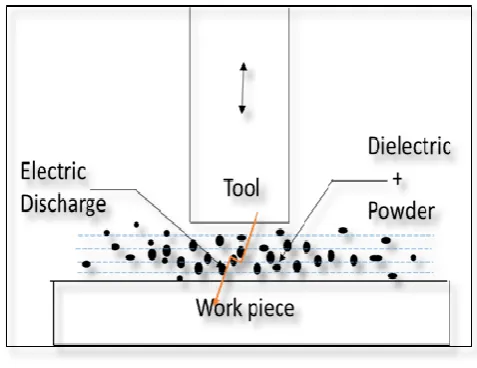
In PMEDM when a voltage of 80–320V is applied across the workpiece and the electrode, electrical intensity in the range of 105 to 107 V/m is generated. Spark gap which is of the order of 25–50 µm is filled up with additive particles supplied through flushing. Under the influence of high potential intensity, the particles become charged, get accelerated, move in a zigzag fashion, and may act as conductors. These conductive particles drastically lower the breakdown strength of insulating dielectric fluid. Gap contamination facilitates ignition process and increases gap size, thereby improving process stability [8]. The working principle of PMEDM is depicted in Figure 3.
[image:2.595.317.556.545.729.2]© 2017, IRJET | Impact Factor value: 5.181 | ISO 9001:2008 Certified Journal
| Page 100
2. LITERATURE REVIEW
2.1 Research developments in PMEDM
Based on the literature review carried out, the contribution to the research pertaining to PMEDM is as discussed below: Jamadar et al. [1] studied the effect of aluminium powder on machining of AISI D3 steel. The machining characteristics are evaluated in terms of material removal rate (MRR), tool wear rate (TWR) and surface roughness (SR). It was observed that aluminium powder mixed in dielectric fluid significantly affect the machining performance.
Kansal et al. [3] studied the effect of silicon powder mixing into the dielectric fluid of EDM on machining characteristics of AISI D2 die steel. Out of many process parameters, Peak current and concentration of powder were found to be most significant parameters for material removal. High Material removal rate was achieved at high concentration of 4 g/l at a peak current of 10 A.
Wong et al. [10] studied the effect of different powders on near mirror finish phenomenon in electrical discharge machining. Al powder at concentration of 2 g/l has been reported to give mirror finish in PMEDM for SKH-54 work materials.
Tzeng et al. [11] presents the effects of various powder characteristics on the efficiency of electro discharge machining SKD-11. It was found that the particle concentration, the particle size, particle density and thermal conductivity of powders were important characteristics that significantly affected the machining performance in the EDM process.
Chow et al. [12] carried out a study on micro-slit machining of titanium alloy with aluminium and SiC powder added in kerosene. It was proposed that SiC powder can produce a better material removal rate at the same conditions when the al powder added to the kerosene.
Pecas et al. [13] studied the effect of silicon powder mixed dielectric on hardened AISI H13 steel. The experimental results indicated the positive influence of 2 g/l concentration of the silicon powder towards the reduction of the operating time required to achieve a specific surface quality.
Karunakaran and M Chandrasekaran [14] considered aluminum, silicon and multi walled Carbon Nano tubes powders in their investigation along with pulse on time, pulse of time and input current to analyze and optimize the responses of Material Removal Rate, Tool Wear Rate and surface roughness. It is evident from the outcomes that the MWCNT powder mix was out performs than other powders which reduce 22% to 50% of the tool wear rate, gives the surface roughness reduction from 29.62% to 41.64% and improved MRR 42.91% to 53.51% than conventional EDM.
Chow et al. [15] conducted the experiments by blending SiC powder in dielectric of EDM. Machining was done on titanic alloy and it was indicated that addition of SiC powder would enlarge the electrode and work piece gap and also extrude debris easily, therefore increasing the material removal rate.
Kung et al. [16] carried out a study on material removal rate (MRR) and electrode wear rate (EWR) on EDM of cobalt bonded tungsten carbide and reported optimal MRR at the al powder concentration of 17.5 g/l. It was observed that electrode wear rate (EWR) values tend to decrease with the powder concentration down to a minimum value after which it tend to increase. Both MRR and EWR increases with an increase of the grain size, peak current and pulse ON time.
Sravan kumar et al. [17] experimented on Silicon Carbide powders mixing into the dielectric fluid of EDM on machining characteristics of SS316 L. The outcomes of the experiments indicated that as the powder concentration increases the material removal rate increases.
Razak et al. [18] investigated on SiC powder concentration and particle size on PMEDM on Hot Die steel. The results explored that addition of particles increases the material removal rated and reduces the tool wear rate and thus reduces the machining time and machining cost.
Hussain et al. [19] studied the effect of al powder on material removal rate of metal matrix composites (Al/SiC). Different parameters were chosen and experimental results shows that the material removal rate increases at low peak current of 2A.
Ojha et al. [20] experimentally investigated MRR and EWR in PMEDM process with Chromium powder suspended dielectric. It was concluded that MRR showed an increasing trend for increase in powder concentration. Work piece was selected as EN8.
Satpal Singh et al. [21] carried out an experimental study of the machining performance of PMEDM on EN 24 alloy steel in terms of material removal ate. A fine powder of tungsten has been suspended in the EDM oil dielectric as an additive. The results clearly showed that addition of tungsten powder has increased the MRR.
Nimo singh et al. [22] mixed Zinc powder with kerosene dielectric of PMEDM and experiment was conducted on EN8 steel. It is observed that significant factors for MRR are powder concentration, peak current and interaction of both. The parameters pulse off time and tool electrode diameter have no significant on the material removal rate.
© 2017, IRJET | Impact Factor value: 5.181 | ISO 9001:2008 Certified Journal
| Page 101
1050 steel. The results indicated that when silicon carbidepowder is mixed into dielectric fluid during EDM process. It gives minor effect on MRR but improves TWR and SR.
2.2 Techniques used to optimize Response
Variables
Optimization techniques are collection of mathematical and statistical Techniques that are useful for modelling and analysis of problems in which output or response is influenced by several variables. Taguchi method and Response Surface methodology are very popular methods for designing experiments and optimize the response variables. In the concept of PMEDM, authors used different optimizing techniques for designing experiments and optimize the machining parameters or response variables.
Jamadar et al. [1] used Taguchi design of experiments to conduct experiments by varying the parameters such as peak current, pulse on-time, concentration of the powder, and polarity. The process performance was measured in terms of material removal rate (MRR), electrode wear ratio (EWR), average surface roughness (Ra).
Kansal et al. [3] conducted experiments on EDM by blending Silicon powder in the dielectric. Process parameters like peak current, pulse on/off time, powder centration have been considered. The process performance is measured in terms of machining rate (MR). Taguchi method is used as Optimization technique to maximize MR.
Kung et al. [16] carried out a study on material removal rate (MRR) and electrode wear rate (EWR) on EDM of cobalt
bonded tungsten carbide.The response surface methodology
(RSM) has been used to plan and analyze the experiments.
Sravan kumar et al. [17] experimented on Silicon Carbide powders mixing into the dielectric fluid of EDM on machining characteristics of SS316 L. process parameters namely peak current, pulse-on time, pulse-off time, powder concentration, powder grain size and nozzle flushing, duty factor have been considered. The process performance is measured in terms of Response variables like Material Removal Rate (MRR) & Surface Roughness (SR). Number of experiments to be conducted is based on Taguchi orthogonal array with three level and three factors.
Razak et al. [18] investigated on SiC powder concentration and particle size on PMEDM on Hot Die steel. Number of experiments to be conducted is based on Taguchi orthogonal array with three level and two factors.
Ojha et al. [20] experimentally investigated MRR and EWR in PMEDM process with Chromium powder suspended
dielectric.Peak current, pulse on time, diameter of electrode
and powder concentration were chosen as process parameters to study the PMEDM performance in terms of
MRR and TWR. Response surface methodology (RSM) has
been used to plan and analyze the experiments.
Satpal Singh et al. [21] suspended a fine powder of tungsten
into EDM oil as an additive. Powder concentration, peak
current, pulse on time and duty cycle were selected as process variables to investigate PMEDM performance in terms of material removal rate (MRR). Experiments have been designed using Taguchi method. Taguchi L9 orthogonal array has been selected for 4-factors 3-levels design.
Nimo singh et al. [22] Studied the effects of various process parameters like powder concentration, peak current, pulse off time, tool electrode diameter and flushing pressure of powder mixed EDM (PMEDM) on material removal rate (MRR) of EN-8 steel by mixing Zinc (Zn) powder to kerosene dielectric. Taguchi’s L-27 (3-levels and 5 factors) Orthogonal Array (OA) designs is considered to design and analyze the experiments. The optimal set of process parameters were predicted to maximize MRR.
Gurule N. B. et al. [24] investigated the potential of PMEDM for enhancing material removal rate (MRR) of Die steel with rotary tool. Taguchi methodology has been adopted to plan and analyze the experimental results.
S Pathee et al. [25] experimentally investigated the presence of silicon particle in dielectric fluid. Concentration of powder in the dielectric fluid, pulse on time, duty cycle, and peak current are taken as independent variables on which the machining performance was analyzed in terms of material removal rate (MRR) and surface roughness (SR). Response surface methodology (RSM) has been adopted to study the effect of independent variables.
K H Syed et al. [26] suspended aluminium powder in the dielectric of PMEDM. Pulse peak current, pulse on-time and concentration of aluminium powder are taken as the process parameters. The output response considered is white layer thickness (WLT). The experiments were planned using face centered central composite design procedure. Empirical model was developed for WLT using response surface methodology (RSM) to study the effect of process parameters. Pradhan, M. K et al. [27] used Response Surface Methodology (RSM) to investigate the effect of input variables discharge current, pulse duration, pulse off time on Surface Roughness
(SR) of the Electrical Discharge Machined surface. The
response is modeled using RSM on experimental data.
© 2017, IRJET | Impact Factor value: 5.181 | ISO 9001:2008 Certified Journal
| Page 102
Singh et al. [29] experimented on machining of OHNS steelusing EDM. Peak current, pulse on time, voltage gap and flushing pressure were input parameters for investigation of material removal rate, and micro hardness. Taguchi method and ANOVA methods were used to optimize the machining parameters of EDM.
3. CONCLUSIONS AND FUTURE SCOPE
PMEDM is very useful type of EDM which gives better results in terms of MRR, SR and TWR and others even in comparison with conventional EDM. The material removal rate increased by mixing powder in the dielectric fluid as compared with conventional EDM process. Tool wear rate in PMEDM is smaller as compared with the conventional EDM Process. Material removal rate is maximum effected by the increase of peak current. Use of powder mix in electrolyte provide mirror like surface finish. Proper work piece and powder combination must be used for better results.
After a thorough scrutiny of the published work, it is very much clear that research is mainly focused on PMEDM of conventional materials such as die steels, alloys etc. Only few researches have worked on powder mixed EDM of Metal Matrix Components (MMCs), alloys etc. Few researches have focused their attention towards non-electrical parameters such as workpiece rotation and electrode rotation. Hence, more studies on the effect of process parameters are needed. Surface modification with micro and Nano-powders has not been tried yet. No published research work on finite element modelling and simulation of process parameters in PMEDM. From the literature survey it is clearly evident that powder mixed EDM has a prominent future but for an implementation of the process in industrial applications further research is needed.
REFERENCES
[1] M. V Kavade, M.M Jamadar“Effect of Aluminium
Powder Mixed EDM on Machining Characteristics of Die Steel (AISI D3),” no. 8, pp. 25–28, 2014.
[2] H. K. Kansal, S. Singh, and P. Kumar, “Numerical
simulation of powder mixed electric discharge machining ( PMEDM ) using finite element method,” vol. 47, pp. 1217–1237, 2008.
[3] H. K. Kansal, S. Singh, and P. Kumar, “Effect of Silicon
Powder Mixed EDM on Machining Rate of AISI D2 Die Steel,” 2007.
[4] D. K. Panda, and R. K. Bhoi, “Electro-Discharge
Machining – A Qualitative Approach,” no. November 2014, pp. 37–41, 2007.
[5] S. Mohal, S.S. Sangwan “Review of Research Work in
Nano powder Mixed Electric Discharge Machining,” vol. 3, no. 11, pp. 56–59, 2017.
[6] B. S. V Ramarao, P. Sailesh, and M. Sreenivasarao, “A
Review on Current Trends in PM-EDM using
Commercial Kerosene as Di-Electric Fluid,” vol. 5, no. 6, pp. 2196–2203, 2016.
[7] S. Gudur, V. V Potdar, and S. Gudur, “A Review on
Effect of Aluminum & Silicon Powder Mixed EDM on Response Variables of Various Materials,” vol. 3, no. 12, pp. 17937–17945, 2014.
[8] H. K. Kansal, S. Singh, and P. Kumar, “Technology and
research developments in powder mixed electric discharge machining ( PMEDM ),” vol. 184, pp. 32– 41, 2007.
[9] A. Kumar, S. Maheshwari, C. Sharma, and N. Beri,
“Research Developments in Additives Mixed Electrical Discharge Machining (AEDM): A State of Art Review” no. April 2013, pp. 37–41.
[10] Y. S. Wong, L. C. Lim, I. Rahuman, and W. M. Tee,
“Near-mirror-finish phenomenon in EDM using powder-mixed dielectric,” vol. 79, pp. 30–40, 1998.
[11] Y. Tzeng and C. Lee, “Effects of Powder
Characteristics on Electrodischarge Machining Efficiency,” pp. 586–592, 2001.
[12] H. Chow, B. Yan, F. Huang, and J. Hung, “Study of
added powder in kerosene for the micro-slit machining of titanium alloy using electro-discharge machining,” vol. 101, 2000.
[13] E. Henriques, “Influence of silicon powder-mixed
dielectric on conventional electrical discharge machining,” vol. 43, pp. 1465–1471, 2003.
[14] Karunakaran, K., and M. Chandrasekaran. "Experimental investigation Nano particles influence in NPMEDM to Machine Inconel 800 with Electrolyte Copper Electrode." 2nd International Conference on Frontiers in Automobile and Mechanical Engineering. 2016.
[15] H. Chow, L. Yang, C. Lin, and Y. Chen, “The use of SiC powder in water as dielectric for micro-slit EDM machining,” vol. 5, pp. 160–170, 2007.
[16] K. Kung, J. Horng, and K. Chiang, “Material removal
rate and electrode wear ratio study on the powder mixed electrical discharge machining of cobalt-bonded tungsten carbide,” no. 11, pp. 95–104, 2009.
[17] S. Gudur and V. V Potdar, “Effect of Silicon Carbide
Powder Mixed EDM on Machining Characteristics of SS 316L Material,” pp. 2003–2007, 2015.
[18] M. A. Razak and A. M. Nanimina, “Improving EDM
Efficiency with Silicon Carbide Powder-Mixed Dielectric Fluid,” vol. 3, no. 1, pp. 40–43, 2015.
[19] K. H. Syed, G. P. Anuraag, G. Hemanth, and S. A.
Subahan, “Powder-Mixed EDM Machining of Aluminium-Silicon Carbide Composites,” vol. 8, no. January, pp. 133–137, 2015.
[20] K. Ojha, R. K. Garg, and K. K. Singh, “Experimental Investigation and Modeling of PMEDM Process with Chromium Powder Suspended Dielectric,” pp. 65–81, 2011.
[21] S. Singh and C. S. Kalra, “Experimental Study of
© 2017, IRJET | Impact Factor value: 5.181 | ISO 9001:2008 Certified Journal
| Page 103
[22] Khundrakpam, Som Kumar, Amandeep Singh,
Gurinder Singh Brar, “Study and Analysis of Zinc PMEDM Process Parameters on,” vol. 4, no. 3, pp. 541–546, 2014
[23] W. Kurnia, P. C. Tan, and M. M. Rahman,
“Improvement of surface quality using silicon carbide powder added dielectric fluid during EDM.” Materials Science and Engineering 184, (2017) [24] Gurule, N. B., and K. N. Nandurkar. "Effect of tool
rotation on material removal rate during powder mixed electric discharge machining of die steel." International Journal of Emerging Technology and Advanced Engineering 2.8 (2012): 328-338.
[25] Padhee, Soumyakant, Niharranjan Nayak, S. K. Panda,
P. R. Dhal, and S. S. Mahapatra. "Multi-objective parametric optimization of powder mixed electro-discharge machining using response surface methodology and non-dominated sorting genetic algorithm." Sadhana (2012): 1-18.
[26]
Syed, Khalid Hussain, and P. Kuppan. "Studies on recast-layer in EDM using aluminium powder mixed distilled water dielectric fluid." International Journal of Engineering and Technology 5 (2013): 1775-1780. [27]
Pradhan, M. K., and C. K. Biswas. "Modeling and
Analysis of process parameters on Surface Roughness in EDM of AISI D2 tool Steel by RSM Approach." (2009).
[28]
Raghuraman, S., K. Thiruppathi, T. Panneerselvam,
and S. Santosh. "Optimization of EDM parameters using Taguchi method and Grey relational analysis for Mild steel IS 2026." international journal of innovative research in science, engineering and technology 2, no. 7 (2013): 3095-3104.