http://dx.doi.org/10.4236/ijaa.2015.51004
Distribution of Mass and Energy in Five
General Cosmic Models
Fadel A. Bukhari
Department of Astronomy, Faculty of Science, King Abdulaziz University, Jeddah, KSA Email: [email protected]
Received 3 March 2015; accepted 17 March 2015; published 20 March 2015
Copyright © 2015 by author and Scientific Research Publishing Inc.
This work is licensed under the Creative Commons Attribution International License (CC BY). http://creativecommons.org/licenses/by/4.0/
Abstract
Distributions of the universe horizon distance and universe horizon volume were investigated in the light of five general cosmic models which were constructed in a previous study. Both distribu-tions increase so slowly up to t ≈ 21.5444 Myr, then they start raising very fast up to t ≈ 60 Gyr. Af-terwards, they increase again very slowly until t ≈ 124 Gyr. Distributions of mass of radiation, matter and dark energy within the horizon volume of the universe were also studied in the five general cosmic models. The masses of both radiation and matter decrease gradually with time while the mass of dark energy increases. The mass of radiation prevailed in the early universe up to t ≈ 34627.5 - 55916.2 yr, where it becomes equal to the mass of matter. Then the mass of matter dominated until t ≈ 9.4525 - 10.0632 Gyr, where it becomes equal to the mass of dark energy. Thenceforward, the mass of dark energy prevails the universe. The cosmic space becomes ap-proximately matter empty in the so far future of the universe.
Keywords
General Cosmic Models, Distribution of Mass and Energy
1. Introduction
In a previous study [1] the distribution of density parameters of radiation, matter and dark energy were investi-gated in details in five general cosmic models. Hence, it would be interesting to study the distributions of equiv-alent mass of radiation, mass of matter and equivequiv-alent mass of dark energy within the horizon volume of the un-iverse in the general models.
Therefore, it is necessary to start this study by investigating the distributions of the horizon distance and hori-zon volume of the universe in the general models at different time intervals depending on the bases discussed in
and discussion are presented in Section 4. Conclusion is shown in Section 5.
2. Methodology
We have seen in [2] that the horizon distance and horizon volume of the universe at the present time are respec-tively
( )
(
)
1 2
1 2
Λ, , , 2
0
1 1 1
1 Ω 1 Ω 1 Ω 1 d .
h o o m o r o
o c
d t a a
H a a a
−
= − − + − + −
∫
(1)( )
8π 3( )
. 3
h o h o
V t = d t (2)
where c H, o,Ω ,Ω ,Ωr o, m o, Λ,o are all defined as in [1]. Thus the horizon distance of the universe at any given time is
( )
(
)
1 2 2
Λ, , , 2
0
1 1 1
1 Ω 1 Ω 1 Ω 1 d .
a
h o m o r o
o c
d t a a
H a a a
−
= − − + − + −
∫
(3a)Consequently the change in the horizon distance of the universe in the time interval between two instants of scale factors a a1, 2 is written as
( )
2(
)
1
1 2 2
Λ, , , 2
1 1 1
Δ h aa 1 Ω o 1 Ωm o 1 Ωr o 1 d .
o c
d t a a
H a a a
−
= − − + − + −
∫
(3b)The horizon volume of the universe at any given time is
( )
8π 3( )
.3
h h
V t = d t (4)
It is also obvious from [2] that the total density of the universe is given by
( )
t c t,Ω .( )
tρ
=ρ
(5)where
( )
,(
, , Λ,)
Ω t =
ρ
c t Ωm t+Ωr t+Ω t . (6)2 , 3 . 8π c t H G
ρ = (7)
2
, 0 ,
, 3
,
Ω
Ωm t m t m o.
c t H H a
ρ
ρ
= = (8)
2
, 0 ,
, 4
,
Ω
Ωr t r t r o.
c t H H a
ρ
ρ
= = (9)
2
Λ, 0
Λ, Λ,
,
Ω t Ω .
t o c t H H
ρ
ρ
= = (10)
( )
(
)
1 2 2
Λ, , , 2
1 1
1 Ω 1 Ω 1 Ω 1 .
o
o m o r o
H
H t a
a a a
= − − + − + −
(11)
Hence, the total mass within the horizon volume of the universe at any given time is expressed as
( )
( ) ( )
.h h
M t =V t
ρ
t (12)Λ,t
M within the horizon volume of the universe at any given time are given by
( ) ( )
, ,m t m t h
M M t
t ρ ρ =
( ) ( )
, , Ω . Ω m t m t hM M t
t
= (13)
( ) ( )
, , Ω . Ω r t r t hM M t
t
= (14)
( ) ( )
Λ, Λ, Ω . Ω t t hM M t
t
= (15)
The cosmic time is given by Equation (16) in [1] as
(
)
1 2 2
Λ, , , 2
0
1 1 1
1 Ω 1 Ω 1 Ω 1 d .
a
o m o r o
o
t a a
H a a
−
= − − + − + −
∫
(16a)Thus the time interval between two instants with scale factors a a1, 2 during the universe expansion is ex-pressed as
(
)
2 1 1 2 2Λ, , , 2
1 1 1
Δ aa 1 Ω o 1 Ωm o 1 Ωr o 1 d .
o
t a a
H a a
−
= − − + − + −
∫
(16b)3. Algorithm
In determination of the distributions of dh
( ) ( )
t V t, h ,Mh( )
t ,Mm t, ,Mr t, andMΛ,t we use the following steps:i) Set t=0,dh=0,K1=1,K2 =2000, then insert the value of amax =0.098 for t≤0.5 Gyr, amax =10
for 0.5< ≤t 50Gyr and amax =1000 for 50< ≤t 124Gyr.
ii) Compute
( )
max 2 . a DA DBLE K =iii) Start general DO loop I=K K1, 2 which includes the following sub steps: iv) a1=DA I
(
−1 ,)
a2=DAI.v) Calculate new value of cosmic time t numerically using(16-b), where t= +t Δt.
vi) Determinate new value of the universe horizon distance dh numerically using (3-b) where, dh =dh+Δdh. vii) Obtain the corresponding values of V Hh, ,
ρ
c t,,Ω ,Ω ,Ω ,Ω ,m t, r t, Λ,t( ) ( )
tρ
t ,Mh( )
t ,Mm t,,Mr t, ,MΛ,t using(4), (11), (7), (8), (9), (10), (6), (5), (12), (13), (14) and (15) respectively. viii) Continue the general DO loop.
4. Results and Discussion
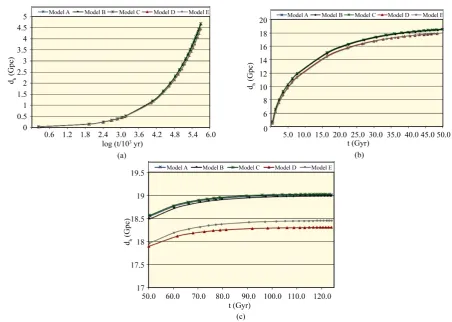
The distribution of the universe horizon distance in the general models up to t=0.5 Gyr is shown in Figure 1(a). The distributions of all models coincide on each other until t≈21.5444 Myr. Then, the distributions of models A, B and C coincide on each other and get upper than the coincided distributions of models D and E. The universe horizon distance increases quite slowly with time in all general models up to t≈21.5444 Myr, hence it stats raising very fast. The distribution of the universe horizon distance in the general models in the range t=0.5 - 50 Gyr is illustrated inFigure 1(b). The distributions of all models coincide on each other up to
1.1111 Gyr
Figure 1. The distribution of the universe horizon distance in the general cosmic models (a) up to t = 0.5 Gyr; (b) in the
range t = 0.5 - 50 Gyr; (c) in the range t = 50 - 124 Gyr.
Table 1 shows the universe horizon distances in the general models at special times. These times are the time of radiation-matter mass equivalence trm, the time of matter-dark energy mass equivalence tmΛ, the present time
13.7 0.2 Gyr o
t = ± and the time tn =124 Gyr.
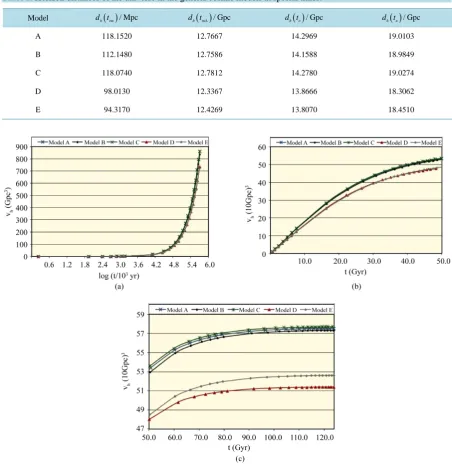
The results illustrated in Figures 1(a)-(c) are supported by those displayed inFigures 2(a)-(c) which show the distributions of the universe horizon volume in the general models in the ranges up to t = 0.5 Gyr, t = 0.5 - 50 Gyr and t = 50 - 124 Gyr respectively.Table 2 presents the universe horizon volumes in the general models at the special times trm,tmΛ,toandtn.
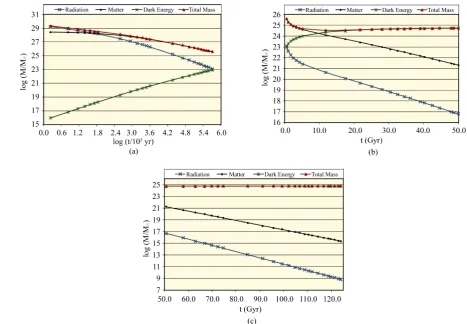
The distribution of mass and energy within the universe horizon volume of the universe in any general model up to t=0.5 Gyr is exhibited inFigure 3(a). The distributions of both radiation and matter decrease gradually with time and intersect at the time trm=34627.5 - 55916.2 yr as shown inTable 3. On the other hand, the dis-tribution of dark energy increases gradually until it intersects with the radiation disdis-tribution at the time
Λ 0.5166 - 0.5839 Gyr
r
t = as seen inTable 4. The distribution of total mass coincides with that of radiation up to t≈5843.4141 yr. Afterwards, the two distributions diverge from each other. However, the distribution of the total mass coincides on the distribution of matter from the time t≈857695.9 yr onwards.
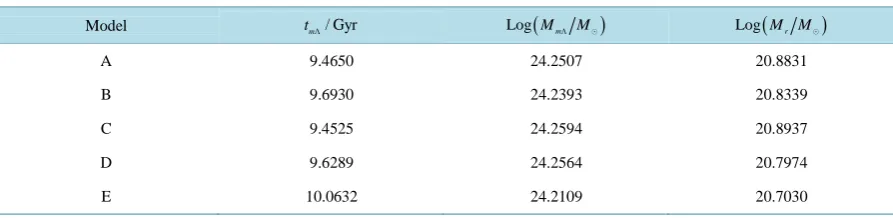
The distribution of mass and energy within the universe horizon volume of the universe in any general model in the range t=0.5 - 50 Gyr is displayed inFigure 3(b). It is obvious that the distributions of matter and radia-tion decrease gradually with time and the former lies above the later. The distriburadia-tion of dark energy increases with time and intersects with the distribution of matter at t=9.4525 - 10.0632 Gyr as illustrated inTable 5. The distribution of the total mass coincides on the distribution of the matter up to t=4.5714 Gyr, then they diverge from each other. Furthermore, the distribution of the total mass coincides on the distribution of the dark energy from t=18.2857 Gyr onwards. Masses of radiation, matter and dark energy within the universe horizon volume in the general models at the present time are illustrated inTable 6.
Table 1. Horizon distances of the universe in the general cosmic models at special times.
Model d th( )rm / Mpc d th( )mΛ / Gpc d th( )o / Gpc d th( )n / Gpc
A 118.1520 12.7667 14.2969 19.0103
B 112.1480 12.7586 14.1588 18.9849
C 118.0740 12.7812 14.2780 19.0274
D 98.0130 12.3367 13.8666 18.3062
E 94.3170 12.4269 13.8070 18.4510
Figure 2. The distribution of the universe horizon volume in the general cosmic models (a) up to t = 0.5 Gyr; (b) in the range
[image:5.595.89.538.611.719.2]t = 0.5 - 50 Gyr; (c) in the range t = 50 - 124 Gyr.
Table 2. Horizon volumes of the universe in the general cosmic models at special times.
Model
( )
3/ Mpc
h rm
V t V th( ) (mΛ / 10 Gpc)3 ( ) ( )
3
/ 10 Gpc
h o
V t V th( ) (n / 10 Gpc)3
A 13820.0 17.4322 24.4819 57.5555
B 11820.0 17.3990 23.7792 57.3248
C 13790.0 17.4916 24.3849 57.7111
D 7890.0 15.7295 22.3372 51.3939
Figure 3. The distribution of mass and energy within the universe horizon volume in any general cosmic model (a) up to t =
[image:6.595.89.541.460.719.2]0.5 Gyr; (b) in the range t = 0.5 - 50 Gyr; (c) in the range t = 50 - 124 Gyr.
Table 3. Cosmic times at which Mr
( )
t =Mm( )
t within the universe horizon volume in the general cosmic models.Model trm/ 10 yr3 Log
(
Mrm M)
Log(
MΛ M)
A 55.9162 28.2526 18.1498
B 49.6665 28.2876 18.0712
C 55.8428 28.2529 18.1562
D 38.4783 28.3338 17.9566
[image:6.595.87.539.601.713.2]E 34.6275 28.3753 17.8515
Table 4. Cosmic times at which Mr
( )
t =MΛ( )
t within the universe horizon volume in the general cosmic models.Model trΛ/ Gyr Log
(
MrΛ M)
Log(
Mm M)
A 0.5839 23.0153 25.5410
B 0.5736 22.9834 25.5375
C 0.5808 23.0202 25.5445
D 0.5166 22.9407 25.5350
50 - 124 Gyr
t= is exhibited inFigure 3(c). Again the distribution of both matter mass and radiation mass de-crease with time and the former is higher than the later. The distributions of dark energy mass and total mass coincide on each other. Masses of radiation, matter and dark energy within the universe horizon volume in the general models at tn are given inTable 7.
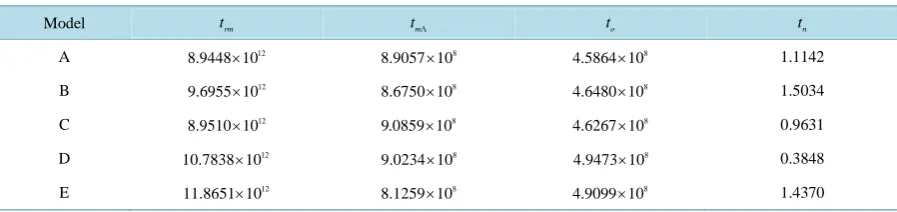
Table 8 shows the equivalent number of the Coma-like clusters to the mass of matter within the universe ho-rizon volume NCOMA
( )
t in the general models at the special times trm,tmΛ,toandtn. It is obvious that thiscontent of matter strongly decreases with time such that the cosmic space becomes almost matter empty in the far future of the universe.
5. Conclusion
[image:7.595.91.538.318.427.2]In this article distributions of the universe horizon distance and universe horizon volume were determined in the five general cosmic models which were established previously. The two distributions were found increasing slowly up to t≈21.5444 Myr, hence they raise appreciably fast up to t=60 Gyr, then they increase again so slowly until t=124 Gyr. Distributions of mass of radiation, matter and dark energy within the universe horizon volume were also investigated in the five general models. The masses of radiation and matter are decreasing with time although the mass of dark energy is increasing. The mass of radiation was dominant in the early
Table 5. Cosmic times at which Mm
( )
t =MΛ( )
t within the universe horizon volume in the general cosmic models.Model tmΛ/ Gyr Log
(
MmΛ M)
Log(
Mr M)
A 9.4650 24.2507 20.8831
B 9.6930 24.2393 20.8339
C 9.4525 24.2594 20.8937
D 9.6289 24.2564 20.7974
[image:7.595.88.539.465.578.2]E 10.0632 24.2109 20.7030
Table 6. Masses of radiation, matter and dark energy within the universe horizon volume in the general cosmic models at
o
t=t .
Model Log
(
Mr M)
Log(
Mm M)
Log(
MΛ M)
A 20.4531 23.9625 24.3973
B 20.4324 23.9683 24.3785
C 20.4570 23.9663 24.4086
D 20.4035 23.9954 24.3981
[image:7.595.88.539.611.717.2]E 20.3684 23.9921 24.3328
Table 7. Masses of radiation, matter and dark energy within the universe horizon volume in the general cosmic models at
n
t=t .
Model Log
(
Mr M)
Log(
Mm M)
Log(
MΛ M)
A 8.8400 15.3480 24.7694
B 8.9797 15.4781 24.7571
C 8.7546 15.2847 24.7779
D 8.1326 14.8863 24.7706
Table 8. Equivalent number of the Coma-like clusters to the mass of matter within the universe horizon volume in the gen-eral cosmic models at special times.
Model trm tmΛ to tn
A 12
8.9448 10× 8
8.9057 10× 8
4.5864 10× 1.1142
B 12
9.6955 10× 8
8.6750 10× 8
4.6480 10× 1.5034
C 12
8.9510 10× 8
9.0859 10× 8
4.6267 10× 0.9631
D 12
10.7838 10× 8
9.0234 10× 8
4.9473 10× 0.3848
E 12
11.8651 10× 8
8.1259 10× 8
4.9099 10× 1.4370
universe up to t=34627.5 - 55916.2 yr, where it becomes equivalent to the mass of matter. Afterwards, the mass of matter prevailed until t=9.4525 - 10.0632 Gyr, where it becomes equal to the mass of dark energy. From this time onwards the mass of dark energy dominates the universe. The cosmic space gets approximately matter empty in the very remote future of the universe.
References
[1] Bukhari, F.A. (2013) Five General Cosmic Models. Journal of King Abdulaziz University: Science, 25.