Pouring fuel on the fire: Th17 cells, the
environment, and autoimmunity
Patrick R. Burkett, … , Gerd Meyer zu Horste, Vijay K.
Kuchroo
J Clin Invest.
2015;
125(6)
:2211-2219.
https://doi.org/10.1172/JCI78085
.
Cytokines play a critical role in controlling the differentiation of CD4 Th cells into distinct
subsets, including IL-17–producing Th17 cells. Unfortunately, the incidence of a number of
autoimmune diseases, particularly those in which the IL-23/IL-17 axis has been implicated,
has risen in the last several decades, suggesting that environmental factors can promote
autoimmunity. Here we review the role of cytokines in Th17 differentiation, particularly the
role of IL-23 in promoting the differentiation of a pathogenic subset of Th17 cells that
potently induce autoimmune tissue inflammation. Moreover, we highlight emerging data that
indicate that environmental factors, including the intestinal microbiota and changes in diet,
can alter normal cytokine regulation with potent effects on Th17 differentiation and thus
promote autoimmunity, which has strong implications for human disease.
Review Series
Find the latest version:
Series Editor: Antonio La Cava
Introduction
The random rearrangement of adaptive antigen receptors allows for incredible diversity of antigen receptor specificity but comes at the cost of creating potentially autoreactive T and B lymphocytes. Although many potentially autoreactive clones are deleted during development or are prevented from causing disease by the various mechanisms of peripheral tolerance, others go on to induce auto-immune disease. Unfortunately, the incidence of autoauto-immune diseases such as MS, type 1 diabetes (T1D), and inflammatory bowel disease (IBD) has been increasing in the last three to four decades (1–3). Thus it is more important than ever to understand the pathways that promote the differentiation and effector func-tion of self-reactive CD4 Th cells into pathologic effector subsets. One of the principal means by which Th cells coordinate immune responses is by producing cytokines. Over 20 years ago, Mosmann and Coffman recognized that Th cells can be divided into distinct subsets on the basis of unique patterns of cytokine production (4). While many different subsets have been identified in the ensuing 20 years, the most well-defined effector Th subsets include Th1 cells, which make IFN-γ; Th2 cells, which produce IL-4; and Th17 cells, which generate IL-17 (Figure 1). The patterns of cytokine production of these subsets endow them with ent functional properties, and these subsets therefore clear differ-ent types of pathogens by inducing distinct types of inflammation. Cytokines also play critical roles in regulating the differentiation of naive Th cells into different effector subsets, independently of antigen specificity, by inducing expression of subset-defining transcriptions factors (5). Thus, cytokines control the differentia-tion of Th cells as well as their effector funcdifferentia-tion.
Given the importance of cytokines in regulating Th cells, it is not surprising that polymorphisms or environmental stimuli that
alter the normal regulation of cytokines are frequently identified as risk factors for the development of autoimmune disease. In particular, mutations or stimuli that result in the dysregulation of cytokines that control Th17 cells appear to particularly predispose to the development of several autoimmune diseases (6, 7). In this Review we focus on the role of cytokines in controlling Th17 cell differentiation and effector function and discuss how environ-mental factors, such as diet and the intestinal microbiota, may predispose to the development of a pathogenic subset of Th17 cells that can promote autoimmune disease.
Cytokine regulation of Th17 differentiation
The observation that IFN-γ–producing Th cells are prevalent in many autoimmune diseases, such as MS and RA, led to the hypothesis that Th1 cells were critical for disease pathogenesis. Paradoxically, in mouse models of RA and MS (collagen-induced arthritis or EAE), mutations in key Th1-related genes such as Ifng,
Ifngr, and Stat1 lead to increased susceptibility to disease, rather
than protection from disease (8–10). Moreover, while mice defi-cient for the p40 subunit of IL-12 were resistant to EAE, p35 sub-unit–deficient mice were still susceptible. This apparent conun-drum was resolved by the recognition that another subunit, p19, could also pair with p40 to form the cytokine IL-23 and that mice lacking p19 were resistant to EAE despite having normal Th1 responses (11–13). Rather than promoting Th1 differentiation, as IL-12 does, IL-23 induced IL-17–producing Th cells, later termed Th17 cells, which can induce autoimmune tissue inflammation (13, 14). Moreover, IL-23 was also found to be crucial to developing intestinal inflammation in several mouse models of IBD (15–17). Thus, IL-23 plays a vital role in promoting T cell–mediated tissue inflammation in murine models of human autoimmune disease, in large part by promoting Th17 differentiation.
While IL-23 is clearly critical for the development of Th17 cells in vivo, naive Th cells do not express IL-23 receptor (IL-23R) (18), suggesting that other cytokines are responsible for the initial
Cytokines play a critical role in controlling the differentiation of CD4 Th cells into distinct subsets, including IL-17– producing Th17 cells. Unfortunately, the incidence of a number of autoimmune diseases, particularly those in which the IL-23/IL-17 axis has been implicated, has risen in the last several decades, suggesting that environmental factors can promote autoimmunity. Here we review the role of cytokines in Th17 differentiation, particularly the role of IL-23 in promoting the differentiation of a pathogenic subset of Th17 cells that potently induce autoimmune tissue inflammation. Moreover, we highlight emerging data that indicate that environmental factors, including the intestinal microbiota and changes in diet, can alter normal cytokine regulation with potent effects on Th17 differentiation and thus promote autoimmunity, which has strong implications for human disease.
Pouring fuel on the fire: Th17 cells, the environment,
and autoimmunity
Patrick R. Burkett,1,2 Gerd Meyer zu Horste,1 and Vijay K. Kuchroo1
1Evergrande Center for Immunologic Diseases, Harvard Medical School and Brigham and Women’s Hospital, Boston, Massachusetts, USA. 2Pulmonary and Critical Care Division, Department of Medicine,
Brigham and Women’s Hospital, Boston, Massachusetts, USA.
Murine Th17 differentiation can also be induced in the absence of TGF-β1 signaling, via the combination either of IL-1β, IL-6, and IL-23 or of TGF-β3 and IL-6 (41, 42). These TGF-β1–independent Th17 cells can efficiently induce autoimmune tissue inflamma-tion upon adoptive transfer, a trait that led to them being termed “pathogenic” Th17 cells. Additionally, they possess a gene expres-sion profile distinct from that of “nonpathogenic” Th17 cells, which are differentiated with TGF-β1 and IL-6.
These observations have led to two competing hypotheses. The first posits that IL-23 cements Th17 lineage commitment such that Th17 cells induced with TGF-β1 and IL-6 are insufficiently committed to the lineage and cannot induce autoimmune tissue inflammation. The second suggests that there are distinct sub-types of Th17 cells whose differentiation is dependent on distinct combinations of cytokines. The latter hypothesis is supported by the finding that pathogenic Th17 cells express higher levels of sev-eral Th1 lineage–associated transcripts, such as the transcription factor T-bet and IFN-γ, and have been shown to be derived from IL-17 single producers by fate mapping experiments (43, 44). Simi-larly, an important feature of human Th17 cells, as well as those isolated from inflamed tissues in mouse models of Th17-mediated disease, is that they coproduce IL-17 with other cytokines, leading to distinct functional roles (45–47). For instance, human Th17 cells that produce both IL-10 and IL-17 preferentially respond to
Staph-ylococcus aureus, while those that produce both IL-17 and IFN-γ recognize Candida albicans, suggesting that distinct pathogens induce distinct subtypes of Th17 cells (40). IL-17/IFN-γ coproduc-ers have been ascribed pathogenic functions in the CNS during EAE; however, it has been difficult to reliably differentiate such cells in vitro. Repeated rounds of in vitro culture in the presence of either Th1-inducing cytokines or IL-23 can induce IL-17/IFN-γ coproducers, albeit at moderate percentages. The transcription factors T-bet, RUNX1, and RUNX3 appear to be important in the acquisition of this phenotype (48, 49).
Large-scale transcriptional analysis of Th17 differentiation at very high temporal resolution has begun to elucidate the molecular networks that control this process, and is a promising approach to the identification of novel regulatory molecules that control pathogenic Th17 differentiation (50, 51). In fact, Th17 development is controlled induction of this lineage. The combination of TGF-β1 and IL-6
effi-ciently induces IL-17–producing murine T cells in vitro and high-lights the reciprocal relationship between induced Tregs, which are generated by TGF-β1 alone, and Th17 cells (19, 20). A series of studies demonstrated that IL-21, a γc-dependent cytokine, could
promote the differentiation of Th17 cells (21–23). In combination with TGF-β, IL-21 induces IL-17 production from naive Th cells and promotes the expression of both RORγt, the lineage-defining transcription factor of Th17 cells, and IL-23R (23, 24). IL-21 could also inhibit the generation of TGF-β–induced FOXP3+ Tregs, and
analysis of IL-6–deficient mice revealed that the ability of IL-21 to generate Th17 cells from Th cells was independent of IL-6 (21). Both IL-6 and IL-21 can induce Th17 cells themselves to produce IL-21. This led to a model of Th17 cell differentiation in which IL-6 elicits autocrine IL-21 production, which then amplifies the Th17 response by inducing itself and upregulating IL-23R, allow-ing for the stabilization and terminal differentiation of the lineage through IL-23. While IL-21 can clearly promote Th17 differentia-tion in vitro, it is not absolutely required in vivo. In particular, both IL-21– and IL-21R–deficient mice are not protected from EAE, indi-cating that IL-21 may have a redundant role in Th17 differentiation in this setting (25, 26). In contrast, IL-21 is absolutely required in the NOD model for development of spontaneous diabetes, as loss of either Il21 or Il21r makes mice resistant to the development of disease (27, 28). Moreover, SNPs in IL21 and IL21R have been implicated in several human autoimmune diseases (29–34).
[image:3.585.37.370.57.247.2]Interestingly, Th17 cells differentiated with just TGF-β1 and IL-6 are inefficient at inducing autoimmunity when transferred in vivo, in part due to their co-production of IL-10 (35). However, the addition of IL-23 to TGF-β1 and IL-6 induces Th17 cells that trigger EAE after transfer, supporting a key role for IL-23 in pro-moting the ability of Th17 cells to induce tissue-specific autoim-munity (36). Interestingly, the role of TGF-β1 in human Th17 cell differentiation is less clear cut, as studies have shown variable importance of this cytokine for human Th17 cell differentiation (37–39). Moreover, human Th17 cells can be efficiently induced by the combination of IL-1β, IL-6, and IL-23, and subsequent work suggests that TGF-β1–dependent Th17 cells may have different functional properties than those differentiated with IL-1β (38, 40).
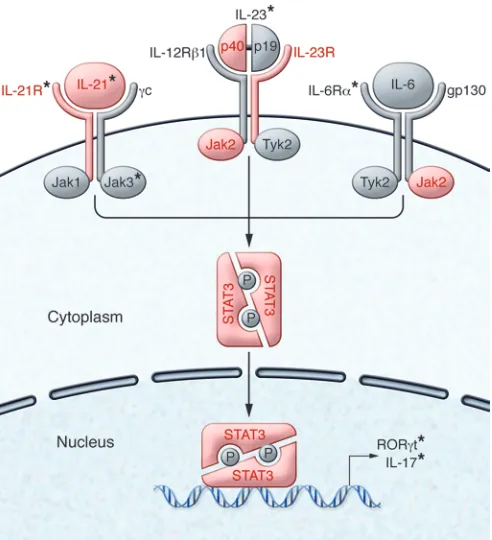
The importance of IL-23 in promoting autoimmune tissue inflammation is further highlighted by the finding that polymor-phisms in genes related to IL-23 and its signaling pathway are associated with several human autoimmune diseases, including IBD, ankylosing spondylitis, psoriasis, and autoimmune thyroid-itis (Figure 2 and refs. 58–60). SNPs in IL23R are associated with both Crohn’s disease and ulcerative colitis, consistent with the crucial role IL-23 has in mouse models of IBD (15, 17, 61). One IBD-associated IL23R SNP, which encodes the mutation R381Q, lies within exon 9 of IL23R and appears to be protective, with a reduced frequency in patients compared with controls. After acti-vation, T cells isolated from individuals expressing IL-23RQ381 have
a reduced frequency of IL-23R+ Th cells and decreased
phosphory-lation of STAT3 after stimuphosphory-lation with IL-23 (62). Moreover, SNPs in the gene encoding IL-12/23p40, which could affect both IL-12 and IL-23 function, have also been linked to psoriasis, psoriatic arthritis, and IBD (63–66). Thus, SNPs affecting the IL-23 pathway are commonly found in human autoimmune disease, and a SNP that results in decreased IL-23R function is protective against the development of intestinal inflammation. These data suggest that the proper regulation of IL-23 is critical to prevent autoimmunity.
STAT3 represents an important downstream mediator of IL-23R signaling, as well as several other inflammatory cytokines, including IL-6 and IL-21, and is crucial for Th17 differentiation in both humans and mice. SNPs in STAT3 have been linked to many of the same human autoimmune diseases associated with the IL-23 pathway, including psoriasis, IBD, and ankylosing spondylitis (66– 68). Loss-of-function mutations in STAT3 lead to the development of autosomal-dominant hyper-IgE syndrome, manifestations of which include chronic mucocutaneous candidiasis and recur-rent staphylococcal infections. These patients have markedly decreased frequencies of IL-17– and IL-22–producing T cells (69– 72). In contrast, several patients have recently been identified who had very early onset multi-organ autoimmune disease and were found to have novel STAT3 mutations that resulted in increased STAT3 activity (73, 74). Such patients have a reduced frequency of circulating FOXP3+ Tregs, and one patient responded clinically to
blockade of IL-6R with tocilizumab with a marked decrease in the frequency of IL-17–producing CD4+ T cells (74). Thus, mutations
in STAT3 can alter Th17 differentiation, and STAT3 mutations and polymorphisms can predispose to the development of autoim-mune disease, highlighting the importance of this molecule.
Regulation of Th17 differentiation by
environmental factors
The relatively recent increase in the incidence of a variety of auto-immune diseases in which Th17 cells and IL-23 have been impli-cated, including MS and IBD, suggests that environmental factors by two self-reinforcing, mutually antagonistic modules: a positive
module containing 22 genes that promote Th17 differentiation and a negative module of 5 genes that inhibit Th17 development. These mutually antagonistic modules are essential for maintaining a bal-ance between Th17 cells and other T cell subsets. Thus, a growing amount of evidence suggests that there may be at least two distinct subtypes of IL-17–producing Th cells and that these subtypes may mediate distinct immunologic functions, although the underlying molecular basis for these subtypes is just beginning to be identified.
IL-23 and autoimmunity
[image:4.585.43.289.55.325.2]Mice that overexpress IL-23 develop a spontaneous inflamma-tory disease similar to ankylosing spondylitis, while mice lack-ing tristetraproline, which regulates Il23 mRNA stability, develop spontaneous systemic inflammation, highlighting the importance of this cytokine in regulating inflammatory T cell populations (52, 53). Moreover, IL-23 is essential for the induction of the pathogen-ic Th17 cell gene expression profile (41). Thus, it is not surprising that the IL-23R is expressed at higher levels in pathogenic Th17 cells and is required for Th17-mediated induction of EAE (41). The pathways activated downstream of IL-23R that are required for pathogenicity are just beginning to be identified. One such molecule, the salt-sensitive kinase SGK1, was recently identified through use of transcriptional networks and predicted protein-protein interactions, experimentally verified to be downstream of IL-23R, and shown to be required for the induction of pathogenic Th17 cells (50, 54, 55). Additionally, the IL-23R–mediated induc-tion of the cytokine GM-CSF is required for the pathogenicity of Th17 cells, although by itself it is not sufficient to induce EAE in vivo (56, 57). Thus, while further investigation into the molecu-lar basis for the differentiation of pathogenic Th17 cells is clearly needed, the critical role of IL-23 in this process is evident.
can be mitigated in the K/BxN mouse model by treatment with either anti–IL-17 or antibiotics that cover Gram-positive organ-isms, is significantly attenuated in germ-free mice, and recurs upon either conventionalization or SFB monocolonization (86). A spontaneous model of relapsing/remitting EAE has been found to be dependent on the presence of commensal microbiota (87). Similarly, in germ-free animals, EAE induced by immunization with complete Freund’s adjuvant/myelin oligodendrocyte gly-coprotein is attenuated compared with EAE in conventionalized mice, and these mice show an increased frequency of Tregs and decreased numbers of IL-17+ CD4+ cells (88). After
monocolo-nization with SFB, germ-free mice are once again susceptible to EAE, with markedly enhanced Th17 responses in both the spi-nal cord and small intestine. This suggests that the SFB-induced microenvironment can foster the differentiation of autoreactive Th17 cells that can then circulate throughout the body and induce inflammatory disease at distal sites, depending on the specificity of the TCRs of the T cells. This possibility is further supported by the finding that adoptively transferred naive Th cells that express an SFB-specific TCR upregulate RORγt in an SFB-dependent manner and can be found in both the intestine and the spleen (81). In contrast, in the case of the NOD model of T1D, SFB colo-nization actually appears to be protective, as SFB-positive NOD mice have a dramatically reduced incidence of diabetes (89). Thus, SFB-induced intestinal Th17 cells can variably modulate the course of organ-specific autoimmune disease.
The mechanisms by which SFB induce intestinal Th17 cells are still being elucidated. Despite playing a critical role in regulating intestinal epithelial homeostasis, TLR-derived MyD88-depen-dent signals appear to be dispensable for SFB-induced intestinal Th17 differentiation (75, 76, 90). However, several studies have suggested an important role for intestinal APCs in promoting the differentiation of microbiota-dependent intestinal Th17 cells via both antigen-dependent and -independent mechanisms (75, 79–81). Intestinal Th17 cells show a substantial degree of reac-tivity to SFB-derived antigens and fail to develop in the absence of MHC class II on CD11c+ cells (80, 81, 83). ATP derived from
lumenal microbes specifically induces upregulation of IL-23p19, IL-6, and TGF-β–activating integrins in a CD70hiCD11clo
popula-tion uniquely present in the lamina propria that can support the differentiation of Th17 cells in vitro (75). Intriguingly, mice lack-ing Entpd7, which encodes an extracellular ATP hydrolase pref-erentially expressed on small intestinal epithelium, have both increased luminal ATP and higher frequencies of intestinal Th17 cells (91). Moreover, while Entpd7-deficient mice are resistant to
Citrobacter rodentium infection, they develop more severe EAE
than WT mice. Thus, microbial-derived peptides and metabolites contribute to the induction of intestinal Th17 cells.
Type 3 innate lymphoid cells (ILC3s), which resemble Th17 cells with regard to the cytokines they produce, appear to regu-late intestinal Th17 cell differentiation in a microbiota-depen-dent manner. Mice lacking Ahr, IL-22, IL-23p19, or IL-23R have relative outgrowth of SFB and increased intestinal Th17 cells, and this appears to be due to a marked decrease in IL-22–pro-ducing immune cells, particularly ILC3s (92–94). IL-22 is critical for maintaining intestinal barrier function, and in the absence of IL-22, SFB increase in relative abundance, leading to an increased may lead to altered immune responses and promote
autoimmu-nity. Given the importance of cytokines in regulating Th17 differ-entiation and the apparently crucial role of IL-23 in promoting a pathogenic Th17 subset, it is important to understand how envi-ronmental stimuli can influence regulation of Th17-related cyto-kines, particularly IL-23. Mucosal tissues such as the intestine have emerged as a key physiologic site for the differentiation and regula-tion of Th17 cells, suggesting that these cells may be particularly sensitive to perturbations from changes in environmental stimuli.
Microbiota. The intestine is home to both a vast array of
commensal microbes and a multitude of immune cells, and the interplay between these two populations has been increasingly recognized to affect immune homeostasis. At steady state, a sig-nificant proportion of the Th cells residing in the lamina propria of the small intestine are Th17 cells (24). Colonization of germ-free mice with normal intestinal microbiota induces the upregula-tion of a number of cytokines, including TNF-α, IFN-γ, IL-1, IL-6, IL-10, and IL-17; however, the induction of IL-17 in this setting is profound, showing an increase of over 1,000-fold (75–77). Con-sistent with this, the development of intestinal Th17 cells requires the presence of the intestinal microbiota, as these cells are absent in germ-free mice (76). The intestinal microbiota are also required for the maintenance of intestinal Th17 cells, as antibiotic treat-ment, particularly antibiotics with activity against Gram-positive organisms, results in marked depletion of this population (76, 77). Thus, normal commensal microbes induce an environment that promotes the differentiation of Th17 cells.
Ivanov and colleagues made the observation that mice from Taconic Farms have a substantially higher frequency of IL-17+
Th cells in the lamina propria than do mice from The Jackson Laboratory (76). Cohousing of Jackson and Taconic mice led to an increased frequency of lamina propria Th17 cells in Jackson mice, suggesting that the bacteria responsible could be transmit-ted between mice (76). A single Gram-positive bacterial species, termed segmented filamentous bacteria (SFB), appears to be pri-marily responsible for inducing intestinal Th17 cells. This Clos-tridial-related species is non-culturable, sporulating, and strongly adherent to ileal epithelium and is nearly absent in mice from The Jackson Laboratory (78, 79). Inoculation of Jackson mice with fecal microflora from SFB-monocolonized mice potently induces expansion of intestinal IL-17+IL-22+ Th cells (79). The majority of
these cells are specific for SFB-derived antigens, although there are conflicting data regarding whether recognition of cognate antigen is required for their differentiation (80–83). SFB coloniza-tion also induces development of secondary and tertiary lymphoid structures in the intestine, and the development of SFB-specific Th17 cells requires such organized structures (84). Thus, a single commensal microbial species is able to exert a marked effect on Th cell differentiation, augmenting the differentiation of a subset important in the pathogenesis of autoimmune disease.
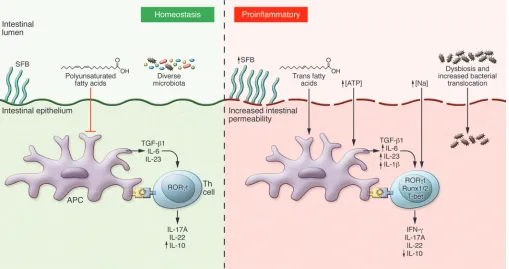
matory state, with increased production of cytokines known to promote Th17 differentiation, including IL-1 and IL-6 (98). More-over, mice placed on a high-fat diet demonstrate increased expres-sion of IL-17, IL-23p19, and RORγt consistent with increased Th17 responses and have more rapid onset of colitis (99). Similarly, mice placed on a diet rich in trans fatty acids, which are found in processed hydrogenated vegetable oil, develop more severe intes-tinal inflammation in response to dextran sodium sulfate, and this is associated with an increase in both IL-17 and RORγt expression (100). Trans fatty acids also directly induce increased expression of IL-23p19 in peritoneal macrophages. However, addition of poly-unsaturated fatty acids (PUFAs), which have been shown to miti-gate obesity-associated metabolic pathology, results in decreased colitis severity in mice placed on a high-fat diet that otherwise would exacerbate disease, and this correlates with decreased levels of a number of Th17-related cytokines (101–103). Interest-ingly, observational data from the Nurse’s Health Study suggest a possible correlation between dietary PUFA intake and a reduced risk of ulcerative colitis, whereas high intake of trans-unsaturated fats was associated with an increased risk of developing ulcerative colitis (104). Thus, both obesity and dietary fat intake can alter the production of cytokines involved in Th17 differentiation and potentially predispose to the development of autoimmunity.
In addition to fats, processed foods are also rich in salt, and recent work has shown that a diet high in salt may promote both Th17 differentiation and induction of autoimmunity (54, 55). This appears to be directly mediated by the salt-sensitive kinase, frequency of Th17 cells in both the intestine and distal secondary
lymphoid tissue (93, 95, 96). IL-23–induced IL-22 also appears to be critical for prohibiting microbiota from entering normally restricted anatomical compartments, as mice deficient in both IL-23R and RAG2 have elevated levels of LPS in both the spleen and liver (93). Furthermore, selective depletion of ILCs results in systemic dissemination of Alcaligenes spp., a normal enteric commensal (97). Dissemination of Alcaligenes induced a sys-temic inflammatory response that was prevented by the admin-istration of exogenous IL-22. Intriguingly, pediatric patients with Crohn’s disease had higher titers of anti-Alcaligenes antibodies compared with healthy controls, suggesting that dissemination of these bacteria may occur in patients with IBD as well. Finally, ILC3s have also been found to express MHC class II and induce peripheral tolerance to commensal-derived antigens, as selec-tive deletion of the MHC class II locus in ILC3s leads to spon-taneous intestinal inflammation associated with expansion of intestinal Th17 cells (80, 92). Thus, the interplay between ILC3s and intestinal microbiota can modulate in vivo Th17 differentia-tion by a number of distinct mechanisms.
Diet. The increased incidence of autoimmune disease over the
last several decades has mirrored the widespread adoption of a diet dependent on processed foods rich in salt, fats, and both sugar and artificial sweeteners. While it is currently unclear whether these two things are related, there is a clear association between obesity and the adoption of a diet heavy in processed foods. Recent work has clearly highlighted the extent to which obesity is an
[image:6.585.43.552.57.326.2]SGK1, which was identified as an important downstream target of IL-23R signaling (50, 54). Increased salt concentrations pref-erentially induced Th17 cells with a pathogenic, pro-inflamma-tory gene signature. Consistent with this, mice placed on a high-salt diet develop more severe EAE (54, 55). While a high-high-salt diet induces multiple physiological changes, it appears that it alters EAE severity by directly affecting T cell priming, since mice with a T cell–specific deletion of Sgk1 have reduced EAE severity and do not develop exacerbated disease on a high-salt diet (54). Given how tightly mammals regulate the plasma sodium con-centration, it is tempting to speculate that the high-sodium diet may exert its effect by altering the differentiation of intestinal Th17 cells toward a pathogenic phenotype, since they would be in close proximity to the increased concentration of sodium in the intestinal lumen; however, this remains to be demonstrated. Although there is no conclusive evidence, a number of recent studies support the concept that a high-salt diet may predis-pose to the development of human autoimmune diseases. One such study found a positive correlation between sodium intake and disease activity in patients with relapsing-remitting MS, as patients with higher salt intake had higher lesion load by MRI and higher disability scores (105). Similarly, the combination of high sodium intake and smoking was associated with a signifi-cantly increased incidence of developing RA (106). Thus, high salt concentrations can promote the differentiation of patho-genic Th17 cells, and increased dietary salt intake may promote autoimmune disease in both mice and humans.
The IL-23/IL-17 axis as a therapeutic target in
autoimmunity
The identification of the IL-23/IL-17 axis as critical for human autoimmune disease has led to the rapid development of many novel therapeutic agents. Monoclonal antibodies to a variety of cytokines and cytokine receptors and small-molecule inhibitors of RORγt and JAKs are in active preclinical and clinical develop-ment (Figure 2). Clinical trials of these agents in human autoim-mune diseases suggest that they hold promise as therapeutics and illuminate the distinct roles these cytokines play in different autoimmune diseases.
Humanized monoclonal antibodies to both IL-17 (secukinum-ab) and IL-17RA (brodalum(secukinum-ab) significantly improved moderate to severe psoriasis as well as psoriatic arthritis (107–110). Moreover, a Phase II clinical trial with secukinumab in MS has been com-pleted, and preliminary results have been reported to be positive (ClinicalTrials.gov identifier: NCT01051817). In contrast, a Phase II study on RA patients with inadequate response to methotrexate reported no significant response to secukinumab, while a Phase Ib study of brodalumab failed to show efficacy in patients with mod-erate to severe RA, suggesting that inhibition of IL-17, one of the many cytokines produced by Th17 cells, may not be efficacious in RA (111, 112). Additionally, in Crohn’s disease, trials of secukinum-ab and brodalumsecukinum-ab failed to show efficacy and even exacerbated disease activity in some patients (113). This is in line with evidence that IL-17A may be protective in murine colitis models (114). Thus, the clinical utility of targeting IL-17 depends greatly on the disease and highlights that IL-17 can play both pathogenic and protective roles in autoimmunity.
Agents targeting IL-23 are also in development. Monoclonal antibodies targeting IL-23/IL-12p40 have shown clinical efficacy for both psoriasis and Crohn’s disease. Ustekinumab, an antibody to the shared IL-12/23p40 subunit, dramatically improves pso-riasis, performing better than etanercept (115–117). Intriguingly, ustekinumab showed benefit in patients with Crohn’s disease, including those with TNF-antagonist refractory disease (118). This is stark contrast to the results seen with inhibition of IL-17 and sug-gests that IL-23 and IL-17 may play distinct roles in the pathobiol-ogy of Crohn’s disease.
Conclusions
Interactions between diet, the microbiota, and intestinal immune cells can markedly alter both systemic immune function and host metabolism, and this appears to be largely mediated by cytokines, particularly those in the IL-23/IL-17 axis. In this regard, intesti-nal ILC3s and Th cells demonstrate reduced production of IL-22 in response to IL-23 in some mouse models of obesity, leading to altered intestinal barrier function (119). Remarkably, adminis-tration of exogenous IL-22 not only rescued barrier function and reduced evidence of inflammation, but also led to improvement in glycemic control and dyslipidemia, highlighting the importance of interactions between the immune system, the microbiota, and host metabolic pathways in maintaining homeostasis. It is also important to note that the development of atherosclerosis is accelerated in several systemic human autoimmune diseases, par-ticularly RA (120). It is thus intriguing to speculate that there are similar pathobiologic processes in play for both autoimmunity and metabolic diseases with an inflammatory component, such as type 2 diabetes and atherosclerosis.
While the past several decades have seen marked changes in diet, it is also likely that improvements in hygiene, the develop-ment of antibiotics, and widespread vaccination have resulted in significant changes in the intestinal microbiota (121, 122). This raises the possibility that altered regulation of cytokines as a consequence of changes in diet, metabolism, and commensal microbes, particularly in the intestinal microenvironment, may contribute to the increased incidence of autoimmune diseases, especially those involving the IL-23/IL-17 axis (Figure 3). Fur-ther investigation of the manner in which these complex and interrelated systems affect cytokine regulation represents a promising area of investigation to better understand the patho-biology of autoimmune disease and is already bearing fruit for identifying promising therapeutic targets to ease the human burden of these diseases.
Acknowledgments
The authors would like to acknowledge funding support from the NIH (P.R. Burkett and V.K. Kuchroo), the Deutsche Forschungsge-meinschaft (G. Meyer zu Horste), the National Multiple Sclerosis Society (G. Meyer zu Horste and V.K. Kuchroo), and the Crohn’s and Colitis Foundation of America (V.K. Kuchroo).
1. Koch-Henriksen N, Sorensen PS. The changing demographic pattern of multiple sclerosis epide-miology. Lancet Neurol. 2010;9(5):520–532. 2. Gillespie KM, et al. The rising incidence of
childhood type 1 diabetes and reduced contri-bution of high-risk HLA haplotypes. Lancet. 2004;364(9446):1699–1700.
3. Molodecky NA, et al. Increasing incidence and prevalence of the inflammatory bowel diseases with time, based on systematic review. Gastroen-terology. 2012;142(1):46–54.
4. Mosmann TR, Cherwinski H, Bond MW, Giedlin MA, Coffman RL. Two types of murine helper T cell clone. I. Definition according to profiles of lymphokine activities and secreted proteins. J Immunol. 1986;136(7):2348–2357.
5. Yamane H, Paul WE. Cytokines of the gamma(c) family control CD4+ T cell differentiation and function. Nat Immunol. 2012;13(11):1037–1044. 6. Croxford AL, Mair F, Becher B. IL-23: one cyto-kine in control of autoimmunity. Eur J Immunol. 2012;42(9):2263–2273.
7. Gaffen SL, Jain R, Garg AV, Cua DJ. The IL-23-IL-17 immune axis: from mechanisms to therapeutic testing. Nat Rev Immunol. 2014;14(9):585–600.
8. Ferber IA, et al. Mice with a disrupted IFN-γ gene are susceptible to the induction of experimental autoimmune encephalomyelitis (EAE). J Immu-nol. 1996;156(1):5–7.
9. Matthys P, Vermeire K, Mitera T, Heremans H, Huang S, Billiau A. Anti-IL-12 antibody prevents the development and progression of collagen-induced arthritis in IFN-γ receptor-deficient mice. Eur J Immunol. 1998;28(7):2143–2151. 10. Bettelli E, et al. Loss of T-bet, but not STAT1,
prevents the development of experimental autoimmune encephalomyelitis. J Exp Med. 2004;200(1):79–87.
11. Oppmann B, et al. Novel p19 protein engages IL-12p40 to form a cytokine, IL-23, with biological activities similar as well as distinct from IL-12. Immunity. 2000;13(5):715–725.
12. Cua DJ, et al. Interleukin-23 rather than inter-leukin-12 is the critical cytokine for autoim-mune inflammation of the brain. Nature. 2003;421(6924):744–748.
13. Langrish CL, et al. IL-23 drives a pathogenic T cell population that induces autoimmune inflam-mation. J Exp Med. 2005;201(2):233–240. 14. Aggarwal S, Ghilardi N, Xie MH, de Sauvage FJ,
Gurney AL. Interleukin-23 promotes a distinct CD4 T cell activation state characterized by the production of interleukin-17. J Biol Chem. 2003;278(3):1910–1914.
15. Yen D, et al. IL-23 is essential for T cell-mediated colitis and promotes inflammation via IL-17 and IL-6. J Clin Invest. 2006;116(5):1310–1316. 16. Uhlig HH, et al. Differential activity of IL-12 and
IL-23 in mucosal and systemic innate immune pathology. Immunity. 2006;25(2):309–318. 17. Ahern PP, et al. Interleukin-23 drives intestinal
inflammation through direct activity on T cells. Immunity. 2010;33(2):279–288.
18. Parham C, et al. A receptor for the heterodimeric cytokine IL-23 is composed of IL-12Rβ1 and a novel cytokine receptor subunit, IL-23R. J Immu-nol. 2002;168(11):5699–5708.
19. Bettelli E, et al. Reciprocal developmental pathways for the generation of pathogenic effector TH17 and regulatory T cells. Nature. 2006;441(7090):235–238.
20. Veldhoen M, Hocking RJ, Atkins CJ, Locksley RM, Stockinger B. TGFβ in the context of an inflammatory cytokine milieu supports de novo differentiation of IL-17-producing T cells. Immu-nity. 2006;24(2):179–189.
21. Korn T, et al. IL-21 initiates an alternative path-way to induce proinflammatory T(H)17 cells. Nature. 2007;448(7152):484–487.
22. Nurieva R, et al. Essential autocrine regulation by IL-21 in the generation of inflammatory T cells. Nature. 2007;448(7152):480–483.
23. Zhou L, et al. IL-6 programs T(H)-17 cell differ-entiation by promoting sequential engagement of the IL-21 and IL-23 pathways. Nat Immunol. 2007;8(9):967–974.
24. Ivanov, et al. The orphan nuclear receptor ROR-gammat directs the differentiation program of proinflammatory IL-17+ T helper cells. Cell. 2006;126(6):1121–1133.
25. Sonderegger I, Kisielow J, Meier R, King C, Kopf M. IL-21 and IL-21R are not required for develop-ment of Th17 cells and autoimmunity in vivo. Eur J Immunol. 2008;38(7):1833–1838.
26. Coquet JM, Chakravarti S, Smyth MJ, God-frey DI. Cutting edge: IL-21 is not essential for Th17 differentiation or experimental autoimmune encephalomyelitis. J Immunol. 2008;180(11):7097–7101.
27. Sutherland AP, et al. Interleukin-21 is required for the development of type 1 diabetes in NOD mice. Diabetes. 2009;58(5):1144–1155.
28. Datta S, Sarvetnick NE. IL-21 limits peripheral lymphocyte numbers through T cell homeostatic mechanisms. PLoS One. 2008;3(9):e3118. 29. Lan Y, Luo B, Wang JL, Jiang YW, Wei YS. The association of interleukin-21 polymor-phisms with interleukin-21 serum levels and risk of systemic lupus erythematosus. Gene. 2014;538(1):94–98.
30. Webb R, et al. A polymorphism within IL21R confers risk for systemic lupus erythematosus. Arthritis Rheum. 2009;60(8):2402–2407. 31. Nohra R, et al. RGMA and IL21R show
associa-tion with experimental inflammaassocia-tion and mul-tiple sclerosis. Genes Immun. 2010;11(4):279–293. 32. Marquez A, et al. Novel association of the
interleukin 2-interleukin 21 region with inflam-matory bowel disease. Am J Gastroenterol. 2009;104(8):1968–1975.
33. Todd JA, et al. Robust associations of four new chromosome regions from genome-wide analyses of type 1 diabetes. Nat Genet. 2007;39(7):857–864. 34. Hollis-Moffatt JE, et al. Only one independent
genetic association with rheumatoid arthritis within the KIAA1109-TENR-IL2-IL21 locus in Caucasian sample sets: confirmation of associa-tion of rs6822844 with rheumatoid arthritis at a genome-wide level of significance. Arthritis Res Ther. 2010;12(3):R116.
35. McGeachy MJ, et al. TGF-beta and IL-6 drive the production of IL-17 and IL-10 by T cells and restrain T(H)-17 cell-mediated pathology. Nat Immunol. 2007;8(12):1390–1397.
36. McGeachy MJ, et al. The interleukin 23 receptor
is essential for the terminal differentiation of interleukin 17-producing effector T helper cells in vivo. Nat Immunol. 2009;10(3):314–324. 37. Manel N, Unutmaz D, Littman DR. The
dif-ferentiation of human T(H)-17 cells requires transforming growth factor-β and induction of the nuclear receptor RORγt. Nat Immunol. 2008;9(6):641–649.
38. Acosta-Rodriguez EV, Napolitani G, Lanzavec-chia A, Sallusto F. Interleukins 1β and 6 but not transforming growth factor-β are essential for the differentiation of interleukin 17-pro-ducing human T helper cells. Nat Immunol. 2007;8(9):942–949.
39. Volpe E, et al. A critical function for transforming growth factor-β, interleukin 23 and proinflam-matory cytokines in driving and modulating human T(H)-17 responses. Nat Immunol. 2008;9(6):650–657.
40. Zielinski CE, et al. Pathogen-induced human TH17 cells produce IFN-γ or IL-10 and are regu-lated by IL-1β. Nature. 2012;484(7395):514–518. 41. Lee Y, et al. Induction and molecular
signa-ture of pathogenic TH17 cells. Nat Immunol. 2012;13(10):991–999.
42. Ghoreschi K, et al. Generation of pathogenic T(H)17 cells in the absence of TGF-β signalling. Nature. 2010;467(7318):967–971.
43. Hirota K, et al. Fate mapping of IL-17-producing T cells in inflammatory responses. Nat Immunol. 2011;12(3):255–263.
44. Yang Y, et al. T-bet is essential for encephalito-genicity of both Th1 and Th17 cells. J Exp Med. 2009;206(7):1549–1564.
45. Annunziato F, et al. Phenotypic and func-tional features of human Th17 cells. J Exp Med. 2007;204(8):1849–1861.
46. Cosmi L, et al. Identification of a novel subset of human circulating memory CD4(+) T cells that produce both IL-17A and IL-4. J Allergy Clin Immunol. 2010;125(1):222–230.
47. Wang YH, et al. A novel subset of CD4(+) T(H)2 memory/effector cells that produce inflam-matory IL-17 cytokine and promote the exac-erbation of chronic allergic asthma. J Exp Med. 2010;207(11):2479–2491.
48. Wang Y, et al. The transcription factors T-bet and Runx are required for the ontogeny of pathogenic interferon-gamma-producing T helper 17 cells. Immunity. 2014;40(3):355–366.
49. Duhen R, Glatigny S, Arbelaez CA, Blair TC, Oukka M, Bettelli E. Cutting edge: the pathogenic-ity of IFN-γ-producing Th17 cells is independent of T-bet. J Immunol. 2013;190(9):4478–4482. 50. Yosef N, et al. Dynamic regulatory network
controlling TH17 cell differentiation. Nature. 2013;496(7446):461–468.
51. Ciofani M, et al. A validated regulatory network for Th17 cell specification. Cell. 2012;151(2):289–303. 52. Sherlock JP, et al. IL-23 induces
spondyloar-thropathy by acting on ROR-γt+ CD3+CD4–
CD8– entheseal resident T cells. Nat Med.
2012;18(7):1069–1076.
53. Molle C, et al. Tristetraprolin regulation of interleukin 23 mRNA stability prevents a spontaneous inflammatory disease. J Exp Med. 2013;210(9):1675–1684.
by inducible salt-sensing kinase SGK1. Nature. 2013;496(7446):513–517.
55. Kleinewietfeld M, et al. Sodium chloride drives autoimmune disease by the induction of patho-genic TH17 cells. Nature. 2013;496(7446):518–522. 56. Codarri L, et al. RORgammat drives
produc-tion of the cytokine GM-CSF in helper T cells, which is essential for the effector phase of autoimmune neuroinflammation. Nat Immunol. 2011;12(6):560–567.
57. El-Behi M, et al. The encephalitogenicity of T(H)17 cells is dependent on IL-1- and IL-23-in-duced production of the cytokine GM-CSF. Nat Immunol. 2011;12(6):568–575.
58. Nair RP, et al. Genome-wide scan reveals associa-tion of psoriasis with IL-23 and NF-κB pathways. Nat Genet. 2009;41(2):199–204.
59. Wellcome Trust Case Control Consortium, et al. Association scan of 14,500 nonsynonymous SNPs in four diseases identifies autoimmunity variants. Nat Genet. 2007;39(11):1329–1337. 60. Australo-Anglo-American Spondyloarthritis
Consortium (TASC), et al. Genome-wide asso-ciation study of ankylosing spondylitis identi-fies non-MHC susceptibility loci. Nat Genet. 2010;42(2):123–127.
61. Duerr RH, et al. A genome-wide asso-ciation study identifies IL23R as an inflam-matory bowel disease gene. Science. 2006;314(5804):1461–1463.
62. Pidasheva S, et al. Functional studies on the IBD susceptibility gene IL23R implicate reduced receptor function in the protective genetic vari-ant R381Q. PLoS One. 2011;6(10):e25038. 63. Tsunemi Y, et al. Interleukin-12 p40 gene (IL12B)
3′-untranslated region polymorphism is associat-ed with susceptibility to atopic dermatitis and pso-riasis vulgaris. J Dermatol Sci. 2002;30(2):161–166. 64. Capon F, et al. Sequence variants in the genes for the interleukin-23 receptor (IL23R) and its ligand (IL12B) confer protection against psoriasis. Hum Genet. 2007;122(2):201–206.
65. Cargill M, et al. A large-scale genetic association study confirms IL12B and leads to the identifica-tion of IL23R as psoriasis-risk genes. Am J Hum Genet. 2007;80(2):273–290.
66. Fisher SA, et al. Genetic determinants of ulcer-ative colitis include the ECM1 locus and five loci implicated in Crohn’s disease. Nat Genet. 2008;40(6):710–712.
67. Danoy P, et al. Association of variants at 1q32 and STAT3 with ankylosing spondylitis suggests genetic overlap with Crohn’s disease. PLoS Genet. 2010;6(12):e1001195.
68. Ellinghaus E, et al. Genome-wide meta-analysis of psoriatic arthritis identifies susceptibility locus at REL. J Invest Dermatol. 2012;132(4):1133–1140. 69. Ma CS, et al. Deficiency of Th17 cells in hyper IgE
syndrome due to mutations in STAT3. J Exp Med. 2008;205(7):1551–1557.
70. Minegishi Y, et al. Dominant-negative mutations in the DNA-binding domain of STAT3 cause hyper-IgE syndrome. Nature. 2007;448(7157):1058–1062.
71. de Beaucoudrey L, et al. Mutations in STAT3 and IL12RB1 impair the development of human IL-17-producing T cells. J Exp Med. 2008;205(7):1543–1550.
72. Milner JD, et al. Impaired T(H)17 cell differentia-tion in subjects with autosomal dominant hyper-IgE syndrome. Nature. 2008;452(7188):773–776. 73. Flanagan SE, et al. Activating germline mutations
in STAT3 cause early-onset multi-organ autoim-mune disease. Nat Genet. 2014;46(8):812–814. 74. Milner JD, et al. Early-onset lymphoproliferation
autoimmunity caused by germline STAT3 gain-of-function mutations. Blood. 2014;125(4):591–599. 75. Atarashi K, et al. ATP drives lamina
pro-pria T(H)17 cell differentiation. Nature. 2008;455(7214):808–812.
76. Ivanov, et al. Specific microbiota direct the differ-entiation of IL-17-producing T-helper cells in the mucosa of the small intestine. Cell Host Microbe. 2008;4(4):337–349.
77. Gaboriau-Routhiau V, et al. The key role of seg-mented filamentous bacteria in the coordinated maturation of gut helper T cell responses. Immu-nity. 2009;31(4):677–689.
78. Klaasen HL, Koopman JP, Poelma FG, Beynen AC. Intestinal, segmented, filamentous bacteria. FEMS Microbiol Rev. 1992;8(3–4):165–180. 79. Ivanov, et al. Induction of intestinal Th17 cells
by segmented filamentous bacteria. Cell. 2009;139(3):485–498.
80. Goto Y, et al. Segmented filamentous bacteria antigens presented by intestinal dendritic cells drive mucosal Th17 cell differentiation. Immu-nity. 2014;40(4):594–607.
81. Yang Y, et al. Focused specificity of intestinal TH17 cells towards commensal bacterial anti-gens. Nature. 2014;510(7503):152–156. 82. Lochner M, et al. Restricted microbiota and
absence of cognate TCR antigen leads to an unbalanced generation of Th17 cells. J Immunol. 2011;186(3):1531–1537.
83. Geem D, Medina-Contreras O, McBride M, New-berry RD, Koni PA, Denning TL. Specific microbio-ta-induced intestinal Th17 differentiation requires MHC class II but not GALT and mesenteric lymph nodes. J Immunol. 2014;193(1):431–438. 84. Lecuyer E, et al. Segmented filamentous
bac-terium uses secondary and tertiary lymphoid tissues to induce gut IgA and specific T helper 17 cell responses. Immunity. 2014;40(4):608–620. 85. Stepankova R, et al. Segmented filamentous
bac-teria in a defined bacbac-terial cocktail induce intes-tinal inflammation in SCID mice reconstituted with CD45RBhigh CD4+ T cells. Inflamm Bowel Dis. 2007;13(10):1202–1211.
86. Wu HJ, et al. Gut-residing segmented filamen-tous bacteria drive autoimmune arthritis via T helper 17 cells. Immunity. 2010;32(6):815–827. 87. Berer K, et al. Commensal microbiota and myelin
autoantigen cooperate to trigger autoimmune demyelination. Nature. 2011;479(7374):538–541. 88. Lee YK, Menezes JS, Umesaki Y, Mazmanian
SK. Proinflammatory T-cell responses to gut microbiota promote experimental autoimmune encephalomyelitis. Proc Natl Acad Sci U S A. 2011;108(suppl 1):4615–4622.
89. Kriegel MA, Sefik E, Hill JA, Wu HJ, Benoist C, Mathis D. Naturally transmitted segmented fila-mentous bacteria segregate with diabetes protec-tion in nonobese diabetic mice. Proc Natl Acad Sci U S A. 2011;108(28):11548–11553.
90. Rakoff-Nahoum S, Paglino J, Eslami-Varzaneh
F, Edberg S, Medzhitov R. Recognition of commensal microflora by toll-like receptors is required for intestinal homeostasis. Cell. 2004;118(2):229–241.
91. Kusu T, et al. Ecto-nucleoside triphosphate diphosphohydrolase 7 controls Th17 cell respons-es through regulation of luminal ATP in the small intestine. J Immunol. 2013;190(2):774–783. 92. Hepworth MR, et al. Innate lymphoid cells
regu-late CD4+ T-cell responses to intestinal
commen-sal bacteria. Nature. 2013;498(7452):113–117. 93. Shih VF, et al. Homeostatic IL-23 receptor
signal-ing limits Th17 response through IL-22-mediated containment of commensal microbiota. Proc Natl Acad Sci U S A. 2014;111(38):13942–13947. 94. Qiu J, et al. Group 3 innate lymphoid cells inhibit
T-cell-mediated intestinal inflammation through aryl hydrocarbon receptor signaling and regula-tion of microflora. Immunity. 2013;39(2):386–399. 95. Upadhyay V, et al. Lymphotoxin regulates
com-mensal responses to enable diet-induced obesity. Nat Immunol. 2012;13(10):947–953.
96. Zenewicz LA, et al. IL-22 deficiency alters colonic microbiota to be transmissible and colitogenic. J Immunol. 2013;190(10):5306–5312. 97. Sonnenberg GF, et al. Innate lymphoid cells
promote anatomical containment of lym-phoid-resident commensal bacteria. Science. 2012;336(6086):1321–1325.
98. Gregor MF, Hotamisligil GS. Inflammatory mechanisms in obesity. Annu Rev Immunol. 2011;29:415–445.
99. Gruber L, et al. High fat diet accelerates pathogenesis of murine Crohn’s disease-like ileitis independently of obesity. PLoS One. 2013;8(8):e71661.
100. Okada Y, et al. Trans fatty acids exacerbate dextran sodium sulphate-induced colitis by promoting the up-regulation of macrophage-derived proinflammatory cytokines involved in T helper 17 cell polarization. Clin Exp Immunol. 2013;174(3):459–471.
101. Monk JM, et al. Dietary n-3 polyunsaturated fatty acids (PUFA) decrease obesity-associated Th17 cell-mediated inflammation during colitis. PLoS One. 2012;7(11):e49739.
102. Monk JM, et al. Th17 cell accumulation is decreased during chronic experimental colitis by (n-3) PUFA in Fat-1 mice. J Nutr. 2012;142(1):117–124. 103. De Caterina R. n-3 fatty acids in cardiovascular
disease. N Engl J Med. 2011;364(25):2439–2450. 104. Ananthakrishnan AN, et al. Long-term intake
of dietary fat and risk of ulcerative colitis and Crohn’s disease. Gut. 2014;63(5):776–784. 105. Farez MF, Fiol MP, Gaitan MI, Quintana FJ,
Correale J. Sodium intake is associated with increased disease activity in multiple sclerosis. J Neurol Neurosurg Psychiatry. 2014;86(1):26–31. 106. Sundström B, Johansson I, Rantapää-Dahlqvist S.
Interaction between dietary sodium and smoking increases the risk for rheumatoid arthritis: results from a nested case-control study. Rheumatology (Oxford). 2015;54(3):487–493.
107. Langley RG, et al. Secukinumab in plaque psoria-sis — results of two phase 3 trials. N Engl J Med. 2014;371(4):326–338.
psoriasis: a randomized, double-blind, placebo-controlled phase II dose-ranging study. Br J Der-matol. 2013;168(2):412–421.
109. Papp KA, et al. Brodalumab, an anti-interleukin-17-receptor antibody for psoriasis. N Engl J Med. 2012;366(13):1181–1189.
110. Mease PJ, et al. Brodalumab, an anti-IL17RA monoclonal antibody, in psoriatic arthritis. N Engl J Med. 2014;370(24):2295–2306. 111. Genovese MC, et al. Efficacy and safety of
secukinumab in patients with rheumatoid arthri-tis: a phase II, dose-finding, double-blind, ran-domised, placebo controlled study. Ann Rheum Dis. 2013;72(6):863–869.
112. Martin DA, et al. A phase Ib multiple ascending dose study evaluating safety, pharmacokinet-ics, and early clinical response of brodalumab, a human anti-IL-17R antibody, in methotrexate-resistant rheumatoid arthritis. Arthritis Res Ther.
2013;15(5):R164.
113. Hueber W, et al. Secukinumab, a human anti-IL-17A monoclonal antibody, for moderate to severe Crohn’s disease: unexpected results of a ran-domised, double-blind placebo-controlled trial. Gut. 2012;61(12):1693–1700.
114. O’Connor W Jr, et al. A protective function for inter-leukin 17A in T cell-mediated intestinal inflamma-tion. Nat Immunol. 2009;10(6):603–609. 115. Leonardi CL, et al. Efficacy and safety of ustekinumab, a human interleukin-12/23 monoclonal antibody, in patients with psoriasis: 76-week results from a randomised, double-blind, placebo-controlled trial (PHOENIX 1). Lancet. 2008;371(9625):1665–1674.
116. Papp KA, et al. Efficacy and safety of ustekinum-ab, a human interleukin-12/23 monoclonal antibody, in patients with psoriasis: 52-week results from a randomised, double-blind,
placebo-controlled trial (PHOENIX 2). Lancet. 2008;371(9625):1675–1684.
117. Griffiths CE, et al. Comparison of ustekinumab and etanercept for moderate-to-severe psoriasis. N Engl J Med. 2010;362(2):118–128.
118. Sandborn WJ, et al. Ustekinumab induction and maintenance therapy in refractory Crohn’s dis-ease. N Engl J Med. 2012;367(16):1519–1528. 119. Wang X, et al. Interleukin-22 alleviates metabolic
disorders restores mucosal immunity in diabetes. Nature. 2014;514(7521):237–241.
120. Shoenfeld Y, et al. Accelerated atherosclerosis in autoimmune rheumatic diseases. Circulation. 2005;112(21):3337–3347.
121. Blaser MJ. Who are we? Indigenous microbes and the ecology of human diseases. EMBO Rep. 2006;7(10):956–960.