© 2017, IRJET | Impact Factor value: 6.171 | ISO 9001:2008 Certified Journal | Page 801
Evolutionary Computation Based Load Frequency Control of Non-linear
Practical Power System with Diverse Source of Power Generation
Santigopal Pain
1, Parimal Acharjee
21Assistant Professor, Dept. of AEIE, Dr. B. C. Roy Engineering College, West Bengal, India 2Assoiciate Professor, Dept. of Electrical Engineering, NIT Durgapur, West Bengal, India
---***---Abstract - In this work, solution to load frequency control (LFC) of a non-linear multisource practical two area interconnected power system is presented using a newly developed evolutionary algorithm. For the practical power system model, diverse source of power generation such as reheat, reheat and hydro generators are used with non-identical value of system parameters. To obtain actual and physically implementable design, the non-linear security constraints viz. generation rate constraint (GRC), governor dead band (GDB) and time delay (TD) are also considered. For achieving the desired objectives, a unique cost function is formulated by considering the important steady state and transient response specifications such as area control error (ACE), steady state error (SSE) and maximum overshoot (Mp).
A novel evolutionary algorithm – chaotic exponential particle swarm optimization (CEPSO) is proposed to obtain the true optimal control gains and the corresponding dynamic performance of the power system. The performance of the developed algorithm is compared with recently developed popular evolutionary algorithms like exponential PSO (EPSO), bacteria foraging optimization algorithm (BFOA) and differential evolution (DE) algorithm. The CEPSO algorithm gives the best performance over the others.
Key Words: Chaos theory, Chaotic logistic map, CEPSO,
Load frequency control, Non-linear constraints, Steady state and transient performances.
1. INTRODUCTION
For good quality of electric power and successful operation, an interconnected power system must match the total generation with the load demand plus system losses. In power system operation, load frequency control (LFC) is an efficient control mechanism for minimizing the mismatches between generation and demand and supplying reliable and good quality of electric power [1]. The main objectives of the LFC are to maintain the frequency and tie-line power at nominal and specified values by making zero steady state error (SSE) and provide good damping characteristic by generating lowest overshoot (Mp) and settling time (ts).
In recent past, several control strategies had been applied to solve the LFC problems in order to get the better steady state and transient performance of the power system. Among the various control strategies, the classical PI control [1] and advance control methodologies such as optimal, robust and adaptive methods [2-5] had been used over the years to address the LFC issues. It has been observed from the literature [1-6] that these controllers are model specific,
applicable only for specific type of disturbance and enhance the system order which in turn increases the complexity of the power system. Moreover, these model based controllers are unable to provide satisfactory performance in the presence of physical security constraints like generation rate constraint (GRC), governor dead band (GDB) and time delay (TD). Therefore, the soft computing based intelligent controllers which have superior robust and adaptive capability compare to conventional controllers had been employed for the design of LFC problems. The popular fuzzy logic control, genetic algorithm and artificial neural network were successfully used to design the control parameters of the LFC system and are presented in [6-9]. In recent years, the powerful PSO and its different forms were widely used for optimization of the complex LFC problems [10-12]. The convergence of PSO was improved by developing exponential PSO (EPSO) [13] algorithm where inertia weight was made adaptive with the iteration. However, PSO sometimes fails to produce expected result due to poor diversity. This drawback was overcome by introducing chaos with PSO and a competent technique Chaotic PSO was developed and efficiently utilized for different optimization problems [14-15]. Recently, the design of LFC were carried out by newly developed soft computing techniques and their hybrid forms like bacteria foraging optimization algorithm (BFOA), differential evolution (DE), artificial bee colony optimization (ABCO), teaching learning based optimization (TLBO), BAT algorithm, hybrid fire fly-pattern search (FF-PS) algorithm, bacteria foraging optimization algorithm-pattern search (BFOA-PS) algorithm [16-22], to name a few, with or without considering the security constraints. In most of the discussed control strategies, the design of LFC was executed by neglecting the non-linear practical security constraints (GRC, GDB and TD) by part or full. The design was carried out by taking simple linear model with same type of generator for all the connected areas. Moreover, in most of the research works, identical parameter values were considered for all the connected generators of different control areas to make the analysis easier. But this should not be done otherwise such design will face difficulty during physical implementation. So, the actual design of LFC system will be obtained by considering different type of generating units with different parameter values and practical security constrained must be considered fully.
© 2017, IRJET | Impact Factor value: 6.171 | ISO 9001:2008 Certified Journal | Page 802
practical LFC model is developed by taking different generating units with different system parameter and all practical limitations. First time, a new chaos based EPSO algorithm (CEPSO) is proposed for the LFC of security constrained two area multi-unit hydro thermal inter-connected power system. To obtain quick convergence and best solution, a novel and logical cost function is formulated by considering multiple objectives like area control error (ACE), SSE and Mp with tuned weighting factors. The results of the proposed algorithm are compared with other nature inspired algorithms such as EPSO [13], BFOA [16] and DE [17]. The performance comparison shows that CEPSO with developed cost function gives best result because of its superior convergence capability.
2. LFC MODEL
In an inter-connected power system the different control areas are connected via tie-line which controls the power sharing between them. The sudden change of electric load
occurs due to momentarily change of power by the consumers or due to disturbances. This result in load-generation mismatches which affects the steady state frequency and tie-line power flow. To maintain the steady condition, LFC becomes active and generate proportionate signal for the connected generators according to their participation factors. In each control area, a suitable controller is connected to facilitate the LFC action. The controller input is the area control error (ACE) which is the linear combination of frequency deviation and tie-line power deviation Ptie[1].
j j j tie
ACE B f P (1)
[image:2.595.45.550.325.701.2]where j = (1, 2), represent the area number, B = Frequency bias factor and Δf = Frequency deviation. The normal operating condition of the power system i.e. zero steady state frequency and tie-line power deviation is maintained by making ACE to zero through LFC.
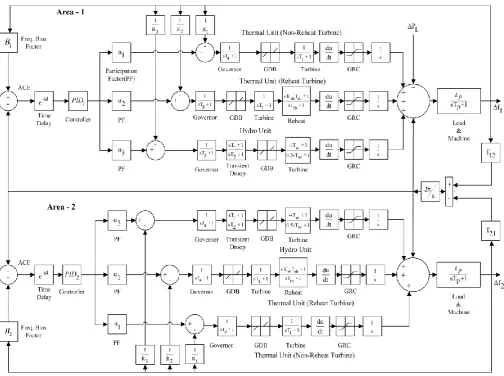
Fig - 1: Transfer function model of two area interconnected realistic power system
In this paper, the practical model is developed by considering the basic physical constraints such as GRC, GDB and TD. The GRC is defined by the rate at which the
© 2017, IRJET | Impact Factor value: 6.171 | ISO 9001:2008 Certified Journal | Page 803
(MCR)/minute respectively. The speed GDB is defined as the total magnitude of the steady state speed change within which there will be no change in the governor controlled valve position. Dead band generally expressed in percent of the rated speed/frequency. For steam and hydro turbine, the GDB are 0.06% and 0.02% of nominal frequency, respectively. The time delay of the communication channel in power system must be cater in proper way otherwise it would degrade the stability of the whole system. A time delay of 2 sec. has been considered for this study. To get physically implementable design, three distinct power generating units such as non-reheat, reheat and hydro units have been considered for each control area. The system parameters of each generator are also taken different to get accurate design of the LFC system. The transfer function/SIMULINK model of the power system is given in Fig. 1 and the parameter values are given in appendix A. According to demand, the connected generators produce power according to their participation factors. The participation factors of non-reheat, reheat and hydro generators are taken as 0.3, 0.5 and 0.2 respectively for both the areas.
3. COST FUNCTION
In this paper, an intelligent control technique to solve LFC problem is presented. The goal of the proposed technique is to regulate the frequency and tie-line power in such a manner, so as to maintain the same performance in changing operating conditions. A logical cost function (v) is formulated to obtain quick convergence and true global solution. First time, along with ACE, the steady state and transient response specifications such as SSE and Mp have been used to develop the cost function for achieving the best steady state and transient performances. Suitable choice of response specifications and weighting factors are highly necessary to attain the desired result. In this work, the primary objective is to minimize SSE to zero. The target value of SSE is taken as 10-4 i.e. it will be assumed that the desired result is achieved if SSE becomes less than 10-4. The weighting factors of the other specifications will be equivalent to SSE. By considering this concept, the weighting factor of each specification of ‘v’
is determined. Thus, a novel cost function as eqn. (2) is derived which is never been used earlier.
0.1
j j j pj
v E SSE M (2)
where MP = Maximum overshoot, SSE = Steady state error of the output frequency, E = Square integral of ACE.
4. PROPOSED ALGORITHM
Evolutionary computation algorithms are not model specific, robust, adaptive and can perform well in presence of disturbance for both linear and non-linear systems. Nowadays, these algorithms are widely used to solve the LFC problems. In this paper, chaotic exponential PSO algorithm is used to solve the proposed practical LFC model.
4.1 Exponential PSO (EPSO) Algorithm
The PSO is a population based evolutionary computation algorithm, introduced by Kennedy and Eberhart in 1995. The algorithm starts with a set of randomly generated particles. Every particle updates their flight paths in accordance with its own flight experience and best position of its companions to achieve the global solution. The velocity and position of the particle are updated according to the following equations.
1 1 ( ) 2 2 ( )
k k k k k
i i i i i i i
v w v c d pbest x c d gbest x (3)
k k k
i i i
x x v (4)
where vik, xik, pbestik are the velocity, position and current best position of the ith particle at kth iteration. gbesti denotes the global best position of the whole particle up to the present iteration. d1, d2 are the random numbers in the range [0, 1] and c1, c2 are the positive constant called constriction factors. wi is the inertia weight for the velocity of ith particle and is obtained by w= wmin + rand ()/2. The performance of PSO is depends on vik, (pbestik - xik), (gbesti - xik) and these three parts are controlled by constriction factors and inertia weight. Because of this reason, these control parameters play crucial role in the PSO convergence process. In this problem, c1 = c2 = 1.44445 are proposed.
4.1.1 Exponential Inertia Weight
In PSO, inertia weight is a key influential parameter which maintains the balance between global exploration and local exploitation. Large w enhances the exploration but increases the convergence time. On the other hand, low w facilitates quick convergence but leads to local optimal solution. To overcome this drawback, w is made adaptive where high value of w at initial search facilitates the global exploration. After that w gradually decreases and enhances the local exploitation capability to achieve the global optimum solution. For suitable variation of w, a non-linear function (5) is developed where it varies exponentially with the generation
max min 1
2
1
( ) ( ) exp
1
w k w w p
k p
K
(5)
where wmax, wmin are the maximum and minimum value of w;
© 2017, IRJET | Impact Factor value: 6.171 | ISO 9001:2008 Certified Journal | Page 804
4.2CEPSO Algorithm
For the non-linear LFC model, the performance of EPSO algorithm is not satisfactory and it sometimes may suffer from local optima. The performance of EPSO is improved by introducing chaotic dynamics because it has the ability of increasing the population diversity. Chaos is the characteristic of non-linear system with deterministic dynamic behavior that has ergodic and stochastic properties, random and unpredictable. It is very much sensitive to parameter used, parameter variation and initial condition. Nowadays, chaos has been widely used in many optimization problems because of its powerful convergence capability. In an optimization problem, chaos variables are introduced as disturbance variable to the main variable and generated by chaotic logistic map. In this work, a new algorithm i.e. chaos base EPSO i.e. CEPSO is developed by combining chaotic local search (CLS) and EPSO.
4.2.1 Chaotic Logistic Map
In the proposed chaotic optimization, the following logistic equation is used to generate the chaos variables [14].
1
[1 ]
k k k
i i i
m m m , k (0,1)
i
m (6)
where m = n-dimensional vector (m m m1, 2, 3...mn) and mik lies in the range (0, 1), µ is the control parameter which stabilizes the chaotic variables and belongs to [0, 4], i =1, 2, 3…n, k = iteration number. The chaotic behavior of equation (6) is governed by µ. The complete chaotic behavior is obtained for µ = 4. For this reason, µ is taken as 4 in this paper. The initial value of m (mi0) belongs to (0, 1) but mi0 does not equal to (0, 0.25, 0.5, 0.75, 1).
4.2.1 Chaotic Local Search (CLS)
CLS is incorporated in the developed algorithm to avoid the local minimum solution. The local exploitation capability of the proposed algorithm is improved by CLS to obtain the global optimum solution. CLS is based on the logistic eqn. (6) which is sensitive on initial conditions.
The detail steps of CLS for the minimization problem are enumerated as follows:
Step 1: Determine the lowest and highest cost function values and the corresponding particles ( min,
k i
x ) and ( max,
k i
x ),
i=1,2,3…n among the whole population set at kthiteration.
Step 2: For kthiteration, evaluate the chaotic variable mik ∈ (0, 1) using the following equation
min,
max, min,
k k
i i
k
i k k
i i
x x
m
x x
(7)
Step 3: For the next iteration, calculate the chaotic variables
mik+1 using the logistic equation (6).
Step 4: Using the chaotic variables, evaluate the decision variables for the next iteration from the equation:
Step 5: Calculate the new solution using decision variables
xik+1.
5. LFC USING CEPSO ALGORITHM
The primary objectives of the proposed design methodology are to achieve zero SSE, minimum overshoot, lowest settling time and stable operation for the developed power system model. PID controller, being the most efficient industrial controller, is used to facilitate this result. Since two different control areas are considered in this study, two different PID controllers are required. The improved steady state and transient performance can be achieved by proper design of
(8)
1 1
k k k
i i i
[image:4.595.315.559.306.750.2]x x m
© 2017, IRJET | Impact Factor value: 6.171 | ISO 9001:2008 Certified Journal | Page 805
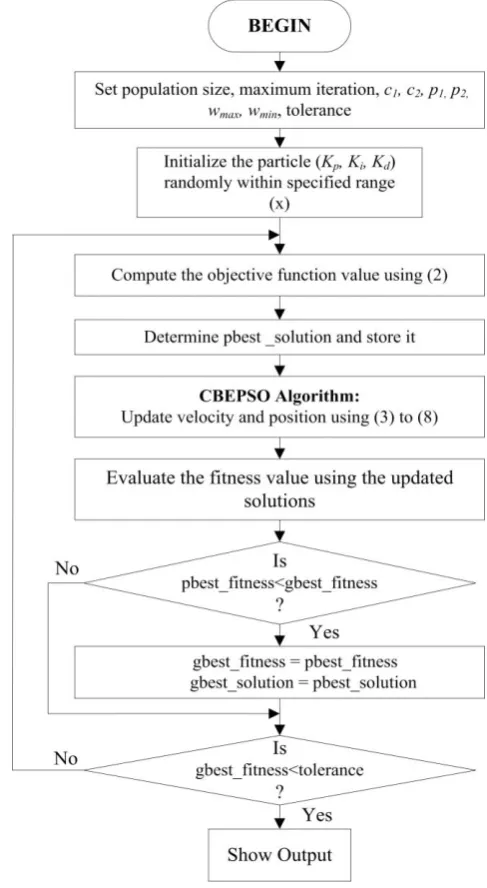
Kp, Ki and Kd for both the areas. In this problem, the control gains are treated as decision variables (particles). A novel CEPSO algorithm is uniquely used to design the control gains properly. From literature, it is found that the proposed algorithm has never been used so far to solve the LFC problem. For quick convergence, the particles are initialized within a specified practical range. Range selection is important otherwise it will aggravate the convergence problem. The practical range of control parameters for the proposed model is obtained as -2 to 2. The Simulink model of the power system model is given in Fig. 1 where a step load change of 0.1 (∆PL = 0.1) is considered at area 1. The simulation process is complicated in this case because of the complex and non-linear characteristic of the given power system model. The pbest and global solution gbest are obtained using the developed CEPSO algorithm. The detail steps of CEPSO algorithm for LFC are given in Fig. 2.
6. RESULTS AND DISCUSSION
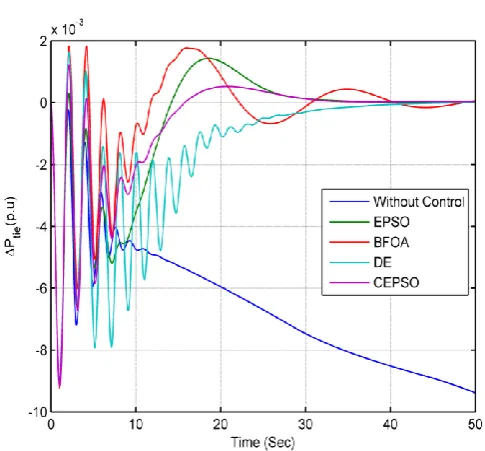
The performance of EPSO, BFOA, DE and CEPSO algorithm is tested using MATLAB 7.1 with a PC of 2GB RAM, Core i5 processor and 2.5 Ghz clock speed. In this section, a performance comparison between different applied algorithms is carried out to validate the superiority of one algorithm over the others. For this purpose, the tuned values of PID control parameters are obtained by performing the simulation 30 times for each algorithm. The transient and steady state performances of the power system are observed using these tuned control parameters. The designed control parameters and the corresponding response specifications are given in Table 1 and Table 2. The response characteristics for different algorithms are depicted in Fig. 3 to Fig. 5.
It is observed from Table 2 and Fig. 3 to Fig. 5 that the performance of BFOA and DE is better than EPSO except in the case of Mp in tie-line power deviation. EPSO produces less
Mp in tie-line compare to BFOA and DE. It is also observed from the results that the steady and transient performances of DE are better compared to BFOA since DE produces less
[image:5.595.317.553.74.267.2]SSE, Mp and tscompare to BFOA. The proposed CEPSO based control methodology with the uniquely formulated cost function produces the best result compare to EPSO, BFOA and DE algorithm. The results demonstrate that the PID controllers tuned by CEPSO improved the power system performance by lessening the frequency and tie-line power deviation to almost zero and improving the transient performances. This leads to the improvement of stability also.
[image:5.595.317.551.301.507.2]Fig – 3: Frequency deviation of area 1
Fig – 4: Frequency deviation of area 2
[image:5.595.313.556.534.759.2]© 2017, IRJET | Impact Factor value: 6.171 | ISO 9001:2008 Certified Journal | Page 806
Table -1: Tuned Control Gains
Table -2: Performance Specification
Algorithm Max. Overshoot (Mp)*10-4 Settling Time[ts (sec)] Steady State Error(SSE)* 10-5
Area 1 Area 2 Tie - Line Area 1 Area 2 Tie - Line Area 1 Area 2 Tie - Line
EPSO [13] 22 25 14 29.84 30.56 28.19 1.9064 1.9273 1.9356
BFOA [16] 16 18 18 28.91 30.51 38.26 1.8584 1.8331 1.7786
DE [17] 10 10 17 28.28 27.88 28.06 1.8052 1.7905 1.7013
CEPSO 4.23 4.72 9.88 20.17 20.37 27.68 1.7431 1.7624 1.6479
7. CONCLUSIONS
The design and analysis of LFC for two area non-linear interconnected multisource power system using different evolutionary algorithms is presented in this study. In each area, three distinct and most popular power generating units such as non-reheat reheat and hydro generation units with real time system parameters are considered to develop the power system model. The parameter values of all generating units are taken different to get the practical design. For achieving faster convergence and desired dynamic performance of the power system, an exclusive cost function is formulated by considering important transient and steady state performance specifications like SSE, Mp and ACE. In this work, a new CEPSO algorithm is developed by combining EPSO and chaos theory to obtain the best steady state and transient performance of the power system. In this newly developed algorithm, the chaos variables are generated in such a way that the diversity of the optimization variables be maintained properly and true optimal control gains are achieved. A comparison study between CEPSO and other efficient algorithms like EPSO, BFOA and DE is carried out. The simulation results prove that the proposed CEPSO algorithm gives the best steady state and transient performances compare to others. The CEPSO produces the excellent damping performance and provides more stability compare to EPSO, BFOA and DE. Due to its simplicity and excellent convergence capability, CEPSO can be easily applied to other complex engineering problems.
APPENDIX
A. The typical values of the system parameters are given bellow:
Area 1/Area 2: Nonreheat - Time Constant of Governor (Tg) = 0.07s/0.08s; Turbine Time Constant (Tt) = 0.4s/0.3s; Droop (R1)= 2.6 Hz/pu MW/2.8 Hz/pu MW; Generation Rate Constraint (GRC) = 0.00167 pu/s/0.00167 pu/s (10% pu MW/min); Governor Dead Band (GDB) = 0.0006 pu/0.0006
pu (0.06% of f); Participation Factor (α1) = 0.3/0.3. Reheat - Time Constant of Governor (Tg)= 0.06s/0.08s; Turbine Time Constant (Tt) = 0.36s/0.42s; Reheat Constant of Turbine (Krh) = 0.3/0.5; Reheat Time Constant of Turbine (Trh) = 7s/10s; Droop (R2) = 2.6 Hz/pu MW/2.8 Hz/pu MW; Generation Rate Constraint (GRC) = 0.0005 pu/s/0.0005 pu/s (3% pu MW/min); Governor Dead Band (GDB) = 0.0006 pu/0.0006 pu (0.06% of f); Participation Factor (α2) = 0.5/0.5. Hydro - Governor Time Constant (Tg)= 0.4s/0.2s; Water Time Constant (Tw) = 1s/2s; Time Constant of the Hydro Governor (T2) = 28.75s/68.8s; Reset time of hydro governor (Tr) = 5s/8s; Droop (R3) = 2.6 Hz/pu MW/2.8 Hz/pu MW; Generation Rate Constraint (GRC) = 0.0167 pu/s/0.0167 pu/s (100% MCR/min); Governor Dead Band (GDB) = 0.0002 pu/0.0002 pu (0.02% of f); Participation Factor (α3) = 0.2/0.2. Frequency bias factor (B) = 0.425 p.u.MW/ Hz/0.380 p.u.MW/ Hz. Load & Machine - Time Constant (Tp) = 4.125s/7.3s; Gain (Kp) = 24.75 Hz/pu MW/43.8 Hz/pu MW; Frequency (f) = 60 Hz/ 60 Hz; Power Capacity = 1800 MW/1200 MW.
B. The algorithm parameters are as follows:
(1) EPSO and CEPSO: Constriction factors, c1 = c2 = 1.44445, maximum inertia weight (wmax) =0.95, minimum inertia weight (wmin) = 0.4, p1 = 0.2, p2 =7. (2) BFOA [16]: No. of bacteria = 10, no. of chemotatic steps = 10, no. of reproduction steps = 4, no. of elimination and dispersal events = 2, probability of elimination and dispersal = 0.25. (3) DE [17]: Population size = 50, iteration number = 100, mutation scale factor (F) = 0.8, crossover rate (CR) = 0.8.
REFERENCES
[1] P. Kundur, Power System Stability and Control, McGraw-Hill, 1994.
© 2017, IRJET | Impact Factor value: 6.171 | ISO 9001:2008 Certified Journal | Page 807 [3] M. Zribi, M. Al-rashed and M. Alrifa, “Adaptive
Decentralized Load Frequency Control of Multi-area Power Systems,” International Journal of Electrical Power & Energy Systems, vol. 27, no. 8, Oct. 2005, pp. 575-583, doi:10.1016/j.ijepes.2005.08.013.
[4] M. Rahmani and N. Sadati, “Hierarchical Optimal Robust Load Frequency Control for Power Systems,” IET Generation, Transmission & Distribution, vol. 6, no. 4, April 2012, pp. 303-312, doi: 10.1049/iet-gtd.2011.0544
[5] C. Zhang, L. Jiang, Q.H. Wu, Y.He and M. Wu, “Delay-Dependent Robust Load Frequency Control for Time Delay Power Systems,” IEEE Transactions on Power Systems, vol. 28, no. 3, Aug. 2013, pp. 2192-2201, doi: 10.1109/TPWRS.2012.2228281
[6] H. Yousef, “Adaptive Fuzzy Logic Load Frequency Control of Multi-Area Power System,” International Journal of Electrical Power & Energy Systems, vol. 68, pp. 384-395, Jun 2015.
[7] K.R. Sudha and R. Vijaya Santhi, “Load Frequency Control of an Interconnected Reheat Thermal System using Type-2 Fuzzy System Including SMES Units,” International Journal of Electrical Power & Energy Systems”, vol. 43, no. 1, pp. 1383-1392, Dec. 2013., doi: 10.1016/j.ijepes.2012.06.065
[8] D.Rerkpreedapong, A. Hasanovic and A. Feliachi, “Robust Load Frequency Control using Genetic Algorithms and Linear Matrix Inequalities,” IEEE Transactions on Power Systems, vol. 18, no. 2, pp. 855-861, May 2003, doi: 10.1109/TPWRS.2003.811005
[9] H. Golpîra, H. Bevrani and H. Golpîra, “Application of GA Optimization for Automatic Generation Control Design in an Interconnected Power System,” Energy Conversion and Management, vol. 52, no. 5, May 2011, pp. 2247-2255.
[10] P. Bhatt, S.P. Ghoshal and R. Roy, “Load Frequency Stabilization by Coordinated Control of Thyristor Controlled Phase Shifters and Superconducting Magnetic Energy Storage for Three Types of Interconnected Two-Area Power Systems,” International Journal of Electrical Power & Energy Systems, vol. 32, no. 10, pp. 1111-1124, Dec. 2010.
[11] K. Zare, M.T. Hagh and J. Morsali, “Effective Oscillation Damping of an Interconnected Multi-Source Power System with Automatic Generation Control and TCSC,” International Journal of Electrical Power & Energy Systems, vol. 65, pp. 220-230, Feb. 2015.
[12] H. Gozde and M.C. Taplamacioglu, “Automatic Generation Control Application with Craziness Based Particle Swarm Optimization in A Thermal Power System,” International Journal of Electrical Power & Energy Systems, vol. 33, no. 1, pp. 8-16, Jan. 2011.
[13] S.Chen, Z. Xu, Y. Tang and S. Lee, “An Improved Particle Swarm Optimization Algorithm based on Centroid and Exponential Inertia Weight,” Mathematical Problems in Engineering, 2014, pp. 1-14.
[14] M. Eslami, H. Shareef, A. Mohamed and M. Khajehzadeh, “An Efficient Particle Swarm Optimization Technique with Chaotic Sequence for Optimal Tuning and Placement of PSS in Power System,” International Journal of Electrical Power & Energy Systems, vol. 43, no. 2, pp. 1467-1478, Feb. 2012.
[15] A.H. Gandomi, G. J. Yun, Xin-She Yang and S. Talatahari, “Chaos-enhanced Accelerated Particle Swarm Optimization,” Communications in Nonlinear Science and Numerical Simulation, vol. 18, no. 2, pp. 327-340, Feb. 2013.
[16] E.S. Ali and S.M. Abd-Elazim, “Bacteria Foraging Optimization Algorithm based Load Frequency Controller for Interconnected Power System,” International journal of Electrical Power and Energy System, vol. 33, pp. 633–638, March 2011.
[17] B. Mohanty, S. Panda and P.K. Hota, “Differential Evolution Algorithm Based Automatic Generation Control for Interconnected Power Systems with Non-linearity,” Alexandria Engineering Journal, vol. 53, pp. 537-552, September 2014.
[18] H. Gozde, M. C. Taplamacioglu and İlhan Kocaarslan, “Comparative Performance Analysis of Artificial Bee Colony Algorithm in Automatic Generation Control for Interconnected Reheat Thermal Power System,” International Journal of Electrical Power & Energy Systems, vol. 42, no. 1, pp. 167-178, Nov. 2012.
[19] A. K. Barisal, “Comparative Performance Analysis of Teaching Learning Based Optimization for Automatic Load Frequency Control of Multi Source Power System,” International Journal of Electrical Power & Energy Systems, vol. 66, pp. 67-77, March 2015.
[20] P. Dash, L.C. Saikia and N. Sinha, “Automatic Generation Control of Multi Area Thermal System using Bat Algorithm Optimized PD–PID Cascade Controller,” International Journal of Electrical Power & Energy Systems, vol. 68, June 2015, pp. 364-372.
[21] S. Panda, B. Mohanty and P.K. Hota, “Hybrid BFOA–PSO Algorithm for Automatic Generation Control of Linear and Nonlinear Interconnected Power Systems,” Applied Soft Computing, vol. 13, no. 12, Dec. 2013, pp. 4718-4730, doi: 10.1016/j.asoc.2013.07.021.