http://dx.doi.org/10.4236/ojf.2015.53025
Nitrogen and Organic Matter
Mineralization in the Tunisian Cork
Oak Forest: A Laboratory Study
Zouaoui Ikbel
1,2, Abbes Chaabane
1, Ouled Sghaier Wided
1, Hasnaoui Foued
1,
Hasnaoui Brahim
1, Smiti Samira
21Sylvo Pastoral Institute of Tabarka, University of Jendouba, Jendouba, Tunisia 2Faculty of Sciences of Tunis, University of Tunis El Manar, Tunis, Tunisia
Email: [email protected]
Received 16 February 2015; accepted 14 March 2015; published 19 March 2015
Copyright © 2015 by authors and Scientific Research Publishing Inc.
This work is licensed under the Creative Commons Attribution International License (CC BY). http://creativecommons.org/licenses/by/4.0/
Abstract
The mineralization of the organic matter is a very important phenomenon which leads to the re-lease of nutriments used by plants. The rate of transformation of the organic matter depends on several factors and parameters such as climatic factors and biological and physicochemical prop-erties of the soil and the litter. In this study, we investigate the effect of the addition of litter of various species as well as the effect of soil moisture on mineralization of organic matter and on mineral nitrogen release in three soils sampled in three cork oak stands during a period of 41 days under the same laboratory conditions. Carbon mineralization was determined using CO2 res-piration method, whereas the mineral nitrogen content was measured at the last day of incubation both in soil samples with added plant leaf material, and in control soil samples without addition under two treatments of moisture (40% and 80% WHC—water holding capacity). Our results show that the addition of leaf litter causes an increase in the microbial activity. Soils without addi-tion were significantly different from the plant leaf added soils in respect to carbon mineralizaaddi-tion at the end of the incubation period. Moreover, it is noted that the mineralization of carbon is more marked with moisture at 80% than that of 40%, contrary to that of the nitrogen, which is not in-fluenced by the variation of moisture.
Keywords
Mineralization, Organic Matter, Carbon, Nitrogen, Cork Oak, Moisture
1. Introduction
processes that determine the amount of organic C remaining in the forest floor (Berg et al., 2001). Thus, Litter decomposition process represents an essential phase in the organic matter and nutrient cycle. The litter decay rate is a factor that largely determines forest soil fertility and its regulation plays an important role in ecosystem functioning(Swift et al., 1979).
Decomposition rate of plant materials and nutrient release patterns are controlled by both biotic and abiotic factors; one of the most important is the litter quality (Aerts, 1997; Silver and Miya, 2001; Teklay et al., 2007). The initial concentrations of nitrogen (N), phosphorus (P), the ratios of C/N and lignin/N are generally recog-nized as the main litter quality variables controlling rates of decomposition (Melillo et al., 1982; Aerts and De Caluwe, 1997; Teklay et al., 2007). In this sense, the carbon-nitrogen ratio (C/N) has been demonstrated to be a good index of the susceptibility of litter to be degraded (Berg et al., 1982; Taylor et al., 1989). In general, litter with a low C/N ratio is decomposed faster than litter with a high C/N ratio (Adams and Atwill, 1982). However, when C/N ratios exceed 75 - 100, other indexes such as lignin/N may be better as indicators of litter quality (Heal et al., 1997).
The mineralization of the organic matter in the soil is a biological process that is influenced by the environ-mental conditions, mainly the temperature and moisture. On the one hand, temperature controls the enzymatic activity of soil microorganisms. On the other hand, soil water content is an important factor that may limit the microbial activity. N’Dayegamiye (2007) stresses that the activity of the microorganisms decreases under dry soil conditions. The activity of microorganisms is also closely associated with nutrient availability, as well as with soil aeration as it controls the diffusion of oxygen in the soil. These factors affect the soil microbial com-munity simultaneously and cannot be separated from each other(Griffin, 1981). The microorganisms are gener-ally considered as being a driving force or a catalyst of the decomposition process. Indeed, they break up the or-ganic matter in order to obtain essential energy for their growth and their activity.
Grundmann et al. (1995) and Uhlirova et al. (2005) have shown that the optimum soil moisture for aerobic microbial processes is 50% - 60% of WHC (soil water holding capacity). At soil moistures below this optimum, low water and nutrient availability limit microbial processes, while at water contents above this optimum, mi-crobial aerobic activity is limited by reduced aeration (Papendick and Campbell 1981) and development of an-aerobic conditions. Until a certain limit, the biological activities and the rates of mineralization increase with the rise in temperature and moisture in the soil.
The organic matter in contact with the soil undergoes a disintegration of its components. The microorganisms of the soil carry out this primarily biological stage. In the soil, the litter is subjected to two great types of proc-esses. A part is mineralized, thus closing the C and N cycles, while the other part, is preserved in the soil and constitutes the humus. Nitrogen and carbon fluxes are closely dependent during the decomposition of litter (Mary et al., 1996). During the decomposition process, carbon is used as energy substrate by the microorganisms and is integrated into the microbial biomass (organization) while the most recalcitrant part, can be stabilized af-ter a period of time (Berg et al., 1982). Moreover, in forest soils, N mineralization of soil organic mataf-ter is an important mechanism as it is the main source of mineral N in these ecosystems.
Mediterranean forests are subject to very restrictive conditions such as frequent drought conditions, higher temperatures and forest management practices that degrade the soil especially in the south part of the Mediter-ranean basin. Little has been investigated about soil C, N and microbial dynamics on organic matter decomposi-tion rates in such Mediterranean ecosystems. The overall objective of this study was to provide informadecomposi-tion about carbon and nitrogen mineralization in North of Africa especially in Tunisia. For this reason, we will ex-amine the effects of the variation of the soil water content and the addition of leaf litter on organic matter and nitrogen mineralization under the same laboratory conditions. This was achieved in three contrasting cork oak forests representative of one of the main forest ecosystems in the south part of the Mediterranean basin. Indeed, cork oak in Tunisia occupies a surface that represents approximately 50% of the area occupied by deciduous fo-rests and approximately 10% of the total forest area in Tunisia and about 5% of the area occupied by the world cork oak forests. In Tunisia, cork oak forests are at 80% in pure stands and at 20% mixed with zeen oak ( Quer-cus canariensis Willd). In addition to their important hydrological and ecological roles, cork oak forests are subject to intense economic exploitation placing Tunisia among major cork producing countries.
2. Materials and Methods
2.1. Study Sites
(Lati-tude 36˚52'57.83"N/Longitude 8˚46'52.48"E). The climate of study sites is Mediterranean and Tabarka be longs to the humid bioclimatic zone. The annual precipitation is 1034 mm. The wettest season is winter with a maxi-mum of 176.2 mm in December followed by November with 157.6 mm. The driest season is summer with a minimum in July 4.9 mm followed by the month of August 11.2 mm. The mean annual temperature is 18.5˚C (Selmi, 1985; Hasnaoui, 1992).
The three sites used for soil sampling are described below and in Table 1. Site 1, called hereafter S1 is com-posed of a pure vegetation of cork oak (Quercus suber L). Site 2 (S2) is composed of a mixed vegetation of cork oak and zeen oak (Quercus canariensis willd). Site 3 (S3) is composed of a degraded vegetation of cork oak. Soils in S1 and S2 have essentially the same chemical characteristics, but soil in S3 presents carbon and nitrogen contents lower than the two others (Table 1).
2.2. Experimental Design
The effects of soil moisture and leaf litter addition on nitrogen and organic matter mineralizationwere studied by incubation under aerobic conditions. This experiment was established following a full factorial design: 4 repli-cates with 4 leaf litter types (Quercus suber (Qs), Quercus canariensis Willd (Qc), Pinus pinaster (Pp) and Pinus pinea (Ppinea)) and 2 controlled soil moistures (80% and 40% WHC) in three study sites.
The soil sampling in the three forests was carried out in October 2006. Five superficial soil samples were taken from the upper 20 cm of each forest after removing litter and debris from the surface and then were mixed, homogenized and considered as a composite and representative samples of each site. These composite samples were oven dried at 30˚C and sieved through a 2 mm mesh sieve before incubation.
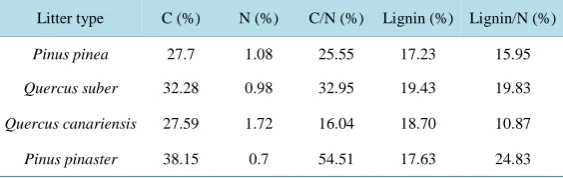
Organic carbon content of soil was determined by the colorimetric method and organic nitrogen content (%) was determined by kjeldahl method. Leaf litter was also collected at the same time, in 2006 from the same forest sites, they were oven dried at 70˚C for 48 h and then passed through a 200 µm mesh sieve. Main Chemical properties of the litter used for the incubation are shown in Table 2.
2.3. Measurement of C and N Mineralization
[image:3.595.172.455.506.596.2]Carbon mineralization was measured as respired CO2-C in closed chamber. According the experimental design described above, 300 g of soils was mixed with 5 g oven-dried leaf and placed in 1000 ml vessels for the carbon mineralization assays. The moisture contents of soils were adjusted to 80% of their field capacity. The same ex-perience was realized with the moisture of 40% WHC. The C-CO2 produced from microbial respiration was trapped periodically in 8 ml NaOH solutions in a small tube. Empty vessel was used as blank. The C-CO2 pro-
Table 1.Main physical and chemical properties (mean ± SE Standard Error, n = 3) of the soils sampled from the three cork oak forest sites.
Characteristic Site 1 Site 2 Site 3
pH 5.28 ± 0.11 5.18 ± 0.07 5.58 ± 0.12
C (%) 10.27 ± 3.6 7.71 ± 3.05 1.66 ± 1.26
N (%) 2 ± 0.3 1.25 ± 0.2 0.5 ± 0.11
C/N ratio 5.13 ± 1.1 6.17 ± 1.09 3.32 ± 0.9
Table 2.Chemical properties of the initial quality of litter used in the experi-mental work.
Litter type C (%) N (%) C/N (%) Lignin (%) Lignin/N (%)
Pinus pinea 27.7 1.08 25.55 17.23 15.95
Quercus suber 32.28 0.98 32.95 19.43 19.83
Quercus canariensis 27.59 1.72 16.04 18.70 10.87
[image:3.595.172.454.633.722.2]duced as a result of microbial respiration was measured about every 3 days by titration with chlorhydric acid HCl. Incubations were carried out for 41 days at non-limiting temperature ranging from 20˚C to 25˚C. Net C-CO2 production from litter decomposition at each sampling time was determined as the difference between cumulative C-CO2 produced by soil + litter and by soil alone, and then the ratio (%) of carbon mineralization of the three soils was calculated by diving the cumulative C-CO2 produced in 41 days by the C added.
Nitrogen mineralization was calculated at the end of the incubation period. For this, 5 g of soil was mixed with 25 ml KCl (1N) solution and shaken for 1 h. Mineral nitrogen was measured using specific ion meter (Thermo-ORION 710).
2.4. Statistical Analysis
Data analysis was performed using SAS software. Statistical significance of differences between means of dif-ferent variables has been determined bythe Student Newman Keuls (SNK) test using a significance threshold of 5%. We tested the effect of litter, sites and soil moisture on carbon and nitrogen mineralization.
3. Results
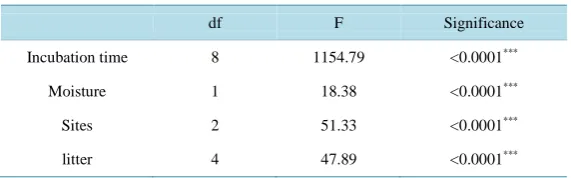
Statistical tests show a highly significant effect (P < 0.0001) of soil moisture, type of soil, addition of fresh litter and the incubation time on the soil respiration (Table 3). The cumulative quantity of C-CO2 produced clearly increased with the incubation time in all treatments (P < 0.0001). There were also significant differences in the quantity of C mineralized between the litters and the two moisture treatments at the end of the incubation period (P < 0.0001, Table 3). No double or triple interaction was reported.
3.1. Moisture Effect
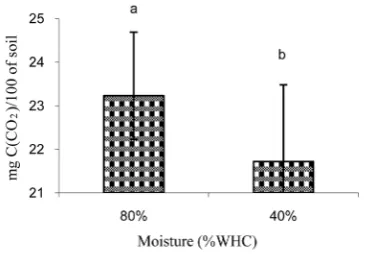
The moisture of samples plays an important role in C mineralization. Indeed, the increase in moisture causes an increase in carbon mineralization (Figure 1). The kinetics of mineralization is much more important at a mois-ture content of 80% of field capacity than 40% and that for the 3 sites (P < 0.0001), (Figure 1). Thus, after 41 days of incubation, the average of the soil respiration over all plots and litter treatments decreases from 23.23 mg C-CO2 at the moisture of 80% WHC to 21.72 mg C-CO2 at the moisture of 40% WHC.
3.2. Effect of Soil’s Type and Litter Addition on C Mineralization
Statistical analysis shows that there is a significant effect (P < 0.0001) of soil type on C mineralization (Table 3). In fact, our study shows that the S1 and S2 have the higher activity of C mineralization. This activity reached after 41 days of incubation, respectively an average of 24.03 and 23.13 mg C-CO2. However, this activity is lower in the S3 (20.28 mg C-CO2) (Figure 2).
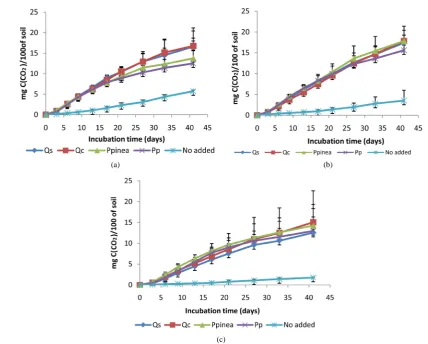
Generally, cumulative C mineralization of soil amended with plant residues was significantly higher than the control during the entire incubation period.
On the one hand, our results suggest that the addition of leaves to the three types of soil clearly increases mi-crobial activity (Figure 3 and Figure 4). However, there has been a latency period ranging from 3 to 5 days de-pending on the nature of soil and the type of litter. The difference between the different types of litter was ob-served clearly after 20 to 30 days of incubation, depending on the type of soil and the moisture.
After 41 days of incubation, the decomposition of Pinu spinea needles in the S1 and S2 at 80% WHC was the fastest and higher than the others while the decomposition of Pinus pinaster was lower than the other litters in
Table 3. Variance analysis of the effect of incubation time, addition of leaf litter and moisture on the rate of C mineralized.
df F Significance
Incubation time 8 1154.79 <0.0001***
Moisture 1 18.38 <0.0001***
Sites 2 51.33 <0.0001***
[image:4.595.171.457.628.717.2]Figure 1. Effect of soil moisture (% WHC―water holding capacity) (soils
plots and litter treatments were pooled) on total amount of respired CO2 (mg C-CO2/100 g of soil). Vertical bars are standard deviations.
Figure 2. Total amount of respired CO2 (mg C-CO2/100 g of soil) in the different sites. Vertical bars are standard deviations.
the three sites and at the two moisture treatments (Figure 3 and Figure 4). On the other hand, the decomposition of Quercus canariensis is higher than Pinus pinea needles in site S1 and S3 at 40% WHC.
3.3. Ratio of C and N Mineralization
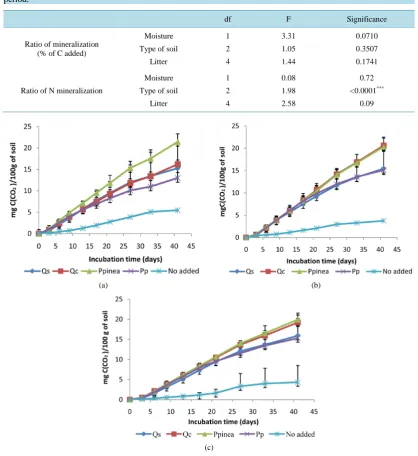
The ratio of carbon mineralization was not statistically affected by moisture content, soil’s type and the addition of litter. In addition, neither was there any significant effect of double and triple interactions (Table 4). The ratio of mineralized nitrogen was only affected by soil’s type (P < 0.0001); this percentage was higher in S1 (2.02%) and lower in site 3 (1.33%) (Figure 5).
4. Discussion
The aim of our study was to provide information on carbon mineralization in North of Africa since little study on this subject has been conducted.
[image:5.595.213.418.260.396.2]Table 4.Effect of moisture, type of soil and leaf litter addition on the variation of the ratio of carbon mineraliza-tion to added carbon and the ratio of N mineralizamineraliza-tion to total nitrogen content of litter at the end of incubamineraliza-tion period.
df F Significance
Ratio of mineralization (% of C added)
Moisture Type of soil
Litter
1 2 4
3.31 1.05 1.44
0.0710 0.3507 0.1741
Ratio of N mineralization
Moisture Type of soil
Litter
1 2 4
0.08 1.98 2.58
0.72 <0.0001***
0.09
(a) (b)
(c)
Figure 3. Cumulative C mineralized in the soils under (a) site 1, (b) site 2 and (c) site 3 at different days at the soil moisture of 80% WHC (water holding capacity). Vertical bars are standard deviation.
The activity of mineralization was most pronounced in the soil added with Pinus pinea (26.42 mg C-CO2/100 g), Quercus canariensis (25.11 mg C-CO2/100 g), and Quercus suber (23.27 mg C-CO2/100 g); but the evolu-tion of the C-CO2 in the three soils added with Pinus pinaster litter at the end of the incubation period was weak and slow compared with other litters. This could be explained by the fact that the needles of this species have a certain inability to be decomposed because these needles have a very long half-life of 5.4 years, while the
Quercus canariensis is 4.96 years (Selmi, 1985; Kurz et al. 2000) and also because of the very high percentage of C/N ratio of the litter (C/N = 54.51).
(a) (b)
[image:7.595.91.520.79.423.2](c)
Figure 4. Cumulative C mineralized in the soils under (a) Site 1, (b) Site 2 and (c) Site 3 at different days at the soil moisture of 40% WHC (water holding capacity). Vertical bars are standard deviation.
Figure 5. Ratio of mineralization of the organic nitrogen in Site 1 (a), Site 2 (b) and Site 3 (c) at the end of incu-bation period.
This was confirmed for Pinus pinaster litter but it was the opposite for Pinus pinea.
In our study, we concluded that the decomposition showed negative correlation with initial lignin content as well as C/N and lignin/N (Table 2). Some studies revealed that lignin concentration largely explained the litter decomposition within and between species (McTiernan et al., 2003;Osono, T. and Takeda, H., 2005).
[image:7.595.207.425.463.600.2]E. F. Salamanca et al. found that Quercus showed a higher decomposition than Pinus litter because the initial substrate quality, that’s the nitrogen, was higher in Quercus than that in Pinus leaf litter.
Previous studies also suggested that initial N concentration or C/N ratio of residues was the main factor con-trolling decomposition and nutrient release (Melillo et al., 1982; Berg, 1986; Taylor et al., 1989; Raiesi, 2006; Teklay et al., 2007).
Also, nitrogen exerts great influence in the early stage of decomposition because it affects the physiological adaptation of decomposer organisms (Richards, 1987), and leaf litter with higher initial N concentration (lower C:N ratio) decomposes faster (Berg and Staaf, 1982).
At the end of the incubation period, the percentage of nitrogen mineralization showed that the mineralization process was higher in S1 and S2 but lower in S3. These results showed that microbial activity was much more intense in the first two soils. In comparison with control samples, we notice that the rate of mineralization in-creases with the addition of litter. Our results contradict those found by Aka and Darici (2005), who found that the percentage of mineralization decreased with the addition of Aleppo pine and oak Kermes litter in different type of soil. According to these findings, stimulatory or inhibitory effects of organic matter addition to soil mi-crobial activity may depend on internal conditions of soils.
Acknowledgements
We are very grateful for the thorough and helpful comments from the reviewer of the manuscript. We also thank all the people who helped us during field and laboratory measurements. Finally, we would like to thank Dr Ka-mel Soudani for his critical and thoughtful comments and for his time spent in preparing our manuscript.
References
Adams, M. A., & Atwill, P. M. (1982). Nitrogen Mineralization and Nitrate Reduction in Forests. Soil Biology and Bio-chemistry, 14, 197-202. http://dx.doi.org/10.1016/0038-0717(82)90023-2
Aerts, R. (1997). Climate, Leaf Litter Chemistry and Leaf Litter Decomposition in Terrestrial Ecosystems: A Triangular Re-lationship. Oikos, 79, 439-449.
Aerts, R., & De Caluwe, H. (1997). Initial Litter Respiration as Indicator for Long-Term Leaf Litter Decomposition of Carex Species. Oikos, 80, 353-361. http://dx.doi.org/10.2307/3546603
Aka, H., & Darici, C. (2005). Carbon and Nitrogen Mineralization in Carob Soils with Kermes Oak and Aleppo Pine Leaf Litter. Soil Biology, 41, 31-38.
Azzalini, A., & Diggle, P. (1993). Prediction of Soil Respiration Rates from Temperature, Moisture Content and Soil Type. J. STOR, Applied Statistics, 43, 505-526.
Berg B., Mc Claugherty, C., De Santo, A. V. et al. (2001). Johnson, Humus Buildup in Boreal Forests: Effects of Litter Fall and Its N Concentration. Canadian Journal of Forest Research, 31, 988-998. http://dx.doi.org/10.1139/x01-031
Berg, B., Staaf, H.,Wessen, B., & Ekbohm, G. (1982). Nitrogen Level and Decomposition in Scots Pine Needle Litter. Oikos, 38, 291-396. http://dx.doi.org/10.2307/3544667
Griffin, D. M. (1981). Water and Microbial Stress. Advances in Microbial Ecology, 5, 91-136.
Grundmann, G. L., Renault, P., Rosso, L., & Bardin, R. (1995). Differential Effects of Soil Water Content and Temperature on Nitrification and Aeration. Soil Science Society of America Journal, 59, 1342-1349.
http://dx.doi.org/10.2136/sssaj1995.03615995005900050021x
Hasnaoui, B. (1992). Chênaies du Nord de la Tunisie, Ecologie et Régénération. Doctorat d’état es-Sciences Naturelles, Univ de Provence Aix Marseille I, 186 p.
Heal, O. W., Anderson, J. M., & Swift, M. J. (1997). Plant Litter Quality and Decomposition: An Historical Overview. In G. Cadisch, & K. E. Giller (Eds.), Driven by Nature: Plant Litter Quality and Decomposition (pp. 3-30). Wallingford: CAB International.
Kurz, D. C., Coûteaux, M. M., & Thiéry, J. M. (2000). Residence Time and Decomposition Rate of Pinus Pinaster Needles in a Forest Floor from Direct Field Measurements under a Mediterranean Climate. Soil Biology and Biochemistry, 32, 1197-1206. http://dx.doi.org/10.1016/S0038-0717(00)00036-5
Mary, B., Recous, S., Darwis, D., & Robin, D. (1996). Interactions between Decomposition of Plant Residues and Nitrogen Cycling in Soil. Plant and Soil, 181, 71-82. http://dx.doi.org/10.1007/BF00011294
Biolo-gy and Biochemistry, 35, 801-812. http://dx.doi.org/10.1016/S0038-0717(03)00107-X
Melillo, J. M., Aber, J. D., & Muratore, J. F. (1982). Nitrogen and Lignin Control of Hardwood Leaf Litter Decomposition Dynamics. Ecology, 63, 621-626. http://dx.doi.org/10.2307/1936780
N’Dayegamiye, A. (2007). La contribution en azote du sol reliée à la minéralisation de la matière organique: Facteur climatique et régies agricoles influençant les taux de minéralisation d’azote. Colloque sur l’azote, CRAAQ-OAQ.
Osono, T., & Takeda, H. (2005). Limit Values for Decomposition and Convergence Process of Lignocellulose Fraction in Decomposing Leaf Litter of 14 Tree Species in a Cool Temperate Forest. Ecological Research, 20, 51-58.
http://dx.doi.org/10.1007/s11284-004-0011-z
Papendick, R. I., & Campbell, G. S. (1981). Theory and Measurement of Water Potential. L.F, 1-22.
Raiesi, F. (2006). Carbon and N Mineralization as Affected by Soil Cultivation and Crop Residue in a Calcareous Wetland Ecosystem in Central Iran. Agriculture, Ecosystems & Environment, 112, 13-20.
http://dx.doi.org/10.1016/j.agee.2005.07.002
Richards, B. N. (1987). The Microbiology of Terrestrial Ecosystems (p. 399). Harlow: Longman.
Salamanca, E. F., Kaneko, N., & Katagiri, S. (1998). Effects of Leaf Litter Mixtures on the Decomposition of Quercus ser-rata and Pinus densiflora Using field and Laboratory Microcosm Methods. Ecological Engineering, 10, 53-73.
http://dx.doi.org/10.1016/S0925-8574(97)10020-9
Selmi, M. (1985). Différenciation des sols et fonctionnement des écosystèmes forestiers sur grés numidien de Kroumirie (Tunisie). Ecologie de la Subéraie-Zeenaie. Doctorat d’état es-Sciences Naturelles, Univ de Nancy I, 200 p.
Silver, W. L., & Miya, R. K. (2001). Global Patterns in Root Decomposition: Comparisons of Climate and Litter Quality Ef-fects. Oecologia, 129, 407-419. http://dx.doi.org/10.1007/s004420100740
Swift, M. J., Heal, O., & Anderson, J. (1979). Decomposition in Terresterial Ecosystems (Studies in Ecology 5, p. 372). Ox-ford: Blackwell Scientific Publication.
Taylor, B. R., Parkinson, D., & Parsons, W. F. J. (1989). Nitrogen and Lignin Content as Predictors of Litter Decay Rates: A Microcosm Test. Ecology, 70, 97-104. http://dx.doi.org/10.2307/1938416
Teklay, T., Nordgren, A., Nyberg, G., & Malmer, A. (2007). Carbon Mineralization of Leaves from Four Ethiopian Agro-forestry Species under Laboratory and Field Conditions. Applied Soil Ecology, 35, 193-202.
http://dx.doi.org/10.1016/j.apsoil.2006.04.002
Uhlirova, E., Elhottova, D., Triska, J., & Santruckova, H. (2005). Physiology and Microbial Community Structure in Soil at Extreme Water Content. Folia Microbiologica, 50, 161-166. http://dx.doi.org/10.1007/BF02931466