
http://dx.doi.org/10.4236/ojsta.2014.34006
Spectrophotometric Characterization of the
Complex Generated in Solution for the
Reaction of H[Ru(III)Cl
2
(H
2
EDTA)] Complex
with AETS Modifier Agent
Angélica M. Lazarin, Rosana Lázara SernagliaDepartamento de Química, Universidade Estadual de Maringá, Maringá, Brazil Email: [email protected]
Received 18 June 2014; revised 3 August 2014; accepted 27 August 2014
Copyright © 2014 by authors and Scientific Research Publishing Inc.
This work is licensed under the Creative Commons Attribution International License (CC BY).
http://creativecommons.org/licenses/by/4.0/
Abstract
Spectrophotometric method was used to evaluate the kinetic of the complex formation from the reaction between H[Ru(III)Cl2(H2EDTA)] and the modifier agent [3-(2-aminoethyl)aminopropyl] trimethoxysilane (AEATS) (μ = 0.50 mol∙dm−3 with NaCF3COO, 298.15 K), in pseudo-first order conditions. These studies showed that the reactions are successives producing several species in-fluenced by the concentrations ratio. The electronics spectrum of all solutions showed a band in 457 nm with variable molar absorptivity (ε).
Keywords
[3-(2-Aminoethyl)aminopropyl]trimethoxysilane, H[Ru(III)Cl2(H2EDTA)] Complex, Spectrophotometric Method, Molar Absorptivity
1. Introduction
The examples in literature are abundant where complexes of Ru(III)/(II) containing organic ligands act as ho-mogeneous catalysts [1]-[4].
The understanding of the alterations in chemical properties of the metallic center Ru(III)/Ru(II) and the coor-dinate ligand of the ethylenediamine type become important, and therefore examples in the literature of com-plexes with this ligand act as anti-inflammatory and anti-tumors [5][6].
metal-lic center. These complexes of Ru(III)-EDTA are very sensible to the variations in the processes of synthesis and crystallization (pH, temperature and time of rest for the attainment of the product), presenting a very rich chemistry, with some products of synthesis [9].
In this work, the studied complex was dichloro(ethylenediaminetetraacetate)ruthenate (III) acid, H[Ru(III)- Cl2(H2EDTA)] (Figure 1), whose molecular structure recently was characterized by crystallographic data, being
an anionic complex, with number of coordination six and approximately octahedral structure. The Ru(III) is linked to two chlorides in cis-position—two atoms of oxygen of the groupings carboxylates in position trans and two nitrogen atoms of the amino groupings of EDTA ligand.
EDTA ligand is linked to four positions to the Ru(III) ion and it forms chelate rings with two free carboxylate groupings. The positions of trans coordination in relation to nitrogen atoms are occupied by two chlorides. The lengths of Ru-Cl linkings are next to those told in literature [7][9][10]. The complex presents EDTA ligand with two carboxylates groupings in trans position. Two EDTA amino groupings with two chlorides (in cis posi-tion) complete the planar formation of the octahedral structure. In this conformation the chelate effect of EDTA ligand must facilitate the reactions of substitution of ligand in this complex.
This study is part of an ampler project, involving the [Ru(III)(HEDTA)(H2O)] complex and its intermediary
of synthesis H[Ru(III)Cl2(H2EDTA)], and even so they are known for a long time, only the reactivity in solution
of the [Ru(III)(EDTA)(H2O)]1− complex ion is well known [11]-[13] and its electrochemical behavior in
mod-ified chemically electrode has been studied [14][15].
In literature [14], it found the study of the electrochemical behavior of the complex ion [Ru(III)(EDTA)(H2O)]1−
adsorbed on modified silica with zirconium oxide (IV), as well as its electrocatalytic activity in the reduction of the oxygen.
In this work we describe the spectrofotometric study of the complex generated in solution for the reaction of the H[Ru(III)Cl2(H2EDTA)] complex with AEATS modifier agent [3-(2-aminoethyl)aminopropyl]trimethox-
ysilane.
2. Experimental
2.1. Preparation of the H[Ru(III)Cl2(H2EDTA)] Complex
It had been dissolved 10.0 g of ruthenium trichloride (Aldrich, P.A.) in 60.0 cm3 concentrate HCl (Merck, P.A.), in a porcelain capsule, water bath and under agitation with a glass baton.
An orange solution was formed that was taken almost to the dryness. This process of evaporation was re-peated many times, after 20.0 cm3 addition of doubly-distilled water. It was added, then, 12.0 g of H4EDTA
(Carlo Erba), suspended in 10.0 cm3 of water. It formed a viscose mass that was dissolved slowly by the addi-tion of 60.0 cm3 of concentrated HCl, under constant agitation. A precipitate was formed, dissolved, forming a dark oil that became an adherent mass. With the 20.0 cm3 addition of water, it had redissolution, and the solution again was evaporated. This procedure was carried out many times. It was added then, 50.0 cm3 of solution 6.0 mol∙dm−3 of HCl. The solution was kept in freezer for three hours, having had the formation of a yellow solid.
This solid, of composition H[Ru(III)Cl2(H2EDTA)], was separated for filtration, washed with ether/ethanol
mixture.
Ru
NO
N
O HO
Cl
Cl HO
[image:2.595.236.355.575.703.2]1
2.2. Characterization of the Complex Generated in Solution for the Reaction of H[Ru(III)Cl2(H2EDTA)] Complex with AETS Modifier Agent
2.2.1. Potenciometric Determination of Apparent pKas of the AEATS
The solution of the AEATS was prepared (1.00 10× −2 mol∙dm−3,µ=0.20 mol∙dm−3 adjusted with NaCF3-
COO), that she was titleholder with HCl (0.1002 mol∙dm−3).
In the treatment of the data it had been used graphical method of derived first and second and also the Mod-ified Gran Method [16].
2.2.2. Espectrofotometric Studied of the Solution 1.56 × 10⁻⁴ mol∙dm−3 of H[Ru(III)Cl2(H2EDTA)] Complex with AEATS Modifier Agent
For the study of the kinetic one of formation a solution of the H[Ru(III)Cl2(H2EDTA)] complex (1.56 × 10⁻⁴
mol∙dm−3) with AEATS modifier agent was prepared (0.35 and 0.50 mol∙dm−3
). The ionic force was adjusted (0.50 mol∙dm−3
in NaCF3COO, 298.15 K) and the electronic spectra had been gotten in the 235 - 800 nm region.
It was also performed the kinetics of formation in ethanol to AEATS concentration of 0.20 mol∙dm−3. The
ki-netic data could have been treating for computational methods, but the considered treatment was the graph for consecutive reactions of pseudo-first order [17], using Excell spread sheet and interactive method.
This treatment is described in literature [17], where two consecutive stages of first pseudo-order are consi-dered:
2 1
k k
A→ →B C
and the following equations are used in this graphical method:
(
)
e( k t1) e( k t2)f A
A − =α − +β − (1)
(
)
1(
)
2[ ]
2 1
A B C A
o
k k
A
k k
ε ε ε ε
α= − + −
− (2)
(
)
1[ ]
2 1 B C o k A k k ε ε
β = −
− (3)
where A=absorbance, ε=molar absorptivity.
As foreseen for Equation (1), two segments of straight lines will be gotten in the graph ln
(
Af − A)
versust (time) and, with the straight line referring to the slower kinetic the values of k2obs (angular coefficient) and
lnβ (linear coefficient) are obtained. The kinetic constant for the fast reaction is calculated using Equation (4) and considering k1obs>k2obs
(
)
e( k t2) e( k t1)f A
A β − α −
∆ = − − = (4)
(
)
( 2)1
ln ln Af eA β k t lnα k t −
∆ = − − = − (5)
calling −βe(−k t2)=w
(
)
1ln∆ =ln Af − lnA −w= α−k t (6)
The amount ln
(
Af − A)
−w corresponds to the difference among the obtained values of the fast kineticand the extrapolation of the linear portion of the slow kinetic.
Then ln
(
Af − A)
−w versus t (time) supplies another constant of speed k1obs (angular coefficient)and the value of lnα (linear coefficient).
Therefore, the two constants are determined and, by Equation (3) the molar absorptivity
( )
εB of theinter-mediate B can be determined.
With all the definitive values
(
k1obs, k2obs, ε εA, B and εC)
the experimental confirmation of the kinetic datais effected applying Equation (7).
[ ]
[ ]
[ ]
T A t B t C t
[ ]
(
)
[ ]
( 1)(
)
1[ ]
( 1) ( 2)2 1
e k t o e k t e k t
T A o A C o B C
k A
A A A
k k
ε ε ε − ε ε − −
= + − + − −
− (8)
In this study of reactivity the relation in solution of the concentrations of ligand with the one of the complex was of 1282 (0.20 mol∙dm−3 (ethanol)), 2244 (0.35 mol∙dm−3) and 3205 (0.50 mol∙dm−3
), therefore always with great excess of ligand.
2.3. Characterization
The complex synthesized H[Ru(III)Cl2(H2EDTA)] was characterized by elemental analysis of carbon, nitrogen
and hydrogen (Microanalysis Laboratory, USP).
The potentiometric measurements were performed in a pH meter/pot Digimed model DMPH-3. Temperature control was performed by a thermostat bath Microquímica, model MQBTZ 99-20.
Microsyringes Gilmont Instruments were used in titrations, model GS-1200A, with a capacity of 2.000 cm3 and 0.002 cm3 of resolution, or 0.2000 cm3 0.0002 cm3 with resolution and a magnetic stirrer Tecnal TE 085. Electronic spectra were made on double beam spectrophotometer UV-Vis GBC 918 coupled to a Cordata mi-crocomputer, dual beam spectrophotometer UV-Vis Hitachi model U-2000 spectrophotometer and double beam spectrophotometer UV-Vis DU-70 using quartz buckets optical path of 1.0 and 0.1 cm.
3. Results and Discussion
Results of microanalysis complex H[Ru(III)Cl2(H2EDTA)] (calculated and experimental): (22.0% and 22.0%) C;
(5.1% and 5.0%) N and (4.4% and 4.1%) H.
The above values are consistent with the complex, H[Ru(III)Cl2(H2EDTA) 4.5 H2O.
The values of apparent pKas for AETS were pKa1=7.15 0.05± and pKa2 =9.88 0.05± .
(
CH O Si CH3) (
3 2)
3NH2(
CH2)
2 NH3 3H O2( ) (
OH Si CH3 2)
3NH2(
CH2)
2 NH3 3CH OH3+ +
− − + ⇒ − − + (9)
( ) (
OH Si CH3 2)
3NH2(
CH2)
2 NH3+
− − (10)
17.15
a pK ⇓
( ) (
OH Si CH3 2)
3NH(
CH2)
2 NH3+
− − (11)
29.88
a pK ⇓
( ) (
OH 3Si CH2)
3NH−(
CH2)
2−NH2 (12)The electronic spectra of the reaction solution of the complex H[Ru(III)Cl2(H2EDTA)]: (1.56 10× −4
mol∙dm−3) with AEATS modified agent 12:35 mol∙dm−3 (pH = 10.9) were registered according to the time, and they had the appearance of a band in the visible region λmax =457 nm (
3 2 9.4 10
ε = × +
cm−1∙mol−1∙dm3) attri-buted to the charge transfer transition metal ligand, with isosbestic point at 395 nm, after five hours of reaction. The final spectrum was attributed to the H[Ru(III)Cl2(H2EDTA)] complex formed with AEATS modified agent
coordinated bidentate to the metal. The formation kinetics were analyzed spectrophotometrically under pseu-do-first order conditions, at 298.15 K, with µ=0.50 mol∙dm−3 (NaCF3COO). The reaction of formation of the
H[Ru(III)Cl2(H2EDTA)] complex with AEATS modified agent was slow and the wavelength chosen for the
ki-netic study was λmax =457 nm.
The Figure 2, graph ln
(
Af − A)
versus time( )
s is representative of the behavior observed in this system,with the obtaining of two lines, showing the existence of three species in solution involving two successive stages, with a competitive product, dependent on the pH and the relationship between the concentrations of the AEATS and complex.
The values of kinetic constants
(
k2obs)
were obtained by the slopes of the straight lines of the graphs of(
)
ln Af − A versus time only for the slow step are shown in Table 1. The formation constants of the
interme-diates, k1obs, giving graphic treatment successive reactions for this system were obtained by the graphs of de
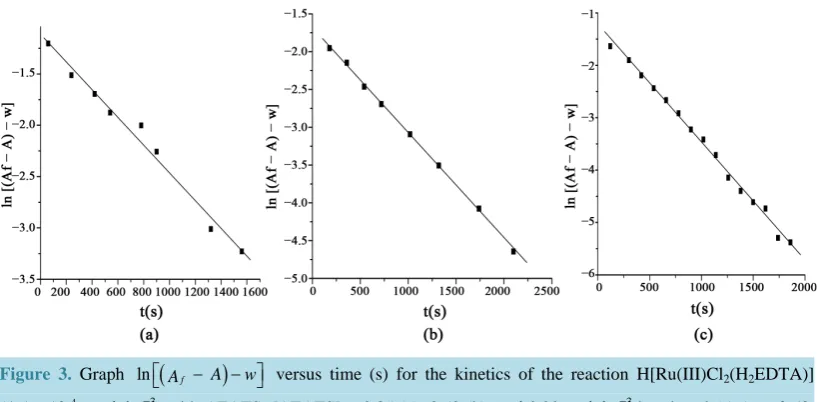
(
)
ln Af − A −w versus time (Figure 3) and are shown in Table 1.
Figure 2. Graph ln
(
Af − A)
versus time (s) for the kinetics of the reaction of H[Ru(III)Cl2(H2EDTA)](1.56 10× −4 mol∙dm−3) with AEATS; [AEATS] = 0.35 (a); 0.50 (b); and 0.20 mol∙dm−3 in ethanol (c)
[image:5.595.94.503.348.549.2](µ= 0.50 mol∙dm−3 in NaCF3COO, 298.15 K).
Figure 3. Graph ln
(
Af − A)
−w versus time (s) for the kinetics of the reaction H[Ru(III)Cl2(H2EDTA)]( 4
1.56 10× − mol∙dm−3) with AEATS; [AEATS] = 0.35 (a); 0.50 (b); and 0.20 mol∙dm−3 in ethanol (c) (µ= 0.50 mol∙dm−3 in NaCF
3COO, 298.15 K).
Table 1. Kinetic data obtained for the formation of H[Ru(III)Cl2(H2EDTA)] (1.56 10× −4 mol·dm−3) with the
AEATS; [AEATS] = 0.35; 0.50 and 0.20 mol·dm−3 (ethanol) (µ= 0.50mol·dm−3 in NaCF3COO, 298.15 K).
[AEATS] mol∙dm−3
2 0 10
ε × − cm−1∙mol−l∙dm3
3 1 10
ε× − cm−1∙mol−1∙dm3
3 2 10
ε × − cm−1∙mol−1∙dm3
4 1obs 10
k × + s−1 6
2obs 10
k × + s−1
0.35 1.7 4.4 9.4 13.5 ± 0.7 44.7 ± 0.3
0.50 2.9 2.4 4.4 14.2 ± 0.3 76 ± 1
0.20 (ethanol) 2.9 2.4 2.9 22.3 ± 0.4 460 ± 7
material
( )
ε0 are also shown in Table 1 and with these data it was possible to confirm the experimental kinetic [image:5.595.96.501.612.683.2]Figure 4. Kinetics of the reaction H[Ru(III)Cl2(H2EDTA)] (1.56 104 −
× mol∙dm−3) with AEATS; [AEATS] = 0.35 (a); 0.50
(b); and 0.20 mol∙dm−3 in ethanol (c) (µ= 0.50 mol∙dm−3 in NaCF
3COO, 298.15 K). (■) Experimental data and () data
using the values of Table 1, for the graphic treatment (Figure 2 and Figure 3) for successive reactions.
in this preliminary study of reactivity:
-ion complex with coordination number six, EDTA attached to the four positions, therefore, with two free carboxylate and the fifth and sixth ethylenediamine bound bidentate ([Ru(III)en(EDTA)]1−, ε=9.4 10× +3 cm−1∙mol−1∙dm3);
-ion complex with coordination number six, EDTA attached to the four positions, therefore, with two free carboxylate, one molecule of H2O in the fifth and sixth ethylenediamine bound monodentate by NH2 ([Ru(III)- (EDTA)en(H2O)]1−,
3
2.4 10
ε= × +
cm−1∙mol−1∙dm3) or by NH (ε=4.4 10× +3 cm−1∙mol−1∙dm3 );
-ion complex with coordination number six, with EDTA attached by five positions and sixth ethylenediamine bound monodentate by NH2([Ru(III)en(EDTA)]1−,
3
1.7 10
ε= × +
cm−1∙mol−1∙dm3);
-ion complex with coordination number six, with EDTA attached by five positions and sixth ethylenediamine bound monodentate by NH2 and having its electrostatic interaction with the NH2
+
group with the COO− of EDTA (ε=2.9 10× +3 cm−1∙mol−1∙dm3).
The study of this complex system with coordination number of six, with EDTA attached by five positions and for the sixth chloride (H[Ru(III)Cl(HEDTA)]) will facilitate the understanding of the reactivity presented when the ratio of the concentrations of the ligand AEATS with the complex of the order of more than 1000 times in solution, in these conditions there is the possibility of bonded reverse reactions in the complex through NH and NH2 ethylenediamine of the AEATS.
4. Conclusion
The complex generated in solution by the reaction of H[Ru(III)Cl2(H2EDTA)] complex with the AEATS
mod-ifier agent was characterized by a spectrophotometric study. Through the spectrophotometric study it revealed a band at 457 nm, attributed to the charge transfer ligand-metal. It was also possible to determine the kinetic con-stants
( )
kobs for the formation of complexes with the ethylenediamine of AEATS ligand bound monodentateand bidentate. This system showed very rich and complex chemistry, where depending on the concentration ra-tio of the AETS modifier agent with H[Ru(III)Cl2(H2EDTA)] complex, disproportionation reaction with
forma-tion of binuclear involving the III and IV species occurs, as suggested by Baar and Anson [18].
Acknowledgements
The authors are indebted to CNPq for financial support and J. A. da Silva for revising the manuscript.
References
[1] Sun, Y., Collins, S.N., Joyce, L.E. and Turro, C. (2010) Unusual Photophysical Properties of a Ruthenium(II) Complex Related to [Ru(bpy)2(dppz)]
2+
. Inorganic Chemistry, 49, 4257-4262. http://dx.doi.org/10.1021/ic9025365
[2] Lazarin, A.M. and Sernaglia, R.L. (1999) Adsorption of H[Ru(III)Cl2(H2EDTA)] Complex on Modified Silica Gel
[3] Masters, C. (1987) Homogeneous Transition-Metal Catalysis. Chapman and Hall Ltd., UK.
[4] Kannan, S., Kumar, K.N. and Ramesh, R. (2008) Ruthenium(III) Complexes of Amine-bis(phenolate) Ligands as Cat-alysts for Transfer Hydrogenation of Ketones. Polyhedron, 27, 701-708. http://dx.doi.org/10.1016/j.poly.2007.10.024
[5] Bulman, R. (1987) Coordination Compounds: Synthesis and Medical Application. Springer-Verlag, Berlin.
[6] Naik, K.H.N.K., Bhimareddy, A. and Naik, N. (2013) Ruthenium Metal Complexes and Their Biological Approach—
A Short Review. International Journal of Pharmaceutical Sciences and Research, 5, 758-773.
[7] Taqui Khan, M.M., Chatterjee, D., Merchant, R.R., Bhatt, A. and Sanal, K.S. (1991) Synthesis of the Complex [RuV= O(edta)]- and Its Application in the Oxidation of Saturated Substrates by Oxygen Atom Transfer Reaction. Journal of
Molecular Catalysis, 66, 289-293. http://dx.doi.org/10.1016/0304-5102(91)80021-T
[8] Toma, H.E. (2003) Molecular Materials and Devices: Developing New Functional Systems Based on the Coordination Chemistry Approach. Journal of the Brazilian Chemistry Society, 14, 845-869.
http://dx.doi.org/10.1590/S0103-50532003000600002
[9] Mukaida, M., Okuno, H. and Ishimori, T. (1965) Synthesis of Ruthenium(III)-EDTA Complex. Nippon Kagaku Zasshi,
86, 598-600. http://dx.doi.org/10.1246/nikkashi1948.86.598
[10] Malecki, J.G., Dziegielewski, J.O., Jaworska, M., Kruszynski, R. and Bartczak, T.J. (2004) Synthesis, Molecular, Crystal and Electronic Structures of [(C6H6)RuCl(HPz)2]Cl and [(C6H6)RuCl2(Me2HPz)]. Polyhedron, 23, 885-894.
http://dx.doi.org/10.1016/j.poly.2003.12.009
[11] Toma, H.E. and Tsurumaki, M. (1990) Oxidative Dehydrogenation of the 2-Aminomethylpyridine (EDTA)
Ruthe-nium(III) Complex. Journal of the Brazilian Chemical Society, 1, 17-21. http://dx.doi.org/10.5935/0103-5053.19900003
[12] Toma, H.E. and Sernaglia, R.L. (1993) Equilibria and Spectroelectrochemical Studies on the Formation of Multi-bridged Tris(bipyrazine) Ruthenium(II) Complexes with Ruthenium-Edta Groups. Talanta, 40, 515-520.
[13] Chatterjee, D., Paul, B. and Mukherjee, R. (2013) Oxidation of Thiocyanate with H2O2 Catalyzed by [RuIII(edta)(H2O)]−.
Dalton Transactions, 42, 10056-10060. http://dx.doi.org/10.1039/c3dt50723h
[14] Peixoto, C.R.M., Kubota, L.T. and Gushikem, Y. (1996) Use of Ruthenium-(Ethylenedinitrilo)-Tetraacetic Acid Mo-nohydrate Ionimmobilized on Zirconium(IV) Oxide-Coated Silica-Gel Surface as an Amperometric Sensor for Oxygen in Water. Analytical Communications, 33, 149. http://dx.doi.org/10.1039/ac9963300149
[15] Gushikem, Y., Peixoto, C.R.M., Rodrigues Filho, U.P., Kubota, L.T. and Stadler, E. (1996) Electrochemical Properties of [Ru(edta)(H2O)]− Immobilized on a Zirconium(IV) Oxide-Coated Silica Gel Surface. Journal of Colloid and
Inter-face Science, 184, 236-240. http://dx.doi.org/10.1006/jcis.1996.0616
[16] Rigobello-Masini, M. and Masini, J.C. (2001) Application of Modified Gran Functions and Derivative Methods to Po-tentiometric Acid Titration Studies of the Distribution of Inorganic Carbon Species in Cultivation Medium of Marine Microalgae. Analytica Chimica Acta, 448, 239-250. http://dx.doi.org/10.1016/S0003-2670(01)01312-5
[17] Espenson, J.H. (1981) Chemical Kinetics and Reaction Mechanisms. McGraw-Hill, New York, 65-69. [18] Baar, R.B. and Anson, F.C. (1985) Preparation and Electrochemical Behavior of Dimeric Complexes of Ru2(III
1/2
, III1/2) and Ru2(IV, IV) Formed by Oxidative Dimerization of [RuIII(edta)OH2]−. Journal of Electroanalytical Chemistry and
![Figure 1. Molecular structure of the H[Ru(III)Cl2(H2EDTA)] complex.](https://thumb-us.123doks.com/thumbv2/123dok_us/8126567.795669/2.595.236.355.575.703/figure-molecular-structure-ru-iii-cl-edta-complex.webp)
![Figure 4. Kinetics of the reaction H[Ru(III)Cl2(H2EDTA)] (1.56 10×−4 mol∙dm−3) with AEATS; [AEATS] = 0.35 (a); 0.50 (b); and 0.20 mol∙dm−3 in ethanol (c) (µ = 0.50 mol∙dm−3 in NaCF3COO, 298.15 K)](https://thumb-us.123doks.com/thumbv2/123dok_us/8126567.795669/6.595.93.535.80.230/figure-kinetics-reaction-edta-aeats-aeats-ethanol-nacf.webp)
