© 2018, IRJET | Impact Factor value: 6.171 | ISO 9001:2008 Certified Journal | Page 922
Two-Factor Data Access Control with Efficient Revocation for
Multi-Authority Cloud Storage System
Ms. Deepa Choudhary
1, Mrs. Vaidehi M
21,2
Department of Information Science & Engineering, Dayananda Sagar College of Engineering.
---***---
Abstract: Attribute-based encryption, particularly for figurecontent arrangement trait based encryption, can satisfy the usefulness of fine-grained get to control in distributed storage frameworks. Since client's properties might be issued by different characteristic experts, multi-specialist figure content strategy property based encryption is a rising cryptographic crude for upholding trait construct get to control in light of outsourced information. Be that as it may, the majority of the current multi-specialist property based frameworks are either unreliable in characteristic level disavowal or absence of proficiency in correspondence overhead and calculation cost. In this paper, we propose a quality based access control plot with two-factor security for multi-specialist distributed storage frameworks. In our proposed conspire, any client can recuperate the outsourced information if and just if this client holds adequate property mystery keys as for the entrance arrangement and approval enter with respect to the outsourced information. Moreover, the proposed plot appreciates the properties of consistent size figure content and little calculation cost. Other than supporting the property level denial, our proposed conspire enables information proprietor to complete the client level repudiation. The security investigation, execution examinations, and test comes about demonstrate that our proposed plot isn't just secure yet in addition down to earth.
Keywords
: Data Security, two-factor protection,attribute-based encryption, attribute-level revocation, user-level revocation, cloud computing.
I. INTRODUCTION
Cloud storage is a standout amongst the most basic administrations, which empowers the information proprietor to have their information in the cloud and through cloud servers to give the information access to the information buyers (clients). In any case, it is the semi-trusted cloud specialist co-ops (CSPs) that keep up and work the out-sourced information in this stockpiling design. In this manner, the protection and security of client's information are the essential snags that block the distributed storage frameworks from wide reception. To keep the unapproved elements from getting to the touchy information, an intuitional arrangement is to scramble information and afterward transfer the encoded information into the cloud. Never the less, the conventional open key
encryption and character based encryption (IBE) can't be specifically embraced. The reason is that they just guarantee the encoded information can be decoded by a solitary known client, with the end goal that it will diminish the adaptability and versatility of information get to control.
In an ABE framework, every client is credited by an arrangement of distinct properties. The client's mystery key and figure content are related with an entrance strategy or an arrangement of qualities. Decoding is conceivable if and just if the traits of figure content or mystery key fulfill the entrance strategy. Such leeway makes ABE at the same time satisfy the information classification and fine-grained get to control in distributed storage frameworks. In KP-ABE, client's mystery key is related with an entrance approach and each figure content is named with an arrangement of properties; while in CP-ABE, each figure content is related with an entrance strategy and client's mystery key is named with an arrangement of traits. Contrasted and KP-ABE, CP-ABE is more appropriate for the cloud-based information get to control since it empowers the information proprietor to authorize the entrance approach on outsourced information.
II. RELATED WORK
© 2018, IRJET | Impact Factor value: 6.171 | ISO 9001:2008 Certified Journal | Page 923 powers are alive in the structure. Also, by capably joining
the standard multi-control design with framework, we manufacture a creamer one, which satisfies the circumstance of characteristics beginning from different powers and achieving security and system level quality.
Shubhangi Vibhute, Prof. M. D. Kale, “A Multi-Authority Access Control System Using Network security”.[1]
This framework proposed an enhance information security assurance instrument for cloud utilizing two parts. In this framework sender sends a scrambled message to a collector with the assistance of cloud framework. The sender requires to know character of recipient nut no need of other data, for example, endorsement or open key. To decode the figure content, recipient needs two sections. The principal thing is a novel individual security gadget or some equipment gadget associated with the PC framework. Second one is private key or emit enter put away in the PC. Without having these two things figure message never unscrambled. The imperative thing is the security gadget lost or stolen, at that point figure content can't be unscrambled and equipment gadget is disavowed or crossed out to decode figure content.
Priya J. Khindre, Shital Y. Gaikwad, Vishnupuri, Nanded (M.S.) “Two-Factor Data Security Protection Mechanism for Cloud Storage System”.[2]
Cloud computing is a blasting processing worldview, enabling clients to remotely store their information in a server and give benefits on-request. To guarantee the information security in the cloud, Data get to control is a productive approach the information get to control end up being a testing issue in distributed storage frameworks because of information outsourcing and lost hope cloud specialist organizations. Figure content Policy Attribute based Encryption (CP-ABE) is viewed as a standout amongst the most reasonable innovations in distributed storage for information get to control, since it gives information proprietors all the more undeviating control on get to arrangements. Be that as it may, it is confused to specifically utilize existing CP-ABE plans to information get to control for distributed storage frameworks because of the characteristic denial issue. An information proprietor (DO) is for the most part ready to store immense measures of information in distributed storage framework for sparing the cost on neighborhood information administration. With no of the information security instrument, the cloud specialist co-op (CSP), be that as it may, can totally access all information of the client. Information proprietor is allowed to completely manage the entrance strategy connected with the information which must be revealed.
M.Karthikraj, S. Arunkumar, M. Muralikrishnan “Secure Data Sharing In Cloud Computing By Implementing Amednded Attribute Based Data Sharing Scheme”.[3]
A productive method for guaranteeing information security in the cloud is by means of access control which has however turned out to be a test because of information outsourcing and endowed cloud servers in distributed storage. Distributed storage frameworks are not any more reliable on the grounds that they either create a few encoded duplicates of similar information or require a completely trusted cloud server. Weighted quality based encryption (WABE) is a fit method for get to control of scrambled information. Access of information in cloud ought to be unequivocally ensured. The review centers to perceive the difficulties looked in securing information and recommend arrangements that enable associations to profit by facilitating information in the cloud. They too bolster fine grained and stretchy access control of shared information facilitated in the cloud. Data about protection and security issues as to capacity of information in the cloud and access by means of the web has been an awesome worry for some associations in exhibit day.
Shashank Joseph, Calvin Mugauri, Chunduru Anilkumar; Sumathy.S “Access Control Using Attribute Based Encryption in Cloud Computing”.[4]
The idea of verifiable database (VDB) empowers an asset compelled customer to safely outsource a vast database to an endowed server so it cloud later recover a database record and refresh it by allocating another esteem. Additionally, any endeavor by the server to mess with the information will be identified by the customer. Recently, Catalano and Fiore proposed a rich structure to construct productive VDB that backings open certainty from another crude named vector duty. In this paper, we bring up Catalano-Fiore's structure from vector responsibility is defenseless against the alleged forward programmed refresh (FAU) assault. Moreover, we propose another VDB system from vector responsibility in light of the possibility of duty official. The development isn't just open obvious yet in addition secure under the FAU assault.
Xiaofeng Chen, Jin Li, Xinyi Huang, Jianfeng Ma, and Wenjing Lou "Openly Verifiable Databases with Efficient Updates".[5]
© 2018, IRJET | Impact Factor value: 6.171 | ISO 9001:2008 Certified Journal | Page 924 receives a bidirectional re-encryption technique in figure
content refreshing, so a security defenselessness shows up. Our proposed assault strategy shows that a renounced client can in any case decode new figure message that are guaranteed to require the new-adaptation mystery keys to unscramble.
Jianan Hong, Kaiping Xue, Member, "Remarks on "DAC-MACS: Effective Data Access Control for Multiauthority Cloud Storage Systems"/Security Analysis of Attribute Revocation in Multiauthority Data Access Control for Cloud Storage Systems".[6]
Attribute based encryption, particularly for figure content arrangement quality based encryption, can satisfy the usefulness of fine-grained get to control in distributed storage frameworks. Since client's qualities might be issued by various property specialists, multi-expert figure content strategy trait based encryption is a developing cryptographic crude for authorizing characteristic construct get to control with respect to outsourced information. Be that as it may, the greater part of the current multi-expert property based frameworks are either unreliable in trait level repudiation or absence of proficiency in correspondence overhead and calculation cost. In this paper, we propose a quality based access control plot with two-factor insurance for multi-specialist distributed storage frameworks. In our proposed conspire, any client can recuperate the outsourced information if and just if this client holds adequate trait mystery keys as for the entrance strategy and approval enter with respect to the outsourced information.
Xiaoyu LI, Shaohua Tang, Lingling XU, Huaqun Wang, and Jie Chen "Two-Factor Data Access Control with Efficient Revocation for Multi-Authority Cloud Storage Systems".[7]
Attribute-based encryption, particularly for figure content strategy quality based encryption, can satisfy the usefulness of ne-grained get to control in open Gloom stockpiling frameworks. Since client's properties might be issued by different property specialists, multi-expert figure content approach quality based encryption is a rising cryptographic crude for authorizing characteristic construct get to control with respect to outsourced information. Be that as it may, the greater part of the current multi-specialist property based frameworks are either shaky in quality level repudiation or absence of effectiveness in correspondence overhead and calculation cost. In this paper, we propose a quality based access control plot with two-factor (2F) insurance for open Gloom stockpiling frameworks. In our proposed plot, any client can recuperate the outsourced information if and just if this client holds adequate quality mystery keys concerning the entrance approach and
Endorsement enter as to the outsourced information. What's more, the proposed conspire appreciates the properties of steady size figure content and little calculation cost. Other than supporting the characteristic level disavowal, our proposed conspire enables information proprietor to do the client level repudiation.
Dr. SauKamaltai “Two factor (2f) Data Access on Open Glooms Storage in Network Security”.[8]
Figure content Policy Attribute-base Encryption (CP-ABE) is viewed as a standout amongst the most reasonable advances for information get to control in distributed storage. In all current CP-ABE plans, it is expected that there is just a single expert in the framework in charge of issuing ascribe to the user's. Be that as it may, in numerous applications, there are various experts co-exit in a framework and every specialist can issue properties autonomously. In this paper, we plan an entrance control structure for multi-specialist frameworks and propose an effective and secure multi-expert access control conspire for distributed storage. The examination and reproduction in multi-specialist get to control conspire is versatile and productive. Kan Yang, Xiaohua Jia, "Quality based Access Control for Multi-Authority Systems in Cloud Storage".[9]
Security and information protection is principal to cloud clients trying to ensure their gigabytes of lively business information from according to unapproved client's who are endeavoring to surpass their power and furthermore it turns into a testing issue in distributed storage frameworks. Figure content Policy Attribute-based Encryption (CP-ABE) is seen as a standout amongst the most appropriate advancements for information get to control in distributed storage, since it gives more straightforward control get to methodologies to the cloud information proprietors. This CP-ABE conspire gives inherent security instruments intended to limit the security assaults and dangers in cloud framework. In this paper, we outline a Fortified Access control for Multi-Authority Cloud Storage Systems, where the procedure of information get to control is reinforced to guarantee the security of the cloud information.
Praveen Kumar, S.Naga Lakshmi," Efficient Data Access Control for Multi-Authority Cloud Storage utilizing CP-ABE".[11]
III. PROBLEM STATEMENT
© 2018, IRJET | Impact Factor value: 6.171 | ISO 9001:2008 Certified Journal | Page 925 outsourced information. Be that as it may, the vast majority
of the current multi-expert quality based frameworks are either unreliable in characteristic level repudiation or absence of proficiency in correspondence overhead and calculation cost.
IV. EXISTING SYSTEM
The greater part of the current framework multi-specialist property based frameworks are either uncertain in trait level denial or absence of proficiency in correspondence overhead and calculation cost. In most existing plans, the measure of figure message straightly develops with the quantity of qualities associated with the entrance strategy, which may cause a substantial correspondence overhead and calculation cost. This will confine the utilization of asset obliged user's. Last yet not the slightest; the property level renouncement is extremely troublesome since each quality is possibly shared by various user's.
V. PROPOSED SYSTEM
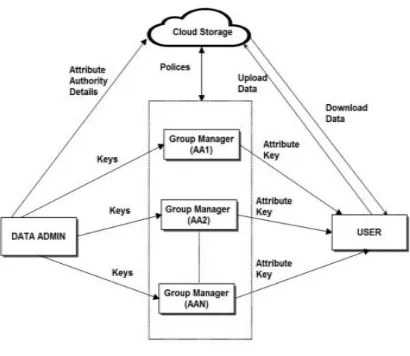
We propose TFDAC-MACS, a safe, effective and revocable information get to control conspire with two-factor assurance for multi-expert distributed storage frameworks in this paper. Overall, our proposed TFDAC-MACS can be considered as a multi-specialist CP-ABE conspire with twofold level repudiation instrument. Contrasted and the current CP-ABE plans for multi-specialist distributed storage frameworks. Our proposed TFDAC-MACS can give two-factor information encryption assurance for multi-specialist distributed storage frameworks. Every client needs to fulfill two necessities while recuperating the outsourced information. One is the property of this client fulfill the entrance strategy, and the other is this client has the approval key.
The structure of TFDAC-MACS comprises of the accompanying stages:
1) PHASE 1 (SYSTEM INITIALIZATION)
In the first place, the CA creates some worldwide open parameter for the framework, and acknowledges both the AA enlistment what's more, client enlistment. At that point, every AA and information proprietor individually create the general population parameters and secret data utilized all through the execution of system.
2) PHASE 2 (SECRET KEY AND AUTHO-RIZATION GENERATION)
At the point when a client presents a demand of trait registration particle to AA, the AA disseminates the comparing attribute mystery keys to this client if his/her
authentication is genuine. At the point when a client presents an approval ask to information proprietor, the information proprietor produces the corresponding approval key and conveys it to this client.
3) PHASE 3 (DATA ENCRYPTION)
For each mutual information, the information proprietor initially characterizes an get to approach, and after that encodes the information under this determined access strategy. From that point, the information proprietor outsources this figure content to the CSP. The encryption task will utilize an arrangement of open keys from the included AAs and the information proprietor's approval mystery key.
4) PAHSE 4 (DATA DECRYPTION)
Every one of the clients in the framework are permitted questioning and downloading any intrigued figure writings from the CSP. A client can recuperate the outsourced information, just if this client holds the adequate characteristic mystery keys concerning access approach and approval key with respect to outsourced information.
5) PHASE 5 (ATTRIBUTE-LEVEL REVOCATION)
For characteristic level repudiation, the AA who deals with the denied property, issues another open key to this renounced quality, and creates trait refresh keys for non-disavowed client's and an arrangement of figure content refresh parts for CSP. Each non-disavowed client who holds the renounced characteristic will refresh the relating trait mystery key after accepting the quality refresh key. In view of the arrangement of figure content refresh parts, the figure writings related with the denied trait will be refreshed by the CSP.
6) PHASE 6 (USER-LEVEL REVOCATION)
© 2018, IRJET | Impact Factor value: 6.171 | ISO 9001:2008 Certified Journal | Page 926 Fig: System Model
VI.METHODOLOGY
• User Group Management with Crypto System
clear-content sign-in convention, ordinarily as a username and secret key, however can interface In the gathering administration, each gathering part is having distinctive open key and private key utilizing any symmetric calculation. When we are running with cryptography procedure, put away information is more secured.
• Encryption Process
Utilizing Encryption process, we can give greater security for outsourcing information.
•FTP Protocol
FTP (File Transfer Protocol) is expand on a customer server show design and uses isolate control and information associations between the customer and the server. FTP clients may validate themselves with a secretly if the server is designed to permit it.
VII. RESULT
In this application we make Hybrid Cloud and give valued copious stockpiling administrations. The clients can transfer their information in the cloud, where the distributed storage can be made secure. Nonetheless, the cloud isn't completely trusted by clients since the CSPs are probably going to be outside of the cloud client's put stock in area. Like we accept that the cloud server is straightforward yet inquisitive. That is, the cloud server won't perniciously erase or alter client information because of the insurance of information reviewing plans, yet will attempt to take in the substance of the put away information and the characters of cloud user's.
VIII. CONCLUSION
We propose another information get to control conspire for multi-expert distributed storage frameworks. The proposed conspire gives two-factor insurance system to improves the secrecy of outsourced information. On the off chance that a client need to recoup the outsourced information, this client is required to hold adequate trait mystery keys as for the entrance arrangement and approval key as to the outsourced information. In our proposed conspire, both the span of figure content and the quantity of blending activities in unscrambling are consistent, which diminish the correspondence overhead and calculation cost of the framework. Also, the proposed conspire gives the client level renouncement to information proprietor in characteristic based information get to control frameworks. Broad security investigation, execution examinations and trial comes about demonstrate that the proposed plot is appropriate to information get to control for multi-expert distributed storage frameworks.
REFERENCES
1. Shubhangi Vibhute, Prof. M. D. Kale, “A Multi-Authority Access Control System Using Network security Vol.4, Issue 12, December 2016.
2. Priya J. Khindre, Shital Y. Gaikwad, Vishnupuri, Nanded (M.S.) “Two-Factor Data Security Protection Mechanism for Cloud Storage System” Vol.4, Issue 7, July 2017.
3. M.Karthikraj, S. Arunkumar, M. Muralikrishnan “Secure Data Sharing In Cloud Computing By Implementing Amednded Attribute Based Data Sharing Scheme” Vol.6, Issue 5 May 2017.
4. Shashank Joseph, Calvin Mugauri, Chunduru Anilkumar; Sumathy.S “Access Control Using Attribute Based Encryption in Cloud Computing”Vol.8, Issue 4, December 2016.
5. Xiaofeng Chen, Jin Li, Xinyi Huang, Jianfeng Ma, and Wenjing Lou “Publicly Verifiable Databases with Efficient Updates” Vol. 12, Issue 5, September/October 2015.
© 2018, IRJET | Impact Factor value: 6.171 | ISO 9001:2008 Certified Journal | Page 927 7. Xiaoyu LI, Shaohua Tang, Lingling XU, Huaqun
Wang, and Jie Chen “Two-Factor Data Access Control with Efficient Revocation for Multi-Authority Cloud Storage Systems” Vol. 5.
8. Dr. SauKamaltai “Two factor (2f) Data Access on Open Glooms Storage in Network Security” Vol. 6, Issue 5, May 2017.
9. Kan Yang, Xiaohua Jia, “Attribute-based Access Control for Multi-Authority Systems in Cloud Storage” 2012.
10. Prof.N.B. Kadu1, Gholap Nilesh2, Saraf Shashir3, Garodi Pravin4, Bora Anand5 “Attribute Based Access Control” Vol. 2, Issue 2, 2016.
11. Praveen Kumar, S.Naga Lakshmi,“ Efficient Data Access Control for Multi-Authority Cloud Storage using CP-ABE” Vol. 2, Issue 12, December 2015.