Journal of Criminal Law and Criminology
Volume 7 | Issue 5
Article 9
1917
Correspondence
Follow this and additional works at:
https://scholarlycommons.law.northwestern.edu/jclc
Part of the
Criminal Law Commons
,
Criminology Commons
, and the
Criminology and Criminal
Justice Commons
This Correspondence is brought to you for free and open access by Northwestern University School of Law Scholarly Commons. It has been accepted for inclusion in Journal of Criminal Law and Criminology by an authorized editor of Northwestern University School of Law Scholarly Commons.
Recommended Citation
NON-SUPPORT AND ITS REMEDIES IN MASSACHUSETTS
The Report on Criminal Remedies in Massachusetts for Failure
to Furnish Support, made recently by the Committee on Law and
Pro-cedure of the Association of Justices of District, Police and Municipal
Courts of that state,' is interesting for two reasons:
First, because it shows how beneficial such an organization of
judges is. The Association was formed in 1911 for the purpose of
improving the practice and forms of procedure in the lower courts
of the state. It has had some modest financial assistance from the
Commonwealth, and has made several small reports. The one under
consideration, made by the Committee on Law and Procedure, of
which Justice Henry T. Lummus of the District Court of Southern
Essex, at Lynn, is the chairman, and a Justice of the Municipal Court
of Boston and three other Justices of District Courts in the state are
members, is its first considerable undertaking.
Though we hear a good deal of "judge-made law," the judges
do not make the laws which they administer. They take what the
legislatures provide, which is often crudely put together, and apply it
as fairly as possible to the cases submitted to them for decision. This
leads to different interpretations of what the law means by different
judges, who use as well as they can the tools with which the legislature
has provided them. In such opinions the judge must follow the law,
and he is limited by the circumstances of the case.
In this report we have something different, for it contains the
judges' opinion of the law, of what it ought to be, of its strong
points and its weak points. The idea is excellent; for, with a common
desire to reach the best results, the judgment of those who deal with
the execution of the law is of the greatest interest to those who are
constructing it, or who desire to improve it.
Second, because of the importance of the subject with which it is
concerned.
The questions with which it deals are not primarily economic but moral questions.2 The ground-work of the remedies for non-support is the Uniform Family Desertion and Non-Support Act, passed on May 18, 1911, Ch. 456. It is interesting to note that the Uniform Act was at first proposed by one of the members of the Conference from the state verbatim as it was adopted by the Conference in the previous year. Some of the social workers, concerned with the enforcement of the former law, got together with the Commissioners, and the Act was fitted in with the Massachusetts law by making some modifications to meet the existing situation.
While this statute, following the compromise phraseology of the Uniform Act, made non-support or desertion a "crime," the penalty prescribed fixed the offense as misdemeanor, and not felony. Indeed, it is the opinion of the justices that the language used as to the manner of instituting proceedings "probably precludes indictment." They ob-serve that "In this it differs widely from the desertion laws of many states, which unwisely make the offense a felony, requiring indictment, and importing into the proceedings all the common law technicalities that were made to depend upon the rather useless distinction between felonies and misdemanors."
This was unfortunately the case with three other states which also passed the Uniform Desertion Act in 1911, and each of which, while using the indefinite word "crime" of the Uniform Law to describe the offense, made it, by reason of the punishment fixed, a felony, with all the obstacles which that involves.
The Massachusetts judges, after an experience of five years with the milder Massachusetts law, say further, and very truly:
"If there must be a choice between complaint and indictment, the Massachusetts choice is not to be regretted. It makes no substantial trouble in interstate rendition cases, because it is well settled that rendition may be had for misdemeanors, upon complaint supported by affidavits."
This is exactly in line with what the editor of this Journal said so well in the issue of November, 1912 (p. 496 ff.), and that they are right in their statement about the ready possibility of interstate ren-dition, or extraren-dition, as it is commonly called, for desertion as mis-demeanor, is shown by the following table of requisitions issued for family deserters each year in New York, which thought it necessary
2
to make the offense felony in 1905 in order to make extradition
possible, and three other states, which have not changed the offense
from misdemeanor, as it was in all four at that time.
TABLE I.
NUMBER OF REQUISITIONS FOR FAILY DEsERmRs EACH YEAR.
Felony. -Misdemeanor-N. Y. N.J. Penna. Mass. 1910 ... 31 40 13 3 1911 ... 38 47 10 5
1912
...
35
37
24
19
1913 ... .. 39 33 32 1914 ... .. 41 31 32The figures for Massachusetts show that those responsible for the
enforcement of the law are working together to reach men who fail
to support their families, wherever they may be found. The statistics
for New York for the last two years were not furnished in response
to a request, but, for the three years for which comparison between
the two states is possible, the above figures show that, in proportion
to the population in 1910, there were more than four times as many
extraditions of deserters to New Jersey for misdemeanor as to New
York for felony; while for the last two years in Massachusetts, after
the law had been fairly put into operation, there were just two and
one-half times as many.
Proof that the offense need not be made felony to secure
extra-dition could not be plainer, and, as the Massachusetts judges say, it
ought not to be made felony.
It may be interesting to note here that a supplementary treaty
between Great Britain and the United States, making family desertion
or non-support an extraditable offense as between the United States
and Canada, is just being completed. The list of offenses covered by
the present treaty was the most comprehensive of that with any nation
when it was signed in 1889, but it did not cover family desertion,
which has grown in importance since. Application for the negotiation
of a supplementary treaty to reach this was made to the State
Depart-ment on January 24, 1913, accompanied by a list of the laws of the
various states on the subject, some of which made the offense felony,
but most of them misdemeanor. It was stated that not only were
there many such deserters between the United States and Canada, but
that a large number of men in Great Britain who deserted their
fam-ilies came to the United States, of which there were 1173 from Glasgow
3Of the 117 cases whose families were relieved during the year, 41 were
alone, out of 340 family deserters who went to foreign countries, in a single year, as stated by the Inspector of the Poor of that city in a recent report.
On February 13th Secretary Knox replied that the request had been forwarded to the American Embassy at London, with instruc-tions to ascertain from the Foreign Office whether the British Govern-ment would be willing to conclude such a suppleGovern-mentary convention. The matter was also taken up by correspondence not only with those interested in Glasgow, London, and Liverpool, but also with various persons interested in the subject in Canada. Among these was the late Sir William Van Home, who gave the effort his active support, and on July 29, 1914, wrote that all the different provinces had given their consent to the treaty except Quebec, and that a further effort was being made to secure its consent.
Three days later the war broke out, and because of the over-shadowing importance of matters connected with it, it was not thought probable that anything further would be done about the treaty, until Secretary Lansing wrote on July 8, 1915, that the American Ambassa-dor at London had reported that the proposal for such a convention was agreeable to the government of the Dominion of Canada, and that a draft convention looking to the accomplishment of the purpose had been sent forward to the Ambassador, with instructions to take steps to bring the negotiation of the treaty to a prompt conclusion. It did not seem appropriate to press the matter further upon those who were so fully occupied with more important matters, but an inquiry when the subject was again ptesented in connection with this review brought out the fact that there had been some delay because of correspondence with the British government, which desired to limit the application of the treaty to Canada; and that, as the State Department had within the last two weeks instructed the American Embassy to consent to this, it was probable that the treaty would be signed without further delay.
When this is done Canada will no longer be a safe place for family deserters from the United States.
pro-bation officers, the evidence required, and the earnings of prisoners under sentence-all these are discussed in the light not only of Massa-chusetts decisions, but also of those of other states, in an effort to reach throughout the state the best interpretation of the law as a whole. We see not what the men who wrote down the words of the law wanted people to understand by it, but what many men have thought it meant in dealing with all sorts of marred and broken lives and their interlacing social relationships.
If anything is apparent, it is that in such cases the judges are con-fronted, not with something solid and of uniform shape, which can be built up according to a preconceived pattern and firmly united, or reunited, so as to preserve it, but with a multitude of living, quivering entities, often mysteriously repellent and requiring the most patient and yet firm and persistent treatment if they are to be restored to normal and happy relaltions. Even then the problems assume new forms because of the changes in modern life, so that while principles remain the same, the judge must be alert as to conditions so as to find their correct application. Space does not permit of examples to illus-trate this, but it is the interpretation of the law in this spirit, with references to a large number of decisions, which makes the Report so helpful to all in any way interested in the problem of non-support.
It urges that the probation officer "should use a systematic method of collections, and should follow up the payments as maturities are followed up in a bank. Promptness is the great preventive of delin-quency." A broadening perception of this fundamental fact no doubt accounts for the rapid increase in collections for support under the Act, which have grown from $25,288 in 1909 under the old law to $221,129 in 1915.
As to the payment of 50 cents per day to the families of men sentenced to imprisonment, which so greatly facilitates the enforce-ment of the Act, and has been of so much help in securing these large collections, the judges say that "there should be no illusion about the payment of 50 cents per day, because in few penal institutions, if any, is there any profit resulting from the labor of prisoners." They ob-serve that "a good amendment to the statute would be one allowing commitment to the state farm, where a shiftless husband could come nearer to earning the money paid his wife."
the responsibility for using this earning capacity to advantage rests on
the state. By all means send such men to the state farm, or a similar
institution, or employ them in making roads. The harder the work
the better, especially if in the open air, for thus the man will sooner
prefer to support his family rather than undergo such labor with so
little profit.
The following figures, embodying a portion of the table in the
Report, show the progress which has been made in the enforcement of
the law during the four complete years following its enactment. The
amount received from Houses of Correction evidently represents the
compensation to families for work performed by men in confinement.
TABLE II.
RESULTS IN FOUR YEARS FOLLOWING ENACTMENT OF UNIFORM DESERTION AND
NoN-SuPPORT LAW IN MASSACHUSETTS IN 1911.
Received from
Sentences of Houses of Non-Support Year. Cases Begun. Imprisonment. Correction. Collections.
1912 ... 3,352 398 $ 6,831 $ 82,416 1913 ... 3,922 581 19,294 140,773 1914 ... 4,622 732 26,516 189,830 1915 ... 5,203 760 28,974 221,129
17,099 2,471 $81,615 $634,148
In this connection it is interesting to note that on June 13, 1912,
Pennsylvania passed a law permitting men to be sentenced to hard
labor for non-support, with a compensation of 65 cents per day to the
families, payments to be made by the counties from which they are
committed in case the labor done in the institution is not sufficient to
pay the running expenses. Under this law there was paid for the
earn-ings of desertion and non-support prisoners in the workhouse at
Pitts-burgh for the three suceeding years $20,753.20, of which $3,078.40
went to prisoners from three adjacent counties; and against this the
Commissioners of the four counties furnished $19,864, or nearly all.
In other parts of the state, however, this part of the law seems to have
been practically without effect. The report of the Municipal Court
of Philadelphia for the year 1915 says that so far the city of
Phila-delphia had made no provision for the carrying out of the law; and
that if the City Councils would appropriate money for this purpose,
the work of the probation department would be greatly facilitated,
because the "chronically non-supporting husband might be sent to the
stone pile," and at least partial support for the children could be
pro-vided, so that the county would not be called upon to give charity to
the family (p. 232).
44
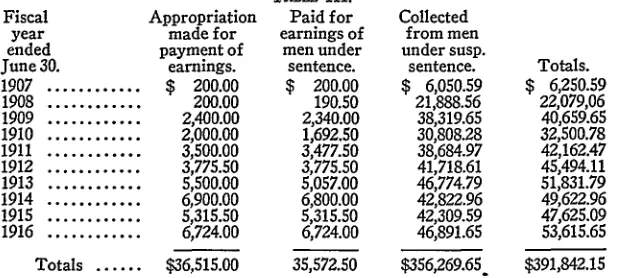
The results under the District of Columbia law passed in 1906,
upon which the Uniform Act of Massachusetts was modeled, are also
interesting:
TABLE III.
Fiscal
Appropriation
Paid for
Collected
year
made for
earnings of
from men
ended payment of men under under susp.
June 30. earnings. sentence, sentence. Totals.
1907 ...
$ 200.00
$ 200.00
$ 6,050.59
$ 6,250.59
1908 ...
200.00
190.50
21,888.56
22,079,06
1909 ...
2,400.00
2,340.00
38,319.65
40,659.65
1910 ...
2,000.00
1,692.50
30,808.28
32,500.78
1911 ...
3,500.00
3,477.50
38,684.97
42,162.47
1912 ...
3,775.50
3,775.50
41,718.61
45,494.11
1913 ...
5,500.00
5,057.00
46,774.79
51,831.79
1914 ...
6,900.00
6,800.00
42,822.96
49,622.96
1915 ...
5,315.50
5,315.50
42,309.59
47,625.09
1916 ...
6,724.00
6,724.00
46,891.65
53,615.65
Totals ...
$36,515.00
35,572.50
$356,269.65.
$391,842.15
The increase in the proportion of earnings as compared with the
collections from men under suspended sentence is due to the fact that
with the excellent conditions at the Workhouse, with 1,154 acres of
land, a farm, a brickyard, a stone quarry, and other means of useful,
invigorating labor, it has been found better for the men to keep them
a longer time, because they return to their families in better condition.
The ratio of earnings to collections for the last year is not widely
different from that for the last year in the Massachusetts table.
It is also worthy of remark that while Massachusetts and
Penn-sylvania have both passed laws for compensation to the destitute
families of men sentenced for non-support, the state of New York,
which lies between them, and which has been talking for more than
ten years about the advantage of such a provision, has done nothing
whatever in this direction, and still cuts off all support for the destitute
families of the men whom it sentences under its quasi-criminal law
by hundreds each year for failure to support them. The contrast is
even more striking in the case of men extradited from other states;
for while Massachusetts and Pennsylvania bring them back on a
mis-demeanor charge, with the possibility of release- under suspended
sentence as soon as they are ready to furnish support, and
compensa-tion to the family until that time, New York still employs for
extra-dition its felony statute passed in 1905, under which many men are
sent to state prison for from one year to two years, with no possibility
amount due under this law, it was declared unconstitutional because its title was defective. This decision has been confirmed by the Supreme Court of the state, but steps are being taken to pass a similar statute which will be free from the
[image:8.612.40.351.126.265.2]of release in less than a year, and no compensation whatever to the family.
The Uniform Family Desertion and Non-support Act worked so well that after an experience of but two years, on the recommendation of the judges who make this report, the legislature passed a law drawn
by them relating to illegitimate children (Act April 26, 1913, Ch.
563), which superseded the previous weak and unsatisfactory law, and which, after declaring in Section 7 that any father of an illegiti-mate child, found to be such under the previous sections, who neg-lects or refuses to contribute reasonably to its support, shall be guilty of a misdemeanor, provides, without again reciting them, that on con-viction he shall be liable to all the penalties and orders of support contained in the Uniform Desertion and Non-Support Act of 1911; and that the practice thereby established shall apply in the case of such illegitimate children.
The change wrought by this act is most gratifying; for whereas under the previous law men secured release from their obligations to the mother as easily as possible, with little reference to the effect on the children, this law is intended to, and does, secure adequate support, so that the child is protected instead of being made a charge upon the
community.
The question whether illegitimate children should be included in the Uniform Desertion and Non-Support Act was left undecided, when it was adopted by the Conference of Commissioners on Uniform State Laws. The experience of Massachusetts shows that they should be included, or, if not included in the act itself, that another act with identical provisions as to their support when their paternity is de-termined should be passed.
After two years further experience under these statutes, finding their operation so satisfactory, a similar law relating to destitute par-ents was passed on April 15, 1915, Ch. 163. The first section defines the offense with proper safeguards, and by the penalty fixed makes it a misdemeanor; and the second section, as in the act relating to illegitimate children, provides that the court may make such orders and require such conditions as are provided in the Desertion and Non-Support Act of 1911.
The experience under this act has not been long enough to permit of extended comments or many references; but there is no apparent reason why, in the light of what has happened under the other two laws, this should not also work well.
by Massachusetts is an admirable'illustration of what may be accom-plished by an intelligent effort to apply to the perplexing problem of non-support the principles of the Uniform Desertion and Non-Support Act. These principles of making the offense of non-support a
mis-demeanor, which permits of extradition, and also permits it to be handled promptly in the lower courts; of providing for periodical pay-ments under orders of the court by men under suspended sentence, with adequate supervision by probation officers; of making hard labor a part of the punishment, if men are imprisoned, and of paying the family 50 cents per day as compensation in such cases, are the result of experience. Taken together, they constitute a complete piece of machinery for dealing wisely, promptly and effectively, not only with benefit to the family, but also with economy to society, with the evil. It is to be hoped that as Massachusetts has profited by the results of her own experience in adding the laws as to illegitimate children and destitute parents to the Uniform Act of 1911, other states may also profit by her experience and deal more effectively with non-support in the same way.
WILLIAm H. BALDVIN,
Washington, D. C., December 1, 1916.
LAWS OF PENNSYLVANIA AND MASSACHUSETTS RELATING TO ILLEGITIMACY.
My DEAR SIR: The article by W. Logan MacCoy, Esq., in 7 Journal of the American Institute of Criminal Law and Criminology, 505, upon the Law of Pennsylvania, relating to illegitimacy, is of much interest to me, as I had something to do with the passage of Massa-chusetts Stat. 1913, Chap. 563, which abolished the old civil, but quasi-criminal, bastardy laws which had existed in Massachusetts for a century and more, and substituted a purely criminal remedy, founded on the Unifoim Desertion Act. I say it is a purely criminal remedy, as it is in form, but the sentence is used merely as a threat to compel support, and not at all as a means of punishing successful fornication. If fornication is to be punished, it must be, in practice, by separate complaint for that offense.
and Municipal Courts of Massachusetts, which I can supply in limited numbers on request.
Mr. MacCoy's statement (p. 513) that "the question of juris-diction in Pennsylvania is on a logical and sound basis," can hardly pass unchallenged, while an illegitimate child resident in Pennsylvania cannot obtain support from its father resident there, merely because the; child was neither begotten nor born there. Failure to support such child should 'be made a criminal offense.
In Massachusetts we adopted the exclusively criminal form of action, because (1) we obtained the use of the probation system for the collection of weekly support, already in use under our variation of the Uniform Desertion Act; (2) we put the control of the prosecution into the hands of the magistrates and responsible public prosecutors, thus preventing unduly cheap or blackmailing cash settlements; and (3) we obtained rights to interstate rendition of runaways. The Pennsylvania statute, like our old one, seems seriously defective in that three months in jail terminates all liability to imprisonment, for that is usually the only effective means of compelling payments. Most of the recommendations with which Mr. MacCoy's article ends are already acomplished facts under our Massachusetts law.
Yours very truly,
(Signed)
HENRYT.
Lummus. 38 Exchange St., Lynn, Mass., Nov. 25, 1916.REPLY TO THE FOREGOING
DEAR SiR: The letter of Judge Lummus "venturing to call to the
attention of our committee" the Massachusetts law of 1913, dealing with the subject of illegitmacy, has been read with interest, though we assure Judge Lummus that the Massachusetts law had not, in the slightest degree,, been overlooked, but on the contrary had received careful consideration. The comments which Judge Lummus makes upon the Massachusetts law and also upon the report of our committee may be considered under three headings:
its attendant advantages, had been in use in Pennsylvania since the
year 1860, and indeed prior thereto. We do, however, entirely agree
with judge Lummus as to the advantages to be secured, from that
form of procedure, though, as we endeavored to point out in our
re-port, the question of "interstate rendition of runaways", as he terms
it, is somewhat complicated by the fact that certain asylum states
con-tinue to refuse to recognize the proceedings as anything more than
civil, no matter what classification is applied to the offense by the
de-manding state.
(2)
Judge Lummus next criticizes the fact that under the
Pennsylvania law, the maximum imprisonment amounts in practice to
only three months, after which the father is not subject to re-arrest.
In our report, however, we dealt expressly with this condition, and
in our 9th recommendation proposed to bring the support of
illegit-mates under the "Stone Pile Act", which will permit the imprisonment
of the father at hard labor, and will provide for the payment by the
county of 65 cents a day toward the support of the child. The three
months limitation of imprisonment will not apply to this act.
(3)
Judge Lummus next challenges a statement which he
attri-butes to us as follows: "The question of jurisdiction in Pennsylvania
is on a logical and sound basis". In reply may we say that we think it
hardly fair to quote only part of a sentence, and that without relation
to its surroundings.
The words which he quotes come at the
con-clusion of a review of the entire question of jurisdiction in
Pennsyl-vania, and what we did say is: "On the whole, the question of
juris-diction in Pennsylvania is on a logical and sound basis."
The specific respect in which our jurisdiction fails is well pointed
out by Judge Lummus, and we are glad to report that our committee
has, for some time, been preparing an act which will remedy this
de-fect by making the failure to support an illegitimate child a distinct
offense. This has already been accomplished in Massachusetts under
their very carefully thought out procedure, and has been in force as to
legitimate children in Pennsylvania under a similar statute since 1903.
Very sincerely yours,
(Signed) W.
LOGAN MACCOY.Philadelphia, Dec. 9, 1916.
STERILIZATION OF THE UNFIT.
In the first place, let me say that I do not take any stock in this
new agitation about the physician or surgeon letting defectives or
degenerates die from lack of surgical operations, etc. I don't believe
society should put the power of life and death into the hands of a
single medical man. I believe it is the physicians business to save life,
and if it afterwards develops that we have saved the lives of defectives
and degenerates, then it is time for society to act for its own
pro-tection.
In a general way, I can most heartily approve of the proposed
legislation as published in your November issue, page 611. I am
ex-ceedingly anxious that we shall not have a lot of half-baked, so-called
eugenic legislation get on our statute books, like laws forbidding the
marriage of cousins and laws compelling the examination of applicants
for marriage license to ascertain if they are affected with venereal
dis-ease. That is not eugenic legislation. It is simply a form a hygienic
legislation. We seem to forget that the gates of heredity are closed
when conception takes place, that eugenic legislation must concern
itself with the elimination of defective germ plasm, and I have long
since come to the conclusion that sterilization is the only adequate
remedy which modern society can employ to protect itself in the
present emergency.
I am in favor of advocating a very conservative policy to begin
with. * If a general survey should be attempted for purposes of
in-augurating sterilization, I should be in favor of annually sterilizing
only the most palpable ten per cent of the total number nominated.
In this connection I have reference to a general sterilization program.
I see no reason why we should delay a straight out and out sterilization
program with reference to institutions to which delinquent and
de-generate citizens are committed.
Segregation might be a temporary compromise and do some good,
but I believe it is unfair to these -defectives after we have allowed
them to come into the world, to deprive them of their natural privileges
and biological pleasures. I think they should be sterilized and allowed
to get married and settle down and live after the natural order of
man-kind, that is, those who are outside of institutional custody.
jeopardy of the strong by the enormous and disproportionate increase and multiplication of the weak.
Society, philanthropy, Christianity, and more recently even med-ical science, are all conspiring together to save all the weak and de-fective members of society, to enable these weak children to attain manhood and womanhood, and to bring into existence large families, numbering from six to twelve children or more. At the same time the American college graduate is not quite reproducing himself. The physician of today who is engaged in the laudable work of saving babies, while le proves himself a blessing to this generation, is, unless society shall do something to curb the results of his work in the future, destined to become a curse to generations yet unborn. Some day men of medicine are going to grow1 weary of representing the spirit of modern society in this life saving work, unless society does something to prevent the continuous and increasing multiplication of the de-generate and defective offspring of these unnormal humans whose lives we men of medicine worked so hard to save.
Even our immigration laws are based on finances and education, and not on blood and taint. We should keep out of this country all classes who are eugenically unsound and let in the eugenically sound immigrant, whether he can read or write or has a doIlar. We can teach him how to read and make money after he reaches our shores. We have taken drugs away from these feeble-minded people and they are going to live their full lives. We even talk of nation-wide prohibition and so take away the opportunity of these feeble-minded
folks from drinking themselves to death. I believe in the Harrison drug law. I am in favor of national temperance, but I want the public to wake up and see where some of our good philanthropic endeavors and well-meant reforms are leading us.
When it comes to sterilization, I am interested in just one funda-mental proposition, and that is feeble-mindedness with its second cousins, epilepsy and insanity. I am decidedly opposed to this agitation for the sterilization of criminals, paupers, prostitutes and inebriates. I believe that considerably more than 75 per cent of public prostitutes are feeble-minded. I believe that more than half of our criminals are feeble-minded, subnormal or otherwise falling in the category of moronism. I believe statistics bear out the assertion that almost 90 per cent of our paupers belong to this group. As to the per cent of feeble-minded among confirmed drunkards, I am not aware that we are in possession of anything reliable in the way of statistics.
normal. I think we had better improve our social and educational system. Criminality, I do not believe, is inherited as such. I hold that it is feeble-mindedness which is inherited. On the other hand, I do not believe prostitution, as with regards to its moral state, is an inheritance. I believe it is a case again of feeble-mindedness. If prostitutes are feeble-minded, sterilize them. If not, try to reform them. Here again I believe that the morals of society need reforming in the case of a so-called fallen woman who is not mentally defective to some degree.
I am heartily in favor of prison reform, temperance.rescue homes, and schools for backward children, (but I am not in favor of spending the public money forever to build institutions and conduct schools for the defective classes while we do absolutely nothing to protect our-selves from their degenerate offspring, which we know are destined
to follow in their foot steps.
I am exceedingly hopeful that the flood of eugenic legislation which is just about due, be kept out of fantastic tendencies and other lines of action that are not fundamentally sound as judged by the known laws of human inheritance. I find on lecturing on this subject to intelligent audiences, women's clubs, and other intelligent social clubs, that eugenics is so little understood that it is confused in the average mind with the subject of sex-hygiene on the one hand and
so-called prenatal influence on the other.
What more urgent work could our state board of health take up than that of educating the layman along eugenic lines? Something must be done 'by agitation as well as legislation in view of our terrible state of ignorance. Just a few days ago I had more than a dozen individuals come up to me after a lecture who protested against my advocacy of sterilization because society did not have a right to unsex any-of its members, and that, please remember, after I had endeavored in the course of a lecture to explain just as far as I could without being indelicate that sterilization did not do this.
of our well-to-do American women who are able to bear children, but who are indifferent to their duties in this respect.
Our Apierican social structure is at the present time thoroughly undermined. It will soon begin to totter, and sterilization is the only remedy I see which the decreasing strong has within its power to apply in its battle to resist the encroachments of the tremendously increasing weak and defective members of society.
And in closing, my dear doctor, I pledge every vestige of my influence and power to be used for the enactment of a sane, scientific, eugenic act for the State of Illinois.
(Signed) WILLIAM S. SADLER, M. D.