N A N O E X P R E S S
Open Access
Simple method for high-performance
stretchable composite conductors with
entrapped air bubbles
Hyejin Hwang
1,4, Dae-Gon Kim
1,5, Nam-Su Jang
2, Jeong-Ho Kong
2and Jong-Man Kim
2,3*Abstract
We integrate air bubbles into conductive elastic composite-based stretchable conductors to make them mechanically less stiff and electrically more robust against physical deformations. A surfactant facilitates both the formation and maintenance of air bubbles inside the elastic composites, leading to a simple fabrication of bubble-entrapped stretchable conductors. Based on the unique bubble-entrapped architecture, the elastic properties are greatly enhanced and the resistance change in response to tensile strains can clearly be controlled. The bubble-entrapped conductor achieves ~80 % elongation at ~3.4 times lower stress and ~44.8 % smaller change in the electrical resistance at 80 % tensile strain, compared to bare conductor without air bubbles.
Keywords:Entrapped air bubbles, Conductive elastic composites, Surfactant, Stretchable conductor, CNT networks
Background
Conductive elastic materials that can retain their elec-trical performance under various deformations have re-cently received great attention due to the potential applications as stretchable conductors and interconnects in stretchable electronics [1–5]. Many efforts have been made to demonstrate various types of conductive elastic materials. Examples include electrical nanonetworks mainly made of conductive carbon nanotubes (CNTs) [6–8] and metallic nanowires (NWs) [9–11], buckled ar-chitectures of metallic thin films [12–14], three-dimensional conductive foams [15–17], and conductive composites synthesized by doping elastomer matrices with conductive nanofillers [18–22].
Among these methods, conductive composites have been considered as one of the most efficient ways of pre-paring conductive elastic materials due to the superior advantages including fabrication simplicity and easy con-trol of the intrinsic electrical properties. In this regard, to date, this method has been widely used to fabricate
functional stretchable devices. However, two critical issues can potentially arise in the conductive composite-based approaches: (1) considerable increase of the stiff-ness of the composites from excessive filler doping and (2) steep change in the electrical conductivity when stretched. These would lead to significant degradation of the mechanical and electrical performance of the stretchable devices.
In this work, we present a new class of CNT-doped stretchable conductor with embedded air bubbles (here-after, bubble conductor) based on conductive elastic composites. The air bubbles inside the composite matrix play a key role in (1) decreasing the stiffness of the composites and (2) sustaining the electrical properties, mainly by allowing considerable reduction of the resist-ance change of the CNT network located at the bound-ary regions upon stretching. The advantages of the proposed approach include process simplicity, cost-effectiveness, and potential scalability for large area fabrication.
Methods
Fabrication of Bubble Conductors
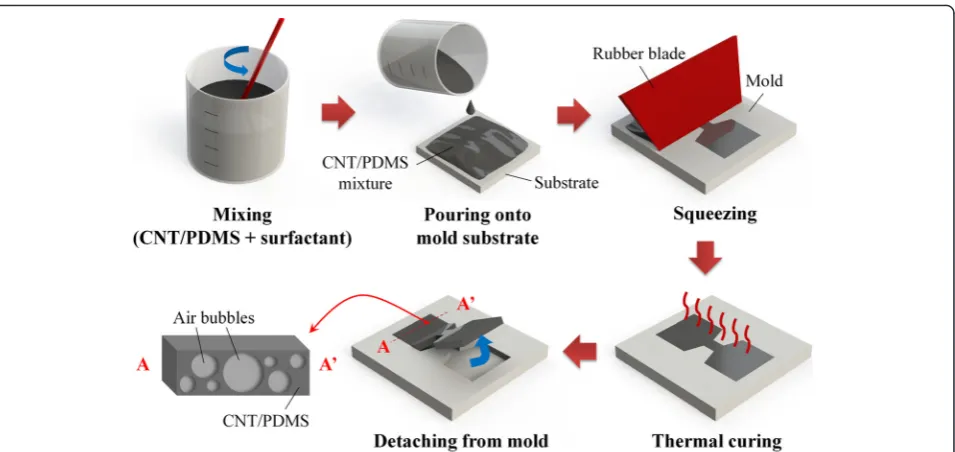
The fabrication process of the proposed bubble conduc-tors is schematically illustrated in Fig. 1. Conductive elastic composites with air bubbles were first synthesized * Correspondence:[email protected]
2Department of Nano Fusion Technology and BK21 Plus Nano Convergence
Technology Division, Pusan National University, Busan 609-735, Republic of Korea
3Department of Nanoenergy Engineering, Pusan National University, Busan
609-735, Republic of Korea
Full list of author information is available at the end of the article
© 2016 Hwang et al.Open AccessThis article is distributed under the terms of the Creative Commons Attribution 4.0 International License (http://creativecommons.org/licenses/by/4.0/), which permits unrestricted use, distribution, and reproduction in any medium, provided you give appropriate credit to the original author(s) and the source, provide a link to the Creative Commons license, and indicate if changes were made.
by dispersing ~3 wt% multiwalled CNTs in polydimethyl-siloxane (PDMS; Sylgard 184, Dow Corning) prepolymer mixed with a curing agent at a weight ratio of 10:1, followed by manually stirring for 30 min. A small quantity of surfactant (sodium lauroyl oat amino acid) was added to the CNT/PDMS mixture to facilitate high-density bub-ble formation and retainment in the mixture. The surfactant-added CNT/PDMS mixture was then squeezed selectively onto a silicon substrate using a polymeric mold with a height of ~500μm. Finally, the bubble conductors were peeled off from the substrate after thermally curing on a hotplate at 80 °C for 30 min. The bare conductors without air bubbles were fabricated by the abovemen-tioned procedure except adding the surfactant.
Characterization
The surface morphologies of the fabricated bubble con-ductors were observed using an optical microscope (OM; BX60M, OLYMPUS) equipped with a CCD mod-ule. A field emission scanning electron microscope (FESEM; S4700, HITACHI) was used to characterize the detailed morphologies of the air bubbles and CNT net-works in the conductors. The stress-strain relationships of the bare conductor and bubble conductor were exam-ined using an automatic testing stand (JSV-H1000, JISC) equipped with a digital push-pull force gauge (HF-10, JISC). All stretching tests were performed using a custom-made jig while monitoring the change in the electrical resistance using a digital multimeter (U1253B, Agilent Technologies). The electrical resistances of the conductors under stretching were recorded after impos-ing a stabilization time of 20 s in each strained state.
Results and Discussion
The surfactant makes it possible to form and maintain air bubbles in the PDMS matrix easily. Figure 2 shows digital and SEM images of the fabricated bubble con-ductor. Highly roughened surface morphology of the conductor represents the presence of air bubbles en-trapped in the conductor, as shown in Fig. 2a. This cross-sectional SEM image in Fig. 2b clearly shows the circular air bubbles inside the conductor. The diameters of the air bubbles were typically in a range from 200 to 500 μm, and the average diameter was ~397.3 μm, as shown in Fig. 2c. We note that the detailed geometry of bubble conductor may be further optimized by control-ling the experimental conditions mainly in the stirring and curing steps. Figure 2d shows a magnified SEM image of the CNT networks embedded in the bubble-entrapped PDMS matrix, which suggests that the three-dimensionally interconnected morphologies at the contact junctions provide electrically conductive paths. The electrical re-sistance of the fabricated bubble conductor was mea-sured to 33.6 ± 7.4 kΩ. Although higher doping level of CNT in the elastic conductor is more suitable for achieving higher electrical conductivity, it may lead to poor processibility due to the increased viscosity of the composites. Therefore, the CNT doping level was ex-perimentally optimized to ~3 wt% with consideration of both the electrical conductivity and the processibility of elastic composites. In addition, it is important to note that the electrical properties of bubble conductor can easily be tailored by doping with various nanoma-terials with different electrical conductivity as conduct-ive fillers.
[image:2.595.61.539.86.312.2]The effect of air bubbles on the elastic properties of the CNT-doped PDMS films was examined by characterizing the stress-strain relationships of the bare conductor and bubble conductor. Figure 3 shows the stress-strain curves for the stretchable conductors. A stress of ~225 kPa was required to elongate the bare conductor without air bub-bles by 1.8 times, which corresponds to ~80 % tensile strain. However, the conductive PDMS film was softened significantly after simply embedding air bubbles into the
polymer matrix, as shown in Fig. 3. By making the con-ductor highly porous, the air bubbles considerably reduce the stress level to ~66 kPa to induce the same strain (80 %). This suggests that the simple bubble formation strategy fairly alleviates increases of the stiffness resulting from toughening in the CNT-reinforced PDMS matrix.
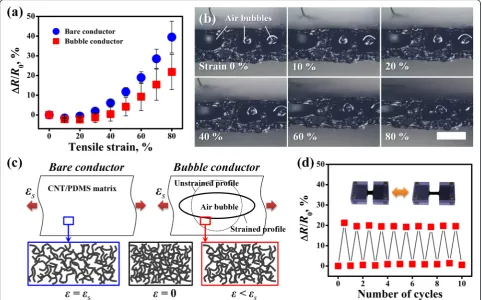
Figure 4a shows the changes in the electrical resistance (ΔR/R0) of the fabricated stretchable conductors as a
function of the applied tensile strain up to 80 %. ΔR/R0
of the CNT-doped stretchable conductor without air bubbles was only ~6.1 % at a tensile strain of 40 %. This suggests that the three-dimensionally interconnected architecture of the CNT networks in the conductor is greatly helpful for retaining the electrical performance by preventing complete disconnection of the conductive networks, even under relatively high strains.
When gradually increasing the tensile strain, ΔR/R0of
the conductor was increased accordingly due to the resulting decrease in the current paths in the CNT net-works, eventually leading to a resistance change of ~39.5 % at a strain of 80 %. The electrical robustness of the stretchable conductor against mechanical deform-ation was significantly improved by the air bubbles, with a negligible resistance change of ~0.4 % at a strain of 40 %. Moreover,ΔR/R0of the bubble conductor at a
ten-sile strain of 80 % was decreased by ~44.8 % (from ~39.5 to ~21.8 %) compared to that of the bare Fig. 2Fabrication results.aDigital image of the fabricated bubble conductor (scale bar: 1 cm),bcross-sectional SEM image (scale bar: 200μm) andcdiameter distribution (66 air bubbles measured) of air bubbles in the CNT-doped PDMS matrix, anddmagnified SEM image of three-dimensionally interconnected CNT network (scale bar: 1μm)
Fig. 3Stress-strain curves of bare conductor and bubble conductor
[image:3.595.57.540.87.351.2] [image:3.595.58.290.533.713.2]conductor. This is mainly attributed to the change in the shape of the air bubbles in response to mechanical deformation.
The air bubbles in the conductor gradually become distorted into an oval shape upon stretching as shown in Fig. 4b. Up to a certain level of strain, most of the CNT networks located at the boundary regions of the air bub-bles are just shifted along the deformed profiles of the bubbles rather than experiencing the applied strain dir-ectly. Moreover, the inter-CNT contact junctions in the bubble conductor can be maintained better than those of the bare conductor, even under high strains, as illus-trated schematically in Fig. 4c. This is probably because that the load applied to the stretchable conductor is in-evitably distributed to deform the air bubbles in the polymer matrix. For this reason, ΔR/R0 of the bubble
conductor is much smaller than that of the bare con-ductor at the same strain levels.
In addition, the rate of increase in the electrical resist-ance of the bubble conductor was also lower than that of the bare conductor, as shown in Fig. 4a. This also means that the morphology of the CNT networks in the bare conductor is greatly affected by the applied tensile
strain. In contrast, the air bubbles play an important role in alleviating the resistance change of the device by allowing the CNT networks to retain the networked architecture even at high strains.
Figure 4d shows ΔR/R0 for the bubble conductor
under repetitive strain loading (0 to 80 %) and unloading (80 to 0 %) for up to 10 cycles. The ΔR/R0values were
quite uniform for each loading state, representing a min-imal standard deviation of ~0.58 %. Importantly, the electrical resistances increased in response to the applied strains and almost returned to the initial state when re-moving all the strains, as shown in Fig. 4d. In this state, the standard deviation was as small as ~0.36 %. This means that the bubble conductors can operate quite reli-ably with considerable reversibility even under repetitive high strains.
Conclusions
We have demonstrated air-bubble-entrapped conductors with both enhanced elastic properties and electrical ro-bustness for stretchable electronics applications. The functional air bubbles can be formed easily and sus-tained in a CNT-doped PDMS matrix with the aid of a Fig. 4Electrical performance of the fabricated bubble conductor under tensile strain.aΔR/R0values measured for bare conductor and bubble
[image:4.595.57.540.89.389.2]small amount of surfactant. It was experimentally found that the bubble conductor requires ~3.4 times lower stress (~66 kPa) compared to the bare conductor (~225 kPa) to achieve ~80 % elongation. The change in the electrical resistance of the stretchable conductor upon stretching to 80 % was decreased by ~44.8 % (from 39.5 to 21.8 %) by integrating air bubbles into the matrix. The bubble conductor also showed quite reliable and reversible performance under repetitive operations, with low standard deviations of 0.58 and 0.36 % in the loading and unloading states, respectively. The bubble conductors could find many potential applications in stretchable electronics due to the advantages that in-clude simple fabrication, enhanced elastic properties, and electrical robustness against physical deformations.
Competing Interests
The authors declare that they have no competing interests.
Authors’Contributions
HH and DGK performed the device fabrication and measurements and participated in drafting the manuscript. NSJ and JHK performed the OM and SEM characterizations. NSJ, JHK, and JMK performed the data analysis. JMK conceived the work, participated in the design and coordination, and wrote the manuscript. All authors read and approved the final manuscript.
Acknowledgement
This research was supported by the Basic Science Research Program (No. 2015R1A2A2A01004038) through the National Research Foundation of Korea (NRF) funded by the Ministry of Science, ICT & Future Planning. HH and DGK contributed equally to this work.
Author details
1Department of Nanomechatronics Engineering, Pusan National University,
Busan 609-735, Republic of Korea.2Department of Nano Fusion Technology
and BK21 Plus Nano Convergence Technology Division, Pusan National University, Busan 609-735, Republic of Korea.3Department of Nanoenergy
Engineering, Pusan National University, Busan 609-735, Republic of Korea.
4Present address: Department of Nanoscience and Technology, Seoul
National University, Seoul 151-742, Republic of Korea.5Present address: School of Electrical and Computer Engineering, Seoul National University, Seoul 151-742, Republic of Korea.
Received: 26 October 2015 Accepted: 5 January 2016
References
1. Ahn JH, Je JH (2012) Stretchable electronics: materials, architectures and integrations. J Phys D: Appl Phys 45:103001
2. Park M, Im J, Shin M, Min Y, Park J, Cho H, Park S, Shim MB, Jeon S, Chung DY, Bae J, Park J, Jeong U, Kim K (2012) Highly stretchable electric circuits from a composite material of silver nanoparticles and elastomeric fibres. Nat Nanotechnol 7:803–809
3. Sekitani T, Nakajima H, Maeda H, Fukushima T, Aida T, Hata K, Someya T (2009) Stretchable active-matrix organic light-emitting diode display using printable elastic conductors. Nat Mater 8:494–499
4. Sekitani T, Someya T (2010) Stretchable, large-area organic electronics. Adv Mater 22:2228–2246
5. Hu L, Pasta M, Mantia FL, Cui L, Jeong S, Deshazer HD, Choi JW, Han SM, Cui Y (2010) Stretchable, porous, and conductive energy textiles. Nano Lett 10:708–714
6. Cohen DJ, Mitra D, Peterson K, Maharbiz MM (2012) A highly elastic, capacitive strain gauge based on percolating nanotube networks. Nano Lett 12:1821–1825
7. Lipomi DJ, Vosgueritchian M, Tee BC-K, Hellstrom SL, Lee JA, Fox CH, Bao Z (2011) Skin-like pressure and strain sensors based on transparent elastic films of carbon nanotubes. Nat Nanotechnol 6:788–792
8. Liu K, Sun Y, Liu P, Lin X, Fan S, Jiang K (2011) Cross-stacked superaligned carbon nanotube films for transparent and stretchable conductors. Adv Funct Mater 21:2721–2728
9. Yun S, Niu X, Yu Z, Hu W, Brochu P, Pei Q (2012) Compliant silver nanowire-polymer composite electrodes for bistable large strain actuation. Adv Mater 24:1321–1327
10. Xu F, Zhu Y (2012) Highly conductive and stretchable silver nanowire conductors. Adv Mater 24:5117–5122
11. Lee P, Lee J, Lee H, Yeo J, Hong S, Nam KH, Lee D, Lee SS, Ko SH (2012) Highly stretchable and highly conductive metal electrode by very long metal nanowire percolation network. Adv Mater 24:3326–3332
12. Lacour SP, Jones J, Suo Z, Wagner S (2004) Design and performance of thin metal film interconnects for skin-like electronic circuits. IEEE Electron Device Lett 25:179–181
13. Wang X, Hu H, Shen Y, Zhou X, Zheng Z (2011) Stretchable conductors with ultrahigh tensile strain and stable metallic conductance enabled by prestrained polyelectrolyte nanoplatforms. Adv Mater 23:3090–3094 14. Bowden N, Brittain S, Evans AG, Hutchinson JW, Whitesides GM (1998)
Spontaneous formation of ordered structures in thin films of metals supported on an elastomeric polymer. Nature 393:146–149
15. Chen Z, Ren W, Gao L, Liu B, Pei S, Cheng HM (2011) Three-dimensional flexible and conductive interconnected graphene networks grown by chemical vapour deposition. Nat Mater 10:424–428
16. Park J, Wang S, Li M, Ahn C, Hyun JK, Kim DS, Kim DK, Rogers JA, Huang Y, Jeon S (2012) Three-dimensional nanonetworks for giant stretchability in dielectrics and conductors. Nat Commun 3:916
17. Ge J, Yao HB, Wang X, Ye YD, Wang JL, Wu ZY, Liu JW, Fan FJ, Gao HL, Zhang CL, Yu SH (2013) Stretchable conductors based on silver nanowires: improved performance through a binary network design. Angew Chem Int Ed 52:1654–1659
18. Huang YY, Terentjev EM (2010) Tailoring the electrical properties of carbon nanotube-polymer composites. Adv Funct Mater 20:4062–4068
19. Lu N, Lu C, Yang S, Rogers J (2012) Highly sensitive skin-mountable strain gauges based entirely on elastomers. Adv Funct Mater 10:4044–4050 20. Kong JH, Jang NS, Kim SH, Kim JM (2014) Simple and rapid micropatterning
of conductive carbon composites and its application to elastic strain sensors. Carbon 77:199–207
21. Woo SJ, Kong JH, Kim DG, Kim JM (2014) A thin all-elastomeric capacitive pressure sensor array based on micro-contact printed elastic conductors. J Mater Chem C 2:4415–4422
22. Liu CX, Choi JW (2012) Precision patterning of conductive polymer nanocomposite using a laser-ablated thin film. J Micromech Microeng 22:045014
Submit your manuscript to a
journal and benefi t from:
7 Convenient online submission 7Rigorous peer review
7 Immediate publication on acceptance 7Open access: articles freely available online 7 High visibility within the fi eld
7Retaining the copyright to your article
Submit your next manuscript at 7 springeropen.com