BIROn - Birkbeck Institutional Research Online
Zhou, Y. and Wang, C. and Yan, X. and Chen, Taolue and Panichella, S. and
Gall, H.C. (2018) Automatic detection and repair of directive defects of Java
APIs documentation. IEEE Transactions on Software Engineering , ISSN
0098-5589.
Downloaded from:
Usage Guidelines:
Please refer to usage guidelines at
or alternatively
Automatic Detection and Repair
Recommendation of Directive Defects in Java
API Documentation
Yu Zhou, Changzhi Wang, Xin Yan, Taolue Chen, Sebastiano Panichella, Harald Gall
Abstract—Application Programming Interfaces (APIs) represent key tools for software developers to build complex software systems. However, several studies have revealed that even major API providers tend to have incomplete or inconsistent API documentation. This can severely hamper the API comprehension and, as a consequence, the quality of the software built on them. In this paper, we propose
DRONE(Detect andRepair of dOcumentatioNdEfects), a framework to automatically detect and repair defects from API documents by leveraging techniques from program analysis, natural language processing, and constraint solving. Specifically, we target at the directives of API documents, which are related to parameter constraints and exception handling declarations. Furthermore, in presence of defects, we also provide a prototypical repair recommendation system. We evaluate our approach on parts of the well-documented APIs of JDK 1.8 APIs (including javaFX) and Android 7.0 (level 24). Across the two empirical studies, our approach can detect API defects with an average F-measure of 79.9%, 71.7%, and 81.4%, respectively. The API repairing capability has also been evaluated on the generated recommendations in a further experiment. User judgments indicate that the constraint information is addressed correctly and concisely in the rendered directives.
Index Terms—API documentation; directive defects; natural language processing; repair recommendation
F
1
INTRODUCTION
A
PPLICATION Programming Interfaces (APIs) are widely used by developers to construct or build complex software systems [1]. Popular applications such as Facebook, Pinterest, Google Maps, or Dropbox are well-known examples of major API providers. A developer of a mobile app, for instance, can use Google Maps APIs for implementing an application that requires user localization information. APIs are beneficial not only for software developers to build software, but also for users of software [2], [3], [4]. For example, many Facebook users enjoy the possibility to sign into Web sites and applications using their Facebook ID, a feature that works on top of the Facebook APIs.API documents represent the most important references for developers to seek assistance or instructions on how to use a given API [5], [6]. API documents need to express the assumptions and constraints of these APIs, i.e., the usage context, so that the clients can follow these guidelines
• Y. Zhou, C. Wang and X. Yan are with College of Computer Science and Technology, Nanjing University of Aeronautics and Astronautics, Nanjing, China. Y. Zhou is also with the State Key Laboratory for Novel Software Technology, Nanjing University, Nanjing, China.
E-mail:{zhouyu,czwang,xin yan}@nuaa.edu.cn
• T. Chen is with Department of Computer Science and Information Systems, Birkbeck, University of London, UK. He is also with the State Key Laboratory for Novel Software Technology, Nanjing University, Nanjing, China, and RISE, Southwest University, Chongqing, China. E-mail: [email protected]
• S. Panichella is with Department of Informatics, Zurich University of Applied Science, Switzerland.
E-mail: [email protected]
• H. Gall is with Department of Informatics, University of Zurich, Switzerland.
E-mail: [email protected]
Manuscript received xxxx, 201X; revised xxxx, 201X.
and avoid pitfalls when using them [7]. For instance, Javadoc documents usually provide the main assumptions and constraints of these APIs, as well as useful examples for various usage contexts or scenarios. However, software evolution in turn may lead to API changes. With these changes, the corresponding documents are accidentally overlooked and not adapted accordingly, so that defective API documents are frequently introduced in practice [8]. By
defective API documents, we mean incomplete or incorrect, and therefore no longer accurate documentation of an API. Consequently, according to several studies, API providers tend to release incomplete or inconsistent API documenta-tion, which deviates from the actual API implementation [4], [9], [10], [11].
Thus, defective API documents are frequently encoun-tered in practice: developers and API users get confronted with inconsistencies present in these documents. This can severely hamper the API comprehension and the quality of the software built on top of it. To address defective API documents, developers try to infer the correct or required knowledge from the source code of the API itself or by searching source code descriptions reported in external artifacts (e.g., StackOverflow) [10], [11], [12], [13]. For instance, some developers, while discussing the use of popular APIs of Facebook, PHP, or JavaScript, state that:
”...the functionality was there, but the only way to find out how to accomplish something was to dig through Stack Overflow”[14]. However, many times API users get easily frustrated by repeated bugs and inconsistencies in API documents; hence, they tend to abandon the API in favor of another vendor’s API [15], [16].
Level 24) to illustrate how they typically look like and why it is important to detect and fix them.
1.1 Real-life cases of API documentation defects
Type compatibility. In JDK1.8, the API document for the methodjavax.swing.JTabbedPane.addTab(String title,
Com-ponent comCom-ponent) states that this method is to “add a
component represented by a title and no icon, the title—the title to be displayed in this tab, component—the component to be displayed when this tab is clicked.” For a developer, this means that it should be possible to pass the method an instance of thejavax.swing.JFrametype, since this argument is compatible with theComponenttype in Java, based on the API documentation. Such kind of API usage will also pass the static check. However, when running, an exception will be thrown. By manually analyzing the code, we found that
addTabinvokesinsertTabwhich, in turn, invokesaddImpl.
The body ofaddImplcontains an assertion to check whether or not one of the arguments (i.e.,Componentin this case) is of the Window type. The documentation of addImpl does clarify that, if a Window object is added to a container,
anIllegalArgumentExceptionwill be thrown. However, this
essential constraint is not mentioned at all in the API documentation forinsertTaboraddTab.
Range assumptions. In JDK1.8, the API document
for java.awt.font.TextLayout.getBlackBoxBounds (int
firstEndpoint, int secondEndpoint) only states that the
argumentfirstEndpoint is “one end of the character range” and the argument secondEndpoint is “the other end of the character range. Can be less than firstEndpoint.” This description turns out to be incorrect. Indeed, the corresponding code actually requires that the firstEndpoint
is not less than 0, and the secondEndpoint is no more than the value of the character counts; otherwise, an
IllegalArgumentExceptionwill be thrown.
Type checks. In JDK1.8, the API document for
javax.swing.JTable.getDefaultEditor(class columnClass)
states that “columnClass return[s] the default cell editor for this columnClass.” However, in the corresponding implementation, the code actually first checks whether or not the argument c is null. If it is, the method directly returns anullvalue without throwing an exception. But this information is not even mentioned in the documentation, instead, the API documentation discusses what will happen ifcisnotnull.
Parameter values. Again in JDK1.8, the API document
for java.awt.event.InputEvent.getMaskForButton(int button)
states that “if button is less than zero or greater than the number of button masks reserved for buttons.” However, in the corresponding source code, one may find that the exceptional condition is button <= 0 || button >
BUT-TON DOWN MASK.length, i.e., the code actually requires
that the value of button should be no greater than 0 — the documentation is incorrect in specifying the range of the argumentbutton.
In Android 7.0, the API document for
android.view.Choreographer.removeCallbacks(int
callbackType, Runnable action, Object token) only explains
that the parameter callbackType is the “callback type” (without further constraints). Meanwhile, the code
does state that the value of the parameter has to be between 1 and a constant CALLBACK LAST, otherwise,
an IllegalArgumentException will be thrown. As another
example in the same API library, the documentation
of android.media.FaceDetector.findFaces(Bitmap bitmap,
FaceDetector.Face[] faces) states that “faces, ..., must
be sized equal to the maxFaces value ... ”. However, the code requires that the size of parameter faces must
not be smaller than the maxFaces value, otherwise an
IllegalARgumentExceptionwill be thrown.
The above examples are simple but evident examples of issues that we refer to as “API documentation defects.” Indeed similar problems can be found in many API docu-ments. On StackOverflow, a contributor complained that “[t]he Javadocs are often flat-out wrong and contradictory, and Sun has often not even bothered to fix them even after 10 years.”1 Note that the projects JDK and Android
are generally considered to be of high quality in their API documentation. Hence, we may consider that the API documents of other projects may suffer from similar or even more severe issues.
1.2 Goals and research questions
Saied et al. [17] enumerated categories of common API usage constraints and their documentation. Undoubtedly, high-quality documentation is indispensable for the usabil-ity of APIs [18], [19], and a complete and correct API docu-ment is key for API users. However, given the bulk of API documents and code, it is practically infeasible to check and discover such problems manually. Even if it is manageable on a small scale, the manual examination would be tedious, inefficient, costly, and error-prone. Automated solutions to address these problems are needed.
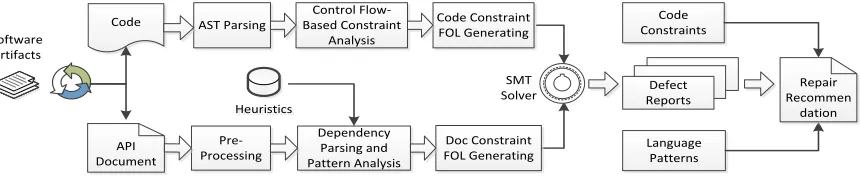
In this paper, we presentDRONE(Detect andRepair of dOcumentatioN dEfects), an automated approach to detect the defects of API documents, as well as to recommend repair suggestions. DRONE combines program analysis, natural language processing, and logic reasoning. It per-forms the following four main steps (illustrated in Figure 1): (1) First, it extracts an annotated document from the source code; (2) Second, it parses the source code to obtain an abstract syntax tree (AST). Based on the AST, control flow decisions and exception handling, as well as call invocations between the methods, are analyzed; (3) Next, it uses natural language processing techniques to tag the text features present in API documents and to extract the relevant parts on restriction and constraints; (4) Finally, it represents the extracted information in first-order logic (FOL) formulae and leverages satisfiability modulo theories to detect potential inconsistencies between documentation and code.
A “defect” in our context encompasses two scenarios. In the first scenario, the constraint description of API usage is incomplete in the documentation (see the examples in JDK and in Android); in the second scenario, the description exists but it is semantically incorrect with respect to the code. Indeed, as reported in a study conducted by Novick et al. [7], completeness and accuracy represent the two most
important attributes of good documentation. We do not treat syntactic errors in the documents as defects, since most of such errors could be detected by grammar checkers and may not be relevant for developers. Instead, we focus on the
semanticaspects. We argue that by identifying and correcting these defects the quality of API documents can be increased, which would positively enhance their usability.
The goal of our study is to investigate to what extent
DRONEis able to automatically detect defects and provide solutions to fix them, taking into account the following two scenarios: (i) when the constraint description of API usage is incomplete; (ii) when the description exists but is
semantically incorrect with respect to the code. Specifically, we measure the accuracy of DRONE in the context of the well-documented APIs of JDK 1.8 and Android 7.0-level 24 (as described in Section 3). [20] defines directives as statements on function signatures (i.e., related to parameter types and values) and exceptions. These are the main focus of our work.
We designed our study to answer two main research questions (RQs) on basis of the well-documented APIs of JDK1.8 and Android 7.0:
RQ1: To what extent does DRONE discover directive defects in Java/Android API documentation?
We assess the accuracy ofDRONE in detecting
directive defectsin API documentation.
RQ2: To what extent does DRONE provide coherent re-pairing solutions for the detected API documentation defects?
We qualitatively analyze the capability of
DRONEin automatically recommending repairs of the detected defects of API documentation directives.
1.2.1 Main assumptions of the research
In this paper, we assume that the API code is correct. The rationale is that they have gone through extensive tests and validation before delivery, hence they are more reliable compared to the documentation. (This assumption can be relaxed though; cf. Section 4.) On the other hand, the API documents are usually a combined description of various pieces of information, such as general descriptions, function signature descriptions, exception throwing declarations, code examples, etc.
Among these, we hypothesize that directives provide the most crucial information for API using developers. Particularly, we focus our attention on method parameter usage constraints and relevant exception specifications. They belong to the method call directive category which represents the largest portion of all API documentation di-rectives (43.7%) [20]. Indeed, all of the discussed illustrative examples (cf. Section 1.1) are directives of this category. We are convinced that automatic detection of such defects in API documents will be of great value for developers to better understand and avoid inappropriate use of APIs. In Java programs, this kind of directive is generally annotated with@param, @exception, @throws, etc.tags. Such structured information makes it easier to automatically extract the document directives.
1.3 Contributions
In summary, this paper makes the following contributions:
1) We propose an approach, which can automati-cally detect and help repair the defects of API document directives. The approach includes static analysis techniques for program comprehension as well as domain-specific, pattern-based natural lan-guage processing (NLP) techniques for document comprehension. The analysis results are presented in the form of first-order logic (FOL) formulae, which then are fed into the SMT solver Z3 [21] to detect the defects in case of inconsistency. A pattern-based patch will be recommended to the users, suggesting how to repair the defects.
2) The approach handles four types of document defects at the semantic level, and these are evaluated on parts of the JDK 1.8 APIs (including javaFX) and Android 7.0 APIs (Level 24) version and their corresponding documentation. The experimental re-sults show that our approach is able to detect 1689, 1605 and 621 defects hidden in the investigated documentation of selected APIs respectively. More-over, the precision and recall of our detection are around 76.4%, 83.8%, 59.4%, 90.3%, 74.7% and 89.4% respectively.
3) We define more than 60 heuristics on the typical descriptions of API usage constraints in API docu-ments, which can be reused across different projects. 4) We have implemented a prototypical API document defect repair recommender system DRONE. Not only can it facilitate the detection and repair of API defects for JDK1.8 and Android 7.0, but it also has the potential of wider applicability in other APIs.
This paper is an extended version of our previous work [9], which has been significantly extended in the following ways:
1) We substantially extended our original study with
new data and experiments: We added more libraries to the data analysis including the latest Android APIs to investigate the broader applicability of
DRONE. Moreover, we extended the size of the original artifact study, extending Experiments I and II of our original paper, by adding further libraries, analyzing in total 27 API libraries belonging to the latest JDK and Android versions. In particular, we also considered javaFX as the javax.swing and java.awt packages are legacy packages which are being replaced by javaFX.
2) We integrated new constraint tags in the detection functionality of defects in API documentation of
DRONE. We integrated the null value constraints related tags, i.e., @NonNull/NotNull and @Nul-lable as they are increasingly used nowadays. By including these tags in our approach, it enables the detection of further documentation defects (as described in the discussion section).
3) We then investigated the extensibility and reliability
detect API documentation defects in such new and well-documented libraries. Thus, we extended the original study with a further experiment (i.e., Part 2 of Experiment II) reporting the results of DRONE when detecting defects in the Android API documents.
4) We have further integratedan automated repair mech-anism into DRONE that recommends fixes for the detected directive defects. In particular, we added a completely new artifact study (i.e., Experiment III), answering an additional research question (RQ2) and involving different analyses to demonstrate the practicality of our approach to repair API documen-tation defects of software libraries. We clarified the exact nature and scope of our approach, i.e., that it is highly generic and applicable to further contexts (e.g., applicable to Android libraries as reported in Section 3.2) and how it relates to other existing approaches (in Section 5).
5) We provide a replication package2of the work with
(i) materials and working data sets of our study, (ii) raw data (to support future studies), (iii) the NLP patterns, the defined NLP heuristics and the repair solutions provided by DRONE. Furthermore, we present a prototypical implementation (described in Section 3) of the approach, which is based on the Eclipse plugin architecture. The source code of the prototype is also available for future study and extension.3
Main findings. We performed three experiments to demonstrate the effectiveness of our approach. Results of the first experiment, related to API defect detection capability of DRONE, show that our approach achieved high F-measure values, ranging between 71.7%, and 81.4% for the various analyzed libraries. In our second experiment, we investigated the applicability on many more API pack-ages, including the one of Android. Results of the second experiment demonstrate that the performance of DRONE
is still encouraging. Interestingly, for libraries of the latest Android APIs,DRONE achieved a precision rate of 74.7% and a recall rate of 89.4%.
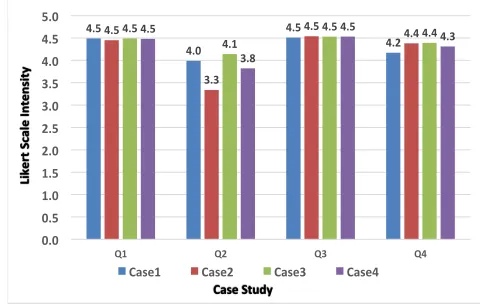
In a third experiment, we involved developers to judge the quality of the generated documentation repair rec-ommendations provided by DRONE. According to this study, DRONE achieved average scores of 4.48, 3.82, 4.53, 4.31 (out of 5), in terms of accuracy, content adequacy, and conciseness & expressiveness, respectively. Qualitative answers from the involved participants suggested the need to improveDRONEby generating more elaborated descrip-tions/templates for “if statement” with many conditions.
In summary, with DRONE we are able to discover various API directive defects in JDK and Android API documents. This is in contrast to what is generally believed that widely used and well-documented APIs would not exhibit such defects.
Paper structure. The remainder of the paper is structured as follows. Section 2 illustrates the technical details of our
2. https://github.com/DRONE-Proj/DRONE/tree/master/Replication 3. https://github.com/DRONE-Proj/DRONE/tree/master/DRONE
approach. The prototype implementation and experiments with performance evaluation are presented in Section 3 followed by a discussion in Section 4. Section 5 puts our approach in the context of related work, and Section 6 provides some conclusions and outlines future research.
2
APPROACH
In the current work, we mainly focus on four cases of pa-rameter usage constraints following [17]. These constraints includenullness not allowed,nullness allowed,range limitation, andtype restriction, a brief explanation of which is given as follows.
• “Nullness not allowed” refers to the case that the null value cannot be passed as an argument to a method. If this constraint is violated, an exception (e.g., NullPointerException) will be thrown.
• “Nullness allowed” refers to the opposite case of “Nullness not allowed.” In this case, the null value can be passed as an argument and no exception will be thrown. When the method is invoked, there is a default interpretation of the null value.
• “Type restriction” refers to the case that some specific type requirements must be imposed on the argu-ment. Apart from the common one that argument types must be compatible with the declared param-eters, they usually include some additional, implicit rules which must be respected. This is usually due to the features of object-oriented languages, in parti-cular, inheritance.
• “Range limitation” refers to the case that there are some specific value ranges for the arguments. If, otherwise, the values of the arguments are out of scope, then usually exceptions will be thrown.
Common rationale expects such usage constraints are specified explicitly in the accompanying documents for a better understanding and application of APIs, otherwise it could potentially mislead the API users. This is, unfortu-nately, not the case in practice, which has led to numerous defects in API documentation. The aim of our work is to detect these defects automatically.
To this end, we propose an approach based on program analysis, natural language processing, as well as logic rea-soning. Our approach consists of four main steps, which are illustrated in Figure 1 with the following brief description.
1) We first extract an annotated document out of the source code which is a relatively simple procedure. We then have two branches (cf. Figure 1).
2) In the upper branch, we exploit static code analysis. We parse the code to obtain theabstract syntax trees
(AST). Based on the AST, the statements of control flow decisions and exception handling, as well as the call invocation relation between methods, can be analyzed. The results are given in a (simple, mean-ing no quantifiers) form of FOL expressions. The details of this step will be elaborated in Section 2.1. 3) In the lower branch, we exploit natural language
Code
API Document Software
Artifacts
AST Parsing
Pre-Processing
Control Flow-Based Constraint
Analysis
SMT Solver
Dependency Parsing and Pattern Analysis
Code Constraint FOL Generating
Doc Constraint FOL Generating Heuristics
Heuristics
Language Patterns
Repair Recommen
dation Code
Constraints
[image:6.612.92.522.42.130.2]Defect Reports
Fig. 1. Approach overview
constraints. They are also encoded as simple FOL expressions. The details of this step will be elabo-rated in Section 2.2.
4) The upper and lower branches meet when an SMT solver is employed to solve the logical equation rela-tion between the pair of FOL formulae derived from the respective procedures. Potential inconsistencies will be reported based on the result returned from the SMT solver.
For technical reasons and for the scalability of the approach, we make the following assumptions.
• For the second step, i.e., the code analysis: (1) we usually bound the depth of the call graph, which is specified as a hyperparameter of the procedure and is provided by the user; (2) we disregard private methods since they are invisible to end users; (3) we disregard method calls in the conditions of statements; and (4) we do not consider aliasing or dynamic dispatching for exception propagation. • For the third step, i.e., handling directives, we
con-centrate on the directives of the form
@tag target description
Here, tag primarily ranges over “param”, “excep-tion” and “throws”. We note that the null value constraints related tags, i.e., @NonNull/NotNull and @Nullable are increasingly used nowadays. Thus we also include these tags in our approach.Targetrefers to the tagged entity and description refers to the constraint related to the target expressions. We hy-pothesize that API developers tend to use recurrent linguistic patterns to describe the constraints in these expressions.
In the following subsections, we will describe the two processing branches consecutively.
2.1 Extract constraints from API source code
In this subsection, we illustrate the workflow of the upper branch in Figure 1. This branch mainly involves static code analysis techniques based on AST and call hierarchy. In particular, a complete program execution usually includes the participation of multiple procedures, and their invoca-tion relainvoca-tion constitutes a call hierarchy. The parameter re-lated constraints are usually introduced by such a hierarchy. The procedure goes through the following steps with API source code as the input, and a FOL formula as the output.
Step 1: Construct AST. By parsing the API source code, we extract an AST treem for each method m. This step is usually a routine of program analysis. In addition, we
generate thestatic call graph G by Eclipse’s CallHierarchy4. From the call graph, we define thecall relationcall(m, n)by computing the transitive closure of the edge relation in the call graph such thatcall(m, n)holds if and only if method mcalls methodn. Note that, as specified in the assumption (1), we bound the depth of the call graph, so technically we compute a sound approximation ofcall(m, n); this is usually sufficient in practice.
Step 2: Extract exception handling information. For each public methodmin the API, by traversing the ASTtreem, we locate each throw statement and collect the associated exception information. We store the exception information of each methodm as a set ExcepInfom of tuples, each of which is of the form(m, P, t, c)where
• mis the current method name,
• Pis the set of formal parameters ofm,
• tis the type of the exception, and
• cis the trigger condition of this exception.
After this step, the directly throwable exception information, as well as the propagating exception information introduced by the method invocation, is obtained.
The pseudo-code of expExtractor is given in Algo-rithm 1. The AST parsing part is implemented with the aid of the Eclipse JDT toolkit. In particular, the methods
isThrowable, isComposite and isMethod in the pseudo-code are from there. The inputs of expExtractor comprise the statement sequence of the source code (represented as an AST) and the depth of the call hierarchy. The algorithm first iterates over all the statements inm. If a statement contains an exception-throw, the relevant information—the exception type, trigger condition, the relevant parameter, as well as the method name—will be recorded and inserted into the list inf oList (line 5-6). Note that we use backtracking to calculate a conjunction of the trigger conditions in case of multiple enclosed branches. (For instance, for the snippet If (A){...If (B) throw...}, both A and B are collected as conjuncts of the trigger condition.) To handle statements with a composite block, we recursively go through the internal statements of the block and extract the corresponding exception information (line 7-10). To handle method calls (for instance, methodmcalls methodn), ifm’s argument(s) is(are) passed onto the callee methodn, we will use the recursion with parameters, i.e., the statement body of the callee method as the parameter, together with the depth value decreased by1 (line 12). Note that we require parameter match in the invocation case to track and to guarantee the constraints are on the same parameter list as the caller method. This recursion continues until the depth
Data:stmList: AST statement block of a methodm, and
dep:integer
Result:inf oList: list of exception information, which records the flow-exception tuples, i.e,(m, P, t, c)
1 begin
2 inf oList←− ∅;
3 ifdep≥0then
4 foreachstm∈stmListdo
/* If stm throws an exception,
records all information in a tuple
and add to the list */
5 ifisThrowable(stm)then
6 inf oList←−inf oList∪ {(m, P, t, c)|P: parametert, t: exceptiontype, c: condition}
/* Recursively invoke itself, in case
of composite statement */
7 else ifisComposite(stm)then
8 ListsubList←−(Block)stm.getBody();
9 inf oList←−
inf oList∪expExtractor(subList, dep);
/* If the statement contains a method call of n, check the invoked
method recursively */
10 else ifisMethod(stm)∧(stm’s args∈m’s list)then
/* n is the callee of m in stm */
11 mList←−n.getBody();
12 inf oList←−
inf oList∪expExtractor(mList, dep−1);
13 end 14 end
15 end
Algorithm 1:expExtractoralgorithm
decreases to0. Since the recursion happens only when there are composite blocks and method invocations, the depth condition guarantees the termination of the algorithm.
Step 3: Calibrate exception handling information.In Step 2, we have collected a list ofExcepInfomfor each methodm by directly analyzing the ASTs. Now we refine them in the following two steps: (1) We remove exceptions irrelevant to the parameter constraints. Namely, for each (m, P, t, c) ∈
ExcepInfom, if none of the parameters in P appear in the conditionc, this piece of information is deemed to be irrelevant, hence we updateExcepInfom := ExcepInfom\ {(m, P, t, c)}. (2) For two methodsm, nsuch thatcall(m, n), assume furthermore that we have(m, P, t, c)∈ExcepInfom and(n, Q, t, c0)∈ExcepInfom, which means there is some exception propagated to m from n. In this case, we again traverse the AST of m. Ifn is enclosed in sometry block ofmand there is a compatible exception type handled and no new exception is thrown in thecatchorfinallystatements ofm,(n, Q, t, c0)is removed fromExcepInfom. Otherwise, a new exception is thrown in thecatchorfinallystatement, and then the related information is recorded and used to update (n, Q, t, c0). Note that this step requires a second traverse of the ASTtreem.
Step 4: Classify exception handling information. In this step, we further classify the cleaned exception information generated from Step 3 into the followingcategories, which is used to formulate parameter usage constraints.
(1) Category “Nullness not allowed”, which consists of exceptions(m, P, t, c)such thatc implies p = null for somep∈P;
(2) Category “Type restriction”, which consists of ex-ceptions(m, P, t, c)such thatccontainsinstanceOf.
(3) Category “Range limitation”, which consists of ex-ceptions(m, P, t, c) where some comparison opera-tors exist in condition c unless it is compared with
null. In that case,(m, P, t, c)wouldnotbe included.
Note that we do not have a category “nullness allowed”, as the related constraints cannot be fully handled by the exception conditions; for them, we utilize and adapt the technique proposed in [17]. Similar to [17], we are interested in API methods where a parameter’s null value is not prohibited and where the null value has a semantics. This is usually reflected by a particular behavior of the method, for example, to instantiate a default object in case of null value. Therefore, we parse the statements inside the API body. If there is an explicit choice statement, we check whether the condition relates to the null value of the parameter. If the condition handles the case where the value is null and no exception is thrown, we would label it as “nullness allowed”. Different from [17], in our approach, the checking process is executed recursively in the case of method invocations where the same parameter is passed to the called method. We set the value of call hierarchy depth the same as for the other three categories in our approach.
Step 5: Constraints generation.We formulate the collected information regarding the parameter usage constraints as a FOL formula ΦAPI. According to the four types of the
parameter usage constraints, we introduce the following
predicates: (1) NullAllow(m, a), (2) NullNotAllow(m, a), and (3)Type(m, a, cl), wheremis a method,ais an argument of m, andclis a datatype in Java.
Accordingly, for each methodm, we generate a formula Φmwhich is a (logic)conjunctionof
(i) NullNotAllow(m, p), if p is a parameter of m and (m, P, t, c)is in the “nullness not allowed” category fromStep 4.
(ii) NullAllow(m, p), ifpis a parameter ofmand “null-ness allowed” category. For such constraints, there are no exceptions thrown. In this part, we do not consider aliasing problems either.
(iii) ¬Type(m, p, cl), ifpis a parameter ofm, and there exists(m, p, t, c)such that
c =⇒ (p=instanceOf(cl)).
(iv) V m,p∈P
V
(m,p,t,c)∈ExcepInfom¬c which specifies the
range of each parameter available from the exception information.
2.2 Extract constraints from directives
Particularly relevant to our approach, JDK’s documen-tation is generated automatically by Javadoc. The content of the document is grouped inside pre-defined delimiters (e.g., /** and */). Standard tags are defined to describe the different pieces of information (for instance, version, author, method signatures, exception conditions, etc.) of the target documents to be generated. Our goal is mainly to detect the defects regarding the parameter constraints and exception declarations of the methods. Javadoc tags provide a useful indicator to extract the relevant textual description from the documentation.
We use NLP techniques, e.g.,part-of-speech (POS) tagging
and the dependency parsing to process API documents. In a nutshell, POS tagging is the process of marking up a term as a particular part of speech based on its context, such as nouns, verbs, adjectives, and adverbs, etc. Because a term can represent more than one part of speech in different sentences, and some parts of speech are complex or indistinct, it turns out to be difficult to perform the process exactly. However, research has improved the accuracy of the POS tagging, yielding various effective POS taggers such as TreeTagger, TnT (based on the Hidden Markov Model), or the Stanford tagger [24], [25], [26]. State of the art taggers reaches a tagging accuracy of around 93% when compared to the tagging results of humans.
In the first step, we perform POS tagging with the Stanford lex parser5 to mark all terms of the words and
their dependency relation in the constraint-related directives extracted from the documents. In particular, we focus on the sentences annotated with @param,@exception, and@throws
tags.
We then pre-process the texts before carrying out dependence parsing. The pre-precessing is necessary because API documentation is usually different from pure natural language narrations (for instance it is frequently mixed with code-level identifiers). The tag headers, i.e.,
@param, @exception, and @throws, will be removed, but their type and the following parameter will be recorded. In addition, some embedded markers (such as <code>) will be removed, whilst the words enclosed with such markers are recorded, since these are either the keyword or the corresponding variable/method/parameter names in the code. Undoubtedly, there are more complicated cases, making the pre-processing a non-trivial task. A typical situation is that there are code-level identifiers and expressions in the documents. For example, the document
of java.awt.color.ColorSpace.getMinValue(int component)
states “@throws IllegalArgumentException if component is less than 0 or greater than numComponents−1”. To tackle that, we first recognize the special variable names and mathematical expressions via regular expression matching. The naming convention of Java variables follows the
camelcase style. If an upper case letter is detected in the middle of a word, the word is regarded as an identifier in the method. Likewise, if a word is followed by some mathematical operator, it will be regarded as an expression. Other cases include the identification of method names (with the affiliation class identifier “.”), constant variables, etc. Composite statements also need to be divided into
5. cf. http://nlp.stanford.edu/software/lex-parser.shtml
simple statements. The statistics of the POS, such as the number of subjects, the number of verbs and the most common verbs are given in the repository of the replication package.6 We observe that the number of directives with
verbs is significantly higher than the ones with subjects. For example, in the latest Android APIs, 6915 directives are with verbs, whereas just 3970 directives are with subjects.
In general, we defined 29 regular expressions and rules to detect these cases. One example to recognize the member functions in the description is of the following form: “\W[A-Za-z ]+[A-Za-z 0-9]*(\.[A-Za-z ]+[A-Za-z 0-9])*(#[A-Za-z ]+[A-Za-z 0-9]*)?\([∧()]*\)\W”. After the specific identifiers and expressions in the description are recognized, they are replaced by a fresh labeled word to facilitate the dependency parsing.
The dependency parsing and linguistic analysis require identification of certain heuristics. For this purpose, we adapted an approach used in previous work [22]. We note that, however, the adaptation to the new context was not a trivial task. Specifically, different from the work by Di Sorbo
et al. [22], we are not interested in leveraging the recurrent linguistic patterns used by developers while writing text messages in development emails to automatically infer their intentions (e.g., discussing a bug report or a feature request). Our goal is to leverage the existinglinguistic patterns reported in API documentsto automatically extract/detect API docu-mentation constraints. As consequence, the heuristics/tools provided in the paper by Di Sorbo et al. [22], [23] are based on linguistic patterns but not applicable for our purpose. This required us to adapt the concept of linguistic patterns/heuristics definition to the API documentation context. For that reason, we explain in detail the steps required for the definition of the heuristics and its utilization in our context:
1) We perform a (manual) analysis of the existing
linguistic patterns of constraints described in API documents which admit similar (recurrent) grammatical structures. This step included a manual examination of 459 documents of java.awt,
javax.swing and javaFX packages for extracting a set of linguistic patterns according to each of the four constraint types. Specifically, we recognized several discourse patterns related to each of the four constraint types. As a simple example, in javax.swing.UIManager.getFont(Object key), the constraint states that an exception would be thrown “if key is null”; while in
java.awt.Component.list(PrintStream out), the
constraint states similarly that an exception would be thrown “if out is null.” In this case, “is null” is the recurrent pattern and will be extracted, therefore. This manual analysis required approximately 1 week of work.
2) For each extracted linguistic pattern we define an NLP heuristic responsible for the recognition of the specific pattern. The formalization of a heuristics requires three steps: (1) discovering the relevant details that make the particular syntactic structure of the sentence recognizable; (2) generalizing some
pieces of information; and (3) ignoring useless information. At the end of this process, a group of relatedheuristicsconstitutes the pattern for a specific constraint category.
At the end of this process, we formalized 67 heuristics (available in the replication package). It is important to mention that, similarly to the work by Di Sorboet al. [22], the accuracy of our approach in identifying API constraints strictly depends on both the accuracy of the aforementioned manual analysis and the overall quality of the API docu-mentation. In particular, as described before, to ensure a proper manual analysis of the recurrent linguistic patterns described in constraints of API documents it required us approximately 1 week of work. Clearly, a poor API documentation with non-standard ways to describe/report API constraints can affect the general accuracy of our results (cf. Section 4 for further discussions). However, adapting the approach to API documents of higher/lower quality may require additional manual analysis.
[image:9.612.88.255.402.467.2]A brief statistics of heuristics for each constraint type is given in Table 1. Since these heuristics are different from each other, during the linguistic analysis phase, one directive will be accepted by at most one heuristics (possibly none, in case that no constraints are specified). We remark that these heuristics are interesting in their own right, and can potentially be reused and extended in other related researches.
TABLE 1 Summary of Heuristics
Constraints types Heuristic number Nullness not allowed 22
Nullness allowed 12
Type restriction 10
Range limitation 23
In total 67
Once the heuristics are identified, we perform dependency parsing and pattern analysis. For this, we largely follow the methodology of [22]. As a concrete example for heuristic-based parsing, the document of
java.awt.Choice.add-Item(String item) states “@exception
[image:9.612.66.285.609.681.2]NullPointerException if the item’s value is equal to <code>null</code>”. We first record the exception type, and then remove the pair of “<code>” and “</code>”. The sentence “if the item’s value is equal to null” is finally sent to the parser.
Fig. 2. POS tagging and dependency example7
7. The meaning of POS tags and phrasal categories can be found via http://www.cis.upenn.edu/∼treebank/
Figure 2 illustrates the dependency parsing result of our example document description. In this sentence, we disre-gard useless words, such as “if”, since its part-of-speech is
IN, i.e., the proposition or subordinating conjunction. The subject of the sentence (nsubj) is “value”, but the value does not appear in the parameter list of the method. We thus check again the neighboring noun (NN), i.e., item, and find it matches the parameter, so we mark it as the subject of the directive. We observe that “equal to” is a recurring phrase that appears in many directives. It indicates an equivalence relation to the following word. The xcomp of such phrase—null in this case—will be the object of the real subject. We can thus define the language structure with “(subj) equal to null” as heuristics during matching. In this way, the subject(subj) and object(“null”) of “equal to” will be extracted and be normalized into the expression subj =obj. In practice, “[verb] equal to”, “equals to” and “[verb] equivalent to” are of the same category, and they will be normalized into the same expression. In this example, the parsing result ends up toitem=null.
We are now in a position to generate the parameter usage related constraints for the documentation, again represented by a FOL formula. From the previous steps, we have identified the relevant sentences via tagging and dependency parsing, with necessary pre-processing. We further divide these sentences into shorter sub-sentences. In the above example, the sentence is transformed to “if component is less than 0 or greater than [specExpression]”. Since“component”is parsed as the subject and“or”is parsed ascc(conjunction in linguistics), the sentence can be further divided into two sub-sentences, i.e., “component is less than 0” and “component is greater than [specExpression]”, and then each sub-sentence is subject to the analysis.
As the next step, we define a set of rewriting rules to translate the obtained sub-sentences into FOL formulae. For instance, “or” is rewritten into a logic disjunction, and “less than” is rewritten as a comparison operator<. As a result, the above example can be rewritten into(component <0)∨
(component > [specExpression]). Finally, we replace the labeled word by the original expression, yielding the output FOL formula of the procedure. In our example, we have (component <0)∨(component >numComponent−1).
2.3 Identify defects
Recall that from the preceding two steps, we have obtained two FOL formulae, namely, ΦAPI and ΨDOC, over the
same set of predicates introduced in the Step 5 in Sec-tion 2.1. Intuitively, they represent the collected informaSec-tion regarding the API source code and the directives of the documents with respect to the four types of parameter usage constraints. The main task of the current step is to detect the mismatch between these two. To this end, our approach is to check whether the two formulaeΦAPI
and ΨDOC are equivalent. If this is the case, one can
method and the parameter thereof, as well as the involved exception. Then we can examine whether such a mismatch is a genuine defect of the API document.
Formally, we make a query to check whether
ΦAPI⇔ΨDOC (1)
holds. If this is indeed the case, we can conclude that the API source code and the related documents are matched. Otherwise (i.e., (1) does not hold), a counterexample is usually returned, suggesting where the mismatching hap-pens. Let us take a simple example of method f(x) with a single argument x. Suppose that, from the API source code, one finds that x must be strictly positive; in this case, we have ΦAPI = x > 0. However, from the API
document, we only see the statement such as x must be non-negative; in this case, we haveΨDOC =x≥0. Under
this circumstance, (1) is instantiated by x > 0 ⇔ x ≥ 0, which clearly fails. By tracing the relevant predicate (in this case x ≥ 0), we can detect the defect of the document and recommend possible repairs which will be discussed in Section 2.4. Note that, when one counterexample is returned, in principle we can only locate one inconsistency. To detect all inconsistencies, we have to update the formulae ΦAPI and ΨDOC by removing the relevant part of the
inconsistencies (defect) which have been detected before and make the query again to find more counterexamples (and thus further inconsistencies). Such a process must be repeated until no further counterexample is returned. In practice, one counterexample often suggests multiple sources of inconsistencies. Hence, only a small amount of rounds is needed.
To perform the check-in (1), we exploit a Satisfiability Modulo Theory (SMT). In general, SMT generalizes boolean satisfiability by adding useful first-order theories such as equality reasoning, arithmetic, fixed-size bit-vectors, arrays, quantifiers, etc [27]. An SMT instance is a formula in first-order logic, where some function and predicate symbols have additional interpretations. In practice, to decide the satisfiability (or the validity) of formulae in these theories, one usually resorts to SMT solvers. They have been applied in many software engineering related tasks as diverse as static checking, predicate abstraction, test case generation, and bounded model checking. Z3 [21] from Microsoft Research is one of the most widely used SMT solvers. It is targeted at solving problems that arise in software verifi-cation and software analysis, and thus integrates support for a variety of theories. It also provides programming level support in multiple languages, for example, Java and Python. Some important functions, such as creating a solver, checking the satisfiability, managing logic formulae, are provided as APIs for third-party usage.
In our scenario, clearly, (1) is equivalent to checking whether
(ΦAPI∧ ¬ΨDOC)∨(¬ΦAPI∧ΨDOC)
is satisfiable. Hence, off-shelf SAT solvers, such as Z3, can be applied.
We note that, however, in practice, there are some spe-cific cases that need to be handled before checking (1). For instance, some constraints extracted from the code contain method calls (e.g., when they appear in the condition
of branching statements), but the code analysis does not further examine the internal constraints of these embedded methods. (For instance, forif (isValidToken(primary)inclass
MimeType of java.awt.datatransfer, we do not trace the
constraints of methodisValidToken(primary).) We note that the aim of isValidToken(primary) is to check whether the value ofprimaryis null or not. The document directive also states that an exception is thrown ifprimaryisnull. It is not difficult to see that, in these cases, the simple comparison of obtained logic formulae would inevitably generate many spurious defect reports. To mitigate this problem, we mark these constraints, ignore them when checking (1), and thus simply regard them as consistent.
To provide some statistics regarding the FOL formulae generated for conducting the experiments described in Section 3.2, in total there are 4,405 variables in Experiment 1, 4,369 variables in Part 1 of Experiment 2, and 1,150 variables in Part 2 of Experiment 2. However, each formula is simple in that it contains only a small number of variables. Indeed, the median values of variables per formula are all 1 in these experiments. As for the total number of clauses, there are 47 in Experiment 1, 17 in Part 1 of Experiment 2, and 10 in Part 2 of Experiment 2. In general, the formulae contain up to 5 clauses with most of them containing only a single clause.
2.4 Repair Recommendation
Once the defects are identified, the next step is to provide meaningful repair recommendations. As illustrated in Fig-ure 1, the repair recommendation is built (or synthesized) on top of the extracted code constraints (in terms of a FOL formula) and document patterns. Specifically, since we mainly consider four categories of parameter constraints, the extracted patterns of each category could be reused as the template for generated text, and we strive to select most concise and informative templates for each category. It is important to mention that recent work in literature proposed the use of templates to document undocumented part of source or test code [28], [29], [30], [31], [32]. However, our scenario is different from the ones of such previous work, as we provide recommendations, based on NLP tem-plates, for replacing, correcting API defects with appropriate repairing solutions, and thus complementing the available human-written documentation. Moreover, different from such previous work, DRONE generates such templates by analyzing both extracted code constraints (in terms of a FOL formula) and document patterns.
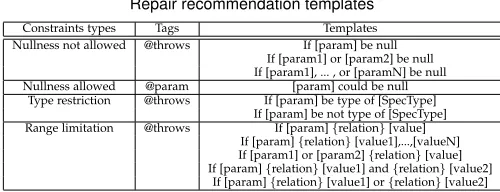
Table 2 illustrates some example templates. For cate-gories “Nullness not allowed” and “Nullness allowed”, it is straightforward to generate atomic repair directives given the FOL formula. That is, we generate a directive stating the corresponding parameter must not or could be null based on the templates.
sentence for “Nullness not allowed”. For example, in
javax.xml.bind.JAXBElement.JAXBElement(QName name,
Class<T> declaredType, Class scope, T value), the
extracted FOL is Or(NullConstraint(declaredType; NEG); NullConstraint(name;NEG)). Accordingly, the generated document is “@throws IlleagalArgumentException If declaredType or name is null”. Meanwhile, for the category “Nullness allowed”, since each parameter has a separate tag, the atomic directive will be directly generated and appended after their corresponding tags based on the templates.
For the “type restriction” category, the simplest case would be to add the type restriction information to the exception related directives. We need to add the concrete type information to replace [SpecType] as shown in the template apart from the corresponding parameter name as shown in Table 2. Note that, despite that our first example indicates the parameter should not be of a particular type, in some other cases, some particular type of parameter is expected. In such case, we add “not” to specify this fact. For example, in
java.security.UnresolvedPermissionCollection.add(Permission
permission), the parameter permission is supposed to
be the type of UnresolvedPermission, otherwise an IllegalARgumentException would be thrown. But this information is missing in the document, and DRONE
will detect this and recommend the repair “@throws IllegalArgumentException If permission is not the type of UnresolvedPermission”.
For the “range limitation” category, we define a set of translations for the numerical relation. For example, “>” will be translated to “greater than”, and “==” translated to “equal to”. There are multiple templates for this category as summarized in Table 2. As a concrete example in
java.security.Signature.update(byte[] data, int off, int len)
[image:11.612.48.298.553.649.2]from JDK 1.8, DRONE detects the incompleteness of the documentation and recommends the repair as “@throws IllegalArgumentException If len or off is less than 0” following the template “If [param1] or [param2]{relation} [value]”. In the case of Boolean value comparison, we just use “be TRUE” or ”be FALSE” instead of “be equal to TRUE” or “be equal to FALSE”.
TABLE 2
Repair recommendation templates
Constraints types Tags Templates Nullness not allowed @throws If [param] be null
If [param1] or [param2] be null If [param1], ... , or [paramN] be null Nullness allowed @param [param] could be null
Type restriction @throws If [param] be type of [SpecType] If [param] be not type of [SpecType] Range limitation @throws If [param]{relation}[value]
If [param]{relation}[value1],...,[valueN] If [param1] or [param2]{relation}[value] If [param]{relation}[value1] and{relation}[value2]
If [param]{relation}[value1] or{relation}[value2]
3
IMPLEMENTATION AND
CASE
STUDIES
We have developed a prototype that implements the ap-proach described in Section 2, based on the Eclipse plugin architecture. In this section, we will present the main graphical user interface of our prototype, while we evaluate its effectiveness in various case studies, as described in
Section 3.2. Specifically, the effectiveness is mainly judged in terms of precision and recall.
The prototype takes API code and document directives as inputs, and outputs repair recommendations for directive defects. Particularly, the tool integrates the SMT solver Z3 to analyze generated FOL expressions written in the SMT-LIB 2.0 standard8 and identify potential defects. Figure 3 and
Figure 4 illustrate the main graphical user interfaces of the prototype.
Figure 3 demonstrates thedefect detectionview. The left panel displays the API packages to be explored byDRONE. The tool can be invoked by selecting it in the menu opened after right-clicking the corresponding package. The tab view of DRONE includes (i) invocation relation analysis, (ii) code parsing and document analysis, and (iii) defect detection. The console on the right part displays the execution traces, which also provide configuration support for saving inter-mediate files during analysis.
Figure 4 demonstrates the defect repairview. The list in the middle of the panel displays the detected defects from the previous step. Once a listed item is left-clicked,DRONE
allows to automatically navigate to the corresponding defect API, which will be highlighted in color. Meanwhile, the repair recommendations will be given on the right part of the tab panel.
3.1 Settings
We conduct three experiments to evaluate our prototype implementation. In Experiment 1, we focus the evaluation on the packages awt, swing and javaFX. In Experiment 2, we reuse the heuristics defined in the first one and evaluate the performance for twelve additional packages in the same project (Part I) and the latest Android APIs (Part II). Finally, in Experiment 3, we evaluate the quality of generated documentation recommendations for detected defects. In all experiments, the evaluations are conducted on a PC with an Intel i7-4790 3.6 GHz processor and 32.0 GB RAM, running Windows 7 64-bit operating system. The depth of call hierarchy is set to 4.
The metrics used in the first two experiments are
precision, recall, and F-measure. Precision measures the ex-actness of the prediction set, whereas recall measures the completeness, which are respectively calculated as follows.
precision= T P
T P +F P (2)
recall= T P
T P +F N (3)
F-measure considers both exactness and completeness, and thus balances the precision and recall.
F-measure= 2×precision×recall
precision+recall (4)
where TP, FP, FN stand for true positive, false positive, and false negative respectively.
In the third experiment, we hire twenty-four graduate students majoring in Software Engineering to evaluate the generated documentation recommendations. Similar to the
Fig. 3. Prototype overview—defect detection
Fig. 4. Prototype overview—defect repair
previous work [29], [32], [33], [34], we primarily consider three aspects, i.e.,accuracy,content adequacy,concisenessand
expressiveness, as the main criteria to assess the quality of the recommendations.
3.2 Results
RQ1:To what extent does DRONE identify directive defects in Java/Android API documentation?
Experiment 1
We first evaluate the performance of our approach applied to the target packages and their documents (i.e., java.awt,
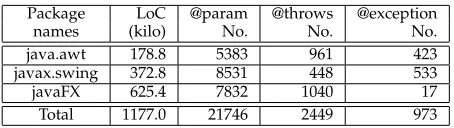
javax.swing and javaFX). The packages parsed by our pro-totype contain around 1.2 million lines of code (LoC)9 and
25,168 Javadoc tags in total. The details are summarized in Table 3. Over these dataset, the program analysis process takes around two hours, while the document analysis takes around 1 hour. Finally, our approach outputs 2510 constraints for the APIs methods.
To calculate the precision and the recall, the ground truth set is required. For this purpose, three computer science master students are hired, who have more than
[image:12.612.112.500.124.562.2]three years of Java development experience, and are asked to manually inspect the obtained results, classifying the items into true/false positives and true/false negatives. In terms of recall, in principle, the total false negatives are required. However, it turns out that manual examination of all involved APIs and their documentation (25,168 Javadoc tags) would be practically impossible. In particular, the tremendous number of inter-procedure invocation makes the manual process both error-prone and time-consuming. Therefore, we only consider those APIs with the constraints detected by our tool as the sample. This means that for what concerns true positives and false positive we rely on the validation performed by the involved master students. We apply a stratified random sampling strategy to examine 10% of the APIs and their documentation outside of the set and only very few (less than 1% of them) are missing. Each report was examined by three subjects independently. A majority vote mechanism was used to resolve possible conflicts. The manual classification process required around five days.
TABLE 3
Data overview in Experiment 1
Package LoC @param @throws @exception
names (kilo) No. No. No.
java.awt 178.8 5383 961 423
javax.swing 372.8 8531 448 533
javaFX 625.4 7832 1040 17
Total 1177.0 21746 2449 973
[image:13.612.49.301.569.658.2]The results of Experiment 1 are summarized in Table 4. Overall, out of these reported 1689 defects (TP+FP), 1291 turn out to be real defects, giving rise to a precision of 76.4%. Combined with 398 false negatives, we get a recall of 83.8%. The average F-measure is 79.9%. In particular, all of the four defective document examples from JDK mentioned in Section 1 are detected successfully. Our approach performs well on the selected API packages where the heuristics are summarized. Moreover, Table 4 also gives the distribution and performance of each constraint category. Range limitation category takes up the largest portion of defective documentation in the selected dataset.
TABLE 4 Results of Experiment 1
Category TP FP FN TN Precision Recall F-measure
Nullness 233 77 7 333 0.752 0.971 0.847
Not Allowed
Nullness 599 63 27 34 0.905 0.957 0.930
Allowed
Range 406 245 121 198 0.624 0.770 0.689
Limitation
Type 53 13 95 6 0.803 0.358 0.495
Restriction
Total 1291 398 250 571 0.764 0.838 0.799
Among these four constraint categories, we found the precision for therange limitationtype and thenullness not al-lowedtype is lower than the other two types. We then exam-ined some false positives: for therange limitation, most false positives are attributed to some vague descriptions of the parameter range. For example, in java.awt.Container.java, the extracted constraint foradd(Component comp, int index)
from the API code is: (index < 0 ∧ ¬(index = −1)), which is propagated from the callee method addImpl(int). But the document directive just states “@exception Illegal-ArgumentException if the index is invalid.” Some other similar vague descriptions are also frequently found, for example, simply been stated “out of range.” Such implicit expressions prohibit the effective extraction of constraints and are deemed to be “defective” in our approach. To mitigate this issue, we can define some specific rules to rectify, i.e., treating such cases as non-defective.
On the other hand, there are some opposite cases where the descriptions are concrete, but difficult to resolve. For ex-ample, in java.awt.Container.areFocusTraversalKeysSet(int id), the document states that “if id is not one of boardFocusManager.FORWARD TRAVERSAL KEYS, Key-boardFocusManager.BACKWARD TRAVERSAL KEYS, [...]”, an IllegalARgumentException will be thrown. The document enumerates all of the valid values for the parameter id. But in the code, the condition for the exception is just id < 0 ∨ id ≥
KeyboardFocusmanager.TRAVERSAL KEY LENGTH.
In this case, since our current implementation does not interpret the constant values, we cannot detect either. But such false positive can be reduced by augmenting with more reference abilities via static analysis tools which is planned in our future research.
The nullness not allowed type suffers from the similar issue as range limitation. The slight difference we observe is the existence of some anti-patterns in the documentation. For example, the document ofjava.awt.Choice.insert(String
item, int index) states “@param item the non-null item to
be inserted”. The linguistic feature of such directive is quite different from what we summarized before, and our approach does not successfully extract the constraints. But we could get around the problem by adding more such “anti-pattern” heuristics into our repository.
We also manually analyzed some false negatives reported by our experiment and found that many are introduced by the method calls embedded in the condition statements. To reduce the false positives, we skipped the constraints inside these embedded methods, and simply regard the accompanying documents as non-defective. This, however, is a double-edged sword, i.e., false negatives are also potentially introduced. For example, in
java.awt.image.AffineTransformOp.Affine-TransformOp(AffineTransform xform, [...]), the method
Experiment 2
In this study, we extend the exploration scale to cover more Java API libraries and different projects. In parti-cular, we consider additional twelve JDK packages (i.e.,
javax.xml, javax.man-agement, java.util, java.security, java.lang,
java(x).sql10, java.imageio, java.io, java.net, java.nio, java.text
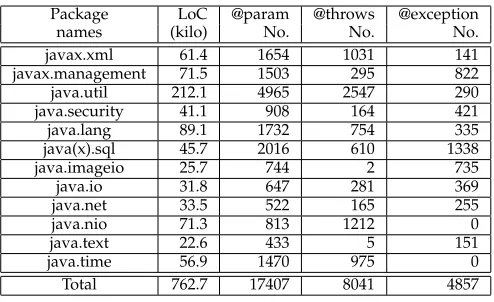
[image:14.612.313.566.73.161.2]and java.time) and the latest Android SDK API (level 24). We separate this experiment into two parts. The first part involves the twelve JDK packages, while the second involves the Android API. We reuse the heuristics from the first experiment. The information of these packages is given in Table 5 and Table 6.
TABLE 5
Data overview for additional JDK packages (Part 1)
Package LoC @param @throws @exception
names (kilo) No. No. No.
javax.xml 61.4 1654 1031 141
javax.management 71.5 1503 295 822
java.util 212.1 4965 2547 290
java.security 41.1 908 164 421
java.lang 89.1 1732 754 335
java(x).sql 45.7 2016 610 1338
java.imageio 25.7 744 2 735
java.io 31.8 647 281 369
java.net 33.5 522 165 255
java.nio 71.3 813 1212 0
java.text 22.6 433 5 151
java.time 56.9 1470 975 0
[image:14.612.50.297.225.376.2]Total 762.7 17407 8041 4857
TABLE 6
Data overview for Android SDK API (Part 2)
Package LoC @param @throws @exception
names (kilo) No. No. No.
android.accounts 6.0 205 25 0
android.bluetooth 28.1 434 58 0
android.database 15.3 548 87 0
android.gesture 3.0 49 0 0
android.graphics 40.8 1226 43 0
android.hardware 74.0 948 246 0
android.location 12.3 172 109 0
android.media 93.3 1171 496 0
android.net 60.2 715 119 2
android.service 14.2 205 15 0
android.view 113.3 2357 151 1
android.webkit 11.9 320 4 0
Total 472.4 8350 1353 3
For the second experiment, again we ask the same subjects, as in the first one, to manually classify the obtained results and use majority vote to resolve possible conflicts. Table 7 summarizes the performance details for each con-straint category in Part 1 of experiment.
Out of these 1605 detected defects, 953 turn out to be true positives, and 652 false positives, giving a precision rate of 59.4%. Taking the 102 false negatives, we get a recall of 90.3%. Similar to the observations of Experiment 1, the precision of therange limitationhas the lowest value among the four. Overall, the performance in terms of precision and F-measure is lower than that of the first experiment, but
10. It contains bothjava.sqlandjavax.sql.
TABLE 7
Results of additional JDK packages (Part 1)
Category TP FP FN TN Precision Recall F-measure
Nullness 405 158 27 842 0.719 0.938 0.814
Not Allowed
Nullness 122 49 8 45 0.713 0.938 0.811
Allowed
Range 374 422 59 338 0.470 0.864 0.609
Limitation
Type 52 23 8 1 0.693 0.867 0.770
Restriction
Total 953 652 102 1226 0.594 0.903 0.717
[image:14.612.314.563.296.385.2]still at an acceptable level. Based on the obtained results, we observe that, when our heuristics are applied to other APIs, although suffered at a decrease in the accuracy, the performance is still kept at an acceptable level with a precision of 59.4% and a recall of 90.3%, and thus these heuristics can be reused.
TABLE 8
Results of Android SDK API (Part 2)
Category TP FP FN TN Precision Recall F-measure
Nullness 246 38 15 82 0.866 0.943 0.903
Not Allowed
Nullness 89 19 3 4 0.824 0.967 0.890
Allowed
Range 123 93 35 66 0.569 0.778 0.658
Limitation
Type 6 7 2 2 0.462 0.750 0.571
Restriction
Total 464 157 55 154 0.747 0.894 0.814
Table 8 summarizes the results of Part 2 of Experiment 2. Out of 621 detected defects, 464 are turn out to be true positives, and 157 turn out to be false positive, giving a precision of 74.7%. Again, both the illustrative defective examples from Android in Section 1 are successfully de-tected byDRONE. With 55 false negatives, we get a recall rate of 89.4%. Slightly different from the findings of the experiments for JDK, the performance of range limitation
category is the second lowest among the four. Totally, the F-measure of this experiment is 81.4%, which further demonstrates the feasibility of DRONE on the selected Android APIs.
[image:14.612.51.296.428.575.2]RQ2: To what extent does DRONE provide coherent repairing solutions for the detected API documentation defects?
Experiment 3
The main purpose of this experiment is to answer RQ2, i.e., to demonstrate the quality of the generated API doc-umentation recommendations by DRONE. As mentioned, we mainly useaccuracy, content adequacy, andconciseness & expressiveness as the criteria to assess the quality of repair recommendation.
• Accuracymainly concerns the correctness of gener-ated constraints descriptions.
• Content adequacy only considers the content of the generated solutions: is the important information about the API implementation (related to its di-rectives) reflected in the generated descriptions? Thus, content adequacy is mainly about whether the constraints are all included.
• Conciseness & expressiveness refers to whether un-necessary information is included in the rendered text: is there extraneous or irrelevant information included in the descriptions, and is the text easily understandable?
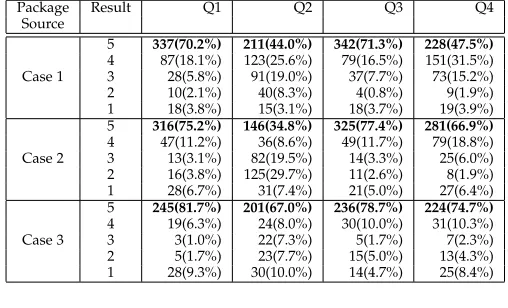
[image:15.612.311.565.383.537.2]Based on the above quality aspects, we design multiple questions, shown in Table 9, for the evaluators. The first two questions addressaccuracyandcontent adequacyrespectively, whereas the third and the fourth question address concise-ness, and expressiveness. The answers of the questions can be among “strongly agree”, “agree”, “neutral”, “disagree”, and “strongly disagree”, corresponding to five discrete levels, ranging from 5 to 1 respectively.
TABLE 9
Questions designed to evaluate repair recommendation
Questions Value Range
Q1 Does the repair recommendation reflect (5-1) the code constraints? (Accuracy)
Q2 Is the repair recommendation helpful to better (5-1) understand and use the API? (Content adequacy)
Q3 Is the repair recommendation free of (5-1) other constraint-irrelevant information? (Conciseness)
Q4 Is the repair recommendation (5-1)
clear and understandable? (Expressiveness)
This part of the experiment includes 24 graduate stu-dents majoring in Software Engineering as subjects. Among them, eighteen were from Nanjing University of Aero-nautics and AstroAero-nautics, five were from University of Zurich, and one was from University of Sannio. All subjects have experience of programming in Java and Android for at least five years. We randomly selected 160, 140, and 100 generated directives from the previous experiments respectively (in total of 400 directive samples), together with the corresponding source code and related constraints. The source code also includes the invocation chains if there is a relevant parameter constraint between the caller and callee methods.
Listing 1 gives a concrete example of the provided sam-ples, taken from com.sun.javafx.robot.FXRobotImage.java. We first list the generated repair recommendation (Line
1-3), followed by the API’s comments and codes (Line 4-15). The comments correspond to the related API directives annotated with specific tags (Line 4-9). The parts of pa-rameter related constraints whose document is missing are also present inside the body of the code (Line 11-13). Each sample is organized in the same format to the participants.
Listing 1. Sample example 1 Check Recommendation :
2 @throws I l l e g a l A r g u m e n t E x c e p t i o n I f x or y i s l e s s than 0 , 3 x i s no l e s s than width or y i s no l e s s than h e i g h t . 4 /∗ ∗
5 . . .
6 ∗ @param x c o o r d i n a t e 7 ∗ @param y c o o r d i n a t e 8 . . .
9 ∗/
10 public i n t getArgb (i n t x , i n t y ){
11 i f ( x< 0 | | x >= width | | y< 0 | | y>= h e i g h t ) { 12 throw new I l l e g a l A r g u m e n t E x c e p t i o n ( . . . ) ;
13 } . . .
14 }
We first introduce the background to the subjects, so they can have sufficient understanding of the requirements. We then assign the 400 samples to the 24 subjects. To ensure that each repair recommendation is reviewed by at least three subjects, we classify them into 8 groups, with 3 participants each group. Accordingly, we assign 50 samples to each group, and each participant is supposed to answer all the four questions in Table 9 independently.
TABLE 10 Results of Experiment 3
Package Result Q1 Q2 Q3 Q4
Source
Case 1
5 337(70.2%) 211(44.0%) 342(71.3%) 228(47.5%) 4 87(18.1%) 123(25.6%) 79(16.5%) 151(31.5%) 3 28(5.8%) 91(19.0%) 37(7.7%) 73(15.2%)
2 10(2.1%) 40(8.3%) 4(0.8%) 9(1.9%)
1 18(3.8%) 15(3.1%) 18(3.7%) 19(3.9%)
Case 2
5 316(75.2%) 146(34.8%) 325(77.4%) 281(66.9%) 4 47(11.2%) 36(8.6%) 49(11.7%) 79(18.8%) 3 13(3.1%) 82(19.5%) 14(3.3%) 25(6.0%) 2 16(3.8%) 125(29.7%) 11(2.6%) 8(1.9%)
1 28(6.7%) 31(7.4%) 21(5.0%) 27(6.4%)
Case 3
5 245(81.7%) 201(67.0%) 236(78.7%) 224(74.7%) 4 19(6.3%) 24(8.0%) 30(10.0%) 31(10.3%)
3 3(1.0%) 22(7.3%) 5(1.7%) 7(2.3%)
2 5(1.7%) 23(7.7%) 15(5.0%) 13(4.3%)
[image:15.612.50.301.476.554.2]1 28(9.3%) 30(10.0%) 14(4.7%) 25(8.4%)
TABLE 11
Average Results of Experiment 3
Package Source Q1 Q2 Q3 Q4
Case 1 4.49 3.99 4.51 4.17
Case 2 4.45 3.34 4.54 4.38
Case 3 4.49 4.14 4.53 4.39
Average 4.48 3.82 4.53 4.31
[image:15.612.339.539.574.635.2]