© 2016, IRJET | Impact Factor value: 4.45 | ISO 9001:2008 Certified Journal
| Page 1041
Experimental study on mechanical properties and microstructure of
copper by cold and cryo rolling.
Jigar Paghadal
1, Kandarp Changela
21
PG Student, Department of Mechanical Engineering, C.S.P.I.T, Charusat University, changa, Gujarat, India
2Assistant Professor, Department of Mechanical Engineering, C.S.P.I.T, Charusat University, changa, Gujarat, India
---***---Abstract –
The influence of mechanical properties andmicrostructure of commercial pure copper by cold and cryo-rolling have been investigated in the present work. Cu was rolled in four high rolling mill for different thickness reduction 20% and 40% at cryogenic temperature and at room temperature and its mechanical properties and microstructure were studied. After each successive pass material is dipped in liquid nitrogen container to achieve cryogenic temperature in cryo-rolling. For cryo rolled sample it is observed that mechanical properties like hardness and tensile strength has sudden improvement compared to cold rolled sample. This was because of higher dislocation density during lower temperature rolling. Microstructure observed in optical microscopy which showed that the number of grain is higher in cryo-rolled sample than cold rolled sample due to grain refinement.
Key Words:
Copper, Cryo-rolling, Cold rolling, Micro- structure, Mechanical properties1. INTRODUCTION
Commercially Cu and its alloys are extensively used for various design application where high strength to weight ratio is one of the basic criteria. Conventional rolling could be a suitable technique for the commercial production of bulk ultrafine grained Cu alloys sheets but due to dynamic recovery and high stacking fault energy of Cu and its alloys, it is difficult to produce ultrafine grained microstructures in the samples [1]. Cu extensively used due to their good mechanical properties.
Plastic deformation (rolling) at cryogenic (liquid nitrogen) temperature has been shown to produce ultrafine grained (UFG) microstructures in commercial Cu alloy. It is believed that the UFG grains impart high strength as expected from Hall–Petch relationship [2]. The enhanced interest in a radical refinement of microstructure down to sub microcrystalline (SMC) and nanocrystal line (NC) grain sizes is one of the basic trends in the development of Contemporary material science. The SPD methods make it possible to efficiently refine the grain size of the majority
© 2016, IRJET | Impact Factor value: 4.45 | ISO 9001:2008 Certified Journal
| Page 1042
with their observed mechanical properties, conventional rolling (Cold rolling) products.
2. PRACTICAL APPROACH
A Cu sheet of dimensions 305 mm (length) x 254 mm (width) x 3 mm (thickness) were used (Specimen not previously deformed). The diameter of roller was 200 mm, length of roller was 1100 mm and speed of roller was 52 rpm. Rollers were driven by 50 hp motor.
Plates of Copper were subjected to rolling in four high rolling mill at cryogenic temperature to achieve 20% and 40%thickness reduction. The samples were soaked in Ln2 container for at least 11 min prior to each roll pass during the rolling process. For samples, the time taken for picking out the samples from cryocan and immediately rolling was 5 seconds and time taken for rolling and putting back the samples into cryocan was less than 30-40 seconds during each pass. The temperature of work piece is required to lower at liquid nitrogen temperature. Based on the mechanical properties and dimensions of samples, the proper dipping duration of the sample in liquid cryorolling was determined and it was used subsequently during cryorolling. During rolling 90% of the mechanical work (Plastic work due to deformation of the work piece and friction work caused by friction between the roll and work piece) was converted in to heat. The initial temperature of sheet and the roll were respectively set at -196˚C and 30˚C, the calculated temperature rise as a function of rolling reduction ratio. When the reduction ratio is less than 40%, the temperature rise caused by plastic and friction work is less than 50˚C. Therefore the sheet temperature after rolling is expected to be lower than -100˚C.
Mechanical properties like hardness and tensile tests were performed to determined hardness value, strength and ductility of copper sample. Rockwell hardness (HR) was measured on the plane parallel to longitudinal axis (rolling direction) by applying a load of 100 kg for 30 seconds. The surface of the specimen was polished mechanically using emery paper prior to each hardness measurement to ensure its clean surface. The hardness value is an average of five measurements made on surface of each specimen. The tensile specimens were prepared in accordance with ASTM Standard with a 25 mm gauge length. The tensile test was performed after polishing the sample in air at room temperature using Universal testing machine operated at a constant crosshead speed with an initial strain rate of 2 mm per minute. The hardness and tensile test is performed at room temperature for both cold and cryo-rolled samples.
The micro structural characteristics of the room temperature rolled and cryorolled copper sample surfaces were characterized by using optical microscopy.
3. RESULTS AND DISCUSSION
3.1 Hardness Property
Here samples of copper used for hardness test is properly cleaned before it is taken in use. For this experiment indenter used having ball size of 1/16”. Load set on the sample is 100 kgf. Chart 1 indicates average hardness for copper in cold and cryo rolled conditions. X-axis indicates thickness reduction in percentage and Y-axis indicates hardness in HRB. Here material is reduced in 20%, 40% in thickness compare to original thickness. Hardness of specimen before deformation was 61 HRB.
Chart 1 indicates average hardness for copper in cold and cryo rolled conditions. The hardness value of the cryorolled samples is higher than the room temperature rolled material hardness increases from 75 HRB to 82.33 HRB with 20 % thickness reduction. Similarly the hardness value for 40 % thickness reduction of the cryorolled sample is higher 85 HRB to 90.8 HRB than the RT rolled material.
An enhancement of hardness in the cryorolled copper sample could be directly attributed to the higher dislocation density and the formation of sub microcrystalline structures. It is observed that the hardness of cryorolled specimen is higher than that of RT rolled materials. It can be explained based on the mechanism that dynamic recovery was effectively suppressed during cryorolling leading to a higher dislocation density as known in the literature [15]. With the formation of fine grains in the cryorolled alloys, hardness would increase due to the restricted mobility of dislocation imposed by higher dislocation density, and misorientation of the grains.
Chart-1: Hardness chart for copper 75.33 82.33 85
90.8
0 20 40 60 80 100
Cold rolled
Cryo rolled
© 2016, IRJET | Impact Factor value: 4.45 | ISO 9001:2008 Certified Journal
| Page 1043
3.2 Tensile Property
TINIUS OLSEN/L-Series H50KL is used for the tensile testing of copper sample. The test specimen is cut as per ASTM (American Society for Testing and Materials) standard parallel to rolling direction. Here in tensile test experiment ASTM standard E-8/E8M-09 is used. As per ASTM standard gauge length used is 25 mm, grip section length is 30 mm, total overall length is 100 mm, width of the strip in reduced section is 6 mm, length of reduced section is 32 mm and radius is 6 mm.
Cold and cryo rolled samples both were taken for tensile testing at room temperature. It is found that in tensile testing cryo rolled samples has higher tensile strength compared to room temperature rolled samples. And it is also seen that load required for tensile test was higher than to cold rolled sample. The large enhancement in strength of cryo rolled sample can be attributed to partial grain refinement and high dislocation density. Due to rolling, quite a large number of dislocations are produced. These dislocations get entangled between the grain boundary which impedes their motion and strength gets increased. With increasing extent of cryo- rolling, more amount of dislocations get piled up within the grain boundaries and the sample start to fracture after quite some time with increasing stress. Thus the ductility gets decreased with the extent of cryo rolling at the cost of its strength [15]. Below chart 2 and chart 3 indicates Load vs. Extension graph for pure copper in tensile testing machine.
Chart-2: 20% Thickness reduction in Cu in UTM
Chart-3: 40% Thickness reduction in Cu in UTM
Table:1 Tensile test result of Cu sample
Copper Tensile strength
(MPa) Elongation (%)
20% RTR 294 8.51
20% CR 316 8.14
20% Aged 296 9.11
40% RTR 297 8.2
40% CR 376 7.56
40% Aged 335 8.24
RTR: Room Temperature Rolled CR: Cryo Rolled
Here in experiment aged sample is also considered to test tensile property of specimen. As mentioned in Table 1 aged sample has very good ductility compare to CR sample in both the case of thickness reduction and it also has good hardness property compare to RTR sample.
3.3 XRD TEST
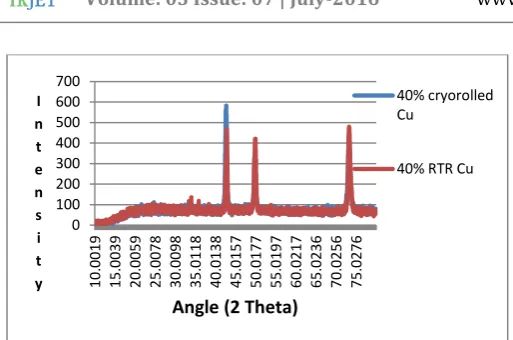
For XRD test all the cryo-treated and aged sample are taken in analysis to determine the crystallite size of the sample. Crystallite size can be determined from the XRD graph. To determine crystallite size manually scherrer formula is used. To determine average crystallite size each peak generated in graph is taken in consideration.
Chart 4: XRD test for 20% thickness reduction for Copper
0 100 200 300 400 500 600 700 800 900 1000
10.
0019
14.
6799
19.
3578
24.
0358
28.
7138
33.
3917
38.
0697
42.
7476
47.
4256
52.
1036
56.
7815
61.
4595
66.
1374
70.
8154
75.
4933
I n t e n s i t y
Angle (2 Theta)
20% cryorolled Cu
© 2016, IRJET | Impact Factor value: 4.45 | ISO 9001:2008 Certified Journal
| Page 1044
Chart 5: XRD test for 40% thickness reduction for Copper
The higher the peaks and intensity the finer crystallite size can be obtained than cold condition, which can be seen from the graph data. Thus from the plotted data it is seen that with the help of lower temperature science or cryogenics treatment ultrafine crystallite size can be achieved than normal room treated materials.
3.4 OPTICAL MICROSCOPY
Before using samples in optical microscope samples (plastically deformed sample) get prepared and etched and then it was put under the microscope. From the present work 40% thickness reduction samples were used to examine the effect of cold and cryo-rolling and as a result grain size number can be determined. It is observed that copper sample at room temperature has grain size number of 0.060, while copper sample which is rolled at cryogenics temperature has grin size number of 0.056. Raw material of pure copper sample taken for the rolling has grain size number of 0.080. From the result it is seen that grain size number is decreasing from cold rolled sample to cryo rolled sample, as the grain size decreasing more fine grain structure is achieved.Which indicate that lower the grain size number, higher the strength of sample.
Cryo rolled sample has fine grain sized because of suppression of dynamic recovery. There was suppression if dynamic recovery as in cryogenic temperature, the total internal energy of the atoms decreased as it is a function of the material. So the atoms kinetic energy decreased which result in suppression of dynamic recovery [15]. Figure 1 shows images taken from optical microscope for three different samples.
(A)
(B) (C)
Fig. 1 Optical microscopy image
(A) Raw material of copper (B) 60% RTR copper (C) 60% CR copper
4. CONCLUSIONS
The influence of lower temperature treatment at liquid nitrogen temperature on mechanical properties and microstructure of CR copper has been investigated and conclusions are made.
1. Cryo-rolled copper exhibit a significant
improvement in mechanical properties like hardness and tensile strength compare to room temperature rolled Al alloy for 20% and 40% thickness reduction. This is because of suppression of dynamic recovery and accumulation of higher dislocation density during lower temperature rolling resulting in higher strength.
2. From optical microscope it is seen that CR copper
at different percent of thickness reduction grain size number is increases of cryo treated sample to room temperature rolled sample due to grain refinement and work hardening which occur due to higher dislocations density.
5. ACKNOWLEDGEMENT
The authors wish to thank all the staff members of SRE India. The authors specially thank to Mr. Dhiraj Dhakad (Director of SRE India) for his consistent and valuable support for providing information related to work.
REFERENCES
[1] P. B. Prangnell, J. R. Bowen, and P. J. Apps et al.,
“Ultra Fine Grain Structures in Aluminum Alloys by Severe deformation Processing,” Mater. Sci. Eng., A 375–377, pp 178-185 (2004).
[2] V. Subramanya Sarma , K. Sivaprasad , D. Sturm c,
M. Heilmaier et al., “Microstructure and
0 100 200 300 400 500 600 700
10.
0019
15.
0039
20.
0059
25.
0078
30.
0098
35.
0118
40.
0138
45.
0157
50.
0177
55.
0197
60.
0217
65.
0236
70.
0256
75.
0276
I n t e n s i t y
Angle (2 Theta)
40% cryorolled Cu
[image:4.595.34.291.72.242.2]© 2016, IRJET | Impact Factor value: 4.45 | ISO 9001:2008 Certified Journal
| Page 1045
mechanical properties of ultra fine grained Cu–Zn and Cu–Al alloys produced by cryorolling and annealing”
[3] F. J. Humphreys, P. B. Prangnell, J. R. Bowen, et al.,
“Developing Stable Fine_Grain Microstructures by Large Strain Deformation,” Philos. Trans. R. Soc. London, Ser. A 357, pp 1663–1681 (1999).
[4] V. Korznikov, A. N. Tyumentsev, and I. A. Digpen
berg et al., “On the Limiting Minimum Size of grains Formed in Metallic Materials Produced by High-Pressure Torsion,” Fiz. Met. Metalloved. 106 (4), 1–7 (2008) [Phys. Met. Metallogr. 106 (4), pp 418–423 (2008)].
[5] Sushanta Kumar Panigrahi, R. Jayaganthan et al.,
Materials Science and Engineering A 480. pp 299– 305. (2008).
[6] H.B.Naik, K.P.Desai, K.Changela et al., “Effect of
cryogenic temperature rolling on mechanical properties and microstructure of pure copper”.
[7] T. N. Konkovaa S. Yu. Mironov, V. N. Danilenko,
and A. V. Korznikov et al., “Effect of low Temperature Rolling on the Structure of Copper, The Physics of Metals and Metallography”, Vol. 110, No. 4, pp. 318–330. (2010)
[8] Y. Huang and P. B. Prangnell et al., “The Effect of
Cryogenic Temperature and Change in Deformation Mode on the Limiting Grain Size in a Severely Deformed Dilute Aluminum Alloy,” Acta Mater. Pp 56, 1619–1632 (2008).
[9] S. K. Panigrahi and R. Jayaganathan et al., “A Study
of the Mechanical Properties of Cryorolled Al– Mg–Si Alloy,” Mater. Sci. Eng., A 480, pp 299–305 (2008).
[10] S. K. Panigrahi, R. Jayaganathan, and V. Chawla et
al., “Effect of Cryorolling on Microstructure of Al_Mg_Si Alloy,” Mater. Lett. pp 62, 2626–2629 (2008).
[11] Y. S. Li, N. R. Tao, and K. Lu et al., “Microstructural
Evolution and Nanostructure Formation in Copper during Dynamic Plastic Deformation at Cryogenic Temperatures,” Acta Mater. Pp 56, 230–241 (2008).
[12] Y. Zhang, N. R. Tao, and K. Lu et al., “Mechanical
Properties and Rolling Behaviors of Nano_Grained Copper with Embedded Nano_Twin Bundles,” Acta Mater. pp 56, 2429– 2440 (2008).
[13] Z. Jasiefiski, H. Paul, A. Pittkowski, and A. Litwora
et al., “Microstructure and Texture of Copper Single Crystal of (112)[111] Orientation Undergoing Channel Die Compression at 77 K,” J. Mater. Process. Technol. pp 53, 187–194 (1995).
[14] Gindin, M. B. Lazareva, V. P. Lebedev, and Ya. D.
Starodubov et al., “Structure and Mechanical Properties of Copper Rolled at Low Temperatures,” Fiz. Met. Metalloved. pp 23, 138– 144 (1967).
[15] P.Aditya Rama Kamalanath, Apu Sarkar et al.,
“Tensile behavior of Zircolay-2”, Global journal, Volume 12, Issue3, version 1(2012).
Jigar Jaysukhbhai Paghadal (Author -1) PG student
Department of Mechanical Engineering M.Tech (A.M.T)
Charusat University-changa.
- Kandarp Changela (Author-2) - Assistant Professor