
© 2016, IRJET ISO 9001:2008 Certified Journal Page 157
PROGRAMMED LEARNING TECHNIQUE: AN EFFECTIVE TOOL IN
TEACHING AND LEARNING GENETICS- MENDELISM AND GENE
INTERACTIONS AT UNDER GRADUATE LEVEL.
Mahesh V. Gokhale
1, Prakash V. Gaikwad
2and Sunetra C. Patil
31, 2Department of Botany, K.B.P.College, Urun-Islampur,-415409,-Dist: Sangli, Maharashtra, India 1Jeevan Shikshan Kendra, Abhivyakti Academy for Research, Education and Awareness (AAREA)1039/3/4 A –
Ward Suprabhat Colony, New Washi Naka, Kolhapur, 416 011, Maharashtra, India
3 Director, Pre-IAS Training Centre, Kolhapur, (Maharashtra) India.
---***---Abstract -
Genetics is an important basic subject inbiology. It covers some allied aspects and becomes difficult to learn and remember. Traditional lecture method is difficult to apply while teaching genetics. Students face number of difficulties which are tried to summarize. As a solution Programmed Learning Technique is applied in classroom and found to be useful for teaching mendelism and gene interactions. It is useful to maintain flow in the chunks of information as well as provide the checkpoints to assess students’ gain. On the basis of increased performance in post test qualitatively and quantitatively, it found to be effective in teaching these subunits at undergraduate level.
Key Words: Mendelism, Gene Interaction, Programmed
learning technique, Undergraduate Level
1.INTRODUCTION
A continuing interest in discovering ways of increasing instructional efficiency and providing suitable materials for independent study prompted the development and testing of programmed materials for use in self-instruction devices or teaching machines in the field of introductory science, psychology, and music etc. The rationale of the teaching machine and its applicability in independent study has been discussed by Skinner (1958); reviews of the present state of the field occur in Galanter (1959) and Silverman (1960); a source book has been prepared by Lumsdaine and Glaser (1960).
Knippels et al. (2000) had interviewed biology teachers and ten meaningful problem categories were extracted as far as teaching and learning genetics is concerned. These are abstract nature of subject, complexity, probabilistic reasoning, image in the student’s mind, mode of examination, terminology in the subject, symbolizing, background knowledge etc. In the classroom teaching during present work it is observed that genetics is quite difficult to the students at undergraduate level. Basically it seems that the study of genetics requires a good blending of knowledge of other aspects in biology ie pollination biology, cell division and even statistical approach etc. Therefore, it
thought worth to provide stepwise material to students to make their knowledge base sound.
The preparation and evaluation of Programmed Learning Material was found to be effective in terms of achievement of students on various subjects has been the subject of study for many researchers like Bhushan (1973), Dewal (1974), Patel (1977), Sodhi (1977), Sansanwal (1978), Parlikar (1979), Pandey (1980), Trivedi (1980), Man (1981), Choudhary (1985), Gautam (1986), Thaker (1993) and Agashe (1995).
Gautam (1986) conducted a study to find out achievement in relation to creative thinking and level of aspiration, while using programmed instructional material. Program learning material was found to be as effective as conventional m e t h o d in terms of achievement of students by Chandrakala (1976) a n d Govinda ( 1976). Few researchers conducted studies to find out the achievement level and favourable opinion towards program learning material (Chauhan, 1973, Mavi, 1981, and Davies, 1982).
In case of Mendelian genetics this type of work is carried out by Larson (1964) at high school level where it was an introductory subject. The present paper reports effectiveness of program learning instructions in teaching Genetics – Mendelism and Gene Interactions as whole units at undergraduate level.
2.MATERIAL AND METHOD
© 2016, IRJET ISO 9001:2008 Certified Journal Page 158 (program learning material) to them. Each subunit was
again discussed with the help of the frames. Sub unit wise the frames were prepared (Table No.-2). Students tried to learn each frame completely one after another. The frames were organized as per the dependency levels of sub units. Actually meiosis is not included in genetics but thought worth to include because it is one of the important base of genetics. While preparing the frames inclusion of extra information was avoided but connectivity of each frame with previous and later one was purposefully maintained. Then post-test was taken using question paper parallel to pre-test.
The marks obtained by the students in pre-test and post-test were analyzed statistically.
3. RESULT AND DISCUSSION
Genetics is considered as difficult and complex topic because it encompasses related topics in biology like cell division, embryology, evolution etc. It also includes statistics and mathematics up to certain level. During regular classroom teaching it is observed that students cannot easily involve in this topic. Moreover, mere lecture method is very difficult to apply for this topic. Therefore, it is thought worth to teach this topic using programmed learning technique.
Programmed learning technique is also called as programmed instruction method. It is a teaching technique in which a learner is presented with a small chunk of information and is asked to answer the questions after understanding it. Basically it is self passed, self administered process. But in the present piece of work it is combined with regular classroom teaching.
Prior to the implementation of this technique the problems related to learning genetics were collected. Most of the students have difficulties in correlating the subject matter with their previous knowledge. Knowledge of meiosis is important in learning genetics. Either it is not studied well by the students or it cannot be easily correlated with genetics. It is difficult to found the interrelations between meiosis and genetics. Terms like homozygous and heterozygous are somewhat difficult for students to learn. Contrasting characters of pea plant cannot be memorized due to lack of observations. Presentation of laws and other interactions in the form of checker board found to be difficult. Stating the genetic interactions and
presenting them with the help of suitable example is difficult to students. These difficulties with arbitrary levels are summed up in Table No. 1.
Prior to implementation of program learning technique regular teaching of the units was completed using lecture method and pre-test was undertaken.
The students were instructed to paste the frames in blank note book one after another by leaving one or two pages after each plate. During and after discussion of the frames, students were encouraged to write their impressions in their own language. After discussion of all the frames two days were allotted to students to study using the frames. Pre-test and post-test question papers were set by maintaining the same skeleton and difficulty level. Both the papers carried 20 marks each, including match the pairs, answer in short, and answer in detail.
The analysis of pre-test and post-test marks is given in the Table No. 3 average increase in the marks in post test is 6.19 2.41
© 2016, IRJET ISO 9001:2008 Certified Journal Page 159 Table -1: Difficulties faced by the students and difficulty
level of individual sub unit in genetics.
Sr. No.
Name of the unit Difficulties Difficulty
level
1 Introduction of
genetics
**
2 Genetics
terminology
Number of terms are to be memorize
*****
3 Meiosis Difficult as it is
a stepwise process, get jumbled with mitosis
*****
4 Contrasting
characters of pea plant
Lack of actual field
observations or diagrams or pictures
**
5 Reasons for
Mendel’s success
These cover different aspects.
***
6 Mendel’s law of
Dominance
Difficult to state correctly.
**
7 Mendel’s law of
Segregation
Difficult to state correctly.
**
8 Mendel’s law of
Independent assortment
Difficult to state correctly.
**
9 Monohybrid cross
and monohybrid ratio.
Presentation in the form of checker board
***
10 Dihybrid cross
and dihybrid ratio.
Presentation in the form of checker board
***
11 Back cross Presentation in ****
the form of checker board
12 Test cross
(Dihybrid cross)
Presentation in the form of checker board
****
13 Introduction of
gene interaction
Difficult to imagine that number of genes are expressing at a time and affecting each other.
***
14 Complementary
gene interaction
Difficult to state correctly. Example cannot be remembered
*****
15 Supplementary
gene interaction
Difficult to state correctly. Example cannot be remembered
*****
16 Dominant
epistasis
Difficult to state correctly. Example cannot be remembered
*****
Table: 2.Following frames (Program learning material) were prepared for ‘Programmed Instructions’ on the subunits of Mendelian Genetics and Gene Interactions.
Sr. No.
Name of the plate / Frame
Content
1 Introduction of
genetics
Brief historical account, Mendelian and post Mendelian genetics, Factor to Gene
2 Genetics Basic terms in Mendelian
© 2016, IRJET ISO 9001:2008 Certified Journal Page 160
terminology suitable examples.
3 Meiosis Knowledge of meiosis is
important as a baseline for genetics. Because in punnett square gametes are to be shown.
4 Contrasting
characters of pea plant
Dominant and recessive characters of stem, seed, cotyledon, pod, flower color and flower position in pea plant with
diagrams.
5 Reasons for
Mendel’s success
Different reasons for Mendel’s success in genetics are discussed. These include suitable characters of pea plant such as its short life cycle, sex organs hidden inside the corolla, possibility of both self and cross fertilization. Mendel’s’ scientific approach, maintenance of up to date record, statistical analysis as well as sincere efforts.
6 Mendel’s law
of Dominance
Statement of the law with example.
7 Mendel’s law
of Segregation
Statement of the law with example.
8 Mendel’s law
of Independent assortment
Statement of the law with example.
9 Monohybrid
cross and monohybrid ratio.
Description with example
10 Dihybrid cross
and dihybrid
Description with example
ratio.
11 Back cross Definition with example.
12 Test cross
(Dihybrid cross)
Description with example
13 Introduction of
gene interaction
It is introduced that the phenotype is interactive effect of number of genes. It is synchronized, blended and coordinated activity of all genes. These
interactions are called as gene interaction. Also the names of gene interactions are stated.
14 Complementary
gene interaction
Verbal description of an interaction with example and punnett square. Phenotypic ratio of the interaction.
15 Supplementary
gene interaction
Verbal description of an interaction with example and punnett square. Phenotypic ratio of the interaction.
16 Dominant
epistasis
© 2016, IRJET ISO 9001:2008 Certified Journal Page 161
[image:5.595.36.564.326.781.2]Table No: 3.Analysis of pre-test and post-test marks.
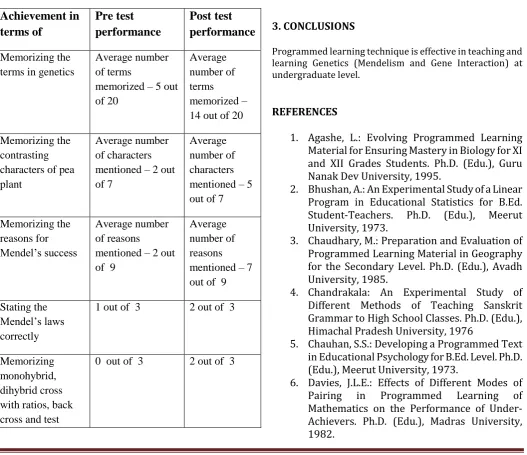
Table No: 4.Qualitative analysis of answer sheets
Achievement in
terms of
Pre test
performance
Post test
performance
Memorizing the terms in genetics
Average number of terms
memorized – 5 out of 20
Average number of terms memorized – 14 out of 20
Memorizing the contrasting characters of pea plant
Average number of characters mentioned – 2 out of 7
Average number of characters mentioned – 5 out of 7
Memorizing the reasons for Mendel’s success
Average number of reasons
mentioned – 2 out of 9
Average number of reasons mentioned – 7 out of 9
Stating the Mendel’s laws correctly
1 out of 3 2 out of 3
Memorizing monohybrid, dihybrid cross with ratios, back cross and test
0 out of 3 2 out of 3
cross
Stating the gene interactions correctly
0 out of 3 2 out of 3
Memorizing the ratios of different gene interactions
1 out of 3 2 out of 3
Reproducing the example of gene interaction with accurate punnett square
0 out of 3 2 out of 3
3. CONCLUSIONS
Programmed learning technique is effective in teaching and learning Genetics (Mendelism and Gene Interaction) at undergraduate level.
REFERENCES
1. Agashe, L.: Evolving Programmed Learning Material for Ensuring Mastery in Biology for XI and XII Grades Students. Ph.D. (Edu.), Guru Nanak Dev University, 1995.
2. Bhushan, A.: An Experimental Study of a Linear Program in Educational Statistics for B.Ed. Student-Teachers. Ph.D. (Edu.), Meerut University, 1973.
3. Chaudhary, M.: Preparation and Evaluation of Programmed Learning Material in Geography for the Secondary Level. Ph.D. (Edu.), Avadh University, 1985.
4. Chandrakala: An Experimental Study of Different Methods of Teaching Sanskrit Grammar to High School Classes. Ph.D. (Edu.), Himachal Pradesh University, 1976
5. Chauhan, S.S.: Developing a Programmed Text in Educational Psychology for B.Ed. Level. Ph.D. (Edu.), Meerut University, 1973.
6. Davies, J.L.E.: Effects of Different Modes of Pairing in Programmed Learning of Mathematics on the Performance of Under-Achievers. Ph.D. (Edu.), Madras University, 1982.
Number of students -
80
Pre test marks
Post test marks
Increase
in the
marks
Range 03-17 05-20
Average
9.38
15.57
6.19
Standard Deviation
© 2016, IRJET ISO 9001:2008 Certified Journal Page 162 7. Dewal, O.S.: A Study of Difficulties in Teaching
English and Effectiveness of Programmed Teaching. Ph.D. (Edu.), M.S. University, 1974. 8. Gautam, P.: Development of Programmed
Instruction in Linear and Branching Styles and Studying the Performance in Relation to Creative Thinking and Level of Aspiration. Ph.D. (Edu.), Himachal Pradesh University, 1986.
9. Galanter, E., [ed.]. 1959. Automatic teaching: the state of the art. John Wiley and Sons, Inc., New York. 198 p
10.Govinda, R.: Development of a Programmed Text on Educational Evaluation and Experimentally Studying its Effectiveness as Instructional Material for B.Ed. Students. Ph.D. (Edu.), M.S. University of Baroda, 1976. 11.Lumsdaine, A. A., and R. Glaser, [ed.]. 1960.
Teaching machines and programmed learning.
Natl. Educ. Assoc, Washington. 724 p.
12.Man, B.S.: An Experimental Study of the Effect of Unit Tests on Retention Following Programmed Instruction Material in a Segment of Physics, Ph.D. (Edu.), Himachal Pradesh University, 1981.
13.Mavi, N.S.: Development of a Programmed Text in Physical Geography for High School Students, Ph.D. (Edu.), Kurukshetra University, 1981.
14.Pandey, I.D.: Use of Programmed Instruction on Teaching Mathematics in Primary Level. Ph.D. (Edu.), Patna University, 1980.
15.Parlikar K.R.: A Study of Suitability of Programmed Learning in Home Science Education for Adolescent Girls. Ph.D. (Edu.), M.S. University of Baroda, 1979.
16.Patel, A.D.: Development and Tryout of Auto-Instructional Programs in Units of Geometry for Class VIII and to Study its Effectiveness in the Context of Different Variables. Ph.D. (Edu.), Sardar Patel University, 1977.
17.Sansanwal, D.N.: An Experimental Study in Programmed Learning for Teaching Research Methodology Course at M.Ed. Level. Ph.D. (Edu.), M.S. University of Baroda, 1978. 18.Skinner, B. F. 1958. Teaching machines. Science
128: 969-977.
19.Silverman, R. E. 1960. Automatic teaching: a review of theory and research. U. S. Naval Training Device Center, Port Washington, N. Y. 47 p.
20.Sodhi, G.S.: Evaluation of Programmed Learning in Chemistry in Relation to Taxonomy of Educational Objectives, Intelligence and Personality Traits at the Higher Secondary Level. Ph.D. (Edu.), Pantna University, 1977. 21.Thaker, M.N.: Investigation into the
Effectiveness of Linear Programmed Material and Branching Programmed Material in the Subject of Economics for Standard XI in Relation to Certain Variables. Ph.D. (Edu.), M.S. University of Baroda. 1993.
22.Trivedi, I.U.: Use of Branching Variety of Programmed Learning Materials as Diagnostic and Remedial Tools. Ph.D. (Edu.), M.S. University of Baroda, 1980.
23.Larson R. C. (1964), Teaching Mendel’s principals to high school biology students using teacher prepared programmed learning materials, A Field Report Presented to The Graduate Division Drake University 101 pp. 24.Knippels, M. C. P. J., Waarlo, A. J. and Boersma,
![(E) 2 Benzoyl 4 [(4 methylphenyl)diazenyl]phenol](data:image/gif;base64,R0lGODlhAQABAIAAAP///wAAACH5BAEAAAAALAAAAAABAAEAAAICRAEAOw==)