© 2016, IRJET | Impact Factor value: 4.45 | ISO 9001:2008 Certified Journal | Page 1305
A Study of Role of Building Information Modeling in Life Cycle Based
Integrated Project Delivery Process
Saravanan S
M.E. final year in Construction Engineering and Management
Meenakshi Sundararajan Engineering College, Chennai 24 - India
---***---Abstract -
In construction projects, the life cycle isimplemented in a cradle to grave approach. It is split into planning, design, construction, operation & maintenance and facility management phases until the useful life of the facility. Traditional project approaches that are used in the industry still face a lot of challenges due to cost & schedule overruns, poor collaboration among the project participants and inefficient ways of handling the constructed facility during the implementation of the life cycle. In order to create an interdisciplinary work environment among the project participants, Integrated Project Delivery (IPD) process, a substitute for traditional approaches focusing on defining the roles of project participants and creating successful project outcomes is introduced last decade. To execute the IPD process, Building Information Modeling (BIM) which is a digital representation of physical and functional characteristics of a facility in which the entire project information that are used during each phases of the project life cycle can be stored in a single database subsequently providing a virtual model can be used as a tool. This project tries to understand the influence of BIM as an efficient tool in an IPD based project structure in a typical construction project. It is concluded from the study that defining goals for a successful life cycle, roles of project participants, developing a suitable framework for transfer of BIM information among the various project participants and the use of final model for facility management are the key to influence the project and develop efficient outcomes from the examination of IPD approach collaborative procedures.
Key Words: Building Information Modeling, Integrated Project Delivery, Project Life Cycle, Design and Construction, Facility Management.
1.INTRODUCTION
A successful project is the one in which the schedule and cost parameters are controlled within the acceptable limits. In construction projects, the life cycle is implemented in a cradle to grave approach. The time taken to complete each phases are grouped to form the entire duration of the project. In traditional construction projects, the maximum effort and cost are usually applied in the ‘Implementation of
Documents’ phase. Traditional construction projects which are using approaches like Design Build (DB) and Design Bid Build (DBB) face a lot of challenges in the coordination and collaboration during the entire life.
Integrated Project Delivery (IPD) is an approach where the organization takes an integrated structure to ensemble AEC professionals into a process that combines the value of individual talents into a combined outcome tied to project goals constructed for a life cycle [1]. The uniqueness of this approach is to provide an interdisciplinary work environment among the project participants to create and accomplish successful project outcomes by working together and following unique goals from the conceptualization stage and continuing through to close out of the project. There are IPD principles that are used to develop contract agreements according to the type of the project. Every project team comprises of Primary (Owner, Designer, Constructor/ Contractor) and Secondary Project Participants.
Building Information Modeling (BIM) is a digital, multi dimensional model, which uses a database as a communication tool for the participants to store all kinds of project information in the life cycle [2]. It can combine the design, cost and schedule information, energy analysis test results and project management logistics in one database, throughout the project’s design and construction with successful collaboration. The model can also be used in the facility management of the building by the owner to perform energy analysis, space coordination, locating building components and maintenance of data.
Depending on the size of the project, the scope of the model varies. The use of BIM helps the project participants in a variety of ways. Generally it reduces the time and cost of construction by performing constructability analysis through the model before undergoing construction. For the contractor, though the initial investment for adopting BIM is high, the return of investment (ROI) covers the investment [3] and the benefits are directly proportional to the effective handling of the model and data.
© 2016, IRJET | Impact Factor value: 4.45 | ISO 9001:2008 Certified Journal | Page 1306
The output from the adoption of BIM is effective decisionmaking and following of the protocols from the review of the model. The decisions made during the development of the model can also be documented and stored in the model and is readily available to any participant subsequently utilizing it. This ensures consistent use of the model throughout the project.
The ‘BIM workflow’, in IPD shows that the effort, effect and cost parameters are required high before the construction phase, thus providing advantages to the completion of the projects by decreasing the effect of input by the project participants in the later stages of project life cycle, thereby saving time and life cycle cost of the facility by avoiding the huge cost of design changes and the project can be successfully delivered to the owner by the AEC professionals, leading to better FM (Facilities Management) practices [6]. As the use of BIM in Indian AEC industries is only 22% [7], it is important to look into the formulation of BIM adoption strategies [8], a framework model has to be prepared for each individual type of construction as the nature of implementation and scope of the utilization of the model varies according to the size of the project.
In this paper a framework is developed for the interoperability among the project participants for planning, design and construction phases from BIM adoption strategies and IPD based collaborative procedures.
2.LITERATURE REVIEW
To focus on providing open and interoperable information exchange, guidelines, recommended practices and specifications are applied for framing philosophies, plans and working methods of data through the entire project life cycle. National Institute of Building Sciences committee published the NBIMS standards (2007) and presented the need and improvement of utilizing project information in all phases (planning, design, construction, operation, and maintenance) of project life cycle.
AIA (American Institute of Architects) National (2007) provides information and guidance on principles and techniques of integrated project delivery (IPD) in designing and constructing projects, which are compared with the case studies of the project from Aruna Mathumanickam (2012) where the effect of the project structure and extensiveness of BIM adoption is relatively studied. From the comparative case study conducted from three commercial projects it was found out that the more integrated the organization structure, the wider the scope of adoption of BIM. The parameters to be considered before the adoption of BIM in Indian AEC industries from the analysis are assigning BIM roles to various participants, contractual innovations specifying the use of BIM, and incorporating collaborative work procedures.
2.1 Importance of BIM Adoption
The potential of using BIM in all phases of the project life cycle is evident from Burcin Becerik-Gerber (2010) where the author from the survey identified, the positive impact research topics that are ‘adopting BIM throughout the project life cycle’, ‘sustainable practices for design and construction’, ‘information management using BIM’, ‘management and organizational issues’ and ‘impact of ROI on Investment (ROI)’. The topics of interests that were identified by the practitioners and students for the design, construction and FM stages of the project life cycle were summarized in this paper. Practices to develop a strategy to fully integrate BIM through a framework and IPD were also specifically addressed by the practitioners that could address the interoperability in the adoption of BIM in the construction sector.
Vinoth Kumar J et al (2009) analyzed the causes for starting BIM where 80% of the attendants agreed that BIM is helpful for process improvement, Application areas that were currently used in the firm where AutoCAD and Revit led with 91% and 64% respectively with 44% of the attendants agreeing BIM as a better design tool [9].
Brittany K. Giel (2013) presented a study to show a positive ROI (Return on Investment) while adopting BIM in construction projects overcoming its high initial investment cost. The benefits of adopting BIM is studied by Azhar (2011) based on the questionnaire survey attended by AEC professionals. The key findings are positive impact (82%), improved outcomes (79%), winning projects (66%) and increased usage (62%).
The most frequent applications of Facilities Management responded in online surveys and face to face interviews from the survey conducted from Burcin Becerik-Gerber (2012) where ‘Locating building components’, the primary application identified by the BIM users (91%) and Non BIM users (69%), followed by the areas involving clash detection, maintenance of data, digital documentation, space coordination, feasibility analysis for the expansion of facility, energy analysis & monitoring and training & development.
2.2 Challenges in BIM Adoption
© 2016, IRJET | Impact Factor value: 4.45 | ISO 9001:2008 Certified Journal | Page 1307
3. METHODOLOGY AND DISCUSSION
Since the information exchange among the project participants during the various phases of the life cycle cannot be the same for all construction projects in the world, working of each project is independently unique depending on the size, nature and complexity of the project. Current construction trends involve modern techniques to be adapted for their facility. Executing the project with BIM proved to be both advantageous and simultaneously more challenging such as interoperability, lack of industry standards, owner’s unwillingness, learning curve of BIM technologies, cost of investment, poor collaboration among project participants and reluctance to openly share information.
The above problems are overcome-able by the effective use of BIM tool in properly documented IPD approach. From the study of investigation of adoption of BIM in Indian AEC industries, it is evident that integrated project structure leads to wide use of application of BIM. Hence, this study takes into consideration, the responsibilities of participants in an IPD formulated project scenario where the project participants ensemble early in the process, the sharing of information becomes open, the risks are collectively managed and openly shared, use of BIM as a tool to store the entire project information across all phases of life cycle in a single database, and creating a successful project delivery agreement tied to the project goals.
The solutions for challenges faced in implementation of each phase of the construction project are well established in terms of a framework model. The life cycle goals that can be used in BIM based projects are better interoperability by assigning roles and responsibilities, reducing the cost of the project, avoiding project delays, effective handover of the project to the owner, achieved by the submission of BIM model, design integration, constructability review, co-ordination for construction, building performance analysis, and facility management.
3.1 Framework
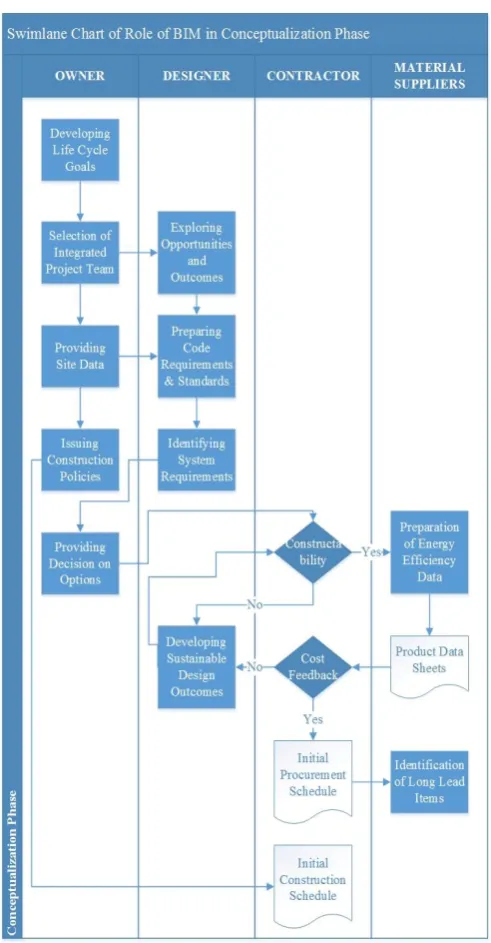
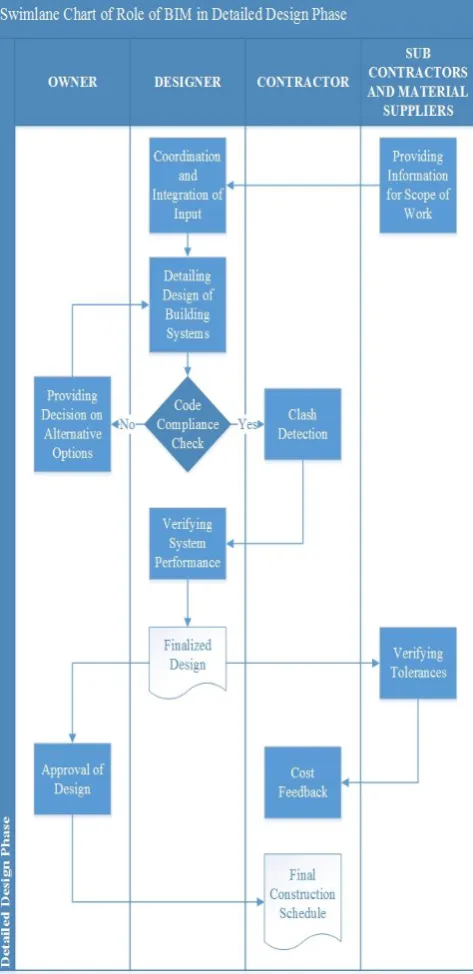
One of the effective ways to develop a framework is by establishing a diagrammatic illustration of the process involved in each phase of the life cycle [11]. A swim lane diagram, which is a method of cross functional flowchart used for process mapping the input, process and the output is developed using Microsoft Visio 2013 for the conceptualization, detailed design and construction phases connecting the roles & responsibilities of project participants and the process involved in the information exchange among them answering the sequence involved and the decisions taken at their respective phases. The ensemble of both primary participants (Owner, Designer and the Contractor) and secondary participants (Third Party Consultants, Sub Contractors, and Material Suppliers) are included earlier in the life cycle when compared to other traditional project
approaches such as Design Build (DB) approach and Design Bid Build (DBB) approach.
Fig -1: Conceptualization phase – swimlane flowchart
[image:3.595.309.555.129.601.2]© 2016, IRJET | Impact Factor value: 4.45 | ISO 9001:2008 Certified Journal | Page 1308
Fig -2: Detailed design phase – swimlane flowchart
The transfer of BIM information among the project participants are depicted in a swimlane diagram. Figure 1 and 2 refers to the planning and design phase which accounts for 50% of BIM usage and the figure 3 refers to construction phase which accounts for the remaining 50% of the use of Building Information Modeling data throughout the end of the life cycle process by handover of the model to the owner after the end of construction where the data shall be used for the facility management process where the key area of application being operation and maintenance.
Fig -3: Construction phase – swimlane flowchart
4. CONCLUSION
[image:4.595.294.553.74.535.2] [image:4.595.40.277.105.593.2]© 2016, IRJET | Impact Factor value: 4.45 | ISO 9001:2008 Certified Journal | Page 1309
REFERENCES
[1] American Institute of Architects (AIA), (2007),
Integrated project delivery: A guide (Version 1). California: American Institute of Architects.
[2] National Institute of Building Sciences, (2007). National
building information modeling standard, Version 1 - Part 1: Overview, Principles, and Methodologies. National Institute of Building Sciences.
[3] Giel, B. K., & Issa, R. R. (2013). Return on Investment Analysis of Using Building Information Modeling in Construction. Journal of Computing in Civil Engineering J. Comput. Civ. Eng.,27(5), 511-521.
[4] Hamdi, O., & Leite, F. (2014). Conflicting Side of Building Information Modeling Implementation in the Construction Industry. J. Leg. Aff. Dispute Resolut. Eng. Constr. Journal of Legal Affairs and Dispute Resolution in Engineering and Construction,6(3), 03013004.
[5] Won, J., Lee, G., Dossick, C., & Messner, J. (2013). Where to Focus for Successful Adoption of Building Information Modeling within Organization. Journal of Construction Engineering and Management J. Constr. Eng. Manage.,139(11), 04013014.
[6] Becerik-Gerber, B., Jazizadeh, F., Li, N., & Calis, G. (2012). Application Areas and Data Requirements for BIM-Enabled Facilities Management. Journal of Construction Engineering and Management J. Constr. Eng. Manage.,138(3), 431-442.
[7] Chougule, N. S., and Konnur, B. A. (2015). A Review of Building Information Modeling (BIM) for Construction Industry. International Journal of Innovative Research in Advanced Engineering (IJIRAE), Issue 4, Volume 2 (April 2015), 2349- 2163.
[8] Muthumanickam, A., Varghese, K., and Mahalingam, A. (2012). Investigation of bim adoption strategies in indian aec industry. World Construction Conference 2012 – Global Challenges in Construction Industry., 28 – 30 June 2012, Colombo, Sri Lanka.
[9] Kumar, V., and Mukherjee, M. (2009). Scope of building information modeling (bim) in India. Journal of Engineering Science and Technology Review., 165-169. [10] Becerik-Gerber, B., & Kensek, K. (2010). Building
Information Modeling in Architecture, Engineering, and Construction: Emerging Research Directions and Trends. J. Prof. Issues Eng. Educ. Pract. Journal of Professional Issues in Engineering Education and Practice, 136(3), 139-147.
[11] CIC (Computer Integrated Construction) Research Program. (2011).BIM project execution planning guide: Version 2.0. 〈http://bim.psu.edu/Project/resources/〉
[12] Azhar, S. (2011). Building Information Modeling (BIM): Trends, Benefits, Risks, and Challenges for the AEC Industry. Leadership Manage. Eng. Leadership and Management in Engineering,11(3), 241-252.
[13] Bataw, A. (2013). Making bim a realistic paradigm rather than just another fad. ARCOM Doctoral Workshop., Birmingham City University, 20th June 13.
[14] Bynum, P., Issa, R. R., & Olbina, S. (2013). Building Information Modeling in Support of Sustainable Design and Construction. Journal of Construction Engineering and Management J. Constr. Eng. Manage.,139(1), 24-34.
[15] Hergunsel, M. (2011). Benefits of building information modeling for construction managers and bim based scheduling. A Thesis Submitted to the Faulty of Worcester Polytechnic Institute.
[16] Lee, S., Yu, J., & Jeong, D. (2015). BIM Acceptance Model in Construction Organizations. Journal of Management in Engineering J. Manage. Eng.,31(3), 04014048.
[17] Mahalingam, A., Yadav, A. K., & Varaprasad, J. (2015). Investigating the Role of Lean Practices in Enabling BIM Adoption: Evidence from Two Indian Cases. Journal of Construction Engineering and Management J. Constr. Eng. Manage.,141(7), 05015006.
[18] S Manning, R., and Messner, I.J. (2008). Case studies in BIM implementation for programming of health care facilities. Electronic Journal of Information Technology in Construction, 13, 446-457.
[19] Nanajkar, A., & Gao, Z. (2014). BIM Implementation Practices at India's AEC Firms. Iccrem 2014.