Tissue- and development-specific expression of
multiple alternatively spliced transcripts of rat
neuronal nitric oxide synthase.
M A Lee, … , Y A Lee, K Lindpaintner
J Clin Invest.
1997;
100(6)
:1507-1512.
https://doi.org/10.1172/JCI119673
.
Nitric oxide (NO) functions as an intercellular messenger and mediates numerous biological
functions. Among the three isoforms of NO synthase that produce NO, the ubiquitously
expressed neuronal NO synthase (nNOS) is responsible for a large part of NO production,
yet its regulation is poorly understood. Recent reports of two alternative spliceforms of
nNOS in the mouse and in man have raised the possibility of spatial and temporal
modulation of expression. This study demonstrates the existence of at least three transcripts
of the rat nNOS gene designated nNOSa, nNOSb, and nNOSc, respectively, with distinct 5'
untranslated first exons that arise from alternative splicing to a common second exon.
Expression of the alternative transcripts occurs with a high degree of tissue and
developmental specificity, as demonstrated by RNase protection assays on multiple tissues
from both fetal and adult rats. Furthermore, terminal differentiation of rat
pheochromocytoma-derived PC12 cells into neurons is associated with induction of nNOSa, suggesting,
likewise, development- and tissue-specific transcriptional control of nNOS isoform
expression. Physical mapping using a rat yeast artificial chromosome clone shows that the
alternatively spliced first exons 1a, 1b, and 1c are separated by at least 15-60 kb from the
downstream coding sequence, with exons 1b and 1c being positioned within 200 bp of each
other. These findings provide evidence that the biological activity of nNOS is […]
Research Article
Find the latest version:
http://jci.me/119673/pdf
J. Clin. Invest.
© The American Society for Clinical Investigation, Inc. 0021-9738/97/09/1507/06 $2.00
Volume 100, Number 6, September 1997, 1507–1512 http://www.jci.org
Tissue- and Development-specific Expression of Multiple Alternatively Spliced
Transcripts of Rat Neuronal Nitric Oxide Synthase
Min Ae Lee,* Li Cai,‡ Norbert Hübner,§ Young Ae Lee,§ and Klaus Lindpaintner*‡§
*Cardiovascular Division, Department of Medicine, Brigham and Women’s Hospital, Harvard Medical School, Boston, Massachusetts 02115; ‡Department of Cardiology, Children’s Hospital, Harvard Medical School, Boston, Massachusetts 02115; and §Max Delbrück
Centre for Molecular Medicine, 13122 Berlin, Germany
Abstract
Nitric oxide (NO) functions as an intercellular messenger and mediates numerous biological functions. Among the three isoforms of NO synthase that produce NO, the ubiqui-tously expressed neuronal NO synthase (nNOS) is responsi-ble for a large part of NO production, yet its regulation is poorly understood. Recent reports of two alternative splice-forms of nNOS in the mouse and in man have raised the possibility of spatial and temporal modulation of expres-sion. This study demonstrates the existence of at least three transcripts of the rat nNOSgene designated nNOSa, nNOSb, and nNOSc, respectively, with distinct 59 untranslated first exons that arise from alternative splicing to a common sec-ond exon. Expression of the alternative transcripts occurs with a high degree of tissue and developmental specificity, as demonstrated by RNase protection assays on multiple tissues from both fetal and adult rats. Furthermore, termi-nal differentiation of rat pheochromocytoma-derived PC12 cells into neurons is associated with induction of nNOSa, suggesting, likewise, development- and tissue-specific tran-scriptional control of nNOS isoform expression. Physical mapping using a rat yeast artificial chromosome clone shows that the alternatively spliced first exons 1a, 1b, and 1c are separated by at least 15–60 kb from the downstream coding sequence, with exons 1b and 1c being positioned within 200 bp of each other.
These findings provide evidence that the biological activ-ity of nNOS is tightly and specifically regulated by a com-plex pattern of alternative splicing, indicating that the no-tion of constitutive expression of this isoform needs to be revised. (J. Clin. Invest. 1997. 100:1507–1512.) Key words: nitric oxide • nitric oxide synthase • alternative splicing • gene expression • transcription
Introduction
Nitric oxide (NO)1 is synthesized by nitric oxide synthase
(NOS) during the NADPH-dependent conversion of L
-argi-nine to L-citrulline. Three isoforms of NOS encoded by dis-tinct genes have been identified. The neuronal and endothelial NO synthases (nNOS, eNOS) are calcium/calmodulin depen-dent; their expression has in the past been viewed as constitutive (1–4). In contrast, the inducible isoform (iNOS) isolated from macrophages is calcium/calmodulin-independent, and expres-sion is induced by cytokine stimulation (5, 6). NO is a multi-functional intercellular messenger affecting diverse aspects of mammalian physiology including regulation of vascular tone, macrophage-mediated cytotoxicity, neuronal differentiation, and synaptic plasticity (7). While the transinteraction of cyto-kine-responsive elements within the promoter region is thought to affect the transcriptional regulation of the iNOS gene (8), the mechanisms by which the ubiquitous expression of the nNOS gene is regulated are unknown.
The highest expression of nNOS in the rat has been dem-onstrated in the brain, in particular in the cerebellum. The gene is also expressed in skeletal muscle, in the myenteric plexus in the gut, in the macula densa of the kidney, and in the heart (9, 10). Based on its widespread expression, nNOS is generally considered to be responsible for the largest propor-tion of tissue NO synthase activity. Although tradipropor-tionally la-beled constitutive, the expression of nNOS may in fact be tightly regulated, as suggested by a number of recent observa-tions. nNOS expression was found to be subject to regulation by estrogen (11), and was induced after axotomy, in parallel with an increased expression of the transcription factors jun and krox (12, 13). Furthermore, transient changes in levels of expression of nNOS have been observed in the developing rat nervous system and lung (14, 15). Likewise, the onset of nNOS expression in the developing tectum in chicken coin-cides with the onset of innervation by axons from retinal gan-glion cells (16).
Recently, two alternatively spliced nNOS transcripts aris-ing from two alternative promoters and differaris-ing in their 59-untranslated regions (59UTR) have been described in hu-man and murine nNOS genes (17, 18). The use of multiple al-ternative promoters in conjunction with alal-ternative splicing may represent a mechanism by which spatial as well as tempo-ral regulation of nNOS gene transcription is achieved.
Here we present evidence for the presence of three differ-entially spliced nNOS variants in the rat as well as a compre-hensive analysis of spatial and temporal expression patterns that further supports the notion that nNOS expression is mod-ulated by specific and complex regulatory mechanisms on the transcriptional level.
Address correspondence to Klaus Lindpaintner, M.D., Cardiovascu-lar Division, Department of Medicine, Brigham and Women’s Hospi-tal, 75 Francis Street, Boston, MA 02115. Phone: 617-732-8174; FAX: 617-264-6830; E-mail: [email protected]
Received for publication 20 March 1997 and accepted in revised form 20 June 1997.
Methods
Rapid amplification of cDNA ends (RACE). Total RNA was ex-tracted from frozen rat tissues by the guanidium thiocyanate–cesium chloride gradient method. Genomic DNA was removed by incuba-tion with RNase-free DNase (Promega Corp., Madison,WI) followed by phenol/chloroform/isoamyl alcohol (25:24:1) extraction and etha-nol precipitation. RACE was carried out as previously described (19). In brief, first-strand cDNA was synthesized from 3 mg total RNA of various tissues with primer N1 (59-ggcgtcatctgctcattccgattc-39) located at position 211 of the published sequence for the rat nNOS gene (3), using Superscript II RNase H- Reverse Transcriptase (GIBCO BRL Life Technologies, Inc., Gaithersburg, MD). The cDNA was column-purified, tailed with terminal transferase (Life Technologies, Inc.) in the presence of dCTP (Pharmacia Diagnostics AB, Uppsala, Swe-den), and then amplified in two sequential rounds of nested PCR in a 25 ml volume, containing 200 nM of each deoxynucleotide triphos-phate, 2 mM magnesium chloride, 0.1 U Taq polymerase (Promega Corp.), 75 nM of a poly(G)-anchor primer, and 200 nM of the gene-specific primers N2 (59-tgtccccgcccccttccttactct-39) or N3 (59 -tcaggggcagcaacgggatgtgtc-39), respectively. In each reaction, an initial denaturation for 2 min at 948C was followed by 35 cycles of 948C for 30 s, 588C for 1 min, and 728C for 2 min and a final extension at 728C for 10 min. Amplicons were fractionated on a 2% agarose gel, puri-fied, and cloned into the PCRII vector using the TA Cloning Kit (In-vitrogen Corp., San Diego, CA). Clones were sequenced with the Taq DyeDeoxy Terminator Cycle Sequencing Kit using primer N3 on an ABI373A automatic sequencer (Applied Biosystems Inc., Foster City, CA). All newly determined sequences have been deposited with the GenBank data base (accession numbers: AF008911, AF008912, AF008913).
RNase protection assay. cDNA clones obtained by RACE-PCR were linearized at appropriate restriction sites at the 59 end of the in-sert. Complementary RNAs were transcribed from 1 mg plasmid in the presence of [a-32P]UTP (DuPont-NEN, Boston, MA) with SP6
RNA polymerase using the MAXIscript kit (Ambion Inc., Austin, TX). Labeled probes were purified over Chromaspin-100 columns (Clontech, Palo Alto, CA). RNase protection assay was carried out using the RPAII kit (Ambion Inc.). In brief, 100,000 cpm of labeled probe was hybridized against 100 mg total RNA or tRNA overnight at 458C. Samples were digested with RNase A and T1, precipitated, and run on a 5.5% denaturing polyacrylamide gel.
Cell culture and reverse transcription PCR (RT-PCR). Differenti-ation of rat pheochromocytoma–derived PC12 cells into neurons was carried out as previously described (20). Cells were plated on
poly-L-lysine coated dishes in DME supplemented with 10% horse serum and 5% FCS (Life Technologies, Inc.) at a density of 5 3 105 cells per
10-cm dish. After 16 h the medium was changed, and 50 ng/ml nerve growth factor (NGF; Sigma Chemical Co., St. Louis, MO) was added. Neurite outgrowth development was monitored by light microscopy. After 9 d cells were washed twice with 13 PBS, and total RNA was extracted using the RNeasy kit (QIAGEN Inc., Chatsworth, CA). 3 mg RNA was reverse transcribed in the presence of 1 mg oligo(dT) and 50 ng random hexanucleotide primers using Superscript II RNase H- Reverse Transcriptase (Life Technologies, Inc.). PCR was carried out as described above after validation that under these conditions PCR product accumulation remained in the exponential phase using 200 nM of each sense and antisense primer. Isoform-specific sense oligonucleotides for nNOSa (A1 59-agcgggatccacagccctggaact-39), nNOSb (B1 59-gactgaggggcgacactaccatgc-39), and nNOSc (C1 59 -cac-cacagcctctggaatgaaaga-39), respectively, were combined with the common antisense primer N1. A cDNA pool derived from brain, em-bryo, and kidney was included as positive control. To monitor expres-sion of a housekeeping gene exon spanning oligonucleotides of the rat b-actin gene (ract1 59-gaccttcaacaccccagccatg-39; ract2 59 -gggccg-gactcatcgtactcct-39) and were used to amplify a 726-bp fragment dur-ing 25 cycles of PCR (21). Amplicons were fractionated on 2% aga-rose gels and blotted onto nylon membrane. Southern blot analysis
was performed with the internally located oligonucleotide N3 labeled with [g-32P]ATP using T4 polynucleotide kinase (New England
Bio-labs Inc., Beverly, MA).
Screening of a rat yeast artifical chromosome library. PCR ampli-fication of screening pools of a rat YAC library (22) was carried out using oligonucleotide sets specific for the alternative first exons of nNOSa (Ay1 59-ggcgctgttggagcccggagca-39; Ay2 59 -ctgctgccgagc-ccgcgcagtt-39), and nNOSb (By1 59-ccttgagtcgctcggccgcaccat-39; By2 59-ggactcctgcgaagccgtcccttg-39) as well as for the 59end (5end1 59 -cgtctgacaagctggtgaccaaga-39; 5end2 59-gaacctccagggcactgtcatagc-39) and 39end (3end1 59-ggctctcacaaaaccgcatcctc-39; 3end2 59 -aaagagggtg-gttgggggcttaa-39) of the published nNOS cDNA sequence. A single YAC, 228H7, was found that yielded specific amplification products for all primer sets tested. YAC DNA was isolated from yeast cells embedded in agarose plugs (22) and digested overnight with each of the restriction endonucleases Pac I, Pme I, Sfi I, and Sap I (New England Biolabs) or with combinations thereof. Subsequently, plug DNA was size-fractionated by pulsed field gel electrophoresis in a 1% agarose gel in 0.53 TBE at 148C, 6V/cm for 18 h with a switching time of 15 s and blotted onto nylon membrane. Total rat genomic DNA was included as control. Southern blot analysis was performed with probes generated by PCR using the same primers as for the li-brary screening. Probes were labeled with [a-32P]dCTP (DuPont
NEN) in the presence of random hexamers using T7 DNA poly-merase (Pharmacia Diagnostics AB).
Results
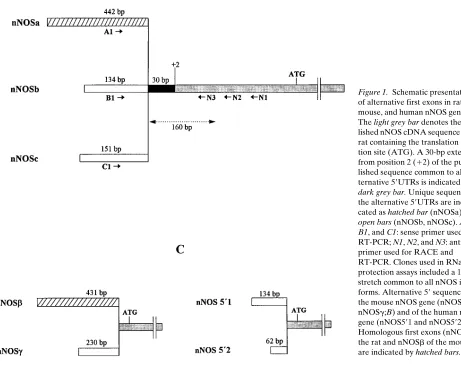
Isolation of multiple nNOS transcripts with unique 59UTRs. Cloning and sequencing of cDNA by RACE from brain, kid-ney, heart, intestine, and embryo led to the identification of three different nNOS mRNA species that are designated as nNOSa, nNOSb, and nNOSc. nNOSa was overall the most abundant isoform, found especially in the brain, while nNOSb was almost exclusively expressed in embryonal tissue and nNOSc in the kidney. A common 39 terminal sequence consist-ing of 30 bp was found to be shared by all isoforms extendconsist-ing 59
from position 12 of the published sequence of the rat nNOS cDNA (3). Based on PCR analysis of genomic DNA, this 30-bp common sequence is contiguous with the published 59 end of the gene, and therefore represents the actual 59 end of the sec-ond exon (previously perceived as the first exon) of the rat nNOS gene. The unique additional 59 terminal sequences rep-resent differential exon 1 sequences of nNOSa, nNOSb and nNOSc that are spliced to this newly identified 30-bp domain of the second exon (Fig. 1). The newly identified unique first ex-ons of nNOSa, nNOSb, and nNOSc are 442, 134, and 151 bp in length, respectively. RT-PCR with isoform-specific sense and antisense primers located at various positions of the cDNA as well as direct sequencing of PCR products yielded no evidence for additional nNOS mRNA species or further variations within the coding sequence, except for a previously described 102-bp insert between exon 16 and 17 (23) that was detectable in skeletal muscle and embryo (data not shown). Comparative databank searches using the BLAST module showed that nNOSa shares a high degree of homology with one of the two alternative first exons identified in the mouse, while neither nNOSb nor nNOSc showed homology to any of the other alter-native first exons described in mouse or human (17, 18).
to 1131. Because all three nNOS mRNA isoforms shared the additional common, newly recognized stretch of 30 bp in exon 2, a 160-bp fragment was expected to be protected, and was in-deed found to be present in all tissues expressing any of the nNOS variants. In addition, specific transcript signals corre-sponding to the 59 terminus of each nNOSa, nNOSb, and nNOSc, were found depending on tissue-specific isoform ex-pression. Consistent with its high prevalence among RACE clones, nNOSa was the most abundant isoform. It showed highest expression in brain, followed by kidney, intestine, E18 embryo, adrenal, heart, and skeletal muscle. In contrast, nNOSb was exclusively expressed in E18 embryo, while nNOSc expression was found in kidney, skeletal muscle, and embryo (Fig. 2). Absolute expression levels of nNOSc are low compared to the other isoforms, and signals were detectable only after prolonged exposure to autoradiographic material. The only tissue that consistently tested negative for all three isoforms of nNOS was the testis.
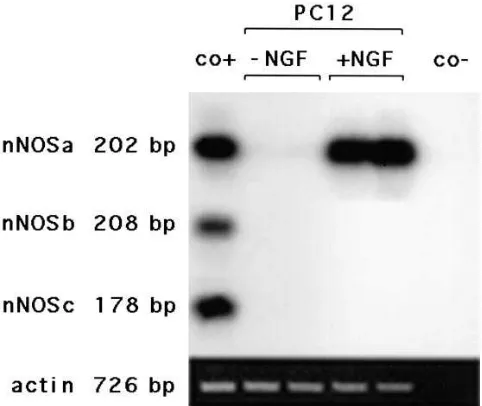
Induction of nNOSa in terminally differentiated PC12 cells. Using sense primers A1, B1, and C1 specific for the al-ternative first exons in combination with the antisense primer
N1 specific for exon 2 of the rat nNOS gene, RT-PCR followed by Southern blotting was carried out on cDNA obtained from rat pheochromocytoma-derived PC12 cells before and after in-duction of neuronal differentiation by NGF. While nNOS ex-pression was almost undetectable under basal conditions, strong induction of nNOSa mRNA was seen in differentiating cells (Fig. 3).
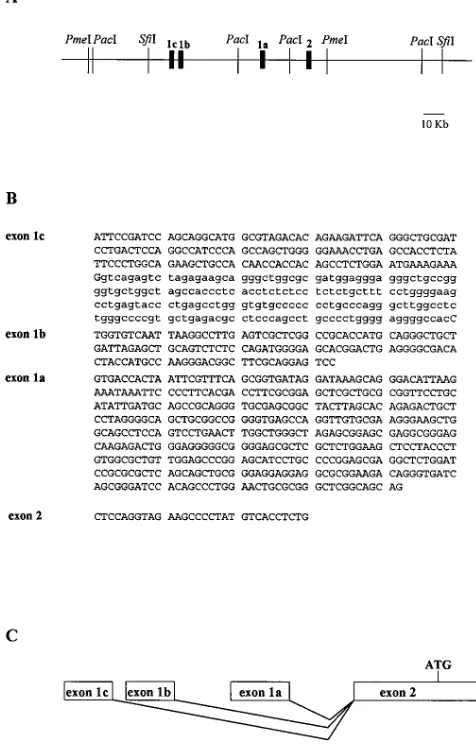
Physical mapping of the alternative first exons of the rat nNOS gene. PCR analyis using genomic DNA as template showed that all newly identified 59UTRs are encoded by a sin-gle exon, and are not interrupted by intronic sequences. Using primers anchored in exons 1c and 1b, the two exons were local-ized at a distance of 150 bp from each other, with exon 1c posi-tioned upsteam of exon 1b. PCR pools of the rat YAC library were screened with primer pairs specific for the alternatively spliced exons (primer pairs Ay1/Ay2 for exon 1a and By1/By2 for exons 1b and 1c), as well as for the 59 end (exon 2) and 39
[image:4.612.71.532.99.468.2]end of the published cDNA sequence. A single YAC (1.1 Mb) was found that gave rise to amplification products from all primer sets. Restriction mapping using infrequently cutting re-striction endonucleases positioned exon 1a at a distance of at
Figure 1. Schematic presentation of alternative first exons in rat, mouse, and human nNOS gene. (A) The light grey bar denotes the pub-lished nNOS cDNA sequence of the rat containing the translation initia-tion site (ATG). A 30-bp extension from position 2 (12) of the pub-lished sequence common to all al-ternative 59UTRs is indicated by a
dark grey bar. Unique sequences of the alternative 59UTRs are indi-cated as hatched bar (nNOSa) or
open bars (nNOSb, nNOSc). A1,
least 15 kb, but of not more than 20 kb upstream of exon 2. Ex-ons 1b and 1c were placed approximately an additional 40 kb upstream of exon 1a (Fig. 4).
Discussion
Our results demonstrate that nNOS in the rat occurs in at least three isoforms characterized by the presence of different first
exons, and that the previously published information regard-ing the 59 end of what we now recognize as exon 2 of the rat nNOS cDNA was incomplete. In addition, we report that the three isoforms of the gene show markedly different expression patterns that are spatially and developmentally distinct. While the relative abundance of nNOS mRNA in the tissues ana-lyzed is consistent with previous studies, our findings demon-strate that overall mRNA levels in some tissues are composed of different amounts of the mRNA variants of nNOS. Further studies using in situ hybridization are necessary to elucidate the spatial and temporal expression of nNOS-mRNA on a tis-sular and cellular level. These observations suggest a more complex and intricate pattern of modulation of expression for this enzyme than previously appreciated, and challenge the heretofore held perception that nNOS is a constitutively ex-pressed gene.
[image:5.612.60.521.59.231.2]The newly identified first exons 1a, 1b, and 1c of the rat nNOS gene are located upstream of the coding sequence, and therefore, do not result in a modification of the encoded pro-tein. Recently, two nNOS mRNAs with alternative 59UTRs were identified in the mouse as well as in humans (17, 18). While rat nNOSa shows close homology to one of the mouse mRNA isoforms (nNOSb), however, no similarity was detect-able between nNOSb and nNOSc and the second 59UTR (nNOSg) in the murine nNOS gene. Likewise, no homology was found between any of the three first exons in the rat and the two reported alternative exons in humans (nNOS 59 and nNOS 592). This observation may simply reflect species-spe-cific differences, or point to the presence of further yet to be identified alternative 59 ends in the rat that are homologous with the alternative first exon in mouse and the two human isoforms, and that may have escaped our present 59RACE analysis due to low abundance. Although the heterogeneity of the 59 ends of nNOS mRNA could be explained by alternative splicing events, it is likely that activation of differential pro-moters is involved in their generation. In support of this, the two human nNOS mRNA species are thought to be tran-scribed from two closely linked, but separable promoters (17).
Figure 2. Analysis of expression by RNase protection assay. Expression patterns of nNOSa (A), nNOSb (B), and nNOSc (C) were examined us-ing 100 mg total RNA from heart (H), testis (T), adrenal (A), intestine (I), kidney (K), brain (B), skeletal muscle (M), and E18 embryo (E); t, tRNA. The sizes of the protected fragments for nNOSa, nNOSb, and nNOSc were 319 bp, 278 bp, and 285 bp, respectively. Pa, Pb, and Pc indi-cate in vitro–transcribed probes that are 466, 410, and 381 bp, respectively, and included vector-encoded sequence. A protected fragment 160 bp in size corresponds to the common sequence shared by all isoforms.
Figure 3.Induction of nNOSa in terminally differentiated PC12 cells. RT-PCR of RNA isolated from each of two dishes of PC12 cells with-out (2NGF) and with NGF treatment (1NGF). Sense primers A1, B1, and C1 (specific for nNOSa, nNOSb, and nNOSc, respectively) were combined with antisense primer N3 (see Fig. 1), and yielded fragment sizes of 202, 208, and 187 bp, respectively. Co1, positive control (cDNA pool derived from rat brain, kidney and embryo).
[image:5.612.57.298.437.640.2]Furthermore, the alternative use of multiple first exons flanked by tissue-specific promoters has been demonstrated for a number of other genes that are ubiquitously expressed, such as for the gene encoding aromatase (which, like nNOS, is a member of the cyotchrome P-450 superfamily) (24) and the gene encoding the glucocorticoid receptor (24). The hypothe-sis that expression of nNOSb may be driven by a developmen-tally regulated promoter is consistent with its transient and ex-clusive expression during development (14, 15). Our observation of developmentally specific expression patterns may shed some light on recent observations obtained in mice carrying a deletion of exon 2 of the nNOS gene (25). We speculate that the relative absence of developmental pathology in this model may be explained by predominance of the still functional tran-script nNOSb from the first alternative exon, that retains 85% activity during critical phases of development (18, 25). The
presence of multiple promoters would allow extensive regula-tion of transcripregula-tion of a single gene both spatially and tempo-rally, as suggested by the tissue- and development-specific ex-pression pattern of nNOS mRNA species presented here.
Reminiscent of the two alternative first exons described in the human nNOS gene, exons 1c and 1b are located in close proximity to each other. A pattern search for the sequence jux-taposed between exons 1c and 1b revealed the presence of a number of consensus sequences such as those known to inter-act with nuclear finter-actor-1, AP1, MyoD, GATA, and histoneH4. Any critical assessment concerning the functional relevance of these sequence elements and the characterization of putative promoters, however, must await the results of specific experi-ments.
Given the broad distribution of nNOS throughout the body and the extensive spectrum of biological functions mediated by NO, it would seem likely that the expression of this enzyme is regulated in a differentiated fashion. The use of alternative promoters is one mechanism that allows spatial- and temporal-specific regulation of transcription. The resulting complexity on the transcriptional level affords the organism the capacity to respond to numerous signals with a high degree of specific-ity. Thus, the level of the short-lived molecule NO in any given tissue is dependent not only on the calcium concentration, but also on a cell’s specific endowment of trans-acting factors that control the relative level of expression of each of the known NO-producing enzymes. The identification of cis- and trans -acting factors that are responsible for the expression of the transcriptional variants of the nNOS gene will provide insight into the molecular mechanisms that control nNOS expression, and thus into the diversity of functional properties of nNOS in these tissues.
Increasing evidence suggests a role of 59 and 39UTRs of mRNAs in the regulation of gene expression. Thus, so-called iron-responsive elements, found in 59UTRs of genes involved in iron metabolism control their translational rate in response to changes of iron levels (26). Certain sequences within the 39 -UTR have been shown to affect mRNA transport and stability (27), and short open reading frames within 59UTR have been implicated in the inhibition of translation (28). It is therefore certainly possible that variations in length or sequence of the 59UTRs of the rat nNOS mRNA isoforms may affect nNOS protein levels via different posttranscriptional mechanisms.
NO has an extremely wide spectrum of functional proper-ties that is unprecedented in biology. As one of the smallest water- and lipid- soluble carriers capable of chaperoning a free electron within and between cells, NO has access to a number of molecules, and is able to modify the state of active sites. It has been implicated in the regulation of ion channels, GTPases, and transcription factors (29–31). To fulfill these multiple roles, a regulated mode of expression of nNOS, as supported by our findings, would appear reasonable, and, indeed perhaps essential.
[image:6.612.56.294.66.440.2]Our observation of developmentally specific expression patterns of nNOS isoforms is compatible with emerging evi-dence that NO is involved in developmental processes such as apoptosis and differentiation. NO has been shown to trigger the switch to growth arrest during differentiation of PC12 cells into neuronal cells in response to NGF, a phenomenon that is accompanied by an induction of both calcium-independent and calcium-dependent NOS acitivity (20). Likewise, NO has been implicated as conferring antiproliferative effects during
Drosophila development, controlling the balance between cell proliferation and cell differentiation (32). Although the rele-vant NOS isozyme has not been specifically identified, dNOS, the only NOS-encoding gene cloned from Drosophila to date, shows strong homology to the mammalian nNOS (33). Our finding that differentiation of PC12 cells into neurons is ac-companied by the induction of nNOSa, the most abundant nNOS transcript found in the mature brain, is consistent with this proposed growth- or differentiation-regulating role of nNOS. In addition, since transcriptional activation of specific promoter elements by NGF in PC12 cells has been demon-strated for a number of genes, such as the genes encoding neu-ropeptide Y gene and transforming growth factor-beta gene (34, 35), it seems reasonable to speculate that a similar mecha-nism may account for the specific induction of nNOSa.
In summary, we report original evidence that differential transcripts of nNOS show tissue- and development-specific ex-pression patterns, and propose that this may represent a here-tofore unrecognized mechanism of regulatory modulation of nNOS expression.
Acknowledgments
We are grateful to Bradford D. Verrecchia and Lily Eng for excellent technical help. This work was supported by a Research Career Devel-opment Award (K04-HL03138-01) to K. Lindpaintner, and a fellow-ship Le1074/1-1 by the German Research Council (Deutsche For-schungsgemeinschaft) to M.A. Lee.
References
1. Lamas, S., P.A. Marsden, G.K. Li, P. Tempst, and T. Michel. 1992. En-dothelial nitric oxide synthase: molecular cloning and characterization of a dis-tinct contitutive enzyme isoform. Proc. Natl. Acad. Sci. USA. 89:6348–6352.
2. Marsden, P.A., H.H.Q. Heng, S.W. Scherer, R.J. Stewart, A.V. Hall, X. Shi, L. Tsui, and K.T. Schappert. 1993. Structure and chromosomal localization of the human constitutive endothelial nitric oxide synthase gene. J. Biol. Chem.
268:17478–17488.
3. Bredt, D.S., P.M. Hwang, C.E. Glatt, C. Lowenstein, R.R. Reed, and S.H. Synder. 1991. Cloned and expressed nitric oxide synthase structurally re-sembles cytochrome P-450 reductase. Nature (Lond.). 351:714–718.
4. Hall, A.V., H. Antoniou, Y. Wang, A.H. Cheung, A.M. Arbus, S.L. Ol-son, W.C. Lu, C. Kau, and P.A. Marsden. 1994. Structural organization of the human neuronal nitric oxide synthase gene (NOS1). J. Biol. Chem. 269:33082– 33091.
5. Xie, Q.-W., H.J. Cho, J. Calaycay, R.A. Mumford, K.M. Swiderek, T.D. Lee, A. Ding, T. Troso, and C. Nathan. 1992. Cloning and characterization of inducible nitric oxide synthase from mouse macrophages. Science (Wash. DC).
256:225–228.
6. Chartrain, N.A., D.A. Geller, P.P. Koty, N.F. Sitrin, A.K. Nussler, E.P. Hoffman, T.R. Billiar, N.I. Hutchinson, and F.B. Mueller. 1994. Molecular cloning, structure, and chromosomal localization of the human inducible nitric oxide synthase gene. J. Biol. Chem. 269:6765–6772.
7. Nathan, C. and Q.-W. Xie. 1994. Nitric oxides synthases: roles, tolls, and controls. Cell. 78:915–918.
8. Lowenstein, C.J., E.W. Alley, P. Raval, A.M. Snowman, S.H. Snyder, S.W. Russel, and W.J. Murphy. 1993. Macrophage nitric oxide synthase gene: two upstream regions mediate induction by interferon gamma and lipopolysac-charide. Proc. Natl. Acad. Sci. USA. 90:9730–9734.
9. Sessa, W.C., J.K. Harrison, D.R. Luthin, J.S. Pollock, and K.R. Lynch. 1993. Genomic analysis and expression patterns reveal distinct genes for endo-thelial and brain nitric oxide synthase. Hypertension (Dallas). 21:934–938.
10. Wilcox, C.S., W.J. Welch, F. Murad, S.S. Gross, G. Taylor, R. Levi, and H.H.H.W. Schmidt. 1992. Nitric oxide synthase in macula densa regulates glo-merular capillary pressure. Proc. Natl. Acad. Sci. USA. 89:11993–11997.
11. Weiner, C.P., I. Lizosoain, S.A. Baylis, R.G. Knowles, I.G. Charles, and S. Moncada. 1994. Induction of calcium-dependent nitric oxide synthases by sex
hormones. Proc. Natl. Acad. Sci. USA. 91:5212–5216.
12. Verge, V.M., Z. Xu, X.J. Xu, Z. Wiesenfeld-Hallin, and T. Hokfelt. 1992. Marked increase in nitric oxide synthase mRNA in rat dorsal root ganglia after peripheral axotomy: in situ hybridisation and functional studies. Proc. Natl. Acad. Sci. USA. 89:11617–11621.
13. Herdegen, T., S. Brecht, B. Mayer, J. Leah, W. Kummer, R. Bravo, and M. Zimmermann. 1993. Long-lasting expression of jun and krox transcription factors and nitric oxide synthase in intrinsic neurons of the rat brain following axotomy. J. Neurosci. 13:4130–4145.
14. Bredt, D.S. and S.H. Snyder. 1994. Transient nitric oxide synthase neu-rons in embryonic cerebral cortical plate, sensory ganglia, and olfactory epithe-lium. Neuron. 13:301–313.
15. North, A.J., R.A. Star, T.S. Brannon, K. Ujiie, C. Welsch, C.J. Lowen-stein, S.H. Snyder, and P.W. Shaul. 1994. Nitric oxide synthase type I and type III gene expression are developmentally regulated in rat lung. Am. J. Physiol.
266:L635–L641.
16. Williams, C.V., D. Nordquist, and S.C. McLoon. 1994. Correlation of ni-tric oxide synthase expression with changing patterns of axon projections in the developing visual system. J. Neurosci. 14:1746–1755.
17. Xie, J., P. Roddy, T.K. Rife, F. Murad, and A.P. Young. 1995. Two closely linked but separable promoters for human neuronal nitric oxide syn-thase gene transcription. Proc. Natl. Acad. Sci. USA. 92:1242–1246.
18. Brennan, J.E., D.S. Chao, S.H. Gee, A.W. McGee, S.E. Craven, D.R. Santillano, Z. Wu, F. Huang, H. Xia, M.F. Peters, et al. 1996. Interaction of ni-tric oxide synthase with the postsynaptic density protein PSD-95 and a1-syntro-phin mediated by PDZ Domains. Cell. 84:757–767.
19. Frohman, M.A., M.K. Dush, and G.R. Martin. 1988. Rapid production of full-length cDNAs from rare transcripts: amplification using a single gene-specific oligonucleotide primer. Proc. Natl. Acad. Sci. USA. 85:8898–9002.
20. Peunova, N. and G. Enikolopov. 1995. Nitric oxide triggers a switch to growth arrest during differentiation of neuronal cells. Nature (Lond.). 375:68–73.
21. Nudel, U., R. Zakut, M. Shani, S. Neuman, Z. Levy, and D. Yaffe. 1983. The nucleotide sequence of the rat cytoplasmic beta-actin gene. Nucleic Acids Res. 11:1759–1771.
22. Cai, L., L.C. Schalkwyk, A. Schoeberlein-Stehli, R.Y.L. Zee, A. Smith, T. Haaf, M. Georges, H. Lehrach, and K. Lindpaintner. 1997. Construction and characterization of a 10-genome equivalent yeast artificial chromosome library for the laboratory rat, rattus norvegicus. Genomics. 39:385–392.
23. Silvagno, F., H. Xia, and D.S. Bredt. 1996. Neuronal nitric oxide syn-thase m, an alternatively spliced isoform expressed in differentiated skeletal muscle. J. Biol. Chem. 271:11204–11208.
24. Harada, N., T. Utsumi, and Y. Takagi. 1993. Tissue-specific expression of the human aromatase cytochrome P-450 gene by alternative use of multiple exons 1 and promoters, and switching of tissue-specific exons 1 in carcinogene-sis. Proc. Natl. Acad. Sci. USA. 90:11312–11316.
25. Huang, P.L., T.M. Dawson, D.S. Bredt, S.H. Snyder, and M.C. Fishman. 1993. Targeted disruption of the neuronal nitric oxide synthase gene. Cell. 75: 1273–1286.
26. Hentze, M.W., and L.C. Kühn. 1996. Molecular control of vertebrate iron metabolism: mRNA-based regulatory circuits operated by iron, nitric ox-ide, and oxidative stress. Proc. Natl. Acad. Sci. USA. 93:8175–8182.
27. Atwater, J.A., R. Wisdom, and I.M. Verma. 1990. Regulated mRNA stability. Annu. Rev. Genet. 24:519–541.
28. Zimmer, A., A.M. Zimmer, and K. Reynolds. 1994. Tissue specific ex-pression of the retinoic acid receptor-beta 2: regulation by short open reading frames in the 5-coding region. J. Cell Biol. 127:1111–1119.
29. Bolotina, V.M., S. Najibi, J.J. Palacino, P.J. Pagano, and R.A. Cohen. 1994. Nitric oxide directly activates calcium-dependent potassium channels in vascular smooth muscle. Nature (Lond.). 368:850–853.
30. Lander, H.M., P.K. Sehajpal, and A. Novogrodsky. 1993. Nitric oxide signaling; a possible role for G-proteins. J. Immunol. 151:7182–7187.
31. Peunova, N., and G. Enikolopov. 1993. Amplification of calcium-induced gene transcription by nitric oxide in neuronal cells. Nature (Lond.). 364:450–453.
32. Kuzin, B., I. Roberts, N. Peunova, and G. Enikolopov. 1996. Nitric ox-ide regulates cell proliferation during Drosophila development. Cell. 87:639– 649.
33. Regulski, M., and T. Tully. 1995. Molecular and biochemical character-ization of dNOS: a Drosophila Ca21/calmodulin-dependent nitric oxide
syn-thase. Proc. Natl. Acad. Sci. USA. 92:9072–9076.
34. D’Arcangelo, G., R. Habas, S. Wang, S. Halegoua, and S.R. Salton. 1996. Activation of codependent transcription factors is required for transcrip-tion inductranscrip-tion of the vgf-gene by nerve growth factor and ras. Mol.Cell.Biol. 16: 4621–4631.
35. Kim, S.J., K. Park, B.B. Rudkin, B.R. Dey, M.B. Sporn, and A.B. Rob-erts. 1994. Nerve growth factor induces transcription of transforming growth factor-beta through a specific promoter element in PC12 cells. J. Biol. Chem.