2018 2nd International Conference on Applied Mathematics, Modeling and Simulation (AMMS 2018) ISBN: 978-1-60595-580-3
Research on Rotor Winding Detection Based on Texture Information and
Convolution Neural Network
Song YAN
1, Xiao-guo ZHANG
2,*and Rong-kai HE
11
School of Mechanical Engineering, Southeast University, Nanjing 210096, China
2School of Instrument Science and Engineering, Southeast University, Nanjing 210096, China
*Corresponding author
Keywords: Image processing, CNN, LBP, Feature extraction.
Abstract. To achieve the rotor winding qualification test, a new detection method based on texture information and convolution neural network is proposed. This method could effectively eliminate the effect of illumination by using LBP to extract image texture information in advance which is calculated by circular radius, and then using convolution neural network to extract features in further to discriminate the workpiece is qualified or not, which can put the discrimination accuracy to a higher stage. The experimental results prove it, which shows that the new method in this paper performs better than traditional methods no matter of the accuracy rate or the time it costs.
Introduction
With the continuous advancement of Industrialization 4.0 and China Manufacturing 2025, the industrial manufacturing industry is developing rapidly and the demand for motors is increasing on a high speed. As the core component of the motor, in the production process of the motor, the quality of the rotor winding is vital to the service life of the motor. Based on current production technology, when commutator and winding wires are winding, which is prone to occur unqualified workpieces , like missing winding workpiece, broken winding workpiece and so on. In view of this situation, the currently commonly used method for testing the qualification of rotor windings on the production line is the manual inspection. In the complex production environment, this method has low efficiency and is not conducive to mass production. With the increase of the working time, the visual inspection easily occurs fatigue damage, which leads to missed or false detections. Therefore, it is urgent to propose a new alternative method that can quickly determine the qualification of rotor windings.
In recent years, the research on machine vision technology and machine learning has developed rapidly, and its utilization in industrial production has become more and more widespread[1]. Japan's Keyence, TOLIMEC, NI, Connex, and BOBST in Switzerland can provide more sophisticated on-line inspection solutions for machine surface quality based on machine vision; Dr. Yang Chunshan and Dr. Kong Yuyong used traditionally Convolutional neural network as a trainable feature extractor and random forest as a pattern recognizer to implement a hybrid method based on deep convolutional neural network and random forest (CNN-RF) to solve the problem of neural cell image segmentation, which has gotten good results on public data collection; Zhang Hui and his team applied BP neural network to remote sensing image classification and obtained accurate classification results [2-5]. However, there are few studies on the qualification analysis of winding parts images, especially the study on machine learning is more deficient.
Detection Algorithm
Sample Description
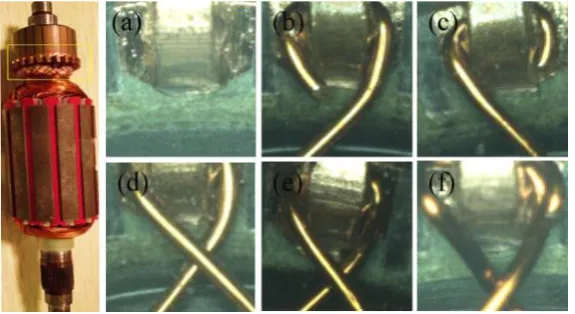
This article mainly focuses on the qualification of the winding of the motor rotor at the hook. Take TT720 as a sample, the winding part to be inspected is shown in Fig1. A motor rotor has 24 hooks, it is tested whether 24 parts are qualified and determines whether the rotor is qualified. By locating and cutting the images of the parts to be tested, the qualification is judged through the detection mechanism. Based on the current rotor production technology, during the rotor commutator and copper wire winding, some unqualified forms are likely to appear, such as missing winding workpiece, broken winding workpiece, as shown in Figure1(a), Figure1(b), and Figure1(c).For relatively qualified parts, there are also two cases, good reflective parts and poor reflective parts caused by irregular shape and uneven illumination, which are shown in Figure1(d) and Figure1(e), Figure1(f).
Figure 1. Test sample picture.
Image Feature Analysis
[image:2.595.155.443.256.413.2]For various cases of rotor winding , through analysis of the rotor image by using filtering , image gray-scale binarization processing and GLCM(Gray-level Co-occurance Matrix), it can be found that there are some differences between different forms[6-7], which listed as follows:
Table 1. Difference between different forms.
Missing winding parts
Broken winding parts Good reflective parts Poor reflective parts Connected-region
size after binarization <=200 500-1100 1000-2000 600-1500
Texture(entropy) <0.08 <0.15 0.15-0.20 0.18-0.25
Texture(contrast) <5 <15 15-18 17-25
Detection Based on Texture Information and Convolution Neural Network
In this paper, it takes LBP operator calculated by circular radius,
LBPP,R= ∑P−1p=0s(gp− gc)2p (1) Where
[image:3.595.168.430.198.332.2]S(x)=1,x>=0; S(x)=0,x<0; (2) When P = 8, R = 1, it is very similar to the classical LBP value, but the difference is that the sampling area is circular and the pixel value must be obtained by two-linear interpolation. The extraction effect diagram is shown as follows:
Figure 2. The result of image processing.
After extracting the texture features of the image, the convolutional neural network is used to further extract the target features to distinguish the rotor winding qualification[11-12]. This paper adopts the convolutional neural network structure as shown in the following figure. The input of the network is the texture feature of image extracted by LBP operator. The first layer of the network is the batch normalization layer, which has the function of regularization of the model. The network contains 6 convolution layers. The size of the convolution kernel is 3*3, and the number of convolution kernels is 32, 32, 64, 64, 128, 128. After each two convolution layers, one largest pooling layer is connected, and the pooling size is 2*2; It consists of two fully connected layers. The output dimension of the first layer is 256, and the output dimension of the second layer is 2. In order to prevent the network from overfitting, a dropout layer is added after the first fully connected layer with a drop ratio of 0.5. Except the softmax activation function in the last classification layer, all other activation functions use the relu activation function. The network optimizer selects Adam, the initial learning rate is 0.001, and the attenuation coefficient is 0.000001.
Figure 3. Algorithm flow chart.
[image:3.595.57.538.549.639.2]Experiments and Analysis Experimental Results
[image:4.595.100.474.220.344.2]The experiment was divided into two steps. In the early stage, in order to avoid the influence of cross winding below, the rotor winding image was segmented by template positioning to obtain the image of the part to be inspected, and the collected image was marked at the later stage. In the training set and validation set, the pictures of qualified part image was 2000, among which 1500 good reflective parts and 500 poor reflective parts. And 1000 pieces of unqualified images, while 700 pieces missing winding workpieces, and 300 broken winding workpieces, finally 2500 randomly selected images are used as training sets, and the rest left for the validation set.
Figure 4. The training curve.
[image:4.595.78.519.442.505.2]After the training detection model was obtained, 1000 images were tested, which contains 450 good reflective parts image, 200 missing winding parts images, 170 broken winding parts images, 180 poor reflective parts images. Comparing with the conventional image processing method and the template matching judgment method, the results are shown in below:
Table 2. Comparation result. Fact
Prediction
qualified unqualified
template
match CNN LBP+CNN
template
match CNN LBP+CNN
Prediction(qualified) 455 628 611 36 227 22
Prediction(unqualified) 175 2 19 334 143 348
And the time all 1000 images tested costs 38.566s, which is on the computer based on win10 system, i7 processor.
Result Analysis
Table 2 indicates that the convolutional neural network based on winding texture information is effective for the rotor winding qualification test. Compared with the traditional image matching processing algorithm and only CNN, this method has higher accuracy rate. The method used CNN only has a poor performance when there is a change in lighting conditions, while the convolutional neural network based on winding texture information does well. The distribution of the number of samples in the data set is not uniform. On the whole, good reflective parts are the most, and broken winding workpieces are the least. This may bring some interference to the subsequent detection model, which can be solved by increasing the number of samples.
Summary
test whether a part is qualified or not, which is faster than manual inspection. In the actual application, the location and interception of the predetected images and the change of the image collection environment, the uneven distribution of the samples and the inadequacy of the negative samples all may have a certain influence on the detection and recognition effect. In the follow-up research work, the data can be augmented by the way of GAN (antagonistic neural network) and the model will be constantly improved, which can advance the classification accuracy of different forms to a higher level.
Acknowledgement
I would like to express my gratitude to all those who helped me during the writing of this thesis. My deepest gratitude goes first and foremost to Professor He Rongkai and Zhang Xiaoguo, my supervisors, for their constant encouragement and guidance. They have walked me through all the stages of the writing of this thesis. Second to my parents and classmates, without their consistent and illuminating encouragements, this thesis could not have reached its present form.
References
[1] Huang Kaiqi, Ren Weiqiang, Tan Tieiu. Summary of Image Object Classification and Detection Algorithms[J].Chinese Journal of Computers, 2014, 37(06):1225-1240.
[2] Sun, T., C. Tseng and M. Chen, Electric contacts inspection using machine vision. Image and Vision Computing [J], 2010. 28(6): pp. 890-901.
[3] Aldrich, C., et al., Online monitoring and control of froth flotation systems with machine vision: A review [J]. International Journal of Mineral Processing, 2010. 96(1-4): pp. 1-13.
[4] Yang Chunshan, Kong Youyong, Yao Lan. Automatic Matching Method of Gun Warhead Mark Based on Image Processing[J]. Mathematics in Practice and Theory, 2010, 40(15): 120-129.
[5] Zhang Hui. Research on Remote Sensing Image Classification Based on BP Neural Network[D]. Shandong Normal University, 2013.
[6] Zhang Bo. Research on key technologies for visual inspection of hard disk coil defects[D]. Guangdong University of Technology 2013.
[7] Wang Long. Research on Image Texture Feature Extraction and Classification[D]. Ocean University of China, 2014.
[8] T. Ojala, M. Pietikäinen, and D. Harwood (1994), "Performance evaluation of texture measures with classification based on Kullback discrimination of distributions", Proceedings of the 12th IAPR International Conference on Pattern Recognition (ICPR 1994), vol. 1, pp. 582-585.
[9] Han Youde, Yang Peng, Ren Gao Shan, Zhang Yuanlong, Lin Quan. Research on texture feature extraction based on DWT and LBP [J]. computer and digital engineering, 2018,46 (03): 566-569.
[10] Tao Xihao, Wan Ding Sheng, Yang Zhiyong. A face detection method based on improved LBP feature [J]. information technology, 2018 (02): 1-4+10.
[11] Lu Zheng. Research on Vehicle License Plate Character Recognition Based on Convolutional Neural Network[A]. China Image and Graphics Society. Proceedings of the 12th National Conference on Image Graphics[C]. China Image and Graphics Society: 2005:4.