R E S E A R C H A R T I C L E
Open Access
Knee extension range of motion and self-report
physical function in total knee arthroplasty:
mediating effects of knee extensor strength
Yong-Hao Pua
1*†, Peck-Hoon Ong
1†, Hwei-Chi Chong
1, William Yeo
2, Celia Tan
3and Ngai-Nung Lo
4Abstract
Background:Knee extensor strength and knee extension range of motion (ROM) are important predictors of physical function in patients with a total knee arthroplasty (TKA). However, the relationship between the two knee measures remains unclear. The purpose of this study was to examine whether changes in knee extensor strength mediate the association between changes in knee extension ROM and self-report physical function.
Methods:Data from 441 patients with a TKA were collected preoperatively and 6 months postoperatively. Self-report measure of physical function was assessed by the Short Form 36 (SF-36) questionnaire. Knee extensor strength was measured by handheld dynamometry and knee extension ROM by goniometry. A bootstrapped cross product of coefficients approach was used to evaluate mediation effects.
Results:Mediation analyses, adjusted for clinicodemographic measures, revealed that the association between changes in knee extension ROM and SF-36 physical function was mediated by changes in knee extensor strength. Conclusions:In patients with TKA, knee extensor strength mediated the influence of knee extension ROM on physical function. These results suggest that interventions to improve the range of knee extension may be useful in improving knee extensor performance.
Background
Knee osteoarthritis (OA) is associated with substantial functional limitations in older adults [1]. Specifically, knee OA, along with hip OA, accounted for the largest propor-tion of disability in walking and stair climbing more than any other chronic diseases [2]. In patients with advanced stages of painful knee OA, although a total knee arthro-plasty (TKA) can effectively restore function, 1 in 6 patients with TKA continue to have substantial physical function limitations [3]. Clearly, an in-depth understand-ing of the modifiable predictors of physical function and their aetiological pathways is needed which, in turn, could assist the refinement of interventions to improve function. Clinically, two common knee impairments before and following a TKA are reduced knee extensor strength and deficits in knee extension range-of-motion (ROM) [4].
Although most [5-12] but not all [13] previous studies have implicated knee strength and knee extension ROM as important predictors of physical function, notably absent from these studies was an evaluation of the inter-relation between knee extensor strength and knee exten-sion ROM: previous studies–by their choice of standard regression analyses–assumed that these 2 knee measures have distinct and unrelated etiologies and that they act through different pathways to influence physical function.
Is it possible that knee extensor strength and knee extension ROM are interrelated? Based on what is known about the length-dependent nature of muscle force produc-tion, [14,15] we believe it is biologically plausible that knee extensor strength may play a role in the mechanistic path-way connecting knee extension ROM and physical func-tion. Indeed, many activities of daily living–for example, level walking [16]–require the knee extensors to produce forces at lesser degrees (~30°) of knee flexion. Ostensibly, at a given knee joint angle near full extension, a flexion con-tracture may limit force production because the knee extensors – the monoarticular vastii in particular – are * Correspondence:[email protected]
†Equal contributors
1
Department of Physiotherapy, Singapore General Hospital, Singapore, Singapore
Full list of author information is available at the end of the article
operating at a disadvantaged (lower) position on the ascending limb of their force-angle curves [14,15]. In as much as this concept may make sense and lead to the refinement of theoretical and intervention models, sup-porting data in patients with TKA are surprisingly sparse.
Because the interrelation between knee extensor strength and knee extension ROM is possible and important to understand clinically, we initiated the present study to examine whether changes in knee extensor strength me-diate the association between changes in knee extension ROM and self-report physical function in a large group of patients before and following a TKA.
Methods
Settings and participants
Our study used a longitudinal pre- and post-TKA design that took advantage of the substantial differences in change for knee impairments and self-report physical function. The study involved 836 consecutive patients aged 50 years or older who underwent a primary TKA for knee OA performed by three high-volume surgeons at Singapore General Hospital, Singapore, from 3 January 2006 to 29 January 2009. To avoid potential confounding effects from a contralateral TKA operation, we excluded patients if they had a contralateral TKA within the 12 months before or 6 months after their index TKA (n= 152). We also excluded patients who (i) had a history of stroke or other neuro-logical disorders (n= 30), (ii) had a history of lower limb fracture (n= 12), (iii) had previously undergone a hip arthroplasty or high tibial osteotomy (n= 26), (iv) had previously undergone a unicompartmental knee arthro-plasty (UKA) on their index knee (n= 4), or (v) developed medical or surgical complications prior to the follow up session (n= 64). Finally, because this exploratory study is concerned with the effects of knee flexion contractures, we excluded patients with missing knee data (n= 48) and patients with knee hyperextension (extension ROM <0°) at the preoperative or follow-up assessment (n= 59). (The recruitment process is summarized in a flowchart in Additional file 1.) Thus, the sample for analysis comprised the remaining 441 patients who underwent a preoperative evaluation within 5 weeks prior to their operation. Of note, this sample size was not based on a formal power calcula-tion but on all eligible patients in our database. Follow-up assessment was conducted approximately 6 months after the operation. All data were collected, as part of the clinical process, by physical therapists and entered into an elec-tronic database per routine practice policies of our institu-tion. All patients in this study were managed using a coordinated clinical pathway to ensure standardized med-ical, pharmacologmed-ical, and rehabilitation care. Within two weeks post TKA, these patients began a 4- to 6-week re-habilitation program at the Singapore General Hospital
outpatient physiotherapy clinic. The Centralized Institu-tional Review Board of Singhealth (CIRB), Singapore, approved the study and waived the need for informed con-sent due to the retrospective and anonymous nature of the study.
Demographic variables
The demographic information collected in this study included age (in years), sex, ethnicity (Singaporean Chinese, as compared with others), and education (1 = primary school or less, 2 = vocational or secondary school, 3 = col-lege or university). Data about comorbidities were retrieved from patients’medical records by a research assistant using a checklist modeled after the Self-Administered Comorbid-ity Questionnaire [17]. Patients’height and weight were also obtained and body mass index (BMI) was calculated as the ratio of weight to squared height (kg/m2).
Self report physical function
At each assessment, patients were interviewed in either English or Mandarin using the Short Form-36 [18], of which we used the physical function subscale as the outcome variable and the bodily pain and mental health subscales as the study covariates. All subscales range from 0–100, with higher scores representing better health state. The English and Chinese versions of the SF-36 have been previously validated for use in Singapore [19].
Knee extensor strength
performed strength testing in the supine position –and not in the seated position – with the intent to reduce the influence of the rater’s strength on the patient’s mea-surements [20]. We attempted to ensure that the same rater evaluated the same patient at each time point al-though this was not fully achievable due to the large patient volume in our hospital (~1,500 TKAs per annum [24]). Nevertheless, all technicians were trained and audited by authors HCC and WY who have a combined experience of over 30 years in orthopaedic and sports physiotherapy. Furthermore, for the supine knee strength measurements, previous studies have demonstrated good test–retest reliability (intraclass correlation coefficients, 0.80 to 0.86) and concurrent validity with Biodex dynamo-metry measurements [20,25].
Knee extension ROM
A large standard goniometer (Jamar, Clifton, NJ, USA) was used to measure passive knee extension ROM. Knee extension ROM was measured with the patients in supine position with the heel elevated on a firm wedge. The axis of the goniometer was placed on the femoral lateral epicondyle. The proximal arm of the goniometer was directed toward the greater trochanter of the femur whilst the distal arm of the goniometer was directed toward the lateral malleolus of the ankle. Patients were asked to relax to allow the knee to passively extend. Two sets of measurements were taken, and the lower measurement (greater knee extension) was recorded. For the knee extension ROM measurements, one previous study in patients with knee OA has demonstrated good test–retest reli-ability (intraclass correlation coefficient = 0.85) [26].
Statistical analysis
We used descriptive statistics to characterize the study sample: we used means (SDs) for continuous variables
and percentages for categorical variables. Analysis of variance (ANOVA) for repeated measures was used to test for change over time in the SF-36 and knee mea-sures. Pearson correlation was used to quantify the cor-relation between knee measures.
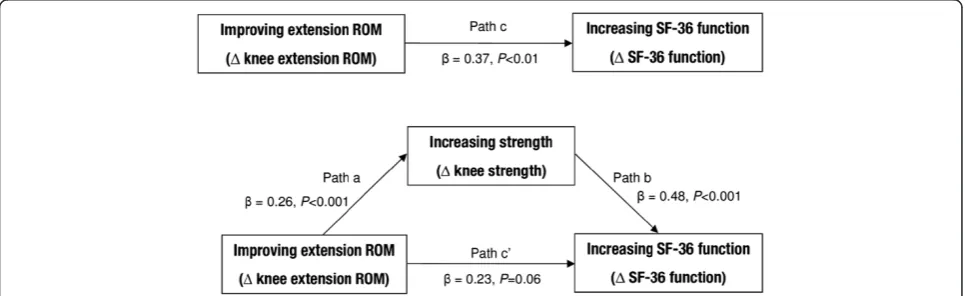
[image:3.595.57.540.547.695.2]We used a mediation model to examine whether knee extensor strength mediated the influence of knee extension ROM on SF-36 physical function at the change scores (pre- to post TKA) level (Figure 1). Covariates in each model included age, sex, BMI, the number of comorbidities, and changes in SF-36 bodily pain and mental health scores. In the mediation model, the total effect (path c) of the independent variable (changes in knee extension ROM) on the dependent variable (changes in SF-36 physical func-tion) comprises a direct effect (path c’) of the inde-pendent variable on the deinde-pendent variable and an indirect (mediation) effect of the independent variable on the dependent variable through the mediator (changes in knee extensor strength). The mediation effect through the mediator is quantified by the pro-duct of the regression coefficient of knee extension ROM on knee extensor strength (path a) and the re-gression coefficient of knee extensor strength on SF-36 physical function (path b). We used the INDIR-ECT macro [27] to estimate the mediation effect (path axb) and its bootstrapped (1,000 samples), bias-corrected and accelerated 95% confidence interval (95% CI). Mediation effects are considered statistically significant when zero is not contained within the 95% CIs [27]. Finally, in sensitivity analysis, we tested a reversed mediation model – wherein changes in knee extension ROM were due to changes in knee extensor strength – to assess the direction of the proposed mediation effects. All statistical analyses were done with PASW software, version 18, and R software, ver-sion 2.15.0.
Results
[image:4.595.306.538.112.223.2]Sample characteristics
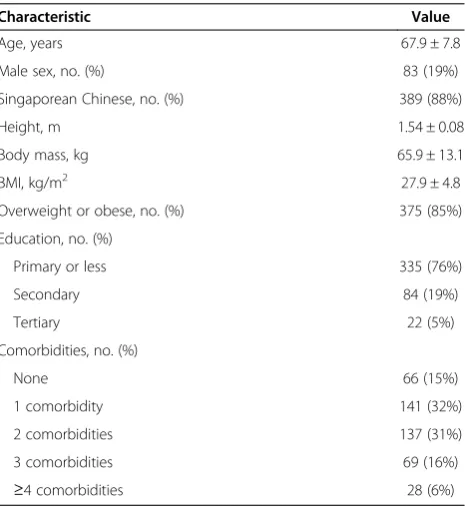
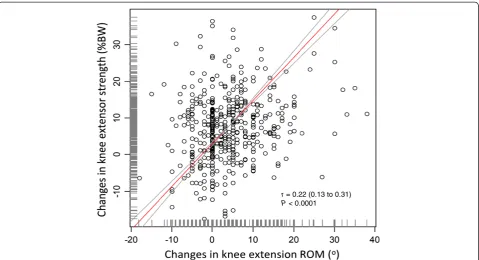
Table 1 summarizes the participants’descriptive charac-teristics, while Table 2 provides the descriptive statistics for the SF-36 physical function and knee measures. The patients were predominantly female (82%) and were on average moderately overweight (mean (SD) BMI, 28(4.8) kg/m2). All SF-36 and knee measures increased signifi-cantly 6 months following a TKA. Specifically, mean SF-36 physical function scores were 39(SD = 23) points preoperatively and 67(SD = 18) points 6 months post-operatively. With respect to the knee measures, knee extensor strength increased from preoperative level by around 40% at the 6 month postoperative assessment (18% BW vs. 26%BW;P< 0.001). Knee extension ROM improved significantly (P< 0.001) from 8.2° (knee flexion contracture) preoperatively to 4.3° postoperatively. Improvement in knee extension ROM was positively associated with increased knee extensor strength (r= 0.22, P< 0.001, Figure 2). Increased SF-36 physical function was positively associated with improvement in knee extension ROM (r= 0.15, P< 0.001) and with increased knee strength (r= 0.27, P< 0.001) (scattergrams are shown in Additional file 1).
Mediation analyses
Figure 1 shows the results of the mediational analyses. Overall, the mediator model accounted for ~29% of the variance in physical function (P< 0.001). Improving knee
extension ROM was significantly associated with increa-sing physical function (P< 0.01 for path c, Figure 1). Con-trolling for covariates, the mediation effect of knee extensor strength on the association between changes in knee extension ROM and physical function was statisti-cally significant (path axb = 0.13; 95% CI, 0.05 to 0.23). In contrast, no mediation effect was observed in the reversed mediation model (path axb = 0.04; 95% CI, -0.01 to 0.11).
Discussion
The purpose of this study was to explore, in patients be-fore and 6-months following a TKA, whether knee exten-sion ROM had an indirect effect on SF-36 physical function through the putative pathway of knee extensor strength. Our results suggest that changes (pre to post TKA) in knee extensor strength mediated the association between changes in knee extension ROM and self-report physical function. To our knowledge, these findings have not been previously described in patients with TKA.
Our results, without considering mediating effects, are consistent with cross-sectional studies [7,9,12] of a positive association between knee extension ROM and physical function in TKA (path c in Figure 1). Furthermore, case series [28,29] and small trials [30] are available demonstra-ting that in patients before and following a TKA, rehabilita-tion intervenrehabilita-tions – for example, such as manual therapy and splinting–increased knee ROM and improved phys-ical function. Overall, our large study using longitudinal change scores extends the previous literature to suggest that knee extension ROM is an important correlate of physical function in TKA.
Consistent with theoretical expectations, changes in knee extension ROM were associated with changes in knee extensor strength (Figure 2) which, in turn, were associated with changes in physical function (Figure 1). Furthermore, the results from the sensitivity analysis using a reversed mediation model support the direction of the proposed mediation. How do we explain our results? As mentioned in the Introduction, a knee flexion contracture
Table 2 Postoperative recovery of SF-36 and knee measures (n= 441)
Variables Pre TKA Post TKA P-value†
SF-36 variables
Physical function 38.8 (22.7) 66.6 (17.9) <0.001
Bodily Pain 36.8 (18.3) 69.0 (23.5) <0.001
Mental Health 75.9 (19.1) 82.7 (14.5) <0.001
Knee variables
Extensor strength, %BW 18.0 (8.0) 25.6 (8.6) <0.001
Extension ROM, deg 8.2 (8.2) 4.3 (4.9) <0.001
Note: Values reported were mean (SD) unless stated otherwise.
Abbreviations: SF-36 = Medical Outcomes Study 36-Item Short-Form Health Survey;ROM, range of motion;BW, body weight;TKA, total knee arthroplasty.
[image:4.595.58.291.463.717.2]†P-values derived from repeated-measure ANOVA.
Table 1 Demographics and patient characteristics (n= 441)
Characteristic Value
Age, years 67.9 ± 7.8
Male sex, no. (%) 83 (19%)
Singaporean Chinese, no. (%) 389 (88%)
Height, m 1.54 ± 0.08
Body mass, kg 65.9 ± 13.1
BMI, kg/m2 27.9 ± 4.8
Overweight or obese, no. (%) 375 (85%)
Education, no. (%)
Primary or less 335 (76%)
Secondary 84 (19%)
Tertiary 22 (5%)
Comorbidities, no. (%)
None 66 (15%)
1 comorbidity 141 (32%)
2 comorbidities 137 (31%)
3 comorbidities 69 (16%)
≥4 comorbidities 28 (6%)
(knee extension ROM > 0°) may potentially compress the force-length relationship [14,15] of the knee extensors such that strength production diminishes at lesser degrees (~30°) of knee flexion. As a corollary, our results indicate that deficits in knee extension ROM are a putative multi-variate cause of knee extensor weakness in TKA. And if future studies can substantiate this notion, the discussion in the literature about whether knee ROM or knee muscle strength should be given greater prominence in TKA re-habilitation [31-33] would become moot.
Our study has limitations. First, although our use of change scores permitted a more rigorous exploration of mediation than do cross-sectional data, our study variables were measured concurrently at each time point which pre-cluded an examination of temporal associations between variables [34]. Accordingly, to better assess the criterion of temporality, future longitudinal studies should evaluate the changes in the independent variable, mediator, and out-comes sequentially over different time points. Second, and relatedly, because we did not have multiple sequential mea-surements at successive time intervals, as pointed out by the reviewer, we were unable to evaluate whether the rate of change in knee extension ROM influenced (moderated) the proposed mediation effects. Third, we did not have any follow-up strength measurements later than 6 months post TKA; hence, we were unable to evaluate the effects of
improving knee extension ROM post 6 months on knee ex-tensor strength and functional ability. Finally, whilst we used a self-report measure of physical function to facilitate data collection, we acknowledge that performance-based measures of physical function are necessary because they provide important, complementary information about func-tional status [35].
Conclusions
Our results indicate that knee extension ROM is an im-portant correlate of physical function in patients with TKA. More important, changes in knee extension ROM and knee extensor strength interrelated to influence phy-sical function. If future studies could demonstrate that the etiology of knee extensor muscle weakness is associated, inter alia, with knee extension ROM deficits, these fin-dings would suggest that interventions to improve the range of knee extension may be useful in improving knee extensor performance.
Additional file
Additional file 1: Figure S1. Flowchart of participant recruitment. TKA = Total Knee Arthroplasty, HTO = High Tibial Osteotomy, UKA = Unicompartmental Knee Arthroplasty.Figure S2.Scattergram of changes in SF-36 physical function scores versus changes in knee
r = 0.22 (0.13 to 0.31)
[image:5.595.59.539.88.348.2]P < 0.0001
extension ROM in 441 patients. The straight line represents ordinary least product regression line with its 95% confidence limits (curved lines): (changes in SF-36 physical function) = 15.5 (14.4 to 16.5) + 2.9 (2.7 to 3.2) X (changes in knee extension ROM). Observed change scores of the knee and SF-36 measures are indicated by the short vertical lines above the x-and y-axes, respectively.Figure S3.Scattergram of changes in SF-36 physical function scores versus changes in knee extension strength in 441 patients. The straight line represents ordinary least product regression line with its 95% confidence limits (curved lines): (changes in SF-36 physical function) = 8.1 (6.3 to 9.7) + 2.5 (2.3 to 2.7) X (changes in knee extensor strength). Observed change scores of the knee and SF-36 measures are indicated by the short vertical lines above the x- and y-axes, respectively.
Abbreviations
OA: Osteoarthritis; ROM: Range of motion; TKA: Total knee arthroplasty; SF-36: Short form 36.
Competing interests
The authors declare that they have no competing interests.
Authors’contributions
Authors YHP, PHO, HCC, WY, CT, and LNN (1) have all contributed to conception and design of this study; (2) have been involved in drafting the manuscript and revising it critically for important intellectual content; and (3) have given final approval of this version to be published.
Acknowledgements
We thank Ms. Tan Bee Yee, the head of the Department of Physiotherapy, Singapore General Hospital, for supporting this study. We also thank Ms. Tiffany Ang, Ms. Alicia Ang, and Ms. Yinjie Lee for their research assistance. Finally, we thank the orthopaedic surgeons from the Singapore General Hospital for allowing us access to their patients. This work is supported by a Singhealth Foundation grant (SHF/FG398S/2009).
Author details
1Department of Physiotherapy, Singapore General Hospital, Singapore,
Singapore.2Orthopaedic Diagnostic Centre, Singapore General Hospital,
Singapore, Singapore.3Allied Health Division, Singhealth, Singapore,
Singapore.4Department of Orthopaedic Surgery, Singapore General Hospital,
Singapore, Singapore.
Received: 13 July 2012 Accepted: 15 January 2013 Published: 18 January 2013
References
1. McNeil JM, Binette J:Prevalence of disabilities and associated health conditions among adults.Morb Mortal Wkly Rep2001, 50:120–125.
2. Guccione AA, Felson DT, Anderson JJ, Anthony JM, Zhang YQ, Wilson PWF, et al:The effects of specific medical conditions on the functional limitations of elders in the Framingham Study.Am J Public Health1994, 84:351–358.
3. Ranawat CS, Ranawat AS, Mehta A:Total knee arthroplasty rehabilitation protocol: what makes the difference?J Arthroplasty 2003,18:27–30.
4. Bhave A, Mont M, Tennis S, Nickey M, Starr R, Etienne G:Functional problems and treatment solutions after total hip and knee joint arthroplasty.J Bone Joint Surg Am2005,87(Suppl 2):9–21.
5. Franklin PD, Li W, Ayers DC:The Chitranjan Ranawat Award: functional outcome after total knee replacement varies with patient attributes. Clin Orthop2008,466:2597–2604.
6. Parent E, Moffet H:Preoperative predictors of locomotor ability two months after total knee arthroplasty for severe osteoarthritis.Arthritis Care Res2003,49:36–50.
7. Zeni JA Jr, Snyder-Mackler L:Preoperative predictors of persistent impairments during stair ascent and descent after total knee arthroplasty.J Bone Joint Surg Am2010,92:1130–1136.
8. Lingard EA, Katz JN, Wright EA, Sledge CB:Predicting the outcome of total knee arthroplasty.J Bone Joint Surg Am2004,
86-A:2179–2186.
9. Ritter MA, Lutgring JD, Davis KE, Berend ME, Pierson JL, Meneghini RM:The role of flexion contracture on outcomes in primary total knee arthroplasty.J Arthroplasty2007,22:1092–1096.
10. Devers BN, Conditt MA, Jamieson ML, Driscoll MD, Noble PC, Parsley BS: Does greater knee flexion increase patient function and satisfaction after total knee arthroplasty?J Arthroplasty2011,26:178–186.
11. Meneghini RM, Pierson JL, Bagsby D, Ziemba-Davis M, Berend ME, Ritter MA: Is there a functional benefit to obtaining high flexion after total knee arthroplasty?J Arthroplasty2007,22:43–46.
12. Mitsuyasu H, Matsuda S, Miura H, Okazaki K, Fukagawa S, Iwamoto Y: Flexion contracture persists if the contracture is more than 15 degrees at 3 months after total knee arthroplasty.J Arthroplasty2011,26:639–643. 13. Miner AL, Lingard EA, Wright EA, Sledge CB, Katz JN:Knee range of motion
after total knee arthroplasty: how important is this as an outcome measure?J Arthroplasty2003,18:286–294.
14. Savelberg HH, Meijer K:The effect of age and joint angle on the proportionality of extensor and flexor strength at the knee joint. J Gerontol A Biol Sci Med Sci2004,59:1120–1128.
15. Anderson DE, Madigan ML, Nussbaum MA:Maximum voluntary joint torque as a function of joint angle and angular velocity: model development and application to the lower limb.J Biomech2007, 40:3105–3113.
16. Nadeau S, McFadyen BJ, Malouin F:Frontal and sagittal plane analyses of the stair climbing task in healthy adults aged over 40 years: what are the challenges compared to level walking?Clin Biomech (Bristol, Avon) 2003,18:950–959.
17. Sangha O, Stucki G, Liang MH, Fossel AH, Katz JN:The self-administered comorbidity questionnaire: A new method to assess comorbidity for clinical and health services research.Arthritis Care Res2003,49:156–163. 18. Ware JE Jr, Sherbourne CD:The MOS 36-item short-form health
survey (SF-36). I. Conceptual framework and item selection.Med Care1992,30:473–483.
19. Thumboo J, Fong KY, Machin D, Chan SP, Leon KH, Feng PH,et al:A community-based study of scaling assumptions and construct validity of the English (UK) and Chinese (HK) SF-36 in Singapore.Qual Life Res2001, 10:175–188.
20. Martin HJ, Yule V, Syddall HE, Dennison EM, Cooper C, Aihie SA:Is hand-held dynamometry useful for the measurement of quadriceps strength in older people? A comparison with the gold standard Bodex dynamometry. Gerontology2006,52:154–159.
21. Stratford PW, Balsor BE:A comparison of make and break tests using a hand-held dynamometer and the Kin-Com.J Orthop Sports Phys Ther1994,19:28.
22. Pua YH:Allometric analysis of physical performance measures in older adults.Phys Ther2006,86:1263–1270.
23. Jaric S, Radosavljevic-Jaric S, Johansson H:Muscle force and muscle torque in humans require different methods when adjusting for differences in body size.Eur J Appl Physiol2002,87:304–307.
24. Ministry of Health. Knee replacement surgery; http://www.moh.gov.sg/ content/moh_web/home/costs_and_financing/HospitalBillSize/ knee_replacementsurgery.html 2011.
25. Arnold CM, Warkentin KD, Chilibeck PD, Magnus CR:The reliability and validity of handheld dynamometry for the measurement of lower-extremity muscle strength in older adults.J Strength Cond Res 2010,24:815–824.
26. Cibere J, Bellamy N, Thorne A, Esdaile JM, McGorm KJ, Chalmers A,et al: Reliability of the knee examination in osteoarthritis: effect of standardization. Arthritis Rheum2004,50:458–468.
27. Preacher KJ, Hayes AF:Asymptotic and resampling strategies for assessing and comparing indirect effects in multiple mediator models. Behav Res Methods2008,40:879–891.
28. McGrath MS, Mont MA, Siddiqui JA, Baker E, Bhave A:Evaluation of a custom device for the treatment of flexion contractures after total knee arthroplasty.Clin Orthop2009,467:1485–1492.
30. Pollard H, Ward G, Hoskins W, Hardy K:The effect of a manual therapy knee protocol on osteoarthritic knee pain: a randomised controlled trial. J Can Chiropr Assoc2008,52:229–242.
31. Mizner RL, Petterson SC, Stevens JE, Axe MJ, Snyder-Mackler L:Preoperative quadriceps strength predicts functional ability one year after total knee arthroplasty.J Rheumatol2005,32:1533–1539.
32. Lamb SE, Frost H:Recovery of mobility after knee arthroplasty: expected rates and influencing factors.J Arthroplasty2003, 18:575–582.
33. Park KK, Chang CB, Kang YG, Seong SC, Kim TK:Correlation of maximum flexion with clinical outcome after total knee replacement in Asian patients.J Bone Joint Surg Br2007,89:604–608.
34. MacKinnon DP:Introduction to statistical mediation analysis. Mahwah, NJ: Erlbaum Psych Press; 2008.
35. Stratford PW, Kennedy DM, Maly MR, Macintyre NJ:Quantifying self-report measures’overestimation of mobility scores postarthroplasty.Phys Ther 2010,90:1288–1296.
doi:10.1186/1471-2474-14-33
Cite this article as:Puaet al.:Knee extension range of motion and self-report physical function in total knee arthroplasty: mediating effects of knee extensor strength.BMC Musculoskeletal Disorders201314:33.
Submit your next manuscript to BioMed Central and take full advantage of:
• Convenient online submission
• Thorough peer review
• No space constraints or color figure charges
• Immediate publication on acceptance
• Inclusion in PubMed, CAS, Scopus and Google Scholar
• Research which is freely available for redistribution