EFFECT OF SUBSTRATE AND SPAWN RATE ON THE GROWTH PARAMETER, YIELD AND BIOLOGICAL EFFICIENCY OF
PLEUROTUS SAJOR-CAJU
1
Pinkal Patel, 2Ratna Trivedi 1,2
Department of Microbilogy, Shree Ramkrishna Institute of Applied sciences, M.T.B college Campus, Athwalines, Surat 395 001, Gujarat, India.
ABSTRACT
The oyster mushroom, Pleurotus sajor-caju was cultivated on paddy straw with
different amount of weight substrate weight using wheat grain spawn at
different rates. The spawning was done by sterilization of substrate. The bags
were kept in mushroom growing room with the maintenance of temperature and
humidity 20̊ c-30̊ c and 60-95 % respectively. The minimum days requires for
completion of spawn run (14.33 days), primordial formation (17.33) and
pinhead formation (20.33) was first observed on spawn rate of 150 gm with
substrate of 3 kg on wet weight basis. Which was followed by spawn run (15.67
days), primordial formation (18.33 days) and pinhead formation (20.67 days) in
treatment with 150gm spawn and 4 kg of substrate. Maximum Stem length and
cap diameter was also higher in treatment with spawn rate of 150 gm with 3 kg
of substrate. The maximum yield on fresh weight basis and biological efficiency
was also found to be as the same treatment of 3 kg of substrate and 150 gm of
spawn. Total soluble protein (16.5 %) and crude fiber (11.9 % )was also in
considerable amount in Pleurotus sajor-caju when cultivated on paddy straw as
substrate.
Key words: Pleurotus sajor-caju, Paddy straw, Spawn
1. Introduction:
The Pleurotus species also called as “Oyster mushrooms” or Dhingri now ranks
many reasons the fungi of the Pleurotus genus have been intensively studied in
many different parts of the world; they have high gastronomic value. They are
able to colonize and degrade a large variety of lignocellulosic residues, they
require shorter growth time when compared to other edible mushrooms, they
demand few environmental controls, their fruiting bodies are not very often
attacked by diseases and pests and they can be cultivated in a simple and cheap
way (Patrabansh and Madan, 1997). P. sajor-caju is one of the most successfully
cultivated species of these mushrooms and it is considered to be delicious
(Zhang et al., 2002). It is a cellulose loving fungus and grow naturally in the
temperate and tropical forests on dead and decaying wooden logs or sometimes
on drying trunks of deciduous or coniferous woods. It may also grow on
decaying organic matter. The fruit bodies are small, grow singly or sometimes
in clusters, oyster shaped, sometimes infundibuliform, greyish brown, stalk
white and gills running down to stalk.(Cultivation of oyster mushroom). Most
of all, Pleurotus spp. can utilize various kinds of substrate materials than any
other mushrooms. Pleurotus species require a temperature of 20-30°C both for
its vegetative growth and reproductive phase in natural habitat. (Chang et
al.,2004). In India, paddy and wheat straw were used for commercial production
of oyster mushroom (Jain and Vyas, 2002). Paddy straw proved to be best
substrate for cultivation of oyster mushroom (Bano and Shrivastava, 1962;
Bonatti et. al, 2004).The importance of edible mushrooms has increased due to
the advances in cultivation technology, which makes the use of agricultural and
industrial residues possible by recycling them as substrates for cultivation,
consequently resulting in low-cost production and a continuous market (Eira,
2004). Moreover, they represent an excellent alternative for discarding several
residues, helping in reducing pollution caused by the presence of these materials
like temperature, humidity, type of substrates, stage of fruit-body development
and post harvest storage affect the composition of mushrooms (Rai at al, 1988).
2. Materials and methods:
2.1 Culture and spawn preparation: A pure culture was maintained on
Potato Dextrose Agar medium in test tubes at the temperature range between
12.1̊ c- 20.0̊ c. Clean whole grains of wheat were taken for the purpose.Grains
were washed in clean water 3 times to remove dust and other impurities. The
grains were then socked in water for 24 hours for absorption of water. Socked
grains were again washed and boiled in water for 20-30 min (Jain, 2005),
drained and put into flask with 2% Calcium carbonate powder, plugged with
non absorbent cotton and then sterilized in autoclave at 22 Lb pressure for 1.5-2
hours. The grains were allowed to cool in room temperature for over night. Next
day flasks were inoculated with agar medium colonized with the mycelium of
pure cultures. About 8-10 days after inoculation, flasks were shaken vigorously.
About three weeks after incubation, grain culture becomes ready for further
multiplication of spawn. Inoculated flasks were incubated at 25±2°C.
2.2 Substrate preparation and cultivation: Paddy straw was taken as
substrate and it had been chopped in to small pieces. The chopped substrates
were steeped in water containing 75 ppm bavistin + 500 ppm formaldehyde for
18 hours (Jain, 2005) to prevent contamination by other fungi. After draining
off excess solution, the steeped substrates were allowed to dry in sunlight to
maintained final moisture content about 65-70 % by putting substrate in palm to
ensure no drops of solution came out. Three different weight of substrate
(media) M1 (2 kg substrate), M2 (3 kg substrate), M3 (4 kg substrate) and three
different weight spawn S1 (50 gm.), S2 (100 gm.), S3 (150 gm.) were used in this
experiment. Spawning is done by layer spawning in polypropylene bag of
18*24 inch size on wet weight basis with three replication. Each bag were
were maintained 20̊ c-30̊ c and 60-95 % respectively. Daily temperature and
humidity were recorded and humidity was maintained by spraying water on
gunny bags inside the mushroom shad. The experiment was laid out as factorial
completely randomised design with three replication and nine treatments. The
growth development and any changes in mushroom bag observed daily. The
time taken for spawn run, primordial formation, pinhead formation, stipe length,
cap diameter, the weight of fresh mushroom was recorded after harvesting of
each three flush. Biological efficiency of mushroom on fresh weight basis was
calculated by using formula given by Chang and Miles (1989).
2.3 Nutritional analysis.
After harvesting mushroom were sun dried and examined for nutritional
analysis. Moisture, total soluble protein, nitrogen, total fat, total carbohydrate,
reducing sugar, non reducing sugar, crude fiber, dietary fiber, ash, β- carotene
were determined with procedure oven dry method, folin lawry method, micro
kjehldalh method, soxhlet method, phenol sulphuric metod, DNSA(Dintro
salisilic acid metod), DNSA(Dintro salisilic acid metod), acid alkali washing
method, sigma kit, muffle furnace method, acetone extraction method
respectively described by Sadasivam and manickamm(1992 )
3. Result and discussion:
Table 1: Effect of spawn and substrate rate on growth parameter of Pl. Sajor- caju
Treatments Spawn run (days)
Primordia formation (days)
Pinhead formation (days)
Stem length (cm)
Cap diameter (cm)
M1S1 20.00 22.33 25.00 2.29 6.01
M1S2 19.33 22.00 25.00 2.41 6.85
M1S3 18.67 21.67 24.33 2.53 6.54
M2S1 19.33 22.00 24.67 2.50 6.73
M2S2 16.00 19.00 21.67 2.73 6.83
M3S1 19.67 22.33 25.00 2.33 6.83
M3S2 17.67 21.67 24.00 2.55 6.93
M3S3 15.67 18.33 20.67 3.00 6.95
S.E.M 0.52 0.58 0.57 0.07 0.25
CD 1.55 1.72 1.68 0.21 0.74
CV % 5.06 4.82 4.19 4.75 6.37
3.1. Spawn Running
Significant results were observed among treatments in terms of days taken for
spawn running. These species behaved drastically on different amount of
growing substrate in completing their mycelial growth. M2S3 took minimum
number of days 14.33 ± 1.55 whereas treatments M3S3 (15.67 ± 1.55) showed
at par result with M2S3 treatment. M1S1 (20.00 ± 1.55 ) took maximum days for
completion of spawn run, which was followed by M3S1 (19.67 ± 1.55) (Table
1). The result for spawn running, primordial formation and fruiting body
formation was found between 17-19 days, 21-23 days,25-27 days for
Pl.sajor-caju on paddy straw as a substrate, Shauket et al.,2012.
3.2. Primordia formation
Treatments showed significant results in terms of days taken for emergence of
primordia after completion of mycelial growth. M2S3 took minimum number of
days 17.33 ± 1.72 whereas treatments M3S3 (18.33 ± 1.72) and M2S2 (19.00 ±
1.72) showed at par result with M2S3 treatment. M1S1 and M3S1 (22.33 ± 1.72)
took maximum days for completion of primordial formation (Table 1).
3.3. Pinhead formation
Significant results were observed among treatments in terms of days taken for
pinhead formation. M2S3 took minimum number of days 20.33 ± 1.68 whereas
with M2S3 treatment. M1S1, M1S2 and M3S1 showed maximum days i.e. 25.00 ±
1.68 (Table 1).
3.4. Stem length
There was a significant result in length of fruit body. M2S3 (3.22 ± 0.21) showed
maximum stem length which was at par with M3S3 (3.00 ± 0.21). Lowest stem
length of fruit body was observed in M1S1 (2.29 ± 0.21) (Table 1). The large
sized fruit bodies are considered to be of good quality and rated highly in
mushroom production but this as an inferior quality since such fruit bodies tend
to break during packaging thereby reducing their quality (B. O. Onyango et al,
2011).
3.5. Cap diameter
Cap diameter showed non significant result but from the table we can see that
numerically M2S3 showed highest cap diameter i.e. 7.17 cm followed by M3S3
(6.95) and M3S2 (6.93) (Table 1).
Table 2: Effect of spawn and substrate rate on yield and biological efficiency
parameter of Pl. Sajor- caju
Treatments 1st harvest (gm)
2nd harvest (gm)
3rd harvest (gm)
Total yield (gm)
Biological efficiency
(%)
M1S1 334.67 250.00 161.00 745.67 98.13
M1S2 380.33 297.33 209.33 887.00 106.25
M1S3 481.67 365.00 255.33 1102.00 142.63
M2S1 415.33 362.67 306.67 1084.67 94.00
M2S2 528.67 430.00 336.67 1295.33 112.25
M2S3 733.33 615.67 403.67 1752.67 148.50
M3S1 324.00 266.67 213.33 804.00 51.31
M3S2 498.67 426.67 344.33 1269.67 79.38
[image:6.595.90.534.556.767.2]S.E.M 22.67 19.49 17.03 40.33 3.74
CD 67.35 57.90 50.59 119.83 11.10
CV % 8.12 8.58 9.90 5.95 6.34
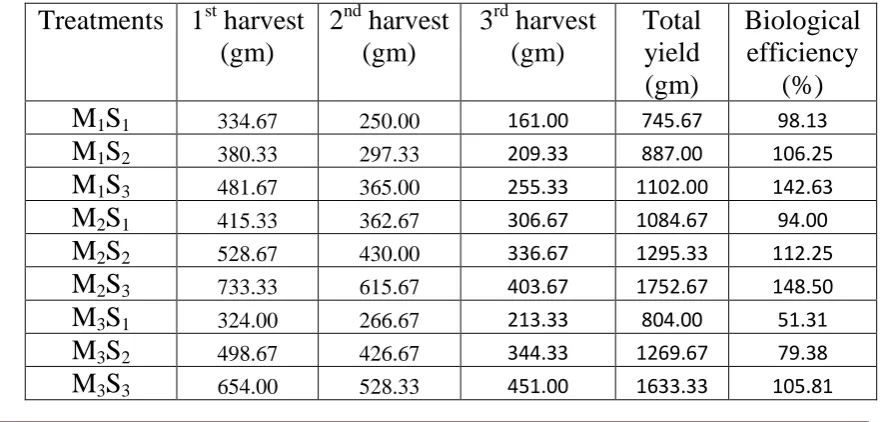
3.6. Total yield and biological efficiency of Mushroom
The treatment results (Table 2) reveal the yield, biological efficiency (B.E.) of
the P. sajor-caju.. Significantly maximum gram of yield of P. sajor-caju was
obtained when it was cultivated on 2 kg of paddy straw i.e. M2S3 (1752.67 ±
119.83) and M3S3 (1633.33 ± 119.83) which was at par with M2S3. The
maximum B.E., with 148.50 % was observed in M2S3 and M1S3 (142.63 %)
which was at par with M2S3, whereas lowest gram of yield was recorded in
M1S1 745.67 ± 119.83 which was followed by M3S1 (804.00 ± 119.83). The
lowest B.E., was observed in M3S1 (51.31 %), which was followed by M3S2
(79.38%)(Table 2). According to Chang and Miles (1982), BE of P. sajor-caju
can be increased to nearly 100% depending on the composition of the substrate.
These Pleurotus sajor-caju significantly on different amount of substrate with
different amount of spawn. Kibar and Peksen (2008) recorded effect of
temperature and light intensity on the development and yield of different
Pleurotus species. About similar result was found by Pandey et al., 2008 in their
experiment maximum yield of pleurotus sajorcaju (1733.60 g/bed) was recorded
on paddy straw(Table.1 and 2), which was at par with wheat straw (1627.49
g/bed)
Table 3: Nutritional content of Pleurotus sajor-caju
Sr. No. Parameter Content
1 Moisture (%) 7.7
2 Total soluble protein (%) 16.5
3 Nitrogen (%) 4.1
4 Total fat (%) 2.5
5 Total carbohydrate (%) 38.5
6 Reducing sugar (%) 23.5
8 Crude fiber (%) 11.9
9 Dietary fiber (%) 12.5
10 Ash (%) 4.7
11 β- carotene(µg/g). 0.35
3.7. Nutritional content
Moisture, total soluble protein, nitrogen, total fat, total carbohydrate, reducing
sugar, non reducing sugar, crude fiber, dietary fiber, ash, β- carotene content of
mature fruiting bodies of P.sajor-caju cultivated on paddy straw as substrate
are shown in Table 3. Moisture content of mature sundried sample of P.
Sajor-caju was (7.7%), total soluble protein (16.5%), Moisture, nitrogen (4.1%), total
fat(2.5 %), total carbohydrate (38.4 %), reducing sugar(23.5 %), non reducing
sugar (14.9 %), crude fiber (11.9 %), dietary fiber (12.5 %), The result of crude
fiber is similar with Arun et al., 2010., ash (4.7 %), β- carotene(0.35 µg/g).
Syred et al, (2003) also confirmed that protein content of mushroom is the
highest among vegetables. The observation made in their fibre content are
equally note worthy and stimulating as fibre content help to facilitate digestion
in man. (Onuoha,2007).The percentage fat content from the mushroom
produced by the substrates is an evident that mushrooms are low in fat and
cholesterol (Syred et al, 2003).
4. Conclusion
The present study shows cultivation of Pl. Sajor-caju generally depends on
different parameters like use of substrate, amount of substrate and spawn,
environmental conditions like maintenance of temperature and humidity during
cropping. As per this experiment it has been observed that use of spawn at
different rate of substrate yield and biological efficiency may be differing case
to case. By focusing on treatment combination of different amount of substrate
substrate and 150 gm of spawn proved to be highest yield and biological
efficiency. And M3S3 treatment which contain 4 kg of wet substrate and 150 gm
of spawn proved to be equally effective for successful cultivation of
Pl.sajor-caju mushroom.
References
1. B. O. Onyango, V.A Palapala, P. F. Arama, S. O. Wagai, B. M. Gichimu.
(2011)Suitability of selected supplemented substrates for cultivation of
Kenyan native wood ear mushrooms (Auricularia auricula), American
Journal of Food Technology, Vol.6, 395–403.
2. Bano Z. and Srivastava H.C. (1962). Studies on cultivation of Pleurotus
species on paddy straw. Food Sci. 12: 363- 365.
3. Bonatti M., Karnopp P., Soares H.M., and Furian S.A. (2004). Evaluation
of Pleurotus ostreatus and Pleurotus sajor-caju nutritional characteristics
when cultivated in different lignocellulosic wastes. Food Chem.
88(3):425-428.
4. Chang, S. T and P. G. Miles. 1982. Introduction to Mushroom Science.
In: S. T. Chang and T. H. Quimio (eds). Tropical Mushrooms: Biological
Nature and Cultivation methods. The Chinese University Press. 3-10.
5. Chang, S.T and Miles, P.G (1991). Cultivation of edible mushrooms.
Chung Chi, J. Hongkong. 4: 76-86.
6. Change, S.T. and Miles, P.G. (1989). Edible Mushroom and their
Cultivation, CRC Press, Boca Raton, Florida, U.S.A.
7. Cultivation of oyster mushroom, published by: Director, National center
for mushroom research and training, Chambaghat, solan-173 213,
8. Eira AF (2000) Cultivo de cogumelos (composta- gem, condução e
ambiente). In Reunião Itiner- ante de Fitossanidade do Instituto
Biológico. Mogi das Cruzes, SP, Brazil. Resumos. pp.71-81.
9. Jain A.K. and Vyas D. (2002). Yield response of P. florida on wheat
straw in combination with other substrates.
10. Jain, A.K. (2005). Studies on cultivation technology of Pleurotus species
and their marketing potential in Sagar region (Ph.D. thesis).
11. Jawad Ashraf, Muhammad Asif Ali, Waqas Ahmad, Chaudhry
Muhammad Ayyub, Jamil Shafi.(2013). Effect of Different Substrate
Supplements on Oyster Mushroom (Pleurotus spp.) Production , . Food
Science and Technology 1(3): 44-51, 2013 http://www.hrpub.org DOI:
10.13189/fst.2013.010302
12. Kibar B., Pekien, A. Modelling (2008). Modelling the Effects of
temperature and light intensity on the development and yield of different
Pleurotus species Agricultura Tropica ET Subtropica. 41: 68 -73.
13. M.I. Bhatti, M.M. Jiskani, K. H. Wagan, M.A. Pathan and M.R. Magsi,
(2007) Growth, development and yield of Oyster mushroom, Pleurotus
ostreatus (jacq.ex.fr.) kummer as affected by different spawn rates. Pak.
J. Bot., 39(7): 2685-2692,.
14. Onuoha C.I (2007): Cultivation of mushroom (Pleurotus tuber regium)
using some local substrates. Life science journal .Vol 4 (4):58-61.
15. Pandey A, Soccol CR, Nigam P, Brand D, Mohan R, Roussos S (2000)
Biotechnological potential of coffee pulp and coffee husk for
bioprocesses. Biochem. Eng. J. 6: 153-162.
16.Pandey R. K, I. B. Pandey, S. Jha.(2008). Performance of oyster
mushroom Plurotus sajor caju on different agricultural waste.
17. Patrabansh, S., and Madan, M. (1997). Studies on cultivation, biological
efficiency and chemical analysis of Pleurotus sajor-caju (Fr.) Singer on
different biowastes. Acta Biotechnologica. 17: 107-122.
18. Rai. R.D., S. Saxena, R.C. Upadhyay and H.S. Sohi. (1988). Comparative
nutritional values of various Pleurotus species grown under identical
conditions. Mush. J. Tropics. 8(3): 93-98.
19. S.T. Chang, P. G. Miles (2004), Mushrooms: Cultivation, Nutritional
Value, Medicinal Effect, and Environmental Impact (IInd edition), CRC
Press, New York,
20. Shauket Ahmed Pala, Abdul Hamid Wani and Riyaz Ahmed Mir. (2012).
Yield performance of Pleurotus sajor- caju on different agro-based
wastes. Annals of Biological Research, 3 (4):1938-1941
21. Syred, A.A., Kadam, J. A., Mane, V. P., Patil, S. S., and Baig, M. M.
(2003): Biological efficiency and nutritional contents of Pleurotus florida
(Mont.) Singer cultivated on different agro- wastes. Nature and Science
Journal.Vol 7(1): 44-48.
22. Zhang R, Xiujin L, Fadel JG (2002). Oyster mushroom cultivation with