2019 International Conference on Computer Science, Communications and Big Data (CSCBD 2019) ISBN: 978-1-60595-626-8
Small-Area Net-Migration Estimation Based on Census Data
Ran REN
1,*, Tomás KELLY
2and Jian HUANG
11University College Cork, Ireland 2Dawn Analytics Limited, Cork, Ireland
*Corresponding author
Keywords: Population projection, Migration estimation, Small-Area.
Abstract. Small-area population projections have applications in emergency planning, transport, commercial site selection and a variety of other areas. The population change of a small area is affected by both the regional economic-demographic influence and demographic processes births, deaths and migration in a complicated way. A number of models have been proposed for small-area population projections. However, the usage and accuracy of these models depend on the data available for analysis. Population change is the outcome of natural birth, death and migration. Hence, population projection can be decomposed to birth projection, death projection and migration projection. Birth projection, death projection can be carried out by using the age-gender specified death rates and age-specific fertility rates for higher level administrative areas (such as county level in Ireland). In this study we develop an empirical modelling approach for small-area migration estimation in Ireland using publicly-available Irish Census (2011 and 2016), death and mortality datasets from the Central Statistics Office (CSO), Ireland. Such estimation has potential applications in small-area population projections.
Introduction
Population change is directly affected by births, deaths and migration and the change of these three components is influenced by some economic elements. Small-area population projections have applications in emergency planning, transport, commercial site collection and a variety of other areas. In this study, “small area” refers to the smallest geographical unit for which census data is available for in Ireland. The overall population and total number of households in each small area vary, however they were designed to have approximately 100 households per unit. Population projections down to this level of geography are subject to a variety of challenges, such as the lack of small-area data available on deaths, births and migration.
Migration is the result of a very complicated set of social circumstances. It means a group of people migrate from one place to another place and their settlements changed. Migration plays an important role in the transformation of economic and social structures in most countries. Migration is not only the output of globalization, but also the communication of immigrant places and emigrant places. It can rapidly affect the economic situation, culture, state politics and population structure of one region. People's intention to migrate can be influenced by many factors. Migration estimation is a branch of demography which:
1) provides suggestions for economic development and management decisions. The majority of social activities are associated with producing and consuming, thus, connected with population and decisions such as choosing the optimum location for shopping mall;
2) provides suggestions for political decision making, such as planning the location for new schools, hospitals and even landscape programmes;
population-related phenomena at play differ significantly. Projections at lower spatial levels could prove useful for many detailed planning purposes.
This paper develops and validates a migration estimation model at small area level in Ireland by using publicly-available census, birth and death datasets from the CSO. The paper contains four sections, this introduction (Section 1), the methodology (Section 2), preliminary modelling results (Section 3) and a concluding discussion (Section 4).
Method
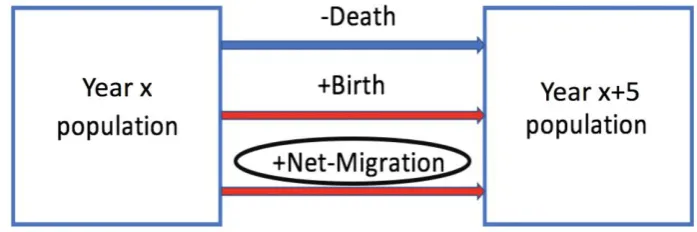
[image:2.595.121.470.226.342.2]Population change is decomposed to birth, death and migration, their relationship can be expressed as the following:
Figure 1. Diagram of birth, death, net-migration and population.
The age and gender structure affects the migration estimates. For example, a man over 80 years old may has a small probability of migrating. If estimates evaluated this cohort using the average migration, it would result in an over-estimation. Furthermore, this age-cohort (80+) is problematic in the census of population is conducted every 5 years in Ireland. Consequently, the age cohorts are divided into gender specific 5-years-old intervals, which are called age-gender specific groups in this study. All calculations are based on a 5-year interval here.
The Migration Estimation Model
In this study, cohort-component analysis [1] is used under a certain set of assumptions. The calculations in this analysis are straightforward and the model can be interpreted in a natural way. An additional benefit of cohort-component analysis is that it is not restricted to estimating the age-gender-specific population. It can also be used to estimate factors influencing population structure, such as births, deaths and net-migration and so on.
Since the migration model is based on 2011 and 2016 census data, it can be described by following equations:
𝑀𝑥,2011,𝑐𝑔 = { 𝑁𝑥,2016,𝑐
𝑔 − 𝐵
2011,𝑐𝑔 + 𝐷𝑥,2011,𝑐𝑔 , 𝑥 = 0
𝑁𝑥+5,2016,𝑐𝑔 − 𝑁𝑥,2011,𝑐𝑔 + 𝐷𝑥,2011,𝑐𝑔 , 𝑥 = 5,10, ⋯ ,80 (1) The variables 𝑁𝑥,2011,𝑐𝑔 and 𝑁𝑥,2016,𝑐𝑔 are the population in small area 𝑐 of gender 𝑔, age 𝑥 at year 2011 and 2016 respectively. 𝐵2011,𝑐𝑔 is the births number of gender 𝑔 in small area 𝑐 between year 2011~2016. 𝐷𝑥,2011,𝑐𝑔 is the number of deaths of gender 𝑔 and age x in small area 𝑐 between year 2011~2016. Whereas 𝑀𝑥,2011,𝑐𝑔 is the migration number of gender 𝑔 and age x in small area 𝑐 between year 2011~2016.
Estimating Number of Births and Deaths
General fertility rate (GFR) is used to calculate the number of birth at each age-specific female group. The births calculation formula is shown as:
𝐵2011,𝑐𝑔 = ∑44𝑥=20𝑁𝑥,2011,𝑐𝑔 × 𝑓𝑥× 𝑟 (3)
where,
𝑓𝑥= 𝐵0
𝐹20~44× 1000 , (4)
where 𝑟 is the gender ratio and 𝑓𝑥 is the age-specific fertility rate of women at child-bearing age (20~44 years old). 𝐵0 is the number of infants born (aged 0). 𝐹20~44 is the number of women at age 20~44. Here we used 20~44 years old as the child-bearing age instead of usually 15~49 years old, because women aged between 20~44 years contribute around 99% births recent years, such approach will not have noticeable effect on estimation of the fertility rate while it reducing the influence that women age structure brings and makes the calculation much easier.
Data Resources
The main data sources used in this study are: 2011 and 2016 census data, birth data and mortality rate data all of which are originally provided by Central Statistics Office (CSO), Ireland.
The age-specific mortality rates are classified by age group, sex and year. The births data are classified by area of residence, year and age group of mothers. The raw census data for 2011 and 2016 data has age-gender-specific groups, an ID number to identify small areas (NID), the name of the county the small areas is contained within and some other useful information. As mentioned above, the net-migration model deals with aggregations of people within small areas (not individuals), therefore small areas boundaries file of Ireland is needed. Here we use the boundary shapefile “Census_2011_Admin_Counties_generalised20m [2]”, which can be downloaded as an open-source file from the CSO website.
Mapping calculated net-migration comes up with three steps: First, transfer the shapefile into a data frame in R (an open source application). Second, aggregate and merge net-migration data to 2011 boundaries data with county name as the join key. Finally, we can plot the migration data on Ireland map.
Results
The proposed migration model is applied to each of 18000 small areas in Ireland. Net-migration estimates are aggregated to county level and cross-validated with county level net-migration estimates available from Ireland’s CSO and displayed on a map of Ireland at county-level spatial scale.
Figure 2 illustrates the spatial distribution of female net-migration for the 5~9 age cohort. Positive net-migration (red) represents moving in, negative net-migration (blue) represents moving out. Fingal and South Dublin have the lowest net-migration estimates. Significant amounts of this cohort move out from these counties. However, Dun Laoghaire Rathdown has the highest positive net-migration. The big cities have people move out while their neighbouring small towns have people move in. It is evident in Figure 3 that Louth has the highest rates of net inward-migration for the 5~9-year-old male cohort. Also, there is a lot of population losing in Cork in Figure 4. Dublin and Cork are the two biggest cities which are located in the mid-east and South of Ireland respectively. They are large centres of population with greater working opportunities than other places in Ireland.
Figure 2. Estimated net-migration number of 5~9 years old female.
[image:4.595.130.445.381.700.2]Figure 4. Estimated net-migration number of 45~49 years old male.
Discussion
Using data from the 2011 and 2016 Censuses, net-migration estimates for a wide-range of gender specified age groups were calculated for the 18000 small areas groups in Ireland. For presentation purposes, these estimates were aggregated to the county level. The maps shown in Figure 2, 3 and 4 only present a small segment of estimates obtained. Migration changes always have a degree of uncertainty, therefore other datasets such as GP registration and mobile record data are required to validate estimations.
Population projection or net-migration estimations should take into account both quantitative and qualitative factors since they are determined by diverse factors such as the economic situation, national culture and so on. Net-migration estimation is always based on certain assumptions, so there are some risks in politicians making decisions on the basis of estimated net-migrations.
Small-area population projection or net-migration can provide much more precise and potentially more accurate population estimates even though it has some risks. It truly provides a lot of helps when the politicians planning proposals, merchants choosing the best location of shops etc. It prevents unnecessary resource wasting and improves efficiency and quality of decision making. In the era of big data, small area population projection will attract more and more research.
References
[1] Hansen, H.S.: Small-area population projections—a key element in knowledge based e-Governance. In: Andersen, K.N., Francesconi, E., Grönlund, Å., van Engers, T.M. (eds.) EGOVIS 2010. LNCS, vol. 6267, pp. 32–46. Springer, Heidelberg (2010).