CHEATING: STUDENT ATTITUDES AND PRACTICAL APPROACHES TO
DEALING WITH IT
Trevor S. Harding
11 Trevor S. Harding, Kettering University, Manufacturing Engineering Program, Flint, MI 48504-4898 [email protected]
Abstract – The preliminary results of educational research conducted at Kettering University is described in which students in an introductory Engineering Materials course (MFGE-370) were asked to complete a survey on their perceptions of cheating. The overall objective of the research was to determine those things students believed constituted cheating, the frequency to which they cheat and their attitudes about what steps could be taken to curtail cheating within a course. Practical approaches to effectively dealing with cheating are also discussed including using learning objectives for writing fair tests, promoting group work through cooperative learning teams, holding review sessions before tests and building a good rapport with students. Data were gathered from 65 students in two offerings of the course.
Index Terms –cheating, cooperative learning,engineering education
I
NTRODUCTIONCheating, whether we like it or not, is a wide spread problem in engineering classes. In one study, as many as 56% of a graduating engineering class reported having cheated while in school [1]. The author believes that students do not inherently want to cheat. Rather, the pressures of obtaining good grades and the limited time students have to complete assignments and study for tests makes them feel that they too must cheat if they are to keep up with other students. This is especially true if they believe other students are cheating and the course is graded on a curve. This paper is based on the tenet that it is better to find ways to help students avoid the temptation to cheat, than to focus on correcting the problem after it has already occurred.
This paper presents the early results of a survey on cheating offered to students in an Engineering Materials (MFGE-370) course at Kettering University, a private, primarily engineering undergraduate institution. The goal of the Engineering Materials course is for students to understand the basic structure -processing-property relationship for metals, polymers, ceramics and composites. The course emphasizes active hands-on learning with an extensive laboratory experience in the belief that this is the most common preferred learning style among engineering students. The course is currently required for all mechanical engineering and manufacturing engineering students resulting in an annual enrollment of 200 – 240 students.
Information regarding student attitudes about what constitutes cheating and the frequency with which they cheat is presented. In addition, the author discusses teaching techniques used in the course to reduce the likelihood of cheating among students. It is the belief of the author that helping students to avoid the temptation to cheat will foster greater ethical responsibility after graduation as students begin their engineering careers.
A
SSESSMENTM
ETHODOLOGYThe primary assessment goals were to measure student perceptions of what constitutes cheating, the frequency of cheating and student attitudes about what actions might reduce cheating in a class. In particular, this last data set was used to develop teaching strategies to reduce the lure of cheating. Data were gathered from students in two different offerings of the Engineering Materials course (MFGE-370). The course was offered during the Spring 2000 quarter and the Summer 2000 quarter.
Students were asked to complete a survey at the start of each term. All student responses to the survey were anonymous. Students in the Spring 2000 term were given the survey in paper format. Students in the Summer 2000 term were asked to complete the survey in a web-based format. Survey data was compiled and analyzed using analysis of variance (ANOVA) where appropriate. Statistical significance is defined at p≤0.05, indicating a less than 5% chance for acceptance of the null hypothesis.
R
ESULTS ANDD
ISCUSSIONStudent Demographics
A total of 65 students, approximately 2.8% of the University student population, responded to the survey. In the Spring term, 26 students responded to the survey out of a total population of 27 students (96.3% response rate) enrolled in the class. At the time of this paper, 39 of the 53 students enrolled during the Summer term have responded to the survey (73.5% response rate).
Spring term would, on average, be more socialized to the academic environment. The average reported grade point average for the study population was 87 (roughly equivalent to a 3.0 on a 4-point scale). A similar value was reported for both study groups indicating equal academic ability. SAT scores were not available to provide a more standardized indicator for academic ability.
TABLE I
CLASS YEAR OF STUDY POPULATION BY COURSE OFFERING Spring
2000
Summer 2000
Both Groups
Seniors 31% 5% 15%
Juniors 65% 87% 78%
Sophomores 4% 5% 5%
Freshmen 0% 2% 2%
The gender and ethnic distributions were also similar for both gro ups of the study. Of the total study population, 76% of respondents were male, 24% female. The ethnic distribution of the study group was 86% Caucasian, 6% African American, 4.5% Asian American and 3.5% foreign students or “other”.
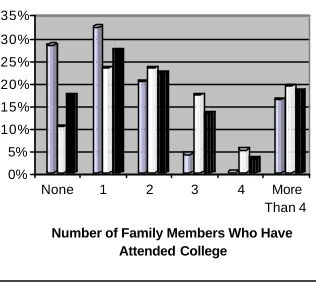
Students were also asked to report on how many closely related family members had attended college. It was felt that students from a family with a strong history of collegiate study might have different attitudes about cheating. Closely related family members were defined as parents (or guardians), siblings and grandparents. Figure 1 shows the distribution of family members who have attended college for each study group and the total study population. Students in the Spring term appear to have marginally less exposure within their families to higher education (p=0.08), although the number of students who were the first to attend college in their family was less than 30%. Students in this category might have less acculturation to higher education; although, one could equally argue that they might be more highly motivated to succeed, and therefore avoid any appearance of impropriety.
Student Perceptions of What Constitutes Cheating
It is often assumed what the term “cheating” means. But when asked, faculty usually do not have a working definition. Rather they respond with an “I’ll know it when I see it” attitude. And any definition that a faculty member does have is often very different from those of students. To understand the challenges involved in reducing student cheating, we must determine what is and what is not perceived as cheating by students. As a part of this survey, students in both study groups were asked to respond whether they felt that each of thirteen different scenarios represented cheating. Students in the Summer term were also asked to state whether they had found themselves involved in any of
these scenarios. The results of this portion of the survey are shown in Table II.
0% 5% 10% 15% 20% 25% 30% 35%
None 1 2 3 4 More
Than 4
Number of Family Members Who Have Attended College
Spring 2000 Summer 2000 Total Population
FIGURE. 1
NUMBER OF FAMILY MEMBERS WHO HAVE ATTENDED COLLEGE BY PERCENTAGE OF STUDENTS IN BOTH STUDY
GROUPS
Interestingly, the top five scenarios that students felt most strongly constituted cheating were related to tests: • Looking at another student’s test,
• Passing an answer to another student during a t est, • Bringing an unapproved cheat sheet to a test,
• Changing answers on a test that was already graded and asking for more points, and
• Having someone else take a test for you.
Over 90% of the respondents in the study felt that each of these scenarios could be considered cheating. This is compared to those scenarios related to homework that received fewer “yes” votes. The difference is apparent from Table II, but is not statistically significant based on the standards established in this study (p=0.116). This suggests that students may take cheating on tests more seriously than homework, though the data is inconclusive. This phenomenon may be related to heavy student workloads. Students might think of cheating on homework as a reasonable, though perhaps not ethical, method of managing their time outside of the classroom. This is supported by the large number of students who admitted to having copied another student’s homework (74%), copying passages from a textbook for homework assignments (62%) and sharing answers with friends in a difficult class (51%).
be attributable to one of two factors: either an intentional effort by several students in this particular course to throw off the results of the survey (the same 5 students responded that each of the above was not cheating) or a misunderstanding of the survey directions. There does not appear to be any alternative explanation given the information available about the respondents. All were Caucasian males with a wide range of academic ability. All were juniors, so the greater seniority of the Spring term group does not appear to be a factor. Further, 4 of these 5 respondents had at least one family member who had attended college, making it unlikely that a lack of exposure to higher education could explain this result.
TABLE II
STUDENT RESPONSE TO “I WOULD CONSIDER CHEATING TO BE . . .” AND WHETHER STUDENTS IN THE SUMMER 2000 TERM FOUND THEMSELVES INVOLVED IN EACH SCENARIO
Scenario Yes No % Summer
2000 group Involved in a Scenario Looking at another student’s
test
97% 2% 36%
Passing an answer to another student during a test
92% 8% 20%
Bringing unapproved cheat sheets to a test
92% 8% 15%
Changing answers on a test that was already graded and asking for more points
91% 9% 0%
Having someone else take a test for you
91% 9% 0%
Copying another student’s homework
86% 14% 74%
Storing information for a test in a calculator or PDA
74% 26% 14%
Copying old homework assignments
72% 28% 18%
Sharing answers with friends in a very difficult class just to get a passing grade
60% 40% 51%
Copying passages out of the textbook for homework assignments
37% 63% 62%
Witnessing cheating and not reporting it to the professor
31% 69% 79%
Working in a group on homework or lab reports
8% 92% 100%
Studying with other students for a test
8% 92% 100%
As a group students clearly felt that looking at another student’s test, passing answers during a test and bringing unapproved cheat sheets to tests was cheating. However, significant numbers of the Summer 2000 group admitted to
having been involved in these scenarios - 36%, 20% and 15% respectively. Similarly, students viewed copying each other’s homework as a form of cheating, but a large majority (74%) admitted to copying homework. This suggests that while students recognize cheating, there is a disconnect with their actual behavior. Again, the author does not believe that this is a result of intentional malicious behavior on the part of the students, but rather caused by the pressures of heavy courseloads. A large number of students also reported copying passages from the textbook for homework assignments (62%), which is probably an effort to save time.
Another observation can be made regarding storing information for a test in a calculator or personal digital assistant (PDA), the modern version of bringing unapproved cheat sheets to an exam. However, only 74% of students felt this was a valid form of cheating; whereas 92% felt bringing cheat sheets to an exam was cheating. It is not clear why this difference would exist, but it may point to a change in student attitudes toward the use of modern technology in education. Although at this point few students (14%) seem to actually bring information to tests stored on calculators or PDAs. More work is needed in this area, especially with the increasing use of web-based courses, distance learning and other technology in the college classroom.
The survey results suggest that students are unlikely to report incidences of cheating that they witness to the instructor of the course. Only 31% of respondents felt that this constituted cheating. Perhaps even wors e, nearly 80% of students had actually witnessed an instance of cheating and not reported it, whether they felt it was their responsibility or not. Identical results were obtained from both the Spring and Summer term groups and there appears to be no correlation with academic standing, grade point average, gender, ethnicity or number of family members who attended college (all values of p>0.05). A stigma has been attached to reporting instances of cheating since at least high school. The results of this survey suggest that students have not yet matured to the point where they appreciate the responsibility of engineers to report unethical behavior or decision making to their managers.
Finally, only 8% of students view working in groups on homework or studying in groups for tests as cheating. Further, a full 100% of students in the Summer term had worked or studied in groups. The author would tend to agree with the students, that working in groups is not cheating and may in fact improve learning.
Frequency of Cheating
assignment), this is equivalent to 1 test per year. However, when examining the Spring and Summer groups separately, it was found that students in the Spring term admitted to cheating on an average of 12.2% of their homework assignments. Those in the Summer term reported cheating on only 6.3% of assignments. This difference was found to be statistically significant (p=0.011). Students in the Spring term also reported cheating on four times as many tests per term than their Summer term counterparts (0.96 vs. 0.22) with a significance of p=0.009. One could speculate that the higher percentage of seniors in the Spring term might have led to a higher rate of cheating. At this time, insufficient data is available to examine this hypothesis.
Students were also asked whether their friends cheated more or less frequently than they did. When asked how often friends cheated on homework assignments the study population reported a value of 18.9% overall. In other words, students expect their friends to cheat more than twice as often as they do on homework (18.9% vs. 8.6%). There was a high degree of significance to this observation (p=0.00003). When asked directly whether their friends were more or less likely to cheat than they were, the results were overwhelming. Of all student respondents, 95% expected other students to cheat more often than they did. Unless all of these students have the same few friends in common that cheat excessively and yet the respondents do not consider each other friends, this situation is not possible. This suggests that students perceive themselves as being less likely to cheat, and perhaps more ethical, than other students are. The difference in results from the Spring and Summer term groups were statistically insignificant for these questions.
Methods of Reducing Student Cheating
Given that students cheat on an average of 1 test per term and on anywhere from 6-19% of homework assignments, it is in the interest of instructors to find innovative ways of reducing the enticement to cheat. In the last portion of the survey, students were asked to identify whether particular approaches used by the author might make them less likely to cheat. Students were asked to rate whether they agreed that a particular action would reduce student cheating on a scale of 1-5; 5 being strongly agree and 1 being strongly disagree. The results are shown in Table III. The author then discusses each scenario and practical suggestions for reducing cheating are offered.
Table III shows that students feel the most effective means of curtailing cheating, of the options available, is for faculty to write fair tests. This conclusion is supported by Wankat and Oreovicz [2] and McKeachie [3]. This does not mean that tests cannot be difficult. To the contrary they should be challenging, but not overwhelming. Students often complain about professors who write tests on material that was never covered in class or that are too long for the time given. This may be a particularly important
observation considering that students view cheating on tests as a very serious discretion. Therefore, signs of cheating may be a strong indication that the instructor is not preparing suitable examinations. To address this issue, the author has used learning objectives to help in constructing tests and assignments for the past two terms. Each topic in the course has a corresponding list of learning objectives. When constructing the test, the author selects several learning objectives deemed most important (the number varies with the length of the test) and writes the problems directly from these. All learning objectives are available to students on the course web page. In this way, students are aware of what is expected of them in the class up-front, rather than having to guess what the instructor might put on the exam. Since using learning objectives, there have been no complaints about unfair tests and no indications of student cheating on tests in the MFGE-370 course when taught by the author.
TABLE III
STUDENT RESPONSE TO “I WOULD BE LESS LIKELY TO CHEAT IF…”
Action Average
Rating*
Standard Deviation The instructor wrote fair tests 4.45 0.83 The instructor cared about my
learning
3.91 0.95
We were allowed to work in groups on homework
3.83 0.89
Tests were open-book or cheat sheets were allowed
3.72 1.11
The instructor held review sessions before tests
3.65 1.08
The instructor knew my name 3.55 1.09 The instructor made copies of the
old exams readily available
3.45 0.98
The instructor discussed ethics at the beginning of the term
3.12 0.94
* 5.0 = strongly agree, 4.0 = agree, 3.0 = neutral, 2.0 = disagree, 1.0 = strongly disagree
informal discussions and have even reported using the suggestions in other courses beyond MFGE-370.
Students also rated being allowed to work in groups on homework highly (rating of 3.83). Many faculty view allowing students to work in groups as a recipe for student cheating. However, as shown in Table II, 100% of student respondents reported working in groups on homework anyway, so the instructor might as well use it to his/her advantage. The author assigns students in MFGE-370 to formal cooperative learning groups at the beginning of the term [6]. These groups then work on weekly homework assignments. The author develops homework assignments at the upper levels of Bloom’s Taxonomy [7] to avoid making the problems too trivial for a group to work on. Many of these problems are design type problems, where the students are expected to define the problem, establish their assumptions and selection criteria, propose viable design options and select the most appropriate design.
The author also allows students in MFGE-370 to bring a single sheet of 8 1/2 in. x 11 in. paper to a test with any information they would like on the paper. This accomplishes two goals. The first is to reduce the chance that students will cheat during a test since they would have the necessary information in front of them. Students felt that having a cheat sheet would make cheating less likely (rating of 3.72). In addition, the act of putting a cheat sheet together reinforces student learning by forcing students to work through their course notes and synthesize the most important information. Students can use the learning objectives to reduce the amount of information they must review and then determine what material should go onto their cheat sheets. This helps them to use their study time more efficiently and requires them to re-write their notes – a good method for improving knowledge retention. The use of cheat sheets also allows tests to be written with more emphasis on the upper levels of Bloom’s Taxonomy (i.e. analysis, synthesis and evaluation).
In addition to the approaches described above, the author conducts a review session before each test (rating of 3.65). Attendance at these reviews is typically in the range of 80% of students enrolled in the class, especially after the first test. At these review sessions, the author discusses problems derived from the learning objectives. Students work in groups to solve these problems. Students are then randomly chosen from each group to answer the problem and pose a solution. This forces the members of the group to depend on one another – every group member must understand the solution. This means that students with better understanding must explain the solution to students with less understanding, which, as it turns out, benefits both groups of students.
The author also makes every effort to learn each student’s name (rating of 3.55) and discusses cheating in terms of engineering ethics (rating of 3.12) at the beginning of each term. In fact, the survey discussed in the present paper is actually a means by which the author stresses to
students how seriously cheating will be taken in the course. The data obtained is secondary.
C
ONCLUSIONSSignificant progress has been made toward the project objectives. Student perceptions as to what constitutes cheating and the frequency with which they do cheat have been assessed. In addition, student attitudes about the effectiveness of various approaches to curtailing cheating have been examined. Students felt that cheating on tests was more serious compared to homework, which is probably a rationalization to justify cheating on homework as a time management tool. Also, a majority of students identified looking at another student’s test, passing answers during tests and copying another student’s homework assignment was clearly cheating. But relatively large numbers of students admitted to having cheated in these ways, suggesting a disconnect between what students consider cheating and their behavior. Students felt storing information on a calculator or PDA was a less serious form of cheating than bringing unapproved cheat sheets to an exam, suggesting some influence of modern technology on student attitudes.
When asked how often they cheat, students reported cheating on 8.6% of homework assignments and roughly 1 test per year. But respondents felt that other students cheated on homework twice as often. In fact, 95% of students felt that their friends were more likely to cheat than they were.
Respondents believed that they would be far less likely to cheat on tests if the professor wrote fair tests. The author found anecdotally that using learning objectives to construct tests and making these learning objectives available to students had a positive influence on student dissatisfaction with tests. Students also felt that having an instructor who cared about their learning and allowed them to work in groups would reduce cheating. The author discusses learning styles in class and uses cooperative learning groups as a way to help curtail cheating.
Future efforts of this research will look more closely at several interesting observations reported here. For example, a more in-depth study of the impact of modern technology of student’s attitudes toward cheating is planned. Also a more detailed analysis of the effect of class standing and family higher education background on attitudes toward cheating will also be undertaken.
R
EFERENCES[1] Todd-Mancillas, W.R. and Sisson, E., “Cheating Among Engineering Students: Some Suggested Solutions,” Engineering Education, 757, 1986. [2] Wankat, P.C. and Oreovicz, F.S., Teaching Engineering, New York: McGraw-Hill, 1993.
[3] McKeachie, W.J., Teaching Tips: Strategies, Research, and Theory for College and University Teachers, 9th Ed., Lexington, Massachusetts: D.C.
Heath and Company, 1994.
[4] Eble, K.E., The Craft of Teaching, 2nd Ed., San Francisco: Jossey-Bass, 1998.
[5] Richard Felder’s “Index of Learning Styles” can be obtained at http://www2.ncsu.edu/effective_teaching/
[6] Johnson, D.W. Johnson, R.T. and Smith, K.A., Active Learning: Cooperation in the College Classroom, 2nd Ed., Edina, MN: Interaction Book Co., 1998.