2018 International Conference on Computer, Communication and Network Technology (CCNT 2018) ISBN: 978-1-60595-561-2
Analysis and Research on "Co-benefits" of PPP Project in Slow-flowing
Water Pollution Control
Yi-han LUO
1,*and Xue-jiao PENG
21
Wuhan University of Technology (NanHu), China 430070 2
University of Mining & Technology (Beijing), China 100083 *
Corresponding author
Keywords: Slow Flow Water, Pollution Control, PPP Project, Internet Plus.
Abstract. Slow-flowing waters mostly refer to landscape water and lake wetlands. Both types of waters are closely related to human work and life. Recently, pollution has become increasingly serious. In order to more effectively manage this problem, government departments have introduced and vigorously developed the PPP model for management. The purpose of this paper is to discuss the difficulties faced by the actual operation of this model, and based on the development trend of the Internet, put forward a smart marketization plan which is based on the Internet plus to promote the development of the goal of co-benefits.
Introduction
Due to the irregular shape of the water and its own closure, the exchange capacity of the water is low, and the water will become slow to flow. The slow flow type of water can be roughly divided into two types: landscape water and lake wetland. This water area is closely related to people's living and working space. With the continuous development of industrialization and urbanization, the impact of human activities on slow-flowing waters has become increasingly acute, making the slow-flowing water ecosystem be an increasingly fragile ecosystem. Although China has introduced the PPP (Public Private Partnership) management model from developed countries, it has developed slowly, the system is incomplete, and related governance measures are relatively backward. There is a certain degree of interest from the PPP model in pursuit of common benefits.
Market Profie of Slow Flow Water Pollution Control
Unoptimistic Water Pollution and the Huge Potential Market
According to the report of national air and surface water environmental quality in 2016, the 112 key lakes (banks), 9 lakes (reservoirs) had class I water quality, accounting for 8.0%; 32 were class II, accounting for 28.6%; 36 Three were Class III, accounting for 32.1%; 19 were Class IV, accounting for 17.0%; five were Class V, accounting for 4.5%; 11 were worse than Class V, accounting for 9.8%. The 106 main lakes in the monitoring of nutritional status, 10 were oligotrophic, 76 were moderately nutritious, 15 were lightly eutrophic, and 5 were moderately eutrophic. In conclusion, the situation of water pollution is not optimistic. At the same time, the location of the water area is closely related to people's living environment, and the demand for repeated regular management is even greater.
The Development of Wastewater Market Promoted By National Favorable Policies
promotion of the treatment of wastewater depth, the demand for upgrading and renovating existing wastewater treatment facilities has increased.
Analysis of PPP Project Predicament
Negative Externality Risks of Wastewater
With the development of society and the improvement of living quality, people have higher and higher requirements for the ecological environment. However, wastewater projects may cause secondary pollution due to chemicals. The wastewater plant does not perform due diligence to discharge waste water to nearby residential areas in order to achieve the short-term interests as soon as possible. The excessive use of noise will affect the nearby residents and make them subjectively unsuitable. What’s more, there is a potential negative external effects such as danger.
The Lack of Sense of Participation from Neighboring Residents Leads to a Crisis of Confidence
Wastewater treatment, especially the treatment of sewage water areas near landscaped areas and residential areas, has not been closely integrated with regional development. It has not carried out multi-processing plan analysis and social stability assessment according to the principles of community resources and satisfaction of all parties. The lack of information disclosure and public participation in the process of project construction, environmental assessment and feasibility study, etc. did not solicit public opinions from neighboring residents. After the project was finalized, the closed decision-making model neglected the pursuit of rights and interests of residents in the vicinity of the stakeholders, causing residents to distrust.
Conflict Management Between BOT Mode And PPP Mode
Both PPP and BOT (Build Operation Transfer) are the financing management methods adopted when government finances are underinvested in infrastructure. In the past, wastewater plants always used the BOT mode of operation. Land was provided by the government. The enterprises carried out real estate construction and operations. The revenue from wastewater fees was transferred to enterprises according to the amount of wastewater on schedule. Several years later, that the land and ground attachments are not repaid to the government, and that the wastewater plant does not need to pay land use tax and pay property tax. There are many application cases of BOT operation mode, and the mode is more mature. The PPP model establishes cooperation and exchanges between the public sector and enterprises, pursues benefit sharing, and shares risks. It requires long-term in-depth cooperation. However, there are few application cases, relevant systems are not perfect, and management risks are relatively large. Compared with the BOT, Most places, especially second and third tier cities, are more likely to choose the BOT model than the PPP model.
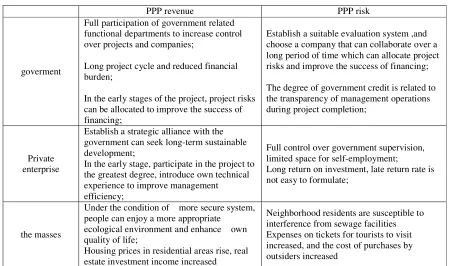
Multi-partyRevenue and Risk Allocation Structure Can Easily Lead to Conflicts of Interest
Table 1. Revenue and risk.
PPP revenue PPP risk
goverment
Full participation of government related functional departments to increase control over projects and companies;
Long project cycle and reduced financial burden;
In the early stages of the project, project risks can be allocated to improve the success of financing;
Establish a suitable evaluation system ,and choose a company that can collaborate over a long period of time which can allocate project risks and improve the success of financing;
The degree of government credit is related to the transparency of management operations during project completion;
Private enterprise
Establish a strategic alliance with the government can seek long-term sustainable development;
In the early stage, participate in the project to the greatest degree, introduce own technical experience to improve management efficiency;
Full control over government supervision, limited space for self-employment;
Long return on investment, late return rate is not easy to formulate;
the masses
Under the condition of more secure system, people can enjoy a more appropriate
ecological environment and enhance own quality of life;
Housing prices in residential areas rise, real estate investment income increased
Neighborhood residents are susceptible to interference from sewage facilities Expenses on tickets for tourists to visit increased, and the cost of purchases by outsiders increased
Proposes a PPP-friendly Internet Plus Intelligence Marketing Solution
Enhance the Level of Intelligence in Wastewater Treatment, Save Labor Costs and Reduce the Risk of Secondary Pollution
Under the background of the Internet plus, the level of technology has developed and production management methods have been continuously intelligent. The government should lead the integration of manufacturing and the Internet, reduce the way such as manual shipboard decontamination, and reduce labor costs. The trend is to require wastewater treatment plants to use the mobile Internet and cloud computing to promote the green transformation of production methods, and to promote the precise coordination of R&D design, raw material supply, processing and manufacturing, and product sales. Accelerate the formation of enterprise intelligence environment data awareness system, and develop large-scale personalized customization, network collaborative manufacturing, and remote operation and maintenance services. Every effort has been made to reduce noise pollution, leakage of chemicals, and secondary pollution during wastewater.
Strengthen the Construction of Information Networks and Improve the Technical Support System for the Coordinated Management of Slow-Flowing Water Pollution
Encourage Green Development and Increase Energy Efficiency
The Internet and Greentech Energy Technology Expo was announced. Encourage enterprises to use green and low-carbon energy, increase the efficiency of resource utilization, eliminate outdated equipment processes, develop new technologies to participate in the exhibition, and actively promote sharing through the live broadcast platform technology on the Internet. The government actively leads the green development of the industry, promotes enterprises to reduce costs and increase efficiency, and enhances the core competitiveness of the manufacturing industry. Vigorously promote the green and low-carbon transition of industrial energy consumption structure, encourage enterprises to develop and utilize renewable energy, and provide appropriate economic subsidies. Water pollution control companies should also develop green and use clean energy. At the same time, the publicity department of the government can conduct moral guidance to the public through the Internet, calling on the public to protect the environment, thereby reducing the frequency of repeated treatment of water pollution.
Establish a Smart Cloud Platform and Introduce Social Media to Share Wastewater Governance with the Public
To strengthen the credibility of government decisions and balance the interests of all parties, government must comprehensively and accurately implement the spirit of the Nineteenth Party Congress, give play to the important role of socialist deliberative democracy, and protect people’s right to information, participation, expression, and supervision. The government creates a smart cloud platform, and the public can check the bids and tenders, wastewater plans and wastewater progress. And if there is an unreasonable situation in it, the social masses can directly reflect the situation through the green channel on the Internet. After the government verifies the situation, it can be dealt with according to law and can give the people some compensation. On the one hand, social media is advocating the promotion of environmental protection and knowledge popularization to enhance the image of the government. On the other hand, it is also used as a third-party group in government and private enterprises to conduct supervision and evaluation. In this way, more decision-making powers will be handed over to the society to be played, social organizations will be responsible for them, and their social integration and interest expression capabilities will be enhanced.
Summary
Effectively implement the PPP project of slow-flowing water pollution control to land, seek the dynamic balance of benefits of multiple stakeholders, pursue the maximization of the entire social benefits, and truly achieve the goal of win-win and common benefit. Guided by Xi Jinping’s socialist ideology with Chinese characteristics in a new era, fully and accurately implement the spirit of the Party’s Nineteenth Congress, and resolutely fight the tough battles of preventing and resolving major risks and pollution prevention. The construction of slow-flowing water pollution as a key work can effectively protect Public security, promote the construction of ecological civilization, improve government management capabilities and strengthen urban planning and construction.
Literature References
[1]Yang, T, Long, R, Cui, X, Zhu, D & Chen, 'Application of the public–private partnership model to urban wastewater', Journal of Cleaner Production, (2017) vol. 142, pp. 1065-1074.
[3]Xu, YL, JFY Yeung and SH Jiang, 'Determining Appropriate Government Guarantees for Concession Contract: Lessons Learned from 10 PPP Projects in China' (2014) 18 International Journal of Strategic Property Management 356.