2018 2nd International Conference on Modeling, Simulation and Optimization Technologies and Applications (MSOTA 2018) ISBN: 978-1-60595-594-0
Energy Efficient Target Coverage in Wireless Visual Sensor Networks
Zhe-yuan XIONG*, Luo-na NIE, Ling CHENG, Hong-gang CHEN and Xiao-min XIONG
Department of Public Security Technology, Jiangxi Police Institute, Nanchang, China
*Corresponding author
Keywords: Wireless visual sensor networks, Target coverage, Energy efficient, Particle swarm optimization.
Abstract. For wireless visual sensor networks, due to high redundancy incurred, it is possible to both preserve energy and enhance coverage quality by first switching off some sensors and then adjusting the orientations of the remaining ones. In this paper, we propose a novel method to automatically configure WVSN in order to maximize coverage and network lifetime in indoor environments. Based on a suitable modeling of cameras and environment, the optimization procedure determines the most appropriate camera position and settings to fulfill a given coverage objective. To achieve this goal, we use a particle swarm optimizer with an appropriate fitness function that takes into account a number of concurrent metrics and constraints. Simulation results show that our proposed approach has greater energy efficiency and can extend the network lifetime, as compared with prior approaches.
Introduction
Wireless Video Sensor Networks (WVSN) provides opportunities to use large number of low-cost low-resolution wireless camera sensors for large-scale outdoor remote surveillance missions. The convenience of deployment and the capability to communicate via wireless links made WVSN attractive in many applications such as remote surveillance, habitat monitoring, intrusion detection, and object tracking.
In general, the position and orientation of nodes in a small and friendly environment are predetermined and well-ordered to optimize the placement of nodes. However, for a largescale sensor network, random deployment has been a viable choice for its easiness in operation and ability to rapidly form the coverage network. Moreover, in a hostile and dangerous environment (e.g., battlefield), it is not possible or feasible to deploy the cameras with accurate position and orientation.
Coverage is a key problem in WVSN: how can cameras select their Field-of-Views (FOV) to increase the amount and quality of information collected by the network. Coverage refers to the quality of service at the field of interest. Coverage estimation in a crowded heterogeneous VSN depends not only on the sensor related parameters and sensor deployment but also on the target related parameters and target distribution.
The settlement of coverage problems is the premise and foundation for performing surveillance tasks. According to different coverage scopes, such problems can be classified into the target (point) coverage, area coverage, and barrier coverage ones [1]. The goal of target coverage is to cover a number of discrete points, usually some physical objects. Area coverage aims to cover a whole designated area. Barrier coverage utilizes sensors to form an intrusion barrier that can detect if there is an intruder being traversing across a specified surveillance area [2]. The target coverage problem is the basic one in WSN, which focuses on how to satisfy coverage requirements of targets and send the sensed data to a base station.
interested in minimizing the overlap between multiple FOVs. In this paper we propose a new method for PTZ camera network planning that addresses the above issues in order to provide a flexible and reliable instrument for camera deployment and setup. The objective is to automatically determine the number, position and pant-tilt-zoom setting of a set of video cameras to optimize the coverage of a given environment.
Most of the methods mentioned before are implemented centrally and need a central coordinator. Although centralized algorithms provide more accurate and near to global optima solutions, they increase the computational complexity and delay, especially when there are too many sensors and widespread environments. Hence, in recent studies, the distributed algorithms to solve the sensor coverage problem have received considerable attention.
Related Works
In PTZ wireless visual sensor network, by leveraging on the PTZ capability, one of the most important applications is real-time object tracking. PTZ camera networks with extended coverage via PTZ capability are good candidates in the application of real-time object tracking. Coverage problems for WVSN have been extensively studied. The objective of sensor coverage problems is to conserve energy usage by minimizing the number of active sensors. The selected sensors should form sufficient coverage of the intended region. When it comes to surveillance of large areas, such as parking lots, public areas, and large stores, the complete coverage of the area at all times is required. Various parameters have been considered by different solutions in the literature, including energy efficiency and bandwidth allocation issues.
The target coverage problem in directional sensor networks (DSN) was first raised by Ai and Abouzeid [3]. The authors formulated the problem as maximum coverage with minimum sensors (MCMS) and proved that it is NP-complete. Then, several heuristic methods were proposed to solve it. The above algorithm was implemented via the three methods of centralized greedy algorithm (CGA), distributed greedy algorithm (DGA), and distributed with priority of sensors with most residual energy. The centralized force-directed algorithm (CFA) and distributed force-directed algorithm (DFA) are alternative to CGA and DGA, respectively, as proposed in [4]. However, [4] does not address the issue of rotating cameras in real time.
In most of studies devoted to target coverage in rotatable directional sensor networks, the suitable sector for supplying the maximum coverage rate is chosen from a fixed and predefined set of sectors. For example, if the angle of view for a sensor is 90 degrees, four sectors can be defined. Reference [5] removes this limitation and adjusts the direction of sensors based on the location of targets to improve the coverage rate. Yen et al. [6] simultaneously addressed the problem of target coverage and network lifetime. Each sensor based on game theory autonomously decides on the on/off status so that the set of active sensors meets different coverage requirements for each target.
Many works have been done so far on how to use energy efficiently in VSN. All of these works have been conducted through different approaches, e.g., distributed power management scheme [7], energy conservation by avoiding redundant data, and deployment strategy [8]. Each type of these approaches has their strengths and limitations. In most of the existing VSN energy management works, the proposed deployment strategies guaranteed the increase in network lifetime.
Problem Formulation and System Model
coverage of the camera is modeled as the 2D circle from the 3D sphere where the radius of the circle is the camera’s focal range times sin (q/2) which q is the camera’s span angle.
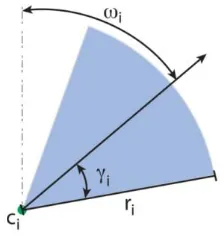
[image:3.595.241.353.187.308.2]In this paper, we adopt the first type of camera planar coverage model where the camera’s coverage zone is modeled as a 2D sector with the camera’s focal range being the radius of the sector and the camera’s span angle being the central angle of the sector. We consider the problem of geometric coverage maximization of a given area A with a set of cameras C = {c1, c2, ..., cn}. Each of these cameras has a given FOV fi defined by an angle ωi, giving the orientation of the camera relative to a fixed position, its range ri, and the angle of the FOV γi. This is illustrated in Figure I.
Figure 1. FOV of a camera sensor.
We decompose the scheduling problem into a number of independent coverage problems. Each corresponds to the formation of a cover set (CS) from active sensing sectors so that the full coverage can be obtained. Each sector can belong to several cover sets. The problem aims to find the largest number of cover sets under the following conditions:
Each target is covered by at least one sector.
There is at most one sector for each sensor in each cover set.
The residual energy of the active sensor in the cover set is not greater than a predefined threshold.
Energy Efficient Distributed Algorithm
The Quality of Service (QoS) Requirements
A video stream captured under favorable conditions will require less pre-processing and maximize the gathered information. When planning the camera configuration, several factors have to be taken into account in order to ensure visibility. For instance, one has to position the camera so that the sensor receives a sufficient amount of light, without being directly exposed to the light source. In order to assess the exposure, we can rely on the image histogram. In fact, over- or under-exposure, as well as low contrast, bias the histogram towards high or low intensity levels, or anyway limit its dynamics. A metric typically associated to the content and contrast of the captured image is the entropy, which is easily computed through the histogram.
For a given camera network configuration, we denote the image captured by the i-th of a set of N cameras as Ii, with i∈ {1, . . ., N}, and its normalized histogram as i(l), where l ∈ {1, . . ., L} are the L intensity levels. We then define the entropy of the i-th image as:
1
( ) - ( )log ( )
L
i i
l
H I W l W l
(1)where the normalized histogram bins are used as an estimate of the probability of the corresponding intensity levels in the i-th image. Within the optimization process, and to maximize the visibility associated to each camera, we will have to maximize the relevant image entropy in the virtual space. This is very important to ensure the independence of the optimization with respect to the local content of the image.
a portion of the observed real scene. This model makes it rather simple to detect the portion of the scene covered by a camera, as well as to track changes in the distribution of ray projections according to the relative changes in camera parameters.
The coverage of a camera will be optimal when the distribution of rays is maximally spread, so that the number of visible cells is maximum. Let be CHi the set of cells hit by camera i, and CS the whole set of cells in which the scene is subdivided, we can simply define the coverage metric Ci
associated to the i − th camera as the ratio of the cardinalities of the two sets:
( )
( )
( )
i i
S
card CH C I
crd C
(2)
Optimization Algorithm
Based on the system model, we have to solve an optimization problem that involves the estimation of 6 parameters for each camera in the system: the 3D spatial position coordinates in the environment (X,Y,Z), the pan and tilt angles, and the zoom. Due to the large number of variables involved and the complexity of the environment, this is rather a complex task. In fact, the solution space is characterized by a high dimensionality and a large number of local minima, thus making unsuitable the use of simple optimization approach such as gradient descent.
In order to solve this problem we adopted the particle swarm optimization (PSO), a well-known global optimization technique that is widely used in literature and has been already applied to camera planning problems, as well as coverage maximization in visual sensor networks [10]. PSO is a robust stochastic search technique modeled on the intelligence of swarms. It has demonstrated to be effective in solving complex non-linear multidimensional discontinuous problems in a variety of fields. Unlike other multiple-agent optimization procedures such as Genetic Algorithms (GA), PSO is based on the cooperation among the agents rather than their competition. With respect to GA, PSO shows three main advantages:
it has a lower algorithmic complexity, as it considers only a single operator connected to the particle speed;
it is easier to tune, due to the lower number of parameters;
it is more effective in preventing the stagnation of the optimization process.
In our implementation, the PSO receives in input the user requirements and constraints in terms of coverage, quality, number and nature of sensors, and provides as output the optimal configuration of the camera network. Furthermore, the optimizer exchanges at each iteration the configuration data with the simulation module, that in turn simulates the virtual coverage, allowing the metrics computation module calculate the cost function associated to the configuration.
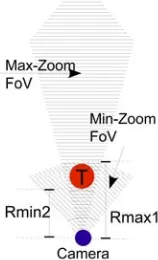
[image:4.595.257.336.648.778.2]In order to project the current solution in the virtual space, the simulation module uses appropriate models for cameras, illumination and environment. In order to keep the complexity low, models are rather essential. For the camera we adopt the classic pinhole camera model, where the rays (whose number is equal to the image pixels) are projected from the camera center onto the surface plane. The orientation of the image plane is defined by the pan and tilt of the camera (Fig. II).
The overall implementation of the optimization process is sketched as follows.
In the initialization phase, the algorithm loads scene description, number of cameras and camera parameters. Then, it randomly initializes the swarm and the initial camera configuration. For each camera location the algorithm determines automatically the admissible pan-tilt ranges with respect to the environment.
Once the current solution is projected into the virtual space, a metric computation module is launched to calculate the quality parameters defined in Section IV-A. Based on those parameters, the algorithm calculates the fitness of the current solution.
Finally, the fitness is input to the PSO engine, which determines the motion of the particles on the swarm and then the new configurations to try. The process is then iterated until the termination criterion is reached. At this point, the algorithm terminates by returning the best configuration found across iterations, and the relevant fitness.
Performance Evaluations
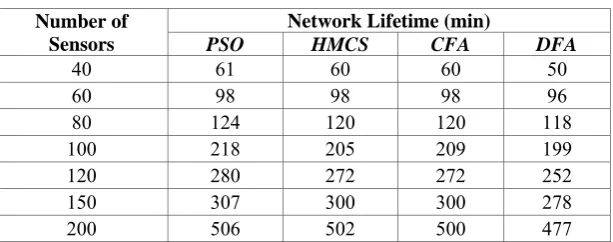
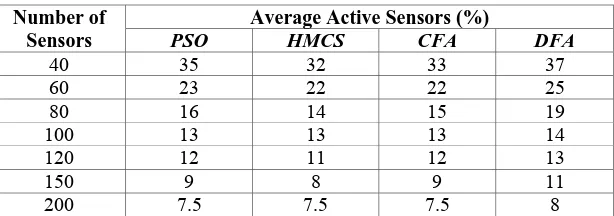
In this section, we evaluate the performance of the proposed method. The most important metrics of efficiency are the network lifetime, followed by communication cost and convergence time of the algorithm. The network lifetime is defined as the time duration when a network initiates its mission until the remaining (live) sensors cannot cover all of the targets. For simplicity, we assume that the energy consumption by sensors is linear; that is, 20 units of energy per minute for sensing activity. The energy consumed for other activities like data communication, wake to sleep transition, and vice versa is assumed negligible. We also assume that each sensor during its activity in each cover set consumes 20% of its initial energy for monitoring, and then it goes into sleep (r = 0.2). The communication cost depends on the number of messages received by each node to acquire the information needed for algorithm. Convergence time is related to the number of algorithm iterations. Algorithms were simulated on MATLAB. N sensors and m targets were randomly and uniformly deployed in a two-dimensional 500 m × 500 m area. Sensing range is 100m, communication range is 200m, and the angle of view is 90o. The proposed optimization algorithm (PSO) is compared to Heuristic algorithm for the Maximum Cover Sets (HMCS) [11] and also CFA and DFA. The performance of the proposed and benchmark methods was compared based on different number of nodes (from 40 to 200) which were scattered in a 500 m × 500 m area. The number of targets is 5. Each experiment was executed 10 times on the random deployment of the nodes and targets. The average of the obtained results is reported, as well.
Table 1. Comparison of network lifetime.
Number of Sensors
Network Lifetime (min)
PSO HMCS CFA DFA
40 61 60 60 50
60 98 98 98 96
80 124 120 120 118
100 218 205 209 199
120 280 272 272 252
150 307 300 300 278
[image:5.595.146.453.542.663.2]200 506 502 500 477
Table 2. The ratio of active sensors.
Number of Sensors
Average Active Sensors (%)
PSO HMCS CFA DFA
40 35 32 33 37
60 23 22 22 25
80 16 14 15 19
100 13 13 13 14 120 12 11 12 13 150 9 8 9 11 200 7.5 7.5 7.5 8
Table II shows the ratio of active nodes (the number of active sensors divided by the total number of deployed sensors) as a function of the number of deployed nodes. It is clear that deploying more sensors leads to a decrease in the ratio of active nodes. According to the results shown in this figure, the ratio of active nodes in PGDL is lower than the other distributed heuristic algorithm; i.e., DFA, in most cases and is close to that of CFA and HMCS as the network density increased. This indicates that our proposed method activates fewer sensors in each cover set to conserve energy of sensors. Consequently, PGDL can hopefully prolong the network lifetime.
Conclusion
This paper presented a novel approach to target coverage in WVSN. The problem has been formulated as an optimization problem and solved through a PSO algorithm. The fitness function to be optimized includes a set of metrics that take into account both the coverage and the quality of acquired video sequences, in terms of content and distortion. The performance of our proposed algorithm was evaluated via simulations and compared to the existing centralized and distributed greedy-based heuristics. The experimental results showed that our proposed algorithm could reach nearly optimal solutions and was superior to the heuristics under comparison in terms of network lifetime.
Acknowledgment
This work was supported by Key Research and Development Program of Jiangxi Province (20161BBG70040), Science and Technology Project of Jiangxi Department of Education (GJJ171058, GJJ161171, GJJ161169, GJJ151188, GJJ151195), General projects of Humanities and Social Sciences in Jiangxi Universities (JC162010), the Opening Project of Collaborative Innovation Center for Economics crime investigation and prevention technology, Jiangxi Province.
References
[1] D. Tao and T.-Y. Wu, “A survey on barrier coverage problem in directional sensor networks,” IEEE Sensor J., vol. 15, no. 2, pp. 876–885, Feb. 2015.
[2] B Shahrokhzadeh,M Dehghan, “A Distributed Game-Theoretic Approach for Target Coverage in Visual Sensor Networks” IEEE Sensors Journal , 2017 , PP (99) :7542-7552.
[3] X. Deng, B. Wang, W. Liu, and L. T. Yang, “Sensor scheduling for multi-modal confident information coverage in sensor networks,” IEEE Trans. Parallel Distrib. Syst., vol. 26, no. 3, pp. 902–913, Mar. 2015.
[4] V. P. Munishwar and N. B. Abu-Ghazaleh, “Coverage algorithms for visual sensor networks,” ACM Trans. Sensor Netw., vol. 9, no. 4, p. 45, 2013.
[6] L.-H. Yen, C.-M. Lin, and V. Leung, “Distributed lifetime-maximized target coverage game,” ACM Trans. Sens. Netw., vol. 9, no. 4, p. 46, 2013.
[7] B. Dieber, C. Micheloni, and B. Rinner, “Resource-aware coverage and task assignment in visual sensor networks,” IEEE Trans. Circuits Syst. Video Technol., vol. 21, no. 10, pp. 1424–1437, Oct. 2011.
[8] H. Li, V. Pandit, and D. P. Agrawal, “Gaussian distributed deployment of relay nodes for wireless visual sensor networks,” in Proc. IEEE Global Commun. Conf. (GLOBECOM), Dec. 2012, pp. 5374–5379.
[9] Dieber, B.; Micheloni, C.; Rinner, B. Resource-aware coverage and task assignment in visual sensor networks. IEEE Trans. Circuits Syst. Video Technol. 2011, 21, 1424–1437.
[10]Y. Morsly, N. Aouf, M. S. Djouadi, and M. Richardson, “Particle swarm optimization inspired probability algorithm for optimal camera network placement,” IEEE Sensors J., vol. 12, no. 5, pp. 1402–1412, May 2012.