2019 International Conference on Computer Intelligent Systems and Network Remote Control (CISNRC 2019) ISBN: 978-1-60595-651-0
Multi-time Window Automatic First-arrival
Picking Method
Zhi-hua Tian, Bin Xie, Yong Pan, Ning-bo Wang, Hao Cheng and Uermaimaiti.Wumaierjiang
ABSTRACT
The sensitivity of energy ratio method varies with the size of time window. We propose a multi-time window energy boundary detection method which improves the picking accuracy for data with a low-to-medium signal to noise ratio (SNR). The multi-time window algorithm effectively improves the system reliability of the energy ratio method. Through the distribution of characteristic values in different time windows, the picking results of low signal-to-noise ratio data can be effectively deleted. Then, a small-step fitting algorithm is applied to the remaining first-arrival characteristic values to obtain the final characteristic value evaluation. Based on the retained first-arrival characteristic values, the missing values were assigned by interpolation, then map the result on the original record and finally, first-arrival picking was completed by using a small time window. We test the performance of each module to prove the validity of the proposed methods. Finally, we design and develop auto-picking system, and the application shows that the accuracy of picking up can meet the needs of production.
KEYWORDS
First-arrival picking, Energy ratio method, System reliability, Interpolation, Multi-time window.
INTRODUCTION
Manual first-arrival picking may be of quality but of low efficiency, and using a computer to automatically and accurately pick the first-arrival of a seismic signal is an “ultimate goal”. The quality of first-arrival pickup provides a basis for static correction and subsequent data processing. Scholars have proposed different ways to pick up first-arrival. Based on the similarity of adjacent seismic traces, Peraldi and Clement(1979) proposed that when using the cross-correlation of adjacent traces to obtain the time lag between first-arrival onset and the peak, this method was less effective when there was a large difference in the waveform between adjacent seismic traces or when there was an abandoned trace[1]. Coppens (1985) was the first to propose the “energy ratio method”, which uses the ratio between the signal energy in one cycle and the energy of the entire time window as the criterion for determining the first arrival[2]. Based on the difference in amplitudes, polarizations and statistical characteristics between environmental noises and seismic signals, Tan et al. (2014) _________________________________________
used the SLPEA algorithm for picking first arrivals of microseismic signals[3]. An et al. (2015) proposed combining ultra-virtual interferometry for ground-scattered waves with traditional ultra-virtual interferometry for refracted waves to enhance first arrivals[4]. Rodrigo Chi-Durán et al. (2017) explored the application of Fourier transform and fractal techniques in automatic first-arrival picking[5]. These existing methods show certain advantages in automatic first-arrival picking yet also have applicability issues. The main issue is that these methods did not perform up to expectation in the automatic picking of first arrivals of low energy levels and low SNR.
THEORY AND METHOD
The energy ratio and energy ratio related improvements in the first pick up process achieved good results. The single-channel boundary detection algorithm, has good noise immunity, the calculation is:
Si |(B/A)(BA)| (1)
Where
p i n
i p
p
S
B ,
p i n
i p
p
S
A represents the sum of the amplitudes of n
points before the current point in the same trace and B represents the sum of the
amplitudes of n points after the current point in the same trace. Si is the
boundary eigenvalue of the ith sample point. In this algorithm, the value of time
window n is vital for the picking result. The sensitivity of different time
windows to seismic data is obviously different. Large time windows can highlight the overall characteristics of data, and small time windows can describe details more accurately.
In the case of good signal-to-noise ratio, the location of larger eigenvalues picked up by different time windows has little difference. In this case, the result of automatic pickup has high reliability. For data with low signal-to-noise ratio, the location and size of eigenvalues of different time windows is so different that it is difficult to accurately pick up the first arrival. For this situation, signal annihilate in noise, it is difficult to accurately pick up the first break eigenvalues no matter what time window is used, so it should be eliminated. However, according to the distribution of eigenvalues calculated by different time windows, the classification of high or low confidence of the eigenvalues can be well achieved.
After experimental testing, we propose to use a multi-time window single-trace energy boundary detection formula to obtain the characteristic value of first arrivals, as well as to eliminate the interference of noises. The calculation is as follows:
max ( / ) ( )
k k k k k
X B A B A
(2)
( )
k k
I pos X (3)
1+ +2
ceil max( ) min( ) ( )
0 , max( ) min( )
K
k k
k k
I I I
I I w
pos final K
I I w
In these expressions, k is the sequential window number, nk is the time window size, i is the current point; The definitions of A and B are the same as
formula (1); Xkis the maximum characteristic value once calculated using the
kth time window; pos X( k) is the position of Xk in the corresponding trace, and
ceil indicates rounding of values; pos final( ) is the final first-arrival position, which is the average position of all previous positions if the difference between characteristic values obtained using different time windows does not exceed w ms; otherwise, if the difference is greater than w ms, the first arrival is marked as abnormal. After a large number of tests with real data, we concluded that the value of w can be determined by means of the wavelet of the recorded first-arrival wave, so that generally half of the wavelet length can be taken as w. For example, if the frequency of the first-arrival wave is 50 Hz and the length of its wavelet is approximately 20 ms, then the value of w is 10 ms.
SYSTEM RELIABILITY ANALYSIS
For this type of algorithm, the choice of the time window plays a crucial role in the picking result. A large time window embraces the general characteristics of the signal, while a small time window provides a more accurate description of the details.
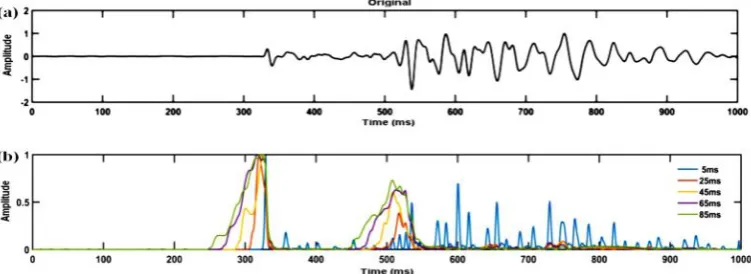
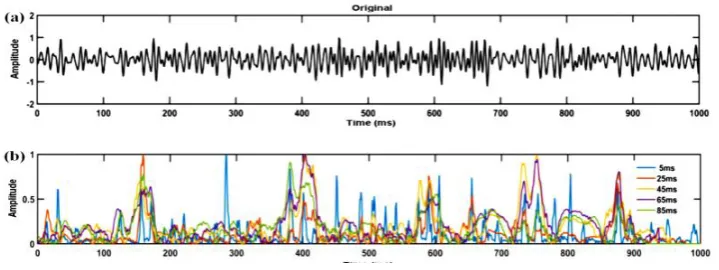
[image:3.595.100.476.522.659.2]Figure 1(a) shows a real seismic trace with high SNR, increasingly large time windows (25 ms, 45 ms, 65 ms and 85 ms) are used. The results (Figure 1(b)) reveal that the characteristic values appear basically in the same place, the results of the automatic first-arrival picking are highly reliable. On the contrary, when dealing with low SNR seismic signal (Figure 2(a)), the result is no longer satisfactory because the location and the magnitude of the characteristic values vary with time window greatly (Figure 2(b)). It is difficult to determine the first arrival accurately regardless of the size of the time window or the type of judgement criterion that is used in the actual processing. In fact, the first arrival is buried in noise and cannot be picked accurately.
Figure 2. First-arrival characteristic values calculated from a real seismic trace with very low SNR (a) using increasingly large time windows of 5 ms, 25 ms, 45 ms, 65 ms and 85 ms (b).
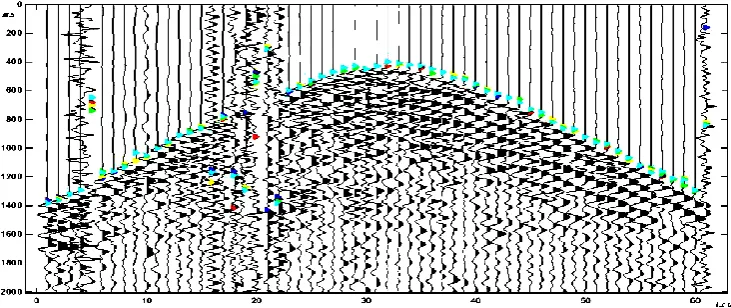
[image:4.595.104.473.442.610.2]Figure 3 shows the actual seismograms. Figure 4 shows the first break determined by different time windows and mapped directly to the original seismograms. The time windows are 10ms, 20ms, 30ms, 40ms and 50ms respectively. Figure 4 it can be seen that there is a huge difference in the first break position determined by different time windows at a noisy location. Figure 5 shows the first break mapping results obtained from the multi-time window single-channel energy boundary detection method. The first break zero is the first-anomaly channel. Comparing Figure 4 and Figure 5, the first-arrival pick-up results show that the multi-time window single-pass energy boundary detection method can well overcome the effect of low signal-to-noise first break on the pick-up result and eliminate the abnormal first break point. The culled first arrivals can be picked up again using the methods described later in this article, resulting in the pick-up result shown in Figure 6.
Figure 4. Using single-time window to obtain the eigenvalue.
Figure 5. Using multi-time window to obtain the eigenvalue.
Figure 6. Final pick results from Figure 3.
CONCLUSIONS
manual time window width settings. The improved method has good system stability.
ACKNOWLEDGMENTS
This work is supported by Open Projects Fund of the State Key Laboratory of Oil and Gas Reservoir Geology and Exploitation (PLN201733), Open Projects Fund of the Natural Gas Geology Key Laboratory of Sichuan Province (2015trqdz03), National Natural Science Foundation of China (NSFC 41674095).
REFERENCES
1. Peradi, R., Clement, A., Digital processing of refraction data Study of first arrival. Geophysical Prospecting, Vol. 20, No. 3, pp. 529-548. March 1979.
2. Coppens, F., First arrival picking on common-offset traces collections for automatic estimation of static corrections. Geophysical Prospecting, Vol. 33, No. 8, pp. 1212-1231, August 1985.
3. Tan Y, He C, Yu J, et al., A combined method for automatic microseismic event detection and arrival picking. Seg Technical Program Expanded. pp. 2335-2340, October 2014.
4. A Sheng-Pei, Hu Tian-Yue, Cui Yong-Fu, et al., Auto-pick first breaks with complex ray paths for undulate surface conditions. Applied Geophysics, Vol. 12, No. 1, pp.93-100, January 2015.