2019 International Conference on Computer Intelligent Systems and Network Remote Control (CISNRC 2019) ISBN: 978-1-60595-651-0
A Coding System Based on GS1
Xuanyu Zhou, Chuanwu Zhang, Liancheng Du,Yong Hu, Ruihua Xie and Xujie Fan
ABSTRACT
GS1 code is a global commodity bar code developed by the International Article Code Association (EAN) and the Uniform Code Council (UCC). It has been widely used in commercial storage logistics, product tracing, and production automation. The basic-level organization of ethnic agriculture and animal husbandry products are relatively lagging behind the product suppliers in other developed regions in China. The basic-level organization of national agricultural and animal husbandry products lags behind the product suppliers in other developed areas. In the process of product traceability, it is more difficult to build an independent traceability system independently, but only in the form of product alliance. The project uses GS1 code as the carrier to form a product alliance for the basic-level organization of ethnic agriculture and animal husbandry products, trace the source code of product alliances, realize product traceability at a lower cost, establish a product credit system, and promote economic development in ethnic areas.
KEYWORDS
GS1 Coding, Internet of Things, Traceability, Agricultural, Livestock Products.
INTRODUCTION
Food is the most important substance to maintain human survival and development. Food-borne diseases have always been an important threat to human health in both developing and developed countries. Paying attention to food safety means paying attention to our present and future. In recent years, people are most concerned about the quality and safety of agricultural products. The important means to ensure the safety of agricultural products is the implementation of traceability of agricultural products, so planning and designing a more scientific, reasonable and feasible coding system of traceability of agricultural products is of vital importance.[1] In 2003, China Goods Coding Center took the opportunity of “Barcode Promotion Project” to promote the application of food traceability system in China.[2] At present, the Ministry of Commerce of the People's Republic of China has established a significant product traceability system, and conduct pilot _________________________________________
Xuanyu Zhou, Chuanwu Zhang, Liancheng Du ,Yong Hu, Ruihua Xie, Xujie Fan
demonstrations in the circulation of meat dishes, the traceability of Chinese herbal medicines, and the traceability of liquor circulation. With the development of science and technology, people's requirements for food safety have also increased. Food packaging bar code and traceability system play an increasingly important role in people's lives. Counterfeiting products and abusing labels lead to less credibility for traceability system in China recently.[3] In particular, counterfeit and inferior products are particularly harmful to agricultural and animal husbandry products with Chinese national characteristics.
Therefore, the main objective of this project is to provide a traceable coding system based on GS1 coding for national agricultural and animal husbandry products. At present, traceability coding and traceability systems are common in the traceability of a single brand company to its subordinate products from breeding, production and processing to warehousing, logistics, sales and other life cycle, in order to establish the reputation system of enterprises and their products and promote the development of the industry. However, agricultural and animal husbandry products in minority areas have the characteristics of characteristics, decentralization and collaboration. Few enterprises can form a complete product chain. Therefore, agricultural and animal husbandry products in minority areas are more suitable for establishing cooperatives such as enterprise alliances based on various organizations, institutions and enterprises. The origin of this is to breed, produce and process the products into warehouses formed by different enterprises in enterprise alliances.
In the supply chain of storage logistics, sales and other products, appropriate coding is given to form a logical chain, which can be mapped to traceable coding according to the risk link in the entity, and then from traceable coding logic to entity link, thus forming a complete traceable logic.
Therefore, this project has the characteristics of simple operation, fast, efficient, safe and reliable. It is conducive to promoting the popularization and application of coding technology. The rest of this paper is organized as follow, this paper introduces the related work involved in this project, as well as the design of database and the implementation of traceability.
RELATED WORK
With the improvement of the physical supply and demand industry chain of the system, a systematic information chain emerged.
From the perspective of information transmission, there may be noise (man-made or natural) that interferes with information transmission in the channel, resulting in information obtained in the next stage of the transmission channel being less than or equal to the amount of information in the upper level.
The ideal government-regulated supply and demand transaction should be to guarantee the maximum amount of information in an industry activity under the limited price limit.
According to the theory of information transmission, reducing the information transmission link can reduce information loss.
Therefore, from the perspective of the supply chain of industrial entities, the abstraction of the minimization of industrial links is the most beneficial to the maintenance of information in the system.
With the coding identifier as the core, the association between the two nodes in the industrial chain is realized by arrows in the form of arrows.
Reuse the Internet of Things technology to encode, identify, transmit, and query the information collected by the associated nodes, realize the entire life cycle of the national agricultural and animal products, and disclose the information of each link chain to realize the industrial chain of the national agricultural and animal products. Monitoring and control, thereby promoting the healthy development of the national agricultural and animal products industry.
PROPOSED SYSTEM
[image:3.612.181.414.528.621.2]This project starts from the design of information system based on the Internet of Things. System controllability is the primary goal of information system design. The implementation of controllability needs to be supported by testability first. Therefore, the design of information system based on the Internet of Things becomes the basic criterion of system design. In the circulation system of national agricultural and animal husbandry products, the competent government departments are involved. Circulation enterprises (including planting and breeding enterprises, production enterprises, sales enterprises, etc.) and consumers of agricultural and animal husbandry products are three main types. Among them, the competent government department is the main body of industry supervision, which has the function of quality inspection and supervision of the whole industry. These three functions are part of the platform system, which largely determines the controllability of the system platform. An ideal government-regulated supply-demand transaction should maximize the symmetry of transaction information. From the perspective of the complete industrial chain of supply and demand of national agricultural and animal husbandry products, the logical relationship is shown in Figure 1.
Figure 1. Industrial chain of national husbandry products.
supervision in the national agricultural and animal husbandry products industry, such as quality monitoring. Based on comprehensive analysis, traceability coding information should include the following aspects:
Regional/quality monitoring: quality is the core element of national agricultural and animal husbandry products, so a sound quality monitoring system is the core element of the development of national agricultural and animal husbandry products industry; as the quality monitoring agencies generally belong to the basic functions of the government, the quality monitoring information includes administrative territorial information.
plot/grower: each administrative region includes multiple plantations, the number of plantations is determined by the minimum capacity from the economic point of view and the planned planting area. Land with similar natural environment (altitude, climate, etc.), belonging to the same operator and for the same purpose can be classified into a unified plot. Because the plot and the operator are related, the plot information coding also identifies the planter information.
Varieties of Agricultural and Animal Husbandry Products: Since there are many agricultural and animal husbandry products in ethnic areas, especially different special agricultural and animal husbandry products in different areas, the identification code of agricultural and animal husbandry products is needed.
Planting batches/provenances: The coding of batches is determined according to the maturity period of timber and the recognition of planting period. The coding of planting batches can also be used as the index value of provenance information, that is, by binding the provenance information to the planting batches, the purpose of coding of planting batches and provenances can be achieved.
Production Processing: Production Processing includes Processor, Processing Workshop, Product Sequence Number and Related Attribute Information.
Product Sequence Number: A label for a day's production of farm and animal husbandry products in a workshop.
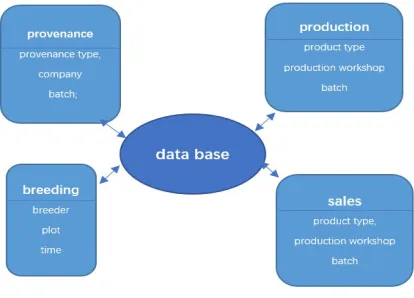
[image:4.612.199.406.481.630.2]The coding scheme of this project is determined from two aspects of product coding requirement and coding efficiency. In the database of this project, we set up the following tables:
Figure 2. Data base.
Principle" means mapping monitoring points with similar attributes to the same coding to improve coding efficiency. Following the above principles, according to the characteristics of the national agricultural and animal husbandry product industry chain, three links are selected as the main node of coding, namely, "(seed source), planting, processing and marketing (including transportation), (user)". Each main node further clarifies the secondary information nodes within the main node according to the actual situation. Traceability is first traced back by the main node (sales-processing-planting). There are two ways to encode traceable information: direct encoding and index code, which means that the encoding can be decoded directly into encoding information, while index code refers to the encoding as the index value of information, which can be used to query the network database to obtain relevant information. In the coding of the Internet of Things, direct coding and index coding are usually combined.
Among them, in the provenance link, the data table should reflect the information of provenance type, company and batch; in the breeding link, the data table should reflect the information of breeder, plot and time; in the production link, the information reflected in the data table should include the information of product type, production workshop and batch; in the sales link, the data table should reflect the information of product type, production workshop and batch. Warehousing logistics, sales companies and other information; the above data tables are integrated into a database composed of information is mutually constrained, the information appearing in one table must be the same information in another table, otherwise it cannot be written. The above database can ensure that every link in the whole product supply chain can be traceable, thus improving the reliability of products and the credibility of national agricultural and animal husbandry products.
EXPERIMENT AND RESULTS
CONFIGURATION ENVIRONMENT
This project involves writing EAN coding rules and building databases. Therefore, in this project, the programming languages used is the SQL language and the Java language. The database version used is MySQL 5.6 and the graphical interface software is NAVICAT. Operating system is based on dual-core 8G Wind10 systems.
RESULT AND DEMONSTRATION
Table I Growers Table
TABLE I. GROWERS TABLE.
TABLE II. PRODUCT TABLE.
Table II. Product Table
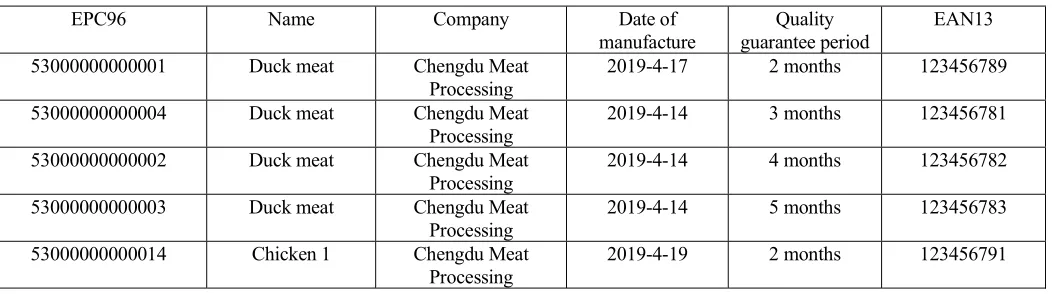
[image:6.612.78.517.505.648.2]Product Table: In this Table, the contents include the EPC96 coding, name, company name, date of manufacture, Quality guarantee period and EAN coding, As shown in Table II.
TABLE III. COMPANY TABLE. Serial
number
Plant products Production Address Name
3211 Mainly engaged in corn, soybean,
cabbage and other products 5 tons Sichuan Dalian Aba prefecture, cooperative Aba agricultural 4211 Mainly for livestock breeding,
such as cows, plateau yak, goats, chickens and ducks and others
10000
head of livestock Sichuan Dalian Liangshan Farm
4220 Engaged in animal husbandry Mianyang City
Animal Husbandry farm
EPC96 Name Company Date of
manufacture guarantee period Quality EAN13 53000000000001 Duck meat Chengdu Meat
Processing 2019-4-17 2 months 123456789
53000000000004 Duck meat Chengdu Meat Processing
2019-4-14 3 months 123456781 53000000000002 Duck meat Chengdu Meat
Processing 2019-4-14 4 months 123456782
53000000000003 Duck meat Chengdu Meat
Processing 2019-4-14 5 months 123456783
53000000000014 Chicken 1 Chengdu Meat
Processing 2019-4-19 2 months 123456791
EPC96 Name Company Quality guarantee period EAN13
53000000000001 Duck meat Chengdu Meat Processing 2 months 123456789 53000000000004 Duck meat Chengdu Meat Processing 3 months 123456781 53000000000002 Duck meat Chengdu Meat Processing 4 months 123456782 53000000000003 Duck meat Chengdu Meat Processing 5 months 123456783 53000000000014 Chicken 1 Chengdu Meat Processing 2 months 123456791
Table III. Company table
1. Zhang Shun, Li Shao-Bo, Huang Hai-Song, Tang Xiang-hong “The research and application of laoganma enterprise internet of RFID tag coding scheme based on EPC GID-96”.
2. Zhang Mei, "Analysis and Comparison of Traceability Systems of Agricultural Products Logistics in the United States and Japan". in World Agriculture, vol. IV, 2014, pp. 136-141.
3. Tonglan and Hu Qiuguang, 'Comparison of Traceability Systems of Quality and Safety of Agricultural Products between China and Foreign Countries', management and management. 2012(11): 95-98.
CONCLUSION
GS1 coding has been widely used in warehousing logistics, product traceability, production automation and other fields. Based on the EPC96 code of GS1, this project traces the source of the code from seed source, breeding, raw material trading, production and processing, sales to all aspects of customers. According to the characteristics of agricultural and animal husbandry products in minority areas, helping Chinese minority areas to establish their own product mechanism can fundamentally help national agricultural and animal husbandry enterprises to establish their own traceability mechanism, which can be mapped to traceability code according to the risk link appearing in the entity, and then from traceability code to entity link.
Complete the whole traceability mechanism to solve the problem of counterfeit and inferior products flooding the market and product reputation. To achieve product traceability at a lower cost, promote the economic development of China's ethnic minority areas, and meet the national demand for food safety.