2019 International Conference on Artificial Intelligence, Control and Automation Engineering (AICAE 2019) ISBN: 978-1-60595-643-5
Performances Comparison between Real-Time Auto-Tuning PID and
Conventional PID Controller for a Dairy Industrial Evaporation
Process Control
Qing-bo MENG, Hong-wei ZHANG
*and Martin HOWARTH
National Centre of Excellence for Food Engineering, Sheffield Hallam University, Sheffield, S1 1WB, United Kingdom
*Corresponding author
Keywords: Three-effect falling film evaporator, Modeling, Conventional PID control, Auto-tuning PID control, Simulation.
Abstract. In this study, an industrial milk evaporation process is introduced and a mathematical model of a multi-effect falling film evaporator is developed using MATLAB/Simulink to evaluate the performance of the controller. A real-time closed-loop auto-tuning PID controller is presented as a candidate control strategy for the evaporation process. The simulation results controlled by auto-tuning and conventional PID are compared and discussed and the performance improvement by the auto-tuning PID controller is illustrated.
Introduction
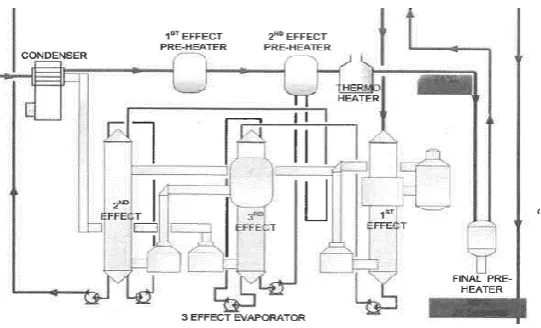
Evaporation in dairy industry is an essential process for concentrating milk, by evaporating excess water to achieve the desired concentration and to prepare for the subsequent spray drying operation. Additionally, evaporation, as an energy intensive process, can also help to reduce the energy cost in milk powder production/drying [1]. During the industrial evaporation process, the milk concentration (total solid content) is required to be evaporated from approximately 5-10% to 48-52% before feeding into the spray dryer. However, food production processes present great challenges to the engineers because it contains many characteristics which make the process particularly difficult to model and control. These characteristics include dynamic behavior that is non-linear and highly complex. In addition there are many key variables which are difficult to measure. Many advanced control theories and methods have been developed and applied to the food industrial manufacturing. For example, adaptive control, proportional–integral–derivative control (PID), robust control, predictive control, Multivariate Statistical Process Control (MSPC) and intelligent control. In this study, a conventional PID controller and an auto-tuning PID are developed and compared for a three-effect falling film evaporation process.
Figure 1. Three effects falling film evaporator.
This study is organized into four sections: section 2 describes the mathematical modelling details and the development of the Simulink model. Conventional PID and auto-tuning PID control strategies are presented in section 3. In the final section, 4, simulation results from both controllers are compared and discussed.
Mathematical Modelling of the Three Effect Falling Film Evaporator
The three-effect falling film evaporator includes:
(i) A separator, which separates the vapor and liquid phases when the evaporation process is taking place. The concentrated product forms a level at the base of the separator in order to avoid flow disturbances caused by the pump running dry.
The Separator Level (L) is calculated by equation (1) as described by Newell & Lee [6]:
𝑑𝐿 𝑑𝑡 =
1
𝜌𝐴 (𝐹1 − 𝐹2 − 𝐹4) (1) Where ρ is the liquid density, A is the cross-sectional area of the separator, and F1, F2, & F4 are the feed, product and vapor flowrates.
(ii) Heat exchanger, which is where the main evaporation process takes place. The water is heated and evaporated by contacting the outside tubes heated by the steam. Concentrated liquid drops down to the bottom of the effect.
The concentration of the liquid is determined by equation (2) in [6]:
𝑑𝑋2 𝑑𝑡 =
𝐹1 ∗ 𝑋1 − 𝐹2 ∗ 𝑋2
20 (2) Where X1 and X2 are the feed concentration and product concentration respectively.
(iii) A condenser, which removes the condensed vapor from the system.
(iv) A steam ejector, which provides hot steam to heat the liquid in the heat exchanger. The steam temperature (𝑇𝑠𝑡𝑒𝑎𝑚) is described by equation (3) in [6]:
𝑇𝑠𝑡𝑒𝑎𝑚 = 0.1538 ∗ 𝑃𝑠𝑡𝑒𝑎𝑚 + 90 (3) Where, 𝑃𝑠𝑡𝑒𝑎𝑚 is the steam pressure.
There are also four equations which determine the mass and energy balances on both feed and steam ejector process as follows [6]:
𝑑𝑀
𝑑𝑡 = 𝑀𝑖𝑛 − 𝑀𝑜𝑢𝑡 − 𝑀𝑣 (4)
𝑑(𝜌𝑠𝑉𝑠)
𝑑𝑡 = 𝜌𝑠∗𝑀𝑠𝑖𝑛
𝑣 −
𝜌𝑠∗𝑀𝑠𝑜𝑢𝑡
𝑣 (5)
𝑑𝑇
𝑑𝐻 𝑑𝑡 =
𝑀𝑠
𝑉𝑠 ∗ 𝐻1 + 𝑈 ∗ 𝐴 ∗ ∆𝑇 ∗ (𝑇𝑠 − 𝑇) − 𝑀𝑠
[image:3.595.169.429.128.198.2]𝑉𝑠 ∗ 𝐻0 ∗ 𝑉 ∗ 𝑄 (7) The key parameters are listed in the following Table 1.
Table 1. Main parameters of the falling film evaporator simulation.
Parameters Description Value
F1 Feed Flowrate 10[kg/min]
F2 Product Flowrate 2[kg/min]
X1 Feed concentration 5[%]
T1 Feed Temperature 40[°C]
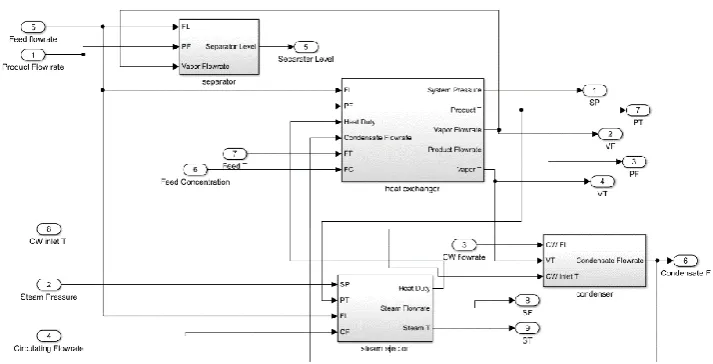
[image:3.595.67.525.338.495.2]In this study, the milk feed concentration is 5% and the desired final product concentration is 52%. Normally, the feed liquid product passes the pre-heater to reach the feed temperature before going into the first effect, but the pre-heater simulation is not considered in this study and the feed temperature is set as a constant with disturbances. Similarly, assuming that F1 and X1, are input parameters which have up to 20% disturbances because of the time delay and heat loss during the product flows from effect to effect. The three effects falling film evaporator simulation model, which is based on the mass and energy balance equations, is developed using MATLAB/ Simulink (Fig. 2). In each effect, the separator, heat exchanger, condenser and steam ejector are developed as a sub-systems (Fig. 3) according to equations Eq. 1 to Eq. 3 above.
Figure 2. Three effects falling film evaporator MATLAB/simulink model.
Figure 3. MATLAB/Simulink model of one effect.
Conventional PID Controller and Auto-Tuning PID Controller
[image:3.595.117.474.526.708.2]many industrial variables, including flowrate, pressure, temperature and level. The two main reasons that PID is commonly used are because of its robustness and ease of operation [8]. The conventional PID controllers are firstly designed to control the three-effect falling film evaporator. The set point is the target milk concentration, which is set to 52% in this study, after evaporating. The product concentration from third effect is treated as a closed-loop feedback signal to calculate the difference error. The PID controller is for product flow rate control in order to minimize the error difference between set point and concentration feedback. A PID controller is designed and tuned for each effect of the evaporator.
[image:4.595.101.483.229.381.2]The auto-tuning PID works by injecting a test signal to collect the system input and output data for estimating the frequency response (Fig. 4). After self-tuning, the controller calculates the updated PID gains according to the data and then replaces the initial PID values.
Figure 4. Schematic of Auto-tuning PID controller.
Simulation Results and Controller Performances Comparison
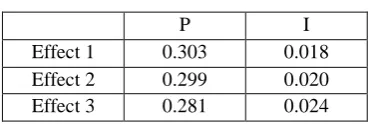
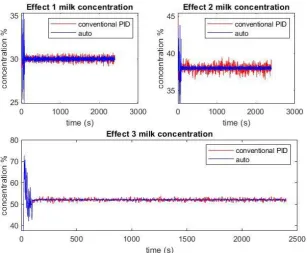
The three effect falling film evaporator for the industrial milk evaporation process mathematical model is developed by using MATLAB/Simulink. The desired milk solid content is evaporated from 5% to 52% in the three effects, where the first effect is from 5% to 30%, the second is from 30% to 38% and the third is from 38% to 52%. Running time for the evaporation process is 40 minutes. The simulation results and controllers performances are shown and compared below. The conventional PID values are listed in table 2.
Table 2. Conventional PID values
P I
Effect 1 0.303 0.018
Effect 2 0.299 0.020
Effect 3 0.281 0.024
[image:4.595.205.392.547.609.2]Figure 5. Simulation results of each effect.
Meanwhile, auto-tuning PID not only has better accuracy, but also better stability performance than the conventional PID. The increasing variance values controlled by conventional PID means that the more complex the plant is or the more effects the plant contains, the more difficult it is for the conventional PID to maintain its performances. On the contrary, the variance values controlled by auto-tuning PID are changing within a very limited range, which means that the auto-tuning PID is more suitable than a convention PID controller for a complex system.
Table 3. Variance values of each effect concentration output with the PID and Auto-tuning controller.
PID Auto-tuning
Effect 1 0.057 0.021
Effect 2 0.185 0.015
Effect 3 0.330 0.025
Conclusions
In this study, a three effect falling film evaporator for the milk industry is introduced. A mathematical model is developed and simulated using MATLAB/Simulink. Two different control strategies are applied in the model in order to achieve the control targets. The simulation results shows that the auto-tuning PID controllers work better on more complex system, and are also more accurate and stable than the conventional PID controllers. Further works need to be focused on other advanced control strategies, such as Model predictive control, Fuzzy logic control, or a combination of different control strategies, such as cascade PID, Fuzzy logic PID.
References
[1] Q. Ruan, H. Jiang, M. Nian, Z. Yan, Mathematical modeling and simulation of countercurrent multiple effect evaporation for fruit juice concentration, J. Food Eng. 146 (2015) 243-251.
[2] J.A. Winchester, C. Marsh, Dynamics and control of falling film evaporators with mechanical vapor recompression, Chemical Engineering. 77 (1999) 357-371.
[image:5.595.189.403.469.527.2][4] V. Miranda, R. Simpson, Modelling and simulation of an industrial multiple effect evaporator: tomato concentrate, J. of Food Eng. 66 (2005) 203-210.
[5] B. Medhat, M.A. Fanaei, H. Zohreie, Mathematical modelling and dynamic simulation of multi-effect falling-film evaporator for milk powder production, Mathematical and Computer Modelling of Dynamical Systems. 21 (2014) 1-23.
[6] R.B. Newell, P.L. Lee, Applied Process Control, A Case Study, New York: Prentice-Hall, 1989.
[7] M. Karimi, A. Jahanmiri, Nonlinear Modeling and Cascade Control Design for Multi Effect Falling Film Evaporators, Iranian J. of Chemical Eng. 3 (2006) 52-63.