2019 International Conference on Information Technology, Electrical and Electronic Engineering (ITEEE 2019) ISBN: 978-1-60595-606-0
Partial Discharge Pattern Recognition Based on Synchrosqueezing
Wavelet Transform and Multi-Scale Characteristic Parameters
Quan GU
1, Wen-bo WANG
1,2,3,*, Qi DI
1, Long QIAN
1,
Min YU
1and Yun-yu JIN
11School of Science, Wuhan University of Science and Technology, China Wuhan, 430065
2Hubei Province Key Laboratory of Intelligent Information Processing and Real-time Industrial
System, China Wuhan, 430065
3Key Laboratory of Digital Mapping and Land Information Application Engineering,
China Wuhan, 430072
*Corresponding author
Keywords: Synchronous squeezing wavelet transformer, Partial discharge, Multi-scale energy multi-scale sample entropy.
Abstract. Aiming at the high dimension of the characteristic of partial discharge and its high sensitivity to noise, firstly, the Synchrosqueezing wavelet transform is used to decompose the four typical partial discharge signals of transformers to overcome the defects of spectrum aliasing and energy leakage between real wavelet packet decomposition sub-bands.; Then, using the difference of energy and complexity of PD signals at different decomposition scales, the parameters of multi-scale energy and multi-scale energy spectrum entropy are used as the feature quantity of discharge type identification; Finally, the extracted features support vector machine classifier for discharge pattern recognition. Experimental results show, the proposed method can achieve better recognition than EMD and wavelet packet decomposition, and proves the effectiveness of the proposed method.
Introduction
Power transformer is one of the most critical equipment in power system, its safety performance affects the safe and effective operation of power grid [1].Partial discharge (Partial Discharge, PD)is the main reason for the insulation damage of power transformer and other large high-voltage equipment, and different types of partial discharge on the insulation damage to varying degrees, the formation mechanism is also different. Therefore, identifying different partial discharge types of transformers quickly and accurately not only provides a solid foundation for the subsequent identification of fault locations, but also has important guiding significance for maintaining the stable and effective operation of the power system [2].
Synchrosqueezing wavelet transform (SWT) is a new time-frequency analysis method based on wavelet transform. It is based on the continuous wavelet transform, and the wavelet coefficients are recombined to extract the time frequency curve. So it has extremely high precision and frequency resolution [3-6], seismic signal detection [7], sonar signal analysis [8] and mechanical fault diagnosis [9].In this paper, SWT is used to process UHF PD signals with typical defects of four kinds of GIS. From the difference of energy distribution and entropy distribution of UHF PD signal in time-frequency domain, the multi-scale characteristic parameters of different insulation defects can be effectively distinguished and achieve discharge type identification is implemented using support vector machine classifiers.
Synchrosqueezing Wavelet Transform
1 * 2 ( , ) ( ) ( ) f t b
W a b f t a dt
a
(1)In the formula:*is the conjugate of the parent wavelet function, a is the scale factor, b is
the translation factor. For any one of the "time-scale" points ( , )b a in wavelet transform results. The
instantaneous frequency f( , )a b of the signal can be estimated by the derivative of the wavelet
coefficient[5]. In the actual calculation, because a b, ,is discrete, supposing aiai1 ( a)i , the
Synchronous squeeze wavelet transform Tf(l, )b can be expressed as [4]
3 2 :| ( , ) | 2
( , ) ( , ) ( )
i f i l
f l a a b f i i i
T b
W a b a a(2)
We can assume that L tk( ) is a small interval in the center of the ridge line of f tk( ) in the time
frequency diagram, and reconstruction formula of f tk( )[5] is
1
( )
( ) Re[ ( , )( )]
k
k f l
l L t
f t C T t
(3)
Multi-scale Energy Statistics Distribution and SWT Energy Entropy Measure
Multi-scale Energy Statistics Distribution
For a given discrete UHF PD signal ( )f i , we assume that f ik( ) is the reconstructed component
after the decomposition of SWT. Now the energy mean and variance of the component signals are characteristic parameters. The calculation steps are as follows:
(1) Synchronizing f i( ) with the wavelet transform.
(2) Calculating the mean of the energy value of the component signal,
21
( ) /
N
k k
i
E f i N
.(3) Calculating the energy variance of the component signal, E ik( )(f ik( ))2 ,
2 1 1 [ ( ) ] 1 N
k k k
i
S E i E
N
SWT Energy Entropy Measure
Definition 1(SWT energy spectrum entropy, SESE): 2
( ) ( ( ))
k k
E i f i is the SWT spectrum of the
component signal f tk( ) at time i, Ek,minand Ek,maxdenote the minimum and maximum values of
the energy spectrum respectively. The interval (Ek,min,Ek,max)is divided into Hsub-intervals, and
the number of energy spectra falling in the h sub-intervals is N hk( ). Then define of the
Synchrosqueezing wavelet energy spectrum entropy is
( ) k( ) log[ k( )]
h
SESE k
p h p h(4)
Data Acquisition and Processing
Discharge Signal Acquisition
Table 1. Test condition of partial discharge models.
discharge type test voltage/kV number of samples
air gap discharge 10/15 250/250
along the surface discharge 15/20 250/250 needle plate discharge 10/15 250/250 suspension discharge 15/24 250/250
Feature Extraction
Morlet wavelet is selected as the wavelet basis, and the UHF PD signals of the four kinds of defects are extracted by synchronous squeezing.
1 2 3 4 5 6 7 8 9 10
0 0.2 0.4 0.6 0.8
P1 P2 P3 P4
[image:3.595.110.471.220.391.2]Sub-band number
Figure 1. The 95% confidence interval of the multi-scale energy parameters.
Sub-band number
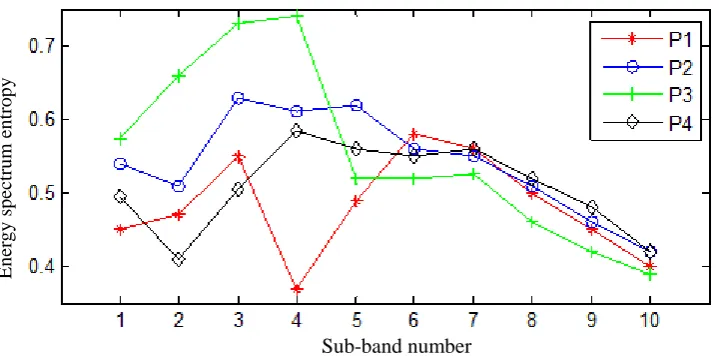
Figure 2. The 95% confidence interval of the multi-scale sample entropy parameters.
The figure 1 and figure 2 shows that the air gap discharge and creeping discharge UHF PD signal energy is concentrated in the more than 400 MHZ band, and the needle plate discharge and suspended discharge UHF PD signal energy is concentrated in the 400 MHZ band. Due to different types of discharge pulse waveform and steepness is different, leading to excitation of UHF signal energy distribution with larger differences, that is used to identify the defect types using multi-scale characteristics of energy is feasible.
Defect Type Identification
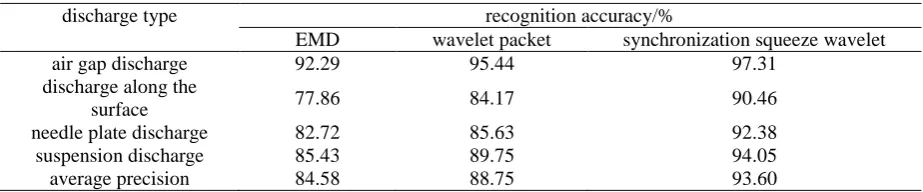
UHF PD signal recognition is using Support Vector Machine (SVM) classifier to achieve. SVM is a kind of novel Machine learning method based on statistical learning theory. For each of 80 sets of experimental data for each discharge type, 50 were selected for training and 30 for testing. The recognition result is shown in Table 2.
R
elativ
e
en
er
g
y
v
alu
e
E
n
er
g
y
s
p
ec
tr
u
m
en
tr
o
p
[image:3.595.99.459.420.598.2]Table 2. Partial discharge identification results.
discharge type recognition accuracy/%
EMD wavelet packet synchronization squeeze wavelet air gap discharge 92.29 95.44 97.31
discharge along the
surface 77.86 84.17 90.46
needle plate discharge 82.72 85.63 92.38 suspension discharge 85.43 89.75 94.05 average precision 84.58 88.75 93.60
The multi-scale feature quantity can be used to describe the time-frequency characteristic of the original signal more accurately, and the better recognition effect is achieved. Multi-scale energy characteristics and multi-scale sample entropy characteristics have achieved good recognition results. The average recognition rate is higher than 90%.
Conclusion
(1) Synchrosqueezing wavelet transform has clearer and more accurate frequency spectrum, using SWT sub-bands to reconstruct can realize precise frequency division, and to overcome the wavelet decomposition and spectrum aliasing between sub-band energy leakage faults. the signal after sub-bands reconstruction can be more detailed and accurate description time-frequency information of UHFPD signals.
(2) The UHF PD signal recognition results of four typical discharge models show that the multi-scale energy and multi-scale entropy characteristic parameters based on SWT can effectively identify four kinds of transformer discharge modes. The average recognition accuracy is higher than 90%, which is obviously better than the partial discharge detection method based on EMD and wavelet packet decomposition.
Acknowledgement
This research was financially supported by National Natural Science Fund(No.61671338,61473213,
51877161), fund from Hubei Province Key Laboratory of Intelligent Information Processing and Real-time Industrial System (Wuhan University of Science and Technology) (znxx2018QN04), fund from Hubei Province Key Laboratory of Systems Science in Metallurgical Process (Wuhan University of Science and Technology (Y201709), and Funded By Open Research Fund Program of Key Laboratory of Digital Mapping and Land Information Application Engineering, NASG(No. GCWD201805)
Reference
[1]Massimo Pompili. Partial Discharge Development and Detection in Dielectric Liquids. IEEE
Transactions on Dielectrics and Electrical Insulation. 2009, 16(6): 1648-1654.
[2]Mang-Hui Wang. Partial discharge pattern recognition of current transformers using an ENN.
IEEE Transactions on Power Delivery, 2005, 20(3): 1984-1990.
[3]Daubechies I, Lu J, Wu H T. Synchrosqueezed wavelet transforms: an empirical mode
decomposition-like tool. Appl Comput Harmon Anal, 2011, 30: 243-261
[4]Iatsenko D, Peter V E M, Stefanovska A. Linear and synchrosqueezed time-frequency
representations revisited. Part I: Overview, standards of use, related issues and algorithms. Digital Signal Processing, 2015, 42(c):1-26.
[5]Sylvain M, Thomas O, Stephen M. A new algorithm for multicomponent signals analysis based
[6]Gaurav T, Eugene B, Neven S F, Wu H T. The synchrosqueezing algorithm for time-varying spectral analysis. Signal Processing, 2013, 93(5):1079-1094.
[7]Mousavi S M, Langston C A, Horton S P. Automatic microseismic denoising and oneset
detection using the synchrosqueezed continuous wavelet transform. Geophysics, 2016, 81(4):341-356.
[8]W Liu, S Cao, Y Liu, Y Chen. Synchrosqueezing transform and its applications in seismic data
analysis. Journal of Seismic Exploration, 2016, 25(3):27-44.
[9]Chuan Li, Ming Liang. Time-frequency signal analysis for gearbox fault diagnosis using a
generalized synchrosqueezing transform. Mechanical Systems and Signal Processing, 2012, 26: 205-217.
[10]Li Jian, Wang Xiaowei, Jin Zhuorui, et al. Multi-scale grid dimension extraction and