2018 3rd International Conference on Information Technology and Industrial Automation (ICITIA 2018)
ISBN: 978-1-60595-607-7
Deleting Method on Duplicated Recommending
Commodities Based on Shopping
Records of Users
Mengyuan Li, Jialin Ma and Alasdair Ivens
ABSTRACT
Leading e-commerce websites typically now have commodity recommendation functionality. Most users will notice that their recommendation list will contain the commodities purchased previously, despite them no longer need the item. Aimed at resolving this situation, a model has been developed which is able to remove such duplicated recommendations. This paper provided a series of comprehensive optimization schemes to delete duplicated items, based on previous filtering schemes, to include in any repurchase cycle.1
INTRODUCTION
Resnick and Varian gave the value of recommender systems [1]: “In a typical recommender system people provide recommendations as inputs, which the system then aggregates and directs to appropriate recipients.”. Almost all of the recommender systems used by e-commercial websites do not remove duplicated items when recommending commodities. For example, a user will continue to receive a recommendation of additional smart phones after purchasing one.
This article is inspired by the scheme of Zhiqing Zhang and adds an independent module to delete duplicated items which, when combined with other recommender functions in the recommender system, promote the effectiveness of the system [2,3].
1
FILTERING SCHEME
Recommending Scheme Considering Repeated Purchase Cycle
Firstly, establish the commodity database and customer transaction database, then classify all the commodities into three classes: long-term repeated purchase cycle, short-term repeated purchase cycle and zero repeated purchase commodities; secondly, calculate short-term purchase cycle and form repeated cycle table; thirdly, calculate the repurchasing states of the target recommended user, find out the commodities on cycle of purchasing on invalid states and on long-term purchase cycle; finally, compare the traditional collaborative filtering scheme with the commodity list obtained from the three steps above[4]. Subsequently, delete the repeated commodities from the commodity list after traditional collaborative filtering, and only then, recommend the commodities in the filtered list to users.
Consider the Limitation of Commodity Repeated Purchase Cycle
The limitation of classification is the first thing to be considered; the original scheme does artificial pre-classification but the classification like this is de-personalized. Next, the limitation of the calculation function of the repeated purchase cycle. The original scheme simply deletes the purchase before the estimated time due to sale activities and does not consider how this event might impact the next purchase cycle. The next component for consideration is the limitation of confirmation of the repeated purchase cycle discrete value, and finally, the limitation of deleting invalid commodities. The original scheme regarded users that have already bought the commodities as being beyond the repurchase cycle and thus will not recommend that commodity any more.
SCHEME REALIZATION
Data Preparation
Tables below are required before starting to delete duplication:
goods. If the commodity is non-consumption, leave it blank in table. Consider of the problem of storage space, only reserved the last time of browsing or putting into shopping cart.
Steps of Deleting Duplicated Commodities
Other tables are also required: a recommendation table I on target users, which can get by any recommended method; a to-be-processed tableI∗, which is the same as I; an exclusion table Ik, which is used to reserve recommendation commodities to
be excluded. All of the tables above only reserve commodity ID.
Step1. Inspect all commodities in I∗ in turn, if the sum of the purchase count of commodities to be inspected and the purchase count of commodities in the same class with commodities to be inspected is 1, move the commodity ID from I∗ to Ik, and delete the never purchased commodities from I*. After inspecting, rename I∗ to
I2∗.
Step2: Inspect all commodities that have a purchase count with less than or equals to 1 under normal prices (not on discount) in I2∗ in turn. If the commodities are on discount, delete them from I2∗, Otherwise. move the commodity ID from I∗ to
Ik. After inspecting, rename I2∗ to I3∗.
Step3: Try to take a commodity from I3∗. If I3∗ is empty, delete the same commodity IDs in I and Ik from I. After operating, rename I to I2. Recommend all
of the commodities in I2 to user, and finish all of the workflow. If I3∗ is not empty,
mark the commodity ID of the commodity took from I3∗ as C, and mark the class of C as U. Then calculate the daily consumption of that class commodities of target user:
𝐺𝐶𝐷𝐴 = ∑ 𝐷𝐸𝑛𝑅(𝑊𝑁−𝐷𝐹𝑖𝑅
𝑡×𝑊𝐶𝑡)
𝑛−1
𝑖=1 (1) DEnR is the date of the last time that target user purchased U class commodity in normal price. DFiR is the date of the first time that target user purchased U class commodity in normal price. EN is the amount that user purchase U class commodity per time. WC is the volume of user purchase U class commodity per time (if WC is empty or is 0, regard it as WC=1), n is the count that user purchase U class commodity between DEnR and DFiR.
Calculate the discrete degree SDc of daily consumption of commodity C of user:
𝑆𝐷𝑐 = √∑𝑛−1𝑖=1(𝐺𝑐𝑡−𝐺𝐶𝐷𝐴)2
𝑛 (2)
Step 4: PE is the total consumption amount between the first-time purchase U class commodities on normal price and the last time purchase U class commodities.
𝑃𝐸 = ∑𝑁 (𝑊𝑁𝑖 × 𝑊𝐶𝑖)
𝐼=1 (3)
N is the count of purchase between the last-time purchase U class commodities on normal price and the last-time purchase U class commodities.
Step 5: Calculate predicted the range of consumption cycle of commodity C (gold repurchase cycle)
The shortest and the longest consumption cycle:
|𝑇𝐻𝑀𝑖𝑛| =𝐺 𝑃𝐸
𝐶𝐷𝐴+min(𝑆𝐷𝐶,𝑆𝐷𝐴,𝑆𝐷𝐶𝐴∗) (4)
|𝑇𝐻𝑀𝑎𝑥| =𝐺 𝑃𝐸
𝐶𝐷𝐴−min(𝑆𝐷𝐶,𝑆𝐷𝐴,𝑆𝐷𝐶𝐴∗) (5)
SDCA∗ is the discrete degree of daily user consumption of commodity C, SDA is a optional parameter, default is 0, it is the discrete degree of other users that are similar to target users. Otherwise, if THMax < 1 after calculating, THMax = 1.
Step 6: Determination on the relationship between current date and gold repurchase cycle. If THMin ≤ TAct ≤ THMax, the commodity is in gold repurchase
cycle. That commodity can be recommended to user. Delete C from I3∗, and do as step 3. If THMin > TAct, the commodity is in consumption cycle. That commodity does not need to be recommended. Move C from I3∗ to Ik, and do as step 3. If
TAct > THMax, the commodity is in an invalid cycle. That commodity will need
further consideration, and do next step. TAct is the time gap between current time and the last time purchase U class commodity.
Step 7: Inspect target users record of whether putting U class commodities into the shopping cart. If the answer is no, do step8. Otherwise, inspect the condition of commodity prices in the shopping cart. If MNow ≥ MSe≥ MCM is true, consumer choose not to purchase because of price. So, Move C from I3∗ to Ik, and do Step 3; If
MNow ≥ MSe ≥ MCM is false, consumer chooses not to purchase not because of the
price. Record DEnR as the established date of the shopping cart record. Get PE by
calculating the shopping cart information, then return to step 5. Among them,
MNowis the latest price of commodity C. MSC is the commodity price when the user
put U class commodity into shopping cart last time. MCM is the average price of all
the U class commodity that user purchased.
𝑃𝐸 = ∑𝑁𝑊𝑖=1(𝑊𝑁𝐼×𝑊𝐶𝐼)
𝑁𝑤 (6)
Nw is the count of purchase of target user on U class commodity.
ALGORITHM INSPECTION
Evaluation Index of Deleting Duplication
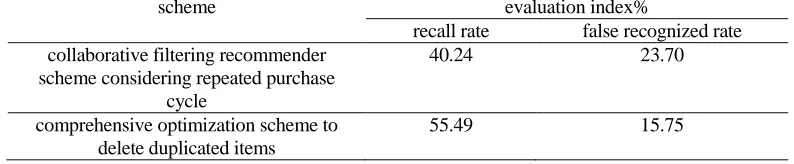
Mainly evaluation from two indicators: recall rate and false recognition rate Recall rate is defined in this paper as the percentage of recommended commodities that are deleted correctly in the recommended commodities that should be deleted. The higher recall rate, the better the evaluation index. The formula of recall rate is:
𝑅𝑒𝑐𝑎𝑙𝑙𝑟𝑎𝑡𝑒 =𝑐𝑜𝑢𝑛𝑡𝑜𝑓𝑠𝑢𝑟𝑝𝑙𝑢𝑠𝑐𝑜𝑚𝑚𝑜𝑑𝑖𝑡𝑖𝑒𝑠𝑡ℎ𝑎𝑡𝑎𝑟𝑒𝑟𝑒𝑐𝑜𝑔𝑛𝑖𝑧𝑒𝑑𝑐𝑜𝑟𝑟𝑒𝑐𝑡𝑙𝑦𝑡𝑜𝑡𝑎𝑙𝑐𝑜𝑢𝑛𝑡𝑜𝑓𝑠𝑢𝑟𝑝𝑙𝑢𝑠𝑖𝑛𝑐𝑙𝑢𝑑𝑒𝑑𝑎𝑐𝑡𝑢𝑎𝑙𝑙𝑦 × 100%(7)
False recognition rate is defined in this paper as the percentage of recommended commodities that are deleted “by mistake” in the recommend commodities that are recognized to be deleted. The lower the false recognition rage, the better evaluation index. The formula of false recognition rate is:
𝐹𝑎𝑙𝑠𝑒𝑟𝑒𝑐𝑜𝑔𝑛𝑖𝑡𝑖𝑜𝑛𝑟𝑎𝑡𝑒 =𝑐𝑜𝑢𝑛𝑡𝑜𝑓𝑐𝑜𝑚𝑚𝑜𝑑𝑖𝑡𝑖𝑒𝑠𝑟𝑒𝑐𝑜𝑔𝑛𝑖𝑠𝑒𝑑𝑡𝑜𝑏𝑒𝑑𝑒𝑙𝑒𝑡𝑒𝑑𝑏𝑦𝑚𝑖𝑠𝑡𝑎𝑘𝑒𝑡𝑜𝑡𝑎𝑙𝑐𝑜𝑢𝑛𝑡𝑜𝑓𝑐𝑜𝑚𝑚𝑜𝑑𝑖𝑡𝑖𝑒𝑠𝑟𝑒𝑐𝑜𝑔𝑛𝑖𝑠𝑒𝑑𝑡𝑜𝑏𝑒𝑑𝑒𝑙𝑒𝑡𝑒𝑑 × 100% (8)
Scheme of the Evaluation Index Obtain
Step 1. Obtain tables required in the algorithm; Step 2. Randomly choose one of the users, named P. Get its statistics of historical purchase records, and the total purchase count of each class of commodities. Step 3. To each commodity that the purchase count is no less than 2, ignore its last purchase record. Import the rest data into the algorithm to calculate, the algorithm will then output the gold repurchase cycles of each commodity. Step 4. Compare the gold repurchase cycles and the date of the last time purchase of user. If that date is in gold repurchase cycle, the recognition is deemed successful, otherwise, is deemed to have failed. Step 5. Use the parameters obtained from Step1~Step 4, calculate recall rate and false recognition rate.
RESULTS
TABLE I. FILTERING SCHEME WITH A COMPARISON OF EXPERIMENT RESULTS.
scheme evaluation index%
recall rate false recognized rate collaborative filtering recommender
scheme considering repeated purchase cycle
40.24 23.70
comprehensive optimization scheme to delete duplicated items
55.49 15.75
CONCLUSIONS
This paper provided a scheme which primarily considers the repeated purchase cycle and then considers multiple conditions in which to delete duplicated recommending commodities. The scheme can also be used in an inverted manner, namely recommending commodities to users which they will need to purchase regularly.
In subsequent research, the following factors will be considered: for some of the commodities, purchase repeatedly is not due to the consumption cycle. For example, one of the target users might purchase a hard drive regularly, but present them to different friends as gifts; the kind of user behaviour is not helpful when calculating the consumption cycle. Classifying hard drives as non-consumption commodities and use the scheme to avoid calculate the cycles is also not advised, as there will be users that purchase hard drives regularly for more storage space. So, a new scheme needs to be devised. Another issue is how best to classify to the appropriate level of detail when calculating cycles. Commodities of the same class will almost certainly have different price ranges, and users might purchase commodities in different price ranges for various undefined reasons.
REFERENCES
1. Resnick, P., & Varian, H. R. 1997. Recommender Systems. Communications of the ACM, 40(3), 56-58. Doi:10.1145/245108.245121.
2. Z. Q.Hu, Z. Q. Zhang, &, M Li. 2017. Research on the Evaluation Method of E-Commerce Logistics Service Quality Based on Text Analysis. Sixteenth Wuhan International Conference on E-Business, 439-447.
3. Terveen, L., Hill, W., Amento, B., McDonald, D., & Crete, J. 1997. PHOAKS: A System for Sharing Recommendations. Communications of the ACM, 40(3), 59-62. Doi:Doi 10.1145/245108.245122.