BIROn - Birkbeck Institutional Research Online
Xu, D. and Liu, J. and Li, Xuelong and Liu, Z. and Tang, X. (2005) Insignificant
shadow detection for video segmentation. IEEE Transactions on Circuits and
Systems for Video Technology 15 (8), pp. 1058-1064. ISSN 1051-8215.
Downloaded from:
Usage Guidelines:
Please refer to usage guidelines at
or alternatively
Birkbeck ePrints: an open access repository of the
research output of Birkbeck College
http://eprints.bbk.ac.uk
Xu, Dong; Liu, Jianzhuang; Li, Xuelong; Liu, Zhengkai and
Tang, Xiaoou (2005). Insignificant shadow detection for
video segmentation.
IEEE Transactions on Circuits and
Systems for Video Technology
15
(8) 1058-1064.
Copyright © 2005 IEEE. Reprinted from
IEEE Transactions on Circuits and
Systems for Video Technology
(ISSN 1051-8215)
.This material is posted
here with permission of the IEEE. Such permission of the IEEE does not in
any way imply IEEE endorsement of any of Birkbeck’s products or services.
Internal or personal use of this material is permitted. However, permission to
reprint/republish this material for advertising or promotional purposes or for
creating new collective works for resale or redistribution must be obtained
from the IEEE by writing to [email protected].
By choosing to view this document, you agree to all provisions of the
copyright laws protecting it.
Citation for this copy:
Xu, Dong; Liu, Jianzhuang; Li, Xuelong; Liu, Zhengkai and Tang, Xiaoou
(2005). Insignificant shadow detection for video segmentation.
London:
Birkbeck ePrints.
Available at: http://eprints.bbk.ac.uk/archive/00000450
Citation as published:
Xu, Dong; Liu, Jianzhuang; Li, Xuelong; Liu, Zhengkai and Tang, Xiaoou
(2005). Insignificant shadow detection for video segmentation.
IEEE
Transactions on Circuits and Systems for Video Technology
15
(8)
1058-1064.
http://eprints.bbk.ac.uk
1058 IEEE TRANSACTIONS ON CIRCUITS AND SYSTEMS FOR VIDEO TECHNOLOGY, VOL. 15, NO. 8, AUGUST 2005
Insignificant Shadow Detection for Video Segmentation
Dong Xu, Jianzhuang Liu
, Senior Member, IEEE
, Xuelong Li
, Member, IEEE
, Zhengkai Liu, and
Xiaoou Tang
, Senior Member, IEEE
Abstract—To prevent moving cast shadows from being mis-understood as part of moving objects in change detection based video segmentation, this paper proposes a novel approach to the cast shadow detection based on the edge and region information in multiple frames. First, an initial change detection mask containing moving objects and cast shadows is obtained. Then a Canny edge map is generated. After that, the shadow region is detected and removed through multiframe integration, edge matching, and region growing. Finally, a post processing procedure is used to eliminate noise and tune the boundaries of the objects. Our ap-proach can be used for video segmentation in indoor environment. The experimental results demonstrate its good performance.
Index Terms—Insignificant shadow detection, multiframe inte-gration, region growing, video segmentation.
I. INTRODUCTION
V
IDEO segmentation is a key technique for semantic object extraction and plays an important role in content-based video coding in MPEG4 [4], [5], [11]–[13], [15], [16], [18], [22]. It is often necessary to separate moving objects from their shadows in video segmentation for many applications such as traffic monitoring, surveillance and video conferencing [17]. There are some different shadow classifications in the literature. According to the scene, there are indoor shadow and outdoor shadow. Shadows can also be classified as ego shadow and cast shadow [9]. The former is part of the object that is not illumi-nated by direct light, while the latter is part of the background where direct light is blocked by the object. When a light source that causes shadows cannot be treated as a point, a penumbra (a partial shadow) and an umbra (a shadow where light is com-pletely blocked) will appear simultaneously [20].According to shadow extent, it can be categorized into signif-icant shadow and insignifsignif-icant shadow. Shadow significance is a relative concept. A shadow is called significant when the edge of the shadow region is as sharp as the edge of its corresponding object. Otherwise, it is considered as insignificant. Shadow sig-nificance depends on several factors such as light source inten-sity, the width of a penumbra, and the background. In sunny days and on cement roads, shadows cast by pedestrians or
vehi-Manuscript received January 4, 2004; revised November 20, 2004. The work was supported by the Natural Science Fund, Anhui, China under Grant 03042307, and in part by the Research Grants Council of the Hong Kong SAR. This paper was recommended by Associate Editor H. Shum.
D. Xu and Z. Liu are with the Department of Electronic Engineering and Information Science, University of Science and Technology of China, Hefei 230027, China (e-mail: [email protected]; [email protected]).
J. Liu and X. Tang is with the Department of Information Engineering, The Chinese University of Hong Kong, Shatin, Hong Kong (e-mail: [email protected]; [email protected]).
X. Li is with the School of Computer Science and Information Systems, Uni-versity of London, Birkbeck College, London WC1E 7HX, U.K. (e-mail: [email protected]).
Digital Object Identifier 10.1109/TCSVT.2005.852402
cles can be considered as significant shadows, where the light is strong with no penumbra area, and the contrast is large between the cement roads and the dark shadows. On the other hand, in normal indoor environment, there is often more than one light in a scene and the size of a light cannot be ignored when compared with the distance between the light and a moving object. Thus, penumbras usually appear and they may be quite large, forming insignificant shadows.
In the literature, much work has been done on significant shadow detection [3], [6], [7], [10], [14], [17], [19], [21]. However, less work [4], [6], [20] can be found on insignificant shadow detection, which is more challenging than the former. In [6], Cucchiaraet al.used some shadow properties in HSV color space to distinguish shadows from moving objects. These properties show that the cast shadow darkens the background in luminance component, and the hue and saturation components change within certain limits. The main drawback of this method is that, when a video sequence is noisy such as one acquired by a low-end camera, pixel-wise classification of moving objects and shadows is not reliable. Other efforts like pre-processing and post-processing are needed [17]. Moreover, pixel-wise processing makes the parameters used in the algorithm sensi-tive with respect to the image luminance and gradient [6]. We believe that edge and region information should be employed for more robust shadow detection.
Stauderet al.[20] analyzed the moving cast shadow behavior extensively and based their approach on four assumptions: 1) a strong light source causing a cast shadow; 2) a static camera, and static and textured background; 3) planar background; and 4) the light source with a certain extent. A cast shadow is found mainly according to the results of change detection, static edge detec-tion, shading change detection and penumbra detection. There are some problems in this approach. Some regions of a moving object, such as the facial part of a human, are easy to be mis-classified as shadow regions because the uniform colors there present the same characteristics as the shadow regions. The re-gions that are always shadowed along the sequence cannot be detected by their algorithm, as pointed out by the authors in [20]. If the assumptions are violated, the shadow will not be detected correctly [17], [20]. Moreover, the computation is quite com-plex [4], [17].
Chienet al.[4] applied a gradient filter to remove moving cast shadows for video segmentation. The reason to use the gradient filter is that in general, a shadow region tends to have a gradual change in luminance value. Moreover, if the illumination or the camera gain changes within the sequence, the shadow effect is small in the gradient domain. As they pointed out, however, this approach has some limitations. The removal of shadow effect relies on smooth change in the shadow region. If a shadow ap-pears in a region with strong texture, the benefit of the gradient
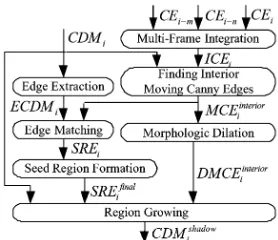
Fig. 1. Block diagram of the cast shadow detection algorithm.
filter will be lost. In addition, when the moving object has weak edges and is less textured, the segmentation result may degrade since the gradient filter also removes some useful information from the original image.
In this paper, we propose an effective approach to the de-tection and removal of moving cast shadows in normal indoor scenes where the camera is stationary. It is especially appro-priate for the applications of indoor video surveillance and con-ferencing. The approach includes: 1) the generations of initial change detection masks and Canny edge maps; 2) shadow re-gion detection by multiframe integration, edge matching, and region growing; and 3) shadow region removal and post-pro-cessing for eliminating noise and tuning object boundaries. The main contribution of this paper is that we successfully separate a moving object from its cast shadow by a region growing scheme, where the selection of seeds in shadow regions and the growing stop criterion are decided by the edge information in multiple frames. We have compared our approach with the gradient filter in [4], which is the most recent and related to our work. The ex-perimental results show that our approach performs better.
II. CASTSHADOWDETECTIONALGORITHM
A. Outline of the Algorithm
The block diagram of the algorithm is shown in Fig. 1. Given a sequence , first an initial change detection mask (CDM) at frame , is obtained. The Canny edge map of this frame is also generated. Then and are fed into the step of the shadow region detection, where and are the Canny edge maps of two pre-vious frames and , respectively. The output of this step, denoted by , is the detected shadow region in . With and , the initial moving object can be created directly. The last step is the post-pro-cessing for eliminating noise and tuning the boundary of the moving object, from which we have the final detected moving
object .
B. Creating Initial CDMs and Canny Edge Maps
To obtain the initial CDM for a frame is an important step for moving object segmentation. This mask usually contains moving objects and cast shadows. We adopt the background reg-istration algorithm proposed by Chienet al.[4] to create it. This scheme has been verified, both in [4] and in our experiments, to
have better performance than the commonly used frame differ-ence technique [12]. Figs. 2(b) and 3(b) shows an example of
.
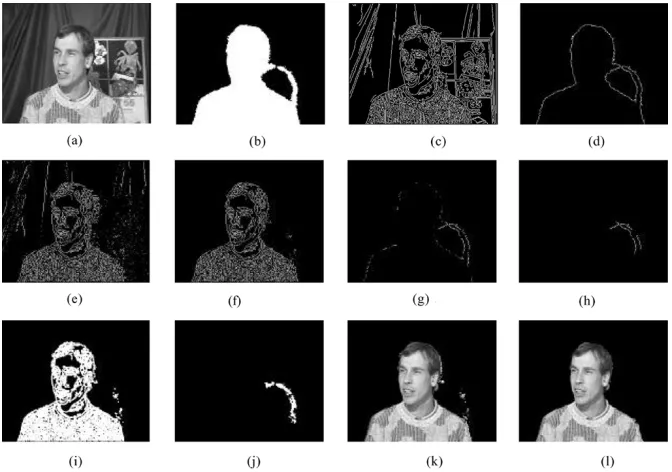
We use the popular Canny edge detection algorithm [2] to generate an edge map because it is excellent for obtaining pre-cise edges. The result is of values 0 and 255, as shown in Figs. 2(c) and 3(c).
From Figs. 2(b) and 3(b), we see that the moving cast shadows appear in the initial CDMs. However, the fact that the transition from the backgrounds to the shadow regions is gradual makes the edges caused by the shadow boundaries almost invisible in Figs. 2(c) and 3(c). This phenomenon exists in indoor environ-ment, and is very useful for the detection of indoor shadows.
C. Shadow Region Detection
The block diagram of the shadow region detection is shown in Fig. 4, which is the kernel of our approach. The detailed ex-planations of the steps are given in the following.
1) Multiframe Integration: In normal indoor environment,
an insignificant shadow often appears in an area where the gray levels change gradually from the background to the shadowed region. An obvious example is shown in Fig. 3(a). Therefore, we can use the Canny edge operation to suppress the weak edges. From Fig. 3(c), we see that few edges exist in the shadow region. The effect of the shadow has been excluded from the edge map. For this example, it is not difficult to remove the shadow from the moving person with the information in Fig. 3(b) and (c). However, in some video sequences, shadows appear in highly textured background, as shown in Fig. 2, where the textured backgrounds bring the edges and affect moving object detec-tion. Therefore, how to remove those edges in shadow regions becomes an important and challenging task.
Edges can be classified asstaticedges andmovingedges. The former belong to the background, and the latter to the moving object. Moving Canny edges are the most important cue for the region growing algorithm discussed later. Thus, it is necessary to distinguish the moving edges from static edges. In [20], Stauderet al.used the information in two consecutive frames to find static and moving edges. But this method is easy to generate manyfalse negative edges, which denotes the moving edges considered as static edges. Fig. 5 shows an example. The original interior Canny edges in Fig. 5(a) are the Canny edges lying inside . (In what follows, the terminterioris used to denoteinside .) Fig. 5(b) shows the interior moving Canny edges obtained by the two-consecutive-frame-based method. Comparing Fig. 5(a) and (b), we see that many moving edges are lost (classified as static edges). In our experiments, we found that these false negative edges may result in seriously bad outcome. For example, there are many gaps in the person’s boundary in Fig. 5(b), indicating that some moving edges have been considered as static edges. Through these gaps, the region growing algorithm may grow into the head and shoulder of the person and thus misclassify part of the moving person into the shadow region.
1060 IEEE TRANSACTIONS ON CIRCUITS AND SYSTEMS FOR VIDEO TECHNOLOGY, VOL. 15, NO. 8, AUGUST 2005
Fig. 2. Illustration of the results of the main steps in our algorithm with frame 46 of the video sequence Erik. (a)f of Erik. (b)CMD . (c)CE . (d) ECMD . (e)ICE . (f)MCE . (g)SRE . (h)SRE . (i)DMCE . (j)CMD . (k)MO . (l)MO .
Fig. 3. Main results for the frame 53 of the video sequence Hall. (a)f of Hall. (b)CMD . (c)CE . (d)SRE . (e)SRE . (f)CDM . (g)MO . (h)MO .
The integrated edge information is kept in , which is de-fined in (1), shown at the bottom of the page, where denotes a pixel. In this scheme, the edge points in the Canny edge map of the current frame are considered as static edges only when they are also the Canny edges in the past frames and . Thus, it is not easy to misclassify the moving object edges as the static edges, preserving the object edges well, and being able to remove the edges in the background effectively (see (4) below where the static edges in are discarded).
In our experiments, and are chosen as 3 and 5, respec-tively; they are not set to 1 and 2, because the former choice
can better preserve edges when the moving object moves very slowly. Fig. 5(c) gives an example obtained by our three-frame-based method where the moving Canny edges in are shown. It is not difficult to see that compared with Fig. 5(b), there are much fewer false negative edges, and the boundary of the moving object is preserved better. Fig. 2(e) shows another example with all the moving Canny edges given. Similar results obtained in our experiments reveal that our multiframe Canny edge integration technique can be used to detect shadow re-gions in both highly textured and smooth backgrounds. The fol-lowing analysis shows the relations among the two-frame-based
not edge if static edge if moving edge otherwise
[image:5.594.110.482.336.513.2]Fig. 4. Block diagram of the shadow region detection.
Fig. 5. Generating interior moving Canny edges by the two methods. (a) Original interior Canny edges. (b) Interior moving Canny edges obtained by the two-frame-based method. (c) Interior moving Canny edges obtained by our multiframe-based method.
method, the multiframe-based method, and the false negative edges.
An edge map can be treated as a grey-level image before con-verted to a binary one in the final step of the Canny edge detec-tion. Our analysis is based on these grey-level edge maps. Let FD be the frame difference of two edge maps. Let and be the false negative rates generated by the two-frame-based and multiframe-based methods, respectively. We define thefalse negative rateas the probability of a moving edge point classified as a static one. Let be the hypothesis that a pixel is a moving edge point. Then
(2) (3)
where is the number of edge maps in the multiframe-based method, all the edge point in ’s are assumed to be indepen-dentaly identically distributed (i.i.d.), and and are the decision thresholds for the two methods. With these analysis and assumptions, we have if . Therefore, our multiframe-based method can produce less false negative edges. The multiframe integration may produce morefalse positive
edges than the two-frame-based method, which can be found
in the shadow regions in Fig. 5(b) and (c). Here false positive edges denote the static edges that are misclassified as moving edges. However, this drawback is not serious in our approach. These edges have little effect on the region growing described later and thus little effect on the shadow detection. Moreover, they can be removed in the postprocessing step.
2) Finding Interior Moving Canny Edges and the Edges of : With and , it is not difficult to find the
interior moving Canny edges, , and the edges of and . Two sets are defined for obtaining them
moving Canny edge (4)
true (5)
where and are pixels, and is a function that re-turnstruewhen and are in 4-neighborhood andfalse other-wise. Fig. 2(d) shows an example of , and Figs. 2(f) and 5(c) give two . The interior moving Canny edges provide important information for the seed point selection and region growing that are discussed later.
3) Edge Matching, Seed Region Formation, and
Morpho-logic Dilation: Because we use a region growing algorithm to
detect the cast shadow, we have to generate some seed points at first. The edges of the shadow region in are good seeds. Therefore, we hope to separate the shadow region edges in from the moving object edges . This can be achieved with and because most edge points in havematching(i.e., corresponding) moving edges in when a small neighbor of each point is considered, while most edge points in fail to find such matching edges [see Fig. 2(d) and (f)]. Thus, we use the following equation to obtain
(6)
where (chosen as 2) is a threshold that confines the searching neighbor, and denotes the chosen chessboard dis-tance. The set serves as the initial seed points for the re-gion growing algorithm.
Fig. 2(g) shows an example of . Comparing Fig. 2(b) and (g), it can be found that the connected white pixels cor-respond to the edges of the shadow region very well. How-ever, some sporadic pixels, which belong to the edges of the moving object, also appear in . In order to remove these points, the component connection algorithm in [8] is imple-mented here to connect the initial seed points. Among all the connected regions, only those with points more than a threshold (chosen as 30) are used to be the final seed region of edges in the shadow region. Fig. 2(h) gives an ex-ample of where the moving edge points in Fig. 2(g) have been removed and the remaining seed points all belong to the shadow region. Although we have focused on the discussion for textured background, our approach works also for smooth background. An example is given in Figs. 3(d) and (e).
[image:6.594.39.293.230.306.2]1062 IEEE TRANSACTIONS ON CIRCUITS AND SYSTEMS FOR VIDEO TECHNOLOGY, VOL. 15, NO. 8, AUGUST 2005
4) Region Growing: The region growing algorithm in [1] is
modified for the shadow detection. The algorithm begins with the seed points in the shadow region (i.e., those in ), expands them pixel by pixel in , and puts the detected shadow points in a set denoted by . It will stop when the region cannot grow anymore. Note that the points in , which mainly belong to the moving object, should not be put in . The pseudocode of the mod-ified region growing algorithm is described as follows.
1. Initialization: into a circle queue cq
andset
2. while do
3. begin
4. Remove a point from cq 5. Label as visitedandput into
6. forevery neighbor of in 4-neighborhooddo
7. if and and has not
been visitedthenput into cq 8. end
Figs. 2(j) and 3(f) show two examples of the region growing. From the results, it can be seen that the shadow regions in are detected very well.
D. Removing the Shadow Region and Post-Processing
With and , the initial moving
ob-ject mask, , can be obtained by
. The detected initial moving ob-ject is simply the region of the original frame in . Figs. 2(k) and 3(g) give two examples of , in which there exist some noise points that do not belong to the moving person. There noise points can be elimi-nated by the post-processing described below.
Several post-processing operations on are applied to remove the noise and tune the boundary of the moving ob-ject. First, a morphologic erosion is applied with a 5 5 square structure element. Second, the component connection algorithm [8] is employed again to remove the small connected regions, which are noise in the background. Finally, a morphologic di-lation operation with a 3 3 square structure element is used to compensate the effect of the morphologic erosion. The final detected moving object in frame is denoted by , two examples of which are given in Figs. 2(l) and 3(h), where satis-factory results are obtained.
III. EXPERIMENTALRESULTS
Standard MPEG-4 indoor testing sequences have been used to test our algorithm. Both objective and subjective evaluations are carried out in the experiments. We also compare our approach with the most recent and related one, namely the gradient filter, proposed in [4].
[image:7.594.304.551.65.266.2]In our algorithm, several parameters need to be pre-defined. The low and the high thresholds in the Canny edge detection al-gorithm are set to 0.2 and 0.8. The frame intervals and in Section II-C.1, and the two thresholds and
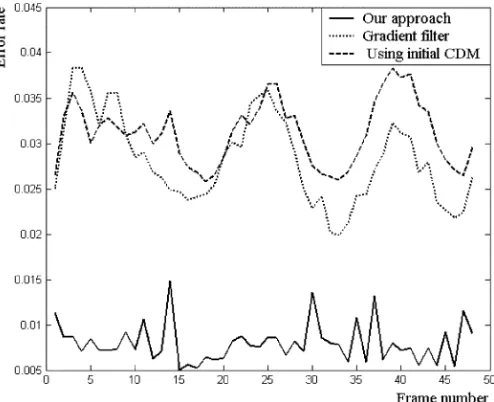
Fig. 6. Error rates in each frame of the Erik sequence for three approaches.
in Section II-C.3, are chosen as 3, 5, 2, and 30, respectively. The three structure elements for the morphologic operations in Sec-tion II-C.3 and SecSec-tion II-D are three squares of 3 3, 5 5, and 3 3 pixels. These parameters are chosen by some initial experiments, and then they are fixed for all the experiments de-scribed in the following.
A. Objective Evaluation
Similarly to [4], we use the error rate of the final detected object mask to show the effectiveness of our approach. It is defined as , where is the frame size, and is the number of pixels in that are different from the reference alpha plane.
The test sequence is Erik, a typical video telephone sequence in format of CIF 352 288 at 10 f/s, where diffuse light and a spot light illuminate the scene. The cast shadow is formed on the left side of the person’s neck. Fig. 6 shows the error rates in every frame of the Erik sequence for three approaches: ours, the gradient filter, and using as the detected object mask. For the third approach, to obtain , the close and open mor-phologic operations are applied for tuning the boundary of the object, as in [4]. Not surprisingly, using as the object mask presents the largest average error rate 3.1% since no any technique is applied to remove the shadows. The gradient filter cannot well handle the case where shadows appear in textured background. Its average error rate is 2.8%. However, our ap-proach performs best with a much lower average error rate 0.8%. Moreover, even the largest error rate of our approach is less than the smallest error rate of the gradient filter for this sequence.
TABLE I
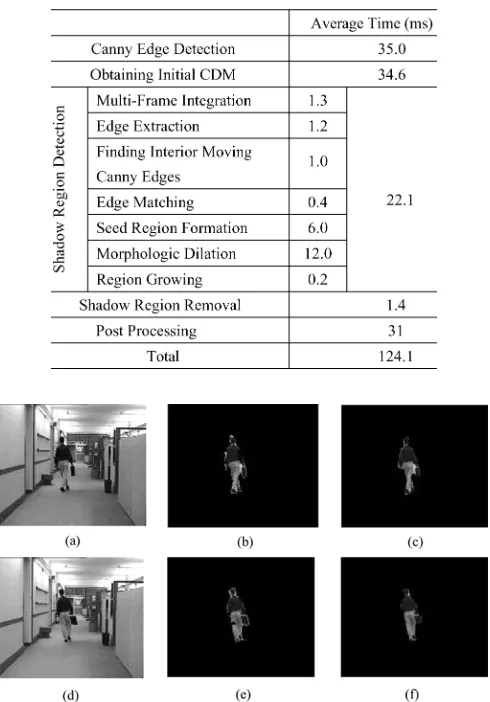
[image:8.594.43.288.88.439.2]AVERAGEPROCESSINGTIME INEACHSTEP OFOURALGORITHM
Fig. 7. Comparison of the gradient filter and our approach for Hall frames 60 and 70. (a) Hall frame 60. (b) Result by GF. (c) Result by ours. (d) Hall frame 70. (e) Result by GF. (f) Result by ours.
B. Subjective Evaluation
Three most commonly used MPEG-4 indoor testing se-quences, Hall (CIF 352 288 at 30 f/s), Erik (CIF 352 288 at 10 f/s), and Silent (CIF 352 288 at 30 f/s), have been used to test our algorithm. For all the frames in these sequences, our algorithm can obtain satisfactory results of moving object segmentation. We have also compared our approach with the gradient filter (GF) in [4] and found that our algorithm performs better.
[image:8.594.306.552.270.426.2]Fig. 7 shows the results obtained by our algorithm and the gradient filter for Hall frames 60 and 70. We see that some parts of the moving person are misclassified by the gradient filter due to the weak edges and less texture on the walking person. There is a gap on the right arm in Fig. 7(b) and a gap on the left leg in Fig. 7(e) of the person. On the other hand, our algorithm presents very good results [Fig. 7(c) and (f)] Fig. 8 shows the compar-isons between the two approaches for Erik frames 18 and 38. In this sequence, the shadows appear in the highly textured back-ground. We can see that the gradient filter cannot well distin-guish the shadow in the textured background from the moving object [Fig. 8(b) and (e)] However, our algorithm obtains much better results [Fig. 8(c) and (f)] More comparisons are given in
Fig. 8. Comparison of the gradient filter and our approach for Erik frames 18 and 38. (a) Erik frame 18. (b) Result by GF. (c) Result by ours. (d) Erik frame 38. (e) Result by GF. (f) Result by ours.
Fig. 9. Comparison of the gradient filter and our approach for Silent frames 112 and 268. (a) Silent frame 112. (b) Result by GF. (c) Result by ours. (d) Silent frame 268. (e) Result by GF. (f) Result by ours.
Fig. 10. Results obtained by our algorithm for some frames of the three sequences. (a) Erik frame 8. (b) Erik frame 16. (c) Erik frame 24. (d) Erik frame 42. (e) Hall frame 35. (f) Hall frame 105. (g) Hall frame 199. (h) Hall frame 257. (i) Silent frame 34. (j) Silent frame 96. (k) Silent frame 153. (l) Silent frame 217.
[image:8.594.304.555.476.654.2]1064 IEEE TRANSACTIONS ON CIRCUITS AND SYSTEMS FOR VIDEO TECHNOLOGY, VOL. 15, NO. 8, AUGUST 2005
can remove all the shadows [Fig. 9(c) and (f)] Again, these re-sults show that our approach outperforms the gradient filter.
More segmentation results obtained by our algorithm are given in Fig. 10 for the three sequences. The frames are picked randomly. These results also demonstrate the effectiveness of our approach to the removal of moving cast shadows.
In our experiments, we found that, similarly to other shadow removal techniques, it is possible for our algorithm to misclas-sify part of a moving object as the shadow or background region, and vice versa, when the moving object (or part of it) moves very slowly and there is little change at the boundary between the object and the background. To overcome this problem, more complicated techniques and further study are required.
IV. CONCLUSION
We have presented a new approach to the detection of moving cast shadows in normal indoor environment. Compared with outdoor shadows at daytime, these shadows are generally insignificant and more difficult to detect. In our approach, a number of techniques have been developed to achieve the goal. They include the generations of initial change detection masks and Canny edge maps, shadow region detection by multiframe integration, edge matching and region growing, and post-processing.
We have tested our algorithm with the most commonly used MPEG-4 testing sequences and compared it with a recently published and most related method called the gradient filter [4]. Both objective and subjective evaluations are carried out in the experiments. The results show that our approach performs better. It can produce satisfactory segmentation when shadows appear in both smooth and highly textured backgrounds. Our algorithm is also efficient; it is not difficult to make it applicable in real time (30 f/s) after some algorithmic optimization. Further work includes doing more experiments to see whether there are better choices of parameters and combining our approach with others to achieve better performance.
REFERENCES
[1] R. Adams and L. Bischof, “Seeded region growing,”IEEE Trans. Pattern Anal. Mach. Intell., vol. 16, no. 6, pp. 641–647, Jun. 1994.
[2] J. F. Canny, “A computational approach to edge detection,”IEEE Trans. Pattern Anal. Mach. Intell., vol. 8, no. 11, pp. 679–698, Nov. 1986.
[3] C. J. Chang, W. F. Hu, J. W. Hsieh, and Y. S. Chen, “Shadow elimination for effective moving object detection with Gaussian models,” inProc. IEEE Int. Conf. Pattern Recognition, 2002, pp. 540–543.
[4] S. Y. Chien, S. Y. Ma, and L. G. Chen, “Efficient moving object segmen-tation algorithm using background registration technique,”IEEE Trans. Circuits Syst. Video Technol., vol. 12, no. 7, pp. 577–586, Jul. 2002. [5] J. G. Choi, S. W. Lee, and S. D. Kim, “Spatio-temporal video
segmenta-tion using a joint similarity measure,”IEEE Trans. Circuits Syst. Video Technol., vol. 7, no. 2, pp. 279–286, Apr. 1997.
[6] R. Cucchiara, C. Granan, M. Piccardi, and A. Prati, “Detecting moving objects, ghosts, and shadows in video streams,”IEEE Trans. Pattern Anal. Mach. Intell., vol. 25, no. 10, pp. 1337–1342, Oct. 2003. [7] G. S. K. Fung, N. H. C. Yung, G. K. H. Pang, and A. H. S. Lai, “Toward
detection of moving cast shadows for visual traffic surveillance,” inProc. IEEE Int. Conf. System Man and Cybernetics, 2001, pp. 2505–2510. [8] R. M. Haralick and L. G. Shapiro, Computer and Robot
Vi-sion. Reading, MA: Addision-Wesley, 1992, pp. 28–48.
[9] C. Jiang and M. O. Ward, “Shadow identification,” inProc. IEEE Conf. Computer Vision and Pattern Recognition, 1992, pp. 606–612. [10] M. Kilgar, “A shadow handler in a video-based real-time traffic
moni-toring system,” inProc. IEEE Workshop Applications of Computer Vi-sion, 1992, pp. 11–18.
[11] C. Kim and J. N. Hwang, “Fast and automatic video object segmentation and tracking for content-based application,”IEEE Trans. Circuits Syst. Video Technol., vol. 12, no. 2, pp. 122–129, Feb. 2002.
[12] R. Mech and M. Wollborn, “A noise robust method for 2-D shape es-timation of moving objects in video sequences considering a moving camera,”Signal Process., vol. 66, pp. 203–217, Apr. 1998.
[13] T. Meier and K. N. Ngan, “Video segmentation for content-based coding,”IEEE Trans. Circuits Syst. Video Technol., vol. 9, no. 8, pp. 1190–1203, Dec. 1999.
[14] I. Mikic, P. C. Cosman, G. T. Kogut, and M. M. Trivedi, “Moving shadow and object detection in traffic scenes,” inProc. IEEE Int. Conf. Pattern Recognition, 2000, pp. 321–324.
[15] F. Moscheni, S. Bhattacharjee, and M. Junt, “Spatiotemporal segmenta-tion based on region merging,”IEEE Trans. Pattern Anal. Mach. Intell., vol. 20, no. 9, pp. 897–915, Sep. 1998.
[16] A. Neri, S. Colonnese, G. Russo, and P. Talone, “Automatic moving ob-ject and background separation,”Signal Process., vol. 66, pp. 219–232, Apr. 1998.
[17] A. Prati, I. Mikic, M. Trivedi, and R. Cucchiara, “Detecting moving shadows, algorithms, and evaluation,”IEEE Trans. Pattern Anal. Ma-chine Intell., vol. 25, pp. 918–923, July 2003.
[18] T. Sikora, “The MPEG-4 video standard verification model,”IEEE Trans. Circuits Syst. Video Technol., vol. 7, no. 1, pp. 19–31, Feb. 1997. [19] Y. Sonoda and T. Ogata, “Separation of moving objects and their shadows, and application to tracking of loci in the monitoring images,” inProc. IEEE Int. Conf. Signal Processing, 1998, pp. 1261–1264. [20] J. Stauder, R. Mech, and J. Ostermann, “Detection of moving cast
shadows for object segmentation,”IEEE Trans. Multimedia, vol. 1, pp. 65–77, Mar. 1999.
[21] X. Tao, M. Guo, and B. Zhang, “A neural network approach to the elim-ination of road shadow for outdoor mobile robot,” inProc. IEEE Int. Conf. Intelligent Processing Systems, Oct. 1997, pp. 28–31.