ISSN: 1992-8645 www.jatit.org E-ISSN: 1817-3195
200
STUDIES ON IMPROVING TEXTURE SEGMENTATION
PERFORMANCE USING GENERALIZED GAUSSIAN
MIXTURE MODEL INTEGRATING DCT AND LBP
1K. NAVEEN KUMAR, 2K.SRINIVASA RAO, 3Y.SRINIVAS, 4CH. SATYANARAYANA
1
Dept. of IT, GITAM University, Visakhapatnam
2
Dept of Statistics, Andhra University, Visakhapatnam
3
Dept. of IT, GITAM University, Visakhapatnam
4
Dept of CSE, JNTUK-Kakinada, Kakinada
E-mail: [email protected], [email protected], [email protected], [email protected]
ABSTRACT
This paper addresses the performance evaluation of the texture segmentation integrating DCT with LBP. In this method, the whole image is converted in to local binary pattern domain. The LBP image is then divided into different non overlapping blocks. From each block, the DCT coefficients are selected in a zig-zag pattern for each block. Assuming the feature vectors follow a multivariate generalized Gaussian mixture model, the model parameters are estimated using EM algorithm. The initialisation of the model parameters is carried using moment method of estimation and using Hierarchical clustering algorithm. The texture segmentation algorithm is developed under Bayesian frame with component maximum likelihood. The performance of the proposed algorithm is evaluated using performance measures such as GCE, PRI and VOI with randomly selected images from Brodatz database. It is observed that this algorithm outperforms existing texture segmentation algorithms with respect to performance measures.
Keywords: Texture Segmentation, Multivariate Generalized Gaussian Mixture Model, Performance
Measures, Local Binary Patterns, DCT Coefficients.
1.
INTRODUCTION
Texture segmentation is one of the most important consideration for image analysis, Hence several methods developed on various methods for texture segmentation[1-2]. Haim Permuter et.al, (2006)[3] has presented a review on texture classification using different approaches such as support vector mechanisms, histogram with maps, vector quantization, nearest neighbour classification, Fissure transformation, Markov random fields and probability models. Geman and Graffigne (1987)[4] has provided a review on Marko random fields for texture analysis. Permuter et.al.(2003)[5] has utilised the Gaussian mixture model for texture classification and shown that this method improved the performance over other methods, But still, the texture segmentation method based on Gaussian mixture model are lagging behind the standard criteria of segmentation performance measures such as correct rate.
ISSN: 1992-8645 www.jatit.org E-ISSN: 1817-3195
201 between adjacent pixels in the image. Therefore to have an accurate texture segmentation one has to consider the integration of DCT coefficients with local binary patterns. The LBP is capable of capturing local information more accurately (D. Haritha et.al(2012))[9]. Hence in this paper we develop a texture segmentation method based on multivariate generalized Gaussian mixture model using integration of DCT with LBP.
The rest of the paper is presented as follows. Section deals with the feature vector extraction using DCT coefficients and local binary patterns. Section 3 is concerned with image texture model using multivariate generalized Gaussian mixture model. Section 4 deals with estimation of model parameters using EM algorithm. Section 5 is concerned initialisation of model parameters. Section 6 deals with experimentation with proposed algorithm. Section 7 presents the performance evaluation metrics and comparative study with earlier models. Section 8 deals with conclusions.
2. FEATURE VECTOR EXTRACTION
USING DCT COEFFICIENTS AND LOCAL BINARY PATTERS
The discrete cosine transform is capable of denoising the image and LBP captures the micro level information of the texture features. The integration of DCT coefficients and local binary patterns will provide efficient extraction of feature vector that can be incorporated in Texture segmentation process. The local binary pattern operator converts each pixel intensity with a decimal number by capturing local structure around each pixel. By subtracting the center pixel value for each pixel is compared with its neighbourhood eight pixel values. The negative values are coded with zero and all others values with 1 resulting a binary number in clockwise rotation. The process usually starts from top left neighbour and the associated decimal values that are generated by concatenating binary values are called local binary patterns(LBP) (Huang et al.,(2011)[10] and Chi et al.,(2007)[11]). The basic drawback of LBP operator is that its small 3X3 neighbourhood cannot capture dominant features with large scale structures. To deal with texture at different scales, the operator was generalized to use neighbourhoods of different sizes (Ojala et al., (2004)[12]). Given a pixel at (xc,yc), the resulting
LBP is expressed in decimal form as
LBPP,R(xc,yc) = 1
0
(
) 2
p
p p c p
q i
i
−
=
−
∑
(1) where, ic corresponds to the gray value of the
center pixel (xc,yc), ip refers to gray values of P
equally spaced pixels on a circle of radius R, and s defines a thresholding function as
1,
0
q(x)=
0,
if x
otherwise
≥
The basic LBP operator is invariant to monotonic gray-scale transformations, which preserve pixel intensity order on the local neighbourhoods. The operator LBP(P,R) produces 2
P
[image:2.612.316.517.397.481.2]different output values , corresponding to 2P different binary patterns formed by P pixels in the neighbourhood. The DCT features extracted from LBP-images have lower ratio than the ones extracted from pixel intensity values. Therefore, the feature vector extraction is implemented in two methods namely, DCT+LBP and DCT+LBP under logarithmic domain. In the first method, the image is transformed in to LBP domain. The obtained LBP image is then divided into non overlapping blocks of MxN size.
Figure 1: Original Texture Images And Images Under LBP Domain
ISSN: 1992-8645 www.jatit.org E-ISSN: 1817-3195
202
3. .MULTIVARIATE GENERALIZED
GAUSSIAN MIXTURE MODEL
In texture analysis, the entire image texture is considered as a union of several repetitive patterns. In this section, we briefly discuss the probability distribution (model) used for characterizing the feature vector of the texture. The feature vector characterizing the image is to follow M-component mixture distribution. Therefore we develop and analyze the textures in an image by considering that the feature vectors representing textures follow M-component multivariate generalized Gaussian mixture distribution (MGGMM) model[4]. The joint probability density function of the feature vector associated with each individual texture is
(2) where,xrr=(xrij) , j=1,2,…..D, is D dimensional random vector represents the feature vector.i = 1,2,….M representing the groups,r = 1,2,….T representing the samples.
θ
is a parametric set such thatθ = µ σ β
( , , )
, wi is the component weightsuch that
M i i 1
w
1
==
∑
andg
i(
x
r
rr,θ
)
is the probability of ith class representing by the feature vectors of the image and the D-dimensional generalized Gaussian distribution is of the form [13].ij
D
ij ij ij ij
r ij
ij ij
j 1
K( ) x
g(x / ) exp ( A( ) 2
β
=
β β − µ
θ = − β
σ σ
∏
r (3) where,µ σ β
ij,
ij,
ij are location, scale and shape parameters.1/ 2
(3 / ) (1/ ) K( )
(1/ )
Γ β Γ β
β =
Γ β
and
/ 2
(3 / )
A ( )
(1 / )
β
Γ
β
β =
Γ
β
(4)with
Γ ⋅
( )
denoting gamma function.
Each parameter
β ≥
0
controls the shape of GGD. This implies, D ij ij r j 1 x 1g(x / ) exp
2A( , ) (1 1) A( , ) β
=
− µ
θ = − β σ
β σ Γ +
β β
∏
r
(5)
The mean value of the generalized Gaussian distribution is
ij ij
x A( , ) ij
1
E(x ) xe dx
1 2 (1 )A( , )
β
−µ
−
∞ β σ
−∞
=
Γ + β σ
β
∫
ij= µ
(6)The GGD is symmetric with respect to
µ
,
hence the odd center moments are zero i.e.,
t ij ij
E x
−µ =
0
,t = 1,3,5,…. The even center
moments can be obtained from absolute
center moments and given by
r / 2 2
ij t ij ij
1 t 1 E x
3 1
σ Γ Γ +
β β
− µ =
Γ Γ
β β
(7)
The variance is
var (x) =
E(x x)
−
2=
E(x
−µ =σ
)
2 2(8)
The model can have one covariance matrix for a generalized Gaussian density of the class. The covariance matrix
Σ
can be full or diagonal. In this paper, the diagonal covariance matrix ix considered. As a result of diagonal covariance matrix for the feature vector, the features are independent and the probability density function of the feature vector isij
ij ij
D ij ij
i rr j 1 ij ij ij x exp
A( , ) g (x / )
1
2 1 A( , )
β
=
− µ
−
β σ
θ =
Γ + β σ
β
∏
r
(9)
4. ESTIMATION OF MODEL PARAMETERS USING EM ALGORITHM
In this section, we consider estimation of model parameters using EM algorithm that maximizes the likelihood function of the model [14]. The sample observations (DCT Coefficients)
1
2
r
(x , x ,...x )
r
r
r
are drawn from image texture which is characterized by the joint probability density function(
)
M
r i i r
i 1
p( x / )
w g
x ,
=
θ =
∑
θ
r
r
(10)
( )
M
r i i rr, i 1
p(x / )
w g x
=
θ =
∑
θ
ISSN: 1992-8645 www.jatit.org E-ISSN: 1817-3195
203 where,
g
i(
x
r
r,θ
)
is given in the above equation (9).
To find the refined estimates of parameters
i ij ij
w ,
µ
and
σ
for i=1,2,3,…M; j=1,2,…..,D. wemaximize the expected value likelihood or log likelihood function. The shape parameter
β
ijis estimated using the procedure given by ShaoquanYU(2012) [15].To estimate
w ,
iµ
ijand
σ
ij , we use the EM algorithm which consists of two steps namely, Expectation (E ) Step where we estimate initial parametersw ,
iµ
ijand
σ
ij from a given texture image data and Maximization (M) Step is to maximizeQ( ,
θ θ
(l))
. Using the steps in the EM algorithm, we get the updated equations for the parameters as shown below.(l) (l) T
r
(l 1) i i
i M (l) (l)
r r 1 i 1 i i
w .g (x , ) 1
w
T w .g (x , )
+
= =
θ
=
θ
∑
∑
r r (11) where (l)(
(l) (l))
ij , ij
θ = µ σ are the estimates at ith
iteration. ij ij T A(N, ) (l) r i tij
(l 1) r 1
ij T A(N, ) (l) r i r 1
t (x , ) (x )
t (x , ) β + = β = θ µ = θ
∑
∑
r r (12)where,A(N,βij) is some function =1 for β =ij 2
and must be equal to
ij
1 1
β − for ij
β ≠
1
, in the caseof N=2, we have also observed that
A(N,
β
ij)
must be increasing function of ij
β
.ij ij 1 1 T ij (l) r
i rij ij r 1 ij ij (l 1) ij T (l) r i r 1 3
t (x , ) . x
1
t (x , )
β β = + =
Γ
β
θ − µ
β Γ
β
σ = θ
∑
∑
r r (13)5.INITIALIZATION OF MODEL
PARAMETERS
The efficiency of the EM algorithm in estimating the parameters is heavily dependent on the number of groups and the initial estimates of the model parameters
w ,
iµ
ijand
σ
ij for i=1,2,3,… ; j=1,2,……,D. Usually in EM algorithm , the mixing parameterw
i
and the distribution parameters ijµ
and
σ
ij are given with some initial values. A commonly used method in initialization is by drawing a random sample from the entire data. To utilize the EM algorithm, we have to initialize the parameters which are usually considered as known apriori. The initial value ofi
w
can be taken asw
i
=1/M, where M is the number of texture image regions obtained from Hierarchical clustering algorithm. Then we obtain the initial estimates of the parameters through sample moments aswi= 1/M
ij
σ
= Standard Deviation of Mth Classij
µ
= T rij r 11
x
T
∑
=substituting these values as the initial estimates, the refined estimates of the parameters can be obtained using EM Algorithm by simultaneously solving the equations (11), (12) and (13) using MATLAB environment.
6. EXPERIMENTATION WITH
PROPOSED SEGMENTATION ALGORITHM
The segmentation algorithm involves the following steps.
Step 1: The feature vectors are obtained by using the technique discussed in section 2.
Step 2: The samples are divided into M groups by Hierarchical clustering Algorithm[16].
Step 3: The mean vector, variance vector, ij
and
ijµ
σ
for each class of the multivariate data is computed.Step 4: Take wi = 1/M, for i=1,2,3,…..M.
Step 5: The refined estimates of wi, ij
µ
and
σ
ij forISSN: 1992-8645 www.jatit.org E-ISSN: 1817-3195
204 Step 6: The assignment of each feature vector into the corresponding jth region (segment) is performed according to the maximum likelihood of the jth component Lj.
That is, Feature vector
x
tr
is assigned to the jth region for which Lj is maximum.
where,
1
e x p
( , )
m a x
1
2 1 ( , )
i j
ij ij
D ij ij
j
j
ij i j ij
x A L
A
β
µ ρ σ
β σ β
=
−
−
=
Γ +
∏
(14)
7. PERFORMANCE EVALUATION AND COMPARATIVE STUDY
To assess the ability and performance of the developed model, texture segmentation is to be performed by using the benchmark dataset of textures available in the Brodatz Texture databases[17]. For each texture image, Hierarchical algorithm is employed over the data of feature vectors that are divided in to M groups. The initial estimate of the parameters wi, ij
µ
and
σ
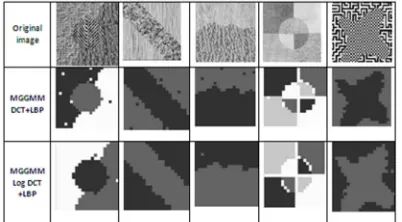
ij are [image:5.612.91.292.570.681.2]obtained for each group using heuristics clustering and moment estimators. Using these initial estimates, the refined estimates are calculated based on the updated equations obtained through EM Algorithm. With these values, texture segmentation is performed based on likelihood of data belonging to a particular group. Then the segmentation image is drawn for the proposed algorithm. The segmentation and quality metrics are evaluated for the proposed model.
Figure 2: Original And Segmented Texture Images With LBP Features
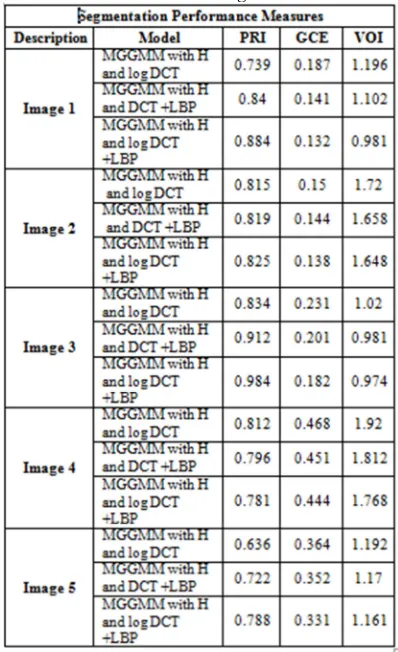
The image segmentation performance measures namely; Probabilistic Rand Index (PRI), the Variation of Information (VOI) and Global Consistency Error (GCE) are computed for the proposed method. The Rand index given by Unnikrishnan et al (2007)[18] counts the fraction of pairs of pixels whose labeling are consistent between the computed segmentation and the ground truth. This quantitative measure is easily extended to the Probabilistic Rand index (PRI). The variation of information (VOI) metric given by Meila (2007)[19] is based on relationship between a point and its cluster. It uses mutual information metric and entropy to approximate the distance between two clustering’s across the lattice of possible clustering’s. It measures the amount of information that is lost or gained in changing from one clustering to another. The Global Consistency Error (GCE) given by Martin D. et al (2001)[20] measures the extent to which one segmentation map can be viewed as a refinement of segmentation. For a perfect match, every region in one of the segmentations must be identical to, or a refinement (i.e., a subset) of, a region in the other segmentation .
ISSN: 1992-8645 www.jatit.org E-ISSN: 1817-3195
[image:6.612.93.292.113.439.2]205
Table 1: Segmentation Performance Measures Of The Textured Images
From Table 1 it is observed that the segmentation performance measures of the proposed segmentation algorithm are closer to the optimal values of PRI, GCE and VOI.
[image:6.612.317.519.211.480.2]Table 2 presents the miss classification rate of the pixels of the sample using the proposed model and earlier Gaussian mixture model.
Table 2: Miss Classification Rate Of The Classifier
Model Miss-classification
Rate
MGGMM-H and
log DCT 12% MGGMM-H and
DCT +LBP 10% MGGMM-H and
log DCT+LBP 9%
From the Table 2, it is observed that the misclassification rate of the classifier with the
multivariate generalized Gaussian mixture model is less when compared to that of GMM.
The accuracy of the classifier is also studied for the sample images by using confusion matrix for segmented regions and computing the quality metrics [21].Table 3 shows the values of accuracy, Sensitivity,Specificity,Precision, Recall,F-Measure for the segmented regions in the image texture.
Table 3: Comparative Study Of MGGMM Withhierarchical Clustering Algorithmwith Variants Of
DCT, LBP And Log DCT
From Table 3, it is observed that the F-measure value for the proposed classifier is more than the earlier Gaussian mixture models. This indicates that the proposed classifier perform well than that of Gaussian mixture model.
8. CONCLUSIONS
[image:6.612.97.290.565.685.2]ISSN: 1992-8645 www.jatit.org E-ISSN: 1817-3195
206 information and LBP image is considered for feature vector extraction. The LBP image is divided in to blocks of non overlapping regions. For each block, the DCT coefficients are computed and are selected in zig0zag pattern. The obtained DCT coefficients form the feature vector for texture segmentation. The EM algorithm is considered and initial parameters are obtained using Hierarchical clustering algorithm and moment method of estimation. The updated parameters are computed and segmentation is performed based on maximum likelihood under Bayesian frame. The performance of the segmentation algorithm is evaluated by considering five random images chosen from Brodatz texture database. It is observed that the model using DCT and LBP performs better than earlier methods based on DCT and DCT under logarithmic domain. It is also observed that the performance metrics namely GCE,PRI,VOI,F-measure are better than earlier models. It is possible to extend this algorithm using truncated generalized Gaussian distribution with DCT and LBP which will be taken elsewhere.
REFERENCES:
[1] Pal S.K and Pal N.R. (1993), “A review on Image Segmentation Techniques”, IEEE Trans. on Pattern Recognition, Volume 26(9), pp.1277-1294.
[2] Vaijainath V. Bhosle, VrushsenP.Pawar (2013), “Texture Segmentation: Different Methods”, International Journal of Soft Computing and Engineering, Vol.3(5), pp. 69 -74.
[3] Permuter Haim, Joseph Francos and Ian Jermyn (2006), “A study of Gaussian mixture models of color and texture features for image classification and segmentation”, Pattern recognition Society, Vol.39, pp.695-706. [4] Geman. S and Graffigne.C ((1987), “Markov
random field image models and their applications to computer vision”, Proceedings of Intl. Congress of Mathematicians 1986, American Mathematical Society, pp.1496-1517.
[5] Permuter Haim, Joseph Francos and Ian Jermyn (2003), “ Gaussian mixture models of texture and colour for image database retrieval”, Proceedings of IEEE Intl. Conference on Acoustics, Speech and Signal processing, Vol.3,pp.569-572.
[6] Naveen Kumar .K, Srinivasa Rao.K, Srinivas.Y and Satyanarayana. Ch(2015),
“Texture Segmentation based on multivariate generalized Gaussian mixture model” ,CMES Journal, Vol.107(3),pp.201-221.
[7] Naveen Kumar. K, Srinivasa Rao.K, Srinivas.Y and Satyanarayana. Ch(2015), “Texture Segmentation using multivariate generalized Gaussian mixture model under log DCT domain”, International Journal of Applied Engineering Research, Vol.10(22), pp.43045-43051.
[8] Rao K.R. and Yip P. (1990), “Discrete Cosine Transform – Algorithms, Advantages, Applications”, Academic press, New york, USA
[9] Haritha .D, Srinivasa Rao.K, Srinivas.Y and Satyanarayana. Ch(2012), “Performance evaluation on the effect of combining DCT and LBP on Face recognition system”, International Journal of Modern Education and Computer Science , Vol.4(11),pp.21-32. [10]Huang Di., Yunhong Wang(2011), “Local
Binary Patterns and its applications to facial Image Analysis: A survey”, IEEE trans. On Sys. Man and Cyber., Vol.41(6),pp.765-781. [11]Chi Ho Chan, Josef Kittler and Kieron
Messer(2007), “Multi scale local binary pattern histogram for face recognition”, Intl. Journal of Advances in Biometrics, Vol.4642(9),pp.809-818.
[12]OjalaT.,Pietikainen.M and Maenpaa.T (2004), “Multiresolution gray-scale and rotation invariant texture classification with local binary patterns”, IEEE Trans. on Pattern Anal. and Machine Intel., Vol.24(7), pp.971-987. [13]M.S.Allili and NizarBougila (2008), “Finite
generalized Gaussian mixture modeling and applications to image and video foreground segmentation”, Journal of Electronic Imaging, Vol. 17(13), pp.05-13
[14]Mclanchlan G. and Peel D.(2000), “ The EM Algorithm For Parameter Estimations”, John Wileyand Sons, New York -2000.
[15]Shaoquan YU, Anyi Zhang, Hongwei LI (2012), “A Review on estimating the Shape Parameters of Generalized Gaussian Distribution”, Journal of Information
Systems, Volume 8(21),pp.9055-9064
[16]Srinivas Y. and SrinivasRao K. (2007), “Unsupervised image segmentation using finite doubly truncated Gaussian mixture model and Hierarchical clustering”, Journal of Current Science ,Vol.93(4), pp.507-514. [17]P. Brodatz, Texture: a photographic album for
ISSN: 1992-8645 www.jatit.org E-ISSN: 1817-3195
207 1966.(http://sipi.usc.edu/database/database.php ?volume=textures).
[18]Unnikrishnan R., Pantofaru. C., and Hernbert M. (2007),“Toward objective evaluation of image segmentation algorithms,” IEEE Transactions in Pattern
Annl.&Mach.Intell,Vol.29(6), pp. 929-944. [19] M. Meila (2007), “Comparing clusterings- an
information based distance”, Journal of Multivariate Analysis, Vol. 98,pp. 873 - 895. [20] D. Martin, C. Fowlkes, D. Tal and J. Malik
(2001), "A Database of Human Segmented Natural Images and its Application to Evaluating Segmentation Algorithms and Measuring Ecological Statistics", Proc. 8th Int’l Conf. Computer Vision, Vol. 2, pp. 416-423.