Full Length Research Article
EVALUATING A PEER MENTORING PROGRAMME FOR HARD-TO-REACH YOUTH
*
Efthymia Efthymiou
Assistant professor, Special Education, United Arab Emirates University, Al Ain, United Arab Emirates. 15551,
United Arab Emirates
ARTICLE INFO ABSTRACT
Peer mentoring is widely used in counselling, guidance, and vocational, socio-psychological support for young people at risk involving one-to-one structured interaction with another young individual. The ‘Young People’s Program’ is a preventative intervention project designed to provide learning and thinking skills in young people in order to develop social awareness, interpersonal skills and increase their chances of employability. The article outlines the program set-up, selection of participants, including the program’s challenges, outcomes and impact on those involved. Future implications of the project are stated.
Copyright © 2016, Efthymia Efthymiou. This is an open access article distributed under the Creative Commons Attribution License, which permits unrestricted use, distribution, and reproduction in any medium, provided the original work is properly cited.
INTRODUCTION
In 2012, the Department of Special Education, at a public university in Lincolnshire, UK, were charged with the delivery of a preventative intervention project over a period of four years (2012-15). This program was in partnership with a private youth organization in the UK, which provided funding to deliver this project, and by an accredited awarding body providing accredited courses to young people. The project, which targeted young people across East Midlands in England, was aimed at young people aged between 14 and 25 years of age, who were disadvantaged or marginalised, for example young people from low-income families, ethnic minorities, or with disabilities. The main aim of the project was to develop learning and thinking skills in young people in order to develop social awareness, interpersonal skills and increase their chances of employability. The support services were provided ‘to young people by their peers’ who were engaged in the role of youth facilitators, peer and cyber. Those young people who demonstrated social and collaborative skills were invited to complete an 8-week accredited course on peer and cyber mentoring, with an additional specialist training in an area of interest, i.e. smoking, sexual health issues. The aim was to introduce young people to the skills required to guide,
*Corresponding author: Efthymia Efthymiou,
Assistant professor, Special Education, United Arab Emirates University, Al Ain, United Arab Emirates. 15551, United Arab Emirates.
support, and advise other young people for making a positive contribution to their family, school, community, or wider society. The project also aimed to equip the participating young people with self-confidence and self-esteem so that they could successfully deal with significant life changes and challenges in the future. The project was committed to providing real skills that can aid young people in gaining future employment, which, in turn, could help them contribute to building a more cohesive, empowered and active community and increase the number of young people on the path to success. The ‘Young People’s Program’ promoted the benefits of peer mentoring as this has been identified as a reliable predictive factor for school drop out (Orr, 1987) with multiple benefits including academic progression (Fantuzzo, Polite, and Grayson, 1990); increase of self-esteem (Sprinthall, Hall, and Gerler, 1992); positive peer interactions (Wells, 1990); and decrease in disruptive school behavior (Greenwood, Carta and Hall, 1998) for hard-to-reach young people who choose not to participate in school activities, resist to comply with school rules, are poorly socialised, and withdraw from school (Bhaeman and Knopp, 1988). The impact of peer mentoring is evident in the professional progress of protégés as they learn new skills (Janasz and Godshalk, 2013) and the psychosocial benefits as it supports individuals that experience poor family support (Johnson, 1997).
ISSN: 2230-9926
International Journal of Development Research
Vol. 6, Issue, 03, pp. 7177-7187, March,2016
International Journal of
DEVELOPMENT RESEARCH
Article History:
Received 24th December, 2015
Received in revised form 08th January, 2016
Accepted 15th February, 2016
Published online 31st March, 2016
Key benefits of the ‘Young People’s Program’ project
The project offered a number of benefits to those young people who participated, including:
Achievement of accredited skills qualification for peer and cyber mentoring programmes;
Increased self-esteem; Increased learner confidence; Increased employability; Transferable skills;
Increased social awareness and responsibility; and
Opportunity to collaborate and exchange ideas with young people from different backgrounds and communities.
For those young people who participated in this project, this not only increased their communication and learning skills, but also provided them with the opportunity to become mentors on future projects, which could develop their skills further. The evaluation explored all of the elements outlined above, including how they were operationalised and influenced those involved.
Staff team
It was important to explore the perceived impact and the benefits on the young people involved in the project. This included the roles of the youth facilitators, peer, and cyber mentors, planning and preparation for the project, and delivery of the project. We were interested in engaging with these people, who used the provision and explored their experiences, the benefits and outcomes for the community, the perceived benefits for the young people and any problem areas.
Young people
Given the short timeframe for the evaluation, the data collected only from four young people who participated in the project. However, there was interest to explore any academic and/or social benefits for those involved in the project.
Parents
It was important to engage with those parents experiencing the provision in order to examine their views of the impact of the project on their children, who were actively involved in the project, as well as the ways in which they perceived the benefits for young people and the wider community in general.
Managers
The views of the managers of the organisations targeting young people, who supported the project, were essential for understanding their contribution to the project and their effect on young people’s involvement.
The managers’ feedback on the services and the resources provided via the ‘Young People’s Program’ project for young people was also interested in exploring the quality and nature of these services for meeting the diverse needs of young people.
MATERIALS AND METHODS
Research design
The evaluation adopted a qualitative approach involving:
Interviews with the staff team of the ‘Young People’s Program’;
Interviews with the young people participating in the project;
Interviews with the managers of organisations contributing to the project; and
Interviews with the parents, whose children were actively involved in the project.
Hence, the evaluation intended to use qualitative methods. This approach enabled the collection of in-depth data from different sources – e.g. youth facilitators, young people, parents, managers –with the purpose of strengthening the validity of our findings by triangulating results obtained by the different informants. Qualitative data were collected using individual, semi-structured interviews with the participants, which were conducted face-to-face. All participants were initially contacted via phone and email asking for permission to participate in interviews regarding the evaluation of the project. The study adhered to strict ethical guidelines protecting the anonymity and confidentiality of participants (staff team of the ‘Young People’s Program’, young people, parents, and management committee in partnership with the private youth organisation). The specific method is described below.
Interviews
The interviews explored issues relating to the project, focusing especially on the involvement of the participants, delivery of the project, benefits and challenges for young people, parents, managers and staff team, and perceived outcomes. The questions designed were open-ended, semi-structured, for allowing the participants to expand on their responses and discuss in-depth the issues explored. A total number of 12 interviews were conducted (See Table 1) on the premises of the private youth organisation, in November 2012.
Interviews were carried out to investigate the perceptions of participants’ experiences of the project, as well as to explore their views on benefits to the young people. The sample involved people from various backgrounds who were active participants in the implementation and delivery of the project were asked to express their views regarding their experiences of the ‘Young People’s Program’ provision. The overall number of the participants is presented in Table 1:
Table 1. Categories of the participants involved in the evaluation of the ‘Young People’s Program’ project
Staff team 2
Young people 4
Parents 4
Each participant was asked to identify their role and responsibilities during their participation in the ‘Young People’s Program’ project (Table 2).
Coding and analysing interview data
All interviews were stored securely as Word documents. Initial data reduction was carried out by a preliminary first level coding of transcripts using broad themes derived from the interviews schedules. Second level coding was then carried out to identify emergent issues within these themes. As the researcher’s coding the interviews was also involved in the data collection, coding checks were carried out for reliability. This procedure helped to clarify of definition of the codes used.
RESULTS
This section reports the findings from the interview strand of the evaluation. Key areas from the interviews were used to organise the data. A summary table of responses appeared at the beginning of relevant sections, and anonymised, illustrative quotations were used where appropriate.
Reasons for the participants’ involvement in the project
[image:3.595.142.462.374.560.2]The participants were asked how they came to be involved in the project (Table 3). The participants mentioned various reasons for getting involved in the project. For the staff team, there was an interest in peer and cyber mentoring and in promoting the associated accredited qualifications and transferable skills. The young people and their parents also saw this as a positive reason for involvement. The young people, who were committed to an active engagement in delivering workshops and mentoring services, saw the opportunity as one, which would facilitate contacts with managers, and would increase their self-confidence, and chances of finding a job in the future. The participating parents were very enthusiastic about their children’s involvement in the project, especially because of their personal and academic/professional development and increased sense of social responsibility. There was also a feeling of contributing to the community of young people with similar concerns.For those managers involved in managing various aspects of the provision, the ‘Young People’s Program’ project was seen as an opportunity to extend existing provision into new areas and, thus, to develop more job placements and social awareness and responsibility to young people.
Table 2. Role responsibilities of the participants in the ‘Young People’s Program’ project
Summary of responses: Role responsibilities
Informing young people
Informing parents
Training young people
Delivering mentoring services
Instructing
Delivering the project to young people
Advertising the project
Communicating with organisations
Arranging open evenings for the parents of the young people in the project
Monitoring the delivery of the project
Scheduling to deliver the project
Assisting with the project development
Organising and delivering the website services
Implementing and delivering team-oriented activities
Supporting staff team and young people in the implementation of activities
Participating and organising events for young people
Assisting in the planning and delivery of the project
Table 3. Reasons for involvement in the ‘Young People’s Program’
Summary of responses: Reasons for involvement in the ‘Young People’s Program’ project
Acquiring accredited qualifications
Delivering peer mentoring
Delivering cyber mentoring
Designing and organising material for the youth organization’s website
Accessing new organisations with the potential of further collaboration
Developing new opportunities for work
Developing employability skills
Developing employability skills
Actively participating in team-oriented activities
Collaborating with organisations that support young people
Supporting young peers with similar problems
Identifying the benefits of the project to the participating young people
Delivery of the services from young people to peers
Organising and delivering social events
[image:3.595.140.462.608.767.2]It also became clear that the organisational bodies involved in the project had a clear commitment to collaborating on the ‘Young People’s Program’ project fulfilled many of their joint objectives.
Partnership with the youth organization
The experience of partnership and collaboration of other organisations with the private youth organisation was described by the participating managers as very positive and identified the contribution of the project to young people as significant and influential. They pointed out that the delivery of accredited qualifications, employability, and promotion of other positive skills has been ‘phenomenal’.
One of the reasons that this has been successful is due to the collaboration of their organisation with the youth organisation for the delivery of projects, events and specific services for young people underlined by common philosophy and values. As two interviewees commented, the collaboration with the youth organisation provided positive services that meet the diverse needs of young people:
With the youth organisation we’ve got the same kind of values and ethos...We delivered employability workshops for young people and an information, and advice and guidance course. Giving young people the skills to go out and work with other young people... signpost them to different organisations or where to go for help when looking for work...
It’s been really positive actually, as I said there was very little work been done around children and young people and obviously, have got fantastic networks and links with young people and what happened was that was sort of combined my expertise around smoke free with Mary’s expertise around peer mentoring and we actually wrote, developed and put together a training course which is accredited for young people around smoke free, so once they’re undergone that training they are qualified to become smoke free peer mentors in their community, in their school and college… so it has been a really positive relationship…
Participation in similar project in the past
Some of those interviewed had participated previously in projects similar in nature to the ‘Young People’s Program’ project:
At that time, we were running a career fair for young people...
I was a volunteer in other youth projects...
Another interviewee had been involved in the delivery of different youth projects with the contribution of the youth organisation:
I worked on a number of projects…a sports project… a six-week summer programme…worked with youth defenders... having joined all these projects and got the necessary experience, I applied for the youth facilitator position...
Setting up the ‘Young People’s Program’ project
Objectives of the project
For all the interviewees, the objectives of the project were stated in terms of supporting the academic/professional, personal, and emotional development of the participating young people:
If a young person has an idea of something that they want to do and they are passionate about, then we’re trying to support them... and it’s also about doing a lot of consultation with young people to find out what they think their main issues are and then our project develops from there, it’s about improving the lives of young people, improving their confidence, and giving them transferrable skills so, things like communication skills and understanding different social situations, hopefully that can get employment...
Build links with other businesses and organizations so that we can link young people to these organisations and offer them work experience…
...increasing young people’s confidence and giving them transferable skills that will help them go to employment
For some, the objectives of the project were also identified in relation to the empowerment of young people to raise their issues, the improvement of their lives, and their input on what kind of and in what ways services are provided:
...empowering and enabling young people to have a voice within their community, to make a difference, providing young people with a range of skills because they are actually the adults of tomorrow, so they have an opinion on service delivery, on services that should be provided and obviously, that peer-to-peer support has been proven, there is a good, strong-based evidence for peer mentoring
...we’re trying to reach the voice of the management committee and what they think about our issues that need to be addressed
An interviewee identified the success of the project as the active engagement of the young people in the learning process in order to acquire further skills and the delivery of the project from young people to other young people:
It gets the point across…it’s more of a helping hand…it brings the message across clearer…it is the only project that makes young people feel that they’ve got responsibilities and makes them feel better about themselves
To empower young people, to give them the skills, and the tools to be able to support each other, to know where to go for different services…the fact that the young people have been able to engage with decision makers from the services, this has been really powerful…the project has been there for young people, to talk about their issues, it was up to the young people to lead the project
Furthermore, the delivery of the project was an opportunity to motivate and encourage young people to express their ideas and to engage in the development of the project for studying the outcomes of such an approach on their level of achievement and creativity:
I feel that the services were really positive, I think there was an element of sort of personalities, I trust their ability to go out and reach young people across the city and I think that one of their values is really targeting and achieving engagement of how to reach young people, I think they do really well with that, they’re very positive, creative, they listen to young people’s ideas and help young people develop those ideas, so that they can actually feel the sense of achievement as well, it’s very much an attitude of ‘you can do it not we will do it for you’, so the ownership is on young people and help them on\build on any ideas that they have...
Benefits of the ‘Young People’s Program’ project
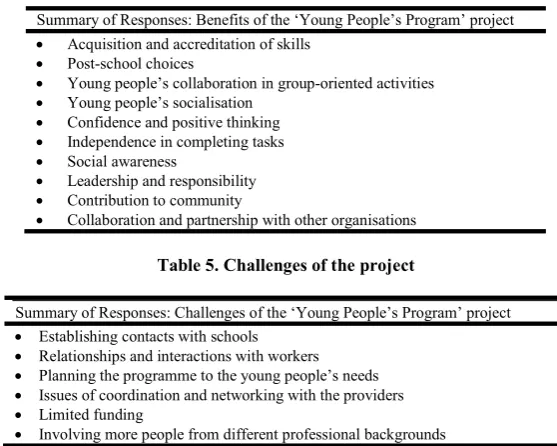
The main benefits of the project according to the interviewees’ responses are presented in Table 4. The summary of responses refers to benefits to the young people and to others.The participants’ accounts about the benefits and challenges of the project are discussed in more detail in the following sections.
Benefits to the young people
Skill acquisition
More common were comments relating to the attainment of employability skills for young people and their socialisation with other people:
But from coming here I didn’t realize he has done so many courses and has got so many certificates, he’s really proud of them, he’s got them all in a neat little folder and he uses each one of them as a stepping stone, and he’s starting a new course he’s going back to the previous ones, and I was thinking if he wasn’t here he wouldn’t have this opportunity cause social courses are not out in the community anymore
They were really committed, just went for it, attended every week … skills developed and confidence and the amount of knowledge that they have around the smoke free agenda is absolutely brilliant, you know they put themselves in situations that they have to talk to people they don’t know start conversations about smoke free… some of those young people have quit smoking…
Two interviewees referred to the young people’s beneficial acquisition of leadership skills in delivering peer mentoring sessions and in increasing self-confidence and motivation:
It was nice because when I did that peer mentoring course I’ve seen how they have achieved, how was at the beginning their confidence and now was so much better and they could stand up and talk …and I thought I was like that and I made them feel better and now they’ve done
their peer mentoring course and they are doing the same to other young people…and the more people get involved the better, you see…
When I did the peer mentoring course I learnt all about it and now I’ve ran peer mentoring courses for other young people as well, it’s big goals you can achieve and I have achieved
Promoting self-confidence
[image:5.595.154.451.383.610.2]Overall, the participants’ responses referred to the project’s impact on the young people’s confidence and positive thinking
Table 4. Benefits of the project
Summary of Responses: Benefits of the ‘Young People’s Program’ project
Acquisition and accreditation of skills
Post-school choices
Young people’s collaboration in group-oriented activities
Young people’s socialisation
Confidence and positive thinking
Independence in completing tasks
Social awareness
Leadership and responsibility
Contribution to community
Collaboration and partnership with other organisations
Table 5. Challenges of the project
Summary of Responses: Challenges of the ‘Young People’s Program’ project
Establishing contacts with schools
Relationships and interactions with workers
Planning the programme to the young people’s needs
Issues of coordination and networking with the providers
Limited funding
[image:5.595.163.442.385.608.2]about their future, their focus on qualifications and key skills for their employment:
It improved my confidence, especially my confidence which was low and my confidence now is absolutely amazing, I couldn’t stand in front of someone doing an interview but I’ve done a lot of interviews since then…
Getting young people jobs and making their confidence a bit better, to have someone to trust and someone to talk to…
It made a huge change…he was never one of the kids in crowd, he was always standing at the back, and watching everybody else…when he joined there was a huge change in him, a huge change, it really did bring him out of his shell, it gave him the confidence , and all the skills that he’s still using until this day…so he’s carrying all these skills right through his adult life…but the changes in him were brilliant to see…because I think he felt that at last he found somewhere that he could take part in…
Developing social awareness
A further issue highlighted was that involvement in the project and the young people’s interaction with other organisations has changed their perspectives and awareness of social issues in a positive way:
it is notoriously difficult to stop a young person from smoking once has started … but the way that we approached the subject it wasn’t from a perspective of ‘smoking is bad for you’ it was looking at tobacco as a whole …
This was supported by other interviewees who highlighted how beneficial their interaction with other young people had been in team-oriented activities for promoting awareness:
we’ve got our own actual project, smoking project, and now I’m going to other young people telling them about my experience of what I’ve learned and try to encourage other young people to stop smoking and we delivered a pilot to youth workers in my area about my experience and I did a presentation about other issues around smoking and it was a benefit because it helped one of the youth workers to quit smoking …that boost my confidence again even more so and it was a great benefit to me and we’ve designed posters as well regarding the effects of smoking
Promoting responsibility
The overall responses of the staff team, the managers, and the parents identified the development of responsibility as being promoted to the young people. Those who believed that responsibility was achieved referred to the beneficial outcomes of developing awareness about social and emotional issues:
He knew that what was happening to him was wrong, the bullying was wrong and he was determined that no kid should ever have to go through what he went through…obviously bullying did damage to him,
physically and mentally but it also empowered him to stand up and say ‘this is not right, this is not fair’ and he’s very sensitive anyway by nature so he knew that if he could do something to stop it happening to another child then it’s all being worthwhile…
One interviewee explained that, as the young people were involved in the project and got trained, they developed responsibility to help other young people out.
...training young people to help other young people out
One of the ways in which young people’s responsibility was enhanced was through their active involvement in delivering the objectives of the project. This was supported by other interviewees who identified positive changes in the attitudes of some young people towards their academic and personal life. They believed that responsibility resulted from the skill scheme of work. Furthermore, the young people were encouraged to develop awareness around a different range of social and health issues, i.e., drugs, smoking, sexual health:
there is an international tobacco control conference… and the young people went to the conference and ran the workshop themselves, which was really positive that they had the confidence, and they felt they could use resources well enough, that could engage an adult audience that included specialists, professors on tobacco control, so the whole project is really positive…
Benefits to others
A number of interviewees highlighted the benefits of the project on their children’s emotional well-being. They characterised the effect of the project’s role on the young people’s lives as ‘positive’:
we got some issues with my child, he moved schools through being bullied, he was very shy, reserved; we just felt that anything he could get involved in to help him get over that would be great…would be positive
The parents referred to the benefits of the project regarding their communication and relationships with their children. Specifically, they reported that the project could facilitate their communication regarding their concerns:
If you have something in common with your child and it’s something you could sit and talk about… then that’s great…so if you could share something through the ‘Young People’s Program’ project then that would be brilliant…
I suppose that ‘Young People’s Program’ opened other doors that school life couldn’t…I think we had a tremendous support, I know that they are like a little family in some ways, they all support each other and is like a support network for us and them, for each of them…
Challenges of the ‘Young People’s Program’ project
challenges are discussed with reference to the staff team, the young people and others’ involvement in the project.
Challenges to the staff team
Interviewees identified some of the challenges regarding the relationships of the young people and interactions with organisations and managers during the delivery of the project. In order to minimize the effect of such a challenge, the project was delivered with the support of the staff team:
The relationship they’ve got with the workers, how they interact with each other, is pretty hard to measure unless you’ve seen them from the beginning. Others found some challenging issues regarding the integration of the project’s activities with the young people’s needs and schedules, as they had their school and college responsibilities:
It takes quite a lot of commitment cause obviously it’s entirely voluntary in terms of money and rewarding systems, we don’t really have anything in place so young people literally dedicate so much of their time and obviously a lot of them have school, they might have jobs, they might be caring for someone at home…
I think one of our main challenges has probably been getting the support of schools and colleges to run what the young people want…with one school I worked with they thought that depression was a really big issue and when we spoke to the head teacher they sort of didn’t want to admit that it was an issue within their school so it was quite hard to try and implement our project around emotional well-being… so making sure that it’s the young people that are taking the lead on issues that are important
In addition, to the disruption in young people’s schedules, the effort of the staff team to maintain the interest and engagement of the young people in the project was a challenging issue:
a number of young people who have been engaged, who have issues at home, at work, it has been a challenge to keep them engaged, but the ‘Young People’s Program’ tried to support these young people from liaising with the local authority services, health services, providing transport, visiting, putting themselves out there to help young people, which is quite unique and completely unbiased…
Another interviewee identified the challenge of selecting appropriate young people as the prospective participants in the management committee, and the delivery of the project at the same time.
there has been a turn over…so our management committee which had a group of twenty…went to university or gone into jobs or started college, so we lost a few of the management committee, so at the moment the challenge is to try and add to the management committee and get more diverse and increased numbers
The issue of limited funding has been mentioned by some interviewees, who commented on the disruption it causes to the delivery of some of the activities of the project:
we don’t really get enough funding, we have a very tight budget and the fact that it is very, very hard to get people together because we want everyone to come…
we need more funding...to involve more people in the project
Challenges to the young people
Some interviewees referred to their engagement in the project and the fear they felt at the beginning of their involvement. However, they identified the project as beneficial for their academic and personal well-being.
you feel scared when you don’t know people, if you don’t know anyone...but now I’m a different person at school
I had challenges as I tried to build myself, help myself, but with the help of young people, and staff here, I managed to boost my confidence
Another challenge for young people was to manage their own fears and to accomplish their targets with the help of the project:
Regarding smoking that was a big challenge, even though the help and staff was there, was hard, but I finally managed to quit and I’m so glad I did because I’ve come such a long way now
I was scared...I didn’t want to talk to people...that was a challenge...but the people here helped me
Outcomes of the ‘Young People’s Program’ project
The interviewees identified a number of common outcomes regarding the improvement of the young people’s academic and social skills, which were achieved through collaborative work and diverse learning and social activities:
They’ve got employment people that they are coming to see what we’re actually doing, they encourage young people to actually go out and find jobs…we’ve gained qualifications in journalism, young advisers …
He works for community and voluntary services which is only a year’s apprenticeship but it has opened a career door for him, he’s found something that he wants to take on further, this is his life now…
They also mentioned the young people’s gaining of communication and interpersonal skills, the contribution to and awareness of their community, and the encouragement of the young people to strengthen their personalities and to develop responsibility, which were key foci of the project:
they’ve gained a lot of interpersonal communication skills from the project, they’ve also become more conscious of the wider community rather than their social community…and it has encouraged the young people to believe in themselves, and they’ve been so willing to give back…and I think that they need young people to believe that they are worthy and that they can contribute …
Certain elements of the training really helped with that cause we’re looking at things like assumptions and stereotypes and how we make assumptions about different people and how we stereotype different groups and young people have the chance to reflect on that
However, some interviewees also reported additional outcomes concerning the young people’s collective work, their training, the development of their thinking skills and their self-improvement. Additionally, the commitment and contribution of the young people in making the services more young people friendly was evident in their constructive feedback on the services provided, and their engagement in creative, team-oriented activities:
We gain a lot of confidence…we always involve young people in events…we will all come up with an event and will put all the ideas together and then we will all know what the event is and then we’ll look for venues for it, we’ll go to the publicity…and we’ll find ways of how we’ll promote it…
for whatever I went through at school, I knew they’ll always be there to support me so I thought that was good…before I preferred to work on my own I didn’t prefer to work like in such a large group of young people, I’ve gained expertise in the field, to meet agendas, how to run health and safety, child protection and confidentiality which I’ve gained through my training on different courses…and I put myself out there as an individual instead of trying to hide all the time…when I’m here I feel that people understand me, it’s a kind of acceptance and I need that acceptance…the more developed, energized and more positive you become…
they’ve gone the right way through by coming to the project so instead of getting into trouble and going downhill, they’d come to the group, spoke to other people, moved on, and seen there are better things out there, being encouraged to go to college and being encouraged to do more…
Because he suffers from depression as well…before he came here he stayed in bed all day , when he got involved he couldn’t stay in bed because he had to get up and come here or go to workshops or that short courses that they run, so he got out of bed…he was preparing, he was using his brain for whatever project they were working on and his
associations then weren’t with the people that didn’t want to do anything with their lives, he was then concentrating in people who had ambitions, and looked at their future…there was a fulfilment, a gratification all of a sudden in his life
It opened up opportunities that he might not have been able to explore...
They manage the project and the young people run it, it’s theirs, and that’s what makes it worth because they feel at home here, they’re like a family, when he got in trouble they were so supportive and he still feels part of it which is nice…it’s something constructive in their lives…people that are young but mature enough to take on that responsibility
He wouldn’t speak out loud, he’s really come out of his shell, and at first he was scared with the microphone and… suddenly, how was throwing in jokes, throwing out prays to the people that was introducing and I was thinking ‘wow! Is that my boy?’
We always have celebration events for young people...we do monthly challenges to get young people together; to get them to meet new people...and hopefully to get them on the management committee...
The usefulness of the outcomes of the ‘Young People’s Program’ project
Most of the participants shared the same perspectives in identifying the usefulness of the project’s outcomes, regarding the young people’s acquisition of social skills and attainment of employability qualifications through active learning and participation. Other useful outcomes were recognised in terms of the young people’s increased confidence:
…increasing young people’s confidence and giving them transferable skills that will help them go to employment
Some stated that the project’s outcomes had improved the lives of the young people and, in turn, verified the quality of work that was delivered through collaboration among the staff team and the young people, which could further be used for letting other young people know about their positive experiences:
If we could use the findings in some way of what impact we had, it’s more about the experiences that young people have had...show that to schools and colleges and give them a better understanding of how the project has benefited them and also give them examples of individuals and how this affected their lives.
We would like to involve young people in our projects, to see whether they want to take the lead in some projects and some of the kind of lessons learned from the project, the way young people like to work, or what kind of sessions they like.
Factors with negative impact on the outcomes of the ‘Young People’s Program’ project
The factors that the participants mentioned in relation to negative impact on the outcomes of the project included the shifting of interest and planning from the development of a social enterprise for young people to the promotion of specific services and activities for the young people:
Initially when the project was written, was one of the things they were going to be doing was linking with certain services they have wanted to come aboard for a full partner, that meant that the project had to change… so quite early on it was supposed to be delivered as a shop or a store at the town centre and what is ended up being is a load of different activities all over the city not only in one particular place, I think going back to the original idea it was a really good idea because there is nothing that’s led by young people in the city centre, that young people control and can work with and I think having that kind of shop would probably have made an even bigger difference now.
The small number of the people involved in the management of the project, and the unexpected changes occurred in the management team, affected the delivery of the project and had impact on the young people and the staff team:
Close team, one member left, but this had a negative impact as she had great relationships with young people, team-wise starting again; it was a bit of a stop-start when they recruited new people… impacted on the young people and on the staff team
Other comments referred to the difficulty of the staff team to respond to the diverse needs of the project and to deliver a broad range of training and mentoring sessions as the funding and the number of people involved in the team are limited:
We are quite a small staff team and sometimes is difficult because there might be a need for one or more groups of young people to get training around peer mentoring but obviously there is only the three of us we can only do as much we can do in one place at one time and we’re almost running at the moment to our full capacity… so obviously if we had more funding to enable us to employ more staff that could hugely benefit the project
Finally, the unwillingness of some of the schools to fully support and participate in the delivery and implementation of the project was an issue for some interviewees. Additionally, some interviewees mentioned that other priorities acted as obstacles regarding the communication of the project’s objectives and outcomes to schools:
Schools have their own priorities, they have their targets that they need to meet and the league tables make it even more difficult and they are focused on getting the GCSEs and the A levels that they need to get; so going in and offering something like this project which is quite difficult to explain to people that don’t know what it is and it might not be seen as a priority
…finding it hard to communicate how it can be beneficial to young people, to schools, and colleges
Factors contributed to the successful outcomes of the ‘Young People’s Program’ project
The participants also reported factors, which had a positive impact on the outcomes of the project. Specifically, factors concerning the commitment and contribution of the staff team to the project, the active involvement of cooperative and enthusiastic young people, the motivated staff and young people, the implementation of a broad range of activities and partnership with various organisations for stimulating the interest of the young people in the project, and the contribution of the hard working team staff were mentioned:
The project’s success is based on the young people’s commitment and enthusiasm because they feel ownership over it, because they’ve driven the project forward and have identified what the main issues are within their communities and the schools and colleges that are based in, I think they feel quite an affinity with the project…so I would say the young people’s commitment and the staff’s commitment…
We’re doing a lot of partnership work, because we work with young people around a range of different issues like sexual health, drugs, smoking, teenage pregnancy, obviously because we’re such a small staff team, we might not have the knowledge to be able to address all of these issues so we’re trying to bring in a specialist sort of advice, so we’ve got funding to deliver a smoke free peer mentoring project around helping young people to stop smoking, we’ve also partnered with an organization which is a global development education charity because of our young people develop workshops around looking at different global issues and help young people to make personal links to global matters…we work with twelve schools and colleges at the moment and deliver our peer mentoring sessions
it’s the people that make the project, because they care about the young people and because if it was ran by different people it wouldn’t have been the same…the belief that they have in the project the young people take on as well…
Other factors reported were the involvement of inspirational, flexible and experienced staff for delivering the project but also the multi-faceted nature of the project:
The passion of the experienced staff, just them being as interested as the young people are, the different activities, fun and attractive activities, the debates, the challenge, the residential, the conferences, the guest speakers, they always allowed the young people to have a big saying of what they actually do…
A number of respondents highlighted the support they get from the staff team and the responsiveness to their needs:
they’re always there helping…giving a helping hand…people, anybody could go on the website to see who we are, what we are and what we do and all the different projects we do you can get involved and you can actually comment and if you want to join in you can ask us there, even my blog is up there about my smoking project and people can read it and comment on it and everything is confidential on there as well
The support of the staff; if you are unable to get here, they get travel to actually get you here; they try to encourage you to carry on doing what you’re doing…
This was further supported by comments regarding the commitment and professionalism of the team staff and the effective management and contribution of the participating young people to the successful outcomes of the project:
it’s ran by the kids as well and it’s not a group of adults, telling the kids how to live their lives, this is what we do…it’s the kids themselves on every level so if any of the kids has got a problem they could go to somebody from their own age group…and it’s important for somebody to be listening to these kids and through this project that’s been able to happen…it’s coming from the kids, it’s for them…
It was a project ran by kids for kids…the objective was for the kids to have somewhere and somebody to go to, to have mentors to speak to if they were having issues with anything, at school, at home, and I think they did achieve those objectives…
DISCUSSION
Overall, the participants recognised the usefulness and success of the project in promoting learning, social and leadership skills, and the accreditation of the qualifications, which the young people attained through support and training. The participants referred to the effectiveness of the project in promoting the scheme of skills development, their transferability and accreditation, and in improving confidence and emotional wellbeing. The evaluation of how such provision would work in the future, the practical challenges in the delivery and implementation of the project were also evident in some participants’ evaluations. The contribution of the participating organisations, and specifically the expertise, experience, and support of the staff team, in achieving the goals of the project represent some participants’ evaluations.
In conclusion, we would like to offer the following three key messages, drawn from the interview data, as points, which might be considered in the future development of the ‘Young People’s Program’ project.
Greater focus on communicating the project’s objectives
The young people were motivated through the support of the team staff that ran the project to develop leadership skills, to take on responsibilities, to achieve their targets and to progress professionally, academically and socially. Improvements were identified by the majority of interviewees regarding improvements to how the project could be communicated to other young people and parents with similar concerns. ‘Getting the message out there a bit more’ will prevent the engagement of young people from anti-social activities and will inform those, who are at risk of exclusion about the benefits of the project.
Advertising the project through various ways is significant for getting more young people involved. This is important as the project fostered the young people’s active involvement in team-oriented activities, their socialisation and stimulated their interest to fully attend their activities. Likewise, their emotional behaviour was improved – young people developed awareness regarding the effect of their actions on their academic/professional progress and social well-being. The project helped them to adopt a positive stance and resulted in them showing a determinacy to accomplish their goals.
Widening the focus of the project
A few of those interviewed stated that further involvement of professionals and parents in delivering the objectives of the project would be beneficial. Moreover, the opportunity to investigate more issues regarding the professional, emotional and social life of young people and to gain qualifications that could be identified by managers is seen as essential and an important motivating factor.
REFERENCES
Bhaeman, R.D. and Knopp, K.A. 1988. The school’s choice: Guidelines for dropout prevention at the middle and junior high school. Columbus. Ohio: National Center for Research in Vocational Education.
Fantuzzo, J., Polite, K. and Grayson, N. 1990. An evaluation of reciprocal peer tutoring across elementary school settings. Journal of School Psychology, 28, 309-323. Greenwood, C., Carta, J. and Hall, V. 1988. The use of peer
tutoring strategies in classroom management and educational instruction. School Psychology Review, 17 (2), 258-275.
Janasz, S.C. and Godshalk, V.M. 2013. The role of e-mentoring in proteges’ learning and satisfaction, Group & Organization Management, 38(6), 743-774.
Orr, M. 1987. Keeping students in school. San Francisco: Jossey-Bass.
Sprinthall, N.A., Hall, J.S. and Gerler, E.R. 1992. Peer counselling for middle school students experiencing family divorce: A deliberate psychological education model. Elementary School Guidance and Counseling, 26 (4), 279-294.
Wells, S. 1990 At-risk youth: Identification, programs, and recommendations. Englewood, NJ: Teacher Idea Press.