Full Length Research Article
CONNOTATION AND PRINCIPLES OF ECOLOGICAL COMPENSATION IN WATER SOURCE
RESERVE AREAS BASED ON THE THEORY OF EXTERNALITY
1,2,
Wang Aimin, *
2Ge Yanxiang and
2Geng Xiangyan
1
School of Management, Taishan Medical University, China
2
School of Economy and Management, Shandong Agricultural University, Taian 271018, China
ARTICLE INFO ABSTRACT
Understanding the connotation and principles of ecological compensation in water source reserve areas is the basis and guarantee for establishing and improving the ecological compensation mechanism of water source reserve areas. This paper firstly reviews the three stages of ecological compensation research progress. Based on the review, using the theory of externality, the ecological environment system of water source reserve areas is then analyzed. This paper argues that the connotation of ecological compensation in water source reserve areas is a kind of institutional arrangement which is designed to internalize externalities. Finally, based on the understanding of the connotation of ecological compensation in water source reserve areas, five principles for establishing and improving the ecological compensation mechanism are proposed including the principle of fairness and justice, the principle of equivalence of equality and responsibility, the principle of flexibility and effectiveness, the principle of "earmark funds, and implementation by law", and the principle of government compensation supplemented with market compensation.
Copyright © 2016, Wang Aimin et al.This is an open access article distributed under the Creative Commons Attribution License, which permits unrestricted use, distribution, and reproduction in any medium, provided the original work is properly cited.
INTRODUCTION
Water source area is where all kinds of water resources are rooted. The protection of the ecological environment of those areas is related to the safety of industrial and residential water of enterprises and residents. Therefore the Chinese government pays great attention to it, classfies drinking water reserve areas into three grades, namely first grade, second grade and quasi reserve areas, and protection requirements are made accordingly. In recent years, the ecological environment protection of the water source has been remarkable, but the economic and social development of water source reserve areas has been greatly restricted. Ecological compensation, as a means of economic incentives, has played a positive role in a number of aspects, such as coordinating the relationship among interest groups in the process of the ecological environment protection in water source reserve areas,
mitigating conflicts between ecological environment
protection and economic and social development, maintaining social equality and so on. Ecological compensation has become a high profile issue in the current society.
*Corresponding author:Wang Aimin
School of Economy and Management, Shandong Agricultural University, Taian 271018, China.
Before the establishment and improvement of ecological compensation mechanism, the first thing to do is to clarify the connotation of ecological compensation in water source reserve areas. On the basis of analyzing the research progress of ecological compensation connotation at home and abroad, the connotation and principle of ecological compensation in water source reserve area will be parsed.
Research progress on connotation of ecological compensation in China and Abroad
As the water source reserve area is an important part of the whole ecosystem, it is important to analyze the connotation of ecological compensation in China and abroad. Since the late 1980s, a large number of theoretical studies of ecological compensation have emerged, however, the definition of ecological compensation raised by Chinese researchers is similar to the concept of PES (payments for environmental/ ecological services payments) raised by international academics. Understanding of the meaning of the ecological compensation in China and abroad experienced a progressive process, and has now become one of the popular fields of academic research. However, as ecological compensation involves professional knowledge from multiple fields, its connotation has not yet formed a unified and standard
ISSN: 2230-9926
International Journal of Development Research
Vol. 06, Issue, 04, pp. 7701-7707, April, 2016
DEVELOPMENT RESEARCH
Article History:
Received 19th January, 2016 Received in revised form 26th February, 2016 Accepted 13th March, 2016 Published online 27th April, 2016
Key Words:
Water source reserve areas, Ecological compensation, Externality,
definition so far. The experts and scholars in different fields, such as ecology, law and economics, have carried out explanations to the connotation of ecological compensation from different angles and with various emphases.
Spontaneous ecological compensation stage
The original ecological concept of compensation originated from ecology, it refers to the natural ecological compensation., meaning the mitigation and compensation adopted by natural ecological system against ecological damage caused by social and economic activities. Ma (1981) argued that the regulation function of the natural ecological system has a certain degree of mutual compensation; however, with the influence imposed on the natural system by human beings, the compensation and adjusting effect is limited. The first practice of Chinese government in 1983 is the charging of restoration fee for destroying environment by mining phosphorite in Yunnan province. The 1991 edition of Dictionary of Ecological Science defined "Natural Ecological Compensation" as when
biological organisms, populations, communities, or
ecosystems are disturbed, the performance of the mitigation, adjustment of their own state to maintain the ability to survive, or in other words the ability to restore the ecological load. Netherlandish scholars Cuperus et al. (1991) suggested that Ecological compensation is to compensate for the loss of compromised ecological function and quality due to economic development, in regard to making up for the damaged areas of the environmental quality or creating a new area with similar ecological functions and environmental quality. Allen et al. (1996) pointed out that, ecological compensation is a kind of restoration or reconstruction of ecological damage. To sum up, the connotation of natural ecological compensation could be defined as the sensitivity and recovery ability of the natural ecological system after suffering from external interference or damage, that is, the self adjustment and repair capacity of the natural ecosystem in responds to external interferences, regardless of human activities.
Stage of punitive ecological compensation
With the development of science technology economy and society, because of the effect of human activities to the natural resources intensifies, the natural resources cannot rely on their own reparability to be reconstructed, causing the carrying capacity of the natural resources to be under the overloaded state. If not compensated, the self restoring ability will reduce and even be deprived. Therefore, from the late 1980s to the beginning of the 90's, study of ecological compensation mounted, economic perspectives have gradually began to be employed in that, field of study has gradually evolved into the economic means and mechanism for promoting the protection of ecological environment, rather than the initial studies focusing spontaneous ecological compensation of natural ecological system. The economic research of ecological compensation begins in Europe, the concept of ecological compensation was defined as follows, if a approved project damages the natural environment, in order to ensure the stability of the ecosystem, restoration or reconstruction must be implemented according to the principle of "no net loss”, as a means of coping with the negative impact on the natural ecological system due to the construction of infrastructure. As
the study and practice of ecological compensation theory progresses, scholars began to believe that ecological compensation is an economic means to motivate people to protect resources and environment. Li (1987) suggested the government to compensate people who live in the mountain forest reserves by the upper reaches of water source, in order to award their contribution for the maintenance of ecological balance in the forest reserve; he also suggested that ecological compensation fee can be extracted from earnings collected from irrigation, water supply etc. Some scholars regarded the ecological compensation as a synonym for compensation for the damage to the ecological environment. Jiang et al. (1990) proposed the principle of "he who pollutes the environment treats; he who exploits protects the environment", on compensating for pollution and ecological damage of agricultural environment. Zhuang et al. (1995) think that the theoretical basis of ecological compensation is the value of ecological environment, which is inherent in natural elements; the ecological environment compensation is compensation for loss of environmental value caused by the damage of ecological environment. He (1999) believes that when units and individuals are in the production of construction and resource development, their actions destroy the sustainable use of water and soil resources, as well as water and soil conservation facilities, topography, geomorphology, etc., thus resulting in the reduction or loss of the original ecological function, they should be charged for compensation, which is actually a social compensation. In this stage, the concept of ecological compensation was given a economic connotation, it mainly emphasizes that the destroyer of the ecological environment should compensate for their destructive behavior, so that the direct loss caused by damaging behaviors to the ecological environment can be compensated and restored. The connotation of ecological compensation is substantially similar to "ecological service fee" or "ecological benefits payment", which is recognized internationally.
Stage of ecological compensation
Since 1990s(From the late 1990s), the connotation of ecological compensation has gained more focus from of life various circles of society focus on the connotation of ecological compensation more deeply,; the content of ecological compensation has changed experienced some new changes on the basis of the previous research. In July 1998, the implementation of the new "forest law" has established the system of forest ecological benefit compensation fund, according to the principles of " he who benefits from
exploiting the environment should compensate for
behavior of damaging (or protecting) resource and environment, and increase the cost (or benefits) of the behavior, thereby stimulate the behavior subject t of the damage (or protection) to reduce (or increase) the external non economic (or external economy) that is brought about by their behavior, so as to achieve the purpose of protecting resources". Shen (2004) believes that ecological compensation is a policy or system, that is, achieving the internalization of ecological protection through a certain policy means, so that whoever benefits from ecological protection should pay the corresponding cost; eliminating "free rider" phenomenon during the consumption of ecological product which is a special public good through system designs, so as to encourage the full supply of public goods; as well as ensuring reasonable return for ecological investors through system innovations, in order to encourage people to engage in ecological protection and investment that promotes ecological capital proliferation. Based on analysis of the external theory of Pigou's welfare economics, Yu Hai et al. (2007) concluded that the ecological compensation is an effective institutional arrangement and policy means, which will internalize externality of the ecological protective or damaging behavior, motivate the ecological protectors or destructors to adjust their own behaviors, so as to achieve the maximization of social welfare, as well as achieving optimal allocation of resources.
By integrating stakeholder theory and ecological
compensation theory, Ma et al. (2014) argued that the ecological compensation is defined as a series of institutional arrangements of the central government or local government. The fundamental goal of this system is to realize the sustainable and healthy development of economy and society. The content of this system is to solve the contradictions between economic development and ecological environment. The principle of this system is to coordinate the conflicts of interest among the main bodies.
Yan Shouguang (2009) pointed out that the connotation of the ecological compensation has gradually been given the legal significance, when it develops from the perspective of ecology to the economic perspective at the same overtime. Zhang Jian (2014) ecological compensation as a kind of interest coordination mechanism, only to enter the legal relationship can be effectively implemented. Zhang Jian (2014) pointed out that as a kind of interest coordination mechanism, the ecological compensation can be effectively implemented only by entering the track of legal relations. From the point of viewpoint of law, Huang Xisheng (2008) think thought that watershed ecological compensation should refer to the situation when a subject to damage emerges because of the use of watershed ecological services that leads to damage of others, or posing negative impact on the natural environment, then the subject to profit should pay the corresponding price, otherwise it will bear the adverse legal consequences. Based on the analysis of the difference between indemnity and compensation, as well as differences between ecological compensation and ecological services payment, Wang et al. (2014) considered the ecological compensation to be a legal system that distributes interests among the beneficiaries and protectors. It is the ecological beneficiaries who protects the ecological environment, so as to realize the sustainable development of river basin economy in various forms of compensation. They believed that the connotation of
watershed ecological compensation should not include the compensation paid for the damage caused by the destruction of the impairers and polluters. And because of its characteristic, it is different from the connotation of the ecological service abroad. Li (2010) thought that the essence of ecological compensation is a compensation for rights, and it adjusts the relationship between environmental interests and economic interests of the stakeholders. And some scholars analyzed the connotation of ecological compensation from the perspective of broad sense and narrow sense. Lv (2003) defined the connotation of ecological compensation from both the broad sense and the narrow sense. Ecological compensation in the narrow sense refers to the general name of a series of activities, such as compensation, treatment, recovery and so on; while in the broad sense, ecological compensation also include financial, physical, technical compensation and beneficial policies for residents who lose the development right because of the protection of the ecological environment, it also includes the expenses for the scientific research and education to improve the awareness and level of ecological environment protection.
The research of this period mainly emphasizes that ecological compensation is an effective system design. It not only charges ecological spoilers for compensation of damaging ecological environment, so as to achieve the effect of internalizing external diseconomy, it also advocates that protectors and builders of ecological environment should be compensated, in order to compensate for their loss of ecological services and the resulting loss. This kind of system arrangement can very well solve the "free riding" phenomenon and "external" characteristics of the special public products, and encourage people to enthusiastically engage in ecological construction and protection, so that the ecological capital can proliferate. According to above analysis, scholars have done a lot of research on the connotation of ecological compensation from the different areas of relevance and different times, however understanding of the connotation of ecological compensation has not unified both the domestically and internationally. These explanations are all followed by the common basis and theoretical sources, the most fundamental purpose of these studies is actually to solve the environmental effects of the externality, so as to alleviate the contradiction between economic and social development, natural resources exploitation and utilization, and to promote the sustainable development of economy and society, as well as balance environmental protection and ecological construction.
Connotation of ecological compensation in water source reserve area
Analysis on the externality of the ecological system of water source reserve areas
economy", Later British economist Pigou made a supplement in 1920s in his book "Welfare Economics", he put forward two concepts of "external non economy" and "internal non economy". And from the perspective of the optimal allocation of social resources in welfare economics, he discussed the theory of externality by using the marginal analysis method of modern economics. And he put forward the net value of marginal society and marginal private net value, and finally formed the externality theory, so the externality theory is also called Pigou theory. Ecological system of water source reserve area is a part of the wetland ecosystem, and it is the important water source securing water supply for enterprises and residents, and it is very important to maintain and protect the ecological environment, the ecological services that it provides are special public products. Non competition and exclusion of public goods lead to over exploitation and utilization , resource allocation inefficiency and market failure of water resources, as well as easily lead to cause the "tragedy of the commons" and the "free rider" phenomenon. The externality of the ecological environment of water source reserve areas is actually an adverse or favorable effect of the ecological economic behavior, which leads to the disproportion of income and cost. Positive externalities refer to the positive effects of this behavior, and negative externalities refer to adverse effects. In order to make sure that the middle and lower reaches of the river get enough and qualified water supply, China has put forward a variety of restrictions on the first grade, second grade and quasi reserved areas, limitations mainly include:(1)use of chemical fertilizers and pesticides shall be banned during the exploitation of land (including farmers who are engaged in the cultivation of crops and economic crops) in in reserved areas when using; (2) enterprises or farmers in the reserved areas shall be moved in accordance with the requirements, or shall be banned from discharging harmful environmental pollutants; (3) residents in the reserved areas shall not be allowed to throw garbage in accordance with the requirements, and shall be required to take on a green lifestyle. In order to secure water supply for the middle and lower reaches, the water source reserve area make sacrifices in the economic and social development, which is essentially an internal non economy, and this is the external economy (i.e., positive externalities) for the middle and lower reaches. Thus, the difference between internal and external emerged. If such sacrifice or loss of the water source reserve area does not get reasonable compensation, the initiatives of ecological environment protection will fall. Then over exploitation of vegetation, deforestation of water conservation forest, and point source pollution as well as non-point source pollution of industrial and agricultural production in reserved areas will appear. These destructions of water safety in the middle and lower reaches of the region is the external non economy (i.e. negative externalities). The externality of the ecological and environmental functions of water source reserve areas can be expressed by the following formula:
1,
2,...,
,
,
j j j j nj mk
E
E
Y
Y
Y
Y
j
k
1, 2,..., ,
i
Y i
n m
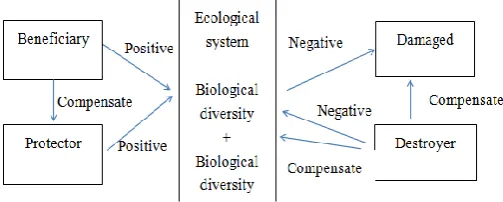
[image:4.595.310.562.346.447.2]Among them, refers to ecological and economic activities, J and K refer to different organizations or individuals. The positive externality (or external economy) of ecological environment function of the water source reserve area is the spillover of the ecological environment function that makes the profit of the society exceed the income of the reserved area, and generally the income outside of reserved areas is often greater than that of the reserved areas. Xie et al (2009) thought for water source reserve area of ecological compensation, the punitive taxes or incentives (collectively referred to as the Pigou tax) which was put forward by Pigou in the book of "Welfare Economics", is to make up the difference between the cost and income of the water source reserve areas. Therefore, the purpose of ecological compensation in water source reserve areas is to maintain the ecological balance of the reserved areas, to develop and utilize resources and environment appropriately, to protect the development interests of conservationists, to let the protector or those who reduce damage get compensated, and to let the beneficiaries or destroyer to pay the cost and price. That is, from the system level and market level, minimizing the externality of ecological economy. Compensation for the positive and negative externalities of the water source reserve area is shown in Figure 2.1.
Fig. 2.1. Schematic diagram of positive and negative externalities of water source reserve area
resources effect can be realized, various inputs to the protection of the water source area can be compensated for the value, objects can be replaced, so as to realize the reproduction and sustainable utilization of the ecological environment system of the reserved area.
Connotation and extension of ecological compensation in water source reserve areas
Based on the above analysis, we believe that ecological compensation of the water source reserve areas is a kind of institutional arrangement which internalizes external effect of the ecological environment. It is established in order to maintain the ecosystem service function of the reserved area, to protect the ecological environment and to maintain sustainable development of resources and economy in the water source reserve area, to punish the destroyer, and to compensate the protector and those who reduce damage. Ecological compensation of water source reserve area is a further expandation and extension in the field of water resource development based on the theory of ecological compensation. It has the characteristics of compensation. Its emphasis is that the ecological environment beneficiaries should compensate the water source protectors and builders in water source reserve areas. The ecological compensation of water source reserve areas mainly involves two aspects:
One is the compensation for the local government and residents in the reserved areas. In order to protect the ecological environment and provide adequate quality water, they have sacrificed the right of economic development. In this case, local government suffer from revenue reduction, farmers experience yield reduction due to loss of arable land or prophibition on the use of fertilizers and pesticides, enterprises are forced to move out of the reserved areas or increase investment on the treatment of water pollutants, residents are relocated as a result of reservoir capacity expansion, and remaining residents are faced with various living restrictions and inconvenience resulting from the rules and regulations in the protection zone. Two is the compensation for protection of the ecological environment and facilities construction investment. In order to protect the ecological environment of the water source area, we need to carry out the maintenance of its infrastructure regularly, implement the construction of reservoir capacity expansion, and equip with all kinds of facilities, such as cleaning and sanitation facilities, sewage treatment equipment, etc., these inputs should be included in the scope of ecological compensation in water source reserve areas.
Principles of ecological compensation in water source reserve areas
The connotation of ecological compensation in water source reserve areas is the basis for forming the ecological compensation system, it runs through the whole ecological compensation system as the soul of the system, leading the institutions and standards of ecological compensation.
The principle of fairness and justice
As a water source area, the water source reserve area is very important for the whole river basin and water quality. As an
effective means of ecological environment protection, ecological compensation system should implement the principle of environmental benefits and the principle of fairness and justice. On the one hand, water resources are the common wealth of mankind, which belong to the public, any person who uses the water resources of the environment should be equal in right. That is to say, a person can not damage the rights and interests of others when using water resources, otherwise, the corresponding compensation should be given to the impaired persons for his behavior; On the other hand, water source reserve areas are often located in remote areas, due to geographic, traffic and other factors, the level of local economic development and income of residents is not high. At the same time in order to maintain the balance of the water environment of the reserved areas, the local government and residents have to give up certain ways of land use, industrial structure development and lifestyle, and these are often able to improve the level of local social and economic development and living standards. However, the land users, enterprises and residents in the water source reserve areas should have the right to development. Their attributions to protect the ecological environment provide a guarantee for the utilization of the ample and high quality water resources in the middle and lower reaches it is necessary to compensate for their contributions. The fair and just principle of the ecological compensation system in the water source reserve areas should be reflected in the aspects of the compensation subject, the standard of compensation and the compensation method. At the same time, it should take into account the economic benefits, ecological benefits and social benefits, so as to maintain natural fairness, as well as fairness within the same generation and across different generations, and to promote the balanced economic and social development of the water source reserve areas and the middle and lower reaches, which is an important part of sustainable development concept.
The principle of equivalence
externalities of ecological services of their protective behavior, they have the right to obtain a reasonable amount of economic compensation, preferential policies or tax relief, which is the way to achieve their economic interests through ownership. Only in this way can the positive external effects be internalized, and can they improve the enthusiasm of protecting the ecological environment of the water source to ensure the sustainable supply of high quality water resources.
The principle of flexibility and effectiveness
Although most of the water source reserve area is located in remote areas, but the characteristics of its ecological region is not the same, and its ecological compensation process involves many stakeholders, which determines that the ecological compensation model is not universal. Therefore, in the formulation and implementation of ecological compensation policy is not appropriate to take the "One size fits all" measure, instead, flexible ecological compensation standards and diversified compensation methods and measures suit local conditions should be employed. At the same time, the flexibility principle needs the wide participation of all interested parties. Therefore, we should improve the awareness and enthusiasm of stakeholders in the protection of the ecological environment of the reserved areas, and strengthen the management of democracy and transparency, thus improving the efficiency of the operation of ecological compensation mechanism. In addition, the ecological compensation system planning should be based on long-term goals, attention should be paid on the long-term effects of the implementation of ecological compensation policy, combined with the short-term effects, in order to ensure the effectiveness of the implementation of ecological compensation policy.
The principle of "earmark funds and implement by law"
Because of the special nature of the water source reserve area, it is in the strategic position of the water source reserve area in the national water security system. So in ecological compensation of the water source reserve area, as the main provider of compensation funds, government should allocate special funds according to the budget, earmark funds to designated use of maintaining and protecting the ecological environment of water source reserve areas, and ensuring the sustainability of the ecological environment. On the other hand, the use of special funds for the construction of ecological should be established and perfected, and strengthen the supervision and management of the use of special funds, and effectively implement the principle of earmarking funds.
The principle of government compensation supplemented with market compensation
Water source reserve areas are the sources of water resources and the birthplaces and upstream of many rivers in China. It has a very important position in the protection of water safety (including water quality and quantity). Water ecological environment of water source reserve area is a kind of public good, it has a public nature, at the same time, because of the externality of water environment, it can easily lead to market failure, requiring government intervention. With the national conditions of China, the government should play a leading role
in the establishment of ecological compensation policy, security, raise of compensation funds, and the supervision and management of the water source reserve areas. But in ecological compensation, on the one hand, although the government compensation of the transaction cost is lower, the cost of the system running is higher, so it needs the market compensation to reconcile the government compensation; On the other hand, the market compensation transaction costs are high, but the system running cost is low, so the market failure and government failure are often two co-existing types of problems. In fact, market failure and government failure are the basic reasons causing the problem of ecological environment. This determines that in the ecological compensation of water source reserve areas, we should take the principle of "government compensation supplemented with market compensation ", so that the ecological compensation system plays an active and initiative role in the protection of the ecological environment of the reserved areas, therefore the ecological compensation policy will be implemented more effectively.
Acknowledgements
Be funded by National Social Science Fund “Study on the construction of ecological compensation system and the related policies of the water source protection zone”(Item number is 14BJY027) ,Research project of Humanities and Social Sciences in the Ministry of Education “Calculation and compensation method of ecological compensation in River Basin”(Item number is 13YJA790025) and Study on ecological compensation policy of drinking water source in Tai'an City—based on the questionnaire survey of residents in water source area (Item number is 15SKX040).
REFERENCES
Allen, A.O. and Feddema, J.J. 1996. Wetland loss and substitution by the section 404 permit program in southern
Califonia. USA [J]. Environmental Management,
(22):263-274.
Biliang, 2005. New institutional economics, Shanxi economic press, 2005
Ceng Xianlei. Chengdu City Xu Yanhe Bai River drinking water ecological compensation of [D]. Xi'an: Xi'an Jiao Tong University, 2014
Dictionary of Environmental Science editorial board. Dictionary of environmental science., 1991. Beijing: Chinese Environmental Science Press, 326. [10] Lai, Huang Xianjin, Liu Weiliang. Research progress of ecological compensation theory and methods [J]. Journal of ecology, 2008,28 (6): 2871-2877.
Ge Yanxiang, Liang Lijuan and Yu Mei, 2006. The construction and operation of the water source ecological compensation mechanism research on the agricultural economy of [J]. 9:22-27.
He Zifu, 1999. On the meaning of soil and water conservation compensation fee and soil erosion control fee [J]. Guangdong water conservancy and hydropower, 5:44-45. Hu Shiqing, 2011. Wu's home training. Nature and
classification of the external nature of contemporary finance, 10:5-14.
Huang Xisheng et al. 2008. Connotation and system of
ecological compensation in river basin [J]. water
conservancy economy, 26 (5): 65-68.
Huang Xisheng, 2012. towering. On transboundary river
ecological benefits compensation principle [J]. Fujian
finance and Accounting Management Cadre College
Journal, 21 (11) 1402-1407.
Jiang Tian, 1990. On the establishment of agricultural
environmental pollution and ecological damage
compensation regulations to explore the protection of agricultural environment, 9 (2): 29-33.
Li Mutang. It is suggested that the state should be compensated [J]. Liaoning forestry science and technology, 1987,6:26-29.
Li Tuanmin, 2010. The basic connotation of ecological compensation of ecological capital equity research [J]. based on forestry economy, 4:100-103.
Lin Ling, 2011. Based on the principle of equitable development of ecological compensation mechanism of in Putian Dongzhen Reservoir Drinking water source reserve areas for example [J]. Fujian finance and Accounting Management Cadre Institute of. 1:14-16.
Liu Sidian, D. mainly research on the principle of compensation for ecological benefit of forest in Beijing: Beijing Forestry University, 2011
Lv Zhongmei, 2003. Beyond and the conservative [M]. Law Press, 355-356.
Ma Guoyong, Chen Hong, 2014. Study on the ecological compensation mechanism based on stakeholder theory [J]. eco economy, 30 (4): 33-49.
Ma Shijun, 1981. The role of ecological law in environmental management -- a brief discussion on the development trend
of modern environmental management [J]. Journal of
Environmental Sciences, 1 (1): 95-99.
Nie Qian, 2014. Foreign ecological compensation practice and policy implications of [J]. ecological economy, 30 (7): 156-160.
Ruud Cuperus 1991. Gudidelines for ecological compensation associated with highways. Biological Conservation, (3):41-51.
Wang Xin, Zhong Chao Zhang, Gaoqi, 2014. Legal thinking on the connotation of river basin ecological compensation
[J]. Journal of Changchun University of Technology
(SOCIAL SCIENCE EDITION), 26: 013007 (6): 52-55. Wang, J. 2006. On harvest. The mechanism and principle of
ecological compensation of natural dialectics research, 2006,22 (1): 31-35.
Xie Jingyi and Yao Yiwei, 2009. Study on the ecological compensation mechanism of water source protection in Danjiangkou reservoir area [J]. theory and practice, 9:89-91.
Yan Shouguang, J. 2009. On environment and sustainable development of the concept of ecological compensation, 3:33-36.
Yu Hai, Ren Yong. Theoretical foundation of ecological compensation: an analytical framework for [J]. urban environment and urban ecology, 2007,20 (2): 28-31. Yu Lu and Yu Fang Li. 2010. The central government supply
areas of ecological compensation defects -- on the contradiction between the principle of compensation and benefits analysis technique [J]. Economy and management research, =6:94-97.
Zhang Jian, 2014. On the legal connotation of ecological compensation [J]. knowledge economy, 9:24-25.
Zhang Shuhuan, 2009. See the economic connotation of [J]. agricultural land ecological compensation from the land requisition compensation and the basis of ecological compensation, 3:27-28.
Zhang Tong, 2011. Study on the ecological vulnerability assessment and ecological compensation mechanism of the water source area of Dalian city [D]. Dalian: Liaoning Normal University.
Zhong Yu, Mao Xianqiang, Zhang Sheng, 2002. Theory of ecological compensation to explore the [J]. China population, resources and environment, 12 (4): 38-41. Zhuang Guotai et al. 1995. The theory and practice of eco
environmental compensation in China [J]. China
Environmental Science, 15 (6): 413-417.