ORIGINAL RESEARCH ARTICLE
CORRELATION BETWEEN BASKET AND PADDLE DISSOLUTION TEST METHODS BY DRUG
RELEASE IN SOLID DOSAGE FORMS FROM NIZATIDINE AND RAMIPRIL
1
Dr. Sambasiva Rao, A. and
2Hareesh Reddy, M.
1
Professor and Principal, Sri Indu Institute of Pharmacy, Hyderabad
2Associate Professor, Shadan College of Pharmacy, Hyderabad
ARTICLE INFO ABSTRACT
Dissolutions studies used both paddle and basket methods to carry to cumulative percent of drug release. In both apparatus which one performs good drug releasing characteristics and simplicity? Pharmaceutical companies strive to ensure that the drugs they product are manufactured in a way that they get absorbed at a rate that will ensure optimum effectiveness of the drug in the body. The rotating speed of the shaft and temperature of the liquid in the vessel is precisely controlled to stomach. The time taken to fully dissolve to sample is then recorded for the scientific analysis. The paddle dissolution method and basket dissolution methods however have unique differences in the way they are carried out. In both methods same conditions are maintained but difference only basket instead of paddle in the equipment. The cumulative perentage of controlled drug release in both methods was very slight difference. Above research studies they are confirm to use in Nizatidine and Ramipril matrix tablets, the percentage of drug release was very slight difference and correlated.
Copyright ©2017,Dr. Sambasiva Rao, and Hareesh Reddy. This is an open access article distributed under the Creative Commons Attribution License, which
permits unrestricted use, distribution, and reproduction in any medium, provided the original work is properly cited.
INTRODUCTION
MATERIALS AND METHODS
Nizatidine: Nizatidine was Kind gift sample from Hetero Pharma India Pvt Ltd, Hyderabad, India. HPMC K4M, Guargum, Carbapol-934 from KP labs, Talc and Magnesium stearate were procured from saraswathia Chemie Pvt Ltd; Mumbai, India. Lactose, PolyvinylPyrollidone and Isopropyl alcohol were procured from S.d fine chem. Pvt Ltd; Mumbai, India. All other chemicals and reagents used were of analytical grade.
Ramipril: Ramipril was kind gift sample from yarrow chemicals private limited, Mumbai India. HPMCK15M, Talc, and Magnesium stearate were procured from KP labs, Hyderabad, India.
*Corresponding author: Dr. Sambasiva Rao, A.
Professor and Principal, Sri Indu Institute of Pharmacy, Hyderabad.
Lactose, Karayagum, Isopropyl alcohol, Polyvinyl pyrrolidone were procured from S.d fine chemicals Pvt Ltd; Mumbai, India. All other chemicals and reagents were used of analytical grade.
Preparation of CR tablets
Nizatidine
Six formulations of controlled release tablets of nizatidine using HPMC K4M and Guargum with three ratios (1:1, 1:2, 1:3) were prepared by wet granulation method. Nizatidine and polymers were mixed separately. Lactose were added to the drug polymer mixture and blended thoroughly for 5 minutes. PolyvinylPyrollidone (PVP) was dissolved in sufficient quantity of isopropyl alcohol (IPA) until it forms a solution and this was added to the drug mixture and mixed thoroughly
to form a coherent mass [15]. Then the coherent mass was
passed through Sieve No: 16 to form granules and the collected granules were dried at 40°C±2°C for 2 hours. The dried granules were passed through sieve No: 22. The granules retained on sieve No: 22 were evaluated for bulk density,
ISSN: 2230-9926
International Journal of Development Research
Vol. 07, Issue, 12, pp.17884-17889, December,2017
Article History:
Received 12th September, 2017
Received in revised form 07th October, 2017
Accepted 14th November, 2017
Published online 30th December, 2017
Available online at http://www.journalijdr.com
Key Words:
Cumulative percent of drug release, Paddle method, Basket method, Nizatidine, Ramipril, Matrix tablets.
Citation: Dr. Sambasiva Rao, A. and Hareesh Reddy, M. 2017. “Correlation between basket and paddle dissolution test methods by drug release in solid
dosage forms from nizatidine and ramipril”, International Journal of Development Research, 7, (12), 17884-17889.
tapped density; bulkiness, angle of repose (Hadjiioannou, 1993), compressibility index and Hausener’s ratio (Table- II&III). Then the granules were mixed with magnesium stearate, talc and finally compressed into tablets (Siepmann, 2001).
Ramipril
Six formulations of controlled release tablets of Ramipril using HPMCK15 and karaya gum each with four formulations (1:1, 1:2, and1:3) were prepared by wet granulation method (Chivate, 2008). The details of each formulation and with composition are shown to Table-2. Ramipril (drug) and polymers HPMCK15M, Karayagum were mixed separately. Lactose and cross caramellose sodium were added to the polymer-drug mixture and blended thoroughly for 5-6 minutes. A coherent mass is formed to dissolve the polyvinyl pyrrolidone (PVP) in sufficient quantity of isopropyl alcohol (IPA) and finally added to drug mixture (Chirico, 2007). Then the coherent mass was passed through sieve number-16 to form granules and the collected granules were dried at
40° ± 2° for 2 hours. The dried granules were passed
through the sieve number-22.The granules retained on sieve number-22 were evaluated for tapped density, bulk density,
bulkiness, compressibility index, Hausners index [4] and angle
of repose. Then the granules were mixed with talc, magnesium stearate and finally compressed in to tablets (Chein, 1992).
RESULTS AND DISCUSSION
Evaluation of Nizatidine granules and tablets
The prepared granules for compression of matrix tablets were evaluated for their flow properties. The bulk density ranged
[image:2.595.310.555.75.191.2]between0.41 to 0.47gm/cm3.
Table 3. Composition of matrix tablet formulation of Nizatidine
Ratio’s of Drug and polymer
Nizatidine: HPMCK4M
Nizatidine: Guargum Ingredients(mg) A1 A2 A3 B1 B2 B3
Nizatidine 10 10 10 10 10 10
HPMCK4M 10 20 30
Guargum 10 20 30
Eudragit 5 5 5 5 5 5
Lactosemonohydrade 61 51 41 61 51 41
Magnesium state 6 6 6 6 6 6
Talc 8 8 8 8 8 8
Isopropyl alcohol q.s q.s q.s q.s q.s q.s
[image:2.595.311.556.225.341.2]Total 100 100 100 100 100 100
Table 4. Composition of matrix tablet [7] formulation of Ramipril
Ratio’s of Drug and polymer
Ramipril: HPMCK15M
Ramipril: Karayagum Ingredients(mg) C1 C2 C3 D1 D2 D3
Ramipril 10 10 10 10 10 10
HPMCK15M 10 20 30
Karayagum 10 20 30
Lactosemonohydrade 65 55 45 65 55 45 Cross caramellose sodium 5 5 5 5 5 5
Magnesium state 4 4 4 4 4 4
Talc 6 6 6 6 6 6
Isopropyl alcohol q.s q.s q.s q.s q.s q.s
Total 100 100 100 100 100 100
Tapped density was within the range of 0.49 to 0.52 gm/cm3.
Bulkiness was found to be the range of 2.36 to 2.46 gm/cm3.
Compressibility index (Korsmeyer, 1983) was found to be the range of 12.26 to 13.36. Angle of repose was within the range of 28.05 to 29.06and Hausners ratio ranged from 1.14 to 1.17. These above values indicate that the prepared granules were exhibited good flow properties. (Table no-3 &5)
[image:2.595.91.507.397.469.2]Evaluation of Nizatidine granules and tablets: The prepared granules for compression of matrix tablets were evaluated for
Table 3. Evaluation of Nizatidine Granules (F1 to F65)
Parameters A1 A2 A3 B1 B2 B3
Bulk density(gm/cm³)* 0.46±0.11 0.43±0.11 0.41±0.31 0.45±0.22 0.43±0.18 0.45±0.16 Tapped density(gm/cm³) 0.52±0.63 0.49±0.24 0.45±0.13 0.51±0.81 0.49±0.17 0.49±0.26 Bulkiness(gm/cm³)* 2.36±0.91 2.41±0.39 2.46±0.13 2.39±0.11 2.41±0.18 2.44±0.11 Angle of repose* 29.61±0.29 28.63±0.35 28.01±0.29 29.05±0.06 28.59±0.63 28.05±0.06 Compressibility index* 13.06±0.0.39 12.89±0.21 12.26±0.17 13.36±0.15 12.87±0.11 13.23±0.10 Hausener’s index* 1.17±0.26 1.16±0.79 1.15±0.09 1.16±0.15 1.16±0.74 1.14±0.29
* All values are expressed as mean± standard deviation, n=5
Table 4. Evaluation of Ramipril Granules (F1 to F6)
Parameters C1 C2 C3 D1 D2 D3
Bulk density(gm/cm³)* 0.41±0.11 0.44±0.10 043±0.50 0.47±0.76 0.43±0.16 0.44±0.56
Tapped ensity(gm/cm³) 0.40±0.91 0.42±0.21 0.41±0.11 0.46±0.32 0.43±0.22 0.44±0.52
Bulkiness(gm/cm³)* 2.43±0.16 2.27±0.71 2.32±0.11 2.12±0.95 2.37±0.18 2.18±0.46
Angle of repose* 22.23±0.94 23.11±0.82 21.9±0.25 24.7±0.12 21.7±0.17 20.7±0.10
Compressibility index* 11.50±0.26 12.24±0.22 12.65±0.91 11.21±0.51 11.61±0.45 12.21±0.11
Hausener’s index* 1.025 1.047 1.048 0.978 1.002 1.011
* All values are expressed as mean± standard deviation, n=5
Table 5. Evaluation of Nizatidine tablets (F1 to F6)
Parameters A1 A2 A3 B1 B2 B3
Hardness*(kg/cm²) 5.01±0.14 5.04±0.29 5.12±0.09 5.09±0.61 5.04±0.31 5.09±0.23 Friability*(%) 0.36±0.04 0.24±0.06 0.21±0.04 0.23±0.05 0.29±0.03 0.25±0.05 Weight variation*(mg) 99.6±4.2 99.1±3.6 99.7±2.9 99.5±3.0 99.3±3.6 99.5±3.0 Content uniformity*(%) 99.45±0.33 97.12±0.12 99.23±0.27 99.48±0.11 96.13±0.23 99.18±0.11 Thickness* (mm) 3.1±0.03 3.3±0.29 3.2±0.51 3.4±0.31 3.2±0.26 3.2±0.51 Diameter*(mm) 7.12±0.02 7.21±0.03 7.34±0.02 7.19±0.05 7.28±0.01 7.36±0.01
*All values are expressed as mean ± standard deviation, n =5 [image:2.595.94.506.511.583.2] [image:2.595.102.495.621.692.2]
their flow properties. The bulk density ranged between0.41 to
0.47gm/cm3. Tapped density was within the range of 0.40 to
0.46 gm/cm3. Bulkiness was found to be the range of 2.12 to
2.43 gm/cm3. Compressibility index was found to be the range
of 11.21 to 12.65. Angle of repose was within the range of 20.07 to 24.07and Hausners ratio ranged from 0.978 to 1.048. These above values indicate that the prepared granules were exhibited good flow properties. (Table no-4 &6)
Case-1 : The percentage drug release of all formulations after 12 hours using HPMC K4M as polymer and paddle method was found to be 85.9% (PA1),84.4% (PA2), 87.1 (PA3) It was
found that the cumulative percentage drug release[1] in the
formulation PA1 was more thanPA2,PA3. The cumulative percentage of drug release in the formulation PA3 showed controlled release than PA1, PA2. A major role played in drug release was the polymer concentration. At higher polymer concentration, the drug release was prolonged than the lower concentration of the polymer. The graphical presentation data of the Ramipril matrix tablet formulations with polymer is shown in (Figure – I)
[image:3.595.97.503.175.247.2]1. Case-(ii): The percentage drug release of all formulations after 12 hours using HPMC K4M as polymer and Basket method was found to be 91.9% (BA1), 89.6% (BA2), 88.8% (BA3) It was found that the cumulative percentage drug release in the
Table 6. Evaluation of Ramipril tablets (F1 to F6)
Parameters C1 C2 C3 D1 D2 D3
[image:3.595.75.529.295.453.2]Hardness*(kg/cm²) 5.11±0.14 5.06±0.29 5.07±0.09 5.02±0.61 5.04±0.31 5.20±0.23 Friability*(%) 0.46±0.04 0.34±0.02 0.11±0.01 0.22±0.05 0.27±0.03 0.23±0.05 Weight variation*(mg) 98.6±4.2 99.1±3.6 99.2±2.9 99.0±3.0 99.3±3.6 99.7±3.0 Content uniformity*(%) 98.45±0.33 98.12±0.12 98.23±0.27 99.28±0.11 96.73±0.23 98.18±0.11 Thickness* (mm) 3.4±0.03 3.1±0.29 3.3±0.51 3.2±0.31 3.3±0.26 3.2±0.51 Diameter*(mm) 7.10±0.02 7.41±0.03 7.14±0.02 7.39±0.05 7.18±0.01 7.26±0.01
*All values are expressed as mean ± standard deviation, n =5
Table 7. Cumulative percentage of drug release from Nizatidine matrix tablet in combination of two different polymers in two different dissolution methods
Time(hrs) Cumulative percentage drug release *
Nizatidine :HPMCK4M Nizatidine : Guargum
Paddle method Basket method Paddle method Basket method
PA1 PA2 PA3 BA1 BA2 BA3 PB1 PB2 PB3 BB1 BB2 BB3
1 17.6 15.1 13.9 17.9 15.8 13.5 14.4 13.2 12.2 14.9 13.9 13.2 2 23.1 22.0 21.2 23.7 21.7 20.6 22.2 21.8 20.6 23.1 22.0 21.6 3 31.7 29.6 28.1 32.4 28.4 27.3 29.0 27.8 24.8 29.8 28.2 26.9 4 39.2 37.3 36.0 40.2 37.2 36.7 37.1 36.6 35.6 38.0 36.3 35.7 5 44.6 43.7 41.9 45.6 43.1 41.5 42.2 41.8 40.6 43.3 43.4 42.6 6 50.9 48.9 45.6 49.5 51.0 45.0 46.6 44.0 43.8 47.2 45.6 45.0 7 58.1 56.4 55.3 57.8 58.9 54.8 56.8 54.9 53.1 57.1 54.1 53.8 8 64.6 63.6 61.2 65.2 63.1 61.8 62.2 61.2 60.5 63.0 60.8 59.1 9 70.9 69.3 68.0 70.4 68.7 69.6 69.4 68.0 67.0 70.4 69.0 68.4 10 78.6 76.1 75.3 77.7 75.2 76.7 75.9 75.3 74.2 74.8 73.4 73.0 11 86.9 85.6 83.1 87.6 84.5 84.7 84.4 83.2 82.2 84.0 83.4 82.0 12 92.4 90.2 87.1 91.9 89.6 88.8 88.7 86.7 84.8 89.8 87.31 86.0 Note- (i) Nizatidine: HPMCK4M PA1, PA2, PA3- Formulation-1, 2,3 (Paddle method)
BA1, BA2, BA3- Formulation-1, 2, 3 (Basket method) Nizatidine: Guargum PB1, PB2, PB3 - Formulation-1, 2,3 (Paddle method) BB1, BB2, BB3 - Formulation-1, 2, 3 (Basket method)
[image:3.595.104.526.492.722.2]formulation BA1 was more thanBA2,BA3. The cumulative percentage of drug release in the formulation BA3 showed controlled release than BA1, BA2.
2. Case (III): The percentage drug release of all formulations after 12 hours using Guargum as polymer and paddle method was found to be 88.74% (PB1), 86.7% (PB2), 84.8 (PB3) It was found that the cumulative percentage drug release in the formulation PB1 was more thanPB2,PB3. The cumulative percentage of drug release in the formulation PB3 showed controlled release than PB1, PB2.
3. Case-(IV) : The percentage drug release of all formulations after 12 hours using Guargum as polymer and Basket method was found to be 89.8% (BB1), 87.3% (BB2), 86.0 (BB3) It was found that the cumulative percentage drug release in the formulation BB1 was more thanBB2,BB3. The cumulative percentage of drug release in the formulation BB3 showed controlled release thanBB1, BB2.
4. Above all cases I, ii, iii, iv. A major role played in drug
release was the polymer concentration [20]. At higher
polymer concentration, the drug release was prolonged than the lower concentration of the polymer. In
dissolution methods [18] like paddle method was
controlled release compare to basket method, but very slight difference was arising.
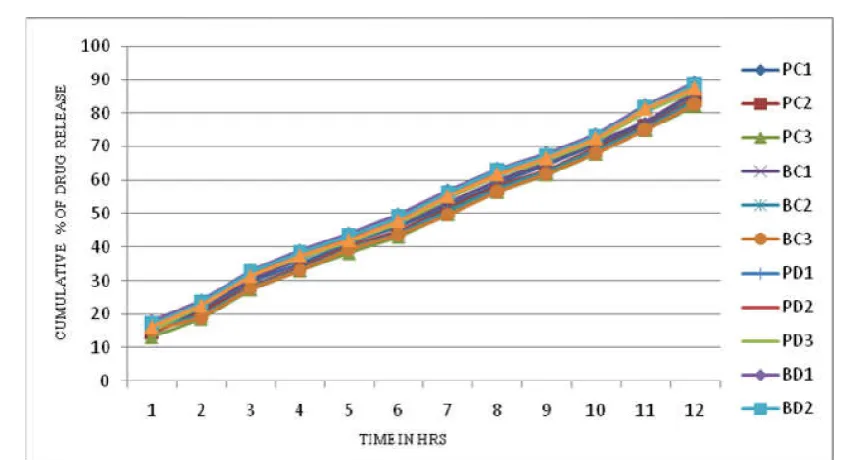
Case-1 : The percentage drug release of all formulations after 12 hours using HPMC K15M as polymer and paddle method was found to be 85.9% (PC1), 84.4% (PC2), 82.1 (PC3) It was found that the cumulative percentage drug release in the formulation PC1 was more thanPC2,PC3. The cumulative percentage of drug release in the formulation PC3 showed controlled release than PC1, PC2
1. Case-(ii): The percentage drug release of all formulations after 12 hours using HPMC K15M as polymer and Basket method was found to be 86.4% (BC1), 83.9% (BC2), 82.9% (BC3) It was found that the cumulative percentage drug release in the formulation BC1 was more thanBC2,BC3. The cumulative percentage of drug release in the formulation BC3 showed controlled release than BC1, BC2.
[image:4.595.67.524.419.774.2]2. Case -(III): The percentage drug release of all formulations after 12 hours using Guargum as polymer and paddle method was found to be 88.2% (PD1), 87.6% (PD2), 86.7% (PD3) It was found that the cumulative percentage drug release in the formulation PD1 was more thanPD2,PD3. The cumulative percentage of drug release in the formulation PB3 showed controlled release than PB1, PB2.
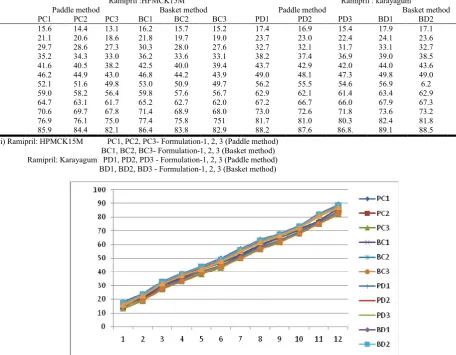
Table 8. Cumulative percentage of drug release from Ramipril matrix tablet in combination of two different polymers in two different dissolution methods
Time(hrs) Cumulative percentage drug release *
Ramipril :HPMCK15M Ramipril : karayagum
Paddle method Basket method Paddle method Basket method
PC1 PC2 PC3 BC1 BC2 BC3 PD1 PD2 PD3 BD1 BD2 BD3
1 15.6 14.4 13.1 16.2 15.7 15.2 17.4 16.9 15.4 17.9 17.1 16.2
2 21.1 20.6 18.6 21.8 19.7 19.0 23.7 23.0 22.4 24.1 23.6 22.5
3 29.7 28.6 27.3 30.3 28.0 27.6 32.7 32.1 31.7 33.1 32.7 31.4
4 35.2 34.3 33.0 36.2 33.6 33.1 38.2 37.4 36.9 39.0 38.5 37.5
5 41.6 40.5 38.2 42.5 40.0 39.4 43.7 42.9 42.0 44.0 43.6 42.1
6 46.2 44.9 43.0 46.8 44.2 43.9 49.0 48.1 47.3 49.8 49.0 47.8
7 52.1 51.6 49.8 53.0 50.9 49.7 56.2 55.5 54.6 56.9 6.2 55.1
8 59.0 58.2 56.4 59.8 57.6 56.7 62.9 62.1 61.4 63.4 62.9 61.7
9 64.7 63.1 61.7 65.2 62.7 62.0 67.2 66.7 66.0 67.9 67.3 66.5
10 70.6 69.7 67.8 71.4 68.9 68.0 73.0 72.6 71.8 73.6 73.2 72.4
11 76.9 76.1 75.0 77.4 75.8 751 81.7 81.0 80.3 82.4 81.8 81.2
12 85.9 84.4 82.1 86.4 83.8 82.9 88.2 87.6 86.8. 89.1 88.5 87.4
[image:4.595.134.471.548.774.2]Note- (i) Ramipril: HPMCK15M PC1, PC2, PC3- Formulation-1, 2, 3 (Paddle method) BC1, BC2, BC3- Formulation-1, 2, 3 (Basket method) Ramipril: Karayagum PD1, PD2, PD3 - Formulation-1, 2, 3 (Paddle method) BD1, BD2, BD3 - Formulation-1, 2, 3 (Basket method)
Figure 2. Percentage drug release of Ramipril matrix tablet formulations
3. Case-(IV) : The percentage drug release of all formulations after 12 hours using Guargum as polymer and Basket method was found to be 89.1% (BD1), 88.5% (BD2), 87.4% (BD3) It was found that the cumulative percentage drug release in the formulation BD1 was more than BD2,BD3. The cumulative percentage of drug release in the formulation BD3 showed controlled release than BD1, BD2.
4. Above all cases I, ii, iii, IV. A major role played in
drug release was the polymer concentration. At higher polymer concentration, the drug release was prolonged than the lower concentration of the polymer. In dissolution methods like paddle method was controlled release compare to basket method, but very slight difference was arising in both methods.
Conclusion
The results of experimental studies of Nizatidine and Ramipril matrix tablets proved that the granules are showed good flow properties, evaluation tests of tablets are within the acceptable
limits, Infra Red (IR) spectral analysis [5] proved that there was
no polymer- drug interaction, all the formulations of kinetic studies were followed zero order drug release and stability analysis revealed that all formulations were found to be stable
after storing at 45° ± 2°C, 75±5% RH up to 45 days. A major
role played in drug release was the polymer concentration. At higher polymer concentration, the drug release was prolonged than the lower concentration of the polymer. In dissolution methods like paddle method was controlled release compare to basket method, but very slight difference was arising in both methods
REFERENCES
An Agarwal, V., Mishra, B. 1999. Design, development and biopharmaceutical property of buccoadhesive compacts of
pentazocine. Drug. Dev. Ind. Pharm., 25: 701-709.
Bourne. D. W. 2002. Pharmacokinetics. In: G. S. Banker, C. T. Rhodes, eds. Modern Pharmaceutical, 4th ed. New York, NY, Marcel Dekker Inc, pp.67-92.
Carstensen, J. T. 1977. Pharmaceutics of solids and solid dosage forms, John Wiley and Sons, New York. p. 100. Chein, Y.W. 1992. Novel drug delivery systems. In: Chien
YW, ed. Oral Drug Delivery and Delivery Systems. New York, NY: Marcel Dekker; 139-196.
Chirico, S., Dalmoro, A., Lamberti, G., Russo, G., Titomanlio, G. 2007. Analysis and modeling of swelling and erosion
behavior for pure HPMC tablet. J. Pharm. Sci 122:181-188
Chivate, A.A., Poddar, S.S., Shajahan, A., Savant, G. 2008. Evaluation of sterculia foetida gum as controlled release
excipient. AAPS PharmSciTech, 9(1): 197-204.
Efentakis, M., Vlachou, M., Choulis, N.H. 1997. Effects of excipients on swelling and drug release from compressed
matrices. Drug Development and Industrial Pharmacy,
23(1):107- 112.
Fernandes, C.M., Ramos, P., Amilcar, C.F., Veiga, F.B. 2003. Hydrophilic and hydrophobic cyclodextrins in a new sustained release oral formulation of Nicardipine: In vitro
evaluation and bioavailability studies in rabbits.
J.Control.Release., 88(1):127-134.
Hadjiioannou, T. P., Christian, G. D., Koupparis, M. A. 1993. Quantitative calculations in pharmaceutical practices and research New Dehli, NY- VCH publishers Inc, pp. 345- 348
Higuchi. T. 1963. Mechanism of sustained action medication, Theoretical analysis of rate of release of solid drugs
dispersed in solid matrices, J. Pharm. Sci. 52:1145-1149.
Korsmeyer, R. W., Gurny, R., Doelker, E., P. Buri, and Peppas. N. A. 1983. Mechanism of solute release from
porous hydrophilic polymers. Int. J. Pharm., 15: 25-35
Mishra, B., Seena, J., Singh, S., Sankar, C. 2003. Development and characterization of matrix tablets of ketorolac
tromethamine. Indian Pharm., 2:86-89.
Mockel, J. E., Lippold, B. C. 1993. Zero-order drug release
[image:5.595.67.528.79.188.2]from hydrocolloid matrices. Pharm. Res., 10: 1066-1070.
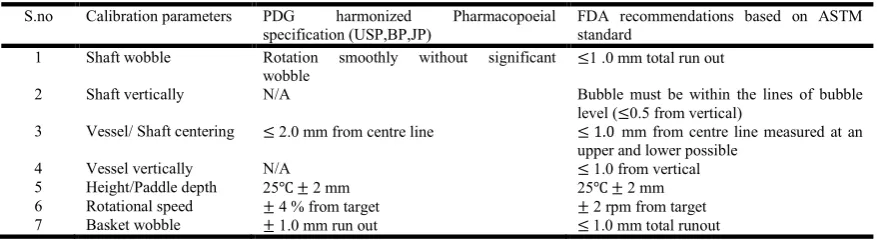
Table 9. Mechanical calibration parameters: Dissolution rotating paddle method
S.no Calibration parameters PDG harmonized Pharmacopoeial specification (USP,BP,JP)
FDA recommendations based on ASTM standard
1 Shaft wobble[9] Rotation smoothly without significant
wobble
≤1 .0 mm total run out
2 Shaft vertically N/A Bubble must be within the lines of bubble level (≤0.5 from vertical)
3 Vessel/ Shaft centering ≤ 2.0 mm from centre line ≤ 1.0 mm from centre line measured at an upper and lower possible
4 Vessel vertically N/A ≤ 1.0 from vertical
5 Height/Paddle depth 25℃ ± 2 mm 25℃ ± 2 mm
6 Rotational speed ± 4 % from target ± 2 rpm from target
Table 10. Mechanical calibration parameters: Dissolution Basket method
S.no Calibration parameters PDG harmonized Pharmacopoeial specification (USP,BP,JP)
FDA recommendations based on ASTM standard
1 Shaft wobble Rotation smoothly without significant wobble
≤1 .0 mm total run out
2 Shaft vertically N/A Bubble must be within the lines of bubble level (≤0.5 from vertical)
3 Vessel/ Shaft centering ≤ 2.0 mm from centre line ≤ 1.0 mm from centre line measured at an upper and lower possible
4 Vessel vertically N/A ≤ 1.0 from vertical
5 Height/Paddle depth 25℃ ± 2 mm 25℃ ± 2 mm
[image:5.595.80.519.219.339.2]Sankar, C., Rani, M., Srivastava, A.K., Mishra, B. Chitosan based pentazocine microspheres for intranasal systemic delivery–development and biopharmaceutical evaluation. Pharmazie. 56: 223-226.
Siepmann, J., Peppas. N. A. 2001. Modeling of drug release
from delivery system based on hydroxypropyl
methylcellulose (HPMC), Adv Drug Deli Rev., 48:139-57
Swarbrick, J. 1996. Advances in controlled drug delivery. S. T.
P. Pharma. 6:53-56
Turner, S., Federici, C., Hite, M., Fassihi, R. 2004. Formulation development and human in vitro-in vivo
correlation for a novel, monolithic controlled- release
matrix system of high load and highly water soluble drug
Niacin. Drug Dev Ind Pharm., 30(8): 797-807.
Vazquez, M.J., Casalderrey, M., Gomej-Amoza, J.G, Martinez- Pacheco, R., Concheiro, A. 1996. Atenolol
release from hydrophilic matrix tablets with
hydroxypropylmethylcellulose (HPMC) mixtures as gelling
agent: effects of the viscosity of HTML mixture. Eur. J.
Pharm. Sci., 4:39-48.