ISSN: 1992-8645 www.jatit.org E-ISSN: 1817-3195
SMALL SIGNAL ANALYSIS OF FLEXIBLE AC
TRANSMISSION SYSTEM USING INTERLINE
POWER FLOW CONTROLLER (IPFC)
1CH. VENKATA KRISHNA REDDY, 2 K.KRISHNA VENI, 3G.TULASIRAM DAS, 4SIRAJ
1Asst. Prof., Department of EEE, CBIT, Gandipet, Hyderabad, India 2 Prof., Department of EEE, CBIT, Gandipet, Hyderabad, India
3
Prof., Department of EEE, JNTUH, Hyderabad, India
4 ME, Department of EEE, CBIT, Hyderabad, India
E-mail: [email protected]
ABSTRAC
The Interline Power Flow Controller (IPFC) is a voltage-source-converter (VSC)-based flexible ac transmission system (FACTS) controller which can inject a voltage with controllable magnitude and phase angle at the line-frequency thereby providing compensation among multiple transmission lines. In this paper, the use of the IPFC based controller in damping of low frequency oscillations is investigated. An extended Heffron-Phillips model of a single machine infinite bus (SMIB) system installed with IPFC is established and used to analyze the damping torque contribution of the IPFC damping control to the power system. The potential of various IPFC control signals upon the power system oscillation stability is investigated a using controllability index. The effect of this damping controller on the system, subjected to wide variations in loading conditions and system parameters, is investigated. Results of simulation investigations in Matlab are presented to validate the proposed approach.
Key words — FACTS, IPFC, Damping, Small Signal Stability
NOTATIONS:
A
P
: transferred power of primary line,B
P
: transferred power of secondary line,e
P
: Total transferred power of lines,s
V
: Terminal voltage of generator,
id
I
: Direct axis current of line i,
C : dc link capacitance
H : inertia constant (M = 2H)
i
m
: Modulation index of series converter
i
δ
: Phase angle of series converter voltage
b
V
: Infinite bus voltage
dc
V
: Voltage at dc link
t
V
: Terminal voltage of the generator
d
X
': Direct axis transient synchronous
reactance of generator
A
K
: AVR Gain
A
T
: Time constant of AVR
iq
I
: Quadrature axis current of line i,
d
X
: Direct axis steady-state synchronous
reactance of generator
q
X
:
Quadrature
axis
steady-state
synchronous reactance of generator,
t
1.INTRODUCTION
Low frequency oscillations with frequency in the range of 0.2 to 2.0 Hz are one of the results of the interconnection of large power systems. Modem power systems are stable if electromechanical oscillations occurring in each area can be damped as soon as possible. To increase power system oscillations stability, Power System Stabilizer (PSS) is a simple, effective, and economical method [1].
"Flexible AC Transmission Systems (FACTS)" technology has been proposed during the last three decades and provides better utilization of existing systems. Interesting FACTS capabilities such as power flow control, damping of power system oscillations, voltage regulation, and reactive power compensation make them a good option for effective utilization of power systems. In this paper one of the FACTS capabilities is damping inter-area oscillations that will be accurately investigated for IPFC.
Interline Power Flow Controller, which is proposed by Guygyi and etal [2] in l998, is a FACTS controller for series compensation with unique capability of power flow management between multi-lines of a substation. In the IPFC structure a number of inverters are linked together at their dc terminals. Each inverter can provide series reactive compensation, as an SSSC, for its own line. However, the inverters can transfer real power between them via their common dc terminal. This capability allows the IPFC to provide both reactive and real compensation for some of the lines and thereby optimize the utilization of the overall transmission system.
Like other FACTS elements, IPFC can be used for increasing power system stability against large and small disturbances.
In this paper the voltage of coupling capacitance between two VSC-based converters is used as a state variable. Output power of the generator is used as an input of PI controller, which creates proper amplitude modulation ratio for the secondary converter.
2.DYNAMIC MODEL OF THE SYSTEM
WITH IPFC
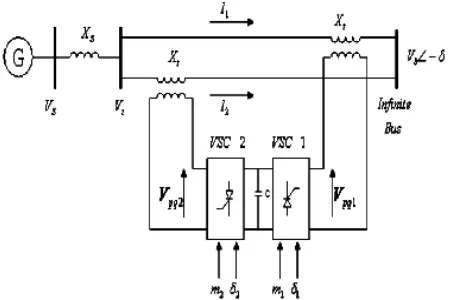
A single-machine infinite-bus (SMIB) system with IPFC, installed on two lines is considered. This configuration which consists of two parallel
[image:2.612.317.544.123.273.2]transmission lines, connects the generator G to an infinite bus, is illustrated in figure 1.
Figure 1 Single Machine Infinite Bus System With IPFC
PSS is not taking into account in the power system. Operating conditions and parameters are represented in the appendix.
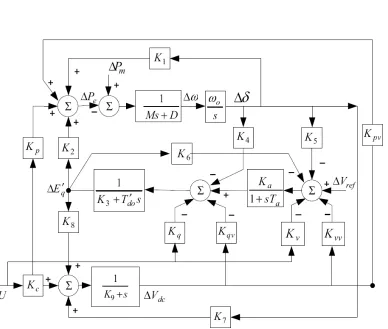
Phillips-Heffron linear model of a single-machine infinite bus system with IPFC is derived from the nonlinear differential equations. Neglecting the resistances of all the components of the system like generators, transformers, transmission lines, and series converter transformers, a nonlinear dynamic model of the system is derived as follows:
(
−
1
)
=
•ω
ω
δ
o --- (1)(
)
[
]
M
D
P
P
m−
e−
−
1
=
•
ω
ω
--- (2)
(
.)
''
/
dofd q
q
E
E
T
E
=
−
+
•
--- (3)
(
)
[
fd A ref s]
Afd
E
K
V
V
T
E
=
−
+
−
/
•
--- (4)
Where,
e
P
=P
1+P
2 --- (5) eP
=V
sd(I
1d+V
sqI
2d) + (I
1q+I
2q) --- (6)q
E
=E
'q+(X
d-X
'd)(I
1d+I
2d) --- (7)s
V
=V
sd+ jV
sq --- (8)=
X
qI
1q+j[E
q'
ISSN: 1992-8645 www.jatit.org E-ISSN: 1817-3195 If the general Pulse Width Modulation (PWM) is
used for VSCs, the voltage equations of the IPFC converters in dq coordinates will be [1]:
+
−
=
2 2 1 1 1 1 1 1cos
cos
2
0
0
δ
δ
m
m
V
I
I
X
X
V
V
dc q d t t q p--- (9)
+
−
=
2 2 1 1 2 2 2 2sin
sin
2
0
0
δ
δ
m
m
V
I
I
X
X
V
V
dc q d t t q p --- (10) where, pqKV
=V
pK + jV
qK=V
pqKe
jδk --- (11)[
1 1 1 1]
1
sin
cos
4
3
δ
δ
q d dc
I
I
C
m
dt
dV
=
+
[
2 2 2 2]
2
sin
cos
4
3
δ
δ
q dI
I
C
m
+
+
--- (12)From figure 1, we have:
s
V
= jX
sI
s+V
pq2+ jX
LI
2 --- (13)This equation in d-q coordinates is as follows:
sd
V
+ jV
sq= jX
s[(I
1d+I
2d)+j(I
1q+I
2q)]+ +jX
L(I
2d+jI
2q)+V
p2+V
bsin
δ
+
jV
bcos
δ
--- (14)
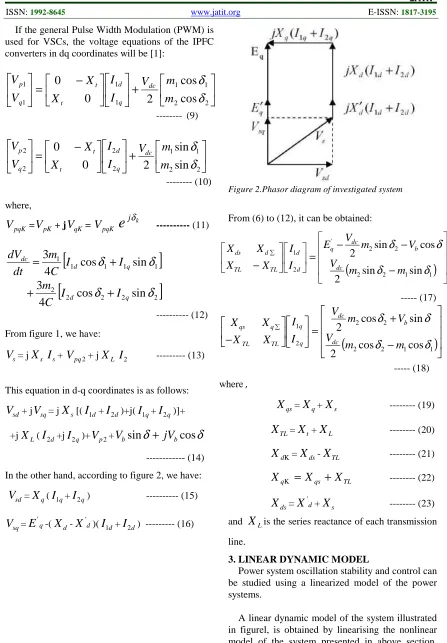
In the other hand, according to figure 2, we have:
sd
V
=X
q(I
1q+I
2q) --- (15)sq
[image:3.612.85.532.70.713.2]V
=E
'q-(X
d-X
'd)(I
1d+I
2d) --- (16)Figure 2.Phasor diagram of investigated system
From (6) to (12), it can be obtained:
(
)
−
−
−
=
−
∑ 1 1 2 2 2 2 ' 2 1sin
sin
2
cos
sin
2
δ
δ
δ
δ
m
m
V
V
m
V
E
I
I
X
X
X
X
dc b dc q d d TL TL d ds(
)
−
+
=
−
∑ 1 1 2 2 2 2 2 1cos
cos
2
sin
cos
2
δ
δ
δ
δ
m
m
V
V
m
V
I
I
X
X
X
X
dc b dc q q TL TL q qs where,
X
qs=X
q+X
s --- (19)TL
X
=X
t+X
L --- (20)Κ d
X
=X
ds-X
TL --- (21)TL qs
q
X
X
X
Κ=
+
--- (22)ds
X
=X
'd+X
s --- (23) andX
Lis the series reactance of each transmissionline.
3.LINEAR DYNAMIC MODEL
Power system oscillation stability and control can be studied using a linearized model of the power systems.
A linear dynamic model of the system illustrated in figurel, is obtained by linearising the nonlinear model of the system presented in above section, --- (17)
around an operating condition. The linearized model is as follows:
+ ∆ ∆ ∆ ∆ ∆ − − − − − − − − − − − = ∆ ∆ ∆ ∆ ∆ • • • • • dc fd q A vv A A A A A A d qv d d d pv dc fd q V E E K K K T K K T T K K T K K T K T T K T K M K M K M D M K V E E 1 9 8 7 6 5 ' ' ' 3 ' 4 2 1 1 0 0 1 0 1 0 0 0 0 0 0 ω δ ω ω δ o o o o o ∆ ∆ ∆ ∆ − − − − − − − − − − − − + 2 2 1 1 2 2 1 1 2 2 1 1 ' 2 ' 2 ' 1 ' 1 2 2 1 1 0 0 0 0 δ δ δ δ δ δ δ δ δ δ m m K K K K T K K T K K T K K T K K T K T K T K T K M K M K M K M K c cm c cm A v A A vm A A v A A vm A d q d qm d q d qm p pm p pm o o o o --- (24)
In the state-space representation, the power system can be modeled as
BU
AX
X
=
+
•
Where the state vector and control vector are as follows:
T
dc fd
q
E
V
E
X
=
∆
δ
∆
ω
∆
'∆
∆
T
m
m
U
=
∆
1∆
δ
1∆
2∆
δ
2
1m
∆
is the deviation in pulse width modulation indexm
1 of voltage series converter-1 in line-1. By controllingm
1, the magnitude of series injected voltage in line-1 can be controlled.2
m
∆
is the deviation in pulse width modulation indexm
2 of voltage series converter-2 in line-2.By controllingm
2, the magnitude of series injected voltage in line-2 can be controlled.1
δ
∆
is the deviation in phase angle of the injected voltageV
pq1.2
δ
∆
is the deviation in phase angle of the injected voltageV
pq2.dc
V
∆
is the deviation of coupling capacitance voltage between converters,Using the mathematical model of the SMIB with IPFC as state space representation in (24), the
Phillips-Heffron model or linear model of the SMIB system can be obtained including IPFC [3].
Where
T
m
m
U
=
∆
1∆
δ
1∆
2∆
δ
2
T
p pm p
pm
p
K
K
K
K
K
=
1 δ1 2 δ2
T q qm q qm
q
K
K
K
K
K
=
1 δ1 2 δ2
T
v vm
v vm
v
K
K
K
K
K
=
1 δ1 2 δ2
This model has 28 constants, presented below and, are functions of the system parameters and initial operating condition stated below.The system is incorporated with IPFC. Load flow analysis is performed to obtain the operating point which is given as follows:
e
P
= 0.900, Q = 0.1958V
s = 1.021
=
b
V
V
pq1=
0
.
3795
V
do=
0
.
4311
9244
.
0
=
qo
V
I
do=
0
.
5469
I
qo=
0
.
7185
o
6056
.
7
=
oδ
oo
71
.
5651
1
=
δ
oo
7
.
725
2
=
δ
The system is linearized about this operating point. The K-constants for the system installed with IPFC, are computed as follows:
0552
.
2
1
=
K
K
2=
0
.
0413
7333
.
0
3
=
K
K
4=
0
.
000001
0185
.
0
5
=
K
K
6=
0
.
6001
0885
.
0
7
=
−
K
K
8=
−
0
.
1088
4 9 7.6663 10
−
× =
K
K
pv=
0
.
0672
0087
.
0
−
=
qvK
K
vv=
−
0
.
0116
0552
.
0
1=
pmK
K
pm2=
0
.
2530
0376
.
0
1=
δ pK
K
pδ2=
−
0
.
0045
0326
.
0
1
=
−
qm
K
K
qδ1=
0
.
0010
0056
.
0
2=
qmK
K
qδ2=
0
.
0033
0360
.
0
1
=
−
vm
K
K
vδ1=
−
0
.
0029
0038
.
0
2
=
−
vm
ISSN: 1992-8645 www.jatit.org E-ISSN: 1817-3195
4 1
7
.
6663
10
−
×
=
cm
K
K
cδ1=
0
.
0672
0087
.
0
2
=
−
cm
K
K
cδ2=
−
0
.
0116
4.DESIGN OF IPFC DAMPING
CONTROLLERS
To improve the damping of low frequency oscillations the damping controllers are provided to produce the additional damping torque. The speed
[image:5.612.97.301.273.316.2]deviation
∆
ω
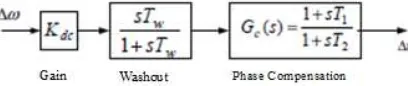
is considered as the input to the damping controllers which reflects the swings on the machines and lines of interest. As such, the output of the controller is in phase with the speed deviation.Fig. 3 Structure of IPFC based damping controller
The structure of IPFC based damping controller is shown in Fig.3. It consists of gain, signal washout and phase compensation blocks. The optimum parameters of the damping controller are obtained using the phase compensation technique [4]. The design is presented as below. The time constants of the phase compensator are chosen such that the phase angle of the system is fully compensated. For the nominal operating condition, the magnitude and
phase angle of transfer function, ∆
P
e/∆U, will becomputed for
s
=
j
ω
n . The gain setting of thedamping controller is chosen to achieve the required damping ratio of 0.1. As observed from (24) there are four choices of input signals (
m
1,δ
1,m
2andδ
2 ) of the IPFC to modulate. The signal which can achieve effective damping control at minimum control cost will be the most efficient. This selection is made at open loop condition before installation of damping controller. The concept of controllability index is used to select the most suitable IPFC control parameter from the damping controller for modulation [5].(1). Compute the natural frequency of oscillation
n
ω
from the mechanical loop asM
K
on
ω
ω
=
1(2). Let γ be the angle of the transfer function
( )
u
P
s
G
es
∆
∆
=
,(phase lag of between ∆u and∆
P
e, where
∆
u
=
[
∆
m
1,
∆
δ
1,
∆
m
2and
∆
δ
2]
as shown in Fig.4.5, ats
=
j
ω
n .(3). The controller designed is made up of washout filter and lead-lag block, with the following transfer function:
( )
2 1
1
1
1
sT
sT
sT
sT
K
s
G
w w s
+
+
⋅
+
=
w
T
is the washout filter time constant and its valuecan be taken as a number between 1 and 20 sec. Assume for the lead-lag network,
T
1=
aT
2 , where a = (1+ sinγ ) /(1− sinγ )and
( )
a
T
n
ω
1
2
=
. The required gain settingfor the desired ratio
ξ
is obtained as,( ) ( )
s
s
M
K
ns
c
G
G
2
ξω
=
, whereG
c( )
s
andG
s( )
s
are evaluated at
s
=
j
ω
n .The eigen values corresponding to oscillatory modes of the system are computed as given in table 1. From the table 1, we observe that the system consists of both local modes and inter area modes. The inter area modes are sufficiently damped, whereas, the local modes are lightly damped.
Table 1: Eigen Values Of The System
Eigen values
Damping ratio of Oscillatory
modes
Natural frequency of Oscillations(Hz)
j
8410
.
9
0032
.
0
±
−
0.0003 1.5662j
5122
.
4
0698
.
10
±
−
0.9126 0.7181-0.0000291 1.000 0
For the nominal operating point, the natural frequency of oscillation
ω
n is equal to 9.8410jphase angle of
G
c( )
s
for the various inputs are computed and given in table 2.Table 2: Magnitude And Phase Angle Of The Transfer Function
( )
s
G
cG
c( )
s
∠
G
c( )
s
1
m
P
e∆
∆
0.055447
o5426
.
1
−
1
δ
∆
∆
P
e0.037634
o
89511
.
0
−
2
m
P
e∆
∆
0.25303
o042285
.
0
−
2
δ
∆
∆
P
e0.0044907
o
98
.
179
−
It can be seen that the phase angle of the system for the control parameter
∆
δ
2 is near to−
180
otherefore the system becomes unstablewhen the controller (
∆
δ
2 ) is used. This controller is not considered in further investigations. Table 3 shows parameters of the remaining three alternative damping controllers computed at the nominal operating point.Table 3: Parameters Of The Ipfc DampingControllers
Damping controller K
1
T
Damping controller
∆
m
1 276.44 0.10439
Damping controller
∆
δ
1 411.91 0.10439
Damping controller
∆
m
262.18
3 0.10169
In the next chapter response of ∆ω with the three alternative damping controllers is simulated. The response of ∆ω is obtained with a step perturbation
of
∆
P
m = 0.01. Simulation results shows that theresponses are identical which indicates that any of the IPFC damping controllers, provide satisfactory performance at the nominal operating point.
However, in order to select the most effective IPFC control signal for damping, the controllability index is computed. The index is computed for the electromechanical mode ( 9.8410jrad/sec) to be damped taking into account
all the control signals one at a time. Table 4 gives the computed values of the indices.
Table 4: Controllability Indices With Different Ipfc Controllable Parameters
IPFC control parameter Controllability Index
1
m
∆
0.179742
m
∆
0.82021
δ
∆
0.121942
δ
[image:6.612.316.519.168.264.2]∆
0.014551Table 4 reveals that the controllability index corresponding to IPFC control parameter
∆
m
2 , is highest and that of∆
δ
2 , is insignificant compared to the other control parameters. Hence, ∆u =∆
m
2 is the best selection for the design of the IPFC damping controller since the minimum control cost (the lowest gain) is needed to provide now on, the damping controllers based on∆
m
2 shall be denoted as damping controller∆
m
2 . In the next chapter the dynamic response of the system with and without the damping controller∆
m
2 is studied.The dynamic performance of the system is further examined considering a case in which two
∆
m
1 ,2
m
[image:6.612.315.545.516.669.2]∆
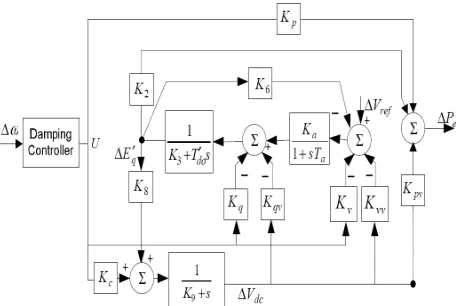
damping controllers operate simultaneously (dual controller).Fig. 4 Transfer function of the system relating component of electrical power
∆
P
e produced byISSN: 1992-8645 www.jatit.org E-ISSN: 1817-3195
Table 5: Phillips-Heffren Model Constants For System Without Ipfc
i Ki
1 3.2944
2 0.8533
3 1.2308
4 0.0640
5 -0.0150
6 0.9220
5.DIGITALSIMULATION
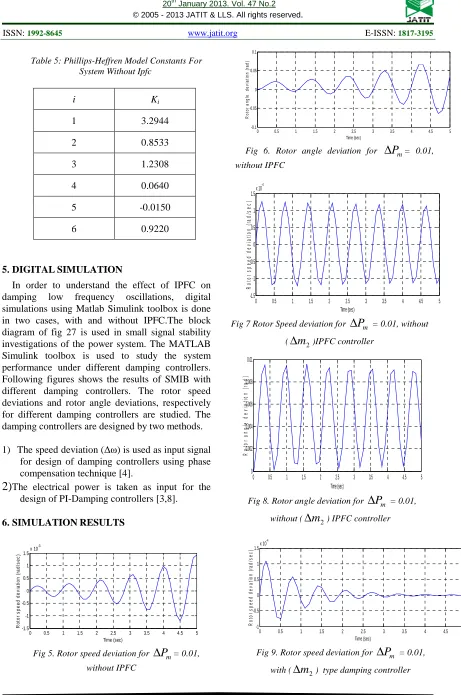
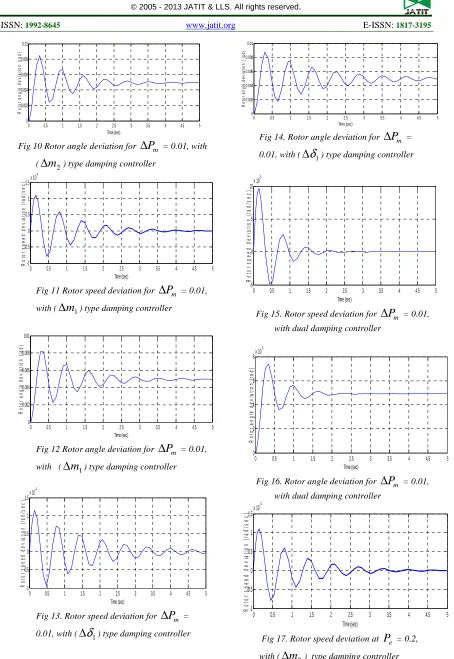
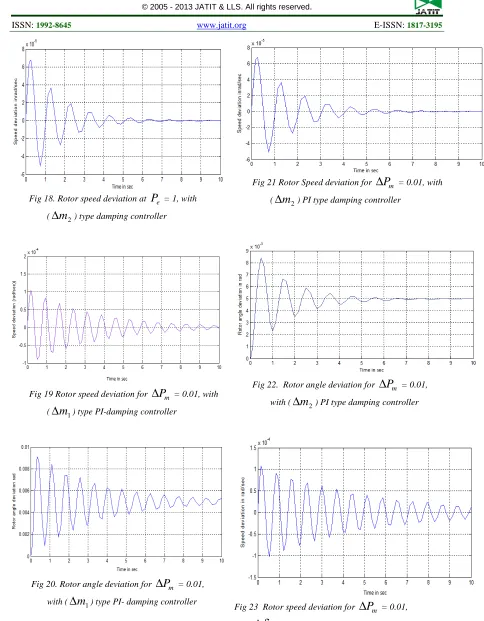
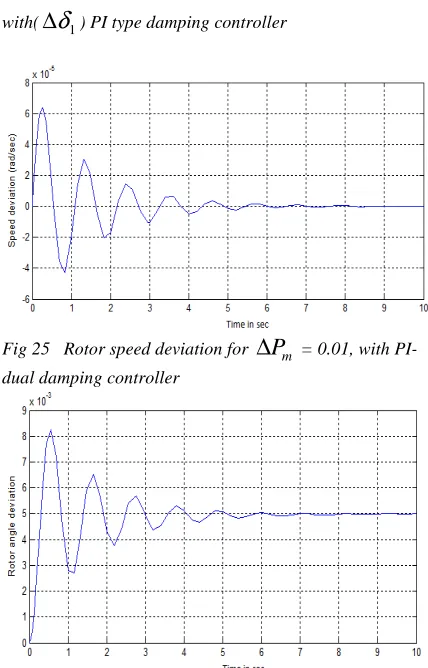
In order to understand the effect of IPFC on damping low frequency oscillations, digital simulations using Matlab Simulink toolbox is done in two cases, with and without IPFC.The block diagram of fig 27 is used in small signal stability investigations of the power system. The MATLAB Simulink toolbox is used to study the system performance under different damping controllers. Following figures shows the results of SMIB with different damping controllers. The rotor speed deviations and rotor angle deviations, respectively for different damping controllers are studied. The damping controllers are designed by two methods.
1) The speed deviation (∆ω) is used as input signal for design of damping controllers using phase compensation technique [4].
2)
The electrical power is taken as input for the design of PI-Damping controllers [3,8].6.SIMULATIONRESULTS
0 0.5 1 1.5 2 2.5 3 3.5 4 4.5 5
-1.5 -1 -0.5 0 0.5 1 1.5x 10
-3
Time (sec)
R
o
to
r
s
p
e
e
d
d
e
v
ia
ti
o
n
(
ra
d
/s
e
c
)
Fig 5. Rotor speed deviation for
∆
P
m= 0.01, without IPFC0 0.5 1 1.5 2 2.5 3 3.5 4 4.5 5
-0.1 -0.05 0 0.05 0.1
Time (sec)
R
o
to
r
a
n
g
le
d
e
v
ia
ti
o
n
(
ra
d
)
Fig 6. Rotor angle deviation for
∆
P
m= 0.01, without IPFC
0 0.5 1 1.5 2 2.5 3 3.5 4 4.5 5 -1.5
-1 -0.5 0 0.5 1 1.5x 10
-4
Time (sec)
R
o
to
r
s
p
e
e
d
d
e
v
ia
ti
o
n
(
ra
d
/s
e
c
)
Fig 7 Rotor Speed deviation for
∆
P
m = 0.01, without (∆
m
2)IPFC controller0 0.5 1 1.5 2 2.5 3 3.5 4 4.5 5 0
0.002 0.004 0.006 0.008 0.01
Time (sec)
R
o
to
r
a
n
g
le
d
e
v
ia
ti
o
n
(
ra
d
)
Fig 8. Rotor angle deviation for
∆
P
m = 0.01, without (∆
m
2) IPFC controller0 0.5 1 1.5 2 2.5 3 3.5 4 4.5 5
-1 -0.5 0 0.5 1 1.5x 10
-4
Time (sec)
R
o
to
r
s
p
e
e
d
d
e
v
a
ti
o
n
(
ra
d
/s
e
c
)
[image:7.612.121.285.118.299.2]0 0.5 1 1.5 2 2.5 3 3.5 4 4.5 5 0 0.002 0.004 0.006 0.008 0.01 Time (sec) R o to r a n g le d e v ia ti o n ( ra d )
Fig 10 Rotor angle deviation for
∆
P
m = 0.01, with (∆
m
2) type damping controller0 0.5 1 1.5 2 2.5 3 3.5 4 4.5 5 -1
-0.5 0 0.5 1 1.5x 10
-4 Time (sec) R o to r s p e e d d e v ia ti o n ( ra d /s e c )
Fig 11 Rotor speed deviation for
∆
P
m = 0.01,with (
∆
m
1) type damping controller0 0.5 1 1.5 2 2.5 3 3.5 4 4.5 5
[image:8.612.90.544.57.716.2]0 0.002 0.004 0.006 0.008 0.01 Time (sec) R o to r a n g le d e v ia ti o n ( ra d )
Fig 12 Rotor angle deviation for
∆
P
m = 0.01, with (∆
m
1) type damping controller0 0.5 1 1.5 2 2.5 3 3.5 4 4.5 5 -1
-0.5 0 0.5 1 1.5x 10
-4 Time (sec) R o to r s p e e d d e v ia ti o n ( ra d /s e c )
Fig 13. Rotor speed deviation for
∆
P
m = 0.01, with (∆
δ
1) type damping controller0 0.5 1 1.5 2 2.5 3 3.5 4 4.5 5
0 0.002 0.004 0.006 0.008 0.01 Time (sec) R o to r a n g le d e v ia ti o n ( r a d )
Fig 14. Rotor angle deviation for
∆
P
m = 0.01, with (∆
δ
1) type damping controller0 0.5 1 1.5 2 2.5 3 3.5 4 4.5 5 -5
0 5 10x 10
-5 Time (sec) R o to r s p e e d d e v ia ti o n ( ra d /s e c )
Fig 15. Rotor speed deviation for
∆
P
m = 0.01, with dual damping controller0 0.5 1 1.5 2 2.5 3 3.5 4 4.5 5 0
2 4 6 8x 10
-3 Time (sec) R o to r a n g le d e v ia ti o n ( ra d )
Fig 16. Rotor angle deviation for
∆
P
m = 0.01, with dual damping controller0 0.5 1 1.5 2 2.5 3 3.5 4 4.5 5 -1
-0.5 0 0.5 1 1.5x 10
-4 Time (sec) R o to r s p e e d d e v ia ti o n ( ra d /s e c )
[image:8.612.108.305.390.505.2]ISSN: 1992-8645 www.jatit.org E-ISSN: 1817-3195
Fig 18. Rotor speed deviation at
P
e = 1, with(
∆
m
2) type damping controllerFig 19 Rotor speed deviation for
∆
P
m = 0.01, with (∆
m
1) type PI-damping controllerFig 20. Rotor angle deviation for
∆
P
m = 0.01, with (∆
m
1) type PI- damping controllerFig 21 Rotor Speed deviation for
∆
P
m = 0.01, with (∆
m
2) PI type damping controllerFig 22. Rotor angle deviation for
∆
P
m = 0.01, [image:9.612.79.563.57.678.2]with (
∆
m
2) PI type damping controllerFig 24 Rotor angle deviation for
∆
P
m = 0.01, with(∆
δ
1) PI type damping controllerFig 25 Rotor speed deviation for
∆
P
m = 0.01, with PI- dual damping controllerFig 26 Rotor angle deviation for
∆
P
m = 0.01, with PI- dual damping controller7.CONCLUSIONS
The IPFC based damping controller is
designed for two different cases. The output of
the power system without IPFC, with IPFC are
obtained and compared.
IPFC as a multitask controller, has an
effective role in damping low frequency
oscillations. In this thesis, this function of
IPFC has been investigated and numerical
results emphasized its significant effect. In
fact, even there is not any damping coefficient
in power systems, IPFC can damp low
frequency oscillations. These effects are
decreasing the amplitude and frequency of
power system oscillations. Moreover it damps
oscillations faster in comparison when there is
not IPFC in the system. The controllability
index
corresponding
to
IPFC
control
parameter
∆
m
2, is highest and that of
∆
δ
2,
is insignificant compared to the other control
parameters. Hence,
∆
u =
∆
m
2is the best
selection for the design of the IPFC damping
controller since the minimum control cost (the
lowest gain) is needed to provide , the
damping controllers based on
∆
m
2.
Dynamic simulations results have
emphasized that the damping controller which
modulates the control signal
∆
m
2provides
satisfactory dynamic Performance under wide
variations in loading condition and system
parameters.
The response of the SMIB installed with
IPFC based Dual converter is improved when
compared to without IPFC and individual
(
m
1,
δ
1,and
m
2) type damping controllers.
Response of SMIB with IPFC for step
perturbation in
∆
P
m= 0.01 ,and
∆
V
ref= 0.01
is good with Dual controller.
The settling time for PI- damping
controller is more as compared to
Phase-compensation based damping controllers.
Phase-compensation
based
damping
ISSN: 1992-8645 www.jatit.org E-ISSN: 1817-3195
Table 6: Comparison of Settling Time for Two cases
IPFC damping controller
PI Controller
Phase
Compensation
1
m
-type controller 10 sec 4.5 sec1
δ
-type controller 10 sec 5 sec2
m
-type controller 9 sec 4 secDual converter 8 sec 3 sec
APPENDIX
The system data and initial operating conditions of the system are as follows:
Generator:
M = 2H = 8.0 MJ/MVA
D = 0; Tdo = 5.044s;
X
d=1.0pu;X
'd = 0.3pu; qX
= 0.6pu ;P
e= 0.900; Q = 0.1958 ;V
s = 1.02;1
=
b
V
Excitation system:
K
A= 50;T
A = 0.05sConverter transformers:
X
t= 0.l puConverter parameters:
m
1= 0.15;m
2=0.10; Transmission line transformers:L
X
= 0.5 pu;X
s=0.15 puDC link parameters:
V
dc= 2.0 pu; C = 1 puREFERENCES
[1] Yao-nan Yu, "ELECTRIC POWER SYSTEM DYNAMICS", New York, Academic Press, Inc. , 1983
[2] Guygyi & etal " THE INTERLINE POWER FLOW CONTROLLER CONCEPT: A NEW
APPROACH TO POWER FLOW
MANAGEMENT IN TRANSMISSION
SYSTEMS", IEEE Transactions on Power Delivery, Vol. 14, No. 3, July 1999.
[3] H.F.Hang, "DESIGN OF SSSC DAMPING
CONTROLLER TO IMPROVE POWER
SYSTEM OSCILLATION STABILITY",
19991EEE.
[4] N.Tambey and M.L.Kothari, "DAMPING OF POWER SYSTEM OSCILLATION WITH UNIFIED POWER FLOW CONTROLLER", IEE Proc.-Gener. Transm. Distrib. Vol.150, No.2, March 2003.
[5] "FLEXIBLE AC TRANSMISSION SYSTEMS (FACTS)", IEE Press, London 1999.
[6] K. V. Patil, J. Senthil, J. Jiang and R. M. Mathur, “Application of STATCOM for Damping Torsional Oscillations in Series Compensated AC Systems,” IEEE Transactions on Energy Conversion, vol. 13, No. 3, September 1998, pp. 237-243.
[7] H.F.Wang and F.J.Swift, “A Unified Model for the Analysis of FACTS Devices in Damping Power System Oscillations Part I: Single-Machine Infinite-bus Power
System,” IEEE Transactions on Power Delivery, vol. 12, No. 2, April 1997, pp. 941-946.