ISSN: 1992-8645 www.jatit.org E-ISSN: 1817-3195
ON CREATION OF THE INTELLIGENT HELP SYSTEM
1G. NURGAZINOVA, 2V. GOLENKOV, 3A. SHARIPBAY, 4A. OMARBEKOVA, 5A. BARLYBAEV
1
Doctoral student, L.N. Gumilyov Eurasian National University, Astana, KAZAKHSTAN
2
Prof., Belarusian State University, Minsk, REPUBLIC OF BELARUS
3
Prof., L.N. Gumilyov Eurasian National University, Astana, KAZAKHSTAN
4
Assoc. Prof., L.N. Gumilyov Eurasian National University, Astana, KAZAKHSTAN
5
Ph.D., L.N. Gumilyov Eurasian National University, Astana, KAZAKHSTAN E-mail: [email protected], [email protected], [email protected], [email protected],
5
ABSTRACT
At the present time, the digital society with such attributes as e-government, e-learning, electronic document management, etc. is actively formed in Kazakhstan, The country is actively carried out the introduction of information smart-technologies in education, although in many countries the concept of Smart education is already a standard way of learning. In this regard, nowadays there is an urgent need for the use of artificial intelligence technology in the learning process in our country. The learning efficiency is determined not only by the choice of the education environment, but also by the knowledge representation. As part of this work, we have attempted to develop intelligent help system with the semantic knowledge representation. This system has more advanced facilities to display the semantic structure of the subject field with the corresponding navigation facilities. As a result of the knowledge representation of the subject field in the form of hypermedia semantic network it is possible to get associative information search, information output on the various requests of the leaner, the visualization of the semantic structure of the knowledge base.
Keywords: Intelligent Tutoring System, Knowledge Representation Language, Knowledge Bases, Ontology, Semantic Networks.
1. INTRODUCTION
The history of the entry of artificial intelligence methods (AI) in the field of education in order to obtain effective tutorial systems (TS) has dozens of years. During that time, unfortunately, in many cases, only experimentally, are developed in order to introduce the achievements of AI methods in the instruction system. These tutorial systems, some researchers did not dare to call "intelligent" is replaced by “Knowledge-Based Tutoring System”, “Adaptive Tutoring System” [1] “Knowledge Communication Systems” [2]. However, most researchers prefer to use the acronym ITS (intelligent tutoring systems).
Researchers are based on the fact that the ITS field covers three different subjects: computer sciences, psychology and pedagogy, each of which has significant differences in order to study the terminology, knowledge structures [3].
There are two main factors motivating the development of advanced ITS. The first factor is the requirement for research. On the research level, there is a need to study in more details the processes of educational interaction [3]. Since the ITS are at the intercrossing of three basic disciplines, it provides an excellent area of research for the various theories of psychologists and scientists in the field of AI and teachers. The second factor is a practical need. At the application level, it is possible to obtain results that can be achieved with the use of ITS, but which cannot be achieved by teachers for various economic and social reasons. [3]. It considered the basic advantages of computer tutorial systems, in particular, intelligent tutoring systems:
- Every student can independently use the system as much time as he needs, and at a convenient time;
ISSN: 1992-8645 www.jatit.org E-ISSN: 1817-3195
of communication with the teacher some of these questions might seem silly or irrelevant. In other words, in the case of communicating with a computer tutorial system is eliminated all the negative situations of human factors, including personal clashes of the teacher and the student, prenotion against any of the students, etc.;
- As distinct from traditional training resources such as books, in the case of a computer system the enormous aggregation of information can be placed within the system, the physically implemented as a computer program or a site and to work with that it is sufficient to have a computer or telephone with the Internet access;
- The use of modern technology makes it possible to significantly expand the visibility and accessibility of the material. In addition to traditional text and illustrations the computer system allows using dynamic illustrations, video, sound bites and other similar facilities.
As an example of such systems, we consider the intelligent help system (IHS) for algebra, created on the basis of an open semantic technology of designing intelligent systems - Open Semantic Technology for Intelligent Systems (OSTIS). In future the created IHS may be used in a process of education as in a pre-school and in a secondary school and also in a system of higher education.
2. TECHNOLOGY OSTIS
OSTIS technology is developed at the Department of Intelligent Information Technologies of Belarusian State University of Informatics and Radio Electronics [4].
OSTIS declared itself as a technology of creating an open semantic technology of component design for intelligent systems, which allows quickly and accurately develop semantically adaptable computer systems. Here, under the semantic technology of component designing for intelligent systems is regarded to a complex of agreed proprietary technologies, provided the entire project of computer systems, including knowledge base, problem solvers, user interfaces, providing the natural language interaction.
As a knowledge representation model in OSTIS are used unified knowledge representation model organized as semantic networks with a set-theoretic interpretation, on the basis of which processing model and user interfaces are build that allows to say about intellectuality of devise systems in response to the following features:
1. The specified knowledge representation model is universal and allows to represent simply as a homogeneous semantic networks of knowledge of any kind (the logical statements and conclusions), and text and multimedia illustrations, etc.;
2. The specified knowledge representation model allows to make a semantic partitioning of subject fields and knowledge filing, which effectively helps the process of education. If necessary, the semantic structure of subject fields can easily be rebuilt.
3. Knowledge representation in the form of a semantic network allows to carry out free web surfing on any contiguity, studying material thus in the consistency which seems more logical for the learner. On the other hand, this approach allows to specify a recommended consistency of study material.
4. This approach to knowledge representation allows unifying not only the knowledge representation model, but also a knowledge processing model, including information retrieval model and solving problems. This fact suggests the implementability of a generic collection of retrieval operations, as well as the implementation of a universal problem solvers that helps to solve a variety of tasks within each of the subject field, which significantly reduces the number of processing operations implemented operations of knowledge processing on retention of compatibility options of each system;
5. The unifying knowledge representation model can not only contribute to each system examples of typical conditions in a given subject field tasks with solutions, but also to talk about intelligent problem solver, which accepts to the system to generate answers to the question by means of the knowledge already available in the Knowledge Base, for example, using rules of logical inference;
6. The unifying knowledge representation allows us not to limit the stock list of custom queries only by specialized dedicated function words, and to give a spontaneous request to a system using the universal programming language of knowledge display, making a list of possible requests depends only from the quantity and knowledge spectrum included in knowledge base system.
ISSN: 1992-8645 www.jatit.org E-ISSN: 1817-3195
make to significantly reduce the time of the student's studying with other systems of this type, for example, the ITS for other academic disciplines. 8. Each user interface component is also displaying a defined item from the knowledge base, which allows, firstly, easy to change the interface system, even during operation, and, secondly, allows the user to ask questions to system, not only concerning the subject field, to which dedicated the system, but also on any of the interface components and other parts of the system. Thus, the user only has to learn to ask the system a few simple questions to further explore all the details of the system already in working process with it.
9. Proposed view and knowledge processing models allow physically separate the meaning of the stored information on the versions of its external manufacturing, in particular, from the entity identifiers within any natural language. This makes it easy to internationalize any of the developed systems as to put the system into any other language must be translated only fragments on free language definitely stored in the knowledge base, without affecting the semantic connections themselves, that is the meaning of the provided information.
In systems engineering by OSTIS technology the approach of evolutionary Component-Based Design is applied, which is based on the constant upgradable libraries of reusable compositions (standard technical solutions) [5]. This approach can significantly reduce the time and improve the quality of the development using the established and proven turnkey solutions.
As an example of this given approach, it considers the software design process mentioned earlier intelligent help system for algebra.
3. DESIGNING THE INTELLIGENT HELP
SYSTEM
Under the intelligent help system (IHS) is meant a system capable of responding to a variety of free-designed user questions and also solve problems from the relevant subject field. IHS is part of the ITS provides information services of users on the studying subject field and may be used as a self-contained systems [6].
To create the IHS for algebra it’s necessary to solve the problems [4]:
- to develop a knowledge base of intelligent help system for algebra;
- to develop a knowledge machine of intelligent help system for algebra;
- to develop a user interface of intelligent help system for algebra.
3.1 The Knowledge base of intelligent help system
Prototyping the intelligent help system for algebra on the base of technology OSTIS consists of several stages. To create a start system version the following steps were carried out: setting a platform installation of descendant sc-systems (installation of storage, installation of sc-machine), the hard core installation of knowledge base of the descendant sc-system, installation of the knowledge machine hard core of descendant sc-system. Further, in order to expand the knowledge base of the descendant sc-system the hierarchical system of subject fields was developed and their ontologies included in the knowledge base of sc-designed system.
The first and most important step in knowledge base design is the elaboration of structure of the declared subject field or several related domains. In order to clarify this structure originally we set up the class of suspected objects, define the subject of the research, define the whole range of keyed site of the semantic network representing the subject field. Within the subject field of algebra there were allocated some private subject fields on the basis of allocation of the subcollection from the range of the classes of the objects:
Subject field for algebra
∈ Subject field
=> Private subject field*: Subject field "Arithmetic" => Private Subject field*: Subject field of arithmetic signs Subject field of numbers
Subject field of mathematical computation Subject field “Elementary Algebra” => Private Subject field*:
Subject field of equations Subject field of inequations Subject field of equations set
Subject field of algebraic and transcendental expressions
Subject field “The theory of elementary functions and elements of analysis”
=> Private subject field*: Subject field of functions
ISSN: 1992-8645 www.jatit.org E-ISSN: 1817-3195
Review of knowledge base from the point of its relation to the subject field allows us to consider the
objects studied at different detail levels, which are
reflected in different types of ontologies. According to [4], [5], [7] to such types of ontologies belongs:
- The structural specifications of subject field - the maximum allocating of object class regarding subject field, subsets and relations that included in the structure of this subject field;
- Terminological ontology - a description of the terms and their key concept synonyms of the subject field;
- Set-theoretic ontology - a description of the set-theoretic relations between the concepts of the subject field;
- Logical ontology - a description of all utterances of considering subject field;
- Logical system of concepts and definitions; - Logical system statements and evidence;
- Ontology tasks and solutions of the problems - a description of the particular tasks considered in a given subject field, and their solutions;
- Ontology of the classes of problems and ways of solving the problems - a description of classes of problems and their solutions.
In work [8] in accordance with the structure of ontologies as an example was described the subject field of positive integers. According to the same structure in further studies [9,10] have been described subject fields of integers, rational numbers.
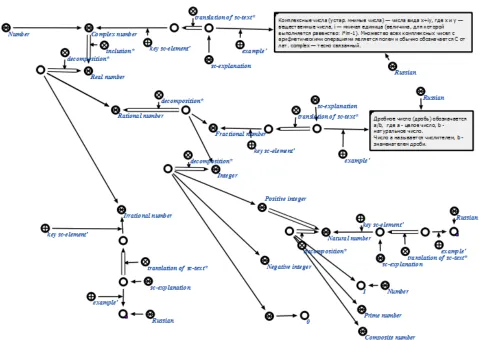
[image:4.612.91.572.357.697.2]By setting each of these subject fields, we get a description of the relevant subject fields. As a result, we obtain the well-structured knowledge base model of the above subject fields presented in the form of a semantic network (Figure 1).
ISSN: 1992-8645 www.jatit.org E-ISSN: 1817-3195
The universal abstract language of semantic networks SC-code (Semantic Computer Code) is used for coding noted semantic network, describing the different kinds of knowledge of the subject field. SC code is a fairly simple computer code of semantic networks, which is a representation of semantic networks, but the most simple form - with the minimum character set and binary connective.
SC code is focused on the information presentation in the computer's memory and can be considered as the basis of structural reconfigurable model of content addressable memory of computers which future-oriented on processing of semantic networks [11].
3.2 The Knowledge machine of intelligent help system
Knowledge machine for algebra, like any system, developed by OSTIS technology, is built on the basis of multi-agent approach and includes itself information-retrieval machine, the basic means of garbage collection, integration and knowledge verifying, reprogramming the knowledge base, as well as intelligent problem solver.
Because of using the technique of Component-Based Design and genericity of the proposed components of knowledge machines, the major part of knowledge machine, including intelligent problem solver, can be built from existing components. The same can be said about the user interface (UI) system - currently the universal components of displaying and editing, suggesting are used in the component library. In addition to the generic components it has been developed a huge number of agents handling knowledge, oriented directly on the subject field of numbers:
- Agent for finding the greatest common denominator of two integers;
- Agent of finding the lowest common multiple of two numbers;
- Agent of two solutions of linear equations; - Agent solution of a quadratic equation, and others.
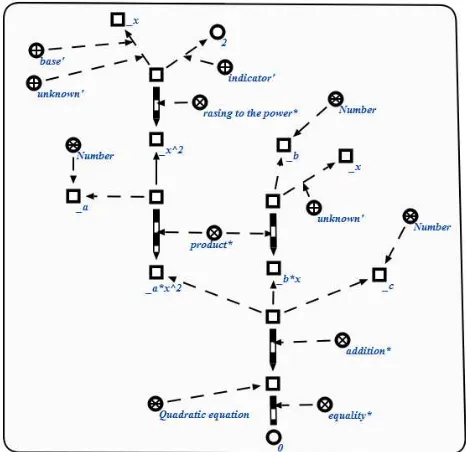
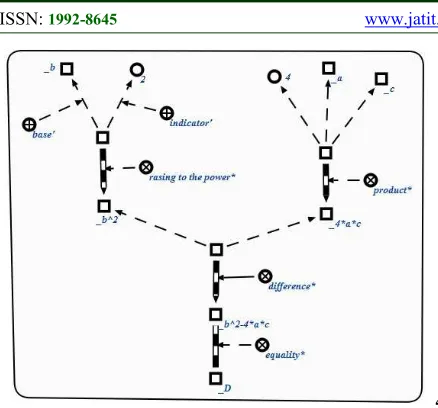
To develop the knowledge processing agents, mainly logical ontology was used containing a system of concepts, statements and evidence. For example, to find the agent module number (Figure2) and agent solutions of the quadratic equation (Figure 3, 4), the contents of the knowledge base contain the following fragments of sentences:
Figure 2 - Fragment of the statements in the knowledge base
[image:5.612.317.541.79.299.2] [image:5.612.317.550.343.569.2]ISSN: 1992-8645 www.jatit.org E-ISSN: 1817-3195
Figure 4 - Fragment of the statements in the knowledge base
3.3 The user interface of intelligent help system
The user interface of the intelligent help system for algebra allows to the user to work with the following escape languages:
- Sc.g-construct- uses information presentation via SCg-code;
- A graphical illustration for algebra - allows the user to work with the knowledge presented in the form of graphs or drawings that can be both dynamically-sized and steady-state;
- Voice message - allows the user to receive information from the system in the form of voice messages, as well as to manage the system, ask questions with the help of spoken messages;
- Free language text - allows displaying information textually.
The information may be presented in the following forms:
- Textually; - As a static image;
- In a form of animated image - video (with or without sound);
- In the form of an interactive flash-demo. The knowledge base of user interface of the intelligent help system for algebra consists of the following sections:
- Reference data - contains videos that demonstrate working with user interface orders and the system itself. Also in this section are contained reports demonstrating the work with commands interactively;
- Description of the editing commands - section is contained class descriptions of the editing commands;
- Protocol of the custom actions - the section includes the entire protocol of custom actions, which consists of user interface commands;
- User Portrait - section, which stores the information collected by the user interface concerning the user and used by him in customizing to the user;
- Manual of ip-components - in this section is contained the description of the ip-components that are used by the interface. Based on this knowledge, the user interface provides user interaction.
- In addition to the above sections of the user interface knowledge base includes knowledge base used by ip-components.
4. EXPERIMENT AND PROGRAM
IMPLEMENTATION OF INTELLIGENT HELP SYSTEM
It is considered the software design process of the start version of the subsidiary sc-system (intelligent help system for algebra) for OSTIS Technologies. One of the main tasks of OSTIS [12] Technology is a problem solution of compatibility of the various components and development the mechanisms of the Component-Based system, knowledge-directed.
According to the method of the component design systems, knowledge-directed [5] on creating a start version of child sc-system according to the OSTIS Technology can be divided into four main stages:
- Selection and platform installation of the implementation of a subsidiary sc-system;
- Installation of the sc-model kernel of knowledge bases, that is, a set of core reusable components of sc-model of knowledge base required to work even for the first prototype of sc-system;
- Installation of the kernel sc-machines, that is, a set of basic reusable components of sc-machines as required to work even for the first prototype sc-system;
- Installation of the kernel sc-models of interfaces, that is a set of basic reusable components of the interface sc-models as required to work for even the first prototype sc-system;
- Installation of the knowledge machines kernel of subsidiary sc-system.
[image:6.612.91.310.72.276.2]ISSN: 1992-8645 www.jatit.org E-ISSN: 1817-3195
variation of the platform focused on the Linux operating system and is accompanied by an installation scripts, making possible to collect and install the selected platform on the required server, [13,14]. This implementation variation of the platform includes the actual sc-storage, as well as a set of compilers.
Once the server has been set picked sc-memory implementation, we can also install compatible with the selected implementation of the platform with the implementation of abstract scp-machine.
Source code and installation instructions of the platform-dependent reusable component OSTIS according to its description in the Library of implementation platforms of sc-models can be found at address [13]. In this version of component for the sc-agents implementation are used .languages like C and C ++.
For the correct operation of an implementation variation of the scp-abstract machine it is necessary an appropriate system with reusable component of sc-models of knowledge bases describing the subject field of the product of underlying programming language oriented on sc- models processing of the knowledge bases and OSTIS sc-agents.
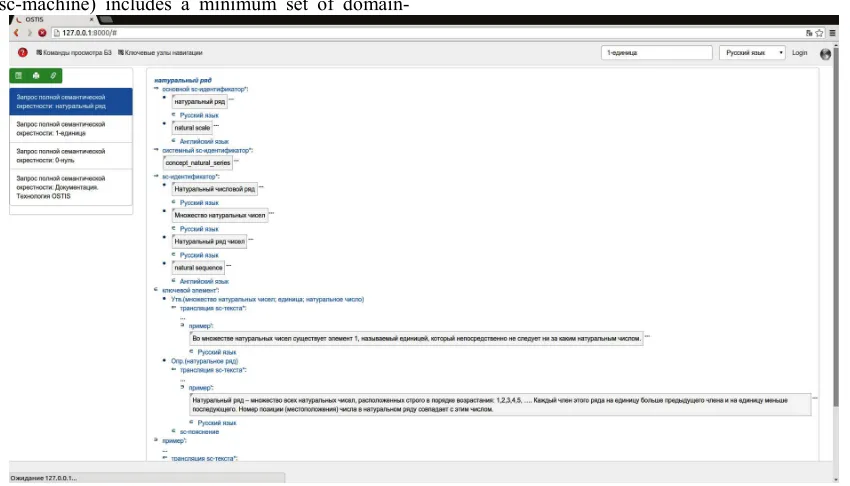
The knowledge machine kernel of sc-systems (sc-machine) includes a minimum set of
domain-specific independent sc-agents of information retrieval required to navigate on the knowledge base of subsidiary sc-system. Sc-models kernel of user interface, as well as the actual implementation platform of the sc-models, is just a platform-dependent reusable component of OSTIS, which should be compatible with the selected platform option. A suitable implementation variation of the user interface kernel described in the Library of reusable components of interface sc-models can be found at [15].
According to the description [5], the selected component contains itself, besides the kernel, the following set of components:
- Viewer of sc-constructs in the SCg-code; - Editor of sc-constructs in the SCg-code; - Viewer of sc-constructs in the SCn code; - A set of components to display sc-links in different formats (PNG, GIF, PDF, HTML, TXT, etc.).
[image:7.612.94.519.444.687.2]Also, the previously selected platform variation of the implementation of sc-models on default includes translators from sc- storage into the format needed for visualization SCg and SCn, as well as a translator from SCg-editor to the sc-storage. Thus, installed arrangement means sufficiently for the basic viewing and for editing sc-constructs through web-interface.
ISSN: 1992-8645 www.jatit.org E-ISSN: 1817-3195
Work on the implementation of the user interface is still under development. Progressively as for the performance, we describe them in more details in the following publications.
5. CONCLUSION
The paper is considered the process of designing intelligent help system for algebra on the basis of an open semantic technology of intelligent systems. The components of the technology are described which used in developing the first prototype design of the system. The possibilities of this prototype are considered. Work on the design of intelligent help system is not completed yet. It requires further user interface development of intelligent help system, the description of which will be presented by us in subsequent works. Also in the future the development of the system is expected in the following areas:
- Expansion of the knowledge base by adding to its new kinds of knowledge;
- Development of new retrieval operations, operations of the intelligent problem solvers,
User inerface components;
- Development of help-system for the user. This work is carried out within the framework of the grant project on "Intelligence tutoring system, monitoring and evaluation of knowledge" under the contract №46 from 12.02.2015.
REFRENCES:
[1] Streitz, N. A. Mental models and metaphors: implications for the design of adaptive user-system interfaces. http://link.springer.com/chapter/10.1007/978-1-4684-6350-7_8#page-1
[2] Wenger, E. Artificial Intelligence and 'Tutoring Systems. Morgan Kaufmann, Los Altos, CA, 1987. http://books.google.by/
[3] Hyacinth S. Nwana. Intelligent Tutoring Systems: an overview. Journal Artificial Intelligence Review 1990, Volume 4, Issue 4, pp 251-277. Digital resource: http://link.springer.com/article/10.1007/BF00168 958
[4] V.V. Golenkov, N.A Gulyakina. Semantic technology of component based-design systems, knowledge-directed//: Materials of the International scientific conference OSTIS" (Minsk, 2015) Minsk BSUIR, 2015.- p.57-58 [5] D.V. Shunkevich, I.T. Davydenko, D.N.
Koronchik, A.V. Gubarevic, A.S Boriskin. Methods of component based- design systems,
knowledge directed// Materials of the International scientific conference OSTIS" (Minsk, 2015) Minsk BSUIR, 2015. – p.93-110 [6] I.T. Davydenko and others. Integrated design
methodology of semantic models of intelligent help systems// Materials of the International scientific conference OSTIS" (Minsk, 2012) Minsk BSUIR, 2012 – p. 457- 466
[7] V.V. Golenkov., N.A. Gulyakina Structuring descriptive space// Materials of the International scientific conference OSTIS" (Minsk, 2014) Minsk BSUIR, 2014. – p.65-67
[8] A.A. Sharipbay, A.S. Omarbekova, G. Nurgasinova Designing of intelligent help system for algebra based on the knowledge database// Materials of the International scientific conference OSTIS" (Minsk, 2015) Minsk BSUIR, 2015- p.157-160
[9] G. Nurgasinova, A. Omarbekova Knowledge bases design on the base of open integrated design technology of intelligent system (OSTIS). Vestnik, VKGTU, 2015, 2, 141-146, ISSN 1561-4212
[10] G. Nurgazinova, V. Golenkov, A. Sharipbay, A. Barlybaev, A. Omarbekova Designing of intelligent reference system for algebra based on the knowledge database. //2015 International Conference on Control, Automation and Artificial Intelligence. DEStech Publications, Lancaster, Pennsylvania 17602 U.S.A. p. 230-235 ISBN: 978-1-60595-278-9
[11] V. V. Golenkov, N.A. Gulyakina Graphodynamic model of parallel knowledge processing: principles of construction, design and realization// Materials of the International scientific conference OSTIS" (Minsk, 2012) Minsk BSUIR, 2012. – p.23-52
[12] IMS. Documentation. OSTIS Technology. [Digital resource] – Access mode: http://ims.ostis.net/
[13] sc-machine. [Digital resource] – Access mode: https://github.com/deniskoronchik/sc-machine [14] sc- machine structure. [Digital
resource]-Access mode:
https://github.com/deniskoronchik/sc-machine/wiki