S T U D Y P R O T O C O L
Open Access
Selenium supplementation for patients with
Graves
’
hyperthyroidism (the GRASS trial): study
protocol for a randomized controlled trial
Torquil Watt
1*, Per Cramon
1, Jakob Bue Bjorner
2,3, Steen Joop Bonnema
4, Ulla Feldt-Rasmussen
1, Christian Gluud
5,
Jeppe Gram
6, Jane Lindschou Hansen
5, Laszlo Hegedüs
4, Nils Knudsen
7, Pernille Bach-Mortensen
8, Runa Nolsøe
9,
Birte Nygaard
10, Flemming Pociot
11, Maria Skoog
5, Per Winkel
5and Åse Krogh Rasmussen
1Abstract
Background:Graves’hyperthyroidism is an autoimmune disease causing hyperfunction of the thyroid gland. The concentration of selenium is high in the thyroid gland and two important groups of enzymes within the thyroid are selenoproteins, that is, they depend on selenium. Selenium may have beneficial effects on autoimmune hypothyroidism and on Graves' orbitopathy, but the effects of selenium on Graves' hyperthyroidism is unknown. We hypothesize that adjuvant selenium may be beneficial in the treatment of Graves' hyperthyroidism. The objective is to investigate if selenium supplementation plus standard treatment with anti-thyroid drugs versus standard treatment with anti-thyroid drugs will lead to a decrease in anti-thyroid drug treatment failure (that is, failure to remain euthyroid, without further treatment, one year after cessation of anti-thyroid drug treatment), faster and longer lasting remission (that is, anti-thyroid drug treatment success), and improved quality of life in patients with Graves’hyperthyroidism.
Methods and design:The trial is an investigator-initiated, randomised, blinded, multicentre clinical trial. Inclusion criteria are: age 18 years or older; diagnosis of active Graves' hyperthyroidism within the last two months; and informed consent. Exclusion criteria are major co-morbidity; previous radioactive iodine treatment; ongoing anti-thyroid drug treatment for more than two months; treatment with immunomodulatory drugs; known allergy towards the components in the selenium and placebo pills; pregnancy or breast-feeding; and intake of selenium supplementation above 70μg per day. We plan to include 492 participants, randomised (1:1) to two tablets of 100μg selenium once daily for the 24 to 30 months intervention period versus two identical placebo tablets once daily. The primary outcome is the proportion of participants with anti-thyroid drug treatment failure (see above) at the end of the intervention period (24 to 30 months). Secondary outcomes are: thyroid-specific quality of life during the first year after randomisation; level of thyroid stimulating hormone-receptor antibodies at 18 months after randomisation and at the end of the intervention period (24 to 30 months); hyperthyroid symptoms during the first year after randomisation; eye symptoms during the first year after randomisation, and at the end of the intervention period (24 to 30 months); adverse reactions during the intervention period; and serious adverse events during the intervention period.
(Continued on next page)
* Correspondence:[email protected]
1
Department of Medical Endocrinology, Copenhagen University Hospital Rigshospitalet, Blegdamsvej 9, DK-2100 Copenhagen, Denmark Full list of author information is available at the end of the article
(Continued from previous page)
Discussion:It was of great importance to the initiators of this trial, that the results would be directly applicable to daily clinical practice. Therefore, it was designed as a pragmatic trial: the patients follow their usual treatment at their usual hospitals. In order to still collect high quality data on the clinical course and quality of life, an elaborate trial management system was designed to keep track of patient input, need for trial personnel input and action, and to collect data from medical chart systems. Meticulous follow-up on missing responses to the QoL measurements has been incorporated into the system, to minimise missing quality of life data. Monitoring of adverse reactions and events is achieved by thorough instruction of the participants, surveillance of patient-reported outcomes, and integration with national databases regarding hospitalizations. A very long intervention period was necessary, since patients are not considered in remission until one year after stopping anti-thyroid drugs. Usually, patients are treated for 12 to 18 months with anti-thyroid drugs, yielding a total intervention period of 24 to 30 months.
Trial registration:ClinicalTrials.gov: NCT01611896.
Keywords:Graves' disease, Selenium supplementation, Pragmatic trial, Quality of life, ThyPRO
Background
Graves’hyperthyroidism is an autoimmune disease caus-ing hyperfunction of the thyroid gland by a mechanism, where auto-antibodies bind to and stimulate the thyroid stimulating hormone (TSH) receptor. It affects individ-uals of all ages and is five to ten times more common in women than in men, with an overall annual incidence in Denmark of about 1,700 patients in 5.5 million people [1]. Treatment of Graves’ hyperthyroidism comprise: 1) anti-thyroid drugs (ATD) (for example, methimazole or propylthiouracil); 2) thyroidectomy, that is, surgical re-moval of the thyroid gland, and 3) radioactive iodine treatment (I131), which permanently reduces thyroid func-tion. In Europe, the primary treatment is usually ATD, which leads to resolution of hyperthyroidism (that is, euthyroidism) in 85% to 90% of patients within 6 weeks [2]. This treatment is usually continued for a period of 12 to 18 months and then tapered off (ATD treatment with-drawal). However, 30% to 60% of patients will experience relapse of hyperthyroidism during the following years [2]. Patients with Graves' hyperthyroidism suffer from a wide range of symptoms and have major impairments in most areas of quality of life (QoL) [3].
Selenium is an essential trace element important for human health. The main dietary sources of selenium in Denmark are meat, poultry, dairy products, bread, cereals and fish [4,5]. The recommended daily intake of selenium is 40 μg for women and 50μg for men. The estimated actual daily intake in Denmark is considered sufficient, but it cannot be ruled out that about 10% of the Danish population could benefit from selenium supplementa-tion [4]. The upper tolerable level of selenium intake is set to 400μg per day in the USA [6] and 300μg per day in the EU [7].
The thyroid gland has the highest selenium concen-tration per unit weight among all tissues. Selenium is incorporated into key enzymes involved in several meta-bolic pathways. The main selenoprotein families are the
glutathione peroxidases, the thioredoxin reductases and the iodothyronine deiodinases [5]. It is hypothesized that the glutathione peroxidases and the thioredoxin reduc-tases participate in a complex defence system maintaining normal thyroid function by protecting the gland from both hydrogen peroxide, which is produced by the thyrocytes, and reactive oxygen intermediates [8,9]. It has thus been hypothesized, that selenium may have a beneficial role in autoimmune thyroid diseases, by blunting the autoimmune process.
We have not identified any published randomised tri-als of selenium supplementation in patients with Graves’ hyperthyroidism. On ClinicalTrials.gov, one ongoing randomised trial is registered on selenium supplementa-tion in Graves’ thyrotoxicosis (NCT01247077). This trial assesses neuropsychological well-being (not otherwise specified), after nine months intake of 200μg selenium, and includes 44 participants. In a multicentre trial among 159 patients with mild Graves' orbitopathy, without hyper-thyroidism, 200 μg selenium selenite improved disease-specific QoL (P <0.001) and reduced eye disease severity (P =0.01) [10]. Another trial evaluated the effect of adding a mixture of antioxidants, including 60 μg of selenium (not otherwise specified) to standard ATD treatment in 29 patients with Graves' disease. During the 60-day fol-low up period euthyroidism was reached more rapidly in patients receiving antioxidants [11-13]. In contrast, several randomised trials have evaluated the effect of selenium on the other major autoimmune thyroid disease: autoimmune hypothyroidism. In six [14-19] of seven [14-20] placebo-controlled clinical trials, selenium treatment re-duced thyroid peroxidase antibody (TPOAb) levels, indi-cating a beneficial effect on the autoimmune activity.
Methods and design
Objectives
The primary objective is to investigate the effect of selen-ium supplementation on the proportion of participants with ATD treatment failure, that is, failure to remain eu-thyroid without further treatment one year after cessation of ATD treatment.
The secondary objectives are to investigate the effect on thyroid-specific QoL, level of TSH-receptor antibody (TRAb), hyperthyroid symptoms, eye symptoms, ad-verse reactions, and serious adad-verse events. Further, we wish to explore the effect of selenium on ATD treat-ment duration, incidence of Graves' orbitopathy, and hypothyroid symptoms.
Design
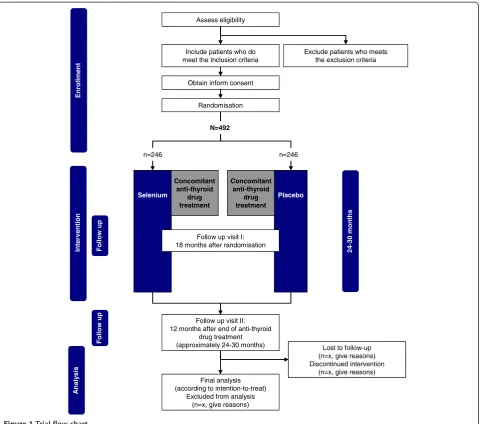
The GRASS (GRAves’disease Selenium Supplementation trial) trial is an investigator-initiated, randomised, blinded, multicentre clinical trial of selenium supplementation ver-sus placebo in patients with Graves’hyperthyroidism. The trial has a parallel-arm design with 1:1 allocation to the experimental intervention group and the control inter-vention group, and involving seven clinical trial sites in Denmark (see Figure 1). The trial also includes a ques-tionnaire and register-based follow up period up to ten years after completion of the intervention period.
Trial participants
All patients with current hyperthyroidism, who are re-ferred to or being followed at the participating clinical trial sites, are considered for participation. Patients are eligible for the GRASS trial, if they comply with the following in-clusion and exin-clusion criteria.
Inclusion criteria
The inclusion criteria are: Graves’hyperthyroidism (first-time diagnosis, defined as patients not yet receiving ATD treatment, or having received ATD treatment con-tinuously for less than two months, or relapse of Graves’ hyperthyroidism defined as patients previously having received and discontinued treatment with ATD); active Graves' hyperthyroidism (TSH <0.1 mU/L and positive TRAb according to local laboratory results) measured within the last two months prior to the inclusion date; age 18 years or older; provision of written informed consent.
Exclusion criteria
The exclusion criteria are: major co-morbidity, rendering the participants unlikely to continuously receive the trial intervention; previous treatment with radioactive iodine; ongoing ATD treatment for more than two months; treat-ment with immunomodulatory drugs, such as cyclospor-ine A, methotrexate, cyclophosphamide; allergy to the components in the selenium and placebo pills; pregnancy
or breast-feeding; intake of selenium supplementation above 70 μg per day; inability to read and understand Danish; lack of provision of informed consent.
Trial intervention Selenium
The compound used in this trial is organic selenium, in the form of selenium yeast, which mainly consists of selenomethionine. The specific product is Organisk selen, 100 μg tablets and is produced by Jemo-Pharm A/S, Stege, Denmark (http://www.jemo-pharm.dk/frame.cfm/ cms/id=977/sprog=2/grp=6/menu=1/). The daily dose is set at 200μg (two tablets taken in the morning). The trial dosage is based on the available clinical data, is not consid-ered to cause adverse reactions, and is lower than the upper tolerable intake level of 300μg per day [6,7].
Placebo
Placebo tablets, identical in size, appearance, taste, smell, and solubility to the experimental intervention tablet are produced by Jemo-Pharm A/S. They have the same con-tent as Organisk selen but are without selenium, as the selenium yeast has been exchanged with yeast grown in selenium-deplete media. The placebo regimen is identi-cal to the selenium regimen.
Randomisation
Randomisation will be performed centrally. The allocation sequence is computer-generated with a varying block size kept unknown to the investigators. Randomisation is stratified by clinical trial site and disease status (inci-dent or relapse), and the allocation ratio is 1:1.
Informed consent procedure
Potential participants are identified at referral or visits to the outpatient clinics and include all patients with current hyperthyroidism (that is, elevated thyroid hor-mone levels). Where Graves’hyperthyroidism is confirmed (that is, TRAb is positive), the potential participant is invited to an information visit by letter. The visit con-sists of obtaining history, blood sampling, information about trial contact, and randomisation.
Duration
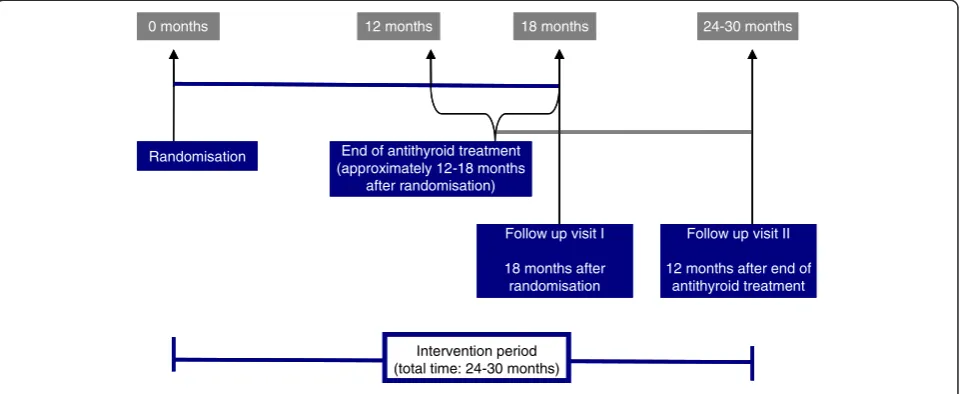
The intervention period for each participant will be 24 to 30 months, as selenium will be given until 12 months after cessation of ATD treatment, which usually lasts 12 to 18 months (Figure 2). The total trial duration is expected to be about 4 years (inclusion period about 17 months and up to 30 months intervention period).
Concomitant medication or treatment
participating clinical trial sites, according to the clinical standards set by the departments. ATD treatment with-drawal must be considered or attempted 18 months after randomisation at the latest.
Participants are advised not to take extra selenium supplementation during the trial. A dose of <70 μg per day is allowed (the content in multivitamin tablets is 55μg). The participants’ consumption of additional selenium supplements will be monitored during the trial through self-report forms.
Monitoring for intervention compliance
Participant compliance with the intervention will be monitored by self-reported tablet intake at 6 and 12 weeks, and 6, 12 and 24 months (Table 1), and by tablet-counting
at trial visits at 18 months and at the end of the interven-tion (24 to 30 months). An investigator will contact the patient if the trial data management system flags a par-ticipant as non-compliant (or overdosing), according to self-report of the number of unopened containers.
Discontinuation
A participant who no longer wishes to participate in the trial can withdraw his/her informed consent at any time without need of further explanation, and this will not have any consequences for the participant’s further treat-ment. In order to conduct intention-to-treat analyses with as few missing data as possible, the investigator may ask the participants which aspects of the trial, they wish to withdraw from. These can include the following:
Placebo
Assess eligibility
Exclude patients who meets the exclusion criteria
Lost to follow-up (n=x, give reasons) Discontinued intervention
(n=x, give reasons) Final analysis
(according to intention-to-treat) Excluded from analysis
(n=x, give reasons)
Int
e
rv
ention
An
a
ly
s
is
Follow
up
Enrollment
Include patients who do meet the Inclusion criteria
Obtain inform consent
Follow up visit II: 12 months after end of anti-thyroid
drug treatment (approximately 24-30 months)
Randomisation
Follow
up
N=492
n=246 n=246
Selenium
24-30
months
Concomitant anti-thyroid
drug treatment
Concomitant anti-thyroid
drug treatment
Follow up visit I: 18 months after randomisation
Placebo
Assess eligibility
Exclude patients who meets the exclusion criteria
Lost to follow-up (n=x, give reasons) Discontinued intervention
(n=x, give reasons) Final analysis
(according to intention-to-treat) Excluded from analysis
(n=x, give reasons)
Int
e
rv
ention
An
a
ly
s
is
Follow
up
Enrollment
Include patients who do meet the Inclusion criteria
Obtain inform consent
Follow up visit II: 12 months after end of anti-thyroid
drug treatment (approximately 24-30 months)
Randomisation
Follow
up
N=492
n=246 n=246
Selenium
24-30
months
Concomitant anti-thyroid
drug treatment
Concomitant anti-thyroid
drug treatment
[image:4.595.59.540.88.512.2]Follow up visit I: 18 months after randomisation
receipt of the trial intervention; participation in the remaining follow up assessments, and analysis of data already collected. The investigators will discontinue a participant’s taking of the trial intervention at any time, if the participant: experiences intolerable adverse reac-tions; is diagnosed with any of the exclusion criteria dur-ing the intervention period; is referred for ablative therapy (radioactive iodine or thyroid surgery) during the inter-vention period. In all three cases, the investigator and/or
the treating physician will, if possible, encourage the participant to continue with follow up assessment and to allow the use of collected data in the analyses.
Blinding
Blinding will be maintained for all parties in the trial, throughout all aspects of the trial. The trial interventions will be identical, and will be packed in identical packages by the Capital Region Pharmacy, and therefore, knowledge Randomisation End of antithyroid treatment
(approximately 12-18 months after randomisation)
Follow up visit II
12 months after end of antithyroid treatment 12 months
0 months 18 months 24-30 months
Intervention period (total time: 24-30 months)
Follow up visit I
18 months after randomisation Randomisation End of antithyroid treatment
(approximately 12-18 months after randomisation)
Follow up visit II
12 months after end of antithyroid treatment 12 months
0 months 18 months 24-30 months
Intervention period (total time: 24-30 months)
Follow up visit I
[image:5.595.59.540.90.287.2]18 months after randomisation
Figure 2Duration of the intervention.
Table 1 Trial schedule for assessments
Follow up
Variable Inclusion
(baseline) 6 weeks
12 weeks
6 months
12 months
18 months
24 months
12 (± 1) months after ATD treatment withdrawal†
Visit x x x
ATD treatment x x x
Thyroid function x1 x1 x1
TSH-Receptor Antibodies x1 xs xs
Serum selenium x (xs) (xs)
Creatinine/iodine ratio in spot urine x
Storage samples (blood and urine) x x x
ThyPRO xr xr xr xr xr xr xr xr
Tablet count xr xr xr xr xr xr xr
Consumption of additional selenium xr xr xr xr
Adverse events* xr xr xr xr xr xr xr
Serious adverse events x
Referral to ablative therapy x x
of allocated intervention group will be unknown to par-ticipants and investigators. All outcome assessments will be performed blinded and statistical analyses will be performed with the blinding intact.
Safety
Selenium is tolerated in short-term doses up to 10,000μg (that is, 100 experimental GRASS tablets). Acute intoxi-cation is very rare and has only been related to accidental or suicidal intake [4,21,22]. Chronic intoxication requires long-term intake of at least 800μg per day [23], according to epidemiological studies in areas with very high selenium content in the soil. Thus, no signs of chronic intoxica-tion have been observed in areas with daily intakes of up to about 800 μg daily. In geographically highly ex-posed groups without signs of intoxication the serum concentrations have been reported to be 148 to 363 μg per L [24] and 284 to 472μg per L [23], respectively. In a study of 200 μg selenium supplementation per day, the serum concentration reached a plateau at around 190μg per L [25].
According to the Danish National Food Institute, the 99th percentile for daily selenium intake through diet in Denmark is 93μg for men and 72μg for women. There-fore, a dosage of 200 μg per day should not bring trial participants above the established upper tolerable intake of 300 μg per day. A review of the safety of selenium supplementation with selenium yeast, which will be used in the GRASS trial [26], concludes that in about a dozen supplementation studies, none has shown evidence of toxicity even up to an intake of 800μg selenium per day over a period of years. In conclusion, the experimental intervention with 200μg selenium per day is not expected to cause adverse reactions. Regardless, participants will be monitored for adverse events.
Overdosing can lead to gastrointestinal discomfort, hair and nail malformations and loss, peripheral neuro-logical symptoms, fatigue and dizziness, and, in the case of very large selenium loads (1,000 times the daily trial dose), cardiovascular collapse and respiratory distress [21,22].
Assessment and reporting of adverse reactions (ARs): participants are prompted to self-report ARs at 6 and 12 weeks, and 6, 12 and 24 months, and are questioned about ARs at the study visits at 18 months of treatment and 12 months after stopping ATD treatment, respect-ively. ARs will be reported as a trial outcome. In addition, participants are instructed to contact their trial contact person if they experience symptoms suggestive of ARs.
Assessment and reporting of serious ARs (SARs), ser-ious suspected SARs (SUSARs) and serser-ious adverse events (SAEs): data on hospital admissions and mortality will be obtained through national registries at the end of the trial. Also, participants are informed and instructed to contact their trial contact person if they are admitted to a hospital
for selenium intoxication, experience a clinical picture indicative of selenium intoxication, or experience a clin-ical picture that is unexpected but suspected to be re-lated to selenium intoxication. When a possible serious event (SAE, SAR, or SUSAR) is identified, details will be sought from the patient’s medical record and through direct contact with the patient. Any SAE, SAR or SUSAR will be reported as an outcome measure.
Outcomes
Outcomes will be assessed seven times during the trial (Table 1).
Primary outcome
The primary outcome is the proportion of participants with the composite outcome of ATD treatment failure in participants receiving ATD treatment during the last 12 months (± 1 month) of the intervention period, who have had thyroid hyperfunction (TSH <0.1) during the last 12 months (± 1 month) of the intervention period, or have been referred for ablative therapy (radioactive iodine or thyroid surgery) at some point during the en-tire intervention period.
Secondary outcomes
The secondary outcomes are each component of the pri-mary outcome as follows: proportion of participants who receive ATD treatment (at any level) during the last 12 months (± 1 month) of the intervention period (separate component of the primary outcome); proportion of partic-ipants who have thyroid hyperfunction (TSH <0.1) during the last 12 months (± 1 month) of the intervention period (separate component of the primary outcome); proportion of participants who have been referred to ablative therapy (radioactive iodine or thyroid surgery) at some point during the entire intervention period (separate compo-nent of the primary outcome); thyroid-specific QoL dur-ing the first year after randomisation, and at the end of the intervention period (24 to 30 months), as mea-sured by the global score in the ThyPRO questionnaire (Appendix 1); level of TRAb at 18 months, and at the end of the intervention period (24 to 30 months); hyper-thyroid symptoms (ThyPRO subscale) during the first year after randomisation; eye symptoms (ThyPRO subscale) during the first year after randomisation, and at the end of the intervention period (24 to 30 months); number of patients with ARs during the intervention period, and number of patients with serious adverse events during the intervention period.
Exploratory outcomes
of the experimental intervention; incidence of Graves' orbitopathy during the intervention period, assessed as clinical activity score (CAS) >1 among patients with CAS scoring in the medical chart, and hypothyroid symptoms (ThyPRO subscale) during the intervention period.
The trial data management system
As a result of the pragmatic design with minimal participant-trial interaction, a large part of the data col-lection, trial conduct, and trial surveillance and timing is handled by the trial data management system. This trial data management system consists of a patient-survey-interface, a trial-personnel-interface, a system-integration interface and a programmemotor. The system will be used for collection of outcomes, adverse events, and other trial-relevant information; for timing of trial events, that is, time for patient-reported outcomes and trial visits; for identification of need for actions (for example, contact to a participant); and for delivery of output to personnel or participants (for example, email notifications).
Research biobank
A research biobank for serum/plasma and urine samples will be established. The samples will initially be kept at each clinical trial site, and will later be analysed at central laboratories. Participants are informed verbally and in writing, and will consent to the withdrawal and storing of biological material in the GRASS trial. Any remaining samples will be transferred to a Biobank designated for future use. These samples will be used for genome-wide association studies (of predictors for remission and experi-mental intervention effects, or other indicators of auto-immunity), as may be specified in forthcoming protocols.
Monitoring
The trial will be monitored according to the International Committee of Harmonization (ICH) guidelines for good clinical research practice [27] by internal monitoring.
Statistical analysis
Primary outcome: ATD treatment failure - sample size estimation
Prior data indicate that the proportion of patients in the placebo group with ATD treatment failure is 50% [28]. If the true proportion with ATD treatment failure is 37.5% among selenium-treated participants (that is, a relative risk reduction of 25%), we will need to include 492 par-ticipants (246 experimental and 246 control parpar-ticipants) to be able to reject the null hypothesis with a power of 80% and a risk of type I error of 5%.
The patient catchment areas of the participating cen-tres include 1,640,000 persons. Assuming an annual inci-dence of Graves' hyperthyroidism of 40 per 100,000 after iodine fortification [1,29] and 50% recurrence rate, the
incident population (including recurrences) will be 788 patients annually. Assuming an inclusion of 45% of the potential patients, this will lead to about 29 participants per month and an inclusion period of about 17 months.
Secondary outcomes - power estimation
For the ThyPRO Global score, hyperthyroid symptoms and eye symptoms, if the true difference between experi-mental and the control participants is 5 (on a scale of 0 to 100) with SD of 20, we will be able to reject the null hypothesis that the population means of the experimental and control groups are equal with a probability (power) of 79%. The associated type I-risk is 5%.
For the level of TRAb, if the true difference in TRAb between experimental and control participants is 0.15 IU per L with SD of 0.5 IU per L, we will be able to reject the null hypothesis with a probability (power) of 91% and a type I error-risk of 5%.
For the number of patients with adverse reactions, prior data indicate that the proportion of participants who experience adverse reactions in the control group is about 5% [26]. If the true proportion of participants in the experimental group who experience adverse reac-tions is 10%, we will be able to reject the null hypoth-esis that the failure rates for experimental and control participants are equal with probability (power) 50%. The type I error probability associated with this test is 5%.
Data analysis
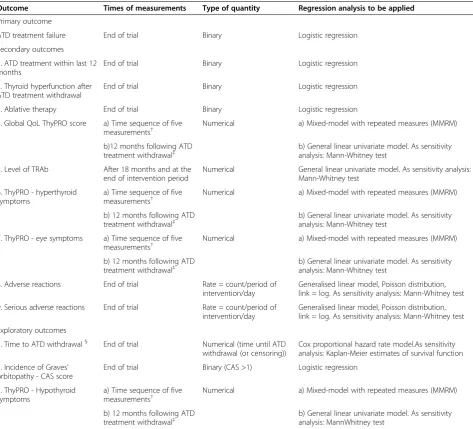
All analyses will be intention-to-treat analyses with the intervention group concealed until two conclusions are drawn. The significance test will be at the 5% level and two-sided. Table 2 shows the priority for each outcome, when it will be measured, the mathematical type of meas-ure, and the analytical procedure to be used when analyz-ing the outcome values.
Analytical procedures
Depending on the specific type of outcome measure, one of five types of regression analysis will be applied (Table 2). Indicator variable I (1 if X and 0 if Y) is included as a covariate and the outcome measure (y) as the dependent variable. All analyses will be conducted both as un-adjusted analyses and un-adjusted for stratification variables (clinical trial site and disease status (incident or relapse)). Discrepancies between the results of the two analyses will be discussed. For each covariate, an exploratory analysis, including the interaction between the covariate and the intervention indicator, will be conducted.
events, the potential for bias caused by non-random miss-ing values will be assessed usmiss-ing a worst- and best-case scenario. The gate keeping method of Dmitrienko et al. [30] will be used to adjust the observedP-values.
Ethical considerations
The GRASS trial has been approved by the Regional Ethics Committee (H-4-2012-026). The trial will be conducted in compliance with the guidelines of the latest Declar-ation of Helsinki and the InternDeclar-ational Conference on Harmonization (ICH) Good Clinical Practice (GCP) Guidelines [27].
Publication plan
The aim is to publish all results, positive, neutral, and nega-tive, in peer-reviewed international journals. Authorship will be determined according to the guidelines from the International Committee of Medical Journal Editors [31].
Discussion
[image:8.595.60.534.110.539.2]The design of the GRASS trial has faced three major challenges: the intent to conduct it as a pragmatic trial with as little interference with daily clinical management as possible, while still measuring QoL meticulously; the intent to comply with the ICH guidelines for GCP, even Table 2 Outcome measures, their priorities, times of measurement, mathematical types and analytical categories (defining the statistical analysis to which they will be subjected)
Outcome Times of measurements Type of quantity Regression analysis to be applied
Primary outcome
ATD treatment failure End of trial Binary Logistic regression
Secondary outcomes
1. ATD treatment within last 12 months
End of trial Binary Logistic regression
2. Thyroid hyperfunction after ATD treatment withdrawal
End of trial Binary Logistic regression
3. Ablative therapy End of trial Binary Logistic regression
4. Global QoL ThyPRO score a) Time sequence of five measurements†
Numerical a) Mixed-model with repeated measures (MMRM)
b)12 months following ATD treatment withdrawal‡
b) General linear univariate model. As sensitivity analysis: Mann-Whitney test
5. Level of TRAb After 18 months and at the
end of intervention period
Numerical General linear univariate model. As sensitivity analysis: Mann-Whitney test
6. ThyPRO - hyperthyroid symptoms
a) Time sequence of five measurements†
Numerical a) Mixed-model with repeated measures (MMRM)
b) 12 months following ATD treatment withdrawal‡
b) General linear univariate model. As sensitivity analysis: Mann-Whitney test
7. ThyPRO - eye symptoms a) Time sequence of five measurements†
Numerical a) Mixed-model with repeated measures (MMRM)
b) 12 months following ATD treatment withdrawal‡
b) General linear univariate model. As sensitivity analysis: Mann-Whitney test
8. Adverse reactions End of trial Rate = count/period of
intervention/day
Generalised linear model, Poisson distribution, link = log. As sensitivity analysis: Mann-Whitney test
9. Serious adverse reactions End of trial Rate = count/period of
intervention/day
Generalised linear model, Poisson distribution, link = log. As sensitivity analysis: Mann-Whitney test
Exploratory outcomes
1. Time to ATD withdrawal§ End of trial Numerical (time until ATD
withdrawal (or censoring))
Cox proportional hazard rate model.As sensitivity analysis: Kaplan-Meier estimates of survival function
2. Incidence of Graves’ orbitopathy - CAS score
End of trial Binary (CAS >1) Logistic regression
3. ThyPRO - Hypothyroid symptoms
a) Time sequence of five measurements†
Numerical a) Mixed-model with repeated measures (MMRM)
b) 12 months following ATD treatment withdrawal‡
b) General linear univariate model. As sensitivity analysis: MannWhitney test
†This analysis (2) includes four measurements relative to the reference time (6 weeks, 12 weeks, 6 months and 12 months).‡This analysis (3) includes one
measurement (12 months following ATD treatment withdrawal or failure to withdraw (alternative treatment instituted or deadline expired)) relative to a different reference time.§
though the intervention is widely considered to be non-toxic and rather, a supplemental nutrient than a drug; and the need for a very long intervention period.
It was of great importance to the initiators of this trial, that the results would be directly applicable to daily clin-ical practice. Therefore, it was decided to conduct a pragmatic trial [32], with as little interference with daily clinical practice as possible. This could be accomplished by letting the patients follow their usual treatment at their usual hospitals by whichever physician was involved in their treatment. At the same time, we found it import-ant to collect high quality data on the clinical course and QoL. We have, therefore, put great effort into the design of a trial management system, which could solve this schism of distance from participants compared to close monitoring. The system initiates and keeps track of patient input (QoL-measurements and other patient-reported outcomes), identifies need for trial personnel input and ac-tion, and collects data on thyroid function from medical chart systems. The system also identifies the site of the information-provider, as well as the disease status of new participants, and delivers randomisation codes stratified by site and disease status. Meticulous follow up on missing responses to the QoL measurements is incorporated into the system, to minimise the usual major problem with missing QoL data in clinical trials.
Somewhat similarly, the need to monitor adverse reac-tions and events in accordance with the ICH guidelines was in conflict with the intent to interfere as little as possible and with the fact that no previous selenium trial has identified any adverse reactions, which would also be quite surprising, given the wide therapeutic range of this dietary supplement. This is solved by a combination of thorough instruction of the participants to contact their trial person in case of symptoms indicative of adverse reactions or events, surveillance of patient-responses to prompts through the trial management system, and inte-gration with national databases regarding hospitalizations.
The third issue was the decision to continue trial intervention until one year after stopping anti-thyroid drugs (ATD treatment withdrawal). Patients are not con-sidered in remission unless they are still euthyroid one year after stopping medication. Since selenium is consid-ered to have an attenuating effect on thyroid autoimmun-ity, a long duration of treatment was considered necessary to test our hypothesis, that is, that selenium can indeed lead to more patients staying in remission (and not just reaching euthyroidism faster and obtaining better QoL).
Trial status
The first patient was enrolled in December 2012.
Abbreviations
ATD:Anti-thyroid drug; AR: Adverse reaction; CAS: Clinical activity score; CRF: Case report form; GCP: Good Clinical Practice; ICH: International
Conference on Harmonization; QoL: Quality of life; SAE: Serious adverse event; SAR: Serious adverse reaction; s-Se: Serum selenium; SmPC: Summary of products characteristics; SUSAR: Suspected serious adverse reaction; T3: Triiodothyronine; T4: Thyroxine; ThyPRO: Thyroid patient related outcome
(thyroid-specific quality of life questionnaire); TPOAb: Thyroid peroxidase antibody; TSH: Thyroid stimulating hormone; TRAb: Thyroid stimulating hormone receptor antibody (TSH receptor antibody).
Competing interest
None of the investigators have any financial or non-financial competing interest.
Author contributions
All authors contributed to the design of the trial, preparation and review of the manuscript and all authors read and approved the final manuscript.
Funding
The GRASS trial is part of the ThyQoL project, a strategic project headed by Ulla Feldt-Rasmussen and funded by the The Danish Agency for Science, Technology and Innovation (grant 271-09-0143). It is also part of a grant given to Torquil Watt by the Danish Council for Independent Research (grant 09–066886).
Author details
1Department of Medical Endocrinology, Copenhagen University Hospital
Rigshospitalet, Blegdamsvej 9, DK-2100 Copenhagen, Denmark.2National Research Centre for the Working Environment, Copenhagen, Denmark. 3Institute of Public Health Science, University of Copenhagen, Copenhagen,
Denmark.4Department of Endocrinology and Metabolism, Odense University Hospital, Odense, Denmark.5Copenhagen Trial Unit, Copenhagen University Hospital Rigshospitalet, Copenhagen, Denmark.6Department of
Endocrinology, Hospital of Southwest Denmark Esbjerg, Esbjerg, Denmark. 7Department of Endocrinology and Gastroenterology, Copenhagen
University Hospital Bispebjerg, Copenhagen, Denmark.8Department of Endocrinology, Copenhagen University Hospital Hvidovre, Copenhagen, Denmark.9Department of Cardiology and Endocrinology, Endocrine Unit, Copenhagen University Hospital Hillerød, Hillerød, Denmark.10Department of Internal Medicine, Endocrine Unit, Copenhagen University Hospital Herlev, Copenhagen, Denmark.11Glostrup Research Institute, Copenhagen University Hospital Glostrup, Copenhagen, Denmark.
Received: 4 September 2012 Accepted: 10 April 2013 Published: 30 April 2013
References
1. Cerqueira C, Knudsen N, Ovesen L, Perrild H, Rasmussen LB, Laurberg P, Jorgensen T:Association of iodine fortification with incident use of antithyroid medication–a Danish Nationwide Study.J Clin Endocrinol Metab2009,94:2400–2405.
2. Hegedus L:Treatment of Graves' hyperthyroidism: evidence-based and emerging modalities.Endocrinol Metab Clin North Am2009,38:355–71. 3. Watt T, Groenvold M, Rasmussen AK, Bonnema SJ, Hegedüs L, Bjorner JB,
Feldt-Rasmussen U:Quality of life in patients with benign thyroid disorders.A review. Eur J Endocrinol2006,154:501–510.
4. Rasmussen LB, Mejborn H, Andersen NL, Dragsted LO, Krogholm KS, Larsen EH,
et al:Selen og Sundhed.Copenhagen: Danmarks Fødevareforskning; 2006. 5. Duntas LH:Selenium and the thyroid: a close-knit connection.J Clin
Endocrinol Metab2010,95:5180–5188.
6. Food and Nutrition Board IoM:Dietary reference intakes for vitamin C, vitamin E, selenium and carotenoids. InFood and Nutrition Board, I.o.M.
Edited by Poillon F, Newberry S. Washington, D.C: National Academy Press; 2000:1.
7. Scientific Committee on Food:Opinion of the Scientific Committee on Food on the Tolerable Upper Intake Level for Selenium. 1. 2000.Brussels: European Commission. Scientific Committee on Food; 2000.
8. Marcocci C, Leo M, Altea MA:Oxidative stress in Graves' disease.European Thyroid Journal2012,1:80–87.
9. Duntas LH:The role of selenium in thyroid autoimmunity and cancer. Thyroid2006,16:455–460.
Baldeschi L, Bencivelli W, Wiersinga W:Selenium and the course of mild Graves' orbitopathy.N Engl J Med2011,364:1920–1931.
11. Vrca VB, Skreb F, Cepelak I, Romic Z, Mayer L:Supplementation with antioxidants in the treatment of Graves' disease; the effect on glutathione peroxidase activity and concentration of selenium.Clin Chim Acta2004,341:55–63.
12. Vrca VB, Skreb F, Cepelak I, Mayer L:Supplementation with antioxidants in the treatment of Graves' disease: the effect on the extracellular antioxidative parameters.Acta Pharm2004,54:79–89.
13. Wertenbruch T, Willenberg HS, Sagert C, Nguyen TB, Bahlo M, Feldkamp J, Groeger C, Hermsen D, Scherbaum WA, Schott M:Serum selenium levels in patients with remission and relapse of graves' disease.Med Chem
2007,3:281–284.
14. Gartner R, Gasnier BC, Dietrich JW, Krebs B, Angstwurm MW:Selenium supplementation in patients with autoimmune thyroiditis decreases thyroid peroxidase antibodies concentrations.J Clin Endocrinol Metab
2002,87:1687–1691.
15. Gartner R, Gasnier BC:Selenium in the treatment of autoimmune thyroiditis.Biofactors2003,19:165–170.
16. Duntas LH, Mantzou E, Koutras DA:Effects of a six month treatment with selenomethionine in patients with autoimmune thyroiditis.Eur J Endocrinol2003,148:389–393.
17. Turker O, Kumanlioglu K, Karapolat I, Dogan I:Selenium treatment in autoimmune thyroiditis: 9-month follow-up with variable doses.J Endocrinol
2006,190:151–156.
18. Mazokopakis EE, Papadakis JA, Papadomanolaki MG, Batistakis AG, Giannakopoulos TG, Protopapadakis EE, Ganotakis ES:Effects of 12 months treatment with L-selenomethionine on serum anti-TPO Levels in Patients with Hashimoto's thyroiditis.Thyroid2007,17:609–612.
19. Nacamulli D, Mian C, Petricca D, Lazzarotto F, Barollo S, Pozza D, Masiero S, Faggian D, Plebani M, Girelli ME, Mantero F, Betterle C:Influence of physiological dietary selenium supplementation on the natural course of autoimmune thyroiditis.Clin Endocrinol (Oxf )2010,73:535–539.
20. Karanikas G, Schuetz M, Kontur S, Duan H, Kommata S, Schoen R, Antoni A, Kletter K, Dudczak R, Willheim M:No immunological benefit of selenium in consecutive patients with autoimmune thyroiditis.Thyroid2008,18:7–12. 21. Pentel P, Fletcher D, Jentzen J:Fatal acute selenium toxicity.J Forensic Sci
1985,30:556–562.
22. Högberg J, Alexander J:Selenium. InHandbook on the toxicology of metals.
Edited by Friberg L, Nordberg GF, Vouk VB. Amsterdam: Elsevier; 1986:482–520.
23. Yang GQ, Wang SZ, Zhou RH, Sun SZ:Endemic selenium intoxication of humans in China.Am J Clin Nutr1983,37:872–881.
24. Longnecker MP, Taylor PR, Levander OA, Howe M, Veillon C, McAdam PA, Patterson KY, Holden JM, Stampfer MJ, Morris JS:Selenium in diet, blood, and toenails in relation to human health in a seleniferous area.Am J Clin Nutr1991,53:1288–1294.
25. Clark LC, Combs GF Jr, Turnbull BW, Slate EH, Chalker DK, Chow J, Davis LS, Glover RA, Graham GF, Gross EG, Krongrad A, Lesher JL Jr, Park HK, Sanders BB Jr, Smith CL, Taylor JR:Effects of selenium supplementation for cancer prevention in patients with carcinoma of the skin. A randomized controlled trial. Nutritional Prevention of Cancer Study Group.JAMA1996,
276:1957–1963.
26. Rayman MP:The use of high-selenium yeast to raise selenium status: how does it measure up?Br J Nutr2004,92:557–573.
27. International Conference on Harmonisation Guideline for International conference on harmonisation of technical requirements for registration of pharmaceuticals for human use:Guideline for Good Clinical Practice E6 (R1). ICH Harmonised Tripartite Guideline. 10-6-1996.http://www.ich.org/fileadmin/ Public_Web_Site/ICH_Products/Guidelines/Efficacy/E6_R1/Step4/ E6_R1__Guideline.pdf.
28. Dupont WD, Plummer WD Jr:Power and sample size calculations. A review and computer program.Control Clin Trials1990,11:116–128.
29. Lantz M, Abraham-Nordling M, Svensson J, Allin G, Allengren B:
Immigration and the incidence of Graves' thyrotoxicosis, thyrotoxic multinodular goiter and solitary toxic adenoma.Eur J Endocrinol2009,
160:201–206.
30. Dmitrienko A, Tamhane AC, Wiens BL:General multistage gatekeeping procedures.Biom J2008,50:667–677.
31. International Committee of Medical Journal Editors:Uniform Requirements for Manuscripts Submitted to Biomedical Journals: Ethical Considerations in the Conduct and Reporting of Research: Authorship and
Contributorship. 2010. http://www.icmje.org/ethical_1author.html. 32. Ware JH, Hamel MB:Pragmatic trials–guides to better patient care?N Engl
J Med2011,364:1685–1687.
doi:10.1186/1745-6215-14-119
Cite this article as:Wattet al.:Selenium supplementation for patients
with Graves’hyperthyroidism (the GRASS trial): study protocol for a
randomized controlled trial.Trials201314:119.
Submit your next manuscript to BioMed Central and take full advantage of:
• Convenient online submission
• Thorough peer review
• No space constraints or color figure charges
• Immediate publication on acceptance
• Inclusion in PubMed, CAS, Scopus and Google Scholar
• Research which is freely available for redistribution