INCORPORATED
PROCEEDINGS
Thirty-Third Semi-Annual
Cray User Group Meeting
No part of this publication may
be
reproduced by any mechanical, photographic, or electronic process
without written permission from the author(s) and publisher. Permission requests should be made in
writing to:
Cray User Group Secretary
c/o Joan Palm
655A Lone Oak Drive
Eagan, MN 55121 USA
The CUG
Proceedings
is edited and produced by Karen Winget,
Fine Point Editorial Services, 1011 Ridge Valley Court, Shepherdstown, WV 25443
Cover designed by Carol Conway Leigh
Autotasking, CF77, CRAY, Cray Ada, CRAY Y-MP, CRAY-l, HSX, MPGS, SSD, SUPERSERVER, UniChem, UNICOS, and X-MP EA are federally registered trademarks and CCI, CFT, CFf2, CFf77, COS, CRAY APP, Cray C++ Compiling System, CRAY C9Q, CRAY
EL, Cray NQS, CRA Y S-MP, CRAY TID, CRA Y X-MP, CRAY XMS, CRAY-2, CraylREELlibrarian, CRInform, CRVTurboKiva, CSIM, CVT, Delivering the power ... , Docview, EMDS, lOS, MPP Apprentice, Network Queuing Environment, Network Queuing Tools, OLNET, RQS, SEGLDR, SMARTE, SUPERCLUSTER, SUPERUNK, Trusted UNICOS, and UNICOS MAX are trademarks of Cray
Cray User Group, Inc.
BOARD OF DIRECTORS
President
Gary Jensen (NCAR)
Vice-President
Jean Shuler (NERSC)
Secretary
Gunter Georgi (Grumman)
Treasurer
Howard Weinberger (TAl)
Director
Claude Lecoeuvre (CEL-V)
Regional Director Americas
Fran Pellegrino (Westinghouse)
Regional Director Asia/Pacific
Kyukichi Ohmura (CRC)
Regional Director Europe
Walter Wehinger (RUS)
PROGRAM COMMITTEE
Jean Shuler, Chair (NERSC)
Robert Price (Westinghouse)
Helene Kulsrud (IDA)
Phil Cohen (Scripps)
LOCAL ARRANGEMENTS
Anke Kamrath
Ange Mason
Mike Vildibill
Jay Dombrowski
Phil Cohen
Dan Drobnis
Gail Bamber
Russ Sinco
Sandy Davey
Chairman's Report
John F. Carlson (CRI)
Cray Research Corporate Report
Robert Ewald (CRI)
CRI Software Report
Irene Qualters (CRI)
CONTENTS
GENERAL SESSIONS
Unparalleled Horizons: Computing in Heterogeneous Environments
Reagan Moore (SDSC)
Cray TID Project Update
Steve Reinhardt (CRI)
PARALLEL SESSIONS
Applications and Algorithms
Porting Third-Party Applications Packages to the Cray MPP: Experiences at the
Pittsburgh Supercomputing Center
Frank C. Wimberley, Susheel Chitre, Carlos Gonzales, Michael H. Lambert, Nicholas Nystrom,
Alex Ropelewski, William Young (PITTSCC)
Some Loop Collapse Techniques to Increase Autotasking Efficiency
Mike Davis (CRI)
Collaborative Evaluation Project of Ingres on the Cray (CEPIC
C.B. Hale, G.M. Hale, and K.F. Witte (LANL)
Providing Breakthrough Gains: Cray Research MPP for Commercial Applications
DentonA. Olson (CRI)
Asynchronous Double-Buffered I10Applied to Molecular Dynamics Simulations of
Macromolecular Systems
3
6
14
21
28
39
44
65
73
Richard J. Shaginaw, Terry R. Stouch, and Howard E. Alper (BMSPRI) 76 A PVM Implementation of a Conjugate Gradient Solution Algorithm for Ground-Water Flow Modeling
Dennis Morrow, John Thorp, and Bill Holter (CRI and NASA/Goddard) 80
Graphics
Decimation of Triangle Meshes
vi
Visualization of Volcanic Ash Clouds
Mitchell Roth (ARSC) and Rick Guritz (Alaska Synthetic Aperture Radar Facility)
A Graphical User Interface for Networked Volume Rendering on the Cray C90
Allan Snavely and T. Todd Elvins (SDSC)
Management
Heterogeneous Computing Using the Cray Y -MP and T3D
Bob Carruthers (CRI)
Future Operating Systems Directions
Don Mason (CRI)
Future Operating Systems Directions-Serverized UNICOS
Jim Harrell (CRI)
Mass Storage Systems
Storage Management Update
Brad Strand (CRI)
RAID Integration on Model-E lOS
Bob Ciotti (NASA-Ames))
Automatic DMF File Expiration
Andy Haxby (Shell U.K.)
ER90®Data Storage Peripheral
Gary R. Early and Anthony L. Peterson (ESYSTEMS)
EMSSICray Experiences and Performance Issues
Anton L. Ogno (EXXON)
AFS Experience at the Pittsburgh Supercomputing Center
Bill Zumach (PIITSC)
AFS Experience at the University of Stuttgart
Uwe Fischer and Dieter Mack (RUS) Cray Research Status of the DCEIDFS Project
Brian Gaffey (CRI)
Networking
SCinet '93-An Overview
Benjamin R. Peek (peek & Associates, Inc.)
Experiences with OSF-DCFJDFS in a 'Semi-Production' Environment
Dieter Mack (RUS)
A 1M-Current Status
Benjamin R. Peek (Peek & Associates, Inc.) Network Queuing Environment
Robert E. Daugherty and Daniel M. Ferber (CRI)
92
100
109
112
114
119
123
136
140
143
153
157
161
169
175
180
Operating Systems
Livennore Computing's Production Control System, 3.0
Robert R. Wood (UNL)
ALACCf: Limiting Activity Based On ACID
Sam West (CR!)
Priority-Based Memory Scheduling
Chris Brady (CR!), Don Thorp (CR!), and Jeff Pack (GRUMMAN)
Planning and Conducting a UNICOS Operating System Upgrade
Mary Ann Ciuffini (NCAR)
UNICOS Release Plans (1994-1995)
Janet Lebens (CR!)
UNICOS 8.0 Experiences
Hubert
Bus~h(ZlB)
UNICOS 8.O-Field Test Experiences
Douglas A. Spragg (EUTEC)
Operations
SDSC Host Site Presentation
Daniel D. Drobnis and Michael Fagan (SDSC)
Tools for the Cray Research OWS-E Operator under UNICOS 8.0
Leon Vann (CR!)
Cray Research Product Resiliency
Gary Shorrel (CR!)
Performance Evaluation
UNICOS 7.C versus 8.0 Test Results
C.L. Berkey (CR!)
Workload Characterization of Cray Supercomputer Systems Running UNICOS for the Optimal
Design of NQS Configuration in a Site
Young
W.Lee and Yeong Wook Cho (KIST) andAlex Wight (Edinburgh University)
Cray C90D Performance
David Slowinski
Software Tools
Cray File Pennission Support Toolset
David H. Jennings and Mary Ann Cummings (Naval Surface Warfare Center)
Tools for Accessing Cray Datasets on Non-Cray Platfonns
Peter W. Morreale (NCAR)
Centralized User Banking and User Administration on UNICOS
Morris A. Jette, Jr., and John Reynolds (NERSC)
209
212
221
224
231
237
239
247
251
255
260
271
291
295
300
Fortran 90 Update
Jon Steidel (CRI)
C and C++ Programming Environments
David Knaak (CRI)
The MPP Apprentice™ Perfonnance Tool: Delivering the Perfonnance of the Cray T3D®
Winifred Williams, Timothy Hoel, and Douglas Pase (CRI) Cray Distributed Programming Environment
Lisa Krause (CRI) Cray TotalView™ Debugger
Dianna Crawford (CRI)
Fortran
110
Libraries on T3DSuzanne LaCroix (CRI)
User Services
User Contact Measurement Tools and Techniques
Ted Spitzmiller (LANL)
Balancing Services to Meet the Needs of a Diverse User Base
Kathryn Gates (MCSR)
Applications of Multimedia Technology for User Technical Support
Jeffrey A. Kuehn (NCAR)
Integrated Perfonnance Support: Cray Research's Online Information Strategy
Marjorie L. Kyriopoulos (CRI)
New and Improved Methods of Finding Information via CRINFORM
Patricia A. Tovo (CRI)
Online Documentation: New Issues Require New Processes
Juliana Rew (NCAR)
MetaCenter Computational Science Bibliographic Infonnation System: A White Paper
Mary Campana (Consultant) and Stephanie Sides (SDSC)
Electronic Publishing:From High-Quality Publications to Online Documentation
Christine Guzy (NCAR)
JOINT
SESSIONS
MSSIOperating Systems
Workload Metrics for the NCAR Mass Storage System
313
320
324
333
338
344
349
353
360
365
369
372
376
380
J.L. Sloan (NCAR) 387
Scientific Data Storage Solutions: Meeting the High-Performance Challenge
Daniel Krantz, Lynn Jones, Lynn Kluegel, Cheryl Ramsey, and William Collins (LANL) 392
Beyond a Terabyte System
Alan K. Powers (SS-NAD) 402
viii
Operations/Environmental MIG
Overview of Projects, Porting, and Perfonnance of Environmental Applications
Tony Meys (CRI)
Operations/MPP MIG
T3D SN6004 is Well, Alive and Computing
Martine Gigandet, Monique Patron, Francois Robin (CEA-CEL)
System Administration Tasks and Operational Tools for the Cray TID System
Susan J. Crawford (CRI)
Performance Evaluation/Applications and Algorithms
I/O Optimisation Techniques Under UNICOS
Neil Storer (ECMWF)
I/O Improvements in a Production Environment
JejfZnis and John Bauer (CRI)
New Strategies for File Allocation on Multi-Device File Systems
Chris Brady (CRI), Dennis Colarelli (NCAR),
Henry Newman (Instrumental), and Gene Schumacher (NCAR)
Performance Evaluation/MPP MIG
The Performance of Synchronization and Broadcast Communication on the Cray T3D Computer System
411
419
426
433
442
446
F. Ray Barriuso (CRI) 455
High Perfonnance Programming Using Explicit Shared Memory Model on the Cray TID
Subhash Saini, Horst Sinwn (CSC-NASA/Ames) and Charles Grassl (CRI) 465
Architecture and Perfonnance for the Cray TID
Charles M. Grassl (CRI) 482
User Services/Software Tools
Confessions of a Consultant
Tom Parker (NCAR)
SHORT PAPERS
Xnewu: A Client-Server Based Application for Managing Cray User Accounts
Khalid Warraich and Victor Hazlewood (Texas A&M)
QEXEC: A Tool for Submitting a Command to NQS
Glenn Randers-Pehrson (USARL)
A TTENDEE LIST
491'
505
507
x
AUTHOR INDEX
Alper, H.E. (Bristol-Meyers Squibb), 76
Barriuso, F.R. (CRI), 455
Bauer,1. (CRI), 442
Berkey, C.L. (CRI), 260
Brady, C. (CRI), 221, 446
Busch, H. (ZIB), 237
Campana, M. (SDSC consultant), 376
Carlson, J.F. (CRI), 3
Carruthers, B. (CRI), 109
Chitre, S. (PITTSC), 39
Cho, Y.W. (KIST), 271
Ciotti, B.
(NASAlAmes), 123
Ciuffini, M. (NCAR), 224
Colarelli, D. (NCAR), 446
Collins, W. (LANL), 392
Crawford, D. (CRI), 338
Crawford, S.I. (CRI), 426
Cummings, M., (Naval Surface Warfare
.
Center), 295
Daugherty, R.E. (CRI), 203
Davis, M. (CRI), 44
Drobnis, D.D. (SDSC), 247
Early, G.R. (ESYSTEMS), 140
Elvins, T.T. (SDSC), 100
Ewald, R.(CRI), 6
Fagan, M. (SDSC), 247
Ferber, D.M., 203
Fischer, U. (RUS), 157
Gaffey, B. (CRI), 161
Gates, K. (MCSR), 353
Gigandet, M. (CEA-CEL), 419
Gonzales, C. (PITTSC), 39
Grassl, C. (CRI), 465, 482
Guritz, R. (Alaska Synthetic Aperture Radar
Facility), 92
Guzy, C. (NCAR), 380
Hale, C.B. (LANL), 65
Hale, G.M. (LANL), 65
Harrell,1. (CRI), 114
Haxby, A. (Shell U.K), 136
Hazlewood, V. (Texas A&M), 505
Hoel, T. (CRI), 324
Holter, B. NASAlGoddard), 80\
Jennings, D.H. (Naval Surface Warfare
Center), 295
Jette, M.A., Jr. (NERSC), 304
Jones, L. (LANL), 392
Kluegel, L. (LANL), 392
Knaak, D. (CRI), 320
Krantz, D. (LANL), 392
Krause, L. (CRI), 333
Kuehn, J .A. (NCAR), 360
Kyriopoulos, M.L. (CRI), 365
Labens, 1. (CRI)231
LaCroix, S. (CRI), 340
Lambert, M.H. (PITTSC), 39
Lee, Y.W. (KIST), 271
Mack, D. (RUS), 157, 175
Mason, D. (CRI), 112
Meys, T. (CRI), 411
Moore, R. (SDSC), 21
Morreale, P. (NCAR), 300
Morrow, D., (CRI)??, 80
Newman, H. (Instrumental), 446
Nystrom, N. (PITTSC), 39
Ogno, A.L. (EXXON), 143
Olson, D.A. (CRI), 73
Pack, 1. (GRUMMAN)), 221
Parker, T. (NCAR),491
Pase, D. (CRI), 324
Patron, M. (CEA-CEL), 419
Peek, B.R. (peek & Assoc.), 169, 180
Peterson, A.L. (ESYSTEMS), 140
Powers, A.K. (SS-NAD), 402
Qualters,
I.
(CRI), 14
Ramsey, C. (LANL), 392
Randers-Pehrson, G. (USARL), 507
Reinhardt, S. (CRI), 28
Rew, J. (NCAR), 372
Reynolds, J. (NERSC), 304
Robin, F. (CEA-CEL), 419
Ropelewski, A. (PITTSC), 39
Roth, M. (ARSC), 92
Saini, S.
(CSC-NASAIAmes), 465
Schroeder, W.I. (GE-AE), 87
Schumacher, G. (NCAR), 446
Shaginaw, R.I. (Bristol-Meyers Squibb), 76
Shorrel, G. (CRI), 255
Sides, S. (SDSC), 376
Simon, H.
(CSC-NASAIAmes), 465
Sloan, J.L. (NCAR), 387
Slowinski, D. (CRI), 291
Snavely, A. (SDSC), 100
Spitzmiller, T. (LANL), 349
Spragg, D.A. (EUTEC), 239
Steidel, 1. (CRI), 313
Storer, N. (ECMWF), 433
Stouch, T.R. (Bristol-Meyers Squibb), 76
Strand, B. (CRI), 119
Thorp, D. (CRI), 221
Thorp, J. (CRI), 80
Tovo, P.A. (CRI), 369
Vann, L. (CRI), 251
Warraich,
K.
(Texas A&M), 505
West, S. (CRI), 212
Williams, W. (CRI), 324
Wimberley, F.C. (PITTSC), 39
Witte, K.F. (LANL), 65
Wood, R.R. (LLNL), 209
Young, W. (PITTSC), 39
Zais, 1. (CRI), 442
CHAIRMAN'S REPORT
John F. Carlson
Cray Research, Inc.
Eagan, Minnesota
Good morning. Thank you for inviting me to
participate today. I want to take the time available to
review our 1993 performance and discuss where we
plan to go in our strategic plan covering us from now
through 1996.
I am taking some time to review our fmancial
condition because you are
allinvestors in Cray
Research. Whether or not you own any of our
common stock, you and your colleagues have invested
your efforts and energy and professional challenges in
Cray Research. I want to use this opportunity to
show that your investment is well placed.
Simply stated, we had a very good year in 1993. We
delivered on our 1993 plan by increasing revenue,
improving margins, reducing costs and delivering our
shareholders solid profits for the year of $2.33 per
share versus a loss for 1992.
Our financial perfonnance enables us to continue
investing at least 15 percent of our revenues into
research and development. No matter what changes
the market brings or we bring to the market, that
commitment will not change.
We achieved those fmancial results while also
delivering two major hardware platfonns and a number
of software advances -- including the creation of
CraySoft -- our initiative to make Cray software
available on non-Cray platforms, right down to PCS.
I am pleased to note, also, that we delivered our new
hardware and software products on time, as promised.
Clearly, we have recovered from our 1992 restructuring
and are realizing the operating savings we hoped would
result from those difficult actions.
For a few specifics, our 1993 revenue grew 12 percent
to $895 million from $798 million in 1992. This
substantial increase resulted principally from strong
sales of large C90 systems. We sold 12 C916
systems in 1993 -- double the number sold a year
earlier. And having moved on from the C90's
introductory stages, we achieved better margins
--which certainly helped our earnings results.
Copyright © 1994. Cray Research Inc. All rights reserved.
We also improved our balance sheet along the way.
We grew our total assets by 15 percent to about $l.2
billion from 1992, generated about $170 million in
cash, improved stockholder's equity by $56 million
and our book value at year-end 1993 was roughly $30
a share.
Return to shareholder's equity was eight percent for the
year and return on capital employed rose to 11 percent.
While these figures are relatively good, they do not yet
hit the levels we have targeted for the company. Our
targets, long tenn, are to deliver 18 to 20 percent
improvements in stockholder's equity and 15 percent
improvement on our return on capital employed.
Also, we ended 1993 with an increase in inventories of
about $52 million. That increase is one figure going
the wrong direction and reflects the ramp-up
investments we made to launch both the T3D and
CS6400 and also the high level of deliveries we
anticipate completing this quarter.
In 1993 we signed a total net contract value of orders
of $711 million compared with $598 million for
1992. This 19 percent increase really reflects the
strong demand for C916s and TIDs. Our order
backlog at year-end was $409 million, just shy of the
record $417 million we reported in 1992. And, yes,
the delayed acceptance of a C916 from December 1992
to January, 1993 was included in the 1992 record
number. Backing out that system for comparison
purposes confrrms that our backlog number for 1993
is going in the right direction, upward.
Today, we have about 500 systems installed around the
world. Those systems are broadening out
geographically and by industry.
In1993, we added
new fIrst-time customers in Malaysia and
Czechoslovakia and installed our first system in Africa
at the South African weather bureau. We also received
orders for our fIrst systems to China -- in both the
PVP and SMP line. Three Superserver systems are
now installed at Chinese universities. The PVP
mainline system will be installed at the Chinese
Weather service, assuming the export license
is grantedas we expect.
4
The orders break out by market sector to: 44 percent government customers, 29 percent commercial and 27 percent with universities.
Our commercial and industrial customers continue to use our systems to deliver solutions for their technical and scientific computing needs. I expect this sector to continue to grow and increase its overall percentage of total orders.
Insofar as our product mix is concerned, 1993 was a very good year. As you know we stepped up deliveries of our C916 systems. We also announced the
availability of extended C90 family ranging in size from two to 16 processors. This range of availability helps make the C90 product more flexible and available to our customers in convenient
configurations. Convenient in size to fit your mission and, hopefully, your budget
The C90 continues to set the performance pace for our customers. As you may know, more than 20 key codes used by our customers run at sustained speeds exceeding six gigaflops. Five of these 20 codes reached speeds of more than 10 gigaflops each. And as we speak, more performance records are being set These records are far more than bragging points. They
are the ultimate measures of getting ~ work done on
~ problems. That will remain a corporate priority
for all our systems.
In the MPP arena, we had a very good launch for the TID system in September. On announcement day we figure we captured third place in the MPP market and expect to be the number one supplier by the end of this year.
By year-end we had 15 orders in hand. I am
particularly pleased to note that this week we are able to announce our first commercial and first petroleum customer for the T3D -- Exxon Corporation. It was particularly gratifying to read their news release in which they described the T3D as a critical tool to their growth strategies because it is the first production quality MPP system in the market. As I said with the
C90 line, that means Exxon will be doing
n:al
workon ~ problems day in and day out on the T3D.
We're also announcing this week some significant benchmark results for the T3D on the NAS parallel benchmark suite. Now I know that there has been a rush to claim moral or technical victory by any number of MPP companies using NAS results and I promise not to enter into that debate. But I do want to bring two points to your attention.
First point has little to do with MPP benchmarks. Rather, it has to do with the results they are compared
to. The 256-processor system is the first of the MPP crowd to approach the C916's performance on any of the NAS parallel benchmarks beyond the
Embarrassingly Parallel test. So the C916, the workhorse of the supercomputing field continues to be the performance leader on these benchmarks. But at 256 processors the TID is starting to give the C916 a run for its money on highly parallel computing, and since the TID is showing near-linear scalability we're confident it will widen its performance and scalability leadership as we move to 512-processors and larger configurations. We're also glad it took another system from Cray to approach the C916's performance.
Second point is to note that these results arrived just six months after the TID was introduced. We all know that we were late to the MPP party. But I think it is even more important to note what is being accomplished following our arrival. Some of our competitors have had two years or more to improve their performance against the C916. I can only assume that they have not announced their complete 256 results to date because they can't efficiently scale up that far.
The strength of the T3D -- and those systems to follow -- reflects the input received from many of you here. This system stands as an example of what can be accomplished when we listen to our customers.
The strength of the TID will be enhanced by another program that had an excellent year -- the Parallel Applications Technology Partners program, or PA TP. When MPP performance shows steady, consistent improvement in a wide range of applications, it will be in part due to the efforts underway between Cray and its PA TP partners, PSC, EPFL, JPL and Los Alamos and Livermore labs. Great things are coming from these collaborations.
The third sibling of the Cray architecture family is our Superservers operation, based in Beaverton, Oregon. They also delivered a beautiful, bouncing and robust baby in 1993 -- the CS6400. The CS6400 is a binary compatible extension of the Sun product line. It serves as a high performance server for networks of workstations and smaller servers running the huge range of Sun applications. Any program that runs on a Sun system will run on the CS6400 without modification and the current product is Solaris 2.3 compatible.
alternative to a mainframe in the so-called
"rightsizing" market It is also important to note that the CS6400 is an excellent alternative to small-configuration MPP systems for both the commercial and scientific and technical markets.
Introduction of the Superserver subsidiary brings me to an important point and sets the stage to discuss our strategic direction. First the important point: Cray Research is focused on its mission of providing the highest perfonning systems to its customers. We are not architecture constrained. In fact, we are the only finn that can provide top-perfonning systems in all three major architectures -- Parallel Vector; Massively Parallel and Symmetric Multiprocessing.
You and your colleagues want solutions. We want to help you get them. It matters little to us whether your ideal solution comes from one specific architecture or another. What matters is that Cray Research continue as a technical partner in finding the solutions.
We don't have to -- nor do we want to -- make two sales every time we talk with you. We don't have to sell you on one architecture or another and then, next sell you on our product over a competitor's. We remain focused on helping deliver the highest perfonnance possible in each architecture. We are certain that if we continue to stick to our knitting with
that focus, we will be successful as you become
successful with our systems.
Now I want to tie this together to our strategic plan. Our plan is simple. We have to grow in order to accomplish the things that are important to you and to us.
If we want to remain at the head of the perfonnance
class, we must continue to invest huge sums each year . in R&D. Those sums are only available if we
continue to grow revenues, earnings, margins and
backlogs. We wouldn't have to change anything in our
strategy if the technical and scientific market was growing, say 30 to 40 percent as it did in the 1970s. But the reality is that the market is flat and, depending on how you measure it, has been for four consecutive years.
At the same time, we don't want to change who we are. We are a technology driven company. We will
~ be a technology driven company committed to
achieving the highest perfonnance possible at the best price.
So, while our focus can't change, our tactics can. As we maintain our marketshare leadership at a relatively flat level in the scientific market for now, at least --we see that a growing need for efficient, price/effective
systems to solve big problems in other markets. Commercial entities of all sizes and shapes are recognizing that they have done a great job in . accumulating huge data bases, but are limited in how well they can manipulate or mine these data bases to their advantage.
Some businesses have said they forgot the second part of the equation -- "what are we going to do with all this infonnation and how, pray tell, are we going to use it to grow our businesses?"
Here's where we believe Cray Research can help.
We believe that our technologies can help. Across all three of the important high perfonnance architectures our products are distinguished by their technical balance. Balance that unlocks the problem-solving potential of increasingly fast microprocessors --regardless of the architecture in which they are embedded.
We combine fast processors with high-perfonnance memory and I/O subsystems and robust, proven software to deliver unsurpassed balance right to your desktop. That won't change. But we may be able to add new applications in other parts of a commercial enterprise.
We plan to use this unique strength to grow our volume and market reach. Instead of finding a Cray system at the R&D center only, I can picture one being used by the marketing or finance functions as well.
Just this last year we've seen new customers emerge from non-traditional fields. Like Wall Street, I expect to see more and more utilization at new locations.
In doing so, much like the early successes of the superserver product, we'll probably draw some attention. Some of our nervous competitors will whisper that we've "lost focus" as we compete for and win commercial business. Quite the contrary, I believe our move to add customers in non-traditional supercomputing areas is an example of our unique focus. We see this approach as the best way to ensure that we don't blink when we face the future. We remain committed to the top of the perfonnance pyramid. We remain focused on the need to invest at least 15 percent of our revenues in to R&D so we can move our perfonnance up the scale to match your demands. And we remain focused on the importance of long-tenn, cooperative relationships with our
customers. And that may be the best single investment we've ever made.
6
Cray Research Corporate Report
Robert H. Ewald
Cray Research, Inc.
900 Lowater Road
Chippewa Falls, WI 54729
ABSTRACf
This paper provides an overview of Cray Research's business in 1993, an update on progress in 1994, and a vision of Cray in the future.
1 1993 Results
1993 proved
to bea very good year for Cray Research,
Inc. We achieved our 1993 plan by delivering a broad
mix of high performance systems and software, and
achieved a return to solid profitability. 1993 was also a
year of substantial change for Cray Research, but before
describing the changes, I will review some terminology.
The
"s
upercomputer Operations" business unit is
focused on high performance, cost effective
computa-tional
toolsfor solving the world's most challenging
scientific and industrial problems and produces our
par-allel vector and highly-parpar-allel products.
In this
technical computing world we have defined three
segments that encompass different customer
character-istics. The "Power" segment can
berecognized as those
with "grand" challenge problems. These customers are
typically from the government and university sector and
require
the highest performance solutions of scientific
and engineering problems. Most of the applications are
mathematically-oriented and are created by
thecus-tomer. This segment typically invests more
than$10
million in computer products. The "Endurance"
seg-ment can be characterized
as customers with production
problems to
besolved. There are a combination of
industrial, government, and academic customers each
solving high performance production engineering,
sci-entific, and data-oriented problems. In this segment,
Copyright
©1994. Cray Research Inc. All rights reserved.
applications are frequently from
thirdparty providers.
PriceJPerformance is of major concern for these
prod-ucts, ranging from about $3 million to $10 million. The
"Agile" market segment is comprised of industrial,
gov-ernment, and academic customers with engineering,
sci-entific, and data-oriented problems. The applications
are generally third
partyand their price/performance is
of paramount importance for the production capability.
The hardware investment here is less than $3 million.
The "Superserver" business unit addresses applications
that require
rapid manipulation and analysis of large
amounts of data in a networked production
environ-ment, and produces products based on Sun
Microsys-tem's SP ARC architecture. Many of the applications
are
atnon-traditional Cray customers in the business or
commercial segment
As
shown in Figure 1, we are changing our organization
to reflect these concepts. Les Davis and I
sharethe
office of Chief Operating Officer and we have two
major business units: Supercomputer Operations and
Superserver Operations. Changes within the
organiza-tion since the last CUG meeting include:
- Gary
Ball, Vice President of Government Marketing
- Rene Copeland, General Manager of "Endurance" Systems - Rene is leading our efforts to ensure that we provide products and services for the industrial, pro-duction-oriented customers.
Dan Hogberg, General Manager of "Agile" Systems -Dan is leading our work with deskside and departmen-tal systems.
- Dave Thompson, Vice President of Hardware Research & Development - Dave has moved from the Software Division to lead our hardware development and engineering efforts. Dave is teamed with Tony Vacca who also leads the Triton and other projects. - Don Whiting, Sr. Vice President, Operations - we have combined all product operational divisions (Inte-grated Circuits, Printed Circuits, Manufacturing, and Systems Test & Checkout) under Don to improve our operational processes and efficiency.
- Lany Betterley, Vice President of Finance & Admin-istration - Larry leads the operational Finance and Administration groups within the business units. The Superservers business unit remains the same, and in addition, Paul Iwanchuk and Penny Quist are acting leaders of new initiatives in Government Systems &
Technology and Data Intensive computing.
Figure 2 shows the progression of orders and the results for 1993, indicating our best year ever for orders for our larger products and a good base of orders for Agile and Superserver products.
During 1993 we installed half of the systems shipped in North and South America and one-third in Europe. As
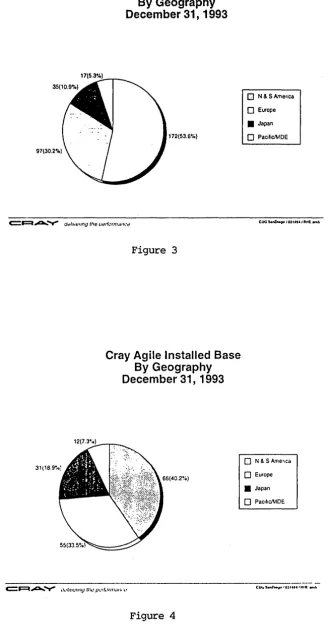
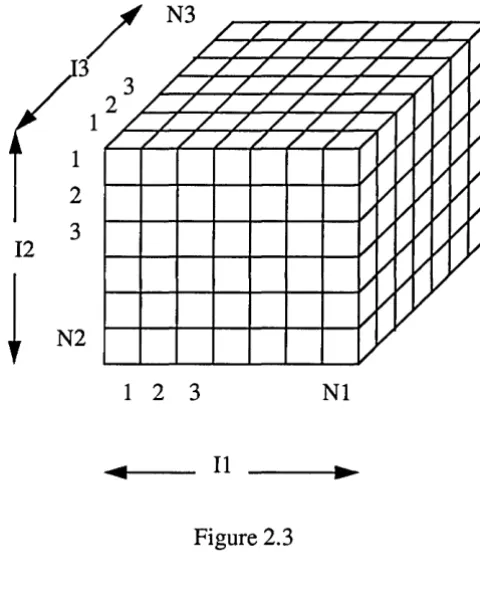
shown in Figure 3, that brings the total installed base to 54 percent North and South America, 30 percent Europe, and 11 percent Japan. We expect that more of our future business will come from non-U.S. based cus-tomers, so the U.S. percentage will continue to decline. The Agile installs in 1993 were distributed 45 percent to the Americas, 33 percent to Europe, and 14 percent to Japan. This brings the total Agile installed base to 40 percent Americas, 33 percent Europe, and 19 percent Japan, as shown in Figure 4. This again reflects the increasing "internationalization" of our business. Figure 5 shows the installed base at year-end 1993 by industry. The most significant changes in the distribu-tion that occurred during the year were increases in the university, aerospace, and environmental segments, and a decrease in the government research lab business reflecting changing government spending.
Figure 6 shows the distribution of the 500 systems installed at customer sites. The Y -MP and EL products are dominant with C-90s and T3Ds just beginning to ramp up.
There were 38 new customers in the Supercomputer business unit and 12 in the Superserver business unit. We welcome all of you to the growing Cray family and hope you will share with us your ideas for the future of computing.
We ended 1993 with the strongest offering of products we have ever fielded. We offer three architectures, each with superior price/performance: parallel vector, massively parallel, and symetric multiprocessing. The parallel vector product line was expanded by extending the Cray C-90 to configurations ranging from 2 to 16 processors. We began shipping the C-92, C-94, and C-98 at mid-year. All the C-90 series systems feature the newest, fastest memory technology available - four megabit SRAM (static random access memory). We also introduced the big memory machines - D-90 with up to 4 billion words of memory.
Two new departmental supercomputers were intro-duced - the EL92 and EL98. The EL92 is the com-pany's smallest, lowest-priced system to date with a U.S. starting price of $125,()()() and a footprint of about four square feet. The Cray EL92 is designed to extend Cray Research compatibility to office environments at attractive prices. The EL98 is available with two, four, six, or eight processors, offering up to 512 million words of central memory and providing a peak perfor-mance of one gigaflops (billion floating point opera-tions per second).
During 1993 we expanded our product offerings for the scientific and technical market by introducing our first massively parallel supercomputer - the Cray TID. We now have five installed and are expecting to install over thirty this year. Reaching that target will make us the leading MPP vendor in 1994.
In addition to these products, the CS6400, a SP ARC-based symmetric multiprocessing system, was introduced with configurations ranging from 4 to 64 processors. This platfOtnl is for commercial data man-agement applications as well as scientific and technical users. We expect to install over 50 of these new machines in 1994.
New announcements in software include the release of Network Queing Environment (NQE) and our Fortran compiler (CF90). Our new business entity "CrayS oft" was successfully initialized to provide Cray software products and technologies to the non-Cray platfOtnls.
2 1994 Plans
8
- Continuing to have a strong financial foundation with some growth over 1993.
- Continue to invest about
15
percent of revenue in R&D to develop hardware and software products and services.- Continue with R&D work on all three product fami-lies: parallel vector, MPP, symmetric multiprocessing. - Continue to unify our UNICOS software base across our PVP and MPP platforms.
- Continue to make more software available on work-stations and servers.
- Improve the application availability, performance, and price/performance on our systems.
- Continue our reliability improvements.
- Better understand the "cost of ownership" of our prod-ucts and make improvements.
3 Strategic Summary
Cray Research is one of the world's leading technology companies. At the heart of our company are four core technology competencies (Figure 7) which set us apart from others, and upon which we will build our future: 1) Hardware and manufacturing technology to create fast, balanced computers.
2) Applications and software that support production computing.
3) The ability to solve problems in parallel.
4) Distributed computing skills that allow us to deliver results directly to the user via a network.
We will focus on these four technology strengths to cre-ate a set of products and services that help solve our customers' most challenging problems. We will lever-age our technology to provide hardware products that range from deskside systems to the world's most pow-erful computers as shown in Figure 8. Our software products and services will enable us to deliver produc-tion computing results to the user anytime, anywhere. To enable this, some of our software and services will be applied to other vendors systems - primarily work-stations. Our CraySoft initiative addresses this market We will also expand our service offerings to better help our customers solve their problems. We will develop new distribution mechanisms in the form of service products that enable us to package our hardware, soft-ware, and application products as total solutions to our
customer's problems. We will develop plans to enable our customers to buy total computational services on demand, in ways that are consistent with their needs and their internal budget constraints (shown as Any-time, Anywhere Solutions in Figure 9).
Spanning all of our systems is the key element that allows the customer to buy and use our systems - the application programs that solve the customer's prob-lem. We will port, adapt, optimize, create, or attract the applications that the customers require. We will lead the industry in converting applications to run in parallel and deliver the performance inherent in parallel sys-tems.
We also recognize that our core competencies, prod-ucts, and services can be applied to problems which are more "commercial" in nature. We will focus our super-computing business on technically-based problems, and will focus our Superserver business and some new efforts on helping solve open system, performance-ori-ented commercial problems. Typically, these commer-cial problems will require the rapid manipulation and analysis of large amounts of data in a networked, pro-duction environment as businesses seek to better under-stand their data and business processes and make better decisions more rapidly. Within both technical and commercial segments, we will also become more cus-tomer driven.
We will also open a pipeline between our technology and selected government customers with our ment systems and technology effort. As the govern-ment customers require, we may:
1) Tailor existing products to better suit application needs.
2) Perform custom R&D work.
3) License selected core technologies for new applica-tions.
In the commercial markets, we will also tailor our prod-ucts to meet a new set of problems - those that are more "data intensive." We will build our Superserver busi-ness on top of Sun's busibusi-ness. We will understand the market requirements for extracting and creating new information from databases for commercial, industrial, and scientific applications. We will then apply our technology and products to that marketplace, and con-sider partnerships to strengthen our position, particu-larly at the high-end of the commercial business. Putting all of these pieces together yields a customer driven, technology company as depicted in Figure 10.
4 References
CRI OPERATIONAL ORGANIZATION
[image:20.615.135.501.66.721.2]rebruory 1894
Figure'l
Orders per Year
160 T
140
t
120t
100
t
80t
mCRS [;iJAgile [] Power/End
1986 1987
Sales and Marketing ;vt()94. allde'
'1988 1989 1990 1991
CRI 4Q93 Overview
Figure 2
1992
C::l=liIIOtt. ...", _;'441-,;,,;,1\1,
1993
10
Cray Installed Base
By Geography
December 31,1993
[image:21.617.151.482.61.705.2]172(53.6%)
Figure
3Cray Agile Installed Base
By Geography
December 31, 1993
Figure 4
o
N & S Americao
Europe• Japan
o
PacificJMDEo
N & S Americao
Europe• Japan
Cray Customer Installed Base
By Industry
As of December 31, 1993
"Includes commercial/government
Figure
5o
UNIVERSITY • CHEMIPHARM·o
OTHER· 181 PETROLEUM E:l RES LABS·rEiJ AUTOMOTIVE
m
AEROSPACE·o
ENVIWEA"cue S.nO'.yo/C.l' ... IH'tL . " ..
Installed Customer Systems
(1) 0% 6% (29)
Sales and Marketing
~Q94 •• 1I".12
2% (12)
32%
(164) ./,/
,,,'''
38% (189)
CAl 4Q93 Overview
Figure 6
(20)
~5
systems~
4%14% (69)
raCRAV-2'1
IllIX-MP~~-;t
J'
aC90
I::IT30
oELS
L1CR~
12
TECHNOLOGY
Fast Computers
Production Oriented
Parallel Computing
Network Delivery
Core Techn%gies
C::~..,A...""'" ... cJe/i"t!flng /fIe performance
Figure 7
Product Core
Technical Market
ENDURANCE
A2 Sol
Technical
Market
ENDURANCE
A2 Sol
POWER
AGILE
Technical Solution Business
Figure 9
AGILE
Overall Strategy Concepts
Figure 10
Systems &
nology
oft
Commercial Market
14
CRI Software Report
Irene M. Qualters Senior Vice President
Cray Research, Inc. 655F Lone Oak Drive Eagan, Minnesota 55121
This paper describes the Cray Research Software Division plans and strategies for 1994 and beyond.
1 Introduction
Since the last CUG, CRI improved the software reliabil-ity while increasing the installed base by 30%, improv-ing perfonnance, and increasimprov-ing functionality. We also changed our organization to create smaller groups, allowing greater focus and agility. This paper covers these topics as well as recent and planned product releases for operating systems, storage systems, con-nectivity, and programming environments. The progress by CraySoft is presented and product retire-ments are noted. At the end of this paper, the status of the recent CRA Y T3D installations are highlighted.
2 Software Divi"ion Reorganization
Our two largest groups, UNICOS and Networking, were reorganized into three new groups: Operating Sys-tems, Networks, and Storage Systems. Dave Thompson (the fonner UNICOS group leader) was promoted to Vice President, Hardware R&D in Chippewa Falls. Paul Rutherford is the leader for the new Storage Sys-tems group. Wayne Roiger is the group leader for Net-working. Kevin Matthews is acting ali the group leader for Operating Systems, until a pennanent leader is cho-sen. (See figure 1 for the updated organization chart.)
3 Reliability
From August 1993 through February 1994 the Software Problem Report (SPR) backlog, incoming rate and fix rates improved (see figure 2). The six-month rolling software and system MITI also improved over this period (see figure 3). The box plot metric (figure 4) confinned this improvement, but shows stability is still an issue at some sites. The dashed lines at the bottom of the chart indicate sites with stability substantially below the mean. The number of sites with low stability has decreased considerably over this period, nevertheless in
Copyright © 1994. eray Research Inc.
All rightli reserved.
1994 we will emphasize reliability improvements at sites with low MITIs.
4 Operating Systems
4.1 UN/COS 8.0 Features (3/10/94)
UNICOS 8.0 was released on March 10, 1994. Its themes include robustness and resiliency, perfonnance, security, standards, and new hardware. On March 9, 1994, UNICOS 8.0 received an official DoD Orange/Red Book B 1 MDIA rating. This culminates four years of effort, making CRI the sole supercomputer vendor evaluated as a network node. UNICOS 8.0 improves our compliance with standards with direct FDDI connectivity and improved POSIX 1003.2 compatibility.
The new platfonns supported include M90, C90, EL98, EL92 (UNICOS support for T3D), J90, DA-60/62/301, DD~301 and ND-12/14 disks, DD-5, RAID 10 disks for EL, EMASS ER90 D2 and Datatower, 3490E tapes, SSD-E 128i and FCA-1 channel adapter. UNICOS 8.0 will also be supported on CRA Y X-MP systems (with EMA support) and CRAY-2 systems.
4.2 Field Tests - UN/COS 8.0
Extensive field tests were completed. We ran six field tests, installed four prereleases, and have nine additional installs in progress. We tested the widest variance of platfonns to date: CRAY X-MP, CRAY Y-MP, CRAY C90, and CRA Y Y -MPIEL platfonns. We included a production tape site-with excellent results. Stability improved, compared to 7.0; the SPR count was reduced and the severity of SPRs declined.
UNICOS 8.0 multithreading perfonnance measure-ments at NASAl Ames showed a 60% reduction in sys-tem overhead, compared with UNICOS 7.0.
4.3 UN/COS 9.0 (3Q95)
UNICOS 9.0 will support Triton and IOS-F hardware. It
brand-ing, AlM, and ONC+ (NFS V3). It will improve the heterogeneous computing capabilities with the Shared File System (SFS) and UNICOS MAX.
A major theme for UNICOS 9.0 is Reliability, Avail-ability, and Serviceability (RAS). Specific RAS fea-tures are UNICOS under UNICOS and checkpointing tapes.
UNICOS 9.0 potentially will support additional periph-erals: EsconIFCA-2, Redwood Autoloader, and IBM NTP.
4.4 UN/COS MAX Releases
UNICOS MAX 1.1 will be released in 2Q94. It includes improvements in resiliency and interactive scheduling. It supports the CRAFf progranuning model.
UNICOS MAX 1.2 is planned to be released in 4Q94. It will support phase-II I/O and job rolling (coarse-grain timesharing). Phase-II I/O adds HISP channels that act as direct data channels between 10Cs and the MPP. The control remains on the host and the 10Cs maintain physical HISP/LOSP connections to the host. This generally increases the number of I/O gateways that can function in parallel.
UNICOS MAX 1.3 is planned to be released in 2Q95, with support for pha'ie-III I/O. Phase-III I/O allows 10Cs to attach to the MPP, without physical connec-tions to the host. Control remains on the host; the host controls the remote 10Cs through virtual channels that pass through the MPP. This allows the number onocs to exceed the number that will physically connect to the host.
5 Storage System~
Several new file systems will be available in 1994 and 1995. All of these features are unbundled and must be ordered separately. The DCEIDFS (Distributed File System) will be released for UNICOS 8.0 in 3Q94. ONC+INFS3 will be available with UNICOS 9.0. The Shared File System (SFS) will first be available in UNI-COS 8.2 and then in UNIUNI-COS 9.0. SFS will support multiple UNICOS hosts sharing ND disks.
Planned hierarchical storage management improve-ments include DMF 2.2, UniTree, and FileServ sup-port. With the introduction of DMF 2.3, we plan to offer client/server for SFS. This means a DMF host could act as a DMF server for systems that share the SFS disks.
On Y -MP ELs we will offer the following peripheral upgrades: SCSI disks (DD-5s), IPI disks (DD-5i),
Metrum tape library, and SCSI tape and disk controller (SI-2).
6 Connectivity
6.1 ATM
A TM pilot tests will run from 2Q94 through 4Q94. The ATM will be connected to CRAY Y-MP and CRAY C90 hosts through Bussed Based Gateways (BBGs) and with native connections on CRA Y Y -MP EL sys-tems. The BBGs will support OC3 and OC12 (622 Mb/s). The native CRA Y Y -MP EL connections will support OC3 (155 Mb/s).
Software support for ATM will be in UNICOS 9.0. Long term plans are to prototype OC48 (2.6 Gb/s) in 1995 on 10S-F and to prototype OC192 (8 Gb/s) in this decade on 10S-F.
6.2 NQX
NQX helps NQS on UNICOS to interoperate with NQE. When one adds NQX to NQS and FT A, the result is the NQE capabilities on a UNICOS host. NQE will replace RQS and Stations.
7 Cray Application
Programming Environment
7.1 Cray Programming Environment 1.0
The CF90 Programming Environment 1.0 was released in December 1993. Cray Research was the first vendor to release full native Fortran 90. Twenty-six CF90 licenses have been purchased.
On average, CF90 compiled code runs within 10% of the speed of eF7? code. Some codes run faster, some slower.
A SPARC version ofCF90 will be available in 3Q94. The CF7? 6.1 Programming Environment for the CRA Y T3D will be released in 2Q94. Its main feature is support for the CRAFT programming environment. The C++ Programming Enviromnent 1.0 for the CRA Y T3D is will also be released in 2Q94. With this release, the MathPack.h++ Tools.h++ class libraries will be available. These libraries are unbundled and must be purchased separately.
7.2 Programming Environment 2.0
The CF90 Progranuning Enviromnent 2.0 for all plat-forms (PVP, MPP, and SPARC) will be released in 2Q95. A goal we expect to meet for CF90 2.0 is to exceed the performance of CF7? .
The C++/C Programming Environment 2.0 for PVP and MPP platforms will be released 2Q95. Note: the
16
C++/CProgramming Environment 2.0 is intended to replace the Cray Standard C Programming Environ-ment 1.0 and the C++ Programming EnvironEnviron-ment 1.0. C++/C is both an ANSI Standard C compiler and a C++ compiler.
7.3 Distributed Programming Environments
The Distributed Programming Environment (DPE) 1.0 is scheduled for release in 3Q94 with support for the SunOS and Solaris platfonns. It includes the front-end for CF90 that allows test compiles on the workstation and dpe_f90, which perfonns remote compiles on the host. It provides A TExpert and Xbrowse locally on the workstation linked through ToolTalk to the host. DPE 2.0 is planned to be released in 2Q95 for the Solaris platform. It will add a full CF90 2.0 cross com-piler and native Cray TotalView support through ToolTalk. With DPE 2.0, the compiler will produce host object code on the workstation and the dpe_f90 command will upload the data to the host and link it on the host with transparent remote commands.
8 CraySoftTM
CrayS oft released its first product in December 1993: NQE for Solaris. This included NQS, a load balancer, queuing clients, and the File Transfer Agent (FT A.) In 3Q94, CraySoft plans to release NQE 1.1 for multi-ple vendors including workstations and servers from IBM, SGI, HP, Sun and Cray Research.
Also in 3Q94, CraySoft plans to release DPE 1.0 for Solaris. (See the Distributed Programming Environ-ments section above.)
In addition, in 3Q94, CraySoft plans to release CF90 1.0 for Solaris.
9 Product Retirement
Ada and Pascal will be placed in maintenance mode one year from now. The last feature development for these products is complete. They will be supported on CRA Y Y -MP, CRA Y M90, and CRA Y C90 platfonns through UNICOS 9.0. They will not be offered on new hardware, such as the CRA Y J90 series.
CrayDoc will replace DocView; DocView will be placed in maintenance mode one year from now. The final OS platform on which DocView will be sup-ported is UNICOS 9.0. CrayDoc will be available with UNICOS 8.0.3
10 CRAY T3D Product Status
Six sites have installed CRA Y T3D systems, and we have received fifteen additional orders. The user base is diverse, including industry, government, and univer-sity customers. The hardware in the field has been highly reliable. The software is stable and maturing. The 110 is performing as expected: over 100 MB/s on one lOG to SSD and over 350 MB/s on four lOGs to SSD.
The CRA Y T3D system is the only MPP that has run all eight of the NAS Parallel Benchmarks on 256 proces-sors. All other vendors have been unable to scale all eight benchmarks to this level of parallelism. The CRA Y C916 system runs all but one of the benchmarks faster than a 256 processor CRA Y T3D system, but the CRAY T3D system is approaching the CRAY C916 perfonnance on many of these benchmarks and is expected to exceed the CRA Y C916 performance when scaled to 512 processors. The scaling has been excel-lent; the performance on 256 processors was almost double that of 128 processors (see figure 5).
The CRA Y T3D system is proving to be an excellent graphics rendering engine. Microprocessors excel at this task, compared with vector processors. The 256 processor CRA Y T3D system runs a ray-tracing appli-cation 7.8 times faster than a CRA Y C916 system. The heterogeneous nature of the CRA Y T3D system is proving to be an advantage for some codes. The SUPERMOLECULE code is a good example. It con-tains a mixture of serial and parallel code. Running the serial code on a fast CRA Y Y -MP processor substan-tially improves the scalability. If all the code, including the serial portion, is run on the MPP, the code runs only 1.3 times faster on 256 processors than on 64 proces-sors. When the serial portion of the code is run on a CRA Y Y -MP CPU, the program runs 3.3 times faster on 256 processors than on 64 processors (see figure 6).
11 Summary
Cray Research remains committed to an Open Super-computing strategy.
have the most comprehensive UNIX security on a major computing platform, including "Trusted UNI-COS", with an official Orange/Red book B 1 MDIA rat-ing. These security features are very useful for commercial sites.
We are constantly improving our data accessibility with features such as ONC+INFS3, DCFJDFS, hierarchical storage management (DMF, UniTree, FileServ), FDDI, HiPPI, and A 1M. Finally, we will continue improve-ments in providing a cohesive environment, including CaSE (CDE), the CraySoft Network Queueing Envi-ronment, Fortran 90, and technology agreements with workstation vendors such as Sun Microsystems, Inc. We will continue our investments in Open Supercom-puting to constantly improve methods for bringing supercomputing to the desktop.
12 Appendix:
Explanation of Box Plots (Figure 4)
12.1 Comparing Estimated Software
and System Time Between Failures
Figure 4 compares the distributions of customer Soft-ware and System MITI estimates. The solid line repre-sents the median customer Software MTTI, and the dotted line represents the median customer System MTTI. The boxplots allow us to see how these distri-butions change over time. The graph compares the MTTI distributions for Software and Systems for of all customer machines.
12.2 Boxplots
Boxplots are often used to give an idea of how a popu-lation or sample is distributed, where it is centered, how spread out it is, and whether there are outliers. The box itself contains the middle 50% of the data. The line in the middle represents the median. The whiskers extend outward to cover all non-outlier data. Outliers are plotted as small dashes. An outlier is a point that "lies out" away from the main body of the group.
The median is a "measure of location." That means it is a nice metric for telling "where we are." (Where we are centered.) The boxes help show us how spread out we are.
While boxplots do not display everything there is to know about a data set, they are quite useful in allowing us to compare one data set to another. By lining box-plots up side by side we can often tell whether two or more data sets are located around the same central
value, or whether they have the same amount of spread.
We use log paper in the Y axis, since otherwise we would not be able to observe what is happening in the lower quartile, and this is probably where we would like to focus our attention.
12.3 Where does the Data Come From?
For each site a list was obtained from the IR database of times when Software or System crashes occurred. From this information we were able to estimate the MITI for each site at any moment in time. In each graph the most recent month is not included. (We expect data that will be reported late to bring the lower part of the last month's box down.) For more informa-tion please feel free to contact David Adams by email ([email protected]) or phone (612) 683-5332.
12.4 Analysis
All of the medians seem to be fairly stable. (They are not moving up or down significantly.) The shaded notch in the middle of each box is a 95% confidence interval on the median for the box. If any two boxes have shaded notches that do not overlap horizontally, then those boxes have significantly different medians in the statistical sense.
18
Supercomputer Operations
Software Division
Irene QUllters Senior Vice President
Software Division
I I
Mike Booth Mark Furtney Paul Rutherford Wayne Rolger Group Leader Group Leader Group LeIder Group Leader Compliers TLC and MPP Software Storage Syatems Networking
Pat Donlin Leary GatM Kevin Matthews Janet Lebens Prolect Leader Program Manager Acting Group Leader Group Leader
ELS Software CraySoft Operating Syatems UNICOS Relea"
I
Nancy Hanna Dick Nelson Pete Sydow BNceWhlte Group Leader Principal Scientist Group Leader Group Leader Human ResourcM FortraniC Research Systems Software Operations & Administration
c::
P-IiI~~~~C!i.~~I_'I.~.~:I~/v~e~rln~g~Uw~p~e~rl~~:ma:n~~~
'.I¥i-i§f'·'Fl:NP'FH •..
~
...
~_
~ ~~.
(Figure 1) ... _, ... ",MC . . .~---~
Number of SPRs
1000
800
600
400
200
o
Aug-93
SPR Status
Backlog
Fixed Rate
Sep-93 Oct-93 Nov-93 Dec-93 Jan-94 Feb-94
P!c::ii3~:l'.:!~~I::!l.~t:I:I
••
~
..
;~;;I;.;lv;;erl.;;.n~g.:uw;;.:p;e;.;.rf,:~.;;.ma=n;.;;~~
. .~
...rnTI_
'.'i--J§f'·"'=8'dFH •
~ ~~.
6000 5000 4000
Hours
3000
~ooo
1000
,,..
,I-,
r--.
,
,
6 Month Rolling
Software and System MTTI
Software
,...
r--
/MTTI
SystemMTTI ~
,....;.. r-- r--r--
r--V
I
, ,
.
~
~
--, ,
"
3183 4183 5183 &In 7/83 1183 8/83 1M3 1111J3 12/83 11M 21M
I
_CFfl*i='llI~D'i:J-'f:l1"C:INi:i;"91::,,·f-~de:II~V.:rt.:.:n"g:the:,;"':rl~onnan=~~;._~
• (Figure 3)________
~~
, .. _ . _UjJ)-
... ... _-Estimated Time Between Failures at Customer Sites
Hours 50,000 20,000 10,000 5,000 2,000 1,000 500 200 100 50 20 10
!
W
=
=
Median Software Mnt Median System Mm
3/93 4/93 5/93 6/93 7/93 8/93 9/93 10/93 11/93 12193 1/94 2194
10 years 6 years
3 years 1 year 6 months
3 months 1 month 2 weeks
1 week
3 days 1 day 12 hours
6 hours 3 hours 1 hour
20
NAS Parallel Benchmarks
Highest Performance Reported
on
Any Size Configuration30.00
~~1
L
25.00 .~ ~III!!:"
20.00
.
... ~-I-~ ~~
~
~~
~ ~-C90CPU Equivalents 15.00
10.00
0.00
I-i
~
~1l
III! ... ~ ~
.Ai. ...
5.00
EP FT'MG IS~ CG
Kernels
c:
c::+i
;::-
'--.:
.:-"'-lI1
--~ I) 1) ~ ,
.,
BT SP LV
Applications
-
CRAYC916 C RA YT3D 256 PEs Other MPPsNote: No Other Major MPP Vendor Scaled All 8 Codes to 256 PEs
IfTIiJ
~I -f==C-;i*;1;~~.lj--;'~~~:-H;~~.-'i~d:~f·~.M~I~lV~erl~n~g~~~p~e~rl~~~ma=n~~~~~
__________________~~~,...
_ _ (Figure 5) ... _ .. _ •• ,.,M· . . . M . . . .
SUPERMOLECULE
Homogeneous versus Heterogeneous Performance
3.5
..,----.,.---.----.,.---,r---.
3.1---1--;----+----1
2.5
L-.J---l---r~n
RelativePeformance 2
1.5
0.5
T3D + 1 Y·MP CPU
256
Number of T3D Processors
Molecule