TEST BUS ASSIGNMENT OF SYSTEM ON CHIP BY USING
CULTURAL PARTICLE SWARM OPTIMIZATION
1ZHONGLIANG PAN, 2LING CHEN
1Department of Electronics, School of Physics and Telecommunications Engineering,
South China Normal University, Guangzhou 510006, China.
Email: [email protected]
ABSTRACT
The system on chip (SoC) must be tested in order to insure the correctness of functions. The test of SoC involves the test of cores and the test of interconnects among cores. The test set of cores must be transported to the inputs of cores through the test access architecture in SoC. Therefore, in order to make the total test time to be minimal, it is necessary to determine an assignment of cores to test access architecture. In this paper, a new method is presented for test bus assignment of system on chip, which is based on cultural particle swarm optimization. In this method, the feasible solutions of test bus assignments are represented by the individuals. The better schemes of test bus assignments are obtained by the evolution of the individuals. The implementation of the method consists of a population space, a belief space, and a communication protocol that describes the exchange mode of knowledge between the population space and belief space. The particle swarm optimization with selection strategy is used for carrying out the evolution of individuals in population space. A lot of experimental results for SoC benchmark circuits demonstrate
that the proposed method in this paper can effectively obtain thetest bus assignments in shorter time than
conventional genetic algorithms.
Keywords: System On Chip, Test Bus Assignment, Cultural Algorithm, Particle Swarm Optimization.
1. INTRODUCTION
The recent significant advances in circuit design technology allow designer integrates a complete system into a single chip, the chip is called system on chip (SoC). In the design procedure of SoC, a large number of reusable building blocks and intellectual property blocks (called as cores) are used, typical cores include DSP cores, embedded memory, CPUs, etc [1]. In order to insure the correctness of core functions, each core in SoC must be tested sufficiently. The test of SoC is a complex and difficult task, it involves the test of cores and the test of interconnects among cores [2,3].
Using minimal time to test all cores in a SoC is a goal of SoC test. In this aspect, the test bus assignment of system on chip is a main problem, which determines both partition and assignment of total test bus width. Sehgal [4] et al investigated the dual-speed architectures of test access mechanism (TAM), and presented a heuristic algorithm for TAM optimization and test bus assignment. Iyengar et al [5,6] discussed the design and co-optimization
of test wrapper and test access mechanism, and presented an approach to get the test bus sizing and the assignment cores to test buses. Rosen et al [7] investigated the problem of worst-case execution time, test bus assignment and system scheduling for the multiprocessor SoC architectures of real-time applications. Larsson et al [8] discussed the optimization of test data transportation mechanism for bus architecture, and presented an approach that uses additional buffers at each core and allows the test of cores asynchronously, therefore can reduce the test time.
For the test bus assignment with thermal constraints, Chunhua et al [9] presented a test bus assignment approach that satisfies the resource, power, and thermal constraints. Aghaee et al [10] used a temperature sensor to implement the temperature-aware test bus assignment. Jiang et al [11] proposed a thermal-aware test bus assignment method to eliminate the hot spots during the manufacturing tests of SoC.
ISSN: 1992-8645 www.jatit.org E-ISSN: 1817-3195
minimization of overall test time. Sehgal [13] et al investigated the design method of hierarchy-aware test infrastructure, the wrapper, and TAM optimization.
In this paper, a new method is presented for the test bus assignment of system on chip, which is based on cultural particle swarm optimization. In this method, the feasible solutions of test bus assignments are represented by individuals, the better schemes of test bus assignment are obtained by performing the evolutionary operations of individuals.
2. FORMULATION OF TEST BUS ASSIGNMENT PROBLEM
2.1 Test Access Architecture
There are many types of cores in a SoC. In order to apply the test set of a given core, access to its peripheries is necessary, therefore this needs a peripheral access architecture around a core to provide both the observability to the core inputs and the controllability to the core outputs. This access architecture is called test access mechanism (TAM). The test access mechanism links test source (e.g. ATE) to core inputs, and links the core outputs to the test sink (e.g. BIST). Here, the BIST is the built-in self-test, the ATE is the automatic test equipment. The TAM is shown in Fig.1 and Fig.2.
In Fig.1, the core has a wrapper. The wrapper serves as the interface between the core and the TAM. The wrapper is a thin shell around the core, it supplies the switch between normal functional access and test access via the TAM. A wrapped core is a core with wrapper. A core without a dedicated wrapper is called unwrapped core.
In Fig.2, there are five cores with wrapper. These cores share a TAM. The test vectors are generated
in the test source, the test responses are captured in the test sink. The TAM bridges the test source and core, as well as core and test sink. The TAM can transport the test vectors and test responses of cores by the SoC pins.
An advantage of wrapped core is that the wrapper can isolate the core during test. In general, a wrapper is in one of three modes: normal mode, internal core test mode, and external test mode. The normal mode is used when the core performs the function of core. The external test mode is used when the interconnection test among several cores are performed. The internal core test mode is used when the test of a core is performed, where the wrapper is put in internal core test mode, and a set of TAM wires is used for the transportation of both test vectors to the core and the test responses from the core.
2.2 Test Bus Assignment
Let K be the number of cores, i.e., there are K
cores in a SoC. Let L be the number of TAMs in a
SoC, suppose these TAMs are TAMj (j=1 to L). Let
the width of TAMj be dj (j=1 to L). The total width
D of test bus is the summation of all dj (j=1 to L),
the D = d1+ d2 + ⋅⋅⋅ + dL.
For the i-th core in a SoC, define following three
parameters: Pi , S0 and Si. The Pi is the number of
test vectors of the i-th core. The S0 is the length of
the longest wrapper scan-out chain, the Si is the
length of the longest wrapper scan-in chain.
Suppose the test time for the i-th core assigned to
TAMj is Ti(dj) cycles. The Ti(dj) can be expressed
by the equation (1).
Ti(dj) = min(Si, S0) + Pi⋅ (max( Si, S0)+1)
(1)
SoC
Core 3 Core 1
Core 4 Core 2
Test Source
Test Sink
Fig.2 An Example Of Test Access Using Core 5 TAM
SoC
Wrapper Test Source
Test Sink Core
TAM
Fig.1 Test Source And Test Sinks.
Suppose the xij is a variable, which is used for
determining the assignment of cores to TAMs
according to following mode: The xij =1 if the i-th
core is assigned to TAMj, the xij =0 if the i-th core
do not assign to TAMj. Thus, the time needed to
test all cores on TAMj is
∑
=
⋅
Kx
1 i
ij j
i
(d
)
T
.The total time to test all cores is expressed by the equation (2).
∑
=⋅
=
K1 i
ij j i
j
T
(d
)
x
max
T
, 1 ≤ j ≤L (2)Therefore, the test bus assignment can be formulated as following problem: For a SoC which has K cores and L test buses with widths d1 , d2 , ⋅⋅⋅ ,
dL, determine an assignment of cores to test buses
such that the total test time T is minimal.
In general, the following two constraints are added to the test bus assignment:
∑
==
L1 j
ij
1
x
, 1≤ i ≤K (3)∑
==
LD
d
1 j
j
(4)
The equation (3) shows that every core is
assigned to exactly one TAMj. The equation (4)
shows that the summation of all TAMj widths is D.
Furthermore, the test bus can be fork out into a set of smaller test buses in order to reduce total test time. These smaller test buses can be used to transport, in parallel, test data to the cores with smaller test data. This test bus subdivision is able to reduce test time, especially when several small cores with small test widths are assigned to a wide test bus. For the cores with larger test data, the undivided parts of test bus are still assigned to them. Therefore, the following constraint is added to the test bus assignment:
dj≤γ, 1≤ j ≤L
(5)
The γ is a positive constant. The inequality (5)
shows that the bits width of each TAMj is at mostγ.
3. TEST BUS ASSIGNMENT BY CULTURAL PARTICLE SWARM OPTIMIZATION
In this Section 3, a new method for the test bus assignment of system on chip is presented, the
method is based on the principle of cultural
algorithms andparticle swarm optimization.
3.1 Structure Of Cultural Algorithms
The cultural algorithms use a basic set of knowledge sources. Each knowledge source is related to the knowledge observed in various social species. These knowledge sources are combined in order to guide the behavior of the individuals [14,15]. The cultural algorithms are based on some theories which try to model cultural as an inheritance process. The cultural algorithms consist of a population space, a belief space, and a communication protocol.
The population spaceconsists of a set of possible
solutions (i.e., individuals) for a given problem. Through time, such individuals can be replaced by some of their offspring. The belief space is used to store of the knowledge that can be acquired by the individuals, the information in belief space must be available for the individuals, so that the individuals can use it to modify their behavior.
There is a communication protocol (i.e., link ) between the population space and belief space. The protocol gives the type of information to be exchanged between the two spaces, the rules about the individuals that can contribute to belief space, and the way that belief space can influence to the new individuals in population space.
In order to update the belief space, the experiences of the individuals in population space are added to belief space by using the Acceptance
function. The knowledge in the belief space is used
to guide the evolution of the individuals in
population space by the Influence function.
There are two main aspects in the implementations for the test bus assignment of system on chip by using cultural particle swarm optimization: (1) The representation of individual, and the fitness of an individual; (2) The implementation steps of the algorithm. The two aspects are given in detail in the following two Sections 3.2 and 3.3.
3.2 Representations Of Individuals
For the test bus assignment of system on chip, an individual is a potential solution of the problem, it
is an integer array of size K+L. It consists of
following two parts. The first part is the assignment
of cores to TAMs, it is an array of K integers with
the i-th element representing the bus number for
ISSN: 1992-8645 www.jatit.org E-ISSN: 1817-3195
an individual is the total width distribution of
TAMs, which is an array of L integers with the j-th
element representing the width of the TAMj, where
the sum of these widths is the total width of all TAMs.
The fitness of an individual is defined by 100/(1+T), the T is the test time given in equation (2). When one of constraint equations (3), (4), and (5) is used, the fitness of an individual is 0 if one of constraints has been violated, else the fitness is
100/(1+T).
3.3 Implementation Steps Of Algorithm
In the following, the particle swarm optimization (PSO) is used for the evolution of the individuals of population space in cultural algorithms. The particle swarm optimization is an evolutionary computation technique that is based on observations of the social behavior of animals such as bird flocking, fish schooling, etc [16,17]. The PSO is initialized with a population of random solutions (i.e., individuals). The individuals in the population are called as particles. The trajectory of each particle in search space is adjusted by dynamically altering the velocity of each particle, according to its own flying experiences and the flying experiences of other particles in search space. Here, for the particle swarm optimization being used in this paper, an improved strategy is used, which is to add selection operation into the PSO in order to accelerate the convergence speed.
The implementation steps of cultural particle swarm optimization for the test bus assignment of system on chip is given in Algorithm 1.
Algorithm 1
Step 1. Generate initial individuals in population space;
Step 2. Evaluate initial individuals in population space, i.e., compute the fitness of individuals in the population space;
Step 3. Initialize the belief space, i.e., produce the initial individuals in the belief space.
Step 4. For each individual in the population space, perform the evolutionary operations in the particle swarm optimization to produce new individuals (i.e., particles). Compute the fitness of the new individuals. Replace some old individuals with the new individuals, when the new individuals are better.
Step 5. Update the belief space with a lot of the accepted new individuals in the population space.
Step 6. If the stopping condition is satisfied, then the procedure is terminated, otherwise, go to the Step 4.
The main tasks of Algorithm 1 are the designs of population space, belief space, and the information exchange between the two spaces. The detail implementations are given as follows.
3.3.1 Design of population space
For the individuals in population space, the coding of individuals adopts the same approach given in the Section 3.2. The new individuals in population space are generated by the Algorithm 2.
Algorithm 2
Step 1. Let P(t) be a population consisting of M
individuals.
Step 2. Perform the operations of particle swarm optimization to each of individual (i.e. particle) in the P(t), where each parent create an offspring.
Step 3. Make all offspring to form an offspring population S(t). Compute the fitness of individuals in the S(t).
Step 4. Perform selection operation, i.e., pick M
individuals to be retained from both parent population P(t) and offspring population S(t). The
new population P(t+1) is made up of the M
individuals.
The implementation of the Step 2 in Algorithm 2 is as follows.
First of all, for each particle (i.e., individual), calculate its fitness. If the fitness is better than the best fitness (named as pBest) in history, then set current value as the new pBest.
Secondly, choose the particle with the best fitness of all the particles as the gBest.
Thirdly, for each particle, calculate its particle velocity according the following equation (6), and update particle position according equation (7).
Each individual is treated as a particle (a point) in
the N-dimensional space. The i-th particle is
represented as Xi = (xil, xi2, ⋅⋅⋅, xiN). Let Pi = (pil,
pi2, ⋅⋅⋅, piN) represent the best previous position
(i.e., the position giving the best fitness) of the i-th
particle.
The index of the best particle among all the particles in the population is represented by the
symbol g. Let the Vi represent the rate of position
change(velocity) for the particle i, the Vi is
The velocity vector and position vector are updated according to following equations:
vij(t+1) = w⋅vij(t) + c1⋅r1⋅ (pij(t)−xij(t))
+ c2⋅r2⋅ (pgj(t)−xij(t)) (6)
xij(t+1) = xij(t) + vij(t+1) (7)
Where 1≤i≤M, 1≤j≤N. The i is the order number of particle, the j represents the j-th dimensional of
particle, the t represents the evolutionary generation
of the algorithm. The c1 and c2 are two positive
constants, the r1 and r2 are two random numbers in
the range [0 1]. The w is a weight, it is a positive
constant.
The implementation of the Step 4 in Algorithm 2 is as follows. Here, the parent population is P(t) and
the offspring population is S(t). Rank the 2M
individuals in the P(t) and S(t) in the descending
order of their corresponding fitness, the first M
individuals with higher fitness are chosen to constitute a new population P(t+1).
3.3.2 Design of belief space
There are three aspects for the design of belief space, i.e, the encoding of belief individual in belief space, the evolution of individuals in belief space, and the use of belief knowledge. The encoding of the individuals in belief space adopts the same encoding used in population space.
All the initial individuals in belief space are generated randomly. The evolutions of individuals in belief space are performed by selection, crossover and mutation operations in genetic algorithms.
For the belief knowledge, the situational knowledge and normative knowledge are used in this paper. The situational knowledge consists of a set of exemplars from the population. An exemplar consists of both a value for each environmental parameter and the fitness of the individual corresponding to the exemplar. The data structure of situational knowledge is represented by a list of
exemplars. Let the number of exemplars be m, let
F(Ei) be the fitness of exemplar Ei. The situational
knowledge is updated by adding the best individual in the population. The situational knowledge is reinitialized if the environmental changes are detected. These can be shown in the following equations:
If the
F
(
Z
tbest)
>
F
(
E
1t)
then,
,
,
t 1m 1 t 2 1 t
1
>
<
+ + +E
E
E
is
,
,
,
1t mt-1 tbest
>
<
E
E
E
;
Else if the environmental changes are detected
then
,
,
,
mt 11 t 2 1 t
1
>
<
+ + +E
E
E
is
<
Z
bestt>
;
Else
,
,
,
mt 11 t 2 1 t
1
>
<
+ + +E
E
E
is
<
E
1t,
E
2t,
,
E
mt>
.
The t= 0,1, ⋅⋅⋅. The
Z
bestt is the best individualin the population at time t. The
E
1t+1andE
2t+1 are the best and the second best exemplars. The situational knowledge represents exemplars or examples for other individuals to follow.The normative knowledge is represented as a set of intervals, and each interval is viewed to be a promising range for good solutions of a parameter. These ranges provide guidelines for which individual adjustments can be made. When the update mechanism of normative knowledge is used, the interval range can move toward to the lower bound or the upper bound, the changes in the environments can be tracked. Therefore, the normative knowledge is able to provide guidelines or standards for individual behavior.
3.3.3 Design of communication protocol
The communication protocol between population space and belief space consists of two functions: Acceptance function and Influence function. The Acceptance function determines which individuals and their behaviors may impact the knowledge in
belief space. The implementation of Acceptance
function is as follows: If the individuals in
population space have evolved µ generations, then
the individuals with minimal fitness in belief space are replaced by the individuals with maximal fitness
in population space, where the µ is a given positive
integer.
The implementation of Influence function is as
follows: If the individuals in population space have
evolved λ generations, then a part of individuals
(e.g. 16%) with lower fitness in population space are replaced by the same number of individuals being selected randomly in belief space, where the
λ is a given positive integer.
ISSN: 1992-8645 www.jatit.org E-ISSN: 1817-3195
Section 4, the experimental results for test bus assignment are given.
4. EXPERIMENTAL RESULTS
We have implemented the test bus assignment of system on chip by using cultural particle swarm optimization given in Section 3 in Visual C++, and a lot of experiments for ITC’02 SoC Test Benchmark Circuits [18] are performed on personal computer with 3.0GHz and 512MB memory. Here we give the experimental results for the SoC benchmark circuits d695, p21241 and p93791.
The parameters used in the Algorithm 1 and Algorithm 2 are: the number of individuals in population space and belief space are 60 and 30, respectively; the maximal number of evolution
iterations is 2000, the values of parameters w, c1
and c2 are 0.95, 0.90, 0.92 respectively for the
equation (6). For the evolution of individuals in belief space, the parameters used in genetic algorithm are: the crossover rate is 0.95, one-point crossover is used, and the mutation rate is 0.0001.
For the test bus assignment of system on chip, we also perform another experiments by using conventional genetic algorithms (CGA) in order to compare the method in this paper with CGA. The parameters used in the conventional genetic algorithm are: the maximal number of evolution generations is 2000, the population size is 90, crossover rate is 0.9; mutation rate is 0.001, the roulette wheel selection scheme and two-point crossover are used.
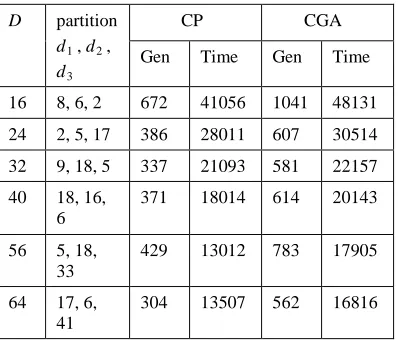
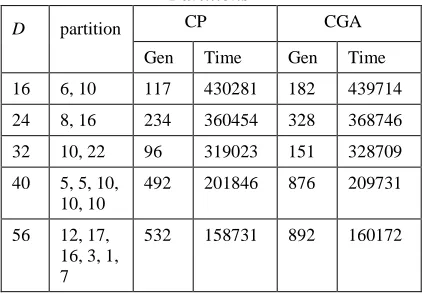
The experimental results are shown in Table 1 to
Table 4. The column “D” shows the total width of
test bus, the column “partition” shows both the number of bus partition and the value of each width. The column “CP” shows the results by using cultural particle swarm optimization in this paper, the column “CGA” shows the results by using conventional genetic algorithms. The column “Gen” shows the evolution generations being needed for obtaining a core assignment, the column “Time” shows the number of cycles being needed, the definition of the cycles is given in equation (1).
The core assignment gives the assignment scheme of core to bus, which is an array of
elements with i-th element representing the bus
number for which the i-th core is assigned.
Each method (the CP and CGA) is performed 20 times repeatedly for a SoC benchmark circuit. For the SoC benchmark circuits d695, p21241 and p93791. The results in Table 1 to Table 4 are
obtained on personal computer with 3.0GHz and 512MB memory, the CPU time taken is less than one minute.
[image:6.612.324.523.259.397.2]The SoC circuit d695 contains ten cores, of which two cores are combinational circuits and eight cores are sequential circuits, i.e., two combinational ISCAS’85 circuits: C6288 and C7552; eight sequential ISCAS’89 circuits: s838, s9234, s38584, s13207, s15850, s5378, s35932, s38417. The Table 1 and Table 2 show the results for SoC d695 with the number of partitions two and three respectively.
Table 1 The Results Of D695 For Two Width Partitions.
D partition d1 , d2
CP CGA
Gen Time Gen Time
16 7, 9 71 40182 124 44390
24 6, 18 64 30514 117 35062
32 11, 21 87 25803 131 28704
40 8, 32 58 20461 93 22031
56 19, 37 161 17734 258 20076
64 41, 23 83 18019 137 19812
[image:6.612.324.523.504.677.2]About the two width partitions of d695, the core assignments obtained for the total width 16, 24, 32, 40, 56 and 64 are ( 1 2 1 1 2 2 1 1 1 1 ), ( 2 1 1 1 2 2 1 1 1 2 ), ( 1 2 1 1 2 2 2 1 1 1 ), ( 1 2 1 1 2 2 1 1 2 2 ), ( 1 2 1 1 2 1 2 2 1 2 ), and ( 1 1 2 2 1 2 1 1 1 1 ), respectively.
Table 2 The Results Of D695 For Three Width Partitions.
D partition d1 , d2 ,
d3
CP CGA
Gen Time Gen Time
16 8, 6, 2 672 41056 1041 48131
24 2, 5, 17 386 28011 607 30514
32 9, 18, 5 337 21093 581 22157
40 18, 16, 6
371 18014 614 20143
56 5, 18, 33
429 13012 783 17905
64 17, 6, 41
304 13507 562 16816
2 2 3 3 2 1 2 3 3 1 ), ( 3 2 1 1 3 2 3 1 2 3 ), and ( 3 3 2 2 3 1 3 2 1 3 ), respectively.
The SoC circuit p21241 contains 28 cores, of which 6 cores are combinational circuits and 22 cores are sequential circuits. The Table 3 shows the results for SoC circuit p21241 with multiple width partitions, where these partitions contain two, five and six, respectively.
Tab.3 The Results Of P21241 For Multiple Width Partitions
D partition
CP CGA
Gen Time Gen Time
16 6, 10 117 430281 182 439714
24 8, 16 234 360454 328 368746
32 10, 22 96 319023 151 328709
40 5, 5, 10, 10, 10
492 201846 876 209731
56 12, 17, 16, 3, 1, 7
532 158731 892 160172
About the width partitions of SoC circuit p21241, the core assignments obtained for the total width 16, 24, 32, 40 and 56 are (2 1 2 2 2 2 2 1 1 1 2 2 1 2 2 2 2 1 1 1 1 1 1 1 1 2 1 1), ( 2 2 2 1 1 2 1 1 1 1 1 1 2 1 1 1 1 1 1 1 1 1 1 1 2 2 2 1 ), ( 1 2 2 2 1 2 2 2 2 1 2 2 1 2 1 1 2 1 1 1 1 1 2 2 2 2 2 1 ), ( 4 4 3 5 3 1 1 1 3 1 1 5 3 2 1 3 5 3 1 4 3 1 1 4 4 5 3 5 ), and ( 1 2 2 1 2 6 6 5 1 1 4 4 6 4 6 5 4 4 4 6 6 1 5 1 2 3 5 6 ), respectively.
[image:7.612.93.304.218.365.2]The SoC circuit p93791 is a larger circuit, it contains 32 cores, of which 18 cores are combinational circuits and 14 cores are sequential circuits. The Table 4 shows the results for p93791 with the number of partitions two and three respectively.
Table 4 The Results Of P93791 For Width Partitions.
D partition CP CGA
Gen Time Gen Time
32 9, 23 302 896051 547 898706
40 17, 23 154 738604 271 749512
48 23, 9, 16
1305 597813 2494 599807
56 10, 23, 23
2491 516862 3805 520174
64 23, 18, 23
1806 461707 2913 470814
About the width partitions of SoC circuit p93791, the core assignments being obtained for the total width 32, 40, 48, 56 and 64 are ( 2 1 1 2 1 2 2 1 1 1 1 2 2 2 1 1 2 1 1 1 1 1 2 1 1 2 2 1 1 2 1 1 ), ( 1 2 2 1 1 2 1 1 2 1 1 1 2 2 2 2 2 1 1 1 1 2 2 1 1 1 2 2 2 2 1 1 ), ( 3 1 2 1 2 1 2 2 1 1 3 3 1 1 2 1 2 2 1 3 1 1 2 2 3 3 1 1 2 1 2 3 ), ( 1 3 2 3 2 3 3 3 3 3 1 2 2 2 2 3 2 1 2 3 3 3 2 1 1 3 3 3 2 2 2 2 ), and ( 1 1 3 1 2 3 1 1 1 3 2 3 1 1 2 2 2 3 2 1 3 1 2 3 1 2 3 1 2 1 1 2 ), respectively.
Summarize the above experimental results for ITC’02 SoC Test Benchmark Circuits, it is shown that the method proposed in this paper can effectively solve the test bus assignment of system on chip, and can obtain test bus assignments in shorter time than conventional genetic algorithms.
5. CONCLUSIONS
The test bus assignment has an affect on the total test time of system on chip. In this paper, a new method is presented for test bus assignment of system on chip, which is based on cultural particle swarm optimization. The feasible solutions of test bus assignment is represented by individuals, the better scheme of test bus assignment is obtained by the evolution of the individuals. The experimental results show that the method proposed in this paper can obtain test bus assignment scheme in shorter time than conventional genetic algorithms. In the further, some work needs to be done in building integrated model for the test bus assignment and many types of core tests.
ACKNOWLEDGEMENTS
This work were supported by National Natural Science Foundation of China (No.61072028), the Project of Department of Education of Guangdong
Province (No.2012KJCX 0040), Guangdong
Province & Chinese Ministry of Education Cooperation Project of Industry, Education and Academy (No.2009B090300339).
REFRENCES:
[1] H.Salamy, J.Ramanujam.“An effective solution
to task scheduling and memory partitioning for
multiprocessor system-on-chip”. IEEE Trans.
on Computer-Aided Design of Integrated Circuits and Systems, vol.31, no.5, 2012, pp.717-725.
[2] A.B.Kinsman, N.Nicolici. “Time-multiplexed
compressed test of SoC designs”. IEEE Trans.
ISSN: 1992-8645 www.jatit.org E-ISSN: 1817-3195
[3] Z.Chenchang, K.Hung. “An
output-capacitor-free adaptively biased low-dropout regulator with subthreshold undershoot-reduction
for SoC”. IEEE Trans. on Circuits and Systems
I: Regular Papers, vol.59, no.5, 2012, pp.1119-1131.
[4] A.Sehgal, K.Chakrabarty. “Optimization of
dual-speed TAM architectures for efficient
modular testing of SoCs”. IEEE Trans. on
Computers, vol.56, no.1, 2007, pp.120-133.
[5] V.Iyengar, K.Chakrabarty, E.J.Marinissen.
“Test wrapper and test access mechanism co-
optimization for system-on-chip”. Journal of
Electronic Testing: Theory and Applications, vol.18, no.2, 2002, pp.213-230.
[6] V.Iyengar, K.Chakrabarty. “Test bus sizing for
system-on-a-chip”. IEEE Trans. on Computers,
vol.51, no.5, 2002, pp.449-459.
[7] J.Rosen, A.Andrei, P.Eles, P.Zebo. “Bus access
optimization for predictable implementation of real-time applications on multiprocessor
systems-on-chip”. Proceedings of IEEE
International Real-Time Systems Symposium, Tucson (USA), Dec. 3-6, 2007, pp.49-60.
[8] A.Larsson, E.Larsson, P.Eles. “Optimization of
a bus-based test data transportation mechanism
in system-on-chip”. Proceedings ofEuromicro
Conference on Digital System Design, Porto
(Portugal), Aug.30 - Sept. 3,2005, pp.403-409.
[9] Y.Chunhua, K.K.Saluja, P.Ramanathan.
“Power and thermal constrained test scheduling
under deep submicron technologies”. IEEE
Trans. on Computer-Aided Design of Integrated Circuits and Systems, vol.30, no.2, 2011, pp.317-322.
[10] N.Aghaee, H.Zhiyuan, P.Zebo, P.Eles.
“Temperature-aware SoC test scheduling considering inter-chip process variation”.
Proceedings of IEEE Asian Test
Symposium, Shanghai(China), Dec.1-4, 2010, pp.395-398.
[11] L.Jiang , X.Qiang, K.Chakrabarty, T.M.Mak.
“Integrated test-architecture optimization and thermal-aware test scheduling for 3-D SoCs under pre-bond test-pin-count constraint”. IEEE Trans. on Very Large Scale Integration (VLSI) Systems, vol.20, no.9, 2012, pp.1621-1633.
[12] H.Harmanani, R.Farah. “Integrated test
scheduling, wrapper design, and TAM
assign-ment for hierarchical SoC”. Proceedings of
Midwest Symposium on Circuits and Systems, Montreal (Canada), Aug.5-8, 2007, pp.1388-1391.
[13] A.Sehgal, S.K.Goel, E.Marinissen. “Hierarchy
-aware and area-efficient test infrastructure design for core-based system chips”. Proceedings of Design, Automation and Test in Europe, Munich (Germany), March 6-10, 2006, pp.1-6.
[14] L.Reyes, C.Zezzatti, C.Santillan. “A cultural
algorithm for the urban public transportation”. Lecture Notes in Artificial Intelligence, vol.6077, 2010, pp.135-142.
[15] J.Alami, A.E.Imrani, A.Bouroumi. “A
multi-population cultural algorithm using fuzzy
clustering”. Applied Soft Computing, vol.7,
no.2, 2007, pp.506-519.
[16] C.Sheng, H.Xia, C.J.Harris. “Particle swarm
optimization aided orthogonal forward
regression for unified data modeling”. IEEE
Trans. on Evolutionary Computation, vol.14, no.4, 2010, pp.477-499.
[17] P.Wang, L.Shi. “Inter-turn short circuit fault
diagnosis of induction motors using the SVM optimized by bare-bones particle swarm
optimization”. Journal of Theoretical and
Applied Information Technology, vol.45, no.2, 2012, pp.573-578.
[18] E.J.Marinissen, V.Iyengar, K.Chakrabarty. ITC