THREE-VALUED ABSTRACTION IN MODEL CKECKING
PROBABIBLISTIC REAL-TIME TEMPORAL LOGIC OF
KNOWLEDGE
ZHIFENG LIU, BO SUN, CONGHUA ZHOU
School of Computer Science and Telecommunication Engineering, Jiangsu University,
Zhenjiang, 212013, China
E-mail: [email protected]
ABSTRACT
Model checking in probabilistic real-time temporal logic of knowledge PTACTLK confronts the same challenge as in traditional model checking, that is the state space explosion problem. Abstraction is one of the most effective methods to alleviate the state space explosion problem, under the traditional framework of two-valued abstraction, the abstract model obtained using abstraction techniques is only the upper approximation of the original model. In this paper, we introduce three-valued abstraction into model checking probabilistic real-time temporal logic of knowledge, define the abstract model of a probabilistic real time interpreted system and present the three-valued semantics of PTACTLK on the abstract model. We prove that the abstract model obtained using the abstraction techniques is not only the upper approximation of the original model but also its lower approximation. At last, a simple communication protocol is adopted to illustrate the effectiveness of our abstraction techniques.
Keywords: Model Checking (MC), Probabilistic Real-time Temporal Logic of Knowledge (PRTLK),
PTACTLK, State Space Explosion(SSE), Three-valued Abstraction(TA)
1. INTRODUCTION
Model checking[1] is a very important automated verification technique for finite state systems, which has been used in the verification of hardware checking, communication protocols and control systems and has attracted wide attention. In model
checking, a multi-agent system S is modelled as a
suitable modelMS, and the specification P to be
verified is represented as a logical formulaφP, thus
the problem of checking whether a specification P
is satisfied by a multi-agent system M is converted
into whether the model checking problemMS |=φP
is valid. Reasoning about knowledge[2] has always been a core in artificial intelligence, thus many specification forms based on modal logic have been proposed and refined in the recent years, and the most popular one is the temporal logic of knowledge, which is a specification language used for modelling and reasoning for multi-agent systems. However, the verification of temporal logic of knowledge using model checking remains lack for several essential functionalities, and one of them is real-time. In paper[3], A. Lomuscio etc have considered the real-time aspect and proposed a
logic to reason about real-time and knowledge in multi-agent systems, that is real-time temporal logic of knowledge TACTLK. By introducing the probabilistic factor into TACTLK we can obtain probabilistic real-time temporal logic of knowledge ---- PTACTLK.
in this way, the information of the original model that is irrelevant to the property to be verified is ignored and the model checking procedure is carried out in the obtained abstract model. As the state space of the abstract model is comparably smaller, the efficiency of verification by model checking is improved significantly.
Under the traditional framework of two-valued abstraction, the abstract model deduced from a original model is only the upper approximation of the original model. That is, if a property is satisfied by the abstract model, then it is also satisfied by the original model. However, if a property is not satisfied by the abstract model, it cannot be inferred that it is not satisfied in the original model either. Three-valued abstraction techniques[8] can alleviate this problem efficiently, which introduces the third value that represents uncertainty besides true and false, and in this way, the abstract model obtained using three-valued abstraction techniques is not only the upper approximation of the original model, but also its lower approximation. The study of three-valued abstraction techniques contains two aspects: the construction of abstract model and abstraction refinement.
In model checking temporal logic, abstraction and abstraction refinement techniques have been studied[7,9], and in real time systems, the construction of abstract model has also been studied[10]. However, as far as we know, none of these techniques has ever been studied in model checking probabilistic real-time temporal logic of knowledge. Therefore, the three-valued abstraction techniques in model checking probabilistic real-time temporal logic of knowledge have been systematically studied in this paper. Our work is as following: (1). For the real time part of probabilistic real-time temporal logic of knowledge PTACTLK, that is PTACTL, the abstract discrete clock valuations[10] is applied to implicitly construct the clock regions of the state space of a probabilistic real time interpreted system, and in this way we can obtain a finite form of the state space of the probabilistic real time interpreted system. For the
epistemic operator K in PTACTLK, the definition
of epistemic equivalent to an agent between two abstract states is given by us, therefore, the abstract states satisfying the constraints of this definition can be combined into one equivalent class and the state space of the probabilistic real time interpreted system can be further simplified. (2). Using the abstraction techniques presented above, the
corresponding abstract model MA can be deduced
from the original model M of a probabilistic real
time interpreted system, the three-valued semantics of PTACTLK on the abstract model is given, and we also prove that the abstract model obtained using the abstraction techniques is not only the upper approximation of the original model but also its lower approximation. (3). Finally, a simple communication protocol is adopted to illustrate the effectiveness of our abstraction techniques.
2. THE SYNTAX AND SEMANTICS OF
PROBABILISTIC REAL-TIME TEMPORAL LOGIC OF KNOWLEDGE PTACTLK
Probabilistic real-time temporal logic of knowledge PTACTLK is obtained by introducing the probabilistic factor into real-time temporal logic of knowledge TACTLK, which is used for modelling and reasoning for multi-agent systems. TACTLK is the fusion of TCTL representing branching real time[11] and the modal logic[12] S5n representing knowledge operators.
Definition 1. (Syntax of probabilistic real-time temporal logic of knowledge PTACTLK)
Suppose PV is a set of propositional variables
containing the symbol T representing the constant
true, Ag is a set of m agents, and I is a time
interval in ℜ with integer bounds. Let
p∈PV , i∈Ag , and Γ ⊆Ag ,then the set of
PTACTLK formulae is defined as following:
: p| p| | | (A UIp ) | (A RIp ) |
ϕ = ¬ ϕ ϕ ϕ ϕ∧ ∨ ϕ ϕ ϕ ϕ
| | | , { , , , }.
p p p p
i
Kϕ DΓ ϕ EΓ ϕ CΓϕ where ∈ < ≤ > ≥
The formula ( p )
I
A Uϕ ψ represents that such a
phenomenon holds with probability p: for each
computation path we have ϕ holds until, in the
interval I ,ψ holds; ( p )
I
AϕRψ represents that such
a phenomenon holds with probability p: for each
computation path we have either ψ holds until, in
the interval I , both ϕ and ψ hold, or ψ always
holds in the interval I ; p
i
Kϕ denotes that with
probability p, agent i considers ϕ as possible. The other basic temporal modalities are
introduced as usual: p ( p )
I I
AGϕ=A⊥Rϕ ,
( )
p p
I I
AF ϕ=AΤUϕ ,⊥= ¬Τ,α → = ¬ ∨β α βand
( )
α ↔ =β α→β ∧( β →α).
Definition 2. (Clock constraint) A clock
constraint g over the set of clock variables C is
formed according to the following grammar:
: | | | |
g = <x c x≤c x>c x≥c g∧g. Where c∈
and x∈C is a clock variable. We use CC C( ) to
denote the set of all the clock constraints over the set of clock variables C.
Definition 3. (Discrete probability distribution) The discrete probability distribution over a
countable set Q is a function: :µ Q→[0,1], such
that ( ) 1
q Q∈ µ q =
∑
. For an uncountable set Q’, weuse Dist Q( ') to represent the set of probability
distributions over its countable subsets.
Timed automata[15,16] are used for modelling the behaviours of time-critical systems, probabilistic timed automata are an extension of timed automata with the ability to express relative likelihoods of state transitions, and the definition of probabilistic timed automata is in the following.
Definition 4. (Probabilistic timed automata) A probabilistic timed automaton can be represented as a tuple: PTA=( ,L Act C l prob Inv, , ,0 , ).where L is a finite set of locations, l0∈Lis the initial location,
Act is a finite set of actions, Crepresents a finite
set of clock variables, probis a probabilistic edge
relation: prob⊆ ×L CC C( )×Act×Dist(2 , )C L and Inv
is a location invariant function Inv L: →CC C( ), it assigns to each location a clock constraint which defines the condition that must be satisfied for the probabilistic timed automaton to stay in this location.
A discrete transition can be made according to ( , , , )l gα p ∈prob which is enabled, that is the
clock constraintgis satisfied by the current clock
valuation v, then the probability of moving to
location 'l from l and resetting all the clocks in
D to 0 is p D l( , ').
As a multi-agent system(MAS) is composed by
n agents( n>0 ,and n is an integer), if each
agenti(1≤ ≤i n)is modelled as a probabilistic timed automaton PTAi=( ,L Act C li i, i, ,0i prob Invi, i), then the
multi-agent system can be modelled as the parallel composition of these n probabilistic timed automata. The definition of the parallel composition of many probabilistic timed automata is as the following.
Definition 5. (Parallel composition of
probabilistic timed automata) The parallel
composition of n probabilistic timed automata
(1 )
i
PTA ≤ ≤i n is a global probabilistic timed
automaton PTA=( ,L Act C l, , ,0 prob Inv, ) , where
1
n
i i
L=
∏
= L , that is a global location l ofprobabilistic timed automaton PTA is a tuple
1 2
( , ,..., )n
l= l l l
,
li∈Li(1≤ ≤i n),
1n i i Act=
= Act,
1
n i i
C=
=C,
1 2 0 ( , ,..., ),0 0 0n
l = l l l l0i(1≤ ≤i n) is the
initial location of the ith probabilistic timed
automaton PTAi ;
1 2 1
( , ,..., )n ni ( )i
Inv l l l =
∧
=Inv l ; if thetransition (( , ,..., ), , , )l l1 2 ln gα p ∈prob is enabled,
then the probability of moving to global location
' ' ' 1 2
( , ,..., )l l ln from ( , ,..., )l l1 2 ln and resetting all the
clocks in D=
( )
i i Act
D α ∈
∑
to 0 is given byp.
The symbol Act a( ) above represents the set of
indices of the probabilistic timed automata whose sets of actions Acti(1≤ ≤i n) contain the action a, that is Act a( ) {1= ≤ ≤i n a| ∈Acti}. And D(D⊆C)
is the set of clock variables thatare reset to 0 during
the global transition.
As the semantic model of TACTLK is real time interpreted systems, the semantic model of PTACTLK is probabilistic real time interpreted systems , which is defined as following.
Definition 6. (The semantic model of PTACTLK) The probabilistic real time interpreted system corresponding to the probabilistic timed automaton PTA=( ,L Act C l, , ,0 prob Inv, ) is a tuple
0 1 1
( , , , ~ ,..., ~ ,n ,..., n, )
M = Q q P P P V , where:
• Q is a finite set of states, which is the subset of
| |C
L R× : | |C
Q⊆ ×L R , and | |C
R is the set of clock
valuations over the set of clock variables C,then
each state in Q is a tuple ( , )l v composed by a
location l and a clock valuation v. All states in Q
are reachable.
• q0 =(0,v0) is the initial state such that
x C
∀ ∈ ,v x0( )=0.
• Pis the probabilistic function of state transitions,
: [0,1]
P Q Q× → , which says the probability of moving to another state from one state is between 0 and 1, and we have
' ,
, ( , ') 1
q Q
q Q P q q
∈
∀ ∈
∑
= Thetransition relation between two state sets can be
denoted as: | | | |
( C) ( ) ( C)
E⊆ L R× × ActR+ × ×L R ,
there exists two kinds of transitions:
(1) Time transition: for δ∈R+, ( , )v δ→
( ,v+δ), if and only if v|=Inv( ), v+ =δ| Inv( ) ;
' ' , ( , ) a ( , )
a∈Act v → v , if and only if
(∃ ∈cc CC C( ))(∃ ⊆D C) such
that cc a D, , '
E
→ ∈
and v|=cc,
' '
[ : 0] | ( )
v =v D = =Inv . where '
[ : 0] v =v D=
represents that clock valuation '
v is obtained in
this way:
' , ( ) 0 x D v x
∀ ∈ = ; '
\ , ( ) ( ) x C D v x v x
∀ ∈ = , the
symbol D represents the set of clock variables
that are reset to 0 in this transition.
• ~i⊆ ×Q Q(1≤ ≤i n,n is the number of agents)
is an epistemic equivalent relation : ' '
( , ) ~ ( , )v i v
if and only if for agent i (1≤ ≤i n) , we have
' ( ) ( )
i = i
and v≅v' . i( ) represents the
location component of agent i in the global
location , and v≅v' denotes that clock
valuations v and v' are equivalent. In fact,~i is an
epistemic accessibility relation.
• P Q Qi: × →[0,1] (1≤ ≤i n) is the probability
function over epistemic relations, such that
' ,
, i( , ') 1
q Q
q Q P q q
∈
∀ ∈
∑
= .• : 2PV
V Q→ is a valuation function, and we have
(( , )) PTA( )
V v =V , VPTA( ) represents the set of
propositional variables that are valid in the location
of probabilistic timed automaton PTA.
Definition 7. (Semantics of PTACTLK: the satisfaction relations)
Let M =( ,Q q P0, , ~ ,..., ~ ,1 n P1,...,P Vn, ) be a
probabilistic real time interpreted system,
, |
M q =α represents that the PTACTLK formula
αis true at state q in M , and in the following
satisfaction relations, the symbol M is omitted.
Suppose p ,φ and ϕ in the following are all
PTACTLK formulae, the satisfaction relation “|=” is defined inductively in the following:
• q|= p iff p∈V q( ) , where p is an atomic
proposition;
• q|= ¬p iff p∉V q( ) , where p is an atomic
proposition;
• |q= ∨φ ϕ iff |q=φ or |q =ϕ;
• |q= ∧φ ϕ iff q|=φand q|=ϕ;
• | ( p )
I
q=A Uφ ϕ iff ∀ ∈ρ fPTA( )q,ρ φ ϕ|= UI and
( )
Pr ( )
PTA
f q
ob p
ρ
ρ
∈
∑
, where ∈ < ≤ > ≥{ , , , }.
• q|=A R(φ Ipϕ) iff ∀ ∈ρ fPTA( )q,ρ φ ϕ|= RI and
( )
Pr ( )
PTA
f q
ob p
ρ
ρ
∈
∑
;
• | p i
q=Kϕ iff '|
( , ')
i q
P q q p ϕ
=
∑
;• | p
q=EΓϕ iff
'|
( , ')
i
q i
P q q p ϕ
= ∈Γ
∑ ∑
;• | p
q=DΓϕ iff
'|
( , ')
i
q i
P q q p ϕ
= ∈Γ
∑ ∏
.In the above, ∀ ∈ρ fPTA( )q denotes any path
starting from the state q; |ρ φ ϕ= UI if and only if
(∃ ∈r I)(πρ( ) |r =ϕ and(∀ <r' r)(πρ( ') |r =φ)), that is, for a path ρstarting from the state q, there exists a
time point r in the time interval I such that on
path ρ the state corresponding to time r satisfies
the formula ϕ , and all the previous states on
ρ satisfy the formula φ.ρ φ ϕ|= RI if and only if
(∀ ∈r I) (πρ( ) |r =ϕor (∃ <r' r)(πρ( ') |r =φ)).C pϕ
Γ
is the transitive closure of EΓpϕ , and its
satisfaction relation is ignored.
3. ABSTRACTION
3.1 The Abstraction Techniques
Every state in the set of states Q of a
probabilistic real time interpreted system can be represented in the form: ( , )v , where is a global
location, and v is a clock valuation for all the clock
variables. Due to the continuous nature of time, we
have v∈R+ , and therefore the state space of
probabilistic real time interpreted systems is infinite. As a result, the existing model checking algorithms for finite state systems can not be applied to model checking probabilistic real time interpreted systems. The state space of probabilistic real time interpreted systems needs to be divided equivalently such that the problem of model checking for probabilistic real time interpreted systems can be converted into model checking for finite state systems.
Suppose M =( ,Q q P0, , ~ ,..., ~ ,1 n P1,...,P Vn, ) is the original model of a probabilistic real time interpreted system, our aim is to present an abstraction technique, and using it a corresponding
abstract model ' ' ' ' ' ' ' ' '
0 1 1 1
( ', , , ,~ ,...,~ , , ,..., , , ',?)
A l u l u l u
n n n
M =Q q P P P P P P V
can be deduced from the original model M .
Therefore , the model checking procedure can be carried out in the obtained abstract model while preserving the properties of the original model.
For every clock variable x∈C in the
probabilistic timed automaton that models a multi-agent system, we use Ix to represent its integer part
variable and Fx its fractional order variable. Ix
is, if x≤cx,then Ix= x ;otherwise Ix=cx(cx is the maximum constant value compared to clock
variable x). Therefore, Ix is an integer ranging
between 0 and cx. For a clock valuation v , order
the clock variables that are smaller than or equal to
the corresponding maximal constant value cx
according to the values of their fractional
parts fract x( ), and we use Fx to represent the
position of clock variable x in this order. For a
clock variable x satisfying x≤cx, the fractional
order variable Fx = 0 if and only if the fractional part of x is zero, that is fract x( )=0. Therefore, Fx
is an integer ranging between 0 to n (n is the
number of clock variables).
Definition 8. (Discrete clock valuations) For the set of clock variables C of the probabilistic timed automaton modelling a multi-agent system, the
corresponding discrete clock valuation d
v is a
function: for every clock variable x∈C, assigns to
Ix a value from {0,…,cx} and to Fx a value from
{0,…, }n , and we use v xd( ) to denote the pair
(vd( ),Ix vd(Fx)).
Definition 9. (Abstract discrete clock valuations) Given a set of clock variables C, one abstract discrete clock valuation over C is a
function va : for each clock variable
x∈C , it
assigns a value from {0,..., }cx to Ix, and a value
from a
F to a x
F .
Definition 10. (Epistemic equivalent to agent i
between two concrete states: ~i) For two concrete
states ( , )l v , ( ', ')l v in a probabilistic real time interpreted system, the epistemic equivalent to
agent i(1≤ ≤i n) between them can be represented
as following: ( , ) ~ ( ', ')l v i l v if and only if
( ) ( ')
i i
l l =l l and v≅v' . That is, the location
component of agent i in the global location l is
the same as that in the global location 'l , and the
two clock valuations v and v' are equivalent.
Definition 11. (Epistemic equivalent to agent i
between two abstract states: '
~i)
Suppose ( , )l v ,( ', ')l v are two abstract states, the
epistemic equivalent to agent i between them is
defined as following: '
( , ) ~ ( ', ')l v i l v if and only if for
each concrete state s1 in ( , )l v , and for each
concrete state s2 in ( ', ')l v , it always holds that
1~i 2
s s . That is, the two concrete states are
epistemic equivalent to agent i.
Having the definition of epistemic equivalent to
agent i (1≤ ≤i n) between two abstract states, the
abstract states satisfying the constraints in the definition can be combined into one abstract state, that is a equivalent class. And therefore the state space of probabilistic real time interpreted systems can be further simplified.
3.2 Constructing the Abstract Model
The abstract model MA corresponding to the
original model M can be deduced according to the
abstraction techniques presented above, that is the abstract discrete clock valuations and the epistemic equivalent to an agent between two abstract states.
Definition 12. (The abstract model of a probabilistic real time interpreted system)
The abstract model MA corresponding to the
original model M of a probabilistic real time
interpreted system is a tuple
' ' ' ' ' ' ' '
0 1 1 1
( ', , , , ~ ,.., ~ , , ,..., , , ', ?)
A l u l u l u
n n n
M = Q q P P ‘ P P P P V ,
where
• ' ' A C
Q =L×R is the set of states of the abstract
model, '
L represents the set of abstract global
locations and A
C
R represents the set of abstract
discrete clock valuations over the set of clock variables C.
• ' ' ' 0 ( ,0 0)
q = l v is the initial abstract state, and to one
of its concrete initial state q0=( ,l v0 0) it holds that
0 0
l ∈L , and ∀ ∈x C,v x0( )=0 .
• ' '
, : ' ' [0,1]
l u
P P Q×Q → are matrices describing the
lower and upper bounds for transition probabilities between abstract states such that for any two
abstract states ∀q q1, 2∈Q' , we have
' 1
( , ') 1
l
P q Q ≤
,
'1 ( , ') 1
u
P q Q ≤
,
' '1 1
( , ') ( , ')
l u
P q Q ≤P q Q
' '
1 2 1 2
( , ) ( , )
l u
P q q ≤P q q
,
where ' '1 1
'
( , ') ( , )
l l
q Q P q Q P q q
∈
=
∑
,
' '
1 1
'
( , ') ( , )
u u
q Q P q Q P q q
∈
=
∑
. The state transition relationin the abstract model can be represented
as: ' ' '
( A) ( ) ( A)
C C
E ⊆ L R× × ActR+ × ×L R , and two kinds of
transitions are available:
(1).Time transition: ( ,va)d→( ,va+d),∀ >d 0, if
and only if a| ( )
v =Inv and a | ( )
v + =d Inv (∀ >d 0);
(2).Action transition: ' '
( , a) a ( , )
a
v → v
(a∈Act), if
and only if (∃ ∈cc CC C( ))(∃ ⊆D C), →cc a D, , '
,
|
a
v =cc and ' '
( 0) | ( )
a a
v =v D= =Inv . '
( 0)
a a
v =v D=
represents that the abstract clock valuation '
a
v is obtained in this way: for each clock variable x in
the set D⊆C ,its integer part variable Ix and
abstract fractional order variable a
x
0, and the values of all the other clock variables in
'
a
v are the same as in a
v .
• ' ' '
~i⊆Q×Q(1≤ ≤i n) is an epistemic equivalent
relation, the epistemic equivalent to agent i
between two abstract states ( , a)
v
, ' '
( , va) can be
represented in the following: ' ' '
( , a) ~ ( , )
i a
v v
, if and
only if the two abstract states satisfy the constraints in definition 11.
• ' '
, : ' ' [0,1]
l u
i i
P P Q×Q → (1≤ ≤i n) are matrices
describing the lower and upper bounds for probabilities over epistemic relations such that
1, 2 '
q q Q
∀ ∈ , '
1 2
( , ) 1
l i
P q q ≤
,
'1 2
( , ) 1
u i
P q q ≤
,
' '
1 2 1 2
( , ) ( , )
l u
i i
P q q ≤P q q , ' '
1 1
( , ') ( , ')
l u
i i
P q Q ≤P q Q .
• ' ' : 2PV
V Q → is a valuation function, for an
abstract state ( , ) v we have (( , )) n1 ( )
i PTA i
V v ==V
(idenotes the global location of the ith concrete
state of this abstract state). That is to say, the set of propositional variables that are valid in an abstract state is the intersection of the sets of the propositional variables that are valid in each of its concrete state.
• ' ? : 2PV
Q → is a valuation function, which
assigns to each abstract state the set of propositional variables whose truth value is uncertain in this state.
Definition 13. (The three-valued semantics of PTACTLK on the abstract model)
' ' ' ' ' ' ' '
0 1 1 1
( ', , , , ~ ,.., ~ , , ,..., , , ', ?)
A l u l u l u
n n n
M = Q q P P ‘ P P P P V
is an abstract model of a probabilistic real time
interpreted systemM , A, |
M q=α denotes that the
PTACTLK formula αholds on the abstract state q
of the abstract model A
M . And the symbol A
M is
omitted in the following satisfaction relations.
Suppose p ,φ and ϕ in the following are all
PTACTLK formulae, the satisfaction relation “|=”
is defined inductively as in the following:
• ' ' , ( ), , ( ), ; | , ( ), , ( ), ; ? ,
p iff p V q that is s q p V s p Ap
q p iff p V q that is s q p V s p Ap p other cases
∈ ∀ ∈ ∈ ∈ = ¬ ∉ ∀ ∈ ∉ ∈ . • , | | ; | ( ), | | ; ?( ),
iff q or q
q iff q and q
other cases
φ ϕ φ ϕ
φ ϕ φ ϕ
φ ϕ ∨ = = = ¬ ∨ = ¬ = ¬ ∨ . • , | | | ( ), | | ; ?( ),
iff q and q
q iff q or q
other cases
φ ϕ φ ϕ
φ ϕ φ ϕ
φ ϕ ∧ = = = ¬ ∧ = ¬ = ¬ ∨ ; . • ' ( ) ' ( ) ( ), ' ( ) '|= ,
r ( ') ;
| ( ), ' ( ) '|= ( ),
r ( ') 1 ;
? ( ), .
PTA
PTA
p
I PTA I
f q
p
I PTA I
f q
p I
A U iff f q U and
P ob p
q A U iff f q U and
P ob p
A U other cases
ρ
ρ
φ ϕ ρ ρ φ ϕ ρ
φ ϕ ρ ρ φ ϕ ρ φ ϕ ≥ ∈ ≥ ∈ ≥ ∀ ∈ ≥ = ¬ ∀ ∈ ¬ ≥ −
∑
∑
, , • ' ( ) ' ( ) ( ), ( ' ( )), '|= ,r ( ') ;
| ( ), ( ' ( )), '|= ( ),
r ( ') 1 ;
? ( ), .
PTA
PTA
p
I PTA I
f q
p
I PTA I
f q
I
A R iff f q R and
P ob p
q A R iff f q R and
P ob p
A R other cases
ρ
ρ
φ ϕ ρ ρ φ ϕ ρ
φ ϕ ρ ρ φ ϕ ρ φ ϕ ≥ ∈ ≥ ∈ ∀ ∈ ≥ = ¬ ∀ ∈ ¬ ≥ −
∑
∑
• ' ' '| ~ ' ' '| ~ ' , ( , ') ;| , ( , ') 1 ;
? , .
i
i
p l
i i
q q q
p l
i i
q q q
p i
K iff P q q p
q K iff P q q p
K other cases ϕ ϕ ϕ ϕ ϕ ≥ = ∧ ≥ =¬ ∧ ≥ ≥ = ¬ ≥ −
∑
∑
• ' '| ' '| , ( , ') ;| , ( , ') 1 ;
? , . p l i q i p l i q i p
E iff P q q p
q E iff P q q p
E other cases ϕ ϕ ϕ ϕ ϕ ≥ Γ = ∈Γ ≥ Γ =¬ ∈Γ ≥ Γ ≥ = ¬ ≥ −
∑ ∑
∑ ∑
• ' '| ' '| , ( , ') ;| , ( , ') 1 ;
? , . p l i q i p l i q i p
D iff P q q p
q D iff P q q p
D other cases ϕ ϕ ϕ ϕ ϕ ≥ Γ = ∈Γ ≥ Γ =¬ ∈Γ ≥ Γ ≥ = ¬ ≥ −
∑ ∏
∑ ∏
As p
CΓ≥ ϕ is the transitive closure of p
EΓ≥ ϕ, the satisfaction relation of CΓ≥pϕon the abstract model
is ignored. In the definitions above, q| ?= φ
represents that the truth value of PTACTLK formula φ on the abstract state q is uncertain.
3.3 Property Preservation Theorem
The aim of abstraction is to simplify the original model of the system while preserving its properties, and in the following we prove that the satisfaction relations of PTACTLK formulae are preserved in the abstract model. That is, if a PTACTLK formula
φ is satisfied by an abstract model A
M , it can be
inferred that the formula φ is also satisfied in the
original model M ; if a PTACTLK formula φ is
not satisfied by an abstract model A
M , it can be
concluded that this formula is not satisfied by the
original model M either. In other words, the
of the original model, but also its lower approximation.
Theorem 1. Suppose M=( , , , ~ ,..., ~ , ,..., , )Q q P0 1 n P1 P Vn
is a probabilistic real time interpreted system,
' ' ' ' ' ' ' '
0 1 1 1
( ', , , , ~ ,.., ~ , , ,..., , , ', ?)
A l u l u l u
n n n
M = Q q P P ‘ P P P P V is
the corresponding abstract model obtained according to the abstraction techniques presented
above, and φ is a PTACTLK formula, we have the
following conclusions: (1). If '
, |
A
M s =φ , then
, |
M s =φ; (2). If '
, |
A
M s = ¬φ, then M s, |= ¬φ.
4. A CASE STUDY
In this section, we present a simple communication protocol , which is adopted to illustrate the effectiveness of our abstraction techniques.
4.1 A Simple Communication Protocol
In our communication protocol, there are two
agents: Sender and Receiver, and they are
connected through a communication channel.
Sender collects data from the environment and
sends the collected data to Receiver via the channel.
The responsibility of Receiver is to receive the data
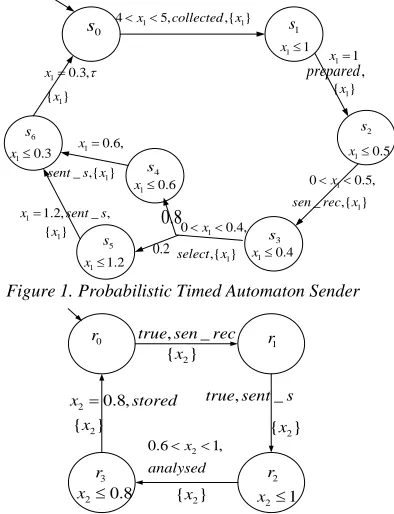
from Sender. The probabilistic timed automata of
Sender and Receiver are presented in Fig.1 and
Fig.2, respectively. Suppose that the communication channel is reliable, that is, the data can’t be lost during the transmission. The protocol works as follows.
0
s s1
1 1
x≤
1 1
4<x<5,collected,{ }x
1 1
x=
1 { }x
2
s
1 0.5
x≤
1
0<x<0.5,
1 _ ,{ }
sen rec x
3
s
1 0.4
x≤
1
0<x<0.4,
1 ,{ }
select x
0.8
0.2
4
s
5
s
1 0.6
x≤
1 1.2
x≤
1 0.6,
x=
1 _ ,{ }
sent s x
1 1.2, _ ,
x= sent s
1 { }x
6
s
1 0.3
x≤
1 0.3,
x= τ
1 { }x
,
[image:7.612.103.300.461.718.2]prepared
Figure 1. Probabilistic Timed Automaton Sender
0
r
1
r
2
r
3
r
, _
true sent s
2
0.6 x 1,
analysed
< <
2 1
x ≤
2 0.8
x ≤
2 0.8,
x = stored
, _
true sen rec
2 { }x
2 { }x
2 { }x
2 { }x
Figure 2. Probabilistic Timed Automaton Receiver
Agent Sender has one clock variable x1, which is
used to record the time that has elapsed in each location. In the initial location s0, the value of x1 is
0. Sender first collects data for 4 to 5 seconds, then it moves to location s1, action collected represents that Sender has finished the work of collecting data. In order to send the collected data to Receiver, Sender prepares communication for 1 second and
moves to location s2, action prepared denotes that
Sender has finished the work of preparing
communication. In location s2 , Sender sends a
synchronization signal sen_rec to Receiver within
0.5 second and moves to location s3. Suppose that
when sending data to Receiver , Sender uses two special ports: port1 and port2 , each port is connected with the channel. However, when Sender is to send data it can only selects one port randomly, and the probability of selecting port1 is 0.8, and port2 is 0.2. If port1 is selected, Sender has to wait for 0.6 second and then begins to send data via port1; if Sender selects port2, it needs to wait
for 1.2 seconds. In location s3, Sender selects a
port randomly within 0.4 second. If the selected
port is port1, then it moves to location s4, else it
moves to s5. No matter which port is selected,
Sender will reach to location s6 after sending data
to Receiver, and it will return to the initial location after staying in location s6 for 0.3 second.
Agent Receiver has a clock variable x2, and its
initial location is r0. Receiver will move to location
1
r from the initial location when it receives the
synchronization signal sen_rec from Sender. After
Receiver has received data from Sender it will
move to location r2, in which it takes 0.6 to 1
second for Receiver to analysis the received data,
and after that Receiver will move to location r3.
Action analysed denotes that Receiver has
completed the work of analysing the received data.
In r3 , Receiver spends 0.8 second to store the
processed data and then returns to the initial location r0. Action stored represents that the work of storing the processed data has been completed.
In the two probabilistic timed automata, besides the edges that are labelled with probability explicitly, the transition probability for all the other edges is 1, which is ignored for simplicity.
In our communication protocol, a concrete state
should be in this form:
1 2
(( , ), (i j vx,vx )) ,
location of this state, the two components ,i j represent that agents Sender, Receiver are in locations s ri, j , respectively; (vx1,vx2) is a clock
valuation over the set of clock variables C={x1,
x2}, which denotes that under this state the values
of clock variables x1, x2 are vx1,vx2, respectively.
As the ranges of the values of the clock variables x1,
x2 in this protocol are 0≤vx1 ≤5, 0≤x2 ≤5 ,
respectively, and
1, 2
x x
v v are all real numbers, there
are infinite states in this protocol, that is, the state space of our protocol is infinite.
4.2 Constructing the Abstract Model of the Protocol
The abstraction techniques presented in section 3 are applied to construct the abstract model of our communication protocol such that the infinite state space of the protocol can be simplified into a finite form.
For any concrete state
1 2
(( , ), (i j vx,vx)) of this
protocol, its clock valuation
1 2
(vx,vx )is represented
using the corresponding abstract discrete clock valuation. In this way, the concrete states whose clock valuations belong to the same abstract discrete clock valuation and global locations are the same can be combined into one abstract state, therefore the state space of the protocol can be greatly reduced and we can obtain the finite form of the infinite state space of our protocol. In the obtained finite form of the protocol, using the
definition of epistemic equivalent to agent Sender
(Receiver) between two abstract states, any abstract
states satisfying the constraints of this definition can be combined into one equivalent class and the state space will be further simplified. At last, the corresponding abstract model of the communication protocol can be obtained. In Fig. 3, all the reachable states of the abstract model obtained using our abstraction techniques are given.
From the abstract model, it can be seen that using our abstraction techniques the infinite state space of the communication protocol has been simplified into a finite form which only has 9 abstract states.
Each state and its location invariant of the abstract model presented above is in the following:
0: ((0, 0), ((0, 0), (0, 0))), (0, 0) ;
S Inv =true
1: ((1, 0), ((0, 0), (4, ))), (1, 0) 1 1;
S α Inv =x ≤
2: ((2, 0), ((0, 0), (5, 0))), (2, 0) 1 0.5;
S Inv =x ≤
3: ((3,1), ((0, 0), (0, 0))), (3,1) 1 0.4;
S Inv =x ≤
4: ((4,1), ((0, 0), (0, ))), (4,1) 1 0.6;
S α Inv =x ≤
5: ((5,1), ((0, 0), (0, ))), (5,1) 1 1.2;
S α Inv =x ≤
6: ((6, 2), ((0, 0), (0, 0))), (6, 2) 1 0.3 2 1;
S Inv = ≤x ∧ ≤x
7: ((0, 2), ((0, 0), (0, ))), (0, 2) 2 1;
S α Inv =x ≤
8: ((0, 3), ((0, ), (0, 0))), (0, 3) 2 0.8.
S α Inv =x ≤
That is, in the obtained abstract model
' ' ' ' ' ' ' '
0 1 1 1
( ', , , , ~ ,.., ~ , , ,..., , , ', ?)
A l u l u l u
n n n
M = Q q P P ‘ P P P P V of
the communication protocol, we have:the abstract
state space '
0 1 2 3 4 5 6 7 8
{ , , , , , , , , }
Q = S S S S S S S S S ; the
initial abstract state '
0 0
q =S ; the state transition
probabilities: ' '
3 4 3 4
( , ) ( , ) 0.8,
l u
P S S =P S S =
' '
3 5 3 5
( , ) ( , ) 0.2
l u
P S S =P S S = , that is, the transition
probability from state S3 to S4 is 0.8 , and from S3
to S5 is 0.2, the transition probability of all the other
neighboring states is 1.
each abstract state and itself is epistemic
equivalent to agent Sender, that is, for each state
'
(0 8) Si∈Q ≤ ≤i , '
~Sender
Si Si holds. Similarly, it is
also hold to agent Receiver.
4.3 Model Checking the Communication Protocol
The first property to be verified is: in the
communication protocol, agent Sender considers
that such a behaviour holds with probability greater
than or equal to 0.6, in which after Sender sends a
synchronization signal sen_rec to Receiver,
Receiver will receive the data between 0.5 and 1
second. The property can be expressed by the
PTACTLK formula 0.6
1 KSender(sen rec AF_ (0.5,1)receive)
φ = ≥ ∧
, where receive
denotes that Receiver has received the data.
The second property to be verified is: agent
Sender considers that such a behaviour holds with
probability greater than or equal to 0.15, in which
after Sender sends a synchronization signal sen_rec
to Receiver, Receiver will receive the data between
1.6 and 2 seconds. The property can be expressed by the PTACTLK formula
0.15
2 KSender(sen rec_ AF(1.6,2)receive)
φ = ≥ ∧ .
In the obtained abstract model A
M , as Sender
moves to the global state S3 after its sending the
synchronization signal, and Receiver moves to state
S6 after its receiving the data, then we only need to
check the time interval and the transition probability between the two states . In the abstract model, it can be easily seen that there are two paths from S3 to S6, in the first path, S3 moves to S6 via
S4, that is, S3→S4→S6; and for the second one,
We first consider path: S3→S4→S6. As the time interval from S3 to S4 is (0,0.4), and the one
from S4 to S6 is 0.6, then it can be inferred that on
this path the time interval between S3 and S6 is
(0.6,1). What’s more, the transition probability from S3 to S4 is 0.8, and the one from S3 to S6 is 1,
then it can be learned that the transition probability from S3 to S6 is 0.8 1× =0.8 on this path. From the
above analysis, we can conclude that after Sender
sends a synchronization signal sen_rec to Receiver,
Receiver will receive the data between 0.6 and 1
second with probability 0.8. In other words, it
satisfies the first property: A| 1
M =φ.
Let us learn about the second path:
3 5 6
S →S →S . As the time interval from S3 to S5
is (0,0.4), and the one from S5 to S6 is 1.2, then it
can be deduced that on this path the time interval between S3 and S6 is (1.2,1.6). In addition, the
transition probability from S3 to S5 is 0.2, and the
one from S5 to S6 is 1, then it can be computed that
the transition probability from S3 to S6 is
0.2 1× =0.2 on this path. From the above analysis,
we can conclude that after Sender sends a
synchronization signal sen_rec to Receiver,
Receiver will receive the data between 1.2 and 1.6
seconds with probability 0.2. Thus, it can be seen that time interval (1.2,1.6) is not a subset of (1.6,2), in other words, it doesn’t satisfy the second
property: A| 2
M ≠φ .
As in Section 3.3 we have proved that the abstract model obtained according to our abstraction techniques is the upper approximation of the original model , it can be concluded that the communication protocol satisfies the first property:
1 |
M =φ ; what’s more, we have also proved that the
abstract model is the lower approximation of the original model, then it can be deduced that our communication protocol does not satisfy the second property , that is, M |≠φ2.
Using our abstraction techniques, the infinite state space of the communication protocol has been reduced to 9 states of the abstract model, which illustrates the effectiveness of our abstraction techniques.
5. CONCLUSIONS AND FUTURE WORK
In order to alleviate the state space explosion problem in model checking probabilistic real-time temporal logic of knowledge, we present the abstraction techniques. The infinite state space of a probabilistic real time interpreted system can be simplified into a finite form using abstract discrete
clock valuations; and using the definition of epistemic equivalent to an agent between two abstract states, the corresponding equivalent relations can be deduced and which can be used to combine the abstract states, therefore, the state space of a probabilistic real time interpreted system can be further simplified. We define the abstract model of a probabilistic real time interpreted system, present the three-valued semantics of probabilistic real-time temporal logic of knowledge on the abstract model, and prove that the abstract model obtained using the abstraction techniques is not only the upper approximation of the original model but also its lower approximation. At last, a simple communication protocol is adopted to illustrate the effectiveness of our abstraction techniques.
There are many interesting avenues for future research. When it can not be known whether a PTACTLK property is satisfied by the abstract
model, that is MA| ?= φ , we have no way of
deciding whether the original model satisfies the property, in this case the abstract model needs to be refined. Therefore, refining the abstract model according to the reason that causes the failure of abstraction is a valuable direction for future research.
ACKNOWLEDGMENT
This work was supported by the National Natural Science Foundation of China (Grant Nos.61003288, 61111130184), the People with Ability Foundation of Jiangsu University(12JD061).
REFRENCES:
[1] [1] Edmund M. Clarke, Orna Grumberg and
Doron A. Peled, “Model Checking”, MIT Press,
Cambridge, MA, 2000.
[2] R. Fagin, J.Y. Halpern, Y. Moses, M.Y. Vardi,
“Reasoning about Knowledge”, MIT Press,
Cambridge, MA, 1995.
[3] Lomuscio, W. Penczek, and B. Wozna, “Bounded model checking for knowledge and real time”, Artif. Intell., 2007, pp.1011-1038. [4] Cormac Flanagan, Patrice Godefroid, “Dynamic
partial-order reduction for model checking
software”, ACM SIGPLAN Notices, Vol. 40, No.
1, 2005, pp110-121.
and Systems, Volume 26 Issue 4, 2004, pp702-734.
[6] Conghua Zhou, Bo Sun, Zhifeng Liu, “Abstraction for model checking multi-agent
systems”. Frontiers Of Computer Science in
China, Volume 5, Number 1, June 2010,
pp14-25.
[7] Edmund M. Clarke, Orna Grumberg, David E. Long., “Model Checking and Abstraction”. ACM Transactions on Programming Languages
and Systems, 1992, 16 (5): Pages 1512-1542.
[8] Grumberg, “3-Valued Abstraction for
(Bounded) Model Checking”, Lecture Notes In
Computer Science, 2009, Vol.5799: pp21-21.
[9] Orna Grumberg, “Abstraction and Refinement
in Model Checking”. Lecture Notes In
Computer Science, 2006, Vol4111, 219-242.
[10] Edmund M. Clarke, Flavio Lerda, and Muralidhar Talupur, “An Abstraction
Technique for Real-Time Verification”, Next
Generation Design and Verification Methodologies for Distributed Embedded
Control Systems, 2007, pp1-17.
[11] Sascha Konrad, Betty H. C. Cheng, “Real-time
specification patterns”. Proceedings of the 27th
international conference on Software
engineering, St.Louis, Missouri(USA), May15–
21, 2005, Pages 372-381.
[12] Carlos Areces, Guillaume Hoffmann and Alexandre Denis, “Modal Logics with
Counting”, Lecture Notes in Computer Science,
2010, Volume 6188, pp98-109.
[13] Christel Baier, Joost- Pieter Katoen, “Principles
of Model Checking”. MIT Press, 2008 , Page
678.
[14] M. Kwiatkowska, G. Norman, R. Segala, and J. Sproston. “Automatic verification of real-time systems with discrete probability distributions”.
Theoretical Computer Science, 282:2002
pp101-150.
[15] Johan Bengtsson and Wang Yi, Timed Automata: Semantics, Algorithms and Tools.
Lecture Notes in Computer Science, 2004,
Volume 3098/2004, pp87-124.
[16] R. Alur, D. Dill, “A theory of timed automata”,
0, 0 1, 0 2, 0
3,1 4,1
5,1 6, 2
0, 2 0, 3
1
1
4 5,
,{ }
x collected x
< <
1
1
x
≤
11,
x
=
1
{ }
x
x1≤0.51
0
< <
x
0.5,
1 2
_ ,{ , }
sen rec x x
1 0.4
x ≤
1 0< <x 0.4,
0.8
0.2
1 0.6
x ≤
1 1.2
x ≤
1 0.6,
x =
1 2
_ ,{ , }
sent s x x
1 1.2, _ ,
x = sent s
1 2
{ ,x x}
1 0.3 x ≤
2 1 x ≤
1
0.3,
x
=
τ
2
1
x
≤
2
0.6<x <1,analysed
2 0.8
x ≤ 2
0.8,
x
=
stored
2
{ }
x
0
S
1
S
2S
3
S
4
S
5
S
6
S
7
S
8
S
,
prepared
1
,{ }
select x
2
{ }
x
1
[image:11.612.154.461.310.484.2]