ISSN: 1992-8645 www.jatit.org E-ISSN: 1817-3195
HYBRID VARIABLES STRUCTURAL RELIABILITY MODEL
BASED ON POSSIBILISTIC RELIABILITY THEORY
1QIANGFENG WANG, 2JIANJUN LI
1Electromechanical, Northwestern Polytechnical University, Xi’an, China
2Luoyang Opto-Electro Technology Development Center, Luoyang, China
ABSTRACT
In this paper, based on possibilistic reliability theory, the hybrid variables structural reliability model, which includes fuzzy variables and interval variables, is researched. The hybrid variables structural reliability model is established based on possibilistic reliability theory. The analytical algorithms of minimum fuzzy reliability index and maximum failure possibility degree in hybrid variables structural reliability analysis are derived in detail. The constraint conditions of hybrid variables structural reliability model are analyzed. The reliability optimum design method of hybrid variables structure is researched. By evaluation of hybrid variables structural reliability through practical examples, it proved that, in the case of two uncertain variables coexisting, the theory presented in this paper is feasible and effective. And thus, it will have great significance in actual engineering, especially for reliability design of complex structures.
Keywords: Possibilistic Reliability, Hybrid Variables Structure, Interval Variable, Fuzzy Variable
1 INTRODUCTION
In practical engineering, the model to deal with uncertain information should be based on the grasp of the data set. Fuzzy set model is an important method of processing fuzzy variables. In structural design, often there may be situations of multiple uncertain information coexistence, that is, the structural parameters consist of both random uncertainty variables and fuzzy uncertainty variables. How to implement structural reliability analysis in the condition of various uncertain variables coexisting has become a practical problem.
Varying from single variable structural reliability design, for reliability design of a structure with hybrid variables, it mainly faces two problems: first, how to handle with different types of uncertain variables and establish the corresponding hybrid reliability model; second, how to establish the reliability model for optimization [1]. In this paper, based on possibilistic reliability theory, the hybrid variables structural reliability model, which includes fuzzy variables and interval variables, is established. The maximum failure possibility degree is introduced as the measurement of the hybrid reliability model. And then, reliability optimization design is carried on with maximum failure possibility degree as constraint; finally, the validity of the theory in this paper is verified by a practical example.
2 HYBRID VARIABLES STRUCTURAL
RELIABILITY MODEL
The functional equation of a structure which contains fuzzy variables and interval variables can be expressed as:
1 2
1 2 1 2
( , )
( , ,..., m, m , m ,..., n) 0
M g X X
g x x x x + x + x
=
= = (1)
During the above formula, X1=[ ,...,x1 xm]T are fuzzy variables, and X2 =[xm+1,xm+2,...,xn]T are interval variables [2].
ISSN: 1992-8645 www.jatit.org E-ISSN: 1817-3195
2
( , D) min( )
S X
η =η α = δ ∞ (2)
It meets the following condition:
1 2 2
( , D) ( , , D) 0
M =g X X =g λ δ X = (3)
During the above formula, ( , , 2D)
gα δ X is the standardized state function corresponding tog X X( 1, 2D).
The corresponding maximum structural failure possibility degree is:
2
2 2
( 1) ( ( , ) 1)
sup{ ( , ) | ( ) 1,
, [0,1]}
D
f oss S oss
D D
P P X
X X R
µ η η α
α η η
η + α
= ≤ = ≤
= ≤
∈ ∈
(4)
During the above formula, both fuzzy reliability index ηS and failure possibility degree µf are the
functions of the interval variables X2, so they are interval variables either [3]. These are:
[ , ], [ , ]
I I
S S
S S S S S S
η ∈η = η η µ ∈µ = µ µ (5)
Considering the physical meanings of the fuzzy reliability index and the requirements of structural
reliability design, we take
S
η and µS as the measurements of hybrid variables structural reliability. Here, the minimum fuzzy reliability index reflects the fuzzy distribution of minimum structural reliability, while the maximum failure possibility degree reflects the maximum likelihood of structural failure. They both reflect the structural reliability from different aspects [4].
3 ANALYSIS OF HYBRID VARIABLES
STRUCTURAL RELIABILITY
By possibilistic reliability theory we can get, for reliability analysis of structures with hybrid variables, it includes the determination of both minimum fuzzy reliability index and maximum failure possibility degree. Here, though the minimum fuzzy reliability index and the maximum failure possibility degree are related to each other in some way, they are not in one-to-one correspondence with each other. The following is the solving method of analysis and optimization for these two metric indices. Consider the linear functional equations of a structure as follow:
1 1
,
1,..., , 1,..., ; 1,..., , 1...,
m n
i i j j
i j
M a R b S
i p p m j q q n
= =
= −
= + = +
∑
∑
(6)During the above formula, R ii, =1, 2,...,p and
, 1, 2,...,
j
S j= q are unrelated fuzzy variables.
, 1, 2,...,
i
R i= +p p+ m and Sj,j= +q 1,q+2,...,n
are unrelated interval variables. ai and bj are arbitrary real numbers.
Let be
1 1
m n
i i j j
i j
g a R b S
= =
=
∑
−∑
, then g is an intervalvariable, that is I [ , ]
g∈g = g g , in which, g and
g are respectively:
1 1
1 1
| | | |
m n
c c
i i j j
i p j q
m n
r r
i i j j
i p j q
g a R b S
a R b S
= + = +
= + = +
= −
+ +
∑
∑
∑
∑
(7)1 1
1 1
| | | |
m n
c c
i i j j
i p j q
m n
r r
i i j j
i p j q
g a R b S
a R b S
= + = +
= + = +
= −
− −
∑
∑
∑
∑
(8)During the above formulas, Ric and Rir are respectively the midpoint and radius of the interval of Ri. c
j S and r
j
S are respectively the midpoint and
radius of the interval of Si.
The functional equation of the structure can be hereby modified as follow:
1 1
, 1,..., , 1,...,
p q
i i j j
i j
M a R b S g
i p j q
= =
= − +
= =
∑
∑
(9)Suppose that the possibility distribution functions of R ii, =1,...,p and Sj,j=1,...,q are respectively:
2
2
( )
( ) exp , 1, 2,..., 2
i
i
c
i i
R i
R
R R
R i p
µ
σ
−
= − =
(10)
2
2
( )
( ) exp , 1, 2,...,
2 j
j
c
j j
S j
S
S S
S j q
µ
σ
−
= − =
(11)
ISSN: 1992-8645 www.jatit.org E-ISSN: 1817-3195
( ) 2 ln , 1, 2,..., ( ) 2 ln , 1, 2,...,
i
j
c
i i R
c
j j S
R R i p
S S j q
α σ α
α σ α
= + − =
= + − = (12)
( ) 2 ln , 1, 2,..., ( ) 2 ln , 1, 2,...,
i
j
c
i i R
c
j j S
R R i p
S S j q
λ σ α
λ σ α
= − − =
= − − = (13)
The corresponding interval midpoints and interval radiuses are respectively:
( ) ( )
, ( ) 2 ln ( ) 2 ln 1, 2,..., , 1, 2,...,
i j c c i i c c j j r i R r i S R R S S R S
i p j q
α α
α σ α
α σ α
= = = − = − = = (14)
Substitute formula (14) into formula (9), we can get:
1 1 1
1
2 ln
2 ln 0
i
j
p q p
c c
i i j j i R i
i j i
q
j S j
j
a R b S a
b g σ αδ σ αδ = = = = − + − − − + =
∑
∑
∑
∑
(15)The corresponding fuzzy reliability index [4] is:
1 1 1 1 1 1 1 1 , 0,
. . = | | 2 ln
| | 2 ln i
j
p q
c c
i i j j
i j
M S
p q
c c
i i j j
i j
p q
c c
i i j j
i j
p
M i R
i
q
j S
j
a R b S g
a R g b S
a R g b S
s t a
b
δ η
δ σ α
σ α = = = = = = = = − + =
+ <
+ ≥ − + −
∑
∑
∑
∑
∑
∑
∑
∑
(16)And correspondingly, the failure possibility degree of the structure [5] is:
2 1 1 1 1 1 1 1 1 1 exp 2 | | | | , 1, i j p q c c
i i j j
i j
p q
i R j S
f
i j
p q
c c
i i j j
i j
p q
c c
i i j j
i j
a R b S g
a b
a R g b S
a R g b S
σ σ µ = = = = = = = = − + − + =
+ <
+ ≥
∑
∑
∑
∑
∑
∑
∑
∑
(17)By formulas (16) and (17), we can get the minimum fuzzy reliability index
S
η and the
maximum failure possibility degree µf as follows:
1 1
1 1
| | 2 ln | | 2 ln
i j
p q
c c
i i j j
i j
p q
S
i R j S
i j
a R b S g
a b
η
σ α σ α
= = = = − + = − + −
∑
∑
∑
∑
(18)2 1 1 1 1 1 exp 2 | | | | i j p q c c
i i j j
i j
f p q
i R j S
i j
a R b S g
a b µ σ σ = = = = − + = − +
∑
∑
∑
∑
(19)For the above linear functions, the minimum fuzzy reliability index and maximum failure possibility degree of the structure are both obtained in the constraint of lower bound of interval variable
g, and the analytical expression can be given [6]. However for the situation of the possibility distribution functions of fuzzy variables are relatively complicated or for a nonlinear performance function, usually it is difficult to get the analytical expression. So in this case, we should take optimization method for solving [7].
4 OPTIMIZATION DESIGN METHOD OF
HYBRID VARIABLES STRUCTURAL
RELIABILITY
The general model of structural reliability optimization can be expressed as:
Find x
Min f x( )
ISSN: 1992-8645 www.jatit.org E-ISSN: 1817-3195 Among them, x is the design variable; f( )• is
the objective function; gj( )• is the constraint function; NC is the number of constraint functions. For uncertain structures, usually f( )• and gj( )•
are related to uncertain parameters.
When the uncertain parameters are only related to the given constraint, then referring to classical probabilistic reliability optimization method, the structural reliability optimization design for a structure, which contains both interval variables and fuzzy variables, can be expressed as:
Find x
Min f x( )
S.t. ( , ) [ ]
j j
f x p f
µ ≤ µ
Or
min max
( , ) [ ], 1, 2,..., ,
j j
r r
N x p N
j NC x x x
≥
= ≤ ≤ (21)
Among them, pis a set of uncertain parameters (including interval variables and fuzzy variables);
j
f µ and
j
r
N denote respectively the maximum
failure possibility degree and the minimum no-failure necessity degree of the jth failure mode or the jth element [8].
5 CALCULATION EXAMPLE AND
DISCUSSION
Let's evaluate the reliability of a structure with hybrid variables. Given the failure mode of a structure as follow:
1 2
1
0 2
R + R − =S (22)
During the above formula, R1 and R2 are respectively the structural strength of mechanism 1 and mechanism 2. They are uncorrelated Gaussian fuzzy variables [9]. There corresponding
distribution parameters are
1 210
c
R = MPa,R2c =305MPa,
1 6.57
R MPa
σ = and
2 10.7
R MPa
σ = ; S∈[381, 409]MPa is the external loading stress of the structure, and it is an interval variable. The following is the try to evaluate the reliability of this structure.
For the above structure with hybrid variables, including fuzzy variables and interval variables,
whose level cut set α is given, its standardized structural functional equation is:
1
2
1 1 2
2
1 2 ln
2 2 ln 0
c c
R
R
R R
S
α σ αδ
σ αδ
+ − +
+ − − =
(23)
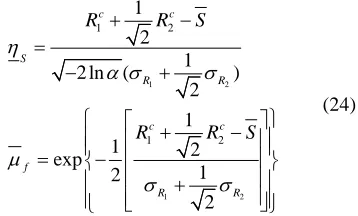
By using the analytical method discussed in this paper, we can obtain the minimum fuzzy reliability index and maximum failure possibility degree. They are respectively:
1 2
1 2
1 2
1 2
1 2
1 2 ln ( )
2 1 1 2 exp
1 2
2
c c
S
R R
c c
f
R R
R R S
R R S
η
α σ σ
µ
σ σ
+ −
=
− +
+ −
= −
+
(24)
Figure (1) shows the possibility distribution of
fuzzy reliability index
S
η and ηS, from which we can see that the maximum failure possibility degree
f
µ is 0.2757 . To investigate the relationship between failure possibility degree and variation-coefficient of the basic variables, let be
1 2
1 2
r
R R
c c c
S R R S
σ σ
β = = = . r
S and c
S are respectively
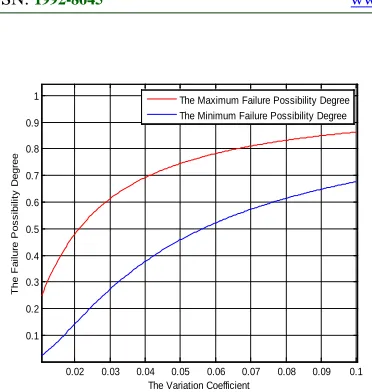
the radius and midpoint of interval variable S . Figure (2) shows the variation of failure possibility
degree µf and
f
µ following with variation degree
of the basic variable β.
0.2 0.3 0.4 0.5 0.6 0.7 0.8 0.9 1 0
5 10 15 20
Level Cut Set
F
uz
z
y
R
el
iabi
li
ty
I
ndex
[image:4.612.344.523.238.346.2]The Minimum Fuzzy Reliability Index The Maximum Fuzzy Reliability Index
[image:4.612.333.498.549.700.2]ISSN: 1992-8645 www.jatit.org E-ISSN: 1817-3195
0.02 0.03 0.04 0.05 0.06 0.07 0.08 0.09 0.1 0.1
0.2 0.3 0.4 0.5 0.6 0.7 0.8 0.9 1
The Variation Coefficient
T
he F
ai
lur
e P
os
s
ibi
li
ty
D
egr
ee
[image:5.612.98.284.82.278.2]The Maximum Failure Possibility Degree The Minimum Failure Possibility Degree
Figure 2: Variation Of Failure Possibility Degree Corresponding To Variables Variation-Coefficient
From figure (1) we can see, fuzzy reliability index
S
η and ηS are both strictly monotone increasing functions of level cut set α. The analysis result is in accordance with the theory researched in this paper. From figure (2) we can see, when the variation coefficient is in the range of 0.01 ~ 0.0622, the maximum failure possibility degree µf will
increase as variation degree of basic variable increasing; and when the variation coefficient is in
the range of 0.0622 ~ 0.1, then 1 1 2
2
c c
R + R <S,
and the maximum failure possibility degree µf is
set to value 1. The minimum failure possibility degree
f
µ will increase as variation-coefficient of basic variable increasing [10].
6 CONCLUSIONS
To solve the problem of reliability design for a structure with hybrid variables, including both including fuzzy variables and interval variables, the hybrid variables structural reliability model based on possibilistic reliability theory is proposed in this paper. The model can fully consider all uncertain information, by which we can implement structural reliability analysis effectively, in the situation of uncertain parameters are lack of sufficient data or the information is incomplete. The practical examples show that, the theory of reliability design of a structure with hybrid variables, which is proposed in this paper, has the advantages of low requirement of
structural information but rational design and strong applicability, and etc. In addition, when the uncertain information is given, the hybrid variables structural reliability model is identical to non-probabilistic reliability model or possibilistic reliability model [11]. Therefore, the hybrid variables structural reliability model based on possibilistic reliability theory can be considered as an effective complement of fuzzy reliability optimal design model and non-probabilistic reliability optimal design model [12].
REFERENCES:
[1] Songqing Shan, G. Gary Wang, “Reliable design space and complete single-loop reliability-based design optimization”, Reliability Engineering and System Safety, Vol. 93, No. 7, 2008, pp. 1218-1230.
[2] Philipp Limbourg, EtiennedeRocquigny, “Uncertainty analysis using evidence theory–confronting level-1 and level-2 approaches with data availability and computational constraints”, Reliability Engineering and System Safety, Vol. 95, No. 1, 2010, pp. 550-564.
[3] C. Jiang, G.R. Liu, X. Han, “A Novel Method for Uncertainty Inverse Problems and Application to Material Characterization of Composites”, Experimental Mechanics, Vol. 48, No. 7, 2008, pp.539-548.
[4] D. Moens, D. Vandepitte, “Recent Advances in Non-probabilistic Approaches for Non-deterministic Dynamic Finite Element Analysis”, Archives of Computational Methods in Engineering, Vol. 13, No. 3, 2006, pp. 389-464..
[5] Juan Ma, Peter Wriggers, “Reliability-based optimization of trusses with random parameters under dynamic loads”, Comput Mech, Vol. 47, No. 1, 2011, pp. 627-640.
[6] Yoshihiro Kanno, “Worst scenario detection in limit analysis of trusses against deficiency of structural components”, Engineering Structures, Vol. 33, No. 04, 2012, pp. 33-42.
[7] Marco Lombardi, Raphael T. Haftkab, “Anti-optimization technique for structural design under load uncertainties”, Computer methods in applied mechanics and engineering, Vol. 157, No. 5, 1998, pp. 19-31.
ISSN: 1992-8645 www.jatit.org E-ISSN: 1817-3195 Mathematics and Mechanics, Vol. 33, No. 9,
2012, pp. 1153-1166.
[9] Marco Savoia, “Structural reliability analysis through fuzzy number approach with application to stability”, Computers and Structures, Vol. 80, No. 5, 2002, pp.1087-1102.
[10] David Moens, Dirk Vandepitte, “A survey of non-probabilistic uncertainty treatment in finite element analysis”, Computer Methods in Applied mechanics and Engineering, Vol. 194, No. 3, 2005, pp. 1527-1545.
[11] A. S. Balu,B. N. Rao, “Multicut-High Dimensional Model Representation for Structural Reliability Bounds Estimation Under Mixed Uncertainties”, Computer-Aided Civil and Infrastructure Engineering, Vol. 27, No. 10, 2012, pp. 419-438.