WRL
Research Report 89/1
SCHEME->C
a Portable
Scheme-to-C Compiler
research relevant to the design and application of high performance scientific computers. We test our ideas by designing, building, and using real systems. The systems we build are research prototypes; they are not intended to become products.
There is a second research laboratory located in Palo Alto, the Systems Research Cen-ter (SRC). Other Digital research groups are located in Paris (PRL) and in Cambridge, Massachusetts (CRL).
Our research is directed towards mainstream high-performance computer systems. Our prototypes are intended to foreshadow the future computing environments used by many Digital customers. The long-term goal of WRL is to aid and accelerate the development of high-performance uni- and multi-processors. The research projects within WRL will address various aspects of high-performance computing.
We believe that significant advances in computer systems do not come from any single technological advance. Technologies, both hardware and software, do not all advance at the same pace. System design is the art of composing systems which use each level of technology in an appropriate balance. A major advance in overall system performance will require reexamination of all aspects of the system.
We do work in the design, fabrication and packaging of hardware; language processing and scaling issues in system software design; and the exploration of new applications areas that are opening up with the advent of higher performance systems. Researchers at WRL cooperate closely and move freely among the various levels of system design. This allows us to explore a wide range of tradeoffs to meet system goals.
We publish the results of our work in a variety of journals, conferences, research reports, and technical notes. This document is a research report. Research reports are normally accounts of completed research and may include material from earlier technical notes. We use technical notes for rapid distribution of technical material; usually this represents research in progress.
Research reports and technical notes may be ordered from us. You may mail your order to:
Technical Report Distribution
DEC Western Research Laboratory, UCO-4 100 Hamilton Avenue
Palo Alto, California 94301 USA
Reports and notes may also be ordered by electronic mail. Use one of the following addresses:
Digital E-net: DECWRL::WRL-TECHREPORTS
DARPA Internet: [email protected]
CSnet: [email protected]
UUCP: decwrl!wrl-techreports
a Portable
Scheme-to-C Compiler
Joel F. Bartlett
January, 1989
Copyright
1989, Digital Equipment Corporation
One way to make compilers portable is to have them compile to an inter-mediate language which is implemented on multiple architectures. By using C as the intermediate language and compiling the LISP dialect Scheme to it, it might be possible to achieve the following benefits. First, since C is the lingua franca of workstations the resulting system should be very portable. Second, it should al-low Scheme programs to interact with those written in other languages. Finally, it should simplify the compiler as it need not repeat the optimization capability available in the C compiler.
However, there might be some unacceptable costs associated with this. First, there might not be a clean translation from Scheme to C, so that the implemen-tation is not quite Scheme. Second, the two-stage translation might result in in-efficient code. Finally, the generated code might be so stylized that it is neither portable nor compatible with other programming languages.
Compiling one language to another, rather than to a specific machine’s instruction set, is a very old idea. The benefits of compiling high-level languages to an intermediate language,
1
UNCOL , and then compiling that language for a specific architecture were first documented in 1958 [17]. Compiling to an UNCOL has at least the following advantages to a compiler writer. First, by emitting UNCOL rather than machine opcodes, a compiler is extremely portable. In theory, it can be ported to any machine which supports the UNCOL. Second, the UNCOL provides a common meeting point for all languages and thus facilitates the construction of programs written in multiple languages. Finally, the UNCOL compiler can simplify the in-dividual language compilers by providing language-independent optimization.
Unfortunately, while many efforts since then have used intermediate languages [3], it is clear that they have not become widely accepted. Instead, standardization efforts have focussed on proprietary instruction set architectures, e.g. the Digitial VAX, and on industry wide standards for higher-level languages, e.g. FORTRAN-77.
However, if one is willing to restrict one’s view to workstations running UNIX [10] or its derivatives, one could consider C [9] as a possible UNCOL. All such systems have a C compiler, and as C was the first high-level language for UNIX, most other languages can call C procedures and use its data structures. Also, since the operating system and many of the applications are written in C, the C compiler provides some level of machine-specific optimization. Finally, since workstation performance is passing that of traditional mainframes, the overhead imposed by using two compilers instead of one can be tolerated.
Since C appears to be a satisfactory UNCOL, our attention can now turn to the problems of compiling Scheme to it. In the sections which follow, it is assumed that the reader has some familiarity with C. The Scheme language is introduced and its differences from C are exposed in section 2. Section 3 provides an overview of the compiler and shows how Scheme can be ef-ficiently mapped to C. Following this, section 4 compares the performance of this Scheme sys-tem to a native LISP implementation, and section 5 discusses the portability of the implemen-tation. From this, section 6 concludes that the Scheme-to-C compiler has met the desired levels of performance, portability, and simplicity, without serious damage to Scheme’s semantics.
2. Scheme By Example
Scheme is a dialect of Lisp which strives for simplicity without sacrificing power. It has a small number of rules for forming expressions which have clearly defined semantics and few restrictions on how they are composed.
When examining the examples which introduce the language, the reader should not con-centrate on the obvious differences in syntax between Scheme and C, but on the differences in semantics. Specific attention is paid to those items which do not cleanly translate to C. Readers interested in going beyond this informal introduction to Scheme are encouraged to consult the standard [13] which was used to form this section, or the text [1].
2.1. Identifiers, Variables, and Binding
Scheme’s identifiers are similar to those used in most languages. For example, A1 is a legal identifier in Scheme and C. However, Scheme also allows identifiers of the form <= or
vector->list and considers upper and lower case forms of a letter to be identical. Thus,
Vector->Listis the same identifier asvECtor->lISt.
One of the uses of identifiers is for variables, which name locations where values can be stored. A variable that does this is said to be bound to the location. The set of all bindings in effect at some point in the program is known as the environment. Every Scheme system has a top level environment which starts out with a number of variables bound to useful primitive values, most of which are primitive procedures that manipulate data. New variable bindings can be added to the environment by expressions of the following form:
(define x 23) binds X to a location containing the value 23
(define plus +) binds PLUS to a location containing the value of +, a predefined function to add two numbers
Variables do not have any type information associated with them. Instead, the type is as-sociated with the object which is the value of the variable.
2.2. Primitive Expressions
A Scheme expression is a construct that returns a value. An expression consisting of a vari-able evaluates to the value in the location bound to the varivari-able.
(define x 23) Creates an initial binding for X
x ==> 23 this means: X "evaluates to" 23 Constants such as strings or numbers evaluate "to themselves":
"This is a string" ==> "This is a string"
23 ==> 23
3.14159 ==> 3.14159
#t ==> #t the boolean for true
(quote a) ==> a
’a ==> a
A procedure call is written by simply enclosing in parentheses the expressions for the proce-dure to be called and the arguments to be passed to it. These expressions are evaluated in any order, then the arguments are passed to the procedure, and finally the procedure returns a value.
(+ 3 4) ==> 7
(+ (abs -3) 4) ==> 7
(= 1 1) ==> #t
(< 2 1) ==> #f
Procedures are created by the evaluation of alambdaexpression. The environment in effect when the lambda expression is evaluated is retained as part of the procedure. When the proce-dure is later called with some actual arguments, these are added to the saved environment, creat-ing an extended environment. The expressions in the body of the lambda expression are evaluated sequentially in the extended environment, and the result of the last expression in the body is returned as the result of the procedure. A few examples are:
(lambda (x) (+ x 1)) ==> #*PROCEDURE* a procedure
(define inc
(lambda (x) (+ x 1))) ==> INC defines a procedure which adds 1 to its argument
(define (inc x) (+ x 1)) ==> INC an equivalent way of defining inc, where the lambda is implied
(inc 23) ==> 24 a procedure call to the previously defined procedure
((lambda (x) (+ x 1)) 3) ==> 4 a procedure call, where the first argument is a lambda expression Unlike many earlier LISP’s which used dynamically scoped variables, Scheme’s variables are lexically scoped. As a result, the variable bindings in force at any point in the program can be determined at compile time.
Conditional execution is provided by the following form. If the value of the first expression is true, then the second expression is evaluated and its value is returned. Otherwise, the third ex-pression is evaluated and its value is returned. For example:
(if (> 3 2) ’yes ’no) ==> yes 1st expression is true
(if (= 1 2) ’yes (+ 2 1)) ==> 3 1st expression is false The final primitive expression allows the value of a variable to be changed:
(define x 10) ==> X binds X to a location containing 10
(+ x 1) ==> 11
(set! x 23) ==> 23 changes X’s value to 23
x ==> 23
2.3. Derived Expressions
Since there are no limitations on how the primitive expressions can be combined, higher-level expressions can be constructed which allow Scheme procedures to be written with a block struc-ture similar to that of C. A set of expressions may be evaluated sequentially by the begin ex-pression:
(begin (f1 1) (f2 2) (f3 3)
’done) ==> DONE
Since expressions in the body of a lambda expression are evaluated sequentially, the previous expression is defined as the evaluation of a function with no arguments, whose body is com-posed of the sequence of expressions:
((lambda () (f1 1) (f2 2) (f3 3)
’done)) ==> DONE
A more powerful form is the and expression that evaluates its arguments from left to right until one evaluates to a false value. To test that an integeryis between one and nine and even, one could write:
(and (< y 9) (> y 1) (zero? (remainder y 2)))
which can be expressed using the primitive expressions as:
(if (< y 9)
(if (> y 1) (zero? (remainder y 2)) #f) #f)
While the latter has the same meaning as the former, it’s clear the former is easier to write and understand. This completes the introduction to Scheme expressions and our attention will now turn to some of their properties.
2.4. Procedures Are More Than Code
At first glance, lambda seems to be some form of syntactic sugar to declare a procedure. When used to declare a simple top level procedure that computes the absolute value of a number:
(define (abs x) (if (> x 0) x (- 0 x)))
(define (make-counter n) ==> MAKE-COUNTER a procedure which returns
(lambda () a procedure
(set! n (+ n 1)) (- n 1)))
(set! c1 (make-counter 100)) ==> #*PROCEDURE* counter with n bound to a location containing 100 Each time the counter procedure is evaluated, it returns the next number:
(c1) ==> 100
(c1) ==> 101
Note thatmake-countercan make many counters, and while they will share the code, they will have their own environments:
(set! c2 (make-counter 200)) ==> #*PROCEDURE* counter with n bound to a location containing 200
(c2) ==> 200
(c2) ==> 201
(c1) ==> 102
(c2) ==> 202
Objects with more complex actions and a larger local state can be constructed in a straightfor-ward manner.
2.5. Objects Are Created at Any Time and Last Forever
The procedures representing counters shown in the previous section can be created at any time. Objects are never explicitly released as long as the program has at least one reference to them. The storage allocator may use garbage collection to recover storage which is no longer referenced. By constrast, in C most objects exist for the entire duration of the program, or are created on entry to a procedure, and deleted on exit from it. Objects that must have indefinite extent are explicitly allocated and returned by calls to C library routines.
2.6. Continuations
Scheme provides a very general control mechanism based upon continuations. A continuation represents the entire future of the computation, i.e. what to do next. In languages which have labels and goto’s, the goto statement’s action can be described as: ignore the implicit continua-tion (which is the next sequential statement), and pass control to a continuacontinua-tion at the label.
The Scheme procedure call-with-current-continuation packages up the current continuation as an escape procedure. The escape procedure is a Scheme procedure of one ar-gument that, if it is later passed a value, will give the value to the continuation that was in effect at the time that escape procedure was created. A simple example is the following which shows how invoking the escape procedure can result in an "upexit" from the sequential execution of expressions in the body of a procedure.
(call-with-current-continuation ==> 1 (lambda (exit)
Here, the division is never executed, as the procedureexitcauses an immediate return to the caller of call-with-current-continuation with the value 1. A trickier example which hints at the power available is the following, where an escape procedure is used to return to the "inside" of a previous computation. When the procedurecount:
(define repeat #t)
(define (count n) (if (= n 0)
(begin (display "*")
(call-with-current-continuation
(lambda (exit) (set! repeat exit)))) (begin (display n)
(count (- n 1)) (display n))))
is called with 3 as its argument, it prints 321*123and sets repeat to an escape procedure which represents the future of the computation just after the*was printed. Every timerepeat
is called, it will return to that point in the computation and print the digits123.
This ability to shift control is significantly more powerful than the upexit capability provided by UNIX’s setjmp and longjmp [10], or Common LISP’s catch and throw [16]. As a result, a large variety of control structures can be fabricated, as is shown in [7].
2.7. Iteration is a Special Case of Function Call
Using the concept of continuations (and ignoring the mechanism used for argument passing and value return), the procedure call and return mechanism of C can be informally described as follows. A procedure call consists of two steps: first create a continuation which represents the point to return to following the call and push it on a stack; then transfer control to the called procedure. Following its execution, the called procedure returns by transfering control to a con-tinuation which it pops from the stack.
When the last thing that a procedure does is to call another procedure, that call is called a tail-call. For example, in the following C code that tests whether a non-negative integer is even or odd:
int even( i ) int i; {
return( if (i == 0) 1 else odd( i-1 ) ); }
int odd( i ) int i; {
return( if (i == 0) 0 else even( i-1 ) ); }
Scheme on the other hand requires that the implementation be properly tail-recursive. A Scheme system must identify tail-calls and not save another continuation when such a call is made. This allows the Scheme version of the previous program to be written as:
(define (even i) (if (= i 0) #t (odd (- i 1))))
(define (odd i) (if (= i 0) #f (even (- i 1))))
which executes with a constant amount of stack space, irrespective of the value of i. This is because the calls to odd and even inside even and odd are recognized as tail-calls and no continuation is saved when the calls are made.
By recognizing how procedure calls are used, Scheme is able to avoid having an interation primitive. When a programmer wishes to iterate, they often use the derived expression do. With it, the programer writes an iterative form which is then expanded by the Scheme implementation into an expression involving recursion. When this expression is executed, those calls which are tail-calls are recognized as such and processed efficiently. That is, the program can be expressed in an iterative manner, and the generated code can be iterative, but the programming language does not directly support iteration.
2.8. A LISP Without Lists?
2
In spite of the fact that pairs and lists are as prevalent in Scheme programs as arrays and integers are in C programs, the discussion to this point has ignored them. The actual data types supported by Scheme and the operations performed upon them are but a minor part of the im-plementation of Scheme. In fact, the only time that lists are used in the primitive expressions is as part of the mechanism which allows procedures which accept a variable number of arguments.
With this overview of the semantics of Scheme, we can now turn our attention to the problems involved in translating Scheme to C.
3. Compiling Scheme to C
As can be seen from the introduction to Scheme, there are major differences from C in the semantics of procedure call and the lifetimes of objects. Smaller though significant differences exist in the semantics of procedures and procedure argument passing. Finally, Scheme introduces a new concept with its escape procedures which capture continuations.
Before examining the solutions to these problems, a short overview of the compilation process is in order. The design of this process owes much to Steele’s RABBIT compiler [15] done at MIT and the ORBIT compiler [11] done at Yale.
Starting with an initial source program:
(define (sample x y z) (if (or (and x y) z) 0 1))
Scheme->C converts all expressions to their equivalent primitive expressions:
(define
(sample x y z) (if
((lambda (x thunk) (if x x (thunk)))
((lambda (x thunk) (if x (thunk) x)) x (lambda () Y)) (lambda () Z))
0 1))
Following this all variables are uniquely named, a process known as alpha-conversion [15], and each primitive form is replaced by an equivalent internal form:
($DEFINE S1000 ($LAMBDA L1001
($IF
(<APPLY> () L1005 (X1006
<-(<APPLY> () L1008 (X1009 <- X1002)
(T1010 <- ($LAMBDA L1011 Y1003)) ($IF X1009 ($CALL () T1010) X1009))) (T1007 <- ($LAMBDA L1012 Z1004))
($IF X1006 X1006 ($CALL () T1007))) C1014
C1013)))
Lambda expressions have their arguments replaced by a unique name. The arguments and other information associated with the expression are stored in a side table indexed by the unique name. All function calls are modified to have an additional initial argument which is a flag identifying tail-calls. The flag is set on tail-calls to the id of the lambda expression that is exited when the call is made. A call where the function is a lambda expression is displayed differently
3
so that the lambda bindings can be observed . Thus, the expression:
(<APPLY> () L1008 (X1009 <- X1002)
(T1010 <- ($LAMBDA L1011 Y1003)) ($IF X1009 ($CALL () T1010) X1009)))
is actually represented internally as:
($CALL ()
($LAMBDA L1008
($IF X1009 ($CALL () T1010) X1009)) X1002
($LAMBDA L1011 Y1003))
Following conversion to the internal form, the program is optimized using rewrite rules similar to those used in the ORBIT compiler. After the application of these transformations, the sample expression becomes:
($DEFINE S1000 ($LAMBDA L1001
(<APPLY> L1001 L1020
(Y1022 <- ($LAMBDA L1024 ($IF Z1004 C1014 C1013))) ($IF X1002
($IF Y1003 C1014 ($CALL L1001 Y1022)) ($CALL L1001 Y1022)))))
At this point in the translation process, one can start to consider emitting code. However, before that can be done, a method for calling procedures must be picked.
3.1. Procedure Call: a Dilemma
One of the strengths of a good C compiler is that it provides significant processor independent 4 and dependent optimization. While many move frequently used local variables to registers , compilers on RISC processors such as the MIPS R2000 [8] make a significant effort to optimize procedure calls. Some procedure arguments are passed in the registers and calls to leaf
5
procedures are optimized. By using C’s procedure call and return mechanisms, one is able to take advantage of these optimizations. In addition, by retaining C’s procedure call and return mechanism, call-outs to and call-backs from other languages can be done in a straightforward manner.
However, there is a drawback to this approach: C is not properly tail-recursive, so all proce-dure calls result in a stack marker being pushed on the runtime stack. It would appear that the compiler writer is faced with a dilemma: use C’s mechanisms and cease to be properly tail-recursive, or avoid them and lose significant amounts of optimization.
After some thought, it was decided to use C’s procedure call mechanism and preserve as much of the tail-recursive semantics as possible through compile-time analysis.
3.2. Procedure Call Analysis
Following the program transformation phase, the compiler analyzes how each procedure is called and uses that information to decide how code for it should be emitted. In the previous example, the lambda expressionL1001 is the proceduresample. Since it is defined at the top level of the program, it is translated into a C procedure. The next lambda expression, L1020, is only called once, so it can be generated in-line where it is called. The final lambda expression,
L1024, is called twice. Each call is a tail-call which is to exit from the lambda expression
L1001 following the execution of L1020. These conditions allow L1024 to be generated in-line at the end of the code for L1001, and calls to it be branches. Thus the C code for the sample program becomes:
TSCP test_sample( x1002, y1003, z1004 ) TSCP x1002, y1003, z1004;
{ | code for L1020
if ( FALSE( x1002 ) ) goto L1032; | tail-call to L1024
if ( FALSE( y1003 ) ) goto L1032; | tail-call to L1024
return( _TSCP( 0 ) ); | L1032:
if ( TRUE( z1004 ) ) goto L1033; | code for L1024
return( _TSCP( 4 ) ); | L1033: | return( _TSCP( 0 ) ); | }
which is similar to the code that one would write in C if one expanded the and and or
6 operators by hand.
The optimization mechanisms used here are not specific toandandor, as they are done only using the primitive expression types. For example, a do loop which prints a sequence of num-bers can be expressed as:
(define (print-1-to-limit limit) (do ((i 1 (+ i 1)))
((> i limit) ’done) (display i)))
(print-1tolimit 8) ==> 12345678DONE
Following expansion to primitive expression types, it results in the following expression:
(define print-1-to-limit (lambda (limit)
((lambda (doloop) (set!
doloop (lambda (i)
(if
(> i limit) ’DONE
(lambda () (display i) (doloop (+ i 1)))))) (doloop 1))
0)))
The loop is turned into a function which is called once with the initial conditions. Inside the loop function, the next iteration is expressed as a tail-call to itself. After the optimizing trans-forms have been applied, the internal form is:
($DEFINE P1000 ($LAMBDA L1001
(<APPLY> L1001 L1003 (D1004 <- C1022) ($SET
D1004
($LAMBDA L1005 <-- loop function
($IF
($CALL () *greater-than* I1006 L1002) C1020
(<APPLY> L1005 L1013 ($CALL () D632 I1006)
($CALL <-- internal tail-call
L1005 D1004
($CALL () *plus* I1006 C1021)))))) ($CALL L1001 D1004 C1021)))) <-- initial call
where the functions*greater-than*and*plus*are expanded in-line. The loop proce-dureL1005can be generated in-line because the variable that it is assigned to,D1004, is never passed as a procedure argument, and all but one of the calls to D1004 are tail-calls which are internal to it. The resulting code is iterative as one would expect:
TSCP test_print_2d1_2dto_2dlimit( l1002 ) TSCP l1002;
{
TSCP X1;
X1 = _TSCP( 4 ); L1032:
if ( GT( INT( X1 ), INT( l1002 ) ) ) goto L1033; scrt6_display( X1, EMPTYLIST );
X1 = _TSCP( PLUS( INT( X1 ), INT( _TSCP( 4 ) ) ) ); goto L1032;
L1033:
return( c1020 ); }
While the analysis shown in the previous examples is powerful enough to compile finite state machines correctly, it does have some limitations. Any procedure which must be compiled as a C procedure can only be tail-called by itself. This includes procedures defined at the top level, and any procedure that is called from multiple places where at least one of the calls is not a tail-call. As a result, the previous tail-recursive example involving two top level procedures is not properly compiled:
(define (even i) (if (= i 0) #t (odd (- i 1))))
(define (odd i) (if (= i 0) #f (even (- i 1))))
However, correct code can be obtained if the user is willing to put a "wrapper" procedure around a set of tail-recursive procedures. By restating the problem as follows, correct iterative code is generated.
(define (even? x)
There are certain to be those in the Scheme community who are offended by the fact that the tail-recursive properties of the language have been compromised. However, the compiler cor-rectly handles tail-recursion in the cases where there is a big win: loops and conditional expres-sions. With minor changes to the program, such things as finite state machines can be correctly compiled. The inability to tail-call all procedures has been traded for high performance and com-patibilty with other tools and languages.
3.3. Procedure Call: Loose Ends
Scheme allows procedures to be defined to accept optional arguments. When the called proce-dure is entered, these arguments are available in a newly constructed list. In this implementation of Scheme, the calling procedure is required to construct the argument list. While this adds code to each call, it assures that procedures will always be called with the correct fixed number of arguments. An example of a procedure which accepts one required argument and additional optional arguments is:
(define (sum x . y) (for-each
(lambda (z)
(set! x (+ x z))) y))
which returns the sum of its arguments. Calls to it are compiled as:
test_sum( _TSCP( 4 ), EMPTYLIST ); (sum 1)
X1 = CONS( _TSCP( 16 ), EMPTYLIST ); X1 = CONS( _TSCP( 12 ), X1 );
test_sum( _TSCP( 4 ), CONS( _TSCP( 8 ), X1 ) ); (sum 1 2 3 4)
A second consideration in calling procedures is that some procedures must be executed in the environment where they were created. For example on each call to a counter procedure,c1:
(define (make-counter n) (lambda ()
(set! (+ n 1)) (- n 1)))
(set! c1 (make-counter 100))
the environment where n is bound must be supplied. This is done by compiling such procedures with a pointer to the environment as an additional argument. It is the caller’s respon-sibility to supply this argument.
A call toc1in the previous example is an example of the most general form of procedure call, where all checking and argument construction must be deferred to runtime. In order to assure that it is correctly done, the following operations must be performed:
•Verify that c1is a procedure and that it is being called with the correct number of arguments.
•Call the procedure with the procedure’s environment as the last argument.
While it would be nice to construct a procedure call with an arbitrary number of arguments with in-line code, C does not allow it. The only mechanism for simulating this is to compute the number of arguments, and use it as an index to a switch statement to select a call with the correct number of arguments. Needless to say, this results in a lot of code, so it must be placed in its own procedure in the runtime library.
One optimization that is made is to assume that the procedure takes no optional arguments. Then, the number of arguments that a procedure P is being called with will be known at compile time and a call statement to a procedure variable X is constructed. If at runtime P is indeed a procedure expecting that fixed number of arguments, then X is set to P. If this is not true, then X is set to a "trampoline" procedure in the runtime library which will handle errors or optional arguments. The environment pointer is always supplied here, as some procedures need it and C permits a procedure to be called with extra arguments which are simply ignored.
Fortunately, there is enough information available at compile time to correctly compile most procedure calls. The compiler uses its knowledge about predefined functions and those defined in the module currently being compiled to generate the correct calling sequence. Other calls emit the previously described general calling sequence. Since it can do many calls in-line, few calls must resort to the most general calling mechanism implemented by the runtime library.
3.4. Storage Allocation
Type information is encoded in objects in a straightforward manner. The implementation re-quires that pointers be 32-bits long and be byte addresses. Since storage is always allocated on a four-byte word boundary, each object is a 32-bit pointer, with the low-order two bits reserved for a tag. Note that this tagging scheme does not result in the loss of any address bits. Depending upon the value of the tag, the rest of the word is either the object, or a pointer to the object.
Since objects have an indefinite lifetime, they must be allocated from a heap. As the objects are never explicitly freed, some mechanism must be provided for objects which are no longer referenced. A review of the literature on garbage collection [5] suggests that garbage collection might be quite difficult in the C environment. Virtually all collection algorithms start with infor-mation found in a root set of pointers which must be in known locations. As a result, the collec-tor must know the conventions for register and stack usage, which must always be followed. Typically this requires that registers which are assumed to contain pointers always be valid, and that pointers never be placed in other registers. Items in the stack must be flagged in such a way that all objects that are pointers can be found, and those that aren’t are never mistaken for pointers.
To solve this problem, a new garbage collection algorithm called "mostly-copying" was devised [2]. Instead of requiring that the root set be a known set of cells containing pointers which define all accessible storage, the new algorithm only requires that the root set include pointers or values derived from pointers which define all accessible storage. The cells in this new root set need not all be pointers, nor is it required that there not be cells which "look like pointers", but aren’t.
Using this root set, the algorithm divides all accessible objects in the heap into two classes: those which might have a direct reference from the root cells, and those which don’t. The former items are left in place, and the latter items are copied into a compact area of memory. In prac-tice, only a very small amount of the heap is left in place, so memory fragmentation is not a problem.
3.5. Runtime Environment
Scheme requires a significantly richer runtime environment than does C. For example, a call to functionain:
(define (a) (eq? (b) ’b))
(define (b) ’b)
7
must return the value #t when both procedures are compiled together, separately compiled, interpreted, or just one is compiled. In order to do this, there can only be one symbol constantb.
Another example where complex initialization is required is:
(define time (current-time-of-day))
where the top level variable time is set to the current time of day. If this code is compiled, then a mechanism must be provided which will assure thattime is initialized at the start of the program. Furthermore, the variable timemust be available at runtime to a Scheme interpreter. If one enters time, then one should get its value. Or, if one enters (set! time 0), one should change the value oftimeseen by interpreted and compiled code.
These examples suggest that C’s model of execution where compile-time globals are set to constant values and execution starts at the main procedure is not powerful enough. Instead, an initialization model similar to that used by Modula-2 is used. The Scheme compiler compiles a module at a time, where each module consists of one or more source files. The module name is supplied in a module directive (module module-name), and define-external expres-sions may be supplied to declare objects defined in other modules. However, unlike Modula-2, there are default external references. All objects defined to be in the initial Scheme environment are predefined. Objects which are not defined in the initial Scheme environment are assumed to be defined in the top level environment at runtime.
The code generated to handle initialization is compatible with that generated by WRL’s Modula-2 compiler. Each module which is compiled has an initialization procedure, module-name__init which is called at the start of execution to initialize the module. This initialization procedure calls the initialization procedures of all other modules needed by that module. At the end of this initialization process, the user’s main procedure is executed.
This environment setup process is best shown by example. The classic "hello, world" program in C is:
main() {
printf( "hello, world\n" ); }
which can be written in Scheme as:
(module hello (main main))
(define (main clargs)
(display "hello, world") (newline))
which compiles into the C code:
/* SCHEME->C */
#include "schemetoc/objects.h"
DEFSTRING( t1004, "hello, world", 12 ); DEFSTATICTSCP2( c1003, t1004 );
static void init_constants() {
}
DEFTSCP( hello_main_v );
DEFSTRING( t1005, "MAIN", 4 ); EXTERNTSCPP( scrt6_display ); EXTERNTSCP( scrt6_display_v ); EXTERNTSCPP( scrt6_newline ); EXTERNTSCP( scrt6_newline_v );
TSCP hello_main( c1002 ) TSCP c1002; {
scrt6_display( c1003, EMPTYLIST ); return( scrt6_newline( EMPTYLIST ) ); }
void hello__init(){}
static void init_modules( compiler_version ) char *compiler_version;
{
main( argc, argv )
int argc; char *argv[]; {
static int init = 0; if (init) return; init = 1;
INITHEAP( 0, argc, argv, hello_main ); init_constants();
init_modules( "(hello SCHEME->C COMPILER 09nov88jfb)" ); INITIALIZEVAR( U_TX( ADR( t1005 ) ),
ADR( hello_main_v ), MAKEPROCEDURE( 1,
0, hello_main, EMPTYLIST ) ); MAXDISPLAY( 0 );
hello_main( CLARGUMENTS( argc, argv ) ); SCHEMEEXIT();
}
Here, the main program is not the user’s code, but the module initialization code. By examin-ing it, one can see the Scheme initialization process.
•When the the C source is compiled, it includes the file schemetoc/objects.h
which defines the types and defines underlying the Scheme system.
•The constantt1004defines the storage for the string "hello, world" which consists of a header identifying the object as a string of length 12, followed by the text. All references to the string in the program are via the variablec1003which contains a tagged pointer to the actual string.
•Turning now to the main procedure, the local static variable init assures that the initialization module is executed exactly once.
•The defineINITHEAPcalls a function in the run-time library to initialize the heap.
•The procedure init_constants is called to build any constant lists or vectors which are required by this module. Since none are needed here, this procedure is empty.
•The call toinit_modulescauses the initialization procedures for all modules re-quired by this one to be executed. In this case, scrt6__init is called because that module contains the proceduresdisplayandnewline.
•The user’s procedure main causes both a C procedurehello_main and a global variable hello_main_v to be created. The global variable is set to a procedure object which in turn points to the C procedure. The define INITIALIZEVAR is called to store the procedure object into the variable hello_main_v, and to as-sociate the namemainwith that variable.
•The number of entries used in the lexical display are recorded by the define
MAXDISPLAY.
•The command line arguments are formed into a list and that is passed to the user’s procedure which prints "hello, world" and then returns.
While some of the initialization is superfluous in this example, most of it is needed most of the time so it’s always generated.
3.6. Variable Binding
Variables in Scheme differ from those allocated by C in that they have indefinite extent. However, compile time analysis can discover how they are used so that they may be efficiently bound. The factors that the compiler considers are:
•Is the variable bound in the top level environment?
•Otherwise, for lambda-bound variables:
•Is the variable closed by a lambda expression?
•Is the variable accessed by a nested procedure?
•Is the variable ever changed byset!?
3.6.1. Global Variables
Variables that are bound in the top level environment are allocated as C globals. Those which are bound to a procedure also require a C procedure with the code. Thus the Scheme module:
(module sample)
(define x 10)
(define (inc x) (+ x 1))
will be compiled into the following globals:
. . .
TSCP sample_x_v; Location for X
TSCP sample_inc_v; Location for INC
TSCP sample_inc( x1004 ) Code for INC
TSCP x1004; {
. . . }
. . .
3.6.2. Automatic Variables
3.6.3. Display-Allocated Variables
Since C does not allow procedures to be nested lexically, the compiler must provide some mechanism for allowing one C procedure to access another’s lexical variables. This is done by allocating such variables to a display, implemented by a set of global variables.
In the following contrived example:
(define (a x)
(define (b y) x) (b x)
(b 2))
the procedureb, nested withina, needs to access the variablexwhich is bound on the calla. Sincebis called twice, and one of the calls is not a tail-call, it must be compiled as a separate C procedure. When a is compiled, a slot in the display is allocated to x. On entry to a the contents of that display entry are saved in a local variable, and the value of x is placed in it. Within aand b, all references toxrefer to the value in the display slot. When ais exited, the display entry is restored to its previous contents.
TSCP test_b1004( y1006 ) Code for b
TSCP y1006; {
return( DISPLAY( 0 ) ); }
TSCP test_a( x1002 ) Code for a
TSCP x1002; {
TSCP SD0 = DISPLAY( 0 ); TSCP SDVAL;
DISPLAY( 0 ) = x1002;
test_b1004( DISPLAY( 0 ) );
SDVAL = test_b1004( _TSCP( 8 ) ); DISPLAY( 0 ) = SD0;
return( SDVAL ); }
Variables must also be allocated to the display when a binding is "captured" by a lambda expression. In the example described earlier which makes counters:
(define (make-counter n) (lambda ()
(set! n (+ n 1)) (- n 1)))
3.6.4. Heap-Allocated Variables
In order to be compatible with the implementation method used for saving the display and continuations, variables allocated on the stack or in the display cannot be changed after their initial binding. So, variables which are changed by set! are bound to a pointer to a pair
8
containing the value, rather than to the actual value . While this adds a level of indirection to each variable access, Scheme programmers are encouraged to write in a functional manner so
set!is not extensively used.
With this in mind, we can now examine the code formake-counter:
TSCP test_l1003( c1019 ) Procedure returned by make-counter
TSCP c1019; that does the counting.
{
TSCP X2, X1;
X1 = DISPLAY( 0 );
DISPLAY( 0 ) = CLOSURE_VAR( c1019, 0 ); PAIR_CAR( DISPLAY( 0 ) ) =
_TSCP( PLUS( INT( PAIR_CAR( DISPLAY( 0 ) ) ), INT( _TSCP( 4 ) ) ) );
X2 = _TSCP( DIFFERENCE( INT( PAIR_CAR( DISPLAY( 0 ) ) ), INT( _TSCP( 4 ) ) ) );
DISPLAY( 0 ) = X1; return( X2 ); }
TSCP test_make_2dcounter( n1002 ) Code for make-counter
TSCP n1002; {
TSCP SD0 = DISPLAY( 0 ); TSCP SDVAL;
DISPLAY( 0 ) = CONS( n1002, EMPTYLIST ); SDVAL = MAKEPROCEDURE( 0,
0,
test_l1003,
MAKECLOSURE( EMPTYLIST,
1, DISPLAY( 0 ) ) ); DISPLAY( 0 ) = SD0;
return( SDVAL ); }
Here,nis allocated a slot in the display, but since it is changed byset!its actual value must be retained in the heap. This binding ofnis made part of the returned procedure. Each time such a procedure is called, a pointer to the saved environment holding the binding ofnis supplied as its argument. On entry, the contents of n’s entry in the display is saved in a local variable. On exit, the display is restored from the local variable.
3.7. Continuations
Various mechanisms have been used to create continuations in Scheme, as is summarized in [4]. Given the fact that we wish to avail ourselves of C’s procedure call/return and local vari-able allocation mechanisms, it makes sense to implement continuations using the stack strategy. When a continuation is constructed bycall-with-current-continuation, the contents of the stack, display, and registers are saved and made a part of the escape procedure. When this procedure is called, it restores the stack, display, and registers, and then returns its argument as its value. Stack copying can be minimized by only copying the portion of the stack which has not already been copied into some other continuation and only restoring the portion of the stack which is not already in place.
While this scheme requires copying, it has two distinct advantages: there is no overhead for the programs which do not use explicit continuations and the mechanism is portable.
3.8. Summary
This completes discussion of the mapping of Scheme’s semantics to C. Even though virtually all of Scheme’s semantics were correctly handled, the implementation cannot properly handle all tail-calls. While unfortunate, the discussions which follow on performance and portability sug-gest that this is not a fatal flaw.
4. Performance in C
While compiling Scheme to C may provide a very portable system, one’s first inclination is to expect that there is a performance penalty. One test that was run suggests that this is not the case. The Gabriel benchmarks [6] were run on a MicroVax II and Scheme->C’s performace was compared against that of a native Lisp implementation, VAX Common Lisp V2.2 as reported in
[14].
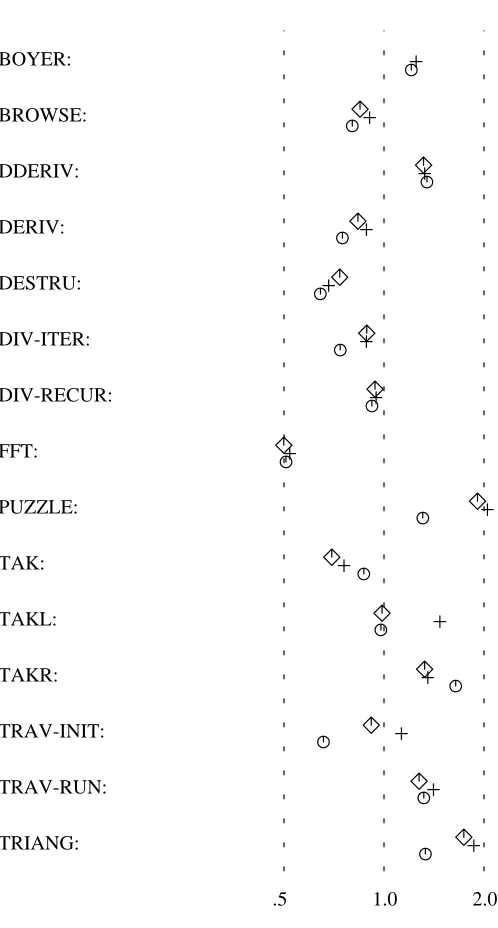
When the benchmarks were compiled using the standard ULTRIX C compiler, the geometric mean of the run-times showed that they were 5% slower than VAX Common Lisp. Better results were obtained when the benchmarks were compiled with the VAX C compiler: the geometric mean of the run-times in this case was the same as with VAX Common Lisp. The best results were obtained when the benchmarks were compiled with the GNU C compiler. Here, the geometric mean of the times showed that Scheme->C was 8% faster than VAX Common Lisp. The results of the individual benchmarks are shown in Figure 1. For each benchmark, there is a
9
data point for each compiler that shows the speed relative to VAX Common Lisp. Values to the left of 1.0 show performance less than VAX Common Lisp, values to the right show greater performance.
Much of the variance in performance in the individual benchmarks is probably due to dif-ferences in the systems. The block compilation model used by Scheme->C and its tail-call analysis probably help performance. On the other hand it loses some performance, in that it uses
the standard procedure call and return instructions, has no floating point optimization, andcons
is implemented by a library procedure rather than in-line code.
In spite of these differences, one can still conclude that performance need not suffer by com-piling to C, and the times obtained when comcom-piling with GNU C indicate that it may be possible to gain. With the advent of powerful C compilers, and RISC machines such as the MIPS R2000 which benefit greatly from extensive optimization, compiling to C as is done here and in Kyoto Common Lisp (KCL) may be preferable to retargetting a common backend when building a port-able compiler.
5. Porting Scheme->C
The Scheme->C system makes few requirements on the target system other than it have a C compiler. The tagged pointer scheme requires that processor addresses be 32-bits in length and denote the first byte of the addressed object. It does not care about byte-order in a word. While UNIX systems typically have one address space for code and data, the implementation does not require it. In order to save and restore state for call-with-current-continuation, there must be a way to save and restore the process’s stack and registers.
The Scheme->C system is broken up into processor dependent and independent modules as follows:
•A Scheme-to-C compiler written in Scheme which emits machine-independent C code.
•A machine-dependent definitions file which is used to compile the C code produced by the compiler to produce a machine-dependent object file.
•Machine-independent portions of the run-time library written in C and Scheme.
•Machine-dependent portions of the run-time library written in C and assembly lan-guage.
Organizing the modules in this manner simplifies porting the compiler to a new system as no host system with an existing implementation is needed. Instead, all work can be done on the target system: the machine-dependent parts of the run-time system are changed, and then the entire system is compiled using the system’s C compiler. Following the initial implementation of the compiler on the Titan workstation developed by WRL [12], it was ported to the Digital VAX, and the DECstation 3100 which uses a MIPS R2000 processor. Each of these ports took less than one week and required less than 100 lines of machine specific code.
In spite of the fact that there is only a small amount of machine dependent code, machine specific optimizations that have a high payoff can still be done. For example, the Titan automatically ignores the low-order two bits of an address when a word in memory is accessed. Thus on a Titan, the type tag need not be masked off before a memory access, and thecar of a pair is accessed:
#define PAIR_CAR( tscp ) ( ((SCP)( tscp ))->pair.car )
while on the VAX, the tag must be explicitly deleted so the code is:
Scheme->C using ULTRIX C, geo. mean of ratios = 0.95 Scheme->C using GNU C, geo. mean of ratios = 1.08 Scheme->C using VAX C, geo. mean of ratios = 1.00 TRIANG:
TRAV-RUN: TRAV-INIT: TAKR: TAKL: TAK: PUZZLE: FFT:
DIV-RECUR: DIV-ITER: DESTRU: DERIV: DDERIV: BROWSE: BOYER:
[image:26.612.134.383.85.549.2].5 1.0 2.0
Figure 1: Performance of Scheme->C relative to VAX Common Lisp V2.2
6. Conclusion
code produced by the Scheme compiler to be compatible with other C programs or code written in other languages. In a similar vein, the garbage collection algorithm used allows Scheme data structures to be mixed with other languages’ data structures.
In spite of the success of this effort, Scheme->C is not for everyone. Its greatest weakness is that it is not a LISP environment. It does not provide any of the tools that an experienced LISP programmer expects. On the other hand, the fact that Scheme->C consists of a compiler and run-time system which can be used with other parts of the computing system is its greatest strength. By combining it with other tools and languages, it is possible to construct stand-alone programs or embedded applications in conventional environments.
7. Acknowledgements
3
The introduction to Scheme in section 2 used material from the Revised Report on the Al-gorithmic Language Scheme, who’s authors have made available to the Scheme community. The Gabriel benchmarks were translated to Scheme by Will Clinger. Bob Alverson, Jon Bertoni, Mary Jo Doherty, Michael Fetterman, John Ousterhout, and David W. Wall carefully read this paper and their insightful comments greatly improved it.
References
[1] Harold Abelson and Gerald Jay Sussman with Julie Sussman. Structure and Interpreta-tion of Computer Programs. The MIT Press, 1985.
[2] Joel F. Bartlett. Compacting Garbage Collection with Ambiguous Roots. Technical Report WRL Research Report 88/2, Digital Equipment Corporation Western Research Laboratory, February, 1988. Also published in LISP Pointers, Vol. 1, No. 6.
[3] Frederick C. Chow and Mahadevan Ganapathi. Intermediate Languages in Compiler Construction - A Bibliography. SIGPLAN Notices 18(11):21-23, November, 1983.
[4] William D. Clinger, Anne H. Hartheimer, and Eric M. Ost. Implementation Strategies for Continuations. In 1988 ACM Conference on LISP and Functional Programming, pages 124-131. August, 1988.
[5] Jacques Cohen. Garbage Collection of Linked Data Structures. ACM Computing Surveys 13(3):341-367, September, 1981.
[6] Richard P. Gabriel. Performance and Evaluation of Lisp Systems. The MIT Press, 1985.
[7] Christopher T. Haynes and Daniel P. Friedman. Embedding Continuations in Procedural Objects. ACM Transactions on Programming Languages 9(4):582-598, October, 1987.
[8] Gerry Kane. MIPS R2000 RISC Architecture. Prentice Hall, Inc., 1987.
[9] Brian W. Kernighan, Dennis M. Ritchie. The C Programming Language. Prentice-Hall Inc., 1978.
[10] Brian W. Kernighan, Rob Pike. The UNIX Programming Environment. Prentice-Hall, Inc., 1984.
[11] David Kranz, Richard Kelsey, Jonathan Rees, Paul Hudak, James Philbin, and Norman Adams. ORBIT: An Optimizing Compiler for Scheme. In Proceedings of the SIGPLAN ’86 Symposium on Compiler Construction, pages 219-233. July, 1986.
[12] Michael J. K. Nielsen. Titan System Manual. Technical Report WRL Research Report 86/1, Digital Equipment Corporation Western Research Laboratory, September, 1986.
3
[13] Jonathan Rees, William Clinger (Editors). Revised Report on the Algorithmic Lan-guage Scheme. SIGPLAN Notices 21(12):37-79, December, 1986.
[14] Walter van Roggen. Lisp Implementations. LISP Pointers 1(5):37-42, December, 1987.
[15] Guy L. Steele Jr. RABBIT: a Compiler for Scheme. Technical Report AI Memo No. 452, Massachusetts Institute of Technology, May, 1978.
[16] Guy L. Steele Jr. Common LISP: The Language. Digital Press, 1984.
Table of Contents
1. Introduction 1
2. Scheme By Example 2
2.1. Identifiers, Variables, and Binding 2
2.2. Primitive Expressions 2
2.3. Derived Expressions 4
2.4. Procedures Are More Than Code 4
2.5. Objects Are Created at Any Time and Last Forever 5
2.6. Continuations 5
2.7. Iteration is a Special Case of Function Call 6
2.8. A LISP Without Lists? 7
3. Compiling Scheme to C 7
3.1. Procedure Call: a Dilemma 9
3.2. Procedure Call Analysis 9
3.3. Procedure Call: Loose Ends 12
3.4. Storage Allocation 13
3.5. Runtime Environment 14
3.6. Variable Binding 17
3.6.1. Global Variables 17
3.6.2. Automatic Variables 17
3.6.3. Display-Allocated Variables 18
3.6.4. Heap-Allocated Variables 19
3.7. Continuations 20
3.8. Summary 20
4. Performance in C 20
5. Porting Scheme->C 21
6. Conclusion 22
7. Acknowledgements 23