APRIL - MAY, 2017, VOL. 4/21 www.srjis.com Page 4856 EFFECT OF TRADITIONAL AND CO-OPERATIVE LEARNING APPROACH ON
STUDENT-OUTCOMES
Shefali Pandya, Ph. D.
Professor Department of Education University of Mumbai
The present study is aimed at ascertaining the combined effect of students’ conceptions of mathematics, mathematics self-efficacy and student engagement in mathematics on their academic achievement in mathematics among traditional classroom and co-operative learning approach. The study adopted the quasi-experimental approach on 159 students of standard IX studying in English medium schools. It was found that (a) The contribution of conception of mathematics to academic achievement in mathematics is the lowest followed by mathematics self-efficacy and student engagement in that order in both control and experimental groups (b) The contribution of conceptions of mathematics, mathematics self-efficacy and student engagement to academic achievement in mathematics is lower in the control group as compared to that in the experimental group, (c) The contribution of mathematics self-efficacy and student engagement to academic achievement in mathematics has doubled in the experimental group as compared to the control group, (d) The effect of conceptions of mathematics, mathematics self-efficacy and student engagement in mathematics on their academic achievement in the experimental group is large and in the control group is medium and (e) Co-operative learning group enhances the effect of conceptions of mathematics, mathematics self-efficacy and student engagement on the academic achievement of students in mathematics. Keywords: Co-operative Learning, Conceptions of Mathematics, Mathematics Self-Efficacy, Student Engagement, Academic Achievement
Introduction :
Co-operative learning encompasses structuring classroom instruction in small groups that
work together in such a way that each student's success depends on the group's success.
Co-operation is does not only include having students sitting beside each other on the same table
and talking with each other in order to undertake learning activities. Co-operation does not
only include activities in which one student does all the work and the others put their names
on the final outcome. Co-operation involves much more than being physically next to each
other, deliberating material, helping or sharing material with other students. There is a vital
APRIL - MAY, 2017, VOL. 4/21 www.srjis.com Page 4857
difference between merely putting students into groups to learn and in organizing
operative interdependence among students. Wide-ranging research has compared
co-operative learning with traditional classroom instruction using the same teachers, curriculum
and assessments. Prior research has found that (a) Students who participate in co-operative
learning learn substantially more, remember it better and develop improved critical-thinking
skills as compared to their counterparts in traditional lecture classes, (b) Students appreciate
co-operative learning more than traditional lecture classes, are more expected to attend
classes, (c) Students are likely to take up jobs that necessitate teamwork.
Several researches have been undertaken both in India and abroad on co-operative
learning. However, the present research differs from prior studies in that it attempts to study
whether there is any effect of students’ conceptions of mathematics, mathematics
self-efficacy, student engagement on their academic achievement in mathematics in the traditional
class and co-operative learning approach using regression analysis. The importance of this
study is paramount in the urban Indian context where there are more than 75 students in a
classroom in contrast to developed countries where the class size is as small as 25 students or
less.
Aim of the Study
To study the combined effect of students’ conceptions of mathematics, mathematics
self-efficacy and student engagement in mathematics on their academic achievement in
mathematics in traditional class and co-operative learning approach.
Methodology
The present study is aimed at studying the effect of traditional and co-operative
learning approach on student-outcomes in terms of the combined relationship of academic
achievement of students with their conception of mathematics, mathematics self-efficacy and
student engagement in (a) control group and (b) experimental group. For this purpose, the
researcher has manipulated the method of teaching to ascertain its effect on all the four
variables, namely, students’ conceptions of mathematics, mathematics self-efficacy, student
engagement and academic achievement. Hence the methodology selected is the experimental
one. In the present investigation, the researcher has used the pre-test post-test non-equivalent
APRIL - MAY, 2017, VOL. 4/21 www.srjis.com Page 4858
O1 X O2, O3 C O4
Where,
O1 & O3 : Pre-test Scores
O2 & O4 : Post-test Scores
X : Experimental Group
C : Control Group
Intervention Programme : In the present research, the researcher developed two instructional programmes based on (a) Co-operative Learning Model and (b) Conventional
Lecture Method on chapters on linear equations in two variables, graphs, ratio and statistics
was developed. The techniques used under Co-operative Learning Model in the present
investigation included Jigsaw Technique and Think-Pair-Share. The researcher obtained
permission from two selected schools for administering the tests and administering the
treatment. The researcher first administered the pre-test on Students’ Conceptions of
Mathematics, Mathematics Self-Efficacy Scale, Student Engagement in Mathematics Scale
and Academic Achievement Test to both, the experimental and control groups. After the
pre-test, the experimental group was taught using the Co-operative Learning Model and the
control group was taught using traditional lecture method. At the end of this, the post-test on
Students’ Conceptions of Mathematics, Mathematics Self-Efficacy Scale, Student
Engagement in Mathematics Scale and Academic Achievement Test were administered to
students and scores were analysed by using statistical techniques. The researcher has used
this design as it was the most feasible one and the interpretation of the results has been
cautiously done. The students of standard IX of both the schools were taught selected topics
in Mathematics subject. The content matter covered in both the schools was the same. The
treatment was given on the basis of content from the text books prescribed by Maharashtra
state text book production and curriculum research, Pune. In the experimental group, the
researcher taught the content matter using the Co-operative Learning Approach. Twenty-two
periods from the school time table were taken up to teach the content in each school. It was
spread over twelve working days. Five days per week were taken up for three weeks,
teaching one to two school periods a day of thirty-five minutes’ duration each. In the control
group, the researcher taught using the traditional lecture method. The content was taught in
APRIL - MAY, 2017, VOL. 4/21 www.srjis.com Page 4859 Sample
In the present research, the sample selected consisted of 159 students including boys
and girls from standard IX of English medium schools situated in Greater Mumbai. The
experimental group consisted of 78 students with 42 boys (53.85 %) and 36 girls (46.15 %).
The control group consisted of 81 students with 40 boys (49.38 %) and 41 girls (50.62 %).
The schools selected for the study were affiliated to the SSC Board, Mumbai with English as
the medium of instruction. The schools were selected randomly using lottery method.
However, the experiment was conducted on intact classes due to reasons beyond the
researcher’s control.
Tools
1. Students’ Conceptions of Mathematics Scale (2015) : This scale developed by the
researcher consists of 20 items, 10 each measuring Fragmented and Cohesive
Conceptions of Mathematics. Its reliability was 0.91 (Cronbach’s Alpha) and 0.86
(Test-Retest Reliability). All items were measured on a 4-point Likert-type scale (1 = strongly
disagree, 2 = disagree, 3 = agree, 4 = strongly agree). Here, a positive score implies
Cohesive Conception of Mathematics whereas a negative score implies Fragmented
Conception of Mathematics.
2. Mathematics Self-Efficacy Scale (2015) : This scale developed by the researcher consists
of two parts. In the first part, general beliefs of students about their confidence in learning
mathematics are measured using 15 items. In the second part, a student’s confidence
about using mathematics in daily life using 10 items is measured. Its reliability was found
to be 0.90 (Cronbach’s Alpha) and 0.81 (Test-Retest). All items in Part I were measured
on a 4-point Likert-type scale (1 = strongly disagree, 2 = disagree, 3 = agree, 4 = strongly
agree). In Part II, items were measured on a 4-point Likert-type scale (1 = very confident,
2 = confident, 3 = somewhat confident and 4 = not at all confident).
3. Student Engagement in Mathematics Scale (Kong, Wong and Lam, 2003) : It consists of
three dimensions, namely, Cognitive Engagement (Surface Strategy, Deep Strategy and
Reliance), Affective Engagement (Interest, Achievement Orientation, Anxiety and
Frustration) and Behavioural Engagement (Attentiveness and Diligence). It contains 21,
22 and 12 items respectively to measure Cognitive Engagement, Affective Engagement
and Behavioural Engagement (total 55 items). Its reliability was found to be 0.89
(Cronbach’s Alpha) and 0.81 (Test-Retest Reliability). All items were measured on a
5-point Likert-type scale (1 = strongly disagree, 2 = disagree, 3 = neutral, 4 = agree, 5 =
APRIL - MAY, 2017, VOL. 4/21 www.srjis.com Page 4860
4. Academic Achievement Test Test in Mathematics : This is a researcher-made test
consisting of total 40 marks and covering topics included in the intervention
(instructional) programme. There are two parallel form tests, Form A for the Pre-Test and
Form B for the Post-Test. This was developed on the basis of a blue-print developed by
the researcher.
Techniques of Data Analysis
The present research used statistical techniques of multiple correlation coefficient and
Cohen’s formula of effect size.
Data Analysis
1. Research Hypothesis H1: There is a significant combined relationship of students’
conception of mathematics, mathematics self-efficacy and total student engagement of
their academic achievement in mathematics in (a) control group and (b) experimental
group.
Null Hypothesis H01 : There is a significant combined relationship of students’ conception of mathematics, mathematics self-efficacy and total student engagement of
their academic achievement in mathematics in (a) control group and (b) experimental
group.
In order to test this hypothesis, the statistical technique of multiple regression
correlation was used wherein, multiple correlation coefficient was computed of Academic
Achievement in Mathematics (AAM) on students’ Conceptions of Mathematics (COM),
Mathematics Self-Efficacy (MSE) and Student Engagement in Mathematics (SEM) twice,
once for students in the control group (CG) and once for students in the experimental group
(EG).
Multiple Correlation of AAM with COM, MSE and SEM for students of CG
Here, the variable AAM is denoted by 4, variable COM is denoted by 1, variable
MSE is denoted by 2 and variable SEM is denoted by 3.
Table 1 shows the matrix of correlation of AAM with COM, MSE and SEM for
[image:5.595.105.474.671.732.2]students of CG.
Table 1 : Matrix Of Correlation Of Aam With Com, Mse And Sem For Students Of Cg
COM (1) MSE (2) SEM (3) AAM (4)
COM (1) 1.00 0.2508 0.1967 0.2910
MSE (2) 0.2508 1.00 0.2631 0.3129
APRIL - MAY, 2017, VOL. 4/21 www.srjis.com Page 4861 The Issue of Multi-Collinearity : The extent of multi-collinearity was computed using the following two methods :
a) The determinant of ′XX can be used as an index of multi-collinearity. Since the
matrix is in correlation form, the possible range of values of the determinant is 0 ≤ |′XX| ≤ 1. If |′XX| =1, the regressors are orthogonal, while if |′XX| =0, there is an exact linear
dependence among the regressors. The degree of the multi-collinearity becomes more severe
as |′XX| approaches zero (Paul, 2012). In the present case, |′XX| = 0.8467133961272777.
This implies that the magnitude of partial multi-collinearity is very low and within tolerable
limits.
Table 2 shows Variance Inflation Factors (VIF) for the independent variables included in
the study :
Table 2 : Magnitude Of Vif For Cg
No. Variable VIF
1 COM-MSE 2.023
2 COM-TSE 2.09
3 MSE-TSE 1.037
Mean VIF 1.717
Since the individual VIF as well as Mean VIF < 10, the extent of multi-collinearity is
much below the permissible limit (Jeeshim and KUCC, 2002). Hence it may be concluded
that the multi-collinearity is not statistically significant.
Before proceeding further, Mardia’s Multivariate Normality Test was computed
which showed that (a) g1p = 0.09314, chi.skew = 0.7656 and p.value.skew = 0.8941, (b) g2p
= 8.0421, z.kurtosis = 0.08761 and p.value.kurt = 0.8765 and (c) chi.small.skew : 0.8631 and
p.value.small : 0.9147. This implies that the data are multivariate normal.
This is shown mathematically as follows : AAM = f (COM, MSE, SEM)
This implies that AAM is a function of COM, MSE and SEM.
The relationship of AAM (4) with COM (1), MSE (2) and SEM (3) in the CG is
shown statistically through the multiple regression equation as follows :
The following are the statistics obtained from the data :
Multiple Correlation of AAM with COM, MSE and SEM :
APRIL - MAY, 2017, VOL. 4/21 www.srjis.com Page 4862 = 0.3209
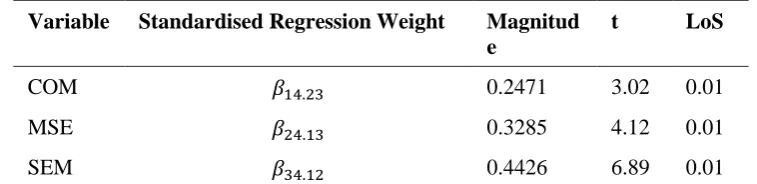
This is followed by testing the significance of the β coefficients obtained in the
[image:7.595.107.486.185.277.2]preceding multiple regression equation as follows in table 3.
Table 3: Significance Of Β Coefficients For Aam In Cg
Variable Standardised Regression Weight Magnitud
e
t LoS
COM 0.2471 3.02 0.01
MSE 0.3285 4.12 0.01
SEM 0.4426 6.89 0.01
The research hypothesis is accepted at P<0.0001. In other words, there is a significant
combined relationship of academic achievement of students with their conception of
mathematics, mathematics self-efficacy and student engagement in CG.
It may be seen that 7.19%, 10.28% and 14.62% of the variance in AAM is explained
by COM, MSE and SEM respectively. Overall, 32.09% of the variance in AAM is explained
by these three variables taken together in CG.
Multiple Correlation of AAM with COM, MSE and SEM for students of EG
Table 4 shows the matrix of correlation of AAM with COM, MSE and SEM for
students of EG.
Here, the variable AAM is denoted by 4, variable COM is denoted by 1, variable
MSE is denoted by 2 and variable SEM is denoted by 3.
Table 4 : Matrix Of Correlation Of Aam With Com, Mse And Sem For Students Of Eg
COM (1) MSE (2) SEM (3) AAM (4)
COM (1) 1.00 0.3412 0.3965 0.3115
MSE (2) 0.3412 1.00 0.4298 0.4784
SEM (3) 0.3965 0.4298 1.00 0.5961
In the present case, |′XX| = 0.8941267395906819. This implies that the magnitude of
partial multi-collinearity is very low and within tolerable limits. Table 5 shows Variance
Inflation Factors (VIF) for the independent variables included in the study :
Table 5 : Magnitude Of Vif For Eg
No. Variable VIF
1 COM-MSE 1.95
2 COM-TSE 1.03
3 MSE-TSE 1.47
APRIL - MAY, 2017, VOL. 4/21 www.srjis.com Page 4863
Since the individual VIF as well as Mean VIF < 10, the extent of multi-collinearity is
much below the permissible limit (Jeeshim and KUCC, 2002). Hence it may be concluded
that the multi-collinearity is not statistically significant.
Before proceeding further, Mardia’s Multivariate Normality Test was computed
which showed that (a) g1p = 0.0851, chi.skew = 0.8645 and p.value.skew = 0.9256, (b) g2p =
8.0564, z.kurtosis = 0.08764 and p.value.kurt = 0.8933 and (c) chi.small.skew : 0.8764 and
p.value.small : 0.8764. This implies that the data are multivariate normal.
The relationship of AAM (4) with COM (1), MSE (2) and SEM (3) in the EG is
shown statistically through the multiple regression equation as follows :
The following are the statistics obtained from the data :
Multiple Correlation of AAM with COM, MSE and SEM :
(P<0.0001) and
= 0.5963
This is followed by testing the significance of the β coefficients obtained in the
preceding multiple regression equation as follows in table 6.
Table 6 : Significance Of Β Coefficients For Aam In Eg
Variable Standardised Regression Weight Magnitude t LoS
COM 0.3605 3.02 0.01
MSE 0.4068 4.12 0.01
SEM 0.4855 6.89 0.01
The research hypothesis is accepted at P<0.0001. In other words, there is a significant
combined relationship of academic achievement of students with their conception of
mathematics, mathematics self-efficacy and total student engagement in EG.
It may be seen that 11.23%, 19.46% and 28.94% of the variance in AAM is explained
by COM, MSE and SEM respectively. Overall, 59.63% of the variance in AAM is explained
by these three variables taken together in EG.
Table 7 shows a comparison of the contribution of COM, MSE and SEM to AAM in
APRIL - MAY, 2017, VOL. 4/21 www.srjis.com Page 4864 Table 7 : Contribution Of Com, Mse And Sem To Aam In Cg And Eg
VARIABLE CG EG
COM 7.19% 11.23%
MSE 10.28% 19.46%
SEM 14.62% 28.94%
Total 100R2 32.09% 59.63%
Formula of Cohen’s Effect Size in Multiple Correlation
(http://www.real-statistics.com/multiple-regression/statistical-power-sample-size-multiple-regression/):
f2 = 0.02 represents a small effect, f2 = 0.15 represents a medium effect and f2 =
0 .35 represents a large effect.
Table8 showscomparison of the effect size of the multiple correlation in CG and EG.
Table 8 : Comparison Of The Effect Size Of Multiple Correlation In Cg And Eg
Group Effect Size Magnitude
CG 0.1516 Medium Effect
EG 1.4771 Large Effect
It can be seen from table 8 that in the traditional teaching group (control group), the
effect size of COM, MSE and SEM is medium whereas in the co-operative learning group
(experimental group), the effect size of COM, MSE and SEM is large.
Conclusion : It can be seen from the preceding analysis that :
a. The contribution of conception of mathematics to AAM is the lowest followed by MSE
and SEM in that order in both CG and EG.
b. The contribution of COM, MSE and SEM to AAM is lower in the control group as
compared to that in the experimental group.
c. The contribution of MSE and SEM to AAM has doubled in the experimental group as
compared to the control group.
d. Co-operative learning group enhances the effect of COM, MSE and SEM on the
academic achievement of students.
e. The effect of students’ conceptions of mathematics, mathematical self-efficacy and
student engagement in mathematics on their academic achievement is large in the
experimental group with co-operative learning approach and moderate in the control
APRIL - MAY, 2017, VOL. 4/21 www.srjis.com Page 4865 Discussion : It can be seen from the conclusion that the contribution of MSE and SEM to AAM has doubled in the experimental group as compared to the control group. This implies
that due to co-operative learning approach, students’ mathematics self-efficacy and student
engagement are influenced which in turn influences their academic achievement of students.
In other words, students’ mathematics self-efficacy and total student engagement mediate the
relationship between co-operative learning approach and academic achievement of students.
A study by Crawford et al (1994) found in their study that a large majority of students
(91%) with fragmented conception of mathematics follow surface approach to learning
mathematics whereas a large majority of students (90%) with cohesive conception of
mathematics follow deep approach to learning mathematics. They further found that (a)
students with a cohesive conception of math tended to achieve at a higher level (p < .05) and
(b) students with a deep approach to learning math tended to achieve at a higher level (p <
.01). The present study has found that co-operative learning approach enhances students’
cohesive conception of mathematics. This in turn implies that these students would follow a
deep approach to learning mathematics leading to better academic achievement.
When students are exposed to co-operative learning approach in the class, they get
social and academic support from their peers. This is expected to strengthen their
mathematics self-efficacy beliefs. On the other hand, students exposed to traditional teaching
of mathematics may have a feeling of inadequacy in comparison with peers which is likely to
undermine their mathematics self-efficacy beliefs.
Linnenbrink and Pintrich (2003) opine that behavioural engagement is the observable
behaviour seen in the classroom. This involves the efforts put in by students into
mathematical tasks and how students interact with their peers the teacher in terms of their
readiness to seek help, attend the classes and so on. Higher self-efficacy is expected to boost
perseverance while handling difficult mathematical concepts and problems. On the other
hand, lower self-efficacy leads to feelings of helplessness and an early acceptance of failure.
Moreover, students with low self-efficacy are less likely to seek help from peers as they fear
that others will interpret their difficulty as foolishness or ignorance. Co-operative learning
reduces such feelings of foolishness or ignorance in the students through positive
interdependence among students and thus students’ behavioural engagement is enhanced.
Besides, the way that co-operative learning sessions are structured and how the peers and
teacher interact with students is significant in cognitive engagement of students. Strong
self-efficacy beliefs imply that student believes that they can complete a task. A student with a
APRIL - MAY, 2017, VOL. 4/21 www.srjis.com Page 4866
complete it. Students who doubt their ability to undertake and complete a task are less likely
to persevere in applying cognitive and meta-cognitive strategies and will become disengaged
if success is not immediate. In addition, affective engagement includes the personal interest
that the student has in the mathematics, the utility that the student feels the subject brings and
the general importance of mathematical knowledge and skills to longer term goals or desires
and hence is motivated to engage in learning.
Regarding student engagement, Ganotice and King (2014) in their study on social
influences on students’ academic engagement and science achievement found that peer
support seemed to be more salient compared to parental and teacher support in enhancing
student engagement. Co-operative learning provides ample social and academic peer
support. Hence, student engagement in co-operative learning is found to be higher as
compared to students from the traditional class. Besides, engagement leads to sustained
interaction and practice (Ervin, Meltzer and Dukes, 2007). Social involvement is a source of
influence on learning and intellectual development of students (Pascarella, 1985; Pike, 1999;
Pike, Kuh & Gonyea, 2003). This in turn leads to stronger influence academic achievement
of students in the co-operative learning group as compared to those in the control group.
References
Andrews, P. & Hatch, G. (2000). A comparison of Hungarian and English teachers´ Mathematics Self-Efficacy and its teaching. Educational Studies in Mathematics, 43, 31-64.
Cheong, C. (2010). From Group-based Learning to Co-operative Learning: A Metacognitive Approach to Project-based Group Supervision. Informing Science: the International Journal of an Emerging Transdiscipline Volume 13.
Chianson, M. M., Kurumeh, M. S., & Obida, J. A. (2010). Effect of co-operative learning strategy on students’ retention in circle geometry in secondary schools in Benue State, Nigeria. American Journal of Scientific and Industrial Research, 2(1), 2010, 33-36. http://dx.doi.org/10.5251/ajsir.2011.2.1.33.36.
Crawford, K., Gordon, S., Nicholas, J., & Prosser, M. (1994). Conceptions of Mathematics and how it is learned: The perspectives of students entering University. Learning and Instruction, 4, 331-345.
Crawford K, Gordon S, Nicholas J, Prosser M 1998. University mathematics students’ Mathematics Self-Efficacy. Studies in Higher Education, 23: 87-94.
Ervin, J., Meltzer, J. and Dukes, M. (2007). Student motivation, engagement and achievement. http://www.ascd.org/publications/books/107034/chapters/Student-Motivation,-Engagement,-and-Achievement.aspx
APRIL - MAY, 2017, VOL. 4/21 www.srjis.com Page 4867 Ganotice, F. and King, R. (2014). Social influences on students’ academic engagement and science
achievement. Psychological Studies, March 2014, 59 (1) : 30–35.
Gocłowska, M. A., Aldhobaiban. N. Elliot, A. J., Murayama, K., Kobeisy, A. & Abdelaziz, A. (2015). Co-operative, competitive, and individualistic learning Temperament and self-based correlates of co-operative, competitive and individualistic Learning preferences. http://onlinelibrary.wiley.com/doi/10.1002/ijop.12206/abstract
Hossain, A., & Tarmizi, R. A. (2013). Effects of co-operative learning on students’ achievement and attitudes in secondary mathematics. Procedia - Social and Behavioral Sciences 93, 2013, 473-477.
Jayapraba, G. (2013). Metacognitive instruction and co-operative learning- strategies for promoting insightful learning in science. International Journal on New Trends in Education and Their Implications, January, Volume: 4 Issue: 1, 2013, 165-172.
Jbeili, I. (2012). The Effect of Co-operative Learning with Metacognitive Scaffolding on Mathematics Conceptual Understanding and Procedural Fluency. International Journal for Research in Education (IJRE) No. 32, 2012, 45-71.
Jebson, S. R. (2012). Impact of Co-operative Learning Approach on Senior Secondary School Students Performance in Mathematics Ife PsychologIA, 20(2), 2012, September.
Linnenbrink, E. A. and Pintrich, P. R. (2003) The role of self-efficacy beliefs in student engagement and learning in the classroom. Reading and Writing Quarterly, 19: 119-137. Available via: http://www.informaworld.com/smpp/content~content =a713845294~db=all~order=page [Accessed 14 April 2016].
Pajares, F. & Miller, M. D. (1997). Mathematics self-efficacy and mathematical problem solving: Implications of using different forms of assessment. Journal of Experimental Education, 65(3), 213-229.
Pandya, S. (2011). Interactive effect of co-operative learning model and learning goals of students on academic achievement of students in mathematics. Mevlana International Journal of Education (MIJE) Vol. 1(2), 30 December 2011, 27-34.
Pascarella, E. (1985). College environmental influences on learning and cognitive development: A critical review and synthesis. In J. Smart (Ed.), Higher education: Handbook of theory and research. 1 (1) : 1–61. New York: Agathon.
Pike, G. (1999). The effects of residential learning communities and traditional residential living arrangements on educational gains during the first year of college. Journal of College Student Development, 38, 609-621.
Pike, G.R., Kuh, G.D., & Gonyea, R.M. (2003). The relationship between institutional mission and student’s involvement and educational outcomes. Research in Higher Education, 44(2), 241-261.
Sharan, Y. & Sharan, S. (1994). Group Investigation in the cooperative classroom. In S. Sharan (Ed.), Handbook of cooperative learning methods (pp. 97-114). Westport, CT: Greenwood Press.
https://pure.york.ac.uk/portal/en/publications/effects-of-co-operative-learning-andembedded-APRIL - MAY, 2017, VOL. 4/21 www.srjis.com Page 4868
multimedia-on-mathematics-learning-in-key-stage-2(a01859f4-e9de-4a7ab752-3a15133f29a4)/export.html.
Slavin, R.E. (1991). Are co-operative learning and untracking harmful to the gifted? Educational Leadership, 48(6), 1991, 68-71. Slavin, R. E. (1991). Synthesis of research on cooperative learning. Educational Leadership, 48, 71-82. Slavin, R.E. (1994). Using Student Team Learning (2nd Ed.). Baltimore, MD: Johns Hopkins University, Center for Social Organization of Schools.
Slavin, R.E. (1995). Cooperative learning: Theory, research, and practice (2nd Ed.). Boston: Allyn & Bacon.
Tran, V. (2014). The Effects of Co-operative Learning on the Academic Achievement and Knowledge Retention. International Journal of Higher Education Vol. 3, No. 2; 2014, 131-140.
Zakaria , E., Solfitri, T., Daud, Y. & Abidin, Z. (2013). Effect of Co-operative Learning on Secondary School Students’ Mathematics Achievement. Creative Education. Vol.4, No.2, 2013, 98-100.