SEPT, Vol. I, ISSUE-II www.srjis.com Page 111
Effect of Concept Mapping Strategy on Achievement in Relation to
Intelligence
Sonia Sharma
Commerce G.S.S.S Model Town, Ludhiana
Gurmeet Singh
Malwa Central College of Education, Ludhiana Received: 24 August 2012
Accepted: 5 September 2012
The student population as whole is already an exceptionally heterogeneous one and promises to become much more than at present. In the complex world importance of method of teaching can not be neglected or over looked. Some students seek simple method other the complex some are interested in known others in unknown. In this study, researcher study the effect of concept mapping strategy on the learning out come of students of 9th class in relation to intelligence and study habits. The sample for this study comprised 200 students of 9th class one group was randomly assigned to experimental group and other group constituted control group. The students from experimental group were taught through concept mapping strategy. The result of study shows that concept mapping strategy were significantly superior to traditional method in teaching retention of Social Studies.
Key Words: Concept Mapping Strategy, Achievement, Intelligence.
Introduction
The student population as a whole is already an exceptionally heterogeneous one and promises to become much more than at present. The 'elegantly put' and the 'patently stated' must be tempered so that the broad difference in the abilities, interest and goals of students, as well as, the diversities, in the needs of society are recognized. Some students seek the simple; others the complex; some pursue the concert; others the abstract; some are interested in the known; others in unknown. The very heart of the learning revolves around the strategy of teaching put to use. A strategy is the art of conducting a campaign. In education, it is a scientific way of presenting the subject, keeping in mind the psychological and physical requirements of children.
SEPT, Vol. I, ISSUE-II www.srjis.com Page 112 The teachers who use the traditional method exclusively on the presentation of the contents to be learned, with all the imperfections which Ansubel points to the expository teaching, which is used in schools (Ansubel, 2003) in which the teacher uses "pure verbal techniques" too early, presenting information very often in a tactful and arbitrary way, without realizing at all if the students have the necessary cognitive readiness, or if they can learn meaningfully.
Concept mapping
A concept map can be considered as some what similar to a spider chart, an organization chart of a flow diagram. The most useful from of a concept map for teaching and learning is one arranged in a hierarchical organization which the more inclusive concepts at the top of the map and the more concrete and specific ones at the bottom.
Originally developed by Novak concept maps are used as teaching tools and have generated many positive results in the classroom. (Novak 1980, 1981) Concept maps are frequently employed in the classroom because they offer a "complementary alternative to natural language as a means to communicate knowledge" (Ganes and Shaw 1995) this visual approach has proven to be of great benefit to diverse student groups.
There are three features used in creating concept maps: (1) a list of concepts, (2) lines that represent the relational links between these concepts, and (3) labels for these linking relationships. The procedure of concept mapping starts with the generation of a list of concept through brainstorming. Connecting lines are drawn between these of concepts to indicate the flow of interrelationships between concepts which may result in a knowledge structure. These maps can be refined by many rethinking and redrawing processes as more knowledge is accumulated form a search. (Novak 1995)
According to Sowa (2000), concept mapping also known as Cognitive Mapping or Sematic Networks is a graphic notation for representing knowledge in patterns of interconnected nodes and arcs.
According to Asan (2007), Concept mapping is a method to visualize the structure of knowledge. Since the knowledge expressed in the maps is mostly semantic, concept maps are sometimes called semantic networks.
SEPT, Vol. I, ISSUE-II www.srjis.com Page 113 expressed on a single two dimensional diagram. These well-thought-out diagrams represent information in a simple but clear manner, which allows learners to visualize key concepts and their interrelationships in a more integral sense in short time. Enhancing a student's abilities to comprehend work-ship materials quickly will help reduce the time constraint problem during presentation. Moreover, concept maps communicate knowledge pictorially instead of using lengthy textual explanations. As research points out, that "mental picture may be providing a framework for organizing and remembering information."(Gambrell and Bakes 1987)
Achievement
Achievement the knowledge we attain from teaching process it also known as achievement
.
Achievement may be defined as the act of achieving or successful performance.Good's Dictionary of Education (1959) defines Achievement as the knowledge attained or skills developed in school subject usually designated by the test scores or by marks assigned by the teachers or by both.
Oxford Advanced Learner’s Dictionary (2000) defined that Achievement is a thing that somebody has done successfully especially using his/her own efforts and skills.
According to Merriam Webster's Collegiate Dictionary (2001) "Achievement is an act of achieving a result gained by efforts, the quality and quantity of student's work."
According to Dictionary of Education (2008), "Academic Achievement is a measure of knowledge gained through informal education usually indicated by test scores, grade point average and degree."
Intelligence
The word intelligence came from the Latin word used by Cicero to translate the Greek word used by Aristotle to explain the cognitive process. Often intelligence is considered as a general capacity to understand and meet satisfactorily with any situation that life may pos various psychologists have taken intelligence in their own way. Some talked of it at biological or psychological level while other thought at mental level. Some define intelligence solely as cognitive or intellectual operation the ability to think in abstract terms to deal with symbols to perceive relationship to reason out and to reach correct generalizations. In every general term, intelligence may be defined as an adjustment or adoption of the individual to his total environment or to any limited aspect of it.
Jarial & Sharma (1980) are of the view that intelligence is an ability which involves the generation of local imperatives.
According to Encyclopedia of Psychology, (2000), Intelligence may be described as one thing a general ability, or as several different things a set of different abilities.
SEPT, Vol. I, ISSUE-II www.srjis.com Page 114 From all definitions, it can be concluded that intelligence is the capacity to do a thing and it is not actuality. It is not thought but capacity to think. It is a native's inherited capacity.
Review of related literature
The present investigation is aimed at exploring the effect of teaching through Concept Mapping on the Achievement and Retention of Students in relation to their Intelligence and Study habits. The review is presented under these major heads:
Teaching through concept mapping and learning outcome.
Academic Achievement and Intelligence.
Retention and Intelligence.
Teaching through concept mapping and achievement
One experimental study (De Wispelaere & Kossnck, 1996) in a junior high and high school Spanish as a second language class found that concept mapping tool improved student's higher order thinking skills as measured by performance on chapter quizzes, tests, and student projects.
Four studies (Alvermann & Boothby 1983; Alvermann & Boothby, 1986; Armbruster et al, 1991; Griffin et al, 1995) in the area of social studies used concept mapping tool to help students organize information from expository texts and comprehend content area reading. All our studies were conducted with either fourth or fifth-grade students. Findings from these studies concluded that concept mapping too helped students select, organize, and recall relevant information, as measured by posttests. Students were also able to transfer thinking and learning skills to novel situations and content.
Students learn mathematics in meaningful ways, by developing their understanding through the construction of their own patterns of meanings and through participation in social interactions and critiques (Novak & Canas, 2006; Novak 2002).
Achievement and intelligence
Clark (1983) Urban and rural Aboriginal - and Anglo-Australian children were tested for reading and math achievement, for nonverbal psychometric test intelligence, and for three cognitive styles. Psychometric intelligence was clearly a more powerful predictor of the effects of culture and location on school achievement than was cognitive style.
Buddhisagar (1991) concluded that them was a significant effect of interaction between treatment and Intelligence on the overall achievement of the students. There was significant effect of interaction between Intelligence and attitude towards the teaching profession on the over all achievement of the students. There was a significant effect of interaction between treatment, Intelligence and attitude towards the teaching profession on the overall achievement of the students.
Objectives of the study
The study will be designed to attain the following objectives:
SEPT, Vol. I, ISSUE-II www.srjis.com Page 115 2) To prepare the achievement test of the selected topics of Social Studies to measure the Learning Outcome of students of IX class.
3) To check the effectiveness of Concept Mapping strategy in Achievement in Social Studies. 4) To study the difference between high and low Intelligence groups in Achievement in Social Studies.
5) To study the first and second order interaction between/among Teaching Strategies, Intelligence and Study Habits.
Null Hypotheses
The study will designed to test the following hypotheses:
1) There will be no difference in Achievement in Social Studies of the group taught through Concept Mapping and Conventional teaching.
2) There will be no difference in Retention of the group taught through Concept Mapping and Conventional teaching.
3) There will be no interaction between Teaching through Concept Mapping and Achievement in Social Studies in relation to Intelligence.
4) There will no interaction between Teaching through Concept Mapping and Retention in relation to Intelligence.
Schematic lay out of the Design
Phase Group-A1 Group- A2
Phase-I (Pre-test)
Phase-II (Treatment) Phase-III (Post-test)
1. Achievement Test as pre- test.
2. Intelligence Test 3. Study Habit
Inventory
Exposure through concept mapping strategy.
Achievement Test as post test.
1. Achievement Test as pre- test. 2. Intelligence Test
3. Study Habit Inventory
Exposure through concept mapping strategy.
Achievement Test as post test.
SEPT, Vol. I, ISSUE-II www.srjis.com Page 116 2X2X2
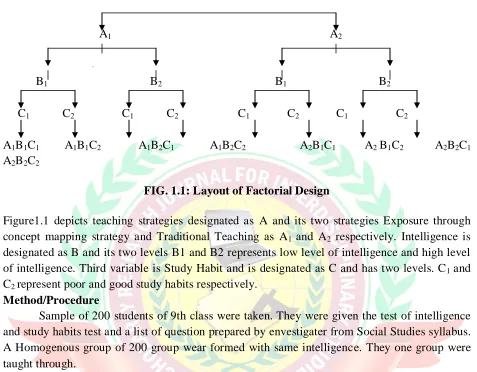
A1 A2
B1 B2 B1 B2 C1 C2 C1 C2 C1 C2 C1 C2
[image:6.612.69.546.93.465.2]A1B1C1 A1B1C2 A1B2C1 A1B2C2 A2B1C1 A2 B1C2 A2B2C1 A2B2C2
FIG. 1.1: Layout of Factorial Design
Figure1.1 depicts teaching strategies designated as A and its two strategies Exposure through concept mapping strategy and Traditional Teaching as A1 and A2 respectively. Intelligence is designated as B and its two levels B1 and B2 represents low level of intelligence and high level of intelligence. Third variable is Study Habit and is designated as C and has two levels. C1 and C2 represent poor and good study habits respectively.
Method/Procedure
Sample of 200 students of 9th class were taken. They were given the test of intelligence and study habits test and a list of question prepared by envestigater from Social Studies syllabus. A Homogenous group of 200 group wear formed with same intelligence. They one group were taught through.
One group of 9th class contributed the experimented group where as another of 9th class formed control group. The permission was taken from the principal of these schools. The students of experimental group were taught through concept mapping strategy. The rapport was established with the students. The students were explained the objectives of study. To begin with concept maps of different topics were taught to students everyday 35 minute period was devoted for this purpose.
Analysis: The objective -wise data analysis was given below.
Significance of the Difference between Means of Pre-test-post Test Scores of achievement of Experimental Group Ninth class students (N=100)
S.No. Group N M S.D SEM t-value
1. Pre-test 100 7.60 3.68 .58
42.90**
2. Post-test 100 27.20 2.45 .39
[image:6.612.90.521.606.681.2]**Significance at 0.01 level
SEPT, Vol. I, ISSUE-II www.srjis.com Page 117 2.45 respectively. The t-ratio was calculated as 42.90 with df = 39 which is significant at .01 level of confidence. This revealed that a significant difference exists between pre-test and post-test scores of Learning Outcomes of experimental group ninth class students. As the mean score of post-test is higher than that of pre-test, it may be concluded that Concept Mapping Strategy has a significant effect on Learning Outcomes of ninth class students.
Therefore the hypothesis 1 stating that there exists no significant difference in pre-test and post-test mean scores of Learning Outcomes of ninth class students through Concept Mapping Strategy stands rejected.
Significance of the Difference between Means of Gain Scores of Learning Outcomes of Experimental Group and Control Group Ninth class students (N=200)
S.No. Group N M S.D SEM t-value
1. Experimental
Group
100 19.60 2.89 .46
13.84**
2. Control Group 100 9.43 4.74 .75
**Significance at 0.01 level
Above tablerevealed that the mean scores of gain scores of Learning Outcomes of experimental and control group ninth class students as 19.60 and 9.43 respectively and their standard deviation as 2.89 and 4.74 respectively. The t-ratio was calculated as 13.84 which is significant at .01 level of confidence. This revealed that a significant difference exists between gain scores of Learning Outcomes of experimental and control group ninth class students. As the mean scores of experimental group is higher than that of control group, it may be concluded that concept mapping strategy has a significant effect on learning outcomes of seventh class students.
Therefore the hypothesis 2 stating that there exists no significant effect of concept mapping strategy on learning outcomes of ninth class students stands rejected.
Summary of 2X2 Analysis of Variance on Learning Outcomes of Social Studies Students through Concept Mapping Strategy and Traditional Technique in relation to Intelligence
Source of Variation SS dsf MS F-Value
Learning Technique (A) 45.16 1 45.16 16.03**
Intelligence 0.16 1 0.16 0.06
First Order Interaction (AXB) Learning Technique X and
Intelligence
9.51 1 9.51 3.37
Within Group (Error) 101.43 36 2.82
Total 156.24 39
SEPT, Vol. I, ISSUE-II www.srjis.com Page 118
Interpretation main influences Main Influence A:
Main influence of Learning Technique (Concept Mapping Strategyand Traditional Method) on variable of learning outcomes of mathematics students.
Table 4.9 reveals that the F-ratio on the variable of learning outcomes of social studies students with Concept Mapping Strategy and traditional method came out to be 16.03 which significant at the 0.01 level of confidence.
This reveals that learning outcomes of mathematics students with Concept Mapping Strategyis significantly different from that with traditional method.
Main Influence B:
Main influence of Intelligence (High and Low) on the variable of learning outcomes of social studies students.
Table 4.9 reveals that the F-ratio on the variable of learning outcomes of social studies students with high and low R Style of Learning and Thinking came out to be 0.06 which is not significant at the 0.05 level of confidence. The means of the groups having high and low intelligence on the variable of learning outcomes of social studies students were found to be 1.18 and 1.05 respectively.
This reveals that there is no significant difference in learning outcomes of social studies students with high and low Intelligence.
Interpretation main influences Main Influence A:
Main influence of Learning Technique (Concept Mapping Strategy and Traditional Method) on variable of learning outcomes of social studies students Table 4.10 reveals that the F-ratio on the variable of learning outcomes of Social Studies students with Concept Mapping Strategy and traditional method came out to be 17.10 which significant at the 0.01 level of confidence.
This reveals that learning outcomes of mathematics students with Concept Mapping Strategyis significantly different from that with traditional method.
Implications:
Concept mapping strategy were found to be significantly superior to the Traditional Method in Teaching and retention of Social Study with carefully developed concept maps these approach promises an interesting way for Social Study teaching.
References
Alude OO and Onelemhemben P.F. (2001). The effect of study habits counseling on the academic performance of secondary school students in English Language. Journal of Research and Extension. Vol. 3893) 17-27.
SEPT, Vol. I, ISSUE-II www.srjis.com Page 119 Alvermann. D.E. & Boothy P.R. (1986). Children's transfer of graphic organizer instruction.
Reading Psychology, 7 (2), 87-100.
Bajwa, H.S. (1998). A study of Academic Achievement in Physics in relation to Intelligence, Creativity, Attitude, School Grade and their Achievement in mathematics in Saudi Arabia. OHIO University Pro-quest Dissertation Abstracts//WWW. Lib. Uni. Com.”
Best, J.W. and Kahn, J.V. (1992). Research in Education. Prentice Hall of India Pvt. Lt d., New Delhi.
Biswas A & Aggarwal J.C. (1971) Encyclopendic Dictionary and Directory of Education. The Academic. Publishers (India) Karolbagh. New Delhi.
Blumner, H.N. (1989). Study Habits and Standardized Test Performance: Prediction of Post secondary Academic Achievement. Dissertation Abstract International, Vol. 50(05)
Chiou, Chei-Chang (2008). Innovations in Education and Teaching International. Vol.45 Issue 4 pages 375-387.
Clark, Lesley A: Halford. Graeme S. (1983). Does Cognitive Style Account for Cultural Differences in Scholastic Achievement? Journal of Cross-Cultural Psychology, Vol.14 No.3 pages 279-296.
Columbia Encyclopedia, Sixth Edition. Copyright 2006 Columbia University Press.
Cristian, J. (1983). Study Habits as Function of Need Achievement (N-Achievement). Indian Educational Review, Vol. 25(3) 71-74.
Deb, Madhu and Grewal, Hirdai Pal (1990). Relationship between Study habits and Academic achievement of Under-Graduate Home Science Final Year Students. Indian Educational Review, Vol. 25(3) 71-74.
De Wispelaere, C., & Kossack, J. (1996). Improving student higher order thinking skill through the use of graphic organizers, Elk Grove Village, IL: Marste's Thesis, Saint Xavier University.
Encyclopedia of Psychology (2000).
http://www.psychology.org/links/Environment_Behavior_Relationships/Intelligenc e/
Gaines, B. R., and Shaw, M. L. G. (1995). Concept Maps as Hypermedia Components, Knowledge Science Institute, University of Calgary. http://ksi.cpsc.ucalgary.ca/articles/ConceptMaps/
Gaines, B. R., and Shaw, M. L. G. (1995). Collaboration through Concept Maps, Knowledge
Science Institute, University of Calgary.
http://ksi.cpsc.ucalgary.ca/articles/CSCL95CM
Gambrell L. & Bales, R. (1987). Visual imagery: A strategy for enhancing listening, reading and writing. Australian Journal of Reading. 10(3), 147-153.
Hathaway. M.D. (1984). Variables of Computer screen display and how they affect learning.
SEPT, Vol. I, ISSUE-II www.srjis.com Page 120 Heryle, D. (1996). Thinking maps: seeing is understanding. Educational Leadership. 53(4),
85-89.
Jain, S.K. (1967). Study Habits and Academic Attainment in Utter Pardesh Colleges. Ph. D., Psychology, Agra University.
Jamuar. K.K. (1974). Study Habits of College Students. Indian International. Publicationas, P.B. 79, Allahabad, 3-116.
Koul, Lokesh (1984). Methodology of Educational Research. Vikas Publishing House Pvt. Ltd. New Delhi.
Kumar, Vinay (2006). Effect of Computer Assisted Instruction on Achievement in relation to Interest. M.Ed Dissertation, Guru Nanak Dev University Amritsar.
Landon Billing, G. (1999). Cannot Anybody Teach These Children? The Promise of Cultured Relevant Teaching. Teaching Today for Tomorrow Journal, Issue 12.
Lawson M.J. (1994). Concept Mapping In the international Education. (2nd ed. vol.2, pp.1026-1031.). Tarrytown, New York: Elsevier Science. Ltd.
Merriam-Webster’s Collegiate Dictionary, 2002, Ontology, http://www.m-w.com/cgi-bin/dictionary?book=Dictionary&va=ontology.