Applying BPR and Balanced Score Card for Project
Appraisal and Evaluation Framework for Not for Profit
Firms
Shashi Kadapa
Abstract- The paper reviews Business Process Reengineering (BPR) techniques along with the Balanced Scorecard (BSC) to improve the reporting or project performance, project appraisal and approval process for not for profit organizations. For profit organizations or commercial organizations have clearly defined business objectives and these include increase in revenue, reduction in costs, and increased profits. However, in not for profit firms, the motivation for taking up projects and the organization objectives is not to make profits but to provide help the poor and needy. The paper examines workflows and the project appraisal process in such organization. BPR measures are suggested to make the project appraisal process transparent. Seven perspectives are identified for the BSC and indicators are suggested for each of these perspectives. The project appraisal process is designed to provide inputs for these indicators. The recommendation is to use benchmarked figures for these indicators from the best projects and other external sources and t hese indicators can to be used for the BSC. A draft BSC template is designed and further suggestions and recommendations to improve the research are made..
Index Terms- Balanced Score Card, Business Process Reengineering, Non-Profit Firms. BSC Template
I. INTRODUCTION
number of business management and improvement tools are in use to improve organization process and two important tools are Balanced Score Card (BSC) and Business Process Reengineering (BPR). This document discuses these tools, examines various theories and models, and presents a template to implement BSC. BPR is the collection of system and methods used to improve the workflows and processes of an organization (Davenport and Short, 1990). The processes to be improved can be within the organization or external to the organization. This means that the process to be improved can be for example, a process to reduce the throughput time of a component. Among the performance management tools available, BSC is increasingly used as a business strategy and performance management tool. In business and project evaluation, financial perspectives and measures are the standard method used for financial analysis. Financial measures include ratios such as profitability, costs, earning per share, return on investment, and return on equity and so on. However, these are regarded as static figures that reveal historic information about a company. Norton and Kaplan proposed the Balanced Score Card that brings in three other perspectives on the same report. The total four perspectives are therefore finance, customers, internal business process and learning and growth (Kaplan and Norton, 1992). The focus of this paper is not for profit organizations and a literature review is presented to understand various concepts, theories and models.
II. RESEARCH IDEA
2.1 Overview of BPR
Improvement can involve internal processes the organization activities are performed. It can also involve processes where external processes such as vendor work processes, release of purchase orders, and improvement in the supply chain, etc. take place (Satyanarayana, 2011). The term BPR means that an existing business process is re-engineered or reconfigured, rethought, and redesigned to transform the process and make it more effective. BPR can involve a number of other processes such as continuous improvement, management information systems, six sigma, TQM and so on (Rogers and Duffy, 2012). These management tools are sometimes used to meet the objectives of BPR. An important note is the BPR can be used to improve the organization processes of not only for profit firms but also of not for profit firms (Hammer and Stanton, 1995).
International Journal of Scientific and Research Publications, Volume 6, Issue 8, August 2016 421 ISSN 2250-3153
2.2. Overview of BSC
Among the four perspectives of BPR, financial perspective is commonly used to assess the performance of a firm. It indicates the manner in which the firm should act to improve the shareholder value. Shareholder value is usually increased when the profitability and sales increase. As in other applications of BSC, some additions may be needed for the BSC and these can be incorporated with due thought (Lipe and Salterio, 2000). It is also possible to incorporate lead and lag indicators in the perspectives and measures. The area where BPR is planned is the internal business process perspective. Considering the project failures and delays, the project appraisal would attempt to ascertain project metrics and risk management techniques so that possible project delays can be anticipated and managed (Kaplan and Norton, 1996).
BSC approach has been used many organizations to improve their performance management method. Implementation of the BSC has improved the internal processes, made employees more accountable and increased the transparency of the internal departments. One of the reasons is that when measures are considered for performance measurement, they would cut across all departments and all related departments would be responsible. As an example, an indicator such as customer satisfaction would not be the responsibility of the customer relations department but would include the whole project appraisal, project design, monitoring and other departments (Zhang and Li, 2009)
III. RESEARCH AND FINDINGS
This chapter provides the literature review of BPR and BSC. Important concepts, theories, and concepts are explained.
3.1. Business Process Reengineering
Business Process Reengineering involves rethinking and changing the process flows and improving the organization processes. The methods are introduced or considered when some shortcomings are evident in the existing systems. A manufacturing firm may decide that the production cycle is too lengthy and so it may decide to change the workflows. This can involve redesigning the machining processes so that more operations are included in a single set up. In some cases, extra operations may be eliminated so that the processes are reengineered with new methods and activities (Trkman, 2010). In many instances, BPR yields improvement in the organisation efficiency, process time is shortened, productivity is increased since the cycle time is reduced, idle time and waste/ excess operations are eliminated and the organization makes profits. In some cases, BPR activity may perhaps lead to worker redundancy since some workflows and organization processes may become redundant. For this reason, BPR has received some negative publicity (Smart et al., 2009).
BPR is actually a change management process where there is a movement from one state to another. In many instances, there is large-scale involvement of multiple teams. The activity can be initiated across the whole organization, for a few departments or even for selected projects (Hanafizadeh et al., 2009). In some cases, BPR activity can be taken up as a trail or pilot project. After reviewing the results, the practices can be implemented across the whole organization. In some cases, even though the BPR activity is restricted to a single project, involvement of shared resources such as HR and maintenance means that more than one department is involved (Salimifard et al., 2010).
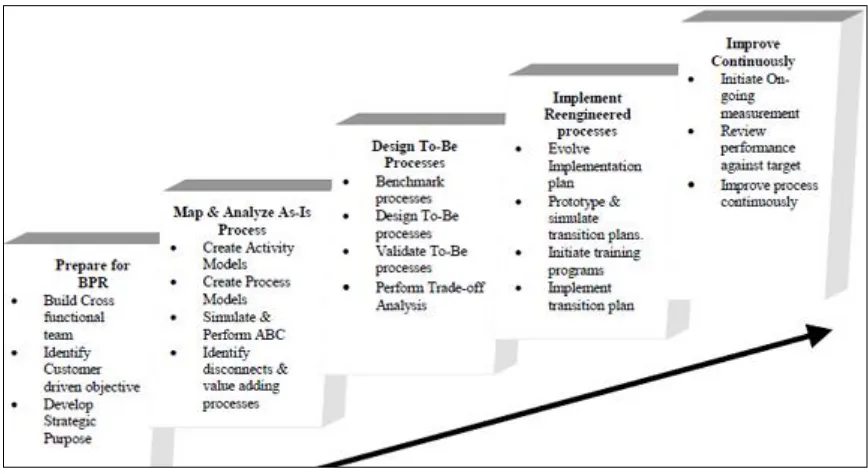
3.1.1. Steps to implement BPR
Figure 3.1. Steps to implement BPR (Source: Muthu, et al, 1999)
The above steps provide the general methodology to implement BPR projects. In the case of service organizations that do not provide any physical products such as automobiles or electronic items and where a conventional manufacturing line is not present, then alternate methods must be considered. Some important steps for not for profit firms are as given below (Ali, 2008).
1. Defining the mission and scope: The mission and scope are very important in BPR projects. Having a wide definition of the mission and attempting to include many activities in BPR may create excessive complexity. The mission and scope should be clearly defined. A top-level decision must be taken on the project for which BPR is to be implemented as a pilot study.
2. Preparing for BPR: The focus of BPR is re-engineering the processes and the focus remains on business processes and not tasks or activities. However, for effective BPR, some understanding of various tasks is also important. It is better to implement the BPR project first as a pilot study. A cross-functional team made of members from the finance, technical, marketing, regional offices and the beneficiary group must be created. The team size should not be very big since managing the team becomes an issue. Around 5-6 members is sufficient. Where required, the team must be given rigorous training BPR and other techniques including BSC (Hunt, 1996).
3. Map and Analyse the Processes: One way to implement BPR is to reengineer all the business process in the project. However, this may lead to efforts spent on processes that are not critical or that do not adversely affect the project. The selected processes must be then mapped and indicators of efficiency defined. These indicators define and quantify the efficiency of the process and they can be throughput time, waste, rejection percent and so on. Only important indicators the form the pulse of the process must be mapped. As an example, the impact of social service project is measured by the number of people covered (Salimifard, et al, 2010).
4. Benchmark indicators: The indicators identified in the previous step must be benchmarked. Source for the benchmark are released reviewing the reports of leading rival firms. This is an important step since the benchmarks will indicate how well or how bad the project is being run. As an example, funds spend on the project are benchmarked by saying that 100 people are helped by each 1000 USD spent (Cheng and Chiu, 2008).
International Journal of Scientific and Research Publications, Volume 6, Issue 8, August 2016 423 ISSN 2250-3153
3.2. Balanced Scorecard in Not for Profit firms
The main issue with using the Balanced Scorecard for Non-Profit and Government Organizations - NPGO firms is that financial success is not the focus. In other words, the firm is not interested in maximizing its profits. The entity that funds activities for beneficiary would not be interested in using the facility constructed or in gaining monetary benefit from the project. As an example, when a bank funds a drinking water project, it is not interested in deriving income by providing water to the poor people and neither does the bank expect each person to pay some money for the drinking water. However, the bank wants to ensure that the funds disbursed are used effectively (Rogers and Duffy, 2012).
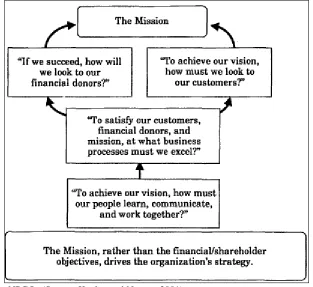
[image:4.612.149.462.208.495.2]Kaplan and Norton (2001) argue that BSC is used in NPGOs by placing the mission at the top perspective and all other perspectives then work to support this mission. When the mission is placed at the top level, then the other objectives in the scorecard are directed to improve and meet the high-level objectives. Please refer to the following figure that places the mission at the top perspective.
Figure 3.2. Adapting BSC for NPGOs (Source: Kaplan and Norton, 2001)
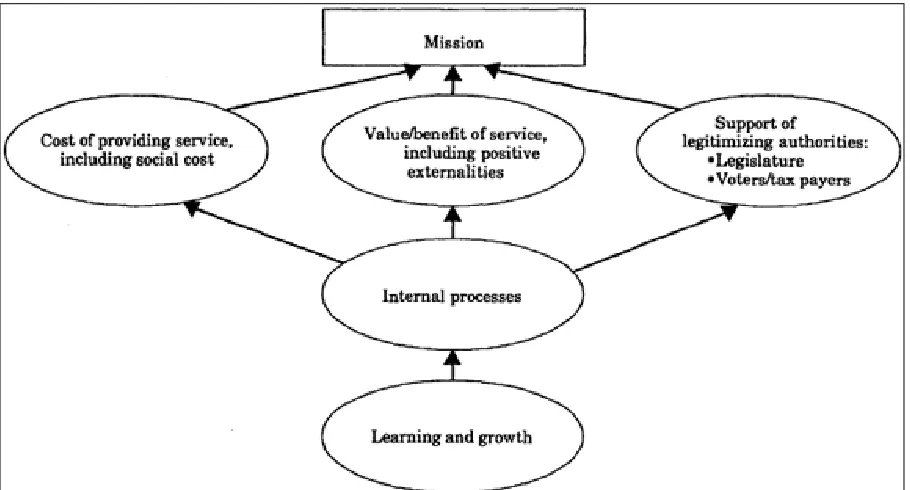
In the case of NPGOs, three high-level perspectives appear and these are the costs incurred, value created and legitimizing support. For the cost-incurred perspective, the emphasis is to improve the operational efficiency of the firm. In this case, the cost measured must include the expenses of the firm and the social costs borne by the beneficiary during the project implementation. Value created perspective specifies the benefits created by the NPGOs to the citizens and this is difficult to measure. In some cases, it is possible to measure the value created in terms of credit extended, families helped, land irrigated and so on. The actual social benefits obtained however become clear only after some time has passed. These benefits are seen in factors such as a drop in the crime rate, drop in rural migration to cities, increase in local employment and so on (Chen, 2010).
Figure 3.3. The 4-perspectives for NPGOs (Source: Kaplan and Norton, 2001)
3.3. Integration BSC and BPR in NPGOs
This section explains how BPR and BSC practices are integrated. The integration ensures that design, implementation is done only once, and efforts are not duplicated. This approach would be used in the later sections of the dissertation.
When it comes to implementing BSC in NPGOs, due care must be taken to ensure that the correct mix of indicators are used. According to Isoraite (2008), the main difference is focusing on the objectives and not the financial outcomes. While the goal is not profits, the project should not run into losses due to ill planning and implementation. After the project is implemented, the project should generate sufficient funds for its upkeep and maintenance. Therefore, if a bridge is built over a river, a minimal toll may be charged so that the income is available to pay for maintenance and salaries of the service staff. A nine step process is recommended and while these steps are similar to what is practiced in private firms, the difference is in the perspectives and performance indicators used. It may well be necessary to bring in a change management program such as BPR to prepare the firm to implement BSC. The steps are explained below (Ahmed, 2009).
1. Assess the project/organization: In this step, the project is assessed to identify the purpose and objectives and the reason for the project. Weakness areas are identified and a BPR activity can be initiated. These correspond to steps 1 and 2 from section '3.1.1. Steps to implement BPR'.
2. Identify strategic themes: In this step, important processes to be used in BSC are identified. It corresponds to step 3 in section '3.1.1.’
3. Identify perspectives and strategic objectives: The process may have a number of indicators. It is important to select one or two important indicators that reflect the whole process. This step corresponds to step 4 of section '3.1.1.’
4. Create a strategy map: In this step, a strategy map giving the objectives and methods of achieving them are given. It means that the indicators selected in the previous step are noted down and the best methods to achieve them are listed.
5. Identify performance metrics: Important performance metrics for the selected indicators should be listed. These indicators should also have suitable benchmarked figures. Therefore, if a rate of return is the financial indicator, then the benchmarked value must also be given.
International Journal of Scientific and Research Publications, Volume 6, Issue 8, August 2016 425 ISSN 2250-3153
8. Implement BSC: The next step is to implement BSC. BPR must first be implemented and BSC can then be taken up.
9. Evaluate and revise BSC: In continuation, the whole exercise of BPR and BSC activities are revised and evaluated.
3.4. Presenting the Balanced Scorecard
Based on the inputs from the previous sections, a sample BSC is presented. It is focused on the project mission and objectives. Given the unique requirement of NPGOs, these seven perspectives and the indicators discussed in the previous chapter are presented as a sample BSC and given below (Al-Mudimigh, 2009; Chen, 2010).
Table 3.1. Sample BSC Format for NPGOs (Source: Authors Construct)
Project Name:
Project Type Code: Country Code: BSC Owner:
Economic Perspective: Financial: Technical:
Indicator Curren
t Value
Benchmark Indicator Curre
nt Value
Benchmark Indicator Curren
t Value
Benchmark
Project cost - PC
Financial Internal Rate of Return - FIRR Technical design – On a scale of 1 to 5
5
Cost/ Benefit analysis: Scale of 1 to 5
5 Debt/Equi
ty Ratio
Schedules maintaina bility - On a scale of 1 to 5
5
Economic rate of return – ERR
5 Ratio of
Implemen tation costs - IC to PC = IC/ PC
Local raw materials - On a scale of 1 to 5 5 Internal Economic Rate of Return – IERR
5 Ratio of
Capital costs - CC to PC = CC/ PC
Land acquisitio n On a scale of 1 to 5
5
Environmental: Project Mission: “To construct a
drinking water system for slum dwellers in Mumbai”
Institutional:
Indicator Curren
t Value
Benchmark Indicator Curren
t Value
Benchmark
Benefits to people versus harm to environm ent - On a scale of 1 to 5
5 Expertise
of beneficiar y teams - On a scale of 1 to 5
5
Safeguard s applied - On a scale of 1 to 5 and Not Applicabl e
5 Relevant
experienc e of local teams - On a scale of 1 to 5
5
Project Name:
Project Type Code: Country Code: BSC Owner:
Economic Perspective: Financial: Technical:
Indicator Curren
t Value
Benchmark Indicator Curre
nt Value
Benchmark Indicator Curren
t Value
Benchmark
Indicator Curren
t Value
Benchmark Indicator Curren
t Value Benchmark Intended beneficiar ies identified - On a scale of 1 to 5
Technical risks managed - On a scale of 1 to 5
Benefits designed for beneficiar ies - On a scale of 1 to 5
Schedule risks managed - On a scale of 1 to 5 Actual beneficiar ies v/s proposed beneficiar ies - ratio
Financing risks managed - On a scale of 1 to 5
IV. CONCLUSION
The paper has discussed important concepts, theories and models of BPR and BSC and applied them to NPGOs. Various concepts and philosophies of methodology are discussed and the methods selected for the research are given. This discussion will serve to guide further research in many ways. The literature review will help in designing the semi-structured interview and in analyzing the responses. The paper has also shown that while it is important to conduct a BPR project, these activities must be integrated with BSC activities as far as possible. This integration helps to avoid duplicating of efforts and makes the system more efficient and this is one of the goals of using BSC. The next section will discuss the methodology for the research.
3.1. Recommendations
Some recommendations are given for implementing BPR and BSC. These must be examined carefully and implemented as required.
The BSC needs to be populated with indicators after concurrence among all project managers and senior managers at the firm. There should be only one BSC format with the same indicators for the whole organization. Such an approach provides
consistency and a method to compare performance of various projects.
Each perspective should have 3 to 4 indicators since having too many indicators makes the task of maintaining BSC difficult. Benchmark indicators are crucial and they must be generated using the best projects at other organizations. If required, these
benchmarks indicators could vary depending on the project type.
It is expected that after some time, the current methods suggested with BPR will become the standard method of project appraisal and evaluation
International Journal of Scientific and Research Publications, Volume 6, Issue 8, August 2016 427 ISSN 2250-3153
of work involved. The findings, performance and shortcomings should be studied carefully and presented to the higher manageme nt for their final approval.
REFERENCES
1. ADB, 2009. Project Appraisal Processes and Procedures Toolkit: Asian Development Bank. Retrieved 25 July 2016 from http://ncrpb.nic.in/toolkits_comp_A&C/toolkits_file/E2_Project%20Appraisal%20Annex_26%20Mar%202009.pdf
2. Ahmed, Z., 2009. Comparative Significance of the Four Perspectives of Balanced Scorecard. Research Paper, Pakistan, University of the Punjab
3. Al-Mudimigh, A., 2009. CRM scorecard-based management system: Performance evaluation of Saudi Arabian banks. Journal of Digital Asset Management, 5, pp. 347-351
4. Ali, H.M., 2008. Business process re-engineering (BPR) implementation in Malaysian service organisations: a study from the perspectives of customers and employees. PhD Dissertation, University of Huddersfield, UK
5. Chen, C, Y., 2010. Linking the balanced scorecard (BSC) to business management performance: A preliminary concept of fit theory for navigation science and management. International Journal of the Physical Sciences, 5 (8), pp. 1296-1305
6. Cheng, T.C. E. and Chiu, I.S., 2008. Critical success factors of business process re-engineering in the banking industry. Knowledge and Process Management, 15(4), pp. 258-269
7. Davenport, T. and Short, J. 1990. The New Industrial Engineering: Information Technology and Business Process Redesign. Sloan Management Review, pp 11–27
8. Hansen, G., 1993. Automating Business Process Reengineering. NY: Prentice Hall
9. Harberger, A.C., 2006. Notes on some issues in social project evaluation. Journal of International Development, 6 (1), pp. 95-107
10. Hammer, M. and Stanton, S. 1995. The Reengineering Revolution. London: Harper Collins
11. Hanafizadeh, P., Moosakhani, M., and Bakhshi, J., 2009. Selecting the best strategic practices for business process redesign. Process Management Journal, 15 (4), pp. 609-627
12. Hunt, D.V., 1996. Process Mapping: How to Reengineer your Business Process. NY: John Wiley and Sons Inc.
13. Isoraite, M., 2008. The Balanced Scorecard method: From theory to practice. Intellectual Economics, 1(3), pp. 18-28
14. Kaplan, R.S. and Norton, D.P. 1992. The Balanced Scorecard - Measures that drive performance. Harvard Business Review, January-February 1992, pp. 71-79
15. Kaplan, R.S. and Norton, D. P.; 1996. Balanced Scorecard: Translating Strategy into Action. Harvard, USA: Harvard Business School Press
16. Kaplan, R and Norton, D., 2001. Transforming the Balanced Scorecard from performance measurement to strategic management, Accounting Horizons, 15 (1), pp. 87-104
17. Lipe, M.G. and Salterio, S.E., 2000. The Balanced Scorecard: Judgmental Effects of Common and Unique Performance Measures. The Accounting Review, 75(3), pp. 282-298
18. Muthu. S., Whitman. L., and Cheraghi. S.H., 1999. Business Process Reengineering: A Consolidated Methodology: Proceedings of The 4th Annual International Conference on Industrial Engineering Theory, Applications and Practice, November 17-20, 1999, San Antonio, Texas, USA
20. Rogers, M. and Duffy, A., 2012. Engineering Project Appraisal. London: Wiley-Blackwell
21. Salimifard, K., Abbaszadeh, M., and Ghorbanpur, A., 2010. Interpretive Structural Modelling of Critical Success Factors in Banking Process Re-engineering. International Review of Business Research Papers, 6 (2), pp. 95-103
22. Satyanarayana, S.V., 2011. Impact of Business Process Re-Engineering in Commercial Banks on Customers: A case study of State Bank of Hyderabad. Opinion, 1 (1), pp. 5-58
23. Smart, P. A.; Maddern, H; and Maull. R. S.; 2009. Understanding Business Process Management: Implications for Theory and Practice. British Journal of Management, 20 (4), pp. 491–507
24. Trkman, P., 2010. The critical success factors of business process management. International Journal of Information Management, 30 (2), pp. 125-134
25. Weerakkody , V., 2009. Social and Organizational Developments through Emerging E-Government Applications: New Principles and Concepts. UK: Brunel University
26. Zhang, Y. and Li, L. 2009. Study on Balanced Scorecard of Commercial Bank in Performance Management System. Proceedings of the 2009 International Symposium on Web Information Systems and Applications, Nanchang, P. R. China, May 22-24, 2009, pp. 206-209
27. Zhang, Y., 2009. Study on Balanced Scorecard of Commercial Bank in Performance Management System. Proceedings of the 2009 International Symposium on Web Information Systems and Applications (WISA’09) Nanchang, P. R. China, May 22-24, pp. 206-209.
AUTHORS First Author – Shashi Kadapa, Bachelor of Engineering, MBA (Marketing).
Shashi Kadapa has worked with Kirloskar Cummins, Pune in the production Department before moving to marketing functions at Balzers AG, Carborundum Universal, and Ashok Iron Works. He shifted to journalism and the IT industry and worked with several IT firms such as MicroWorld, EcTone, and at Patni Computers, where he was a member of the Knowledge Management practice. He now freelances and works with selected UK and USA based firms on research projects. He also writes fiction and creative writing.