ISSN 2250-3153
Effect of Constructivist Teaching Method on
Students’ Academic Performance in Metalwork in
Technical Colleges in Yobe State, Nigeria
LKAMA, Julius Drambi (PhD)
1
Modibbo Adama University of Technology PMB 2076, Yola, Adamawa State, Nigeria
E-Mail: [email protected]
GSM: +2347030105408 DABO, Umar Yusuf
DOI: 10.29322/IJSRP.9.06.2019.p9070
http://dx.doi.org/10.29322/IJSRP.9.06.2019.p9070
ABSTRACT
This study determined the effectiveness of Constructivist teaching method on students’ performance in metalwork in technical colleges in Yobe State, Nigeria. The study adopted quasi-experimental research design in which intact classes were used. Two research questions were raised to guide the study, two hypotheses were formulated and tested at 0.05 level of significance. The sample size was 58 students selected from the two technical colleges in the state. The instrument used for data collection was Metalwork Performance Test (MWPT) which was validated by three experts with a reliability coefficient of 0.82. Mean was used to answer the research questions while ANCOVA was employed to test the hypotheses at 0.05 level of significance. The study found that students in experimental group performed higher than those in control group. This implies that constructivist teaching method is more effective than lecture method in teaching measurement and marking out; and drilling process. The study therefore recommended that Metalwork teachers should be trained to use constructivist teaching method; also the National Board for Technical Education should consider reviewing its curriculum to incorporate constructivist method of teaching her programs.
Key words: Constructivist, Teaching Method, Performance, Students, Metalwork
1.0 INTRODUCTION
The ability of Nigeria to realize the vision of becoming one of the twenty largest economies in the world is largely dependent on her capacity to transform her youth into highly skilled and competent citizens capable of competing globally (Eneh, 2011). A major part of the responsibility for preparing such a workforce rests on the nation’s education sector. Therefore, to realize this vision and in order to be competitive in the global economy, Nigeria needs to develop the appropriate knowledge and skills (Federal Ministry of Education, 2012). Technical education is the foundation of nations’ wealth and development. It is a type of education that is meant to produce semi-skilled, skilled and technical manpower necessary to restore, re-vitalize, energize, operate and sustain the national economy and substantially reduce unemployment (Ogumbe, 2015). Technical Education is a form of education involving in addition to general education the study of technologies and related sciences and the acquisition of practical skills, attitudes, understanding and knowledge relating to occupations in various sectors of the economic and social life. Technical education is an aspect of education that leads to acquisition of practical and applied skills as well as basic scientific knowledge through training.
The goals of Technical Vocational Education and Training (TVET) as contained in National Policy on Education (FRN, 2013) are as follows:
ISSN 2250-3153
ii. Provide technical knowledge and vocational skill necessary for agricultural, commercial and economic development; and
iii. Give training and impart the necessary skills to individual for self-reliance economically
The above stated goals of TVET are expected to be achieved after technical education recipients undergo and receive proper training. Technical colleges train craftsmen in auto-mechanic, plumbing, carpentry and joinery, cabinet making, painting and decorating, fabrication and welding, electrical installation, radio and TV repair, building construction and a few other areas. On completion of the program the recipients can obtain work in industries, further their education or establish businesses of their own (NBTE, 2011). In technical colleges many subjects are incorporated to meet the requirement of various trades’ e g metalwork. The methods of delivery of these trade related courses is the major concern as it is not like any other theoretical subjects. Metalwork is a practical process of transforming metals to form various shapes and sizes, parts, assemblies, or large-scale structures. The term covers a wide range of work from large ships and bridges to precise engine parts and delicate jewelry. It therefore includes a correspondingly wide range of skills, processes, and tools. Modern metalworking processes, though diverse and specialized, can be categorized as forming, cutting, or joining processes, furthermore today’s machine shop includes a number of machine tools capable of creating precise and useful work piece.
According to United Nation Education Scientific and Cultural Organization, UNESCO (2001), on completion of metalwork module in technical college, the students should be able to;
1. Understand workshop safety rules and their application in handling and using hand tools, portable power tools and machine tools.
2. Know the physical properties, manufacturing process and application of ferrous and nonferrous metals in common use. 3. Select and use common measuring, marking out, cutting and striking tools.
4. Understand the basic working principles of drilling machine and be able to use it for various types of screws treads rivets, and be able to rivet and cut screws by hand. Understand the application of various types of screw threads and rivets, and be able to rivet and cut screws by hand.
5. Understand the ISO system of tolerances and fits, and their application in engineering production. 6. Produce simple engineering components using casting process.
7. Understand the essential features and working principles of the center lathe and carry out basic operations such as turning, stepped turning facing, taper turning, knurling, chamfering and undercutting.
The success in understanding and acquiring the above mentioned themes depend on the effectiveness of instructional method. The use of varieties of teaching methods is a must for teachers if learning is to be effective and efficient, and hence there is need for a good teacher to be multi-talented in other to be conversant with the use of various teaching methods in the teaching and learning process (Dorgu, 2015). Contrary to this speculation, most of teachers in technical college are becoming addicted to use of particular teaching method particularly lecture method of teaching.
ISSN 2250-3153
This method of teaching according to Center for Instructional Development and Distance Education CIDDE (2014) provides an economical and efficient method for delivering substantial amounts of information to large numbers of student; it offers current information (more up to date than most texts) from many sources; and provides a summary or synthesis of information from different sources as well as creating interest in a subject as lecturers transmit enthusiasm about their discipline. In term of effectiveness, lecture method being the most widely practicing method of teaching had been found to be less effective in students’ academic achievement compare to other method of instruction (Oviawe, 2010; Ameh & Dantani, 2012; Musa & Hassan, 2015). Center for Instructional Development and Distance Education (2014) proposed the following hints to be observed for a successful delivering of lecture;
i. Present an outline of the lecture (use the blackboard, overhead transparency or handout) and refer to it as you move from point to point.
ii. Repeat points in several different ways. Include examples and concrete ideas. iii. Use short sentences.
iv. Stress important points (through your tone or explicit comments). v. Pause to give listeners time to think and write.
vi. Use lectures to complement, not simply repeat, the text.
vii. Learn students’ names and make contact with them during the lecture.
viii. Avoid racing through the last part of the lecture. This is a common error made by instructors wishing to cram too much information into the allotted time.
ix. Schedule time for discussion in the same or separate class periods as the lecture.
x. Prepare because preparation reduces stress, frustration, insecurity and consequent ineffectiveness.
Constructivist views learning as a constructive process in which the learner is building an internal illustration of knowledge, a personal interpretation of experience. This representation is flexible always open to modification and not rigid, its structure and linkages forming the ground to which other knowledge structures are attached to. Learning is then an active process in which experience has an important role to play in understanding and grasping the meaning of a particular concept (Amineh & Hanier, 2015). They further stated that this view of knowledge does not necessarily reject the existence of the real world, instead it agrees that reality places constrains on the existing concepts, and contends that all individuals’ knowledge of the world is the interpretations of their experiences. According to Khalid and Azeem (2012) the constructivist teacher help the students through problem-solving and inquiry-based learning activities with which students formulate and test their ideas, draw conclusions and inferences, and pool and convey their knowledge in a collaborative learning environment. Constructivism transforms the student from a passive recipient of information to an active participant in the learning process. Always guided by the teacher, students construct their knowledge actively rather than just mechanically ingesting knowledge from the teacher or the textbook. The task of the instructor is to translate information to be learned into a format appropriate to the learner's current state of understanding. Peter and William (1999) stated that constructivist instructional approach is applicable to teaching of technical education, where students are expected to acquire reliable knowledge and skills. The approach according them emphasize the ability of individuals to construct similar, if not identical, mental models based on similar or identical experiences, this conformed to the requirement of technology education. Olufemi (2008) opined that the constructivist pedagogy could be a better choice if some or all of the following conditions prevailed;
1. The roles of the teacher will not be that of transferring knowledge or ‘pouring’ in some facts to the learner but in acting as a facilitator who encourages learner by giving tasking activities, organize and set probing questions and experiments while the learner is left to interact with available resources to find meaning of the ‘real’ world.
ISSN 2250-3153
3. In the case where the Centre focus of learning emphasizes the roles of the learner in evaluation and assessment; undertaking tasks, searching knowledge in the sea of information on the net and when sieving information and ideas in order to come up with fresh insight remains the focus of learning activities.
Constructivism promotes social and communication skills by creating a classroom environment that emphasizes collaboration and exchange of ideas. Students must learn how to articulate their ideas clearly as well as to collaborate on tasks effectively by sharing in group projects. Students must therefore exchange ideas and so must learn to negotiate with others and to evaluate their contributions in a socially acceptable manner. This is essential to success in the real world, since they will always be exposed to a variety of experiences in which they will have to cooperate and navigate among the ideas of others. Abbas and Karema (2014) opined that this approach has some advantages compare to traditional approach to the sense that it:
i. Makes the learner focus of the educational process by activating the role of learner discovers and looking and performs activities.
ii. Allows the learner the opportunity to debate and dialogue with fellow learners or with the teacher in order to assist the growth of the language of dialogue and make him active.
iii. Links between science and technology, which gives learners the opportunity to see the importance of science for society and the role of science in solving the problems of society.
iv. Makes learners think in a scientific way.
v. Encourages constructivist learning model to develop a spirit of cooperation and work as a team
Constructivism promotes social and communication skills by creating a classroom environment that emphasizes collaboration and exchange of ideas. Students must learn how to articulate their ideas clearly as well as to collaborate on tasks effectively by sharing in group projects. Peter, Abiodun and Oke (2010), Akanwa and Ovute (2014) and Duyilemi and Bolajoko (2014) observed that, students perform better when taught using constructivist method of teaching than the conventional methods of teaching technical subjects. Musa and Hassan (2015), Oguguo (2015) and Ndubuisi (2016) also confirm that, constructivist method of teaching use to be more effective in terms of performance than the conventional methods of teaching.
Despite the huge investment by Nigerian government on technical colleges program aimed at improving the image and performance of technical college students, the performance of the students in metalwork has not been encouraging specifically in Yobe state. One of the technical colleges in Yobe state has the following performance in Metalwork NABTEB examination from 2014 to 2016. In 2014 only 65 students sat for the examination and 38 % passed while 62% failed; in 2015,only 38 students sat for the examination 37% passed and 63% failed; and in year 2016, only 39 students sat for the examination 30% passed and 70% failed. This indicates serious decline in academic performance in the subject.
This persistent poor performance has been partly ascribed to inadequate teaching and instructional methods adopted by technical teachers, and that is why NABTEB chief examiner in his report after May/June 2017 marking exercise suggested that technical teachers should consider other teaching methods in teaching technical subjects (NABTEB, 2017). So it is evident that the subject cannot thrive without appropriate instructional methods. As such, exploring the most effective method between constructivist teaching method and lecture method to teach the subject became a major concern.
1.1 Purpose of the Study
The main purpose of this study is to determine the effect of constructivist teaching method on the academic performance of metalwork students in technical colleges in Yobe state. Specifically, the study intended to;
1. Determine the effect of constructivist method of teaching on the academic performance of students when taught measurement and marking out in metalwork fabrication in technical colleges in Yobe State;
2. Determine the effect of constructivist method of teaching on academic performance of metalwork students when taught drilling process in metalwork fabrication in technical colleges in Yobe state.
ISSN 2250-3153
1. What is the performance of metalwork students taught measurement and marking out with constructivists’ teaching method and those taught with lecture method in technical colleges in Yobe State?
2. What is the performance of metalwork students taught drilling process with constructivists’ teaching method and those taught with lecture method in technical colleges in Yobe State?
1.3 Research Hypotheses
H01 There is no significant difference in the mean performance of metalwork students taught measurement and marking out with constructivists’ teaching approach and those taught with lecture method in technical colleges in Yobe State.
H02 There is no significant difference in the mean performance of metalwork students taught drilling process with constructivists’ teaching approach and those taught with lecture method in technical colleges in Yobe State.
2.0 METHODOLOGY
The design for the study was quasi-experimental pretest, post-test non-equivalent control group. The design was chosen and considered appropriate for the study because school authorities will hardly allow the researcher to disrupt their normal school setting. Creswell (2012) stated that in such a situation researchers must have to use intact groups since they cannot artificially create groups for the experiment. The geographical area of the study is Yobe State, which is located in Northeastern part of Nigeria. The target population for the study 74 which consists of NTC II in all Government Science and Technical Colleges that are offering metalwork. This covered students from three Government Science and Technical College located in Potiskum, Damagum and Geidam. Purposive sampling technique was employed to sample out 58 NTC II students.
The instrument used for data collection was a Metal Work Performance Test (MWPT) multiple choice test items that consists two sections A and B. Each section has 20 questions making a total of forty (40) researcher-made objective questions. Section A asked questions on measurement and making out while section B on drilling process. The instrument was validated by two experts from Modibbo Adama University of Technology Yola to check the adequacy of the content, logical sequence and suitability of the technical terms used. To ensure a reliability of the instrument test-retest procedure was employed and reliability coefficient of 0.82 was obtained using product moment correlation coefficient. The scores obtained from the pre-test and post-test was analyzed using mean and standard deviation to answer the research questions, while Analysis of covariance (ANCOVA) was used for testing the null hypotheses at 0.05 level of significance. Any group with higher mean in the performance test was taken to have performed better and the method used in teaching them was equally considered better. While for the hypotheses if the p-value is less than 0.05, the null hypothesis was rejected. Alternatively if the p-p-value is greater than or equal to 0.05, the null hypothesis was accepted.
3.0 Results
3.1 Research Question 1
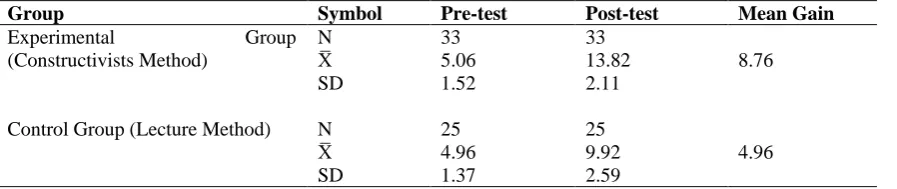
[image:5.595.33.482.658.752.2]What is the academic performance of metalwork students taught measurement and marking out with constructivists’ teaching method as experimental and those taught with lecture method as Control in technical colleges in Yobe State?
Table 1
Means Performance Score and Standard Deviations of Pretest and Posttest of Experimental and Control Groups on measurement
and marking out
Group Symbol Pre-test Post-test Mean Gain
Experimental Group (Constructivists Method)
N 33 33
8.76
X̅ 5.06 13.82 SD 1.52 2.11 Control Group (Lecture Method) N 25 25
4.96
X̅ 4.96 9.92 SD 1.37 2.59 N = Number of Subjects; X̅ = Mean and SD = Standard Deviation
ISSN 2250-3153
Table 1 shows that prior to the use of constructivist method in the teaching of measurement and marking out to metalwork students in the experimental group, the mean score was 5.06 while the standard deviation was 1.52. The control group has a pretest mean score of 4.96 and the standard deviation of 1.37. The standard deviation of 1.52 for the experimental group and 1.37 for the control group indicates that there is slight variation in test scores of experimental group than in control group. But after the treatment which was teaching the students, the posttest mean scores for the experimental students is 13.82 while for the control group is 9.92 with the standard deviation of 2.11 and 2.59 respectively. The table also shows that the mean gain difference was 8.76 for experimental group and 4.96 in lecture method. This implies that the students taught measurement and marking out with constructivist teaching method performed better in the achievement test than those taught with lecture method. The result shows that constructivist teaching method is the better method in teaching measurement and marking out compared to lecture method.
3.2 Research Question 2
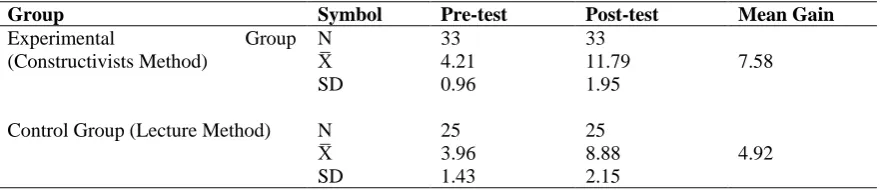
[image:6.595.33.474.416.511.2]What is the academic performance of metalwork students taught drilling process with constructivists’ teaching method as experimental and those taught with lecture method as Control in technical colleges in Yobe State?
Table 2
Means Performance Score and Standard Deviations of Pretest and Posttest of Experimental and Control Groups on Drilling
process
Group Symbol Pre-test Post-test Mean Gain
Experimental Group (Constructivists Method)
N 33 33
7.58
X̅ 4.21 11.79 SD 0.96 1.95 Control Group (Lecture Method) N 25 25
4.92
X̅ 3.96 8.88 SD 1.43 2.15 N = Number of Subjects; X̅ = Mean and SD = Standard Deviation
Table 2 shows that, in drilling process section of MWAT, experimental group have a pre-test mean score of 4.21 with a standard deviation of 0.96, while the control group has a pretest mean score of 3.96 and a standard deviation of 1.43. There is closeness in the test scores in experimental group than in control group based on standard deviation of 0.96 for the experimental group as against 1.43 for the control group. In post-test, the mean scores for the experimental group was 11.79, while for the control group it was an increased to 8.88. But despite the increased it was low when compared with the mean of experimental group. The table also shows that the mean gain difference was 7.58 for experimental group and 4.92 in control group. This implies that the students taught drilling process with constructivist teaching method performed better in the achievement test than those taught with lecture method. The finding proves that constructivist teaching method is the better method in teaching drilling process compared to lecture method.
3.3 Hypothesis 1
There is no significant difference in the mean academic performance of metalwork students taught measurement and marking out with constructivists’ teaching method and those taught with lecture method in technical colleges in Yobe State.
Table 3
Analysis of Covariance of the Mean Performance Scores of Students Taught Measurement and Marking out with two different
ISSN 2250-3153
Source of Variance Sum of Squares
DF Mean
Square
F Sig. of F
(p-value)
Corrected Model 216.15a 2 108.08 19.51 .00 Intercept 618.82 1 618.82 111.69 .00 Pretest (Covariate) .004 1 .004 .001 .98 Group (Teaching Methods) 215.95 1 215.95 38.98 .00 Error 304.75 55 5.54
Total 9066.00 58 Corrected Total 520.90 57
Table 3 reveals that the F value of pretest is 0.001 with significant of F at 0.98 which is greater than 0.05 indicating that there is no significant different in the covariate. The F-calculated value for teaching methods (1, 55) is 38.98 with p-value of 0.00. Since the p value of 0.00 is less than 0.05, the null hypothesis is therefore rejected. Hence, there is significant difference between the mean performance of students taught measurement and marking out with constructivist teaching method and those taught with lecture method. It means that there is a significant different in effectiveness of constructivist and lecture teaching method in teaching measurement and marking out.
3.4 Hypothesis 2
[image:7.595.37.475.367.473.2]There is no significant difference in the mean academic performance of metalwork students taught drilling process with constructivists’ teaching method and those taught with lecture method in technical colleges in Yobe State.
Table 4
Analysis of Covariance of the Mean Performance Scores of Students Taught Drilling Process with two different teaching methods
Source of Variance Sum of Squares
DF Mean
Square
F Sig. of F
(p-value)
Corrected Model 124.12a 2 62.06 14.95 .00 Intercept 386.06 1 386.06 93.00 .00 Pretest (Covariate) 3.84 1 3.84 .93 .34 Group (Teaching Methods) 114.39 1 114.39 27.56 .00 Error 228.31 55 4.15
Total 6789.00 58 Corrected Total 352.43 57
Table 4 reveals that the F-calculated value of pretest (that the covariate) is 0.93 with p-value of 0.34 which is greater than 0.05. This shows that there is no significant different in the pretest. The table also reveals that F-calculated value for teaching methods (1, 55) is 27.56 with p-value of 0.00. Since the p value of 0.00 is less than 0.05, the null hypothesis is therefore rejected. Meaning there is significant difference between the mean performance of students taught drilling process with constructivist method and those taught with lecture method. This shows that there is a significant different in effectiveness of constructivist and lecture teaching method in teaching drilling process.
4.0 Major Findings
The following are major findings emerged from the study:
1. Constructivist teaching method is better than lecture method in teaching measurement and marking in technical colleges in Yobe State.
2. Constructivist teaching method is better than lecture method in teaching drilling process in technical colleges in Yobe State.
3. There is a significant different in effectiveness of constructivist and lecture teaching method in teaching measurement and marking out.
ISSN 2250-3153
4.1 Discussion of Findings
The main concern of the study was to determine the effectiveness of constructivist teaching method. This was done by determining which among the two methods (constructivist and conventional lecture) of instructional delivery is better for metalwork related courses. Both research questions one and two are talking about the two methods, therefore the two questions can be discussed concurrently. The findings revealed that, the constructivist method of teaching performed better than the conventional lecture method in the two research questions. This is because the mean achievement for experimental group is higher than that of control group in all cases. This therefore agree with the findings of Petet, Abiodun and Oke (2010), Akanwa and Ovute (2014), Duyilemi and Bolajoko (2014), Musa and Hassan (2015), Oguguo (2015) and Ndubuisi (2016) who found that, constructivist method of teaching is better than the conventional method of teaching and learning practical related subjects. This was also confirmed by the results of the hypotheses which showed that, there is significant difference in the mean performance of the students that were taught using constructivist method and that of conventional methods in the favour of constructivist method. All the studies reviewed showed that constructivist method of teaching is always better than that of conventional (lecture) method in teaching and learning technical subjects.
The implication of this finding is that constructivist teaching method, in which students are actively engaged in teaching and learning process is more effective than lecture method in enhancing students’ achievement on measurement and marking out of metalwork concepts and also drilling process.
4.2 Conclusion
The study found out that, the use of constructivist teaching method is more effective compared to lecture method in improving the academic performance of metalwork students in technical colleges. Drawing from the findings of this study, it can be concluded that for metalwork students to do well, constructivist method should be employed in teaching metalwork. This will motivate and promote the interest of the students in terms of achieving good results. It will also encourage parents, and teachers would be proud of using the method as an effective means of teaching Metalwork. Moreover, base on this study, there is a dare need for metalwork teachers in the technical college to develop interest in using constructivist teaching method to teach metalwork related subjects.
4.3 Recommendations
In line with the findings of this study, the researcher proffered the following recommendations:
1. Metalwork teachers should be trained to adopt constructivist instructional teaching method for teaching technical related subjects in schools.
2. There should be training and re-training opportunities for the technical teachers through in-service training or workshops/ seminars on regular basis.
3. National Board for Technical Education (NBTE) should consider review of curriculum for National Technical Certificate in order to incorporate constructivist instructional technique as a method of teaching technical courses.
References
Abbas, H. L. & Karema, E. S. (2014). The effectiveness of constructivist learning model in the teaching of mathematics. Journal of Applied and Industrial Sciences, Vol. 2 No.3, pp 106-109
Akanwa, U. N. & Ovute, A. O. (2014). Effect of constructivist teaching model on SSS physics students’ achievement and interest.
ISSN 2250-3153
Ameh, P. O. and Dantani, Y. S. (2012). Effects of lecture and demonstration methods on the academic achievement of students in chemistry in Nassarawa local government area of Kano state. International Journal of Modern Social Sciences, Vol. 1 No.1, pp 29-37.
Amineh, R. J. and Hanieh D. A. (2015). Review of Constructivism and Social Constructivism. Journal of Social Sciences, Literature and Languages Vol. 1 No.1, pp 9-16
Center for Instructional Development and Distance Education CIDDE (2014). The Lecture method. available http://www.cidde.pitt.edu/teaching/ lecture- method (Accessed April 10th, 2018)
Creswell, J. W. (2012). Educational research: planning, conducting, and evaluating quantitative and qualitative research.
Boston: Pearson Education, Inc.
Dorgu, T. E. (2015). Different teaching methods: a panacea for effective curriculum implementation in the classroom.
International Journal of Secondary Education, Vol. 3 No. 6-1 pp, 77-87
Duyilemi, A. N. & Bolajoko, A. O. (2014) (2014). Effects of constructivists' learning strategies on senior secondary school student’s achievement and retention in biology. Mediterranean Journal of Social Sciences, Vol.5 No.27, pp 627-633.
Eneh, O. C. (2011).Nigeria’s Vision 20:2020-Issues, Challenges and Implications for Development Management. Asian Journal of Rural Development, Vol. 1 No.1, pp 21-40.
Federal Ministry of Education (2012). 4-years strategies plan for the development of the education sector: 2011-2015. Abuja; FME
Federal Republic of Nigeria (2013). National policy on education. Abuja; NERDC
Kelley, M. (2018). Measuring, Marking & Cutting Out. httplocal.ecollege.ieContentAPPRENTICEliuind_insulationmod1m1unit3.pdf (accessed June 10th, 2018)
Khalid, A. & Azeem, M. (2012). Constructivist Vs Traditional: Effective Instructional Approach in Teacher Education.
International Journal of Humanities and Social Science, Vol. 2 No. 5,pp 170-177.
Mele, E. F. (2018). Introduction to teaching profession. Yola, Nigeria; Paraclete Publishers (Educational).
Musa, A. & Hassan, U. M. (2015). Effects of using constructivist instructional approach on students’ academic achievement in auto-mechanic in government technical colleges of Yobe state. Nigerian Journal of Technology Teacher Education Vol.5 No.1,pp 242-249
National Board for Technical Education (2017). National business and technical examination board syllabus for engineering
trade. Abuja; NBTE
National Board for Technical Education (2011). Report for technical education committee on the development of national
vocational qualification framework (NVQF) for Nigeria. Kaduna; NBTE
Ndubuisi, C. P. (2016). Effects of constructivist instructional model on junior secondary school students’ achievement and interest in social studies. Unpublished Doctoral Dissertation; University of Nigeria, Nsukka.
Oguguo, B. C. E. (2015). Effects of constructivist method of teaching on students’ achievement in financial accounting: issues and challenges for accountancy education development. Knowledge Review, Vol. 33 No. 2,pp 1-7.
Ogumbe, B. F. (2015). Assessment of mechanical engineering craft practice production units in technical colleges in south-south zone of Nigeria. Unpublished Doctoral Dissertation; University of Nigeria, Nsukka.
ISSN 2250-3153
Oviawe, J. I. (2010). Differential effects of three instructional methods on students’ performance in building technology in polytechnics in Nigeria. Unpublished Doctoral dissertation; University of Nigeria, Nsukka.