The Economic and Social Review, Vol. 29, No. 3, July, 1998, pp. 259-284
Worklife Mobility Typologies as Background
to C u r r e n t Class Position — a Research Note
R O B E R T L . M I L L E R
The Queen's University of Belfast
Abstract: Retrospective job history data from a large probability sample of males in Northern
Ireland is used to construct four typologies of intragenerational occupational mobility. The four typologies are based upon: (1) a Class (worklife) perspective; (2) an Internal and External Labour markets perspective; (3) Economic Sectors; (4) Career Increments. Each typology has a distinct conceptual background which leads to a unique and non-overlapping operationalisation. Present position does reflect past worklife history. Varying worklife mobility histories of different class strata are found by comparing the present social class position of respondents with their intragenerational mobility histories across the four typologies. These unique worklife mobility backgrounds support the utility of intragenerational analyses for class analysis.
I I N T R O D U C T I O N
T
his paper w i l l present four d i s t i n c t perspectives on the conceptualisation of w o r k l i f e m o b i l i t y : t h e "class" perspective w i t h i t s o r i g i n s i n m a i n s t r e a m social s t r a t i f i c a t i o n theory; the "career" perspective w h i c h evaluates w o r k l i v e s as conscious, i n c r e m e n t a l progressions t h r o u g h jobs; t h e "labour m a r k e t " perspective based u p o n theories o f i n t e r n a l a n d e x t e r n a l l a b o u r m a r k e t s ; t h e "sector" perspective w h i c h centres u p o n d i v i s i o n s i n t o centre a n d p e r i p h e r i a l economic a c t i v i t y . Separate modes of o p e r a t i o n a l i s i n g t h e four perspectives are presented w i t h reference to retrospective j o b histories. T h e p r o p o r t i o n a l v a r i a t i o n across t h e w o r k l i f e o f each perspective i s evaluated. F i n a l l y , t h e background of c u r r e n t class positions — t h e extent t o w h i c h c u r r e n t class positions result from a m i x e d or u n m i x e d w o r k l i f e h i s t o r y across each of t h e perpectives — w i l l be p r e s e n t e d .1T h e d o m i n a n t perspective on social m o b i l i t y , p a r t i c u l a r l y w i t h i n Europe, r e m a i n s t h e class perspective. The p r i m e indicator of social position is a social class, w i t h "class" b e i n g o p e r a t i o n a l i s e d b y a coding o f occupation. T h e c r i t e r i a for t h e o p e r a t i o n a l i s a t i o n of class m a y p u r p o r t to be based i n either a M a r x i a n (e.g., W r i g h t ) or a W e b e r i a n (e.g., Goldthorpe a n d E r i k s o n ) v i e w o f s t r a t i f i c a t i o n , t h o u g h m a n y c o m m e n t a t o r s have n o t e d t h e considerable p r a c t i c a l o v e r l a p i n these conceptually d i s t i n c t v i e w p o i n t s (e.g., S0renson, 1991). W h i l e i n t e r g e n e r a t i o n a l m o b i l i t y , c o m p a r i n g t h e p o s i t i o n o f t h e c u r r e n t g e n e r a t i o n w i t h t h a t o f t h e i r parents, has been t h e most commonly used, t h e s t u d y o f m f r a g e n e r a t i o n a l , or w o r k l i f e , m o b i l i t y is a t t r a c t i n g i n c r e a s i n g i n t e r e s t . T h e f i r s t i n v e s t i g a t i o n s o f i n t r a g e n e r a t i o n a l m o b i l i t y w e r e based u p o n a r u d i m e n t a r y comparison o f social position at t h e t i m e o f e n t r y i n t o t h e l a b o u r m a r k e t , as i n d e x e d by " f i r s t j o b " , w i t h t h e c u r r e n t position, i n d i c a t e d by present/last job. Phenomena such as "counter m o b i l i t y " ( r e t u r n i n g d u r i n g t h e career to an advantaged o r i g i n position after a n i n i t i a l l o w s t a r t i n g p o i n t ) w e r e i n v e s t i g a t e d (e.g., Goldthorpe, 1987; M i l l e r , 1986). Since t h e n , a n u m b e r o f other a n a l y t i c a l approaches have been u t i l i s e d . T h e m o s t w e l l - k n o w n o f these have been: t h e use of class spells — counts of t h e n u m b e r o f changes i n e x t e r n a l l y - d e f i n e d class p o s i t i o n across t h e w o r k l i f e (e.g., F e a t h e r m a n a n d Selbee, 1988; C a r r o l l a n d M a y e r , 1986); the d u r a t i o n of t i m e spent i n a class (e.g., G e r s h u n y , 1993); h a z a r d or r a t e models — p r e d i c t i v e models of t h e l i k e l i h o o d t h a t a c e r t a i n type of j o b move w i l l occur w i t h i n a g i v e n span of t i m e (e.g., T u m a a n d H a n n a n , 1984); a n d sequencing models — e s t a b l i s h i n g s i m i l a r sequences o f j o b moves b y t h e n u m b e r o f changes r e q u i r e d t o m a k e one sequence resemble another (e.g, A b b o t t a n d H r y c a k , 1990; H a l p i n a n d C h a n , 1998).
perspective; a n d a n economic sector perspective. These o t h e r perspectives now w i l l be presented.
I I W O R K L I F E M O B I L I T Y T Y P E S | (1) The Career Perspective
I n t r a g e n e r a t i o n a l j o b m o b i l i t y often is equated w i t h career m o b i l i t y . A v a r i e t y of q u a l i t a t i v e studies of "career" a t t a i n m e n t i n specific occupational situses, however, have p r o v i d e d an a l t e r n a t i v e conceptual o r i e n t a t i o n for v i e w i n g w o r k l i v e s . The concept o f a career has evolved w h i c h sees t h e career as a series of g r a d u a l j o b increments t a k i n g place w i t h i n a broad occupational situs i n w h i c h t h e increments are a r e g u l a r series of rises i n level o f s k i l l , a u t h o r i t y , self-autonomy at w o r k , a n d occupational standing. I n t h i s manner, one can i d e n t i f y career progressions, simple i m p r o v e m e n t s i n j o b histories, stable j o b h i s t o r i e s w h i c h l a c k a n u p w a r d progression, a n d u n s t a b l e or w o r s e n i n g j o b histories. T h i s view o f w o r k l i f e m o b i l i t y m a y be t e r m e d t h e "Career" perspective.
(2) The Labour Market Perspective
A second v i e w p o i n t , t h e Labour Market perspective, also has been advanced b y researchers o f w o r k l i f e m o b i l i t y . T h e jobs of a w o r k l i f e are seen as o c c u r r i n g w i t h i n e i t h e r a " p r i m a r y " or "secondary" l a b o u r m a r k e t . E n t e r p r i s e s m a y r e q u i r e t w o t y p e s o f w o r k e r s : " p r i m a r y " employees possessing scarce s k i l l s v a l u a b l e t o t h e f i r m w h o have possibly developed t h e s e s k i l l s t h r o u g h i n - f i r m t r a i n i n g or experience; a n d "secondary" employees w h o provide a flexible source of basic l a b o u r power t h a t can be b r o u g h t i n or discarded at w i l l depending u p o n s h o r t - t e r m demand. F i r m s are seen as u t i l i s i n g different labour management strategies i n order to f i l l t h e i r demands for each type of w o r k e r . " P r i m a r y " employees are selected o n t h e basis o f p r i o r qualifications or t h e i r anticipated a p t i t u d e . Since t h e i r value to t h e f i r m ( a n d t o c o m p e t i t o r s ) increases w i t h experience a n d t r a i n i n g , " p r i m a r y " employees w i l l be kept w i t h the f i r m by a c o m b i n a t i o n of strategies i n c l u d i n g t r a i n i n g i n s k i l l s t h a t w i l l n o t transfer easily to other employers, h i g h a n d i n c r e m e n t a l wages, pension p l a n s , "benevolent" m a n a g e m e n t policies i n c l u d i n g r i g h t s o f t e n u r e , t h e tolerance or even encouragement o f u n i o n i s a t i o n etc. Note t h a t t h e motives u n d e r l y i n g t h e management policies of a "good" f i r m are those of self-interest r a t h e r t h a n a l t r u i s m .
s k i l l s , t h e y can be "picked u p " or "dropped" as v a r y i n g conditions of labour d e m a n d dictate. (Dale, 1987, p. 561.) "Enlightened" management policies are absent, n o t due t o a n y desire t o e x p l o i t w o r k e r s , b u t r a t h e r because t h e y w o u l d n e u t r a l i s e t h e p r i m e advantages o f secondary labour; t h e low cost of t h e i r wages a n d t h e i r u t i l i t y as a reserve pool of workers t h a t can be moved easily i n or o u t of t h e f i r m as changing m a r k e t conditions require.
T h e l a b o u r m a r k e t perspective has been elaborated f u r t h e r by a sub d i v i s i o n i n t o " i n t e r n a l " a n d "external" labour m a r k e t s . I n d i v i d u a l firms w i l l n o t be made u p solely of p r i m a r y or secondary employees b u t m a y c o n t a i n w o r k e r s of b o t h types — p r i m a r y employees r e c r u i t e d selectively who enjoy t h e benefits described above a n d secondary employees excluded from these benefits w h o w i l l n o t receive o p p o r t u n i t i e s for i n - f i r m t r a i n i n g a n d i n c r e m e n t a l advancement. I n effect, t w o labour pools w i t h i n i n d i v i d u a l firms are hypothesised — a n " i n t e r n a l labour m a r k e t " of privileged, selected w o r k e r s who have t h e o p p o r t u n i t y of a v a i l i n g themselves o f t h e f u l l advantages o f p r i m a r y w o r k e r s a n d the others, employees w i t h i n t h e firm w h o enjoy l i t t l e m o r e b e n e f i t t h a n t h e ( t e m p o r a r y ) occupancy o f a j o b . T h e b o u n d a r i e s between w o r k i n g w i t h i n t h e firm a n d being out of i t are permeable for these secondary employees. W h i l e t h e y m a y have l o n g duration o f e m p l o y m e n t w i t h a firm, t h e y have few advantages as a r e s u l t of t h e i r employment. I n p a r t i c u l a r , t h e y do not have security of t e n u r e ; a secondary w o r k e r of l o n g d u r a t i o n m a y not be i n a n appreciably better position t h a n a new secondary r e c r u i t .
To r o u n d o f f t h e c o n s i d e r a t i o n o f t h i s l a b o u r m a r k e t perspective, a conception of "occupational i n t e r n a l l a b o u r m a r k e t s " ( " O I L M s " ) p a r a l l e l to t h a t o f " f i r m i n t e r n a l l a b o u r m a r k e t s " ( " F I L M s " ) can also be i d e n t i f i e d i n w h i c h the O I L M transcends any single firm and,
comprises a p a r t i c u l a r o c c u p a t i o n a l group, u s u a l l y a craft (or p r o fessional) occupation. Here e n t r y is generally controlled by members of t h e occupational group and m o b i l i t y occurs among employers w i t h i n t h e occupational group. I n these m a r k e t s the w o r k e r gets h i s security n o t from t h e i n d i v i d u a l employer b u t from his s k i l l , the competitive supply o f w h i c h is c o n t r o l l e d b y t h e o c c u p a t i o n a l g r o u p . ( K a l l e b e r g a n d Sorenson, 1979, p. 359; see also Dale, 1987, p. 561.)
(3) The Sector Perspective
"extra-occupational" a n d located at t h e level o f f i r m s a n d i n d u s t r i e s , c a n also be d i s t i n g u i s h e d . F i r m s , a n d t h e i n d u s t r i a l sectors i n w h i c h t h e y are located, can be categorised i n t o "core" a n d " p e r i p h e r y " types. (Beck, H o r a n a n d Tolbert, 1978, p. 706.) Core f i r m s a n d i n d u s t r i e s m a k e u p a more advantaged sector o f t h e economy. Enterprises i n t h e core t e n d t o be large a n d " c a p i t a l i n t e n s i v e " ( t h a t is, i n v e s t m e n t i n p h y s i c a l p l a n t is h i g h ) , have secure, h i g h p r o f i t m a r g i n s , possess h i g h l y s k i l l e d u n i o n i s e d workforces a n d have clear, r a t i o n a l / b u r e a u c r a t i c styles of management. I n contrast, enterprises i n t h e p e r i p h e r a l sector t e n d t o be smaller, profits are u n c e r t a i n a n d fluctuations i n d e m a n d a n d t h e f a i l u r e of f i r m s a n d crises i n t h e i n d u s t r y are common. T h e workforce is less s k i l l e d a n d non-unionised a n d management is n o t w h a t one w o u l d call "professional".2
T h e core economy includes those i n d u s t r i e s t h a t comprise t h e muscle o f . . . economic a n d p o l i t i c a l power. ... The f i r m s i n t h e core economy are noted for h i g h p r o d u c t i v i t y , h i g h profits, i n t e n s i v e u t i l i s a t i o n of c a p i t a l , h i g h incidence o f m o n o p o l y elements, a n d a h i g h degree o f u n i o n isation. ...
Beyond t h e fringes o f the core economy lies a set o f i n d u s t r i e s t h a t l a c k almost a l l o f t h e advantages n o r m a l l y found i n center f i r m s . C o n c e n t r a t e d i n a g r i c u l t u r e , n o n d u r a b l e m a n u f a c t u r i n g , r e t a i l t r a d e , a n d sub-professional services, t h e p e r i p h e r a l i n d u s t r i e s are n o t e d for t h e i r s m a l l f i r m size, l a b o r i n t e n s i t y , p r o d u c t m a r k e t c o m p e t i t i o n , l a c k o f u n i o n i z a t i o n , a n d l o w wages. U n l i k e core sector i n d u s t r i e s , t h e p e r i p h e r y lacks the assets, size, a n d political power to t a k e advantage o f economies o f scale or to spend large sums o n research a n d development." (Bluestone et al., 1973, pp. 28-29, c i t e d i n Beck, H o r a n a n d T o l b e r t , 1978, pp. 706-7.)
I n a n elaboration o f t h i s sectorial perspective, some authors (e.g., Hodson, 1978) separate o u t a t h i r d " p u b l i c " category o f s t a t e - o w n e d f i r m s a n d i n d u s t r i e s ; seeing those enterprises i n public ownership as being less d i r e c t l y d r i v e n b y t h e need to secure profits a n d more i n s u l a t e d from t h e r i g o u r s of economic c o m p e t i t i o n . W h i l e t h e above L a b o u r M a r k e t a n d Career per spectives can be seen to relate d i r e c t l y to j o b m o b i l i t y , t h e Sector perspective differs i n t h a t i t defines a c o n t e x t w i t h i n w h i c h d i f f e r e n t p a t t e r n s o f i n t r a g e n e r a t i o n a l m o b i l i t y m a y take place.
(4) The Class (Worklife) Perspective
M a n y a u t h o r s have n o t e d t h a t m o b i l i t y between social classes can, o f course, t a k e place d u r i n g w o r k l i v e s as w e l l as between generations. T h i s gives rise t o a f o u r t h perspective, t h a t of Class (worklife). Classes, i f they are more t h a n j u s t aggregates o f occupational codes, are made u p of endogamous n e t w o r k s o f social connections w i t h d i s t i n c t viewpoints, mores a n d interests. T h e d y n a m i c o f class f o r m a t i o n takes place p r i m a r i l y w i t h i n i n t r a g e n e r -a t i o n -a l w o r k l i f e m o b i l i t y ( E s p i n g - A n d e r s e n , 1993, pp. 16-17; M -a y e r -a n d C a r r o l l , 1987, pp. 14-15). M o b i l i t y between classes or s t r a t a m u s t overcome b a r r i e r s other t h a n j u s t t h e i n s t r u m e n t a l closure of scarce or v a l u e d social resources. Knowledge o f m o b i l i t y opportunities, the need to resocialise oneself i n o r d e r t o a t t e m p t m o b i l i t y a n d t h e necessity b o t h to b r e a k free f r o m e x i s t i n g social n e t w o r k s a n d t o f o r m new n e t w o r k s m a y a l l constitute p r o found b a r r i e r s to class m o b i l i t y w i t h i n a single lifetime. (Richardson, 1977.) I f t h e class perspective is correct, m o b i l i t y should be d i s t i n c t l y p a t t e r n e d a n d t h e w o r k l i f e class composition o f those located at t h e extremes of h i g h e r a n d l o w e r s t r a t a s h o u l d be m o r e d i s t i n c t t h a n t h a t o f those i n i n t e r m e d i a t e positions.
So, at least four d i s t i n c t perspectives located i n w o r k l i f e m o b i l i t y can be isolated — each w i t h a d i s t i n c t conceptual framework. One should note t h a t on the g r o u n d there has been considerable overlap i n t h e i r use. For example,
O n a W e b e r i a n v i e w o f social class, t h e employees o f a f i r m w i t h a n i n t e r n a l l a b o r m a r k e t m a y be s a i d t o compose a single class to t h e e x t e n t t h a t t h e i r m o b i l i t y experiences are homogeneous. ... Indeed, a reasonable i n t e r p r e t a t i o n o f t h e l i t e r a t u r e on i n t e r n a l labor m a r k e t s is t h a t i t sees employees w o r k i n g w i t h i n such a f i r m as h a v i n g q u a l i t a t i v e l y different career chances to others — they are, so to speak, a class apart ( M a y e r a n d C a r r o l l , 1987, p. 18.)
w o r k l i f e was concentrated. Nevertheless, w h i l e t h e r e m a y be considerable c o n c e p t u a l o v e r l a p , t h e s e p e r s p e c t i v e s do h a v e d i f f e r e n t c o n c e p t u a l "lineages". F u r t h e r m o r e , conceptual a r g u m e n t s do n o t a l w a y s l e a d one t o clear conclusions as t o w h a t exact correspondences t o expect. W h i l e a n overlap b e t w e e n " t r u e " career j o b changes a n d m o v e m e n t s i n a n i n t e r n a l l a b o u r m a r k e t could be expected, t h e a n t i c i p a t e d f o r m o f other correspon dences are n o t so clear (e.g., Esping-Andersen, 1993, p. 15). T h e c u r r e n t state of t h e o r i s i n g i n t h e r e l a t e d areas o f "careers", "labour markets", "sectors" a n d t h e "social classes" o f w o r k l i v e s has n o t gone as far as e x p l i c i t l y s e t t i n g o u t i n a s y s t e m a t i c m a n n e r t h e p o t e n t i a l i n t e r r e l a t i o n s h i p s b e t w e e n these typologies; nor have t h e proportionate size o f t h e possible i n t e r r e l a t i o n s been established. ( K a l l e b e r g a n d Sorenson, 1979.) T h e e x t e n t a n d n a t u r e o f t h e a c t u a l correspondences between c u r r e n t social class a n d t h e other typologies is t h u s a m a t t e r for e m p i r i c a l verification. ( C a r r o l l a n d M a y e r , 1986; H a c h e n , 1990.)
I l l O P E R A T I O N A L I S A T I O N O F T H E "CAREER", " L A B O U R M A R K E T " , "SECTOR" A N D "CLASS" ( W O R K L I F E ) P E R S P E C T I V E S
B y t h e i r n a t u r e , t h e conceptualisations o f careers a n d l a b o u r m a r k e t s ( p a r t i c u l a r l y i f i n t e r n a l labour m a r k e t s are t h e focus) r e q u i r e w o r k l i f e d a t a of a c o n t i n u o u s n a t u r e . T h e d i v i s i o n o f economic a c t i v i t y i n t o "core", " p e r i p h e r a l " a n d " p u b l i c " sectors needs a t t h e m i n i m u m a d e t a i l e d classification o f i n d u s t r y a n d i d e a l l y w o u l d u t i l i s e firm-by-firm i n f o r m a t i o n o f a h i g h standard.
T h e retrospective j o b histories of the I r i s h m o b i l i t y study provide d e t a i l e d , continuous i n f o r m a t i o n o n t h e w o r k experiences o f r e p r e s e n t a t i v e samples o f I r i s h males aged between 18 a n d 65 t h a t w i l l allow o p e r a t i o n a l i s a t i o n o f t h e concepts o f "career" a n d "labour m a r k e t " m o b i l i t y . T h e " I r i s h M o b i l i t y S t u d y "3 collected i n f o r m a t i o n on m a n y aspects of the respondents' lives a n d o f t h e i r f a m i l i e s t h a t w e r e r e l e v a n t t o t h e topic o f social m o b i l i t y , b r o a d l y conceived. W h i l e based u p o n a cross-sectional survey, t h e I r i s h m o b i l i t y d a t a takes a l o n g i t u d i n a l f o r m . The core o f t h e i n t e r v i e w schedule was a set o f r e t r o s p e c t i v e "life h i s t o r y " sections c o v e r i n g each respondent's m i g r a t i o n , educational experience, w o r k , a n d m a r r i a g e a n d f e r t i l i t y . A n y changes i n t h e life h i s t o r y sections o f t h e i n t e r v i e w schedule w e r e i n d e x e d b y t h e year, m o n t h a n d age of t h e respondent a t t h e t i m e t h e y occurred. T h i s allows t h e d a t a t o be c o n s t i t u t e d i n t h e f o r m o f a " g r i d " i n w h i c h the status o f a n y or a l l
respondents can be established by age, calendar m o n t h and year, or any other t i m e - i n d e x e d p o i n t , such as " X years after s t a r t i n g first full-time job".
The coding of j o b d a t a included t h e detailed classification of i n d u s t r y used by t h e B r i t i s h Census w h i c h , a l o n g w i t h a special coding d i s t i n g u i s h i n g b e t w e e n " p u b l i c " a n d " p r i v a t e " sector jobs, a l l o w e d a m a l g a t i o n s i n t o t h e l a b o u r m a r k e t types a n d economic sectors used below. Also, coding i n t o t h e B r i t i s h Census E m p l o y m e n t S t a t u s a n d d e t a i l e d C l a s s i f i c a t i o n o f Occu p a t i o n s a l l o w e d exact r e c o d i n g i n t o t h e Hope-Goldthorpe ( C A S M I N ) class schema adapted below. The data used below are from the N o r t h e r n I r i s h h a l f of the I r i s h m o b i l i t y study.
W h i l e these operationalisations are not perfect, being a k i n to a secondary a n a l y s i s ,4 t h e y are at least as rigorous (and i n m a n y respects more rigorous) t h a n m a n y previous a t t e m p t s t o apply e m p i r i c a l l y t h e ideas of career, labour m a r k e t a n d i n d u s t r i a l sector. For instance, t h e operationalisations are based u p o n a c t u a l j o b changes r a t h e r t h a n a cross t a b u l a t i o n m a t r i x o f positions h e l d at one p o i n t i n t i m e compared w i t h positions h e l d at another t i m e i n w h i c h , for some, t h e r e has been no change between t h e t w o t i m e s . I f t h e codings a t t w o p o i n t s i n t i m e are t h e same, i t is because t h e t w o different positions b e i n g compared genuinely do have t h e same coding r a t h e r t h a n b e i n g a n artefact of t h e same position recorded twice.
F u r t h e r m o r e , t h e e m p i r i c a l l y d i s t i n c t operationalisations of t h e concepts can be c a r r i e d o u t so as to m i r r o r t h e i r conceptually d i s t i n c t o r i g i n s . F o r example, t h e c r i t e r i a for establishing t h a t a p a r t i c u l a r j o b move is a "career i n c r e m e n t " can be different from the c r i t e r i a for establishing w h e t h e r or n o t t h e same j o b move was one t h a t occurred i n a " p r i m a r y i n t e r n a l " l a b o u r m a r k e t — w h i c h c r i t e r i a i n t u r n can be defined differently f r o m those for e s t a b l i s h i n g w h e t h e r t h e j o b m o v e d i n t o is located w i t h i n t h e "core", "periphery" or "public" sectors.
(1) The Career Perspective
U t i l i s i n g t h e C a r e e r Perspective as discussed above, j o b moves w e r e categorised i n t o four types o f "career" moves:
(a) "True" Career Moves — U s i n g t h e conceptualisation of career given i n t h e discussion (and w o r k i n g w i t h i n the l i m i t a t i o n s of t h e coding schemes used o n t h e I r i s h m o b i l i t y s t u d y w h i l e e x p l o i t i n g t h e p o t e n t i a l o f t h e complete sequential retrospective j o b histories), a j o b change t h a t h a d at least one o f t h e f o l l o w i n g characteristics was considered a "true" career move:
• i n m a n u a l w o r k , a move from semi- or u n s k i l l e d w o r k to s k i l l e d w o r k ; • i n m a n u a l w o r k , a move f r o m a " w o r k e r " category t o a f o r e m a n /
supervisor category;5
• a move f r o m " r o u t i n e " n o n m a n u a l w o r k t o t h e s u p e r v i s i o n o f n o n -m a n u a l e-mployees;
• a move from an apprenticeship to s k i l l e d m a n u a l w o r k ;
• a move from m a n a g i n g or e m p l o y i n g less t h a n 25 employees to employ i n g 25 or more employees;
• a move f r o m m a n a g i n g less t h a n 25 employees to m a n a g i n g 25 or more employees;
• a move t o a j o b i n w h i c h a l a r g e r n u m b e r o f other w o r k e r s are super vised t h a n previously;
• any move i n w h i c h t h e m a i n reason for t h e j o b change was g i v e n as "promotion";
• i n a g r i c u l t u r e , a move f r o m a g r i c u l t u r a l l a b o u r e r t o f a r m e r or f a r m manager.
M o v e m e n t across a blue c o l l a r / w h i t e c o l l a r b o u n d a r y was n o t i n i t s e l f considered a career move.
(b) "Improvements"— ( A g a i n based u p o n the above conceptual discussion.) A j o b change w i t h a n y o f t h e f o l l o w i n g c h a r a c t e r i s t i c s b u t none o f t h e
characteristics of a career move were considered to be a n "improvement": • any move t o a "higher" Hall-Jones occupational level except for a move
from " S k i l l e d m a n u a l " to "Routine nonmanual";
• any move t o a j o b more t h a n eight u n i t s h i g h e r t h a n t h e previous j o b on t h e 100-unit scale o f "occupational s t a n d i n g " used by t h e I r i s h m o b i l i t y study (the I r i s h Occupational Index);
• a move from u n e m p l o y m e n t or p a r t - t i m e w o r k to f u l l - t i m e w o r k ; • a move from u n e m p l o y m e n t to p a r t - t i m e w o r k ;
• any moves from the category "employee" to the categories of "employer", "manager" or "self-employed" n o t already coded as "true" career moves; • any j o b change t h a t r e s u l t e d i n a n increase i n a n n u a l income o f more
t h a n £200.
(c) "Drops" — Job changes w i t h a n y of t h e f o l l o w i n g characteristics were considered "drops":
• any move t o a "lower" Hall-Jones occupational level except for a move from "Routine non-manual" to "Skilled manual";
• any move t o a j o b more t h a n eight u n i t s lower t h a n t h e previous j o b i n i t s s t a n d i n g on t h e I r i s h Occupational Index;
• a move from f u l l - t i m e w o r k t o u n e m p l o y m e n t or p a r t - t i m e w o r k ; • a move from p a r t - t i m e w o r k to unemployment;
• i n m a n u a l w o r k , a move from s k i l l e d w o r k to semi- or u n s k i l l e d w o r k ; • i n m a n u a l w o r k , a move from foreman/supervisor to a "worker" category; • i n n o n - m a n u a l w o r k , a move from supervising non-manual employees t o
r o u t i n e n o n - m a n u a l w o r k ;
• a move from e m p l o y i n g 25 or more employees t o e m p l o y i n g or m a n a g i n g less t h a n 25 employees;
• a move f r o m m a n a g i n g 25 or m o r e employees t o m a n a g i n g less t h a n 25 employees;
• a n y move f r o m a n employer or manager status to n o n - m a n u a l super visor or any m a n u a l category;
• a shift from farmer or f a r m manager to a g r i c u l t u r a l labourer;
• any j o b change t h a t r e s u l t e d i n a drop i n a n n u a l income of more t h a n £150;
• any j o b change r e s u l t i n g from redundancy or being fired.
I n i n s t a n c e s i n w h i c h some c r i t e r i a i n d i c a t e d a "drop" w h i l e o t h e r s i n d i c a t e d a n "improvement", t h e j o b change was considered to be a "drop". I n t h e less l i k e l y instances i n w h i c h some c r i t e r i a suggested a " t r u e " career move w h i l e others suggested a "drop", t h e "career" c r i t e r i a took precedence.
(d) "Stable" — I t was possible t h a t a j o b change could have occurred for w h i c h none o f t h e above c r i t e r i a apply. I n these cases, the change was recorded as "stable" move.
A l t o g e t h e r , t h e net r e s u l t of a p p l y i n g these c r i t e r i a to t h e respondents' j o b histories results i n each j o b change being placed i n a "Career" typology made u p of four categories: (a) "True" career moves; (b) "Improvements"; (c) "Stable" j o b changes; a n d (d) "Drops".
(2) The Labour Market Perspective
C e n s u s S t a n d a r d I n d u s t r i a l C l a s s i f i c a t i o n code, t h e j o b c h a n g e w a s
considered to be " i n t e r n a l " .6 S i m i l a r l y , a j o b change i n w h i c h t h e p r i o r a n d
present j o b s b o t h h a d t h e same d e t a i l e d occupational coding (the 223 " u n i t
g r o u p s " o f t h e OPCS Classification of Occupations, 1970) was t y p e d as a
" p r i m a r y " change. B y cross-referencing the t w o c r i t e r i a , one a r r i v e s a t four
"labour m a r k e t " categories of job change:
(a) "Primary /Internal" — t h e move is i n t o a j o b o f t h e same d e t a i l e d
occupational a n d i n d u s t r i a l codings;
(b) "Secondary/Internal" — t h e m o v e i s i n t o a j o b w i t h a d i f f e r e n t
occupational coding b u t the same i n d u s t r i a l c o d i n g ;7
(c) "Primary/External" — t h e m o v e i s i n t o a j o b w i t h t h e s a m e
occupational coding b u t a different i n d u s t r i a l c o d i n g ;8
(d) "Secondary/External" — t h e m o v e i s i n t o a j o b w i t h d i f f e r e n t
occupational and i n d u s t r i a l codings.9
(3) The Sector Perspective
T h e d e t a i l e d i n d u s t r i a l classification codes i n c o m b i n a t i o n w i t h a separate
coding of jobs i n t o p r i v a t e or p u b l i c sector jobs also a l l o w e d t h e d e v e l o p m e n t
of a n "Economic Sector" typology. F o l l o w i n g Beck, H o r a n a n d T o l b e r t ' s (1978)
d i s c u s s i o n o f " d u a l economy" t y p o l o g i e s , j o b s w e r e c a t e g o r i s e d b y t h e i r
location i n t o : (a) "Core"; (b) "Peripheral" or; (c) "Public" s e c t o r s .w
6. Ideally, job changes would only be coded as "internal" if the move had taken place as part of a "career chain" (Spenner, Otto and Call, 1982) or "job ladder"; and, in the case of F I L M moves, within a single firm. The Irish data, unfortunately, were not coded by firm. The use of "same industry" as a proxy for "same firm" has been used elsewhere (e.g., Beck, Horan and Tolbert, 1978) with the rationale that the firms located under the same detailed industrial code will tend to be similar in their scale and organisation. Also, "same industry" will mean "same firm" at least part of the time. One should note that since the industry coding procedues used in the Irish mobility study were based on firm or enterprise, taking industry as a proxy for firm does mean that all those job changes considered as "external" will be accurately labelled "external" by firm as well as by industry. Furthermore, most of the respondents have spent all or most of their working lives in Northern Ireland. The small size of the province and the relatively small number of firms in it increases the probability that the same detailed coding of industry for two adjacent jobs does in fact reflect "same firm". Nevertheless, one must recognise that this is a "loose" operationalisaton of the concept of internal labour market move.
7. (1) and (2) together make up F I L M moves. (Althauser, 1989.) 8. (3) can also be called OILM moves.
9. While the labels applied to the four categories are different, this procedure follows very closely the "Labour Market Typology" utilised by Dale (1987).
(4) The Class (Worklife) Perspective
A "Class ( w o r k l i f e ) " t y p o l o g y was developed i n a l i k e m a n n e r . U s i n g o c c u p a t i o n a l categories developed by Goldthorpe a n d Hope as p a r t o f t h e N u f f i e l d College s t u d y of social m o b i l i t y i n E n g l a n d a n d Wales (Goldthorpe a n d Hope, 1974), a l l jobs h e l d d u r i n g t h e respondents' w o r k l i v e s were t y p e d as: (a) "Upper Middle Class" (upper a n d l o w e r service classes); (b) "Lower Middle Class" ( t h e i n t e r m e d i a t e groups o f o t h e r n o n - m a n u a l w o r k e r s , p r o p r i e t o r s a n d farmers) or; (c) "Working Class" (skilled, semi- and u n s k i l l e d m a n u a l w o r k e r s , i n c l u d i n g a g r i c u l t u r a l labourers) i n order to y i e l d a "Class ( w o r k l i f e ) " t y p o l o g y .1 1 N o t e t h a t t h i s "class schema" s h o u l d be seen as a n e x p l i c i t l y W e b e r i a n set o f occupational categories.
I V T H E R E S U L T S — A S S E S S M E N T O F W O R K L I F E T Y P O L O G I E S Some problems w i t h t h i s approach come from d u r a t i o n and sequence. W i t h r e g a r d to d u r a t i o n , i n the "economic sector" and "class" typologies, d u r a t i o n i n a sector is the most m e a n i n g f u l w a y of a p p l y i n g the concept. Therefore, i n the analyses below, "economic sector" a n d "class" (worklife) figures w i l l be based on t h e p r o p o r t i o n a t e d u r a t i o n of t i m e spent i n a given sector or social class, respectively.
I n t h e case of t h e "career" a n d "labour m a r k e t " typologies, however, t h e p r o p o r t i o n a t e figures are based u p o n j o b moves r a t h e r t h a n t i m e i n jobs. Therefore, a q u i c k series of jobs h e l d over a short t i m e can p o t e n t i a l l y exert as m u c h or more influence over the t y p i n g of a person's w o r k l i f e as t h e rest o f h i s t i m e i n w o r k . W h i l e the typologies being used take account of sequence by c o m p a r i n g each c u r r e n t job w i t h t h e i m m e d i a t e l y preceding job, the sequence of types o f j o b changes across t h e whole w o r k l i f e are n o t k n o w n . So, for example, a n i n d i v i d u a l whose early jobs were a series of career progressions t h a t t h e n ended w i t h several "drops" w o u l d end up being labelled, despite his failures at t h e end, as one whose worklife had been m a i n l y a "true career".
T h e system of proportions used i n t h e analyses below is defensible w i t h r e g a r d to t h i s problem. F i r s t , w h i l e d u r a t i o n is a problem for the "career" and "labour m a r k e t " typologies, a s o l u t i o n emphasising d u r a t i o n w o u l d i n fact have posed more problems for i n t e r p r e t a t i o n and analysis t h a n the procedure t h a t has been adopted. A f t e r categorising a j o b change as to type of move, one could t h e n have computed the d u r a t i o n of t i m e u n t i l the next j o b change and
a t t h e e n d a r r i v e d a t a set o f proportions based u p o n s u m m e d a m o u n t s o f d u r a t i o n r a t h e r t h a n simple j o b changes. I n t h e cases o f "careers" and "labour m a r k e t s " , however, t h e m e a n i n g of t h e concepts resides i n t h e comparison between t w o jobs r a t h e r t h a n t i m e spent i n a j o b ; e.g., one is i n a n i n t e r n a l labour m a r k e t by v i r t u e of a series of moves w i t h i n the labour m a r k e t , n o t by r e t a i n i n g the same position i n a f i r m for decades. Hence, replacing the system based o n sequence w i t h one based o n d u r a t i o n w o u l d o n l y i n t r o d u c e artefactual effects.
A second p r o b l e m , t h e r e l a t i v e r e l i a b i l i t y o f t y p i n g w o r k l i v e s b y a n aggregate o f a l l j o b changes across a career i n preference to a t t a c h i n g p r i m e i m p o r t a n c e to t h e most recent j o b changes, can be seen more as a c a u t i o n for i n t e r p r e t i n g r e s u l t s t h a n as a p r o b l e m r e q u i r i n g a s o l u t i o n . T a k i n g t h e h y p o t h e t i c a l w o r k l i f e p a t t e r n o f a n i n d i v i d u a l w h o spends m o s t o f h i s1 2 w o r k i n g life i n a progression of i n c r e m e n t a l career moves followed by a "drop" at t h e end, one can argue t h a t the most salient fact o f t h e w o r k l i f e is n o t t h e f a l l i n recent years as t h e i n d i v i d u a l ' s career perhaps "peaked" a n d t h e n began to decline b u t r a t h e r t h a t the i n d i v i d u a l i n fact h a d h a d a career.
G i v e n t h e l i m i t a t i o n s o f cross-sectional d a t a c o l l e c t i o n i n w h i c h i n f o r m a t i o n is u s u a l l y obtained o n l y for people's present occupations, most typologies o f social p o s i t i o n necessarily m u s t concentrate solely u p o n t h e present s i t u a t i o n . T h i s leaves moot t h e question of t h e routes by w h i c h people came to occupy t h e i r present p o s i t i o n . T h e o p e r a t i o n a l i s a t i o n o f a set o f w o r k l i f e typologies based u p o n p r o p o r t i o n o f moves or a p r o p o r t i o n a t e d u r a t i o n could prove problematic i f t h e l a t t e r p a r t o f a j o b h i s t o r y i n fact was n o t representative o f t h e w o r k l i f e as a whole — p a r t i c u l a r l y t h e case for t h e "Career" a n d "Labour m a r k e t " typologies i n w h i c h the proportions are based u p o n moves r a t h e r t h a n t o t a l d u r a t i o n .
A s a means o f o b t a i n i n g i n d i c a t i o n s o f t h e degree o f r e l i a b i l i t y o f t h e proportionate methodology, the categorisation o f t h e last occupation or move is compared w i t h the p r o p o r t i o n of the respondent's whole w o r k l i f e t h a t falls i n t o t h e same category for each o f t h e four w o r k l i f e typologies (Tables 1 to 4 below). W h i l e t h e l a s t j o b or move does c o n t r i b u t e t o t h e o v e r a l l p r o p o r t i o n a n d consequently any correspondence m u s t be p a r t l y a r t e f a c t u a l , a h i g h degree o f correspondence nevertheless w o u l d i n d i c a t e t h a t r e l y i n g u p o n
p r o p o r t i o n s t o d e t e r m i n e w o r k l i f e typologies is n o t i n t r o d u c i n g completely mis-specified a p p l i c a t i o n s . A n d , as argued above, t h e r e are advantages t o r e l y i n g u p o n a system o f p r o p o r t i o n s as a more r e l i a b l e means o f t y p i n g w o r k l i v e s as a whole.
Table 1: Proportions of Worklives in each Economic Sector by Sector of Present ILast Occupation
Present! Last Proportion of Worklife in:
Occupation is: Core Periphery Public
Core 0.65 0.26 0.04
Periphery 0.05 0.90 0.03
Public 0.08 0.32 0.53
Overall mean 0.18 0.66 0.09
Coefficient of variation 1.72 0.59 2.48
Ratio of Mid to Lowest and Highest:
of Means 1.00 3.67 0.50
of coefficient of variation 1.00 0.34 1.42
Notes: (a) Differences between present economic sectors are significant over all three worklife typologies at 0.001 level.
(b) Analysis limited to respondents aged over 27 who have held more than one job position.
(c) Instances i n the worklife where the respondent did not occupy a job could not be classified into an economic sector. Hence, the proportions i n the rows will not sum to 1.00.
Table 2: Proportions of Career Types of Job Moves by Move into Present Work Position
Proportion of Job Moves that were: Last Move was: "True" Career Improvement Stable "Drop"
True" career 0.63 0.13 0.05 0.19
Improvement 0.23 0.43 0.07 0.28
Stable ' 0.20 0.18 0.29 0.33
'Drop' 0.21 0.21 0.06 0.51
Overall 0.31 0.27 0.10 0.32
Coefficient of variation 0.90 0.82 1.51 0.74
Ratio of Mid to Lowest and Highest:
of means 1.07 0.93 0.35 1.10
of coefficient of variation 1.05 1.01 1.76 0.86
Notes: (a) Differences between last move career types are significant over all four worklife typologies at 0.001 level,
(b) Analysis limited to respondents aged over 27 who have held more than one job position.
Table 3: Proportions of Labour Market Types of Job Moves by Move into Present Work Position
Proportion of Job Moves that were:
Last Move Internal/ Internal/ External/ External/
was: Primary Secondary Primary Secondary
Internal/Primary 0.89 0.01 0.03 0.07
Internal/Secondary 0.08
0.82
0.01 0.09External/Primary 0.13
0.02
0.70 0.15External/Secondary 0.05
0.03
0.04 0.88Overall 0.13
0.16
0.06 0.64Coefficient of variation 2.02 2.01 3.12 0.62
Ratio of Mid to Lowest and Highest:
of Means 0.90 1.10 0.41 4.41
of coefficient of variation 1.00
1.00
1.55 0.31Notes: (a) Differences between last move labour market types are significant over all four worklife typologies at 0.001 level,
v a r i a t i o n , t h e r a n g e o f v a r i a t i o n is n o t as g r e a t as t h e r a n g e i n m e a n occurrence. F o r instance, again i n Table 1, t h e r a t i o of m e a n proportions i n t h e t h r e e economic sectors ranges from 0.50 to 3.67 w h i l e the range o f ratios of t h e corresponding coefficients of v a r i a t i o n is only 0.34 to 1.42. T h a t is, once one allows for the size of proportions, the less frequently occurring categories are more homogeneous t h a n w o u l d be expected i f movement i n or out of t h e m was due only to t h e i r smaller r e l a t i v e size.
V D I S T R I B U T I O N O F T H E W O R K L I F E T Y P O L O G I E S ACROSS "PRESENT CLASS"
T u r n i n g t o t h e w o r k l i f e backgrounds of present class strata, t h e presen t a t i o n o f e m p i r i c a l results continues i n the worklife perspective b y d i s p l a y i n g t h e d i s t r i b u t i o n s of t h e non-class w o r k l i f e typologies across "present class" positions. A s an a i d to i n t e r p r e t a t i o n , the "upper" a n d "lower service" s t r a t a i n t h e class schema are sub-divided i n t o those w i t h a n d w i t h o u t t e r t i a r y educational qualifications a n d t h e "skilled m a n u a l " s t r a t a is sub-divided i n t o those w h o possess or do not possess apprenticeships or higher level vocational qualifications.
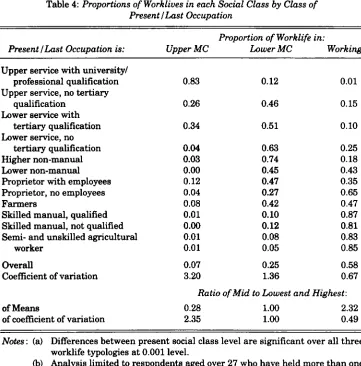
Table 4, "Proportions of W o r k l i v e s i n each Social Class by Class of Present/ L a s t Occupation", d i s p l a y s a more complex p a t t e r n of r e s u l t s t h a t are o f s u b s t a n t i v e i m p o r t a n c e . A s i n the other tables, the association between t h e t y p i n g o f t h e l a s t j o b a n d t h e whole w o r k l i f e is strong. T h e four m a n u a l categories of p r e s e n t occupation d i s p l a y w o r k l i f e h i s t o r i e s i n w h i c h , o n average, over 80 per cent of the w o r k l i v e s have been spent i n " w o r k i n g class" jobs. S k i l l e d m a n u a l w o r k e r s w h o possess q u a l i f i c a t i o n s have spent t h e
greatest p r o p o r t i o n o f t h e i r lives of a l l those i n " w o r k i n g class" jobs; pre s u m a b l y r e f l e c t i n g t h e b e t t e r m a n u a l jobs t h a t can be g a i n e d w i t h a n apprenticeship or t e r t i a r y / v o c a t i o n a l qualification.
a g r i c u l t u r a l labour p r i o r to becoming a f a r m e r i n t h e i r o w n r i g h t (often as a " f a m i l y w o r k e r " a w a i t i n g inheritance), have spent more t i m e i n t h e " w o r k i n g class" category t h a t includes a g r i c u l t u r a l w o r k e r s t h a n i n t h e "lower m i d d l e class" category t h a t includes farmers.
Table 4: Proportions of Worklives in each Social Class by Class of Present I Last Occupation
Proportion of Worklife in:
Present I Last Occupation is: Upper MC Lower MC Working Upper service w i t h university/
professional qualification 0.83 0.12 0.01
Upper service, no tertiary
qualification 0.26 0.46 0.15
Lower service with
tertiary qualification 0.34 0.51 0.10
Lower service, no
tertiary qualification 0.04 0.63 0.25
Higher non-manual 0.03 0.74 0.18
Lower non-manual 0.00 0.45 0.43
Proprietor with employees 0.12 0.47 0.35
Proprietor, no employees 0.04 0.27 0.65
Farmers 0.08 0.42 0.47
Skilled manual, qualified 0.01 0.10 0.87
Skilled manual, not qualified 0.00 0.12 0.81
Semi- and unskilled agricultural 0.01 0.08 0.83
worker 0.01 0.05 0.85
Overall 0.07 0.25 0.58
Coefficient of variation 3.20 1.36 0.67
Ratio of Mid to Lowest and Highest:
of Means 0.28 1.00 2.32
of coefficient of variation 2.35 1.00 0.49
Notes: (a) Differences between present social class level are significant over all three worklife typologies at 0.001 level.
(b) Analysis limited to respondents aged over 27 who have held more than one job position.
(c) Instances i n the worklife where the respondent did not occupy a job could not be classified into class. Hence, the proportions i n the rows w i l l not sum to 1.00.
none of t h e i r t i m e i n " w o r k i n g class" jobs. I n m a r k e d contrast, those presently "upper service" w i t h o u t h i g h e r qualifications have spent on average only a q u a r t e r of t h e i r w o r k l i v e s at the "upper m i d d l e class" level and a significant p o r t i o n o f t i m e i n " w o r k i n g class" jobs. A s i m i l a r p a t t e r n , t h o u g h somewhat a t t e n u a t e d , also holds for those presently i n t h e l o w e r service s t r a t a . I t is n o t e w o r t h y t h a t those i n l o w e r service occupations w h o do possess h i g h e r e d u c a t i o n a l q u a l i f i c a t i o n s have spent p r o p o r t i o n a t e l y more o f t h e i r t i m e i n u p p e r m i d d l e class jobs a n d less t i m e i n w o r k i n g class jobs t h a n t h e p a r t of t h e "upper service" group who lack higher qualifications.
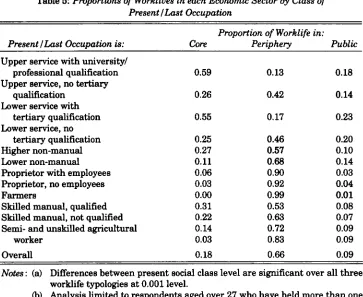
To close, the backgrounds of the detailed social class categories i n the other three w o r k l i f e typologies w i l l be displayed. Table 5 displays the proportions o f w o r k l i v e s spent i n t h e three economic sectors by the detailed categorisation o f p r e s e n t social class. T h e i m p o r t a n c e o f e d u c a t i o n a l q u a l i f i c a t i o n for t h e p a r t i c i p a t i o n of those presently i n the "service" group remains apparent. Over h a l f o f t h e w o r k l i v e s o n average has been spent i n the core sector o f those now i n "upper" or "lower service" occupations w h o also have t e r t i a r y q u a l i fications. I n c o n t r a s t , o n l y a q u a r t e r of t h e w o r k l i v e s o f upper a n d l o w e r service class m e m b e r s w h o l a c k h i g h e r q u a l i f i c a t i o n s has been i n t h e core economic sector. T h i s f i g u r e is no h i g h e r t h a n t h a t for those c u r r e n t l y i n h i g h e r n o n - m a n u a l w o r k . I n i t s t u r n , the higher non-manual group has spent a longer average w o r k l i f e t i m e i n t h e core sector t h a n i t s lower n o n - m a n u a l c o u n t e r p a r t . P a r t i a l l y as a n a r t e f a c t o f t h e o p e r a t i o n a l i s a t i o n o f t h e p e r i p h e r a l category, f a r m e r s a n d b o t h categories of proprietors have spent t h e v a s t m a j o r i t y o f t h e i r w o r k l i v e s i n t h e p e r i p h e r a l sector. (For farmers, t h i s r e s u l t is also a n accurate depiction of the worklife p a t t e r n of a g r i c u l t u r a l l a b o u r t o farmer. ( M i l l e r , 1986)) W h i l e t h e modal economic sector for a l l four " m a n u a l w o r k " categories is the p e r i p h e r a l sector, t h e salience of location i n t h e core sector for present e m p l o y m e n t i n s k i l l e d m a n u a l w o r k can be seen. W h e n b o t h s k i l l e d and q u a l i f i e d , m a n u a l w o r k e r s show a h i g h e r average w o r k l i f e d u r a t i o n i n t h e core sector a n d a l o w e r d u r a t i o n i n the p e r i p h e r a l sector t h a n e i t h e r o f t h e non-manual categories.
Table 5: Proportions of Worklives in each Economic Sector by Class of Present/Last Occupation
Proportion of Worklife in:
Present/Last Occupation is: Core Periphery Public
Upper service w i t h university/
professional qualification 0.59 0.13 0.18
Upper service, no tertiary
qualification 0.26 0.42 0.14
Lower service with
tertiary qualification 0.55 0.17 0.23
Lower service, no
tertiary qualification 0.25 0.46 0.20
Higher non-manual 0.27 0.57 0.10
Lower non-manual 0.11 0.68 0.14
Proprietor with employees 0.06 0.90 0.03
Proprietor, no employees 0.03 0.92 0.04
Farmers 0.00 0.99 0.01
Skilled manual, qualified 0.31 0.53 0.08
Skilled manual, not qualified 0.22 0.63 0.07
Semi- and unskilled agricultural 0.14 0.72 0.09
worker 0.03 0.83 0.09
Overall 0.18 0.66 0.09
Notes: (a) Differences between present social class level are significant over all three worklife typologies at 0.001 level,
(b) Analysis limited to respondents aged over 27 who have held more than one job position.
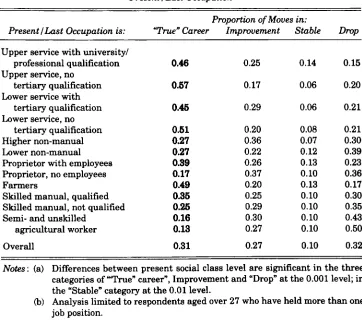
professional qualifications" s t r a t u m tends to confirm t h i s . ) Those presently i n t h e service s t r a t a w h o got t h e r e w i t h o u t t h e benefit o f h i g h e d u c a t i o n a l qualification are more l i k e l y t o have a r r i v e d by t h e more i n d i r e c t i n c r e m e n t a l r o u t e of a n u m b e r of "true" career moves. Presumably these results reflect t h e i m p o r t a n c e o f e d u c a t i o n a l q u a l i f i c a t i o n for d i r e c t e n t r y i n t o t h e r e l a t i v e l y p r i v i l e g e d "service classes" t h a t has been n o t e d elsewhere i n m o r e r u d i m e n t a r y i n t r a g e n e r a t i o n a l analyses for N o r t h e r n I r e l a n d ( M i l l e r , 1986), t h e Republic o f I r e l a n d ( H o u t , 1989) a n d for E n g l a n d a n d Wales. ( G o l d t h o r p e , 1987.) W h e n G e r s h u n y c a r r i e d out a n analysis o f h i s t o r i c a l t r e n d s i n i n t r a g e n e r a t i o n a l m o b i l i t y i n E n g l a n d t h a t u t i l i s e d d e t a i l e d r e t r o s p e c t i v e j o b histories, he also found strong evidence for t h e increasing salience for d i r e c t e n t r y v i a e d u c a t i o n a l routes i n t o upper m i d d l e class positions. (Gershuny, 1 9 9 3 . )1 3
I t is n o t e w o r t h y t h a t , i n comparison to those i n n o n - m a n u a l categories, those presently i n t h e higher a n d lower non-manual categories do not display m a r k e d l y b e t t e r profiles across t h e four types of career w o r k l i f e experience. T h e i m p o r t a n c e o f t h e possession of skills a n d qualifications for w h a t may be seen as " m a n u a l careers" (see A s h t o n 1973, cited i n B r o w n , 1982, p. 125) appears i n t h e contrasts i n t h e proportions of "true" career moves a n d "drops" between t h e s k i l l e d a n d u n s k i l l e d m a n u a l s t r a t a t h a t w o r k to t h e advantage of s k i l l e d w o r k e r s ( s k i l l e d m a n u a l s show h i g h e r proportions of "true" career moves a n d fewer "drops" t h a n semi- and u n s k i l l e d and a g r i c u l t u r a l workers). F i n a l l y , t h e l a r g e p r o p o r t i o n o f " t r u e " career moves for f a r m e r s can be a t t r i b u t e d to t h e above-noted p a t t e r n of m o v e m e n t f r o m t h e category o f " a g r i c u l t u r a l w o r k e r " t o t h a t of "farmer".
[image:20.459.59.421.293.613.2]T a b l e 7 d i s p l a y s t h e p r o p o r t i o n a t e l a b o u r m a r k e t experience o f t h e d e t a i l e d class categories. T h e large proportions of the w o r k l i v e s of t h e upper
Table 6: Proportions of Moves in each Career Type by Class of Present I Last Occupation
Proportion of Moves in:
Present/Last Occupation is: T r u e " Career Improvement Stable Drop Upper service with university/
professional qualification 0.46 0.25 0.14 0.15
Upper service, no
tertiary qualification 0.57 0.17 0.06 0.20
Lower service w i t h
tertiary qualification 0.45 0.29 0.06 0.21
Lower service, no
tertiary qualification 0.51 0.20 0.08 0.21
Higher non-manual 0.27 0.36 0.07 0.30
Lower non-manual 0.27 0.22 0.12 0.39
Proprietor w i t h employees 0.39 0.26 0.13 0.23
Proprietor, no employees 0.17 0.37 0.10 0.36
Farmers 0.49 0.20 0.13 0.17
Skilled manual, qualified 0.35 0.25 0.10 0.30
Skilled manual, not qualified 0.25 0.29 0.10 0.35
Semi- and unskilled 0.16 0.30 0.10 0.43
agricultural worker 0.13 0.27 0.10 0.50
Overall 0.31 0.27 0.10 0.32
Notes: (a) Differences between present social class level are significant i n the three categories of T r u e " career", Improvement and "Drop" at the 0.001 level; i n the "Stable" category at the 0.01 level,
a n d l o w e r service s t r a t a w i t h h i g h e r q u a l i f i c a t i o n s t h a t have been moves w i t h i n a " p r i m a r y / i n t e r n a l " labour m a r k e t again indicates t h a t m a n y of these i n d i v i d u a l s entered directly i n t o a higher level occupation i n w h i c h t h e y have t h e n r e m a i n e d .1 4 F u r t h e r m o r e , t h e h i g h e r p r o p o r t i o n s o f "secondary/ i n t e r n a l " l a b o u r m a r k e t moves o f those i n t h e service s t r a t a w h o do n o t possess h i g h e r e d u c a t i o n a l q u a l i f i c a t i o n s are c o n g r u e n t w i t h a w o r k l i f e career i n w h i c h i n d i r e c t e n t r y t o t h e service s t r a t a has been gained t h r o u g h w o r k i n g one's w a y u p a n i n t e r n a l career ladder o f a n u m b e r of jobs w i t h i n a
Table 7: Proportions of Moves in each Labour Market Type by Class of Present/Last Occupation
Proportion of Moves in:
Present/Last Primary/ Secondary/ Primary/ Secondary/
Occupation is: Internal Internal External External
U p p e r service w i t h university/professional
qualification 0.45 0.05 0.12
0.38
Upper service, no
tertiary qualification 0.16 0.16 0.09
0.60
Lower service with
tertiary qualification 0.42 0.09 0.05
0.44
Lower service, no
tertiary qualification 0.14 0.17 0.05
0.64
Higher non-manual 0.11 0.07 0.12
0.70
Lower non-manual
0.11
0.10 0.050.74
Proprietor with employees 0.15 0.23 0.06
0.56
Proprietor, no employees 0.16 0.14 0.06
0.64
Farmers 0.06 0.78 0.01
0.15
Skilled manual, qualified 0.17 0.08 0.14
0.61
Skilled manual,
not qualified 0.12 0.05 0.05
0.78
Semi- and unskilled 0.07 0.06 0.04
0.83
agricultural worker 0.27 0.12 0.04
0.57
Overall 0.13 0.16 0.06
0.64
Notes: (a) Differences between present social class level are significant i n the Primary/Internal, Primary/External and Secondary/External categories at the 0.001 level; i n the Secondary/External category at the 0.01 level, (b) Analysis limited to respondents aged over 27 who have held more than one
job position.
single f i r m or i n d u s t r y . T h e h i g h e r t h a n average proportions of farmers a n d p r o p r i e t o r s w i t h employees i n t h e same category o f " s e c o n d a r y / i n t e r n a l " moves can be t a k e n as specific instances of a general p a t t e r n o f m o v i n g from b e i n g e m p l o y e d t o becoming a n o w n e r w i t h i n a single i n d u s t r i a l category. T h e r e l a t i v e l y exposed positions o f t h e semi- a n d u n s k i l l e d a n d t h e s k i l l e d m a n u a l s w h o l a c k q u a l i f i c a t i o n s can be seen w h e n one notes t h a t these t w o categories have t h e l a r g e s t p r o p o r t i o n s of a l l whose j o b moves have been exposed t o t h e r i g o u r s o f a "secondary/external" labour m a r k e t .
V I C O N C L U S I O N
L o o k i n g across a l l four o f t h e typologies, the present/last move or p o s i t i o n is a good i n d i c a t o r o f t h e overall worklife, b u t only i n the restricted sense t h a t t h e m o d a l state across t h e whole w o r k l i f e tends t o be m i r r o r e d by t h e c u r r e n t state. T h e r e are exceptions t o t h i s r u l e — p a r t i c u l a r l y for proprietors w h e r e t h e m a j o r i t y o f t h e w o r k l i f e w o u l d have been spent i n t h e broad " w o r k i n g class" s t r a t a . W h e t h e r one is l o o k i n g across t h e economic sector, careers, labour m a r k e t or class typologies, there is v a r i a t i o n i n the background of each c u r r e n t state. T h e typology w h e r e the c u r r e n t state corresponds most closely t o t h e w h o l e w o r k l i f e is t h a t for l a b o u r m a r k e t s , where t y p i c a l l y over 80 per cent o f j o b moves across t h e l i f e t i m e were i n t h e same category as t h e l a s t move. T h e career typology shows the most v a r i a t i o n overall.
L o o k i n g a t c u r r e n t class positions, one finds considerable difference i n t h e i r backgrounds across the four typologies. A m o n g s t the higher n o n - m a n u a l service s t r a t a , t h e possession o f e d u c a t i o n a l q u a l i f i c a t i o n s is a s i g n i f i c a n t d i s c r i m i n a t o r . T h e o n l y service category t h a t can c l a i m to be t r u l y "upper" across t h e w h o l e o f t h e w o r k l i f e is t h e "upper service w i t h u n i v e r s i t y or professional q u a l i f i c a t i o n " group, where, overall, 83 per cent o f t h e w o r k l i v e s h a v e been spent i n t h e u p p e r m i d d l e class. T h e possession o f h i g h e r educational q u a l i f i c a t i o n s for the service class categories raises t h e t i m e t h e y have spent i n t h e core economic sector a n d p r i m a r y / i n t e r n a l l a b o u r m a r k e t s . Those i n service groups t h a t do n o t possess h i g h e r educational qualifications w e r e t h e m o s t l i k e l y t o have used i n c r e m e n t a l career m u t e s t o reach t h e i r c u r r e n t positions.
experience e n d i n g i n a l o w e r m i d d l e class c u r r e n t p o s i t i o n . B y d e f i n i t i o n , moves i n p r o p r i e t o r s h i p , especially from a g r i c u l t u r a l w o r k e r t o f a r m e r , are almost always career moves. C u r r e n t proprietors' w o r k l i v e s have been located a l m o s t exclusively w i t h i n t h e p e r i p h e r a l sector. F i n a l l y , a m o n g t h e n o n -m a n u a l categories, t h e h i g h e r n o n - -m a n u a l s t r a t a show p a t t e r n s t h a t are f i r m l y located i n t h e n o n - m a n u a l s t r a t u m t h r o u g h o u t t h e i r w o r k l i v e s . I n contrast, t h e p a t t e r n s for t h e lower n o n - m a n u a l s t r a t u m resemble more t h a t of the m a n u a l categories, r a i s i n g the prospect of a " w h i t e collar proletariat".
T h e a b i l i t y o f w o r k l i f e analyses to isolate mechanisms t h a t p o i n t t o t h e d i s t i n c t life experiences of different class s t r a t a has been hypothesised as one of t h e m a i n advantages of i n t r a g e n e r a t i o n a l over i n t e r g e n e r a t i o n a l analyses of social m o b i l i t y (e.g., Esping-Andersen, 1993; M a y e r and C a r r o l l , 1987). T h e above r e s u l t s , w h i c h find v a r y i n g p a t t e r n s o f class b a c k g r o u n d across four d i s t i n c t perspectives on worklife m o b i l i t y , demonstrate j u s t such phenomena of u n i q u e experiences across class s t r a t a .1 5
REFERENCES
ABBOTT, A., and A. HRYCAK, 1990. "Measuring Resemblance i n Sequence Data: A n Optimal Matching Analysis of Musicians' Careers", American Journal of Sociology, Vol. 96, No. 1, pp. 144-195.
ALTHAUSER, ROBERT P. 1989. "Internal Labor Markets", Annual Review of Sociology , Vol. 15, pp. 143-161.
AUNGER, EDMUND A. 1975. "Religion and Occupational Class i n Northern Ireland", The Economic and Social Review, Vol. 7, No. 1, pp. 1-21.
BECK, E.M., PATRICK M . HORAN, and CHARLES M . TOLBERT I I , 1978. "Stratifi cation i n a Dual Economy: A Sectoral Model of Earnings Determination", American Sociological Review, Vol. 43, No. 5, pp. 704-720.
B L A U , PETER, and OTIS DUDLEY DUNCAN, 1967. The American Occupational Structure, New York: John Wiley.
BLOSSFELD, HANS-PETER, 1986. "Career Opportunities i n the Federal Republic of Germany: A Dynamic Approach to the Study of Life-course, Cohort and Period Effects", European Sociological Review, Vol. 2, No. 3, pp. 208-225.
BROWN, RICHARD, 1982. "Work Histories, Career Strategies and the Class Structure", i n Anthony Giddens and Gavin MacKenzie (eds.), Social Class and the Division of Labour: Essays in Honour of Ilya Neustadt, Cambridge: Cambridge University Press.
CARROLL, GLENN R., and KARL ULRICH MAYER, 1986. "Job-Shift Patterns i n the Federal Republic of Germany: The Effects of Social Class, Industrial Sector, and Organizational Size", American Sociological Reviewed. 51, pp. 323-341.
DALE, ANGELA M . , 1987. "Labor Market Structure i n the United Kingdom: Evidence from Occupational Mobility", Work and Occupations Vol. 14, No. 4, pp. 558-590. DEPARTMENT OF FINANCE A N D PERSONNEL, 1985. "Religion," CHS Monitor.
Belfast: Policy Planning Research Unit.
ERIKSON, ROBERT, and J O H N H . GOLDTHORPE, 1987. "Worklife and Inter-generational Class Mobility: A Comparative Analysis". Paper presented to the International Sociological Association Research Committee on Social Stratification and Mobility, Nuremberg Meeting, 22-25 April.
ESPING-ANDERSEN, G0STA, 1993. "Post-industrial Class Structures: An Analytical Framework", i n G. Esping-Andersen (ed.), Changing Classes: Stratification and Mobility in Post-industrial Societies, London: Sage, pp. 7-31.
FEATHERMAN, DAVID L . , and L . K E V I N SELBEE, 1988. "Class Formation and Class Mobility: A New Approach with Counts from Life History Data", i n Matilda White Riley (ed.), Social Structures and Human Lives, Volume 1, Newbury Park, California: Sage, pp. 247-264.
GERSHUNY, JONATHAN, 1993. "Post-industrial Career Structures i n Britain", i n G. Esping-Andersen (ed.), Changing Classes: Stratification and Mobility in Post-industrial Societies, London: Sage, pp. 136-170.
GOLDTHORPE, J O H N H . , 1987. Social Mobility and Class Structure in Modern Britain, Oxford: Clarendon Press.
GOLDTHORPE, J O H N H . , and K E I T H HOPE, 1974. The Social Grading of Occupations: A New Approach and Scale, Oxford: Clarendon Press.
H A C H E N , D.S., 1990. "Three Models of Job Mobility i n Labor Markets", Work and Occupations, Vol. 17, No. 3, pp. 320-354.
H A L P I N , BRENDAN, and TAK WING CHAN, 1998. "Class Careers as Sequences: A n Optimal Matching Analysis of Work-life Histories", European Sociological Review, Vol. 14 (forthcoming).
HODSON, RANDY D., 1978. "Labor i n the Monopoly, Competitive, and State Sectors of Production," Politics and Society, Vol. 8, pp. 429-480.
HOUT, M I C H A E L , 1989. Following in Father's Footstep: Social Mobility in Ireland, Cambridge, Massachusetts: Harvard University Press.
JACKSON, J O H N A., 1979. Final Report on Grant HR1430/1, "Determinants of Occupational Status and Mobility i n Northern Ireland and the Irish Republic", London: Social Science Research Council.
KALLEBERG, ARNE L . , and AAGE B. S0RENSON, 1979. "The Sociology of Labor Markets", Annual Review of Sociology, Vol. 5, pp. 351-379.
r l
Structural Constraints on Career Mobility", European Sociological Review, Vol. 3, No. 1, pp. 14-38.
MILLER, ROBERT L . , 1986. "Social Stratification and Social Mobility i n Northern Ireland", i n Patrick Clancy, S. Drudy, K Lynch and L. O'Dowd (eds.), The Sociology of Modern Ireland, Dublin: Institute of Public Administration.
PIORE, M I C H A E L J., 1975. "Notes for a Theory of Labor Market Stratification", i n Richard C. Edwards, M . Reich and D . M . Gorden (eds.), Labor Market Segmentation, Lexington, Massachusetts: Heath.
RICHARDSON, C.J., 1977. Contemporary Social Mobility, London: Frances Pinter. S0RENSON, A.B., 1991. "On the Usefulness of Class Analysis i n Research on Social
Mobility and Socioeconomic Inequality", Acta Sociologica, Vol. 34, pp. 71-87.
SPENNER, K E N N E T H I . , LUTHER B. OTTO, and VAUGHN R.A. CALL, 1982. Career Lines and Careers. Volume III: Entry into Careers Streams, Lexington, Massachusetts: Heath.
S P I L E R M A N , SEYMOUR, 1978. "Careers, Labor M a r k e t Structure, and Socioeconomic Achievement", American Journal of Sociology, Vol. 83, pp. 551-593. TUMA, NANCY B., and MICHAEL T. HANNAN, 1984. Social Dynamics: Models and
Methods, Orlando: Academic Press.
WIGGINS, RICHARD D., 1988. "A Retrospective Analysis of a Call-Back Strategy i n a Survey of Occupational Mobility", Research Working Paper 33, London: Faculty of Social Sciences and Business Studies, The Polytechnic of Central London.
W I N F I E L D , I . , R.T. CAMPBELL, and A.C. KERCKHOFF, 1989. "Career Processes i n Great Britain and the United States", Social Forces, Vol. 68, pp. 284-308.
A P P E N D I X
C A T E G O R I S A T I O N I N T O E C O N O M I C SECTORS
Core: M e t a l m a n u f a c t u r i n g , chemicals, a l l m e t a l goods, engineering a n d v e h i c l e i n d u s t r i e s , p r o c e s s i n g o f r u b b e r a n d p l a s t i c s , a i r t r a n s p o r t , b a n k i n g a n d finance a n d insurance (except for "social security services");
-p o r t s u -p -p o r t , storage a n d t r a n s -p o r t services n o t elsewhere specified, r e n t i n g o f movables, r e a l estate a n d domestic a n d personal services a n d other services not elsewhere specified; Public: A n y j o b categorised as "public" by a coding of each j o b separately