• No results found

Two photon absorption based detection in semiconductor microcavities

N/A
N/A
Protected

Academic year: 2020

Share "Two photon absorption based detection in semiconductor microcavities"

Copied!
144
0
0

Loading.... (view fulltext now)

Full text

(1)

LEABHARLANN CHOLAISTE NA TRIONOIDE, BAILE ATHA CLIATH TRINITY COLLEGE LIBRARY DUBLIN OUscoil Atha Cliath The University of Dublin

Terms and Conditions of Use of Digitised Theses from Trinity College Library Dublin

Copyright statement

All material supplied by Trinity College Library is protected by copyright (under the Copyright and Related Rights Act, 2000 as amended) and other relevant Intellectual Property Rights. By accessing and using a Digitised Thesis from Trinity College Library you acknowledge that all Intellectual Property Rights in any Works supplied are the sole and exclusive property of the copyright and/or other I PR holder. Specific copyright holders may not be explicitly identified. Use of materials from other sources within a thesis should not be construed as a claim over them.

A non-exclusive, non-transferable licence is hereby granted to those using or reproducing, in whole or in part, the material for valid purposes, providing the copyright owners are acknowledged using the normal conventions. Where specific permission to use material is required, this is identified and such permission must be sought from the copyright holder or agency cited.

Liability statement

By using a Digitised Thesis, I accept that Trinity College Dublin bears no legal responsibility for the accuracy, legality or comprehensiveness of materials contained within the thesis, and that Trinity College Dublin accepts no liability for indirect, consequential, or incidental, damages or losses arising from use of the thesis for whatever reason. Information located in a thesis may be subject to specific use constraints, details of which may not be explicitly described. It is the responsibility of potential and actual users to be aware of such constraints and to abide by them. By making use of material from a digitised thesis, you accept these copyright and disclaimer provisions. Where it is brought to the attention of Trinity College Library that there may be a breach of copyright or other restraint, it is the policy to withdraw or take down access to a thesis while the issue is being resolved.

Access Agreement

By using a Digitised Thesis from Trinity College Library you are bound by the following Terms & Conditions. Please read them carefully.

(2)

Two-photon absorption based detection in

semiconductor microcavities

by

John O’Dowd

Thesis submitted for the degree of Doctor in Philosophy

under the supervision of

Prof. John F. Donegan

School of Physics

Trinity College Dublin

(3)

IKTRIMITY COLLEGE^!

(4)

Declaration

I declare that the w ork in this thesis has not been previously subm itted as an exercise fo r a degree to this or any other university.

T h e w ork described herein is entirely my ow n, except for the assistance m entioned in the acknow ledgem ents and collaborative w ork m entioned in the list o f publications.

(5)
(6)

A lot done, a lot more to do.

(7)

Abstract

The most important feature o f a two-photon absorption microcavity (TPAM ) is that of its enhancement of the optical field which enhances the level of two- photon absorption (TPA) for a particular input optical power incident on the detector. The TPAM is shown to not only enhance the level o f TPA but also to suppress the level of residual single photon absorption (SPA) relative to the level of TPA. This allows a TPA dominated signal to be accessed at much lower incident optical powers than would be possible for a similar GaAs absorbing region which was not sandwiched between two highly reflective distributed Bragg retlectors (D BR’s). The TPA coefficient is estim ated to be approximately 15 cnVGW at 1560 nm in (001) GaAs. The residual SPA coefficient in the unintentionally doped GaAs active layer of the TPA M (which is grown by metal- organic chemical vapour deposition) is approxim ately 1.0 x 10“^ cm"'.

(8)

The polarisation dependence o f a TP AM has been investigated. The deviation in the dependence o f the detector response from that of bulk GaAs is shown to be due to the birefringence of the cavity. A theoretical model based on the convolution of the cavity birefringence and the polarisation dependence of TPA in GaAs is described and shown to match the m easured polarisation dependence of the TP AM very well.

The level of TPA generated by polarised band limited amplified spontaneous emission (BL-ASE) noise has been shown analytically and experimentally to have the same mean pow er dependence as an on-off modulated signal with a generalised duty cycle equal to 50 %. A simple formula is derived which describes the TPA dependence on the optical signal to noise ratio (OSNR) for an optically amplified signal with polarised BL-ASE noise. The theory was validated by carrying out an OSNR m easurement using a TPAM and the theory was shown to fit the measured data very well.

(9)

Publications and presentations

1. P. M aguire, L. P. Barry, T. Krug, J. O'Dowd, M. Lynch, A. L. Bradley, J. F. Donegan, and H. Folliot, "Direct m easurem ent o f a high-speed (>100Gbit/s) OTDM data signal utilising two-photon absorption in a sem iconductor microcavity," in Lasers and Electro-Optics Society. LEOS, 2005), 142-143.

2. T. Krug, W. H. Guo, J. O ’Dowd, M. Lynch, A. L. Bradley, J. F. Donegan, P. J. Maguire, L. P. Barry, and H. Folliot, "Resonance tuning of two- photon absorption m icrocavities for wavelength-selective pulse m onitoring," IEEE Photon. Technol. Lett. 18, 433-435 (2006).

3. P. M aguire, K. Bondarczuk, L. P. Barry, J. O ’Dowd, W. H. Guo, M. Lynch, A. L. Bradley, J. F. Donegan, and H. FoUiot, "Dispersion m onitoring for high-speed WDM networks via two-photon absorption in a semiconductor microcavity," in ICTON, 2006),

4. J. O ’Dowd, W. H. Guo, M. Lynch, A. L. Bradley, and J. F. Donegan, "Investigation of residual Single Photon Absorption in Two Photon Absorption Semiconductor M icrocavities," in ISOPL, 2006),

5. P. J. Maguire, L. P. Barry, T. Krug, W. H. Guo, J. O'Dowd, M. Lynch, A. L. Bradley, J. F. Donegan, and H. Folliot, "Optical signal processing via two-photon absorption in a sem iconductor microcavity for the next generation of high-speed optical com m unications network," J. Lightwave Technol. 24, 2683-2692 (2006).

6. K. Bondarczuk, P. J. Maguire, L. P. Barry, J. O ’Dowd, W. H. Guo, M. Lynch, A. L. Bradley, J. F. Donegan, and H. Folliot, "Chromatic dispersion monitoring o f 80-Gb/s OTDM data signal via two-photon absorption in a semiconductor microcavity," IEEE Photon. Technol. Lett.

19,21-23 (2007).

(10)

two-photon absorption photodetectors," IEEE Photon. Technol. Lett. 19, 432- 434 (2007).

8. F. Smyth, J. O'Dowd, D. C. Kilper, J. E. Simsarian, L. P. Barry, B. Roycroft, and B. Corbett, "lOGbit/s modulation of a fast switching slotted fabry-parot tunable laser," in Lasers and Electro-Optics, and the International Quantum Electronics Conference. CLEOE-IQEC. European Conference on, 2007), 1-1.

9. J. O'Dowd, D. C. Kilper, W. H. Guo, J. F. Donegan, and S. Chandrasekhar, "Optical channel monitoring using two photon absorption," in Lasers and Electro-Optics, and the International Quantum Electronics Conference. CLEOE-IQEC. European Conference on, 2007),

1-1.

10. K. Bondarczuk, P. J. Maguire, L. P. Barry, J. O'Dowd, W. H. Guo, M. Lynch, A. L. Bradley, J. F. Donegan, and H. FoUiot, "Wavelength tuneable pulse monitoring using a two-photon-absorption microcavity," in Lasers and Electro-Optics, and the International Quantum Electronics Conference. CLEOE-IQEC. European Conference on, 2007), 1-1.

11. J. O'Dowd, W. H. Guo, E. Flood, M. Lynch, A. L. Bradley, J. F. Donegan, and L. P. Barry, "Temperature tuning of two-photon absorption microcavity photodetectors for wavelength selective pulse monitoring," Electron. Lett. 44, 989-991 (2008).

12. W. H. Guo, J. O'Dowd, E. Flood, T. Quinlan, M. Lynch, A. L. Bradley, J. F. Donegan, K. Bondarczuk, P. J. Maguire, and L. P. Barry, "Suppression o f residual single-photon absorption relative to two-photon absorption in high finesse planar microcavities," IEEE Photon. Technol. Lett. 20, 1426-

1428 (2008).

13. W. H. Guo, J. O'Dowd, M. Lynch, A. L. Bradley, J. F. Donegan, L. P. Barry, and D. C. Kilper, "Two-photon absorption generated by optically amplified signals," Electron. Lett. 44, 1087-1088 (2008).

(11)

absorption microcavity photodetector," Opt. Express 16, 17682-17688

(2008).

15. K. Bondarczuk, P. J. M aguire, L. P. Barry, J. O'Dowd, W. H. Guo, M.

Lynch, A. L. Bradley, and J. F. Donegan, "High-speed chromatic

dispersion monitoring of a two-channel W DM system using a single TPA

microcavity," in Lasers and Electro-Optics, Conference on Quantum

Electronics and Laser Science. CLEO/QELS. Conference on, 2008), 1-2.

16. J. O'Dowd, W. H. Guo, E. Flood, M. Lynch, A. L. Bradley, and J. F.

Donegan, "Influence of acceptance angle on high-finesse microcavity two

photon absorption photodetectors," in PhotonOS, 2008), M D-7881-7104.

17. J. O ’Dowd, W. H. Guo, E. Flood, M. Lynch, A. L. Bradley, and J. F.

donegan, "Generalized description of polarization dependence o f two-

photon absorption detectors," in Photon08, 2008), M D -7881-7115.

18. J. O'Dowd, W. H. Guo, E. Flood, M. Lynch, A. L. Bradley, and J. F.

donegan, "Influence of acceptance angle of high-fmesse microcavity two-

photon absorption photodetectors," in ICPS, 2008), TH-PD3-146.

19. J. O'Dowd, W. H. Guo, E. Flood, M. Lynch, A. L. Bradley, and J. F.

Donegan, "Polarization characterization of a two-photon absorption

(12)

Acknowledgements

I w ould like to thank Prof. J. F. D onegan for suggesting this work and for giving m e the opportunity to jo in his group. His support over the course o f my PhD has m ade all o f this w ork possible.

T hanks to Dr. T. K rug for his help fam iliarising m e with the labs during the first few m onths o f my PhD as well as to M r. E. Flood and Mr. T. Q uinlan for their help during the final few m onths.

This w ork on a day to day basis has been carried out with the continuing support o f Dr. W. H. Guo. H is help in all areas o f this work, both experim ental and theoretical could not be m ore appreciated. His tolerance with my never ending barrage o f questions has been astonishing.

Thanks to Dr. L. B radley and M. Lynch for their suggestions and assistance during the course o f this work.

I w ould like to thank A lcatel-L ucent for allow ing me to spend tim e in Bell Labs in C raw ford Hill. I am especially thankful to Dr. D. C. K ilper for inviting me to w ork in his labs. His suggestions have been very useful and w ithout him large segm ents o f this w ork w ould not have been possible. I am also appreciative o f all the help I received w hile in Bell, especially from Dr. M. Dinu and Dr. R. Giles.

M any thanks to all the m em bers o f the “ sem iconductors photonics gro u p ” w ith special thanks to Dr. V. W eldon for his technical support. To all the group m em bers who have m ade my tim e in the group m ore enjoyable.

Special thanks to the Dr. L. P. Barry, Dr. P. M aguire, K. B ondarczuk and F. Sm yth and all the m em bers o f R .LN .C .E. for all there assistance.

(13)

Thanks to my friends from outside college, especially Fiona, Oisin and Dermot. Thanks also to my friends in the U.S. who made my stay all the more enjoyable, especially Elizabeth and John.

(14)

Contents

D eclaration... i

A bstract...iv

Publications and presentations...vi

A cknow ledgem ents... ix

C o n te n ts...xi

A bbreviations... xiv

1. Introduction... 1

1.1 Background and m otivation...1

1.2 Thesis outline...2

1.3 Nonlinear optical processes: two-photon absorption... 4

1.4 Applications of two-photon absorption... 7

1.4.1 Introduction... 7

1.4.2 Optical time division m ultiplexing... 10

1.4.3 Auto and cross co rrelatio n ...12

1.4.4 Optical performance m onitoring...15

2. Transfer matrix m ethod...17

2.1 Fabry-Perot e ta lo n ...17

2.1.1 Etalon transmission and reflection... 17

2.1.2 Intra-cavity field... 19

2.1.3 Field enhancem ent... 21

2.1.4 Phase response... 22

2.1.5 Distributed Bragg reflecto r... 24

2.1.6 Phase shift in a D B R ...28

2.2 Transverse matrix m e th o d ...28

3. Two-photon absorption microcavity detector... 33

3.1 Basic principle... 33

3.2 Electric fie ld ...36

(15)

3.4.1 Layer stru ctu re... 40

3.4.2 P ro cessin g ... 43

3.4.3 Diode characteristics... 44

3.4.4 Difference between designed cavity response and actual response 46 4. SPA suppression...48

4.1 SPA and TPA enhancem ent...48

4.2 SPA and TPA generated photocurrent... 49

4.3 Experimental investigation of enhancem ent... 49

4.4 Spot size m easurem ent...56

4.5 C onclusion... 59

5. Influence o f limited cavity acceptance angle...60

5.1 Influence o f acceptance angle... 60

5.2 Theoretical analysis... 61

5.3 Investigation of practical microcavity... 65

5.4 C onclusion... 70

6. Polarisation dependence... 72

6.1 In troduction... 72

6.2 Polarisation dependence of TPA in semiconductor microcavity...72

6.3 C onclusion... 85

7. Two-photon absorption generated by amplified spontaneous em issio n ... 87

7.1 Amplified spontaneous em ission...87

7.2 TPA generated by a modulated sig n a l... 88

7.3 SPA based detection of amphfied spontaneous em issio n... 89

7.4 TPA based detection of amplified spontaneous em ission... 91

7.5 Experim ental investigation o f O S N R ... 93

7.6 C onclusion... 98

8. Two-photon absorption microcavity applications...99

8.1 Channel identification...99

8.1.1 Optical channel m onitoring...99

8.1.2 Need for channel identification... 100

(16)

8.2 Temperature tuning...105

8.2.1 M icrocavity tu ning...105

8.2.2 Temperature tu n in g ...105

8.3 C onclusion...110

9. Conclusions and future w ork... 111

9.1 Conclusion...I l l 9.2. Future w o rk ... 113

(17)

Abbreviations

APD Avalanche photodiode

ASE Amplified spontaneous emission

BL-ASE Band-limited amplified spontaneous emission

BPF Band pass filter

CW Continuous wave

DPSK Differential phase shift keying

DWDM Dense wavelength division multiplexing EDFA Erbium doped fiber amplifier

FPE Fabry-Perot etalon

FWHM Full width at half maximum

NRZ Non-return to zero

OOK On-off keyed

0 P M Optical performance monitoring OSA Optical spectrum analyser OSNR Optical signal to noise ratio PA Polarisation controller

PD Photodetector (average power meter) PRBS Pseudo random binary sequence

RZ Return to zero

SHG Second harmonic generation SPA Single-photon absorption TLS Tuneable laser source

TPA Two-photon absorption

TP AM Two-photon absorption microcavity VOA Variable optical attenuator

(18)

1. Introduction

1.1 Background and m otivation

T he m otivation o f the w ork dem onstrated in this thesis is twofold. Firstly the usefulness o f using T PA as a m eans o f m onitoring netw ork perform ance is investigated. The dem onstrated usefulness o f TPA as a m onitoring tool increases the need for a T PA detector w hich can w ork at the low optical pow ers present. A TPA m icrocavity is investigated as being such a detector.

(19)

investigation of some TPA based 0 P M techniques. These applications as well as a num ber of other TPA based applications are outlined in section 1.4. Also a number o f TP AM 0 P M applications are demonstrated.

1.2 Thesis outline

Chapter 2: An introduction is given to etalon theory as well as a description of etalon reflection and transmission characteristics. The phase response of reflections from the etalon mirrors and the intracavity field are described. Distributed Bragg reflectors (DBRs) are introduced and their response investigated using the transverse matrix method (TMM).

Chapter 3: A microcavity structure is introduced and a description o f the spectral dependence o f both the reflection and the transmission response is given. The electric field in the microcavity and the lifetime o f signals in the cavity are also discussed. Details of the TP AM devices which have been used in this thesis are given, including details of both device growth processing.

Chapter 4: The primary function of a TP AM structure is to enhance the level of TPA. The effect of this enhancement on the level o f single photon absorption (SPA) in a TP AM is investigated. It is shown that the cavity acts to enhance the level of both SPA and TPA in the TP AM. When the overall effect o f SPA and TPA enhancement is compared, the overall influence of the enhancement is to minimise the level of SPA relative to the level of TPA.

(20)

the T P AM. The theory derived can be used to calculate the optim um incident spot diam eter for a T P A M in order to m axim ise the level o f TPA.

C hapter 6; The polarisation response o f a TP AM is investigated. The deviation in the dependence o f the detecto r response from that o f bulk G aA s is shown to be due to the birefringence o f the cavity. A theoretical model based on the convolution o f the cavity birefringence and the polarisation dependence o f TPA in G aA s is described and show n to m atch the m easured polarisation dependence o f the T P A M detector very well.

C hapter 7: An investigation o f the level o f TPA generated by a signal which is com prised o f polarised band-lim ited am plified spontaneous em ission noise (B L­ A SE) has been carried out. A theoretical investigation o f the level o f TPA generated by an A SE signal is shown to be in excellent agreem ent with the experim ental data. An optical signal to noise ratio (O SN R) m easurem ent is also carried out to further validate the theoretical model.

C hapter 8: A TPA M is show n to be capable o f operating as a channel identification m onitor. T he detector is show n experim entally to be capable o f discrim inating betw een three different signal types w hich are BL-ASE, a 10 G bs ' 33 % return to zero o n -o ff keyed (R ZO O K ) signal and a 40 Gbs * non return to zero differential phase shift keyed (N R Z-D PSK ) signal. A lso shown is the therm al tuning o f the TPA M w hich can be used to tune the TPA M by approxim ately 5 nm w ith a 40 °C change in device tem perature.

(21)

1.3 Nonlinear optical processes: two-photon absorption

N onlinear optics is an extrem ely broad field w hich is covered by a n u m b er o f books and an extrem ely large num ber o f scientific jo u rn al publications, see for exam ple [5-7]. N onlinear optics is used to refer to the range o f processes w hich occur due to the incidence o f intense incident light on a m aterial. The intensity o f light necessary in order to produce this m odification o f the m aterial system is quite large. D ue to this, it was only w ith the advent o f the laser in 1960 and it becam e easier to access the nonlinear optical regim e that research into nonlinear optics becam e an active field o f research [8]. In 1961 second harm onic generation (SHG ) at an optical frequency was dem onstrated [9] and follow ed soon after by the observation o f several other coherent optical frequency m ixing effects (i.e. optical difference frequency generation and optical third-harm onic generation) [10]. W ith the observation o f these nonlinear effects it was realised that the definition o f the electrical polarisation vector (P) could be re-expressed in order to explain these nonlinear effects. In conventional (linear) optics

P - e o X ' E (1.1)

w here is the perm ittivity o f free space, x is the susceptibility o f the m edium

and E is the electric field, this equation can be re-expressed as a pow er series in order to take into account the effect o f higher order m aterial susceptibilities:

P = + + (1.2)

w here x ' < the first, second and third o rd er susceptibilities,

respectively. P^{t) = e^x'E^i^) and P^{t) = e^x^E^it) can be referred to as the

second and third order nonlinear polarisation, respectively. T P A is a third ord er

process and as such P^ w ill be discussed in greater detail.

It is im portant to note that a rank tensor w ith 3"^ (81) term s. F o r

third order polarisation the Fourier c o m p o n e n t , a s s o c i a t e d w ith a

(22)

{q) , , K ) = ^ Y . x l u («,-• )e^(o)^, k^)e, {co, , k , ) E, (a) , , k, ) (] .3 ) ^ jkl

w here E j , and are the com ponent field am phtudes, and i , j , k and / are the

crystals principal crystallographic axes [ 100], [01 0 ] and [00 1 ], w hich are represented here by the unit vectors x , y and z ■ Photon energy and m om entum

conservation m ean that co^ = o)j + and k. = k . + + A:,, respectively.

It is m ore convenient for (1.3) to be w ritten in a lab fram e as this allow s an arbitrary set o f polarisation directions to be defined as the principle axes. This is done by expressing (1.3) in term s o f frequencies coh, g>c and cOd and by

defining the polarisations using the unit vectors b , c and d , (1.3) can then be

expressed in term s o f a direction a and a frequency [11 ]

^ bed ijkl (1.4)

E , ((0,, k , )E^ {co^. , k^ )E , {(O, , k, )

where a* = d* ■ i , bj = b ■ j , c i ^ = c - k and d ^ = d 1 are the direction cosines for the

projections P*, E^, E^ and E^ onto the directions i , j , k and I , respectively. The

sum m ation over i and o ver the direction cosine a* is to take into account the

contributions o f all P. along the a* direction. In order for P^ to be found fo r all

cOa, the sum m ation over the three axis directions { b , c and d ) m ust be carried out for all instances for w hich the com bination o f the three fields { E ^ , E ^ and E ^ ) for

which a - (U. + £ e ) + CO,a o c a and k^ - k . + k + k . .a b e d

(1.4) can be sim plified by taking into account sym m etry associated with isotropic m aterials (such as G aA s which is the m aterial for which the TPA based detection in this thesis has been carried out). D ue to the intrinsic sym m etries in

the structure o f G aA s, fo*" G aA s has only 21 values w hich are non-zero, and

o f these only 4 are independent [11]. The four independent elem ents are o f the

form: Xgggg, ZgghhZghgi, and Xghhg > w here g and h are used to refer to the tensor

(23)

can be described by o which can be used as a measure o f the anisotropy o f the material. (This value is investigated for a TP AM in chapter 6.)

^ ^ x x x x i ^ x x y y + Z x y x y y ^ x y v x ) ^xxxx

By using (1.5) and expressing terms of the form (5 • c)(b d] as

( S - d i p - d ) ^ + Y ^ a ^ b . c . d , (15)

i i.j^i

(1.4) can be expressed (without the explicit stating o f the frequency and wavevector dependencies for simplicity) as [11]

(1.7) bed

where Xejj defined as

X e f f { a ; b , c , d) = Zxxyy(a - b l c - d) + d \ b c )

+ Zxyxy{3* c i b - d)+ o -z,^ Y .^ -b .q d . ^^ i

For degenerate resonant TPA that is the subject described by this thesis, (1.8) can be further simplified. As all fields in degenerate TPA have the same frequency {co), the only tensor elements needed are of the form

Also, intrinsic permutation symmetry allows for the interchange of / with j, k and /. As a result o f these symmetries only three independent tensor elements

remain, which are the elements Xxxxx’ Xxxyy^^^ Xxyyx^ Xxyxy (1-7) and (1.8) can now be expressed as [11]

^ _ Xxxxx ~ iXxxyy '^Xxyxy ) H Q ' ) Xxxxx

and

{a;b,c,d) = Zxxyyi^ ' b \ c • ^ )+ Xxyyx\a - d \b - f)+ (d* - c ) p d)]

+ <^XxxxxY.^*Mc.d, (1.10)

i

(24)

pum p and probe polarisation being considered (jj), as these are the only term s necessary in order to explain degenerate TPA.

(1.1 1)

w here is the absolute o f E^^{co,k^). The term s neglected in form ulating

(1.11) refer to a cross polarised pum p and probe which describe cross phase m odulation. (1.11) is then substituted into the reduced w ave equation

ICO

2nc£„ (1.12)

w here the slow ly varying envelope approxim ation and a transform ation to time- retarded coordinates w ere m ade and w here n and c are the refractive index and speed o f light, respectively. The variation in the intensity o f the com bined pum p and probe (Ip) as it propagates along direction z can then be described by [11]

(1.13)

w here the T PA absorption coefficient for a co-polarised pum p and probe (fipp) is defined as

O) In'c^e,

CO In^c^e,

lm ^ e f f ( P ’ P* ' P’ P)

X . , yy \ P - Pf + Z I I

(1.14)

1.4 Applications o f two-photon absorption

1.4.1 Introduction

(25)

switches have been used. For short pulses (< 10 ps) operating at high data rates (> 40 Gbs ') this becomes increasingly difficult although certain schemes have been found to allow linear detectors to be used to characterise short optical pulses [12]. This limit on pulse duration is imposed because of a fundamental limitation on the frequency response of the electronics involved in these measurements which result in problems with measurements at speeds in excess of 50 GHz [13].

W hile TPA is the primary focus of this thesis, a number o f these applications as well as numerous other applications can be carried out using other non-linear processes. These processes include second harmonic generation, four- wave mixing and the optical Kerr effect [14-16]. W hat follows is an outline of some o f the most promising and useful applications which have been suggested which utilise TPA based detection.

(26)

Conduction

band . Energy

hv

hv

Valence band

k electron wavevector

Fig. 1.1 Sim plified schem atic o f band structure o f a direct bandgap material, show ing a degenerate TPA process.

(27)

1.4.2 Optical time division multiplexing

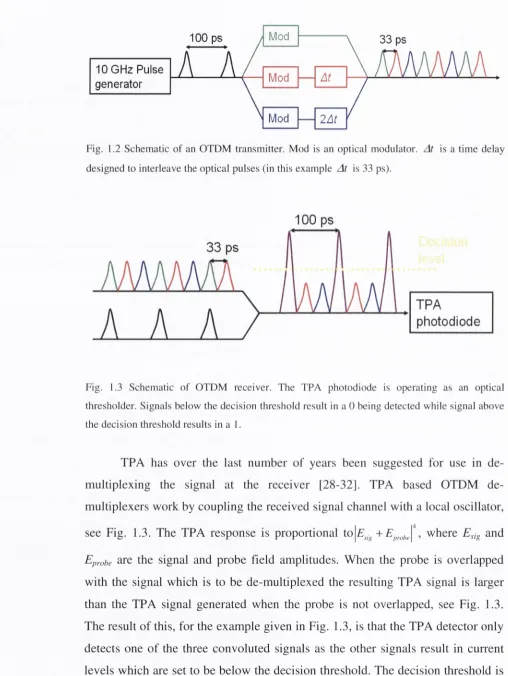
One method of increasing individual channel data rates is via the use of optical time division multiplexing (OTDM ) [24, 25], see Fig. 1.2. OTDM makes it possible to achieve optical channel data rates that operate at much higher frequencies than that of the electrical equipment which generated the constituent optical signals. This increase in data rates is achieved using a pulse source which operates at a frequency for which the electrical components are easily available (which currently means working at around 10 GHz). This signal is then separated using a passive optical splitter, see Fig. 1.2. Each of the separated signal channels is individually encoded with data. The signals are then delayed so as to have each of the signal channels evenly distributed in the time domain in the bit slot when they are multiplexed together. Recently, transmission of an individual channel with a data rate of 170 Gbs ' over a distance of 4320 km was achieved using OTDM [26]. Also individual signals with channel data rates o f 2.56 Tbs ' have been transmitted error free (bit error rate (BER) < 10'^) [27].

(28)

10 GHz Pulse generator

100 ps Mod 33 ps

Mod At

Mod 2At

Fig. 1.2 Schem atic o f an O TD M transmitter. M od is an optical modulator. A t is a tim e delay designed to interleave the optical pulses (in this exam ple A t is 33 ps).

100 ps

33 ps

photodiode

Fig. 1.3 Schem atic o f O TDM receiver. The TPA photodiode is operating as an optical thresholder. Signals below the decision threshold result in a 0 being detected w hile signal above the decision threshold results in a 1.

T P A has o v e r the last n u m b e r o f years been suggested for use in d e ­ m u ltip lex in g the signal at the re c e iv e r [28-32], T P A based O T D M d e ­ m ultip lex ers w o rk by co u p lin g the received signal ch annel w ith a local oscillator,

I 1 * ^

see Fig. 1.3. T h e T P A re s p o n s e is p roportional t o , w here E^ig and

[image:28.534.5.513.56.732.2]
(29)

which is not overlapped with the local oscillator. In this way, the TPA detector is working as a high speed optical threshold [33]. This means the TPA based photodiode which is operating at the same frequency as the pulse generator is capable of detecting the signal even though it is not capable of operating at the channel data rate (i.e. 30 Gbs '), see Fig. 1.3.

1.4.3 Auto and cross correlation

For pulses with pulse widths below 10 ps, electrical detection using a fast photodetector is in general no longer suitable. Both auto-correlation and cross­ correlation of optical pulses can be used to retrieve temporal information about extremely short pulse (< 10 ps). Autocorrelation involves investigating a pulse in a pump-probe type measurement while using the pulse itself as the probe, see Fig 1.4 The signal under test is split using a beam splitter with one arm corresponding to the signal arm and the other being the probe arm [34, 35]. The variable time delay on the probe arm is varied and then the signals are recombined before being detected using a TPA photodiode [36].

Signals under test

TPA

photodiode

Variable time delay

(30)

It has been shown that T P A based autocorrelation can be used to retrieve

tem poral inform ation about extrem ely short optical pulses [21, 37-39]. TPA

based autocorrelation has been dem onstrated as being possible even at very low

optical pow ers [40]. A lim itation o f autocorrelation is that w hile it can give

accurate inform ation about pulse duration the result o f an autocorrelation is

alw ays sym m etric and so gives Uttle to no inform ation about pulse shape [5, 41],

C rosscorrelation is also a very pow erful pulse characterisation technique.

T he m ain advantage o f crosscorrelation over autocorrelation is that the pulse

shape (level o f pulse asym m etry) can be m easured. The asym m etry o f a pulse

can be very im portant as it can be used to obtain inform ation relating to a num ber

o f characteristics o f a pulse such as pulse chirp. The prim ary way in w hich

crosscorrelation is used in telecom m unication system s is in carrying out optical

sam pling m easurem ents.

O ptical sam pling involves taking a pulse stream and then investigating its

am plitude in the time dom ain using a tem porally short probe pulse (ideally much

shorter than the pulses under test), see Fig. 1.5. The probe pulse is set to have a

low repetition frequency (i.e. approxim ately 10 M Hz) w hich is a frequency that

is set to be slighdy offset from being an integer m ultiple o f the o f the repetition

frequency o f the pulses under test [29]. The sm all frequency offset acts like a

variable tem poral delay o f the probe signal relative to the pulses under test and so

the probe scans across the pulses under test in the tim e dom ain. The low probe

pulse repetition frequency ensures that only one probe pulse interacts with the

pulse train at any one tim e. T his m eans that the TPA detector electrical response

is only required to operate at a frequency greater than the repetition frequency o f

the probe pulse. TPA based optical sam pling has shown to be w ell suited to

(31)

signals under test

100 ps

10 GHz Pulse generator

T PA

photodiode Probe pulse

10 MHz Pulse generator

Fig. 1.5 Schem atic o f an optical sam pling (cross correlation) system utilising a TPA

photodetector.

Another application of cross correlation is to carry out clock recovery. Clock recovery refers to recovering the electrical timing signal which operates at the individual channel data rate [1]. Clock recovery involves synchronizing the phase of a local clock signal with that o f the clock signal of the incident pulses which are to be detected, see Fig. 1.6 [45]. When the clock pulses are overlapped in the time domain with the data pulses the detected TPA photocurrent is maximised and so by varying the delay between the data and the clock signal the clock is deemed to be found when the TPA signal is maximised [46], Successful clock recovery has been shown previously for signal data rates of 80 Gbs ' using TPA based detection [47].

1

0

1

1

Data

At

TPA

photodiode

Clock

Variable tim e delay

Fig. 1.6 Schem atic o f a clock recovery (cross correlation) system utilising a TPA photodetector,

[image:31.532.28.523.24.746.2]
(32)

1.4.4 Optical performance monitoring

O ptical perform ance m onitoring (0 P M ) is a general term that refers to m onitoring the fidelity o f the transm ission o f an optical signal as it is transm itted through an optical netw ork [48]. 0 P M is taken in general to be a m eans o f m easuring netw ork health and channel degradation. A variety o f different form s o f 0 P M have received attention over the last num ber o f years [48-50], Through the use o f O PM it is hoped that the netw ork w ill have increased flexibility, reliability and functionality [51-53]. T o date the m ost com m on form s o f OPM have been carried out using linear detection. These schem es focus around the m onitoring o f average signal pow er, channel pow er, channel w avelength, degree o f signal polarisation, bit error rate (BER) and spectral O SN R [48, 54-60]. A lso a num ber o f m onitoring schem es based on placing low frequency m odulated signals on the transm itted signal and then m onitoring the transm ission o f these m odulated signals at different points throughout the netw ork have been dem onstrated [61, 62]. These schem es suffer from a num ber o f draw backs related to the quality o f the inform ation that can be garnered from the m easurem ent as well as the interpretation o f m ultiple im pairm ents resulting in problem s interpreting the m easured result as well as high im plem entation costs.

(33)

As well as the linear detection schemes mentioned above there are also a

wide variety of 0 P M schemes based on non linear processes such as SHG, four

wave mixing [63] and the optical Kerr effect. Each of these processes has been

linked with a large number of monitoring applications. SHG is most widely used

in carrying out SHG frequency resolved optical gate (SHG-FROG) applications,

which is a measurement which can retrieve both the intensity and phase

inform ation of a pulse in real time (> 2Hz) [15, 64, 65].

In this thesis, TPA based 0 P M schemes are investigated [66, 67]. The

schemes that have been looked at here are based on monitoring OSNR and on

m easuring channel presence. TPA based OSNR monitoring has been investigated

(34)

2. Transfer matrix method

2.1 Fabry-Perot etalon

T he Fabry-Perot etalon (FPE) is the basic structure on w hich the T PA M is based

[71, 72]. W hen the resonance condition o f the etalon is satisfied the overall

reflectivity o f the etalon tends tow ards a m inim um w hile the intra-cavity field

can be greatly enhanced. In order to characterise the response o f a m icrocavity

w hich consists o f tw o distributed B ragg reflectors (D B R ’s) the response o f a

sim ple two m irror etalon m ust be understood. This is because the response o f a

m icrocavity as a w hole can be quite com plex. It is instead easier to study each

D B R on its ow n and then to treat each DBR as a single etalon mirror. This then

allow s basic etalon theory to be used in order to describe the response o f a

m icrocavity. The prim ary things that m ust be investigated in order to characterise

the response o f a FPE are the fields generated (reflected, transm itted and in the

spacer region o f the etalon) and the phase shift in the m irrors associated with

changing w avelength and incident angle.

2.1.1 Etalon transmission and reflection

A F P E ’s response is m ade up o f reflection and transm ission spectra associated

w ith the m ake up o f its m irrors. To study the FPE response the transm ission and

reflection coefficients associated with these layers m ust first be calculated. The

theory described here only deals w ith transverse electric m odes (TE) as under

norm al experim ental conditions the influence o f transverse m agnetic m odes

(TM ) is insignificant. T he reason the TM m ode is not investigated here is

(35)

to normal which is the conditions under which the TP A M has been used for the

w ork discussed in this thesis.

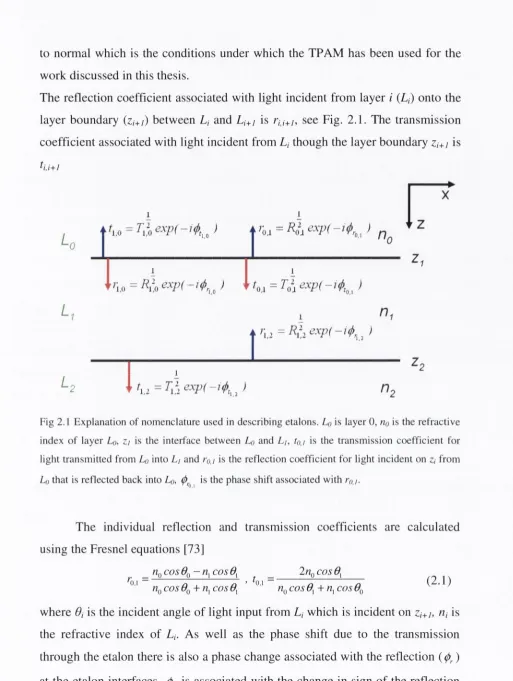
The reflection coefficient associated w ith light incident from layer i (L,) onto the layer boundary (z,+/) between L i and L,+/ is see Fig. 2.1. The transmission coefficient associated w ith light incident from L, though the layer boundary is

U,i+I

L

L.

L,

1

1

'■o.-

n

0

1

T ~ ~

---n.

j

Ki=T,\exp(-i(f> )

n .

z

Fig 2.1 Explanation o f nomenclature used in describing etalons. Lo is layer 0, Hq is the refractive index o f layer L o , Z i is the interface between L o and L /, to ,i is the transmission coefficient for light transmitted from Lo into L i and ro.i is the reflection coefficient for light incident on Zi from L)that is reflected back into L), ^ is the phase shift associated with r o j.

The individual reflection and transmission coefficients are calculated

using the Fresnel equations [73]

cos - n, cos 6. 2n„ cos 0.

'■o' cos 6(j + n^ cos 0^ i cos 6^, + n, "acos 0^ ( 2 - 1 )

where is the incident angle o f light input from L, which is incident on Zi+i, is the refractive index o f L,. As well as the phase shift due to the transmission

through the etalon there is also a phase change associated with the reflection ( )

at the etalon interfaces. 0^ is associated w ith the change in sign o f the reflection

coefficient. I f the reflection coefficient is negative then this results in a ;r phase

[image:35.534.13.526.28.709.2]
(36)

with Ko where as there is no phase shift associated with the sign of the reflection

coefficient when nj > n2- The transmission coefficient has no phase shift

associated with it. If the m irror has no loss then

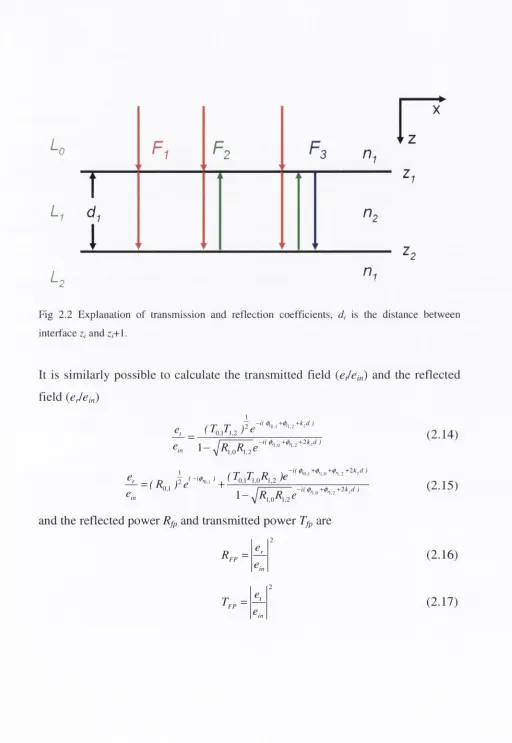
2.1.2 Intra-cavity field

For simplicity the normal incidence case is considered here when calculating the

intra-cavity field ejei„ (where is the electric field in the cavity and is the

field incident on the cavity). The reflection and transmission coefficients are

calculated as shown in Fig 2.2. The field in the cavity builds up as the signal

incident through zi is internally reflected a number of times in the etalon. The

signal builds up according to

(2.2)

(2.3)

(2.4)

(2.8) (2.6)

(2.7) (2.5)

(2.5-2.8) shows that the field builds up as a geometric power series

y = F,+Fi

F^ = F^{x), F^=F^{x)

Fj + f ; = >’X , F^ + F^ = yx^

(2.9)

(2 . 10)

(2 . 11)

(2.12)

(37)

X

L

T

d ,

I

L

z

1

n.

Fig 2 .2 Explanation o f transm ission and reflection coefficien ts, is the distance betw een

interface z, and z ,+ 1.

It is similarly possible to calculate the transm itted field (e/e,>,) and the reflected

field

’d,]

and the reflected power 7?/^ and transmitted pow er Tfp are

2 P

R / r p =

e . .

(2.14)

(2.15)

(2.16)

[image:37.536.14.526.33.776.2]
(38)

2.1.3 Field enhancement

T he reason for the use o f a m icrocavity structure in carrying out TPA based

detection is that the field {Eaa) in the spacer region (active region) o f an etalon is

greatly enhanced. As T P A is dependent on the level o f TPA generated

photocurrent in a detector can be greatly increased by enhancing the field in the

active region. The field in the active region is given in (2.13).

w here z refers to distance travelled from zi in the z direction (see Fig. 2.2),

w here d is the thickness o f the spacer region. The ratio o f TPA generated in a cavity relative to a non-cavity case is . The non-cavity case refers to

absorption in a layer identical to the active region but w hich is not sandw iched

betw een tw o m irrors

as all rem aining sine term s disappear (as 2 L d is 2k ) for the resonance case.

(2.18)

w hich was derived using:

( a + = | a p + j Z ? | ' ’ + 2 Re{ab* ) (2.19)

is the intensity o f the field in the active region, b* is the conjugate o f b,

R tiab *) is the real part o f ab*. 4

(39)

2.1.4 Phase response

In order to investigate the phase response the first step is to find the transmitted

electric am plitude Efr- For sim plicity a 2 layer structure as is show n in Fig. 2 .2 is investigated

T T “' o . r 1 . 2

(2.22)

1+ 2 - 2 7^1.0^1,2cos{y/)

w here y/ = +2k^d . If for som e reason \j/ changes by a sm all am ount Syj

aw ay from resonance i.e. due to a change in w avelength (A) o f the signal incident

on the cavity, then the transmitted pow er is found using (2 .1 7 , 2 .2 2 ) to be

approxim ately

T T0 . 1 '' 1 .2 T

(

1

- A a F

where the denom inator is calculated using the expansion

“ . , 2 n

\ n Hf

(2 .2 3 )

2 (2 .2 4 )

T he spectral dependence o f (2 .2 3 ) is Lorentzian around the resonant w avelen gth

o f an etalon. The full width at h a lf m axim um (FW H M ) o f the Lorentzian

response can be worked out using;

T,p{at FWHM)^ T T-'o .r 1.2 T T-'o.i-' 1.2

(1 f w h m 2(1

From (2.25) can be calculated

F W H M

2(1- / ? )

(2 .2 6 )

w here R = -yjRioRi 2 * so R is the average reflectivity o f the etalon. If Sy/ is assum ed

to be due entirely to the shift in incident w avelen gth (A.) aw ay from the resonance

w avelength (Xq), then

dy/ ~ SXd y/

~ d l SA

4 m d dZ

+

-d(/>^' ^1,0 +

(40)

The first term on the right side o f (2 .2 7 ) is due to phase change in the spacer

layer in the etalon and can be ea sily calculated. The tw o rem aining terms on the

right had side are phase shifts due to the top and bottom mirrors resp ectively. The

mirror phase shifts b ecom e difficult to calculate for etalons with m ultiple layers

in their top and bottom mirrors as is the case in the TPA M under study in this

thesis. This m eans that in practice the transverse matrix m ethod (T M M ) is used

to study the TPA M response.

U sing (2 .2 7 ) the Free Spectral Range (FSR ) and the fin esse o f the etalon

can be calculated. (2 .2 7 ) can be expressed as

(2 .2 8 )

where d^^ and d^_^ are penetration depths into the zi and Z2 interfaces resp ectively

(2 .2 9 )

1 -Att dA

S o the spectral FW HM o f the transm ission spectrum at normal in cidence is

(2 .3 0 )

w here D = n^d^ +d^^^ the group index o f the spacer region. T he phase

shift associated with the FSR is = I n . The w avelength shift to g o to the

next resonant peak o f the etalon is

SX,FSRsr^ — = F'SR2£) (2 .3 1 )

The fin esse o f an etalon is the FSR divided by SA so:

Finesse - . (2 .3 2 )

(1-/?)

Experim entally R for a cavity is calculated by sim ulating the cavity response

using the transverse matrix m ethod (see section 2.2) in order to find D . T hen R is

(41)

2.1.5 Distributed Bragg reflector

The mirror structure used in creating a TP AM is a DBR. A DBR is made up of mirror pairs which have high (/i/,) and low (n/) refractive indices respectively. The individual thickness of each of these layers is:

A.

d.

4n, (2.33)

where Xg is the design wavelength (Bragg wavelength) for the mirrors, di is the physical thickness of L,.

F3 1^3

L

z

Fig. 2.3 Phase accum ulation for signal norm ally incident on D BR at A,b.

[image:41.534.14.524.19.687.2]
(42)

shown (Fy, F2, and Fj) is 0. This means the reflected signals are in phase and so

add constructively resulting in such a DBR structure having high reflectivity

centred on Ag. The phase of the transmitted signal increases by nil for each layer

it passes through with an output phase of n resulting from the structure shown in

Fig. 2.3. Once the input signal deviates from Xg then the phase shift resulting

from transiting a layer deviates from tt/2 and -jtH respectively. In practice the

resulting phase, reflection and transmission of the DBR is investigated using the

transverse matrix method (TMM).

Results of a TMM simulation for the reflection, transmission response of a

DBR are shown in Fig. 2.4 (a, b). The DBR structure simulated is a GaAs/AlAs

structure with 20 mirror pairs with Xb = 1550 nm. The high refractive index

contrast between air and the top mirror of the DBR means that the signal in the

cavity is quite close to normal (0 degrees) even if the signal input onto the cavity

with quite a large angle, see Fig. 2.4(a). From the inset of Fig. 2.4(a) the

dependence of phase shift is plotted (for the same range of angles as the main

graph, 0 to 90 degrees). The dependence of phase shift on is shown to be

linear for a wide range of angles, which is important for assumptions later in this

thesis, see section 5.2. The reflectivity and transmissivity of a DBR are shown

not to be strongly dependent on incident angle, see Fig. 2.4(b). The spectral

dependence of the phase shift associated with reflection and transmission for the

DBR is shown in Fig. 2.5(a). In practice the only part of the phase response

which is of interest is the response around Xb. It is shown in Fig. 2.5(b) that the

deviation in phase shift around Xb is linear with respect to changing wavelength.

This is an important approximation which is used in theory to describe the phase

response of a microcavity around resonance, see section 5.2. It can be seen from

the response shown in Fig. 2.5 (b) that a DBR consisting of multiple m irror pairs

produces a high reflectivity spectral region (stop band) which is centred on Xb.

The width o f the stop band is dependent on the difference in refractive indices of

the two layers of the m irror pair. By increasing the contrast in the refractive

(43)

0.0 -0.1 -0.2 CO

S -0.1 " O

03 -0.5

^ -0.2

jc w 0 -0.3 w

-0.4

-0.5

80

0 20 40 60

Incident angle (degrees)

Fig. 2.4 (a) Dependence o f phase shift on incident angle for a DBR with 20 GaAs/AlAs m irror

pairs, Xb= 1550 nm. Fig. 2.4 (a) (inset) Dependence o f phase shift on a DBR with 20

GaAs/AlAs mirror, Phase shift is linearly dependent on for angles less than 50 degrees. 0

degrees for both graphs means the signal is normally incident on the DBR.

I . O - h

0.8

-> 0-6

o 0)

o3 0 .4 - DC

0.2-1

0.0

-Reflection T ransm ission

0

— I— 20

— I—

40 " S '

1.0

0.8

0.6 :>

w w

0.4 w c. 03

0.2

0.0

Incident angle (degrees)

Fig. 2.4 (b) Angle dependence o f reflectivity and transmissivity o f a DBR with 20 GaAs/AlAs

(44)

Reflection Transm ission

03 0.5

c CO

TD

CO

0.0

-x:

(/} 0)

^ -0.5

Q.

1300 1400 1500 1600 1700 1800

Wavelength (nm)

Fig. 2.5 (a) Spectral dependence o f phase shift associated w ith reflection and transmission fo r a

D B R w ith 20 G aA s/A lA s m irro r pairs, Ib = 1550 nm. The dependency on phase shift on

wavelength around Ab is shown to be linear.

1.0

0.8

>>

o

_03

“o 0.4

DC

0.2

0.0

1300 1400 1500 1600 1700 1800

Wavelength (nm)

Fig. 2.5 (b) Spectral dependence o f reflection and transmission fo r a D BR w ith 20 G aA s/A lA s

— — R eflection T ransm ission

1.0

0.8

0.6 ■ > CO

cn

0.4 w

a CO

0.2

[image:44.534.13.528.44.746.2]
(45)

2.1.6 Phase shift in a DBR

The mirror penetration depths are extremely im portant as they must be taken into account when calculating the effective active region length. The phase shift associated with a DBR is quite complicated, and so for simplicity it is calculated in this thesis using the TMM. The phase response for a DBR with 20 GaAs/AlAs mirror pairs and Ag = 1550 nm is shown in Fig 2.5. The phase shift dependence on wavelength is seen to be linear for a wide wavelength region (> 30 nm) around Ag. Due to this linear phase response around Xb the derivative of

the phase response around can be used to describe the phase response for all wavelengths of practical interest in this work. The derivative o f the phase response is related to ^) through (2.29).

2 .2

Transverse m a trix m ethod

In order to explain the response of an etalon with a more complicated structures i.e. large numbers of mirrors it is convenient to use the TMM. A and B are defined as shown in Fig. 2.6. The definitions for the reflection and transmission coefficients are the same as those shown in Fig. 2.1.

A, and B, are the amplitudes of the waves travelling through L, in the z and - z directions respectively:

A + i ~ ^ i + i ^ + i . i (2-34)

= (2.35)

(46)

no

1^0

Bo

^ 1 ^ 1

\ A

i

[ 8 ,

^2

^ 2

^2

■ ^ 2

d,-i

^ 1 - 1

l A-, 1

\B„,

n,

I

a

1

s,

^ m - 2 ^ m - 2 ^ m - 2

,'

'^m-2

^ m - 2

^ m - 1 ^ m - 1 f ^ m - 1

-1 ^ m - 1

-j-1

■i+1

■m-2

- m - 1

'm

F ig. 2 .6 D efin itio n o f variables u sed to d efin e layer structure and tran sm ission as u sed in

d e fin itio n o f the T M M . A, and Bj are the a m p litu d es o f the w a v e s travellin g through Lj.

(2.34) and (2.35) can be expressed as

A =7^(A >i . / + 1

= ■

(2.38) and (2.39) can be expressed in matrix form as

A ' 1 1 n . M A . , ' A . , '

A . h . i + l n . M 1

l + l

(2.38)

(2.39)

(2.40)

where M,+/ is the transfer matrix from L, to L,+/. When calculating the result of

transitions through multiple layers the phase change due to propagation through

the layers must be taken into account. The phase shift due to the signal transiting

the space between boundary z, and z,+/ is

CO

[image:46.534.15.517.56.821.2]
(47)

where Oj is the incident angle for hght incident on Zi+i from L„ see Fig. 2.7, co =

2 n f , f i s the input signal frequency, k. is the wave vector and is equal to y5,n„ =

Po, is the z component o f k

k,. = - {n^Psin (2.42)

The effect of the phase shift on signals as they pass through the layers o f a

multi layer structure is taken into account by calculating a propagation m atrix P,

for each of the layers (L,)

0

0 (2.43)

The minus sign in P,(2, 2j is due to the signal travelling in the - z direction. The

propagation through a series of layers can be represented in matrix form as

A.

B.

- M P M

A

1 -2

1 1 1

1 + K> 1 I ^ 2 2 .1 1

(2.44)

F is the matrix which describes the effect of the propagation through the entire

multi layer structure.

In order to calculate as defined in (2.44) r, and ?,./ must be calculated

using (2.1). In practice it is easier to implem ent the TMM by expressing the

Fresnel equations (2.1) in terms of k{.

_ n- cos 6. cosO-^^ _ ~k^

n.cos9.^n.^,cos9.^, k^^

h , i + \

2rij cos 6^ _ 2^^ cos 0^ + rt cos k^ + k.

(2.45)

(2.46)

(48)

L

i+1

^/+7 i+1 i+1 i+ 1 i+1

i+1

i+2 i+2

L

i+2

Z

z

i+1

Z: i+2

F ig. 2 .7 D efin itio n o f variables u sed to d efin e layer structure and tran sm ission as u sed in

d efin itio n o f the T M M .

The reflectivity and the transm issivity o f the multi layer structure is

calculated by letting B,„ equal to zero, w hich can be done because there are no

m ore layers to reflect light back into the cavity after z,„

A) = ^nA„ (2.47)

Bo = F , A , (2.48)

From (2.34) and (2.35) the reflection (r) and transm ission {t) coefficients for the

m ulti layer structure can be calculated

A ) ^11

Al^_L

A ) ^11

T he reflectivity and transm issivity o f the m ulti layer structure can be described as

t

-(2.49)

(2.50)

kr

(2.51)

[image:48.533.10.513.50.797.2]
(49)

Both r and t are complex variables whose phase angle gives the phase change

(50)

3. Two-photon absorption microcavity detector

3.1 Basic principle

The detector used to carry out TPA based monitoring in this work is a TPA

microcavity (TP AM) [71, 72]. The TP AM ’s which have been used consist of two

highly reflective DBR’s between which is sandwiched a one

X

thick active

region, see Fig 3.1. The response of such a structure is explained by calculating

the response of each DBR individually (reflection, transmission and phase shift)

using the TMM, see section 2.2. Then each DBR is treated as a single mirror and

so the cavity can be described using etalon theory, see section 2.1.

GaAs/AIAs DBR

Active

region

AlAs/GaAs DBR

(/)

CO I f )

<

(/> CO

<r

<U )

CO CO

< CO

<r

<

(/)

CO

<r

ro

o

<

CD

o

< <

CD

o

< CD

CD

< CD

O

<

B

ro \_ -»— ' c/) (/> < CD (3

F ig. 3.1 S ch em a tic o f a m icr o ca v ity structure c o n sistin g o f top and b ottom D B R ’s w ith 2 0 and

(51)

3.5

-3.4

-^ 3.3

-■D C

1

3.2

-2 3.1

-<i>

a:

3.0

-2.9

-0 2 4 6 8 10

z (^lm)

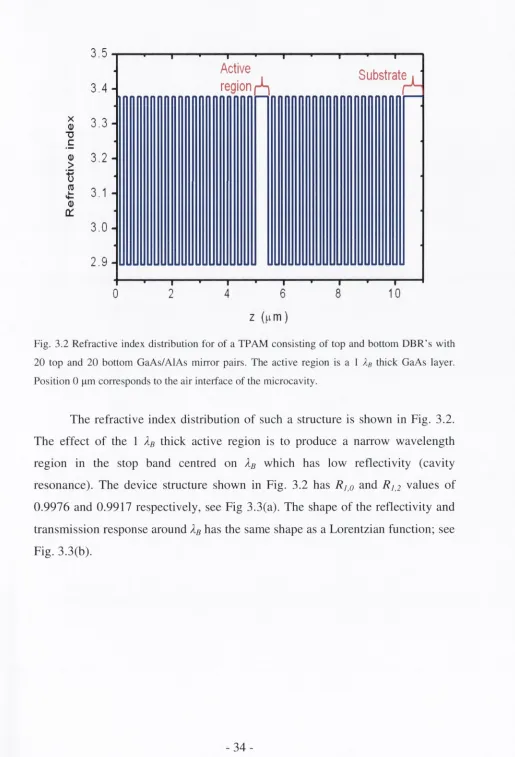
Fig. 3.2 Refractive index distribution for o f a TPAM consisting o f top and bottom D B R ’s with

20 top and 20 bottom G aA s/A lA s mirror pairs. The active region is a 1 Ag thick G aAs layer.

P osition 0 |im corresponds to the air interface o f the microcavity.

T he refractive index distribution o f such a structure is shown in Fig. 3.2.

T h e effect o f the 1 Ag thick active region is to produce a narrow w avelength

region in the stop band centred on Xb w hich has low reflectivity (cavity resonance). The device structure show n in Fig. 3.2 has R i o and R / 2 values o f

0.9976 and 0.9917 respectively, see Fig 3.3(a). The shape o f the reflectivity and

transm ission response around Ab has the sam e shape as a L orentzian function; see Fig. 3.3(b).

[image:51.535.15.530.35.792.2]
(52)

R e fle c tio n T ra n s m is s io n

0.8

c

o

o 0.6

Q)

“a

DC 0.4

0.2

0.0

1550 1650

1350 1450 1750

Wavelength (nm)

Fig. 3.3 (a) R eflectivity and transm issivity dependence o f a T P A M consisting o f 20 top and 20

bottom G aA s/A lA s D BR m irro r pairs. The active region is 1 1b thictc.

0.8

-— -— R e fle c tio n T ra n s m is s io n A L o re n tz ia n fit

0.2

-0.0

1549 1550 1551

c g

c/5

w E w c

CO

Wavelength (nm)

Fig. 3.3 (b) R eflectivity and transm issivity dependence o f a m icrocavity fo r a narrow

[image:52.536.10.522.36.735.2]
(53)

T h e FW H M o f the spectral response o f the reflection and the transm ission

(cavity bandw idth) is given by (2.25). This equation show s that the F W H M o f

the spectral dependence o f the cavity reflection and transm ission sp ectra is

d ep en d ent on the product o f the reflection and transm ission o f the top and b ottom

D B R ’s. Increasing the reflectivity o f the entire cavity ( R ) results in a d ecrease in

the FW H M o f the reflection/transm ission response o f the cavity. The reflection

o f the cavity at resonance is m inim ised by balancing the cavity, w hich m eans

m atching the front and back m irror reflectivities (set R q j equal to R i ,2)- It can be

seen in Fig. 3.3(b) that even though the top and bottom D B R ’s o f the sim ulated

cavity are identical the cavity is not com pletely balanced (reflectivity d oes not

reach 0 at Ag). The cause o f this im balance is that the top D B R has an air

interface w hile the bottom m irror has an interface w ith a G aA s substrate. If the

substrate w ere rem oved (leaving the bottom D B R w ith an air interface) then the

reflectivity at resonance fo r this structure w ould be 0. In practice the m inim um

reflectivity o f the m icrocavity is not im portant in relation to TPA based detection

as w e are only interested in the enhancem ent o f the electric field and the cavity

bandw idth. It is also im portant to note that due to grow th considerations that the

response o f grow n TPA M structures w ill not exactly m atch the theoretical

response as described above. The m ain difference is in the reflectivity o f the

D B R ’s w hich in practice is slightly low er reflectivity that suggested by the

theory. D ue to this the reflectivity o f the devices m ust be calculated

experim entally.

3.2 Electric field

T he benefit o f using a T PA M is that it results in a large enhancem ent o f the

optical field in the active region o f the cavity. The electric field in a T P A M can

be calculated for the entire structure using the T M M , see section 2.2. T he electric

Figure

Fig. 1.2 Schematic of an OTDM transmitter. Mod is an optical modulator. At is a time delay
Fig. 1.5 Schematic of an optical sampling (cross correlation) system utilising a TPA
Fig 2.1 Explanation of nomenclature used in describing etalons. Lo is layer 0, Hq is the refractive
Fig 2.2 Explanation of transmission and reflection coefficients,
+7

References

Related documents

Similarly, analysis of educational tools selected by the teachers for the teaching of the concept of ecosystem following training on the systems approach can provide

Broad-spectrum and durable resistance suggested in this case that most of the RD6 introgression lines are resistant to blast disease, especially the lines containing the QTLs on

Nevertheless, in both clades the extrinsic venom gland muscles function to raise intraglandular pressure, the venom chambers of the distal venom delivery system appear to pool venom

(B) Processes proposed to influence the ammonium content of the animal tissues and ammonium efflux from animals: (i) algal assimilation of animal-derived ammonium, as predicted

Boudt and Zhang (2013) suggested a jump-robust TSRV (RTSRV) estimator as a mixture of the TSRV estimator in (6), and the truncated realized volatility estimators of Macini and Ren´

1. Relationships between fasting plasma glucose levels and insulin secretion during intravenous glucose tolerance tests.J. The glucose receptor: a defective mechanism in

Finally, we have to consider a suggestion first made by Bush and colleagues (11). According to this the failure to measure incorporation of Cu6' into ceruloplasmin in Wilson's